Starling forces
Contents
• Starling Principle
• Starling Equation
• Starling Equilibrium
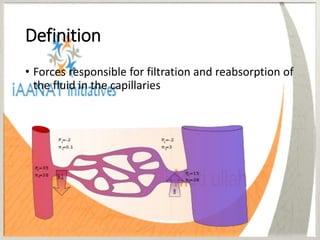
Definition
• Forces responsible for filtration and reabsorption of
the fluid in the capillaries
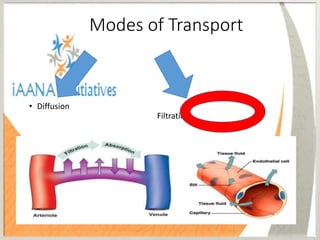
Modes of Transport
• Diffusion
Filtration
Starling Forces
• The 4starling forces are:
Hydrostatic Pressure in Capillaries Pc
Hydrostatic Pressure in Interstitium Pi
Oncotic Pressure in Capillaries ∏c
Oncotic Pressure in Interstitium ∏i
PRINCIPLE
• Starling Hypothesis:
• The fluid movement due to the filtration across the capillary wall is
dependent on the balance between the HYDROSTATIC PRESSURE
GRADIENT and
ONCOTIC PRESURE GRADIENT across the capillary wall.
Starling Equation
• Fluid Movement =k[(Pc – Pi) – (∏c - ∏i) ]
where:
• K = Capillary Filtration Coefficient
• K depends upon permeability and the area
available
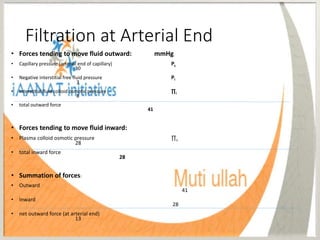
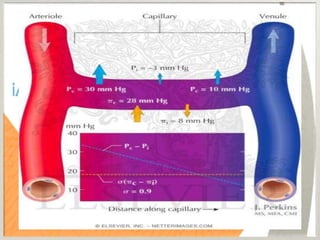
Filtration at Arterial End
• Forces tending to move fluid outward: mmHg
• Capillary pressure (arterial end of capillary) Pc
30
• Negative interstitial free fluid pressure Pi
3
• Interstitial fluid colloid osmotic pressure ∏i
8
• total outward force
41
• Forces tending to move fluid inward:
• Plasma colloid osmotic pressure ∏c
28
• total inward force
28
• Summation of forces:
• Outward
41
• Inward
28
• net outward force (at arterial end)
13
Reabsorption at Venous End
• Forces tending to move fluid inward:
• Plasma colloid osmotic pressure ∏c
28
• total inward force
28
• Forces tending to move fluid outward:
• Capillary pressure (venous end of capillary) Pc
10
• Negative interstitial free fluid pressure Pi
3
• Interstitial fluid colloid osmotic pressure ∏i
8
• total outward force
21
• Summation of forces:
• Inward
28
• Outward
21
• net inward force
7
Starling Equilibrium
• The amount of fluid Filtering from the
arterial end of capillaries equals almost
exactly the fluid returned to the
circulation by Absorption
• Slight disequilibrium is balanced by
lymphatics.
Starling equilibrium
• Mean Forces Tending to Move Fluid Outward
mm Hg
• Mean capillary pressure
17.3
• Negative interstitial free fluid pressure
3.0
• Interstitial fluid colloid osmotic
pressure 8.0
• TOTAL OUTWARD pressure
28.3
• Mean Forces Tending to Move Fluid Inward
• Plasma colloid osmotic pressure
28.0
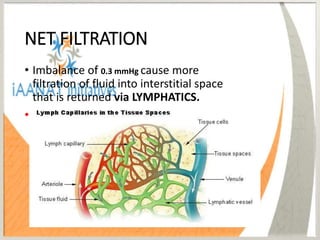
NET FILTRATION
• Imbalance of 0.3 mmHg cause more
filtration of fluid into interstitial space
that is returned via LYMPHATICS.
• It is 2ml per minute.
Starling forces

Starling forces

  • 1.
  • 2.
    Contents • Starling Principle •Starling Equation • Starling Equilibrium
  • 3.
    Definition • Forces responsiblefor filtration and reabsorption of the fluid in the capillaries
  • 5.
    Modes of Transport •Diffusion Filtration
  • 6.
    Starling Forces • The4starling forces are: Hydrostatic Pressure in Capillaries Pc Hydrostatic Pressure in Interstitium Pi Oncotic Pressure in Capillaries ∏c Oncotic Pressure in Interstitium ∏i
  • 7.
    PRINCIPLE • Starling Hypothesis: •The fluid movement due to the filtration across the capillary wall is dependent on the balance between the HYDROSTATIC PRESSURE GRADIENT and ONCOTIC PRESURE GRADIENT across the capillary wall.
  • 8.
    Starling Equation • FluidMovement =k[(Pc – Pi) – (∏c - ∏i) ] where: • K = Capillary Filtration Coefficient • K depends upon permeability and the area available
  • 9.
    Filtration at ArterialEnd • Forces tending to move fluid outward: mmHg • Capillary pressure (arterial end of capillary) Pc 30 • Negative interstitial free fluid pressure Pi 3 • Interstitial fluid colloid osmotic pressure ∏i 8 • total outward force 41 • Forces tending to move fluid inward: • Plasma colloid osmotic pressure ∏c 28 • total inward force 28 • Summation of forces: • Outward 41 • Inward 28 • net outward force (at arterial end) 13
  • 11.
    Reabsorption at VenousEnd • Forces tending to move fluid inward: • Plasma colloid osmotic pressure ∏c 28 • total inward force 28 • Forces tending to move fluid outward: • Capillary pressure (venous end of capillary) Pc 10 • Negative interstitial free fluid pressure Pi 3 • Interstitial fluid colloid osmotic pressure ∏i 8 • total outward force 21 • Summation of forces: • Inward 28 • Outward 21 • net inward force 7
  • 12.
    Starling Equilibrium • Theamount of fluid Filtering from the arterial end of capillaries equals almost exactly the fluid returned to the circulation by Absorption • Slight disequilibrium is balanced by lymphatics.
  • 13.
    Starling equilibrium • MeanForces Tending to Move Fluid Outward mm Hg • Mean capillary pressure 17.3 • Negative interstitial free fluid pressure 3.0 • Interstitial fluid colloid osmotic pressure 8.0 • TOTAL OUTWARD pressure 28.3 • Mean Forces Tending to Move Fluid Inward • Plasma colloid osmotic pressure 28.0
  • 14.
    NET FILTRATION • Imbalanceof 0.3 mmHg cause more filtration of fluid into interstitial space that is returned via LYMPHATICS. • It is 2ml per minute.