G.H.PATEL COLLEGE OF
ENGINEERING&TECH
ADVANCE ENGINEERING MATHEMATICS (2130002)
BY:- uttam trasadiya
Mechanical engineering
GCET college
vvnagar
PARTIAL DIFFERENTIAL EQUATIONS
• The relationship between a
dependent variable and two or more
independent variables and partial
differential coefficients of a
dependent variable with respect to
these independent variables is called
as a partial differential equation.
FORMATION OF PDEs
• A PDEs can be formed in Two
ways:
By eliminating arbitrary
constants from the given
relation .
By eliminating arbitrary
functions from the given
relation .
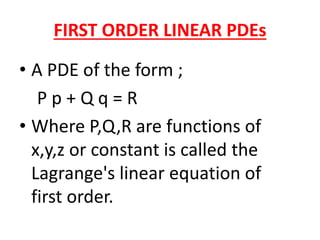
FIRST ORDER LINEAR PDEs
• A PDE of the form ;
P p + Q q = R
• Where P,Q,R are functions of
x,y,z or constant is called the
Lagrange's linear equation of
first order.
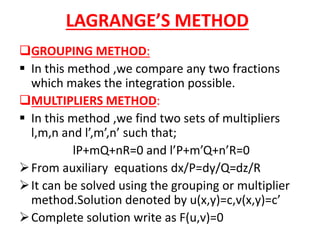
LAGRANGE’S METHOD
GROUPING METHOD:
 In this method ,we compare any two fractions
which makes the integration possible.
MULTIPLIERS METHOD:
 In this method ,we find two sets of multipliers
l,m,n and l’,m’,n’ such that;
lP+mQ+nR=0 and l’P+m’Q+n’R=0
From auxiliary equations dx/P=dy/Q=dz/R
It can be solved using the grouping or multiplier
method.Solution denoted by u(x,y)=c,v(x,y)=c’
Complete solution write as F(u,v)=0
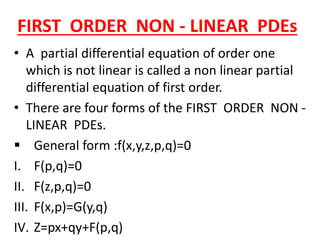
FIRST ORDER NON - LINEAR PDEs
• A partial differential equation of order one
which is not linear is called a non linear partial
differential equation of first order.
• There are four forms of the FIRST ORDER NON -
LINEAR PDEs.
 General form :f(x,y,z,p,q)=0
I. F(p,q)=0
II. F(z,p,q)=0
III. F(x,p)=G(y,q)
IV. Z=px+qy+F(p,q)
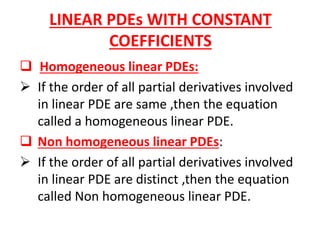
LINEAR PDEs WITH CONSTANT
COEFFICIENTS
 Homogeneous linear PDEs:
 If the order of all partial derivatives involved
in linear PDE are same ,then the equation
called a homogeneous linear PDE.
 Non homogeneous linear PDEs:
 If the order of all partial derivatives involved
in linear PDE are distinct ,then the equation
called Non homogeneous linear PDE.
ONE DIMENSIONAL WAVE EQUATION
• Where u(x,t) is deflection of string.
The wave equation is mainly used to
determined the motion of vibrating string.
if the initial deflection u(x,0) is f(x) and initial
velocity is g(x),then the solution of wave
equation is given by


















 

 L
nx
L
ctn
Bn
L
ctn
Bntxu
n

sin]sin*cos[),(
1
2
2
2
2
2
x
u
c
t
u





)0,(x
t
u


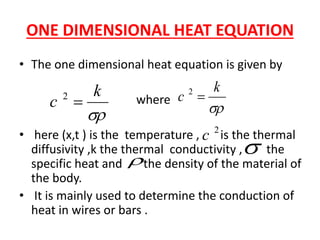
ONE DIMENSIONAL HEAT EQUATION
• The one dimensional heat equation is given by
where
• here (x,t ) is the temperature , is the thermal
diffusivity ,k the thermal conductivity , the
specific heat and the density of the material of
the body.
• It is mainly used to determine the conduction of
heat in wires or bars .

k
c 2
2
c


k
c 2
SOLUTION OF HEAT EQUATION
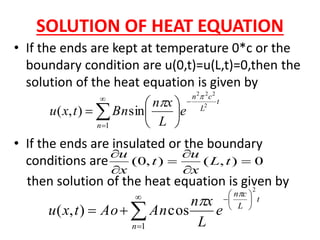
• If the ends are kept at temperature 0*c or the
boundary condition are u(0,t)=u(L,t)=0,then the
solution of the heat equation is given by
• If the ends are insulated or the boundary
conditions are
then solution of the heat equation is given by
t
L
cn
n
e
L
xn
Bntxu
2
222
sin),(
1

 







 
0),(),0( 





tL
x
u
t
x
u











1
2
cos),(
n
t
L
cn
e
L
xn
AnAotxu


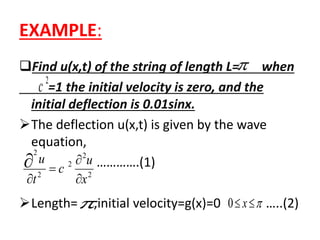
EXAMPLE:
Find u(x,t) of the string of length L= when
=1 the initial velocity is zero, and the
initial deflection is 0.01sinx.
The deflection u(x,t) is given by the wave
equation,
………….(1)
Length= ,initial velocity=g(x)=0 …..(2)
2
c
2
2
2
2
2
x
u
c
t
u





  x0

We know that,
u(0,t)=u( ,t)=0 for all
u(x,0)=0.01sin3x
We know that the solution of (1) together
with (2) is given by………
Here g(x)=0 so , Bn*=0
…..(3)
 0t
 x0


















 

 L
nx
L
ctn
Bn
L
ctn
Bntxu
n

sin]sin*cos[),(
1






 

 L
ctn
Bntxu
n

cos),(
1






L
nx
sin
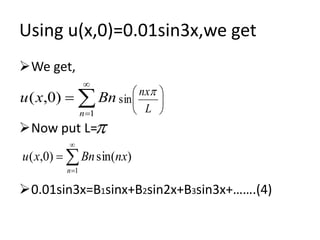
Using u(x,0)=0.01sin3x,we get
We get,
Now put L=
0.01sin3x=B1sinx+B2sin2x+B3sin3x+…….(4)






L
nx
sin



1
)0,(
n
Bnxu

)sin()0,(
1
nxBnxu
n




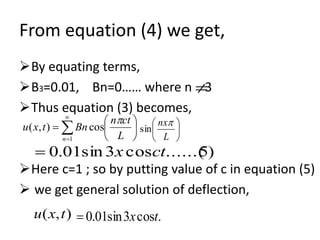
From equation (4) we get,
By equating terms,
B3=0.01, Bn=0…… where n 3
Thus equation (3) becomes,
Here c=1 ; so by putting value of c in equation (5)
 we get general solution of deflection,







 

 L
ctn
Bntxu
n

cos),(
1






L
nx
sin
)5......(cos3sin01.0 ctx
.cos3sin01.0 tx),( txu
THANK YOU…..

Advance enginering mathematics

  • 1.
    G.H.PATEL COLLEGE OF ENGINEERING&TECH ADVANCEENGINEERING MATHEMATICS (2130002) BY:- uttam trasadiya Mechanical engineering GCET college vvnagar
  • 2.
    PARTIAL DIFFERENTIAL EQUATIONS •The relationship between a dependent variable and two or more independent variables and partial differential coefficients of a dependent variable with respect to these independent variables is called as a partial differential equation.
  • 3.
    FORMATION OF PDEs •A PDEs can be formed in Two ways: By eliminating arbitrary constants from the given relation . By eliminating arbitrary functions from the given relation .
  • 4.
    FIRST ORDER LINEARPDEs • A PDE of the form ; P p + Q q = R • Where P,Q,R are functions of x,y,z or constant is called the Lagrange's linear equation of first order.
  • 5.
    LAGRANGE’S METHOD GROUPING METHOD: In this method ,we compare any two fractions which makes the integration possible. MULTIPLIERS METHOD:  In this method ,we find two sets of multipliers l,m,n and l’,m’,n’ such that; lP+mQ+nR=0 and l’P+m’Q+n’R=0 From auxiliary equations dx/P=dy/Q=dz/R It can be solved using the grouping or multiplier method.Solution denoted by u(x,y)=c,v(x,y)=c’ Complete solution write as F(u,v)=0
  • 6.
    FIRST ORDER NON- LINEAR PDEs • A partial differential equation of order one which is not linear is called a non linear partial differential equation of first order. • There are four forms of the FIRST ORDER NON - LINEAR PDEs.  General form :f(x,y,z,p,q)=0 I. F(p,q)=0 II. F(z,p,q)=0 III. F(x,p)=G(y,q) IV. Z=px+qy+F(p,q)
  • 7.
    LINEAR PDEs WITHCONSTANT COEFFICIENTS  Homogeneous linear PDEs:  If the order of all partial derivatives involved in linear PDE are same ,then the equation called a homogeneous linear PDE.  Non homogeneous linear PDEs:  If the order of all partial derivatives involved in linear PDE are distinct ,then the equation called Non homogeneous linear PDE.
  • 8.
    ONE DIMENSIONAL WAVEEQUATION • Where u(x,t) is deflection of string. The wave equation is mainly used to determined the motion of vibrating string. if the initial deflection u(x,0) is f(x) and initial velocity is g(x),then the solution of wave equation is given by                       L nx L ctn Bn L ctn Bntxu n  sin]sin*cos[),( 1 2 2 2 2 2 x u c t u      )0,(x t u  
  • 9.
    ONE DIMENSIONAL HEATEQUATION • The one dimensional heat equation is given by where • here (x,t ) is the temperature , is the thermal diffusivity ,k the thermal conductivity , the specific heat and the density of the material of the body. • It is mainly used to determine the conduction of heat in wires or bars .  k c 2 2 c   k c 2
  • 10.
    SOLUTION OF HEATEQUATION • If the ends are kept at temperature 0*c or the boundary condition are u(0,t)=u(L,t)=0,then the solution of the heat equation is given by • If the ends are insulated or the boundary conditions are then solution of the heat equation is given by t L cn n e L xn Bntxu 2 222 sin),( 1             0),(),0(       tL x u t x u            1 2 cos),( n t L cn e L xn AnAotxu  
  • 11.
    EXAMPLE: Find u(x,t) ofthe string of length L= when =1 the initial velocity is zero, and the initial deflection is 0.01sinx. The deflection u(x,t) is given by the wave equation, ………….(1) Length= ,initial velocity=g(x)=0 …..(2) 2 c 2 2 2 2 2 x u c t u        x0 
  • 12.
    We know that, u(0,t)=u(,t)=0 for all u(x,0)=0.01sin3x We know that the solution of (1) together with (2) is given by……… Here g(x)=0 so , Bn*=0 …..(3)  0t  x0                       L nx L ctn Bn L ctn Bntxu n  sin]sin*cos[),( 1           L ctn Bntxu n  cos),( 1       L nx sin
  • 13.
    Using u(x,0)=0.01sin3x,we get Weget, Now put L= 0.01sin3x=B1sinx+B2sin2x+B3sin3x+…….(4)       L nx sin    1 )0,( n Bnxu  )sin()0,( 1 nxBnxu n    
  • 14.
    From equation (4)we get, By equating terms, B3=0.01, Bn=0…… where n 3 Thus equation (3) becomes, Here c=1 ; so by putting value of c in equation (5)  we get general solution of deflection,            L ctn Bntxu n  cos),( 1       L nx sin )5......(cos3sin01.0 ctx .cos3sin01.0 tx),( txu
  • 15.