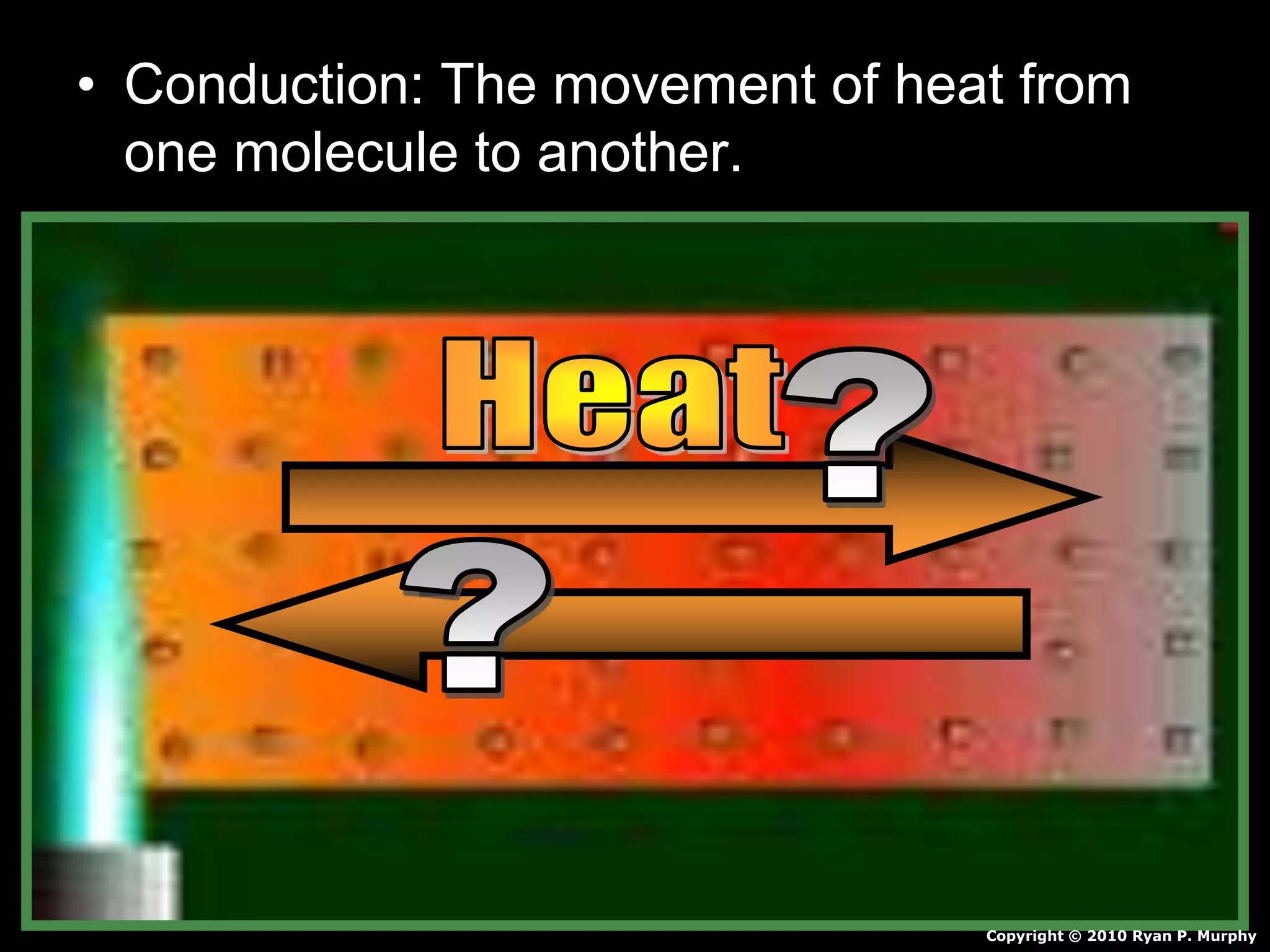
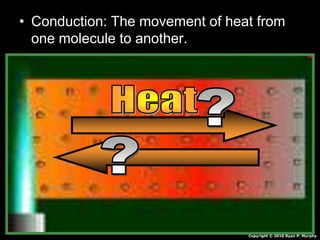
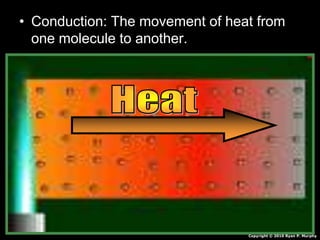









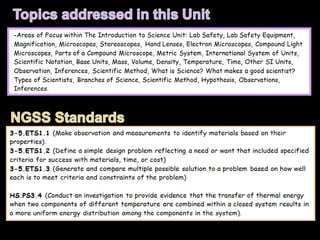
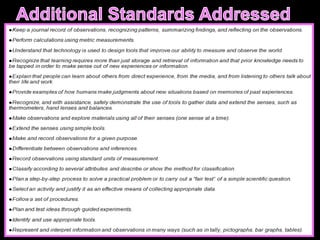
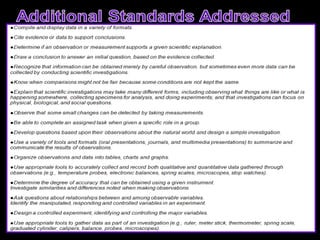
• Conduction: The movement of heat from
one molecule to another.
Copyright © 2010 Ryan P. Murphy
• RED SLIDE: These are notes that are
very important and should be recorded in
your science journal.
• BLACK SLIDE: Pay attention, follow
directions, complete projects as described
and answer required questions neatly.
Copyright © 2010 Ryan P. Murphy
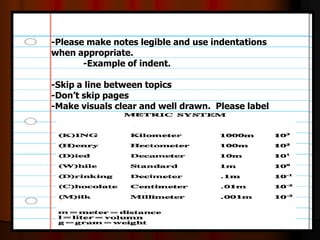
-Please make notes legible and use indentations
when appropriate.
-Example of indent.
-Skip a line between topics
-Don’t skip pages
-Make visuals clear and well drawn. Please label
• http://sciencepowerpoint.com/
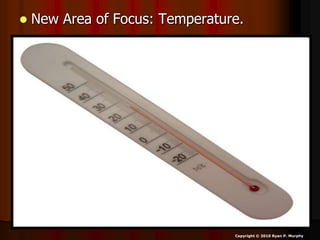
 New Area of Focus: Temperature.
Copyright © 2010 Ryan P. Murphy
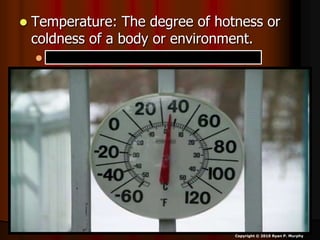
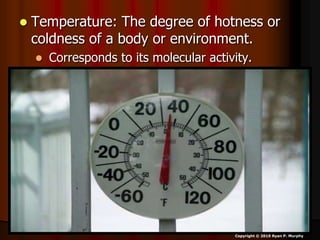
 Temperature: The degree of hotness or
coldness of a body or environment.
 Corresponds to its molecular activity.
Copyright © 2010 Ryan P. Murphy
 Temperature: The degree of hotness or
coldness of a body or environment.
 Corresponds to its molecular activity.
Copyright © 2010 Ryan P. Murphy
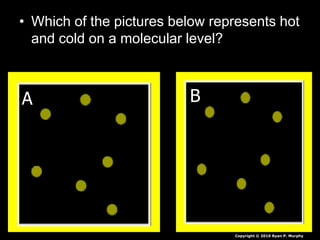
• Which of the pictures below represents hot
and cold on a molecular level?
Copyright © 2010 Ryan P. Murphy
A B
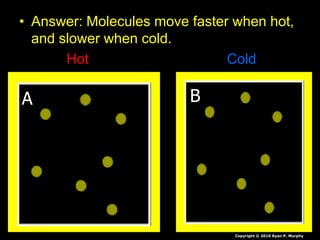
• Answer: Molecules move faster when hot,
and slower when cold.
Hot Cold
Copyright © 2010 Ryan P. Murphy
A B
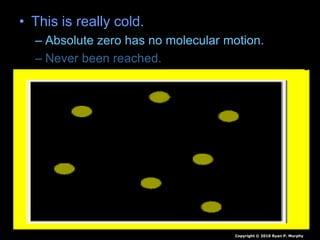
• This is really cold.
– Absolute zero has no molecular motion.
– Never been reached.
Copyright © 2010 Ryan P. Murphy
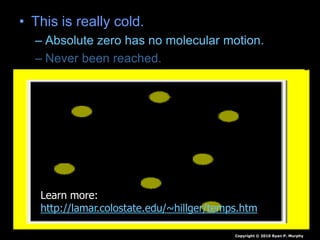
• This is really cold.
– Absolute zero has no molecular motion.
– Never been reached.
Copyright © 2010 Ryan P. Murphy
Learn more:
http://lamar.colostate.edu/~hillger/temps.htm
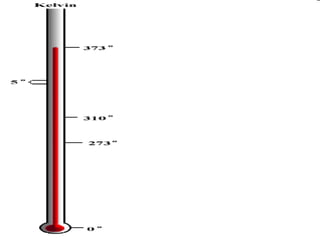
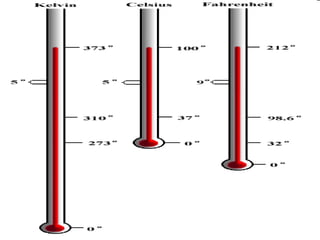
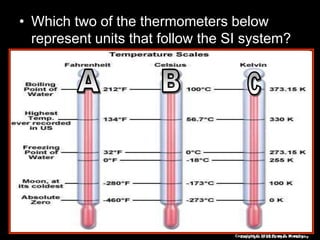
• Which two of the thermometers below
represent units that follow the SI system?
Copyright © 2010 Ryan P. MurphyCopyright © 2010 Ryan P. Murphy
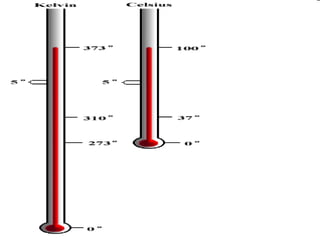
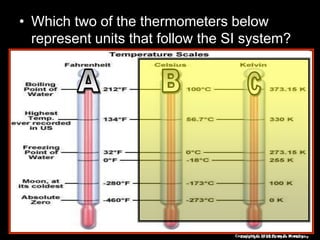
• Which two of the thermometers below
represent units that follow the SI system?
Copyright © 2010 Ryan P. MurphyCopyright © 2010 Ryan P. Murphy
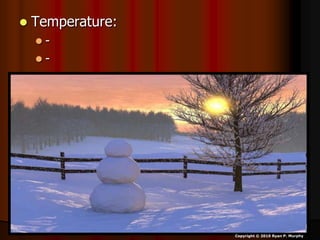
 Temperature:
 -
 -
Copyright © 2010 Ryan P. Murphy
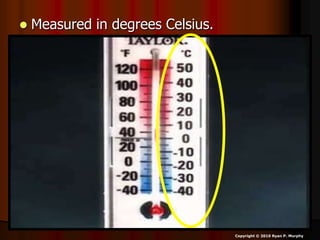
 Measured in degrees Celsius.
Copyright © 2010 Ryan P. Murphy
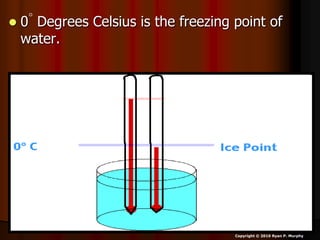
 0 Degrees Celsius is the freezing point of
water.
Copyright © 2010 Ryan P. Murphy
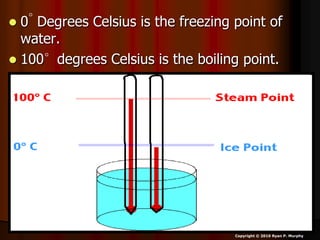
 0 Degrees Celsius is the freezing point of
water.
 100 degrees Celsius is the boiling point.
Copyright © 2010 Ryan P. Murphy
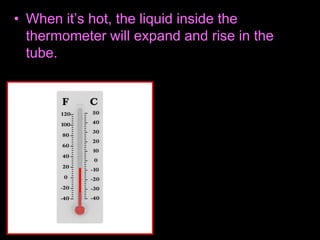
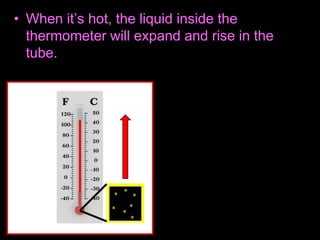
• When it’s hot, the liquid inside the
thermometer will expand and rise in the
tube.
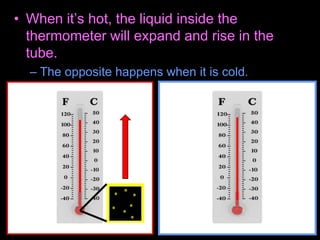
• When it’s hot, the liquid inside the
thermometer will expand and rise in the
tube.
• When it’s hot, the liquid inside the
thermometer will expand and rise in the
tube.
– The opposite happens when it is cold.
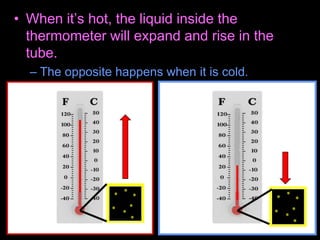
• When it’s hot, the liquid inside the
thermometer will expand and rise in the
tube.
– The opposite happens when it is cold.
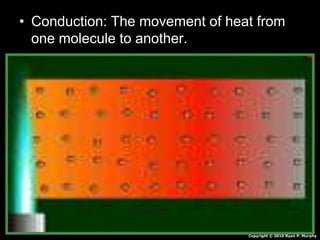
• Conduction: The movement of heat from
one molecule to another.
Copyright © 2010 Ryan P. Murphy
• Conduction: The movement of heat from
one molecule to another.
Copyright © 2010 Ryan P. Murphy
• Conduction: The movement of heat from
one molecule to another.
Copyright © 2010 Ryan P. Murphy
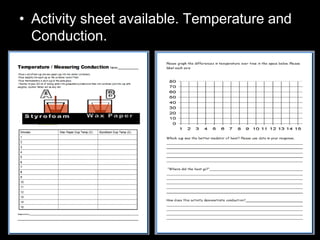
• Activity sheet available. Temperature and
Conduction.
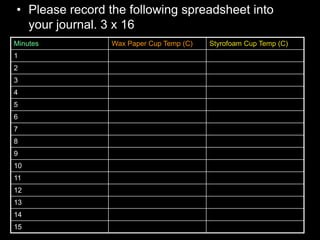
• Please record the following spreadsheet into
your journal. 3 x 16
Minutes Wax Paper Cup Temp (C) Styrofoam Cup Temp (C)
1
2
3
4
5
6
7
8
9
10
11
12
13
14
15
• Activity! Conduction
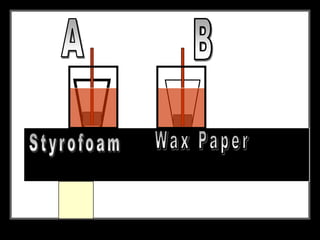
– Place a styrofoam cup and wax paper cup
into two similar containers.
– Place weights into each cup so the container
cannot float.
– Place thermometers in each cup at the same
place.
– Teacher to pour 100 ml of boiling water into
graduated cylinders and then into container
(not into cup with weights).
• Caution! Water will be very hot.
– Record temperature of each on spreadsheet.
• Questions.
– Which cup was the better insulator of heat?
Please use data in your response.
– Please measure the temperature of the water
on the outside of each container?
• Record this temperature in your journal and discuss
your findings? “Where did the heat go?”
– How does this activity demonstrate conduction?
• Questions.
– Which cup was the better insulator of heat?
Please use data in your response.
• Questions.
– Which cup was the better insulator of heat?
Please use data in your response.
– The styrofoam cup was the better insulator of
heat because it was ____ degrees cooler than
the wax paper cup.
• Questions.
– Please measure the temperature of the water
on the outside of each container?
• Record this temperature in your journal and discuss
your findings? “Where did the heat go?”
• Questions.
– Please measure the temperature of the water
on the outside of each container?
• Record this temperature in your journal and discuss
your findings? “Where did the heat go?”
– The water on the outside of the wax paper cup
was cooler because the thermal energy was
transferred into the cup through conduction.
• Questions.
– How does this activity demonstrate conduction?
• Questions.
– How does this activity demonstrate conduction?
– This activity demonstrates conduction because
thermal energy moved through the molecules in
the cup. This evidence in the recorded
temperature changes.
• Activity! Please convert 95 degrees
Fahrenheit into degrees Celsius.
– Formula is on the next slide.
Copyright © 2010 Ryan P. Murphy
• Activity! Please convert 95 degrees
Fahrenheit into degrees Celsius.
– Formula is on the next slide.
“The Fahrenheit
Scale makes me
angry!”
Copyright © 2010 Ryan P. Murphy
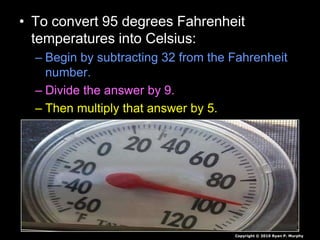
• To convert 95 degrees Fahrenheit
temperatures into Celsius:
– Begin by subtracting 32 from the Fahrenheit
number.
– Divide the answer by 9.
– Then multiply that answer by 5.
Copyright © 2010 Ryan P. Murphy
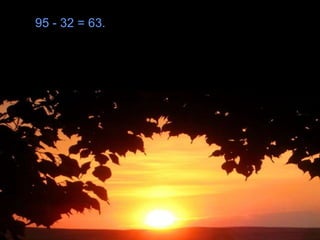
95 - 32 = 63.
Copyright © 2010 Ryan P. Murphy
95 - 32 = 63.
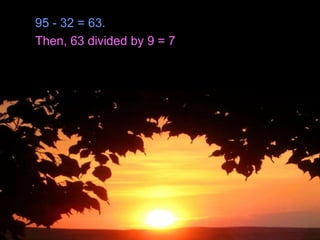
Then, 63 divided by 9 = 7
Copyright © 2010 Ryan P. Murphy
95 - 32 = 63.
Then, 63 divided by 9 = 7
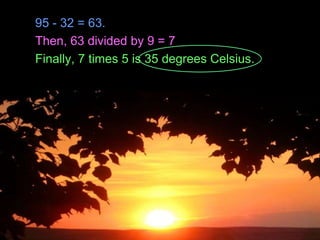
Finally, 7 times 5 is 35 degrees Celsius.
Copyright © 2010 Ryan P. Murphy
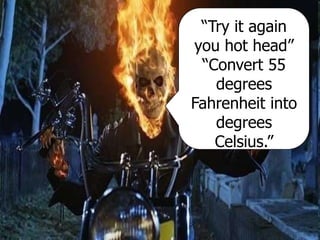
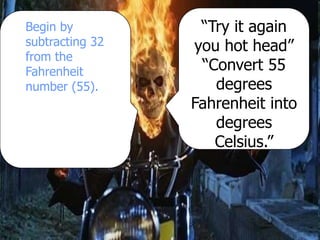
“Try it again
you hot head”
“Convert 55
degrees
Fahrenheit into
degrees
Celsius.”
“Try it again
you hot head”
“Convert 55
degrees
Fahrenheit into
degrees
Celsius.”
Begin by
subtracting 32
from the
Fahrenheit
number (55).
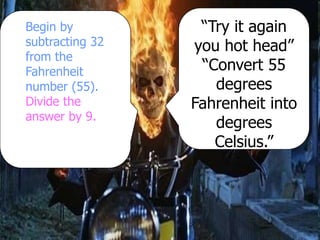
“Try it again
you hot head”
“Convert 55
degrees
Fahrenheit into
degrees
Celsius.”
Begin by
subtracting 32
from the
Fahrenheit
number (55).
Divide the
answer by 9.
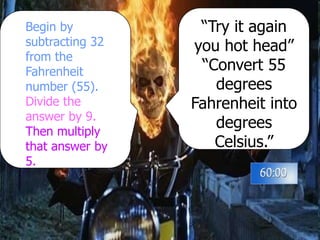
“Try it again
you hot head”
“Convert 55
degrees
Fahrenheit into
degrees
Celsius.”
Begin by
subtracting 32
from the
Fahrenheit
number (55).
Divide the
answer by 9.
Then multiply
that answer by
5.
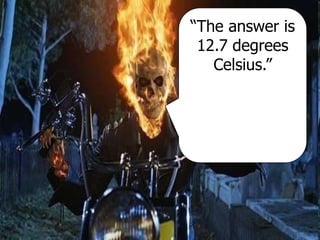
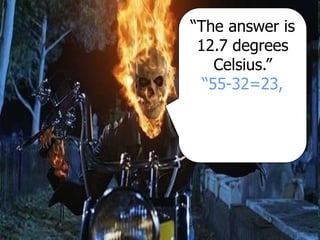
“The answer is
12.7 degrees
Celsius.”
“The answer is
12.7 degrees
Celsius.”
“55-32=23,
“The answer is
12.7 degrees
Celsius.”
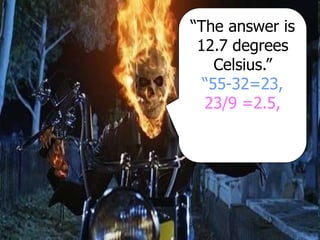
“55-32=23,
23/9 =2.5,
“The answer is
12.7 degrees
Celsius.”
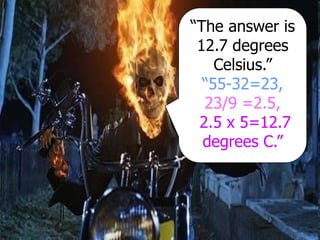
“55-32=23,
23/9 =2.5,
2.5 x 5=12.7
degrees C.”
Copyright © 2010 Ryan P. Murphy
• Because many people have never learned
the metric system.
Copyright © 2010 Ryan P. Murphy
• Because many people have never learned
the metric system. Please convert 20
Degrees Celsius into Fahrenheit:
Copyright © 2010 Ryan P. Murphy
• Because many people have never learned
the metric system. Please convert 20
Degrees Celsius into Fahrenheit:
– Begin by multiplying the Celsius temperature
by 9.
Copyright © 2010 Ryan P. Murphy
• Because many people have never learned
the metric system. Please convert 20
Degrees Celsius into Fahrenheit:
– Begin by multiplying the Celsius temperature
by 9.
– Divide the answer by 5.
Copyright © 2010 Ryan P. Murphy
• Because many people have never learned
the metric system. Please convert 20
Degrees Celsius into Fahrenheit:
– Begin by multiplying the Celsius temperature
by 9.
– Divide the answer by 5.
– Now add 32.
Copyright © 2010 Ryan P. Murphy
• Answer: 68 Degrees Fahrenheit.
– Begin by multiplying the Celsius temperature
(20) by 9.
– Divide the answer by 5.
– Now add 32.
20 X 9 = 180
180 / 5 = 36
36 +32 = 68
Copyright © 2010 Ryan P. Murphy
• Answer: 68 Degrees Fahrenheit.
– Begin by multiplying the Celsius temperature
(20) by 9.
– Divide the answer by 5.
– Now add 32.
20 X 9 = 180
180 / 5 = 36
36 +32 = 68
Copyright © 2010 Ryan P. Murphy
• Answer: 68 Degrees Fahrenheit.
– Begin by multiplying the Celsius temperature
(20) by 9.
– Divide the answer by 5.
– Now add 32.
20 X 9 = 180
180 / 5 = 36
36 +32 = 68
Copyright © 2010 Ryan P. Murphy
• Answer: 68 Degrees Fahrenheit.
– Begin by multiplying the Celsius temperature
(20) by 9.
– Divide the answer by 5.
– Now add 32.
20 X 9 = 180
180 / 5 = 36
36 +32 = 68 F
Copyright © 2010 Ryan P. Murphy
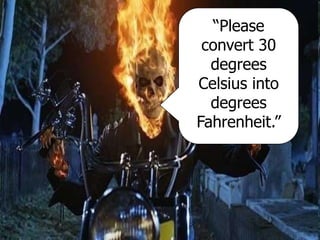
“Please
convert 30
degrees
Celsius into
degrees
Fahrenheit.”
“Please
convert 30
degrees
Celsius into
degrees
Fahrenheit.”
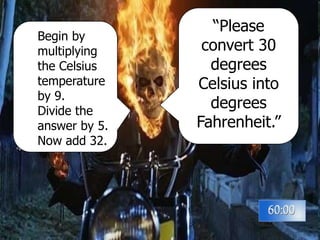
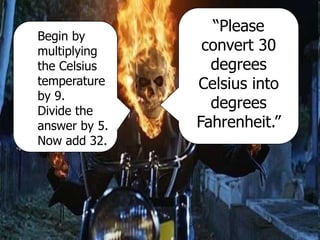
Begin by
multiplying
the Celsius
temperature
by 9.
Divide the
answer by 5.
Now add 32.
“Please
convert 30
degrees
Celsius into
degrees
Fahrenheit.”
Begin by
multiplying
the Celsius
temperature
by 9.
Divide the
answer by 5.
Now add 32.
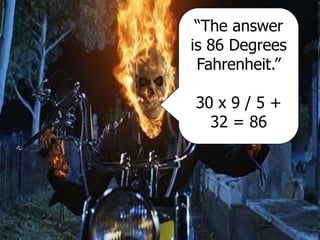
“The answer
is 86 Degrees
Fahrenheit.”
30 x 9 / 5 +
32 = 86
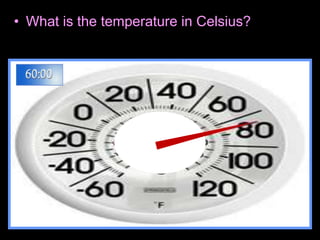
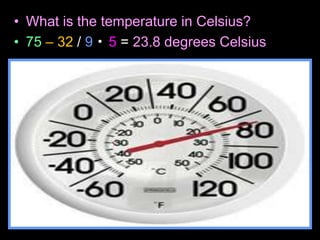
• What is the temperature in Celsius?
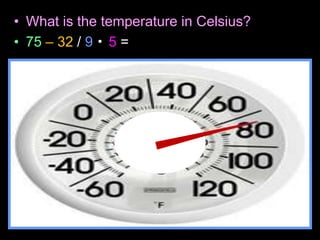
• 75 – 32 / 9 5 =
• What is the temperature in Celsius?
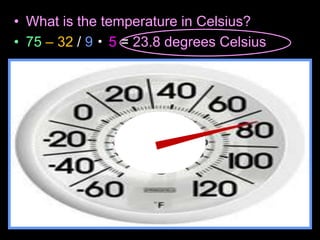
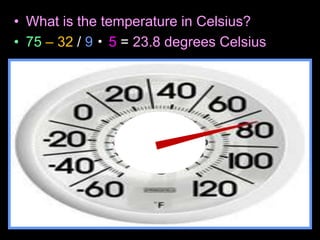
• 75 – 32 / 9 5 = 23.8 degrees Celsius
• What is the temperature in Celsius?
• 75 – 32 / 9 5 = 23.8 degrees Celsius
• What is the temperature in Celsius?
• 75 – 32 / 9 5 = 23.8 degrees Celsius
“To get
Fahrenheit from
Celsius” “You
can also take the
temperature in
Celsius and
multiply by 1.8
and then add 32
degrees.
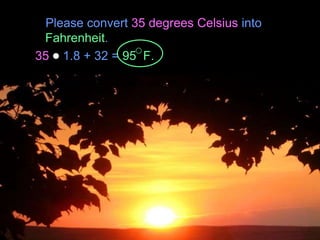
Please convert 35 degrees Celsius into
Fahrenheit.
Copyright © 2010 Ryan P. Murphy
Please convert 35 degrees Celsius into
Fahrenheit.
35 1.8 + 32 =
Copyright © 2010 Ryan P. Murphy
Please convert 35 degrees Celsius into
Fahrenheit.
35 1.8 + 32 = 95 F.
Copyright © 2010 Ryan P. Murphy
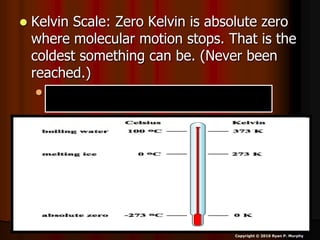
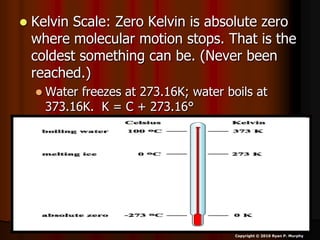
 Kelvin Scale: Zero Kelvin is absolute zero
where molecular motion stops. That is the
coldest something can be. (Never been
reached.)
 Water freezes at 273.16K; water boils at
373.16K. K = C + 273.16°
Copyright © 2010 Ryan P. Murphy
 Kelvin Scale: Zero Kelvin is absolute zero
where molecular motion stops. That is the
coldest something can be. (Never been
reached.)
 Water freezes at 273.16K; water boils at
373.16K. K = C + 273.16°
Copyright © 2010 Ryan P. Murphy
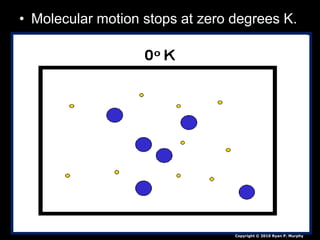
• Molecular motion stops at zero degrees K.
Copyright © 2010 Ryan P. Murphy
• Activity! Red Light, Green Light. Except
it’s Zero K, Warm Again.
Copyright © 2010 Ryan P. Murphy
• Activity (Optional) Red Light Green Light
Zero K Warm Again
• Activity (Optional) Red Light Green Light
Warm Again Again
• Activity (Optional) Red Light Green Light
Zero K Warm Again
• Activity (Optional) Red Light Green Light
Warm Again Again
• Activity (Optional) Red Light Green Light
Zero K Warm Again
• Students line up in a safe place.
• Teacher creates finish line
• When teachers spins and says Zero K you must
freeze / stop.
• When teacher says Warm Again and spins you
may try and advance to the finish.
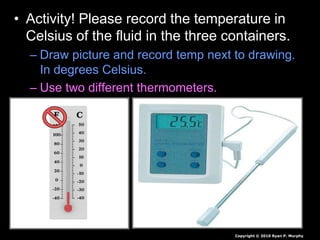
• Activity! Please record the temperature in
Celsius of the fluid in the three containers.
– Draw picture and record temp next to drawing.
In degrees Celsius.
– Use two different thermometers.
Copyright © 2010 Ryan P. Murphy
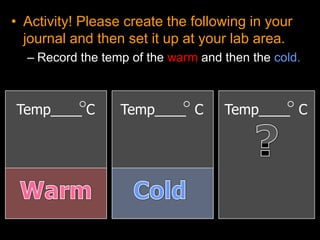
• Activity! Please create the following in your
journal and then set it up at your lab area.
– Record the temp of the warm and then the cold.
Temp____ C Temp____ C Temp____ C
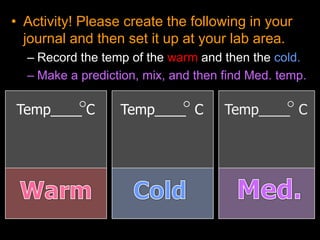
• Activity! Please create the following in your
journal and then set it up at your lab area.
– Record the temp of the warm and then the cold.
– Make a prediction, mix, and then find Med. temp.
Temp____ C Temp____ C Temp____ C
• Raise your hand when you think you know
the picture beneath the boxes.
– You only get one guess.
Copyright © 2010 Ryan P. Murphy
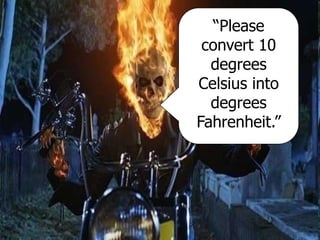
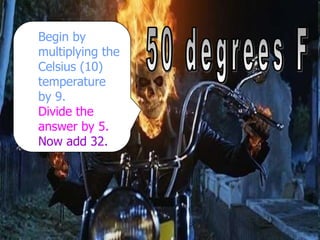
“Please
convert 10
degrees
Celsius into
degrees
Fahrenheit.”
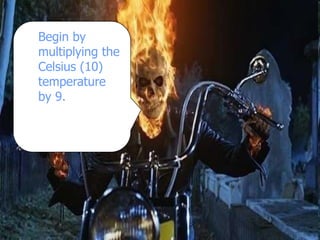
Begin by
multiplying the
Celsius (10)
temperature
by 9.
Begin by
multiplying the
Celsius (10)
temperature
by 9.
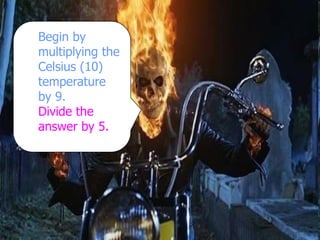
Divide the
answer by 5.
Begin by
multiplying the
Celsius (10)
temperature
by 9.
Divide the
answer by 5.
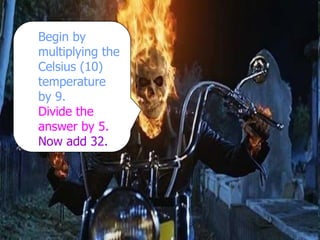
Now add 32.
Begin by
multiplying the
Celsius (10)
temperature
by 9.
Divide the
answer by 5.
Now add 32.
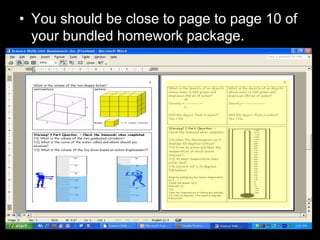
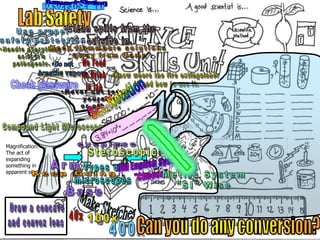
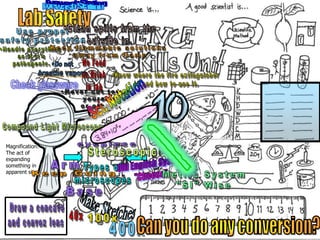
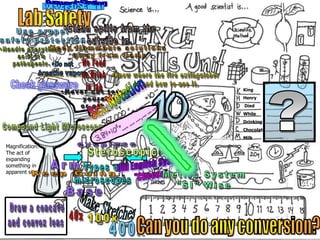
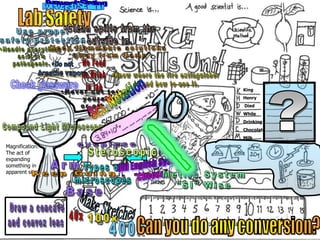
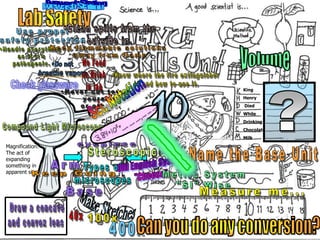
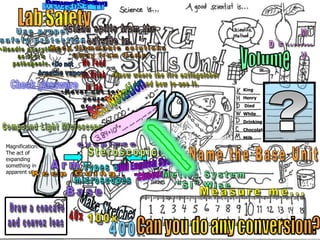
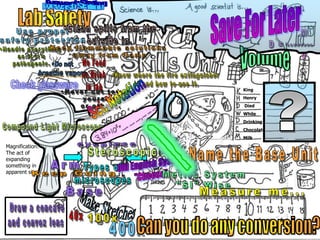
• You should be close to page to page 10 of
your bundled homework package.
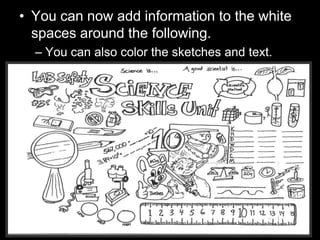
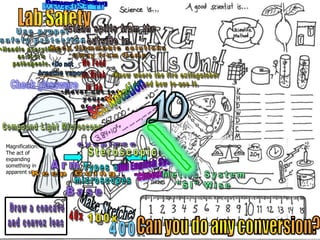
• You can now add information to the white
spaces around the following.
– You can also color the sketches and text.
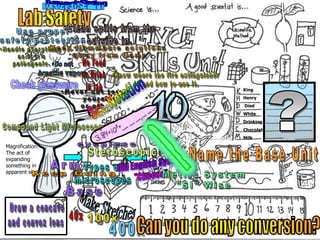
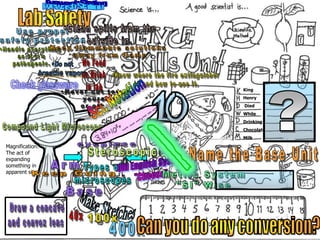
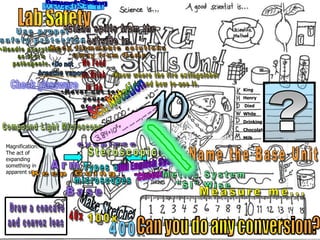
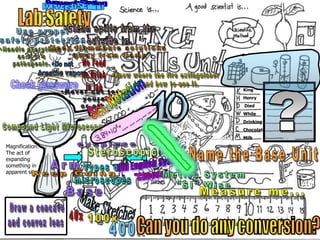
Magnification:
The act of
expanding
something in
apparent size.
Magnification:
The act of
expanding
something in
apparent size.
Magnification:
The act of
expanding
something in
apparent size.
Magnification:
The act of
expanding
something in
apparent size.
King
Henry
Died
While
Drinking
Chocolate
Milk
Magnification:
The act of
expanding
something in
apparent size.
King
Henry
Died
While
Drinking
Chocolate
Milk
Magnification:
The act of
expanding
something in
apparent size.
King
Henry
Died
While
Drinking
Chocolate
Milk
Magnification:
The act of
expanding
something in
apparent size.
King
Henry
Died
While
Drinking
Chocolate
Milk
Magnification:
The act of
expanding
something in
apparent size.
King
Henry
Died
While
Drinking
Chocolate
Milk
Magnification:
The act of
expanding
something in
apparent size.
King
Henry
Died
While
Drinking
Chocolate
Milk
Magnification:
The act of
expanding
something in
apparent size.
King
Henry
Died
While
Drinking
Chocolate
Milk
Magnification:
The act of
expanding
something in
apparent size.
King
Henry
Died
While
Drinking
Chocolate
Milk
Magnification:
The act of
expanding
something in
apparent size.
King
Henry
Died
While
Drinking
Chocolate
Milk
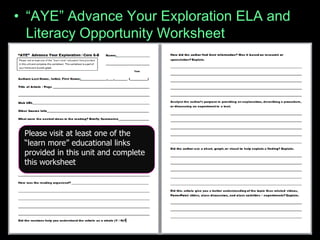
• “AYE” Advance Your Exploration ELA and
Literacy Opportunity Worksheet
– Visit some of the many provided links or..
– Articles can be found at (w/ membership to
NABT and NSTA)
• http://www.nabt.org/websites/institution/index.php?p=
1
• http://learningcenter.nsta.org/browse_journals.aspx?j
ournal=tst
Please visit at least one of the
“learn more” educational links
provided in this unit and complete
this worksheet
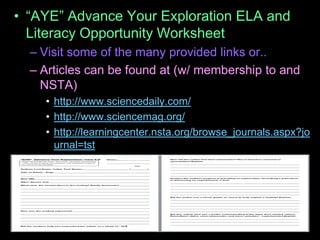
• “AYE” Advance Your Exploration ELA and
Literacy Opportunity Worksheet
– Visit some of the many provided links or..
– Articles can be found at (w/ membership to and
NSTA)
• http://www.sciencedaily.com/
• http://www.sciencemag.org/
• http://learningcenter.nsta.org/browse_journals.aspx?jo
urnal=tst
• http://sciencepowerpoint.com/
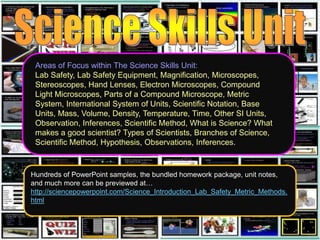
Areas of Focus within The Science Skills Unit:
Lab Safety, Lab Safety Equipment, Magnification, Microscopes,
Stereoscopes, Hand Lenses, Electron Microscopes, Compound
Light Microscopes, Parts of a Compound Microscope, Metric
System, International System of Units, Scientific Notation, Base
Units, Mass, Volume, Density, Temperature, Time, Other SI Units,
Observation, Inferences, Scientific Method, What is Science? What
makes a good scientist? Types of Scientists, Branches of Science,
Scientific Method, Hypothesis, Observations, Inferences.
Hundreds of PowerPoint samples, the bundled homework package, unit notes,
and much more can be previewed at…
http://sciencepowerpoint.com/Science_Introduction_Lab_Safety_Metric_Methods.
html
• This PowerPoint is on small part of my Science Skills Unit. This unit
includes…
• A Four Part 2,000+ Slide PowerPoint presentation full of class
activities, review opportunities, project ideas, video linksm
discussion questions, and much more.
• 16 page bundled homework package that chronologically follows the
PowerPoint slideshow. Modified version provided.
• Worksheets, curriculum guide, Common Core worksheet.
• 15 pages of unit notes with visuals for students who require
assistance and support staff.
• Many video and academic links
• 1 PowerPoint review game with answer key.
• Flashcards, rubrics, activity sheets, and much more.
• http://sciencepowerpoint.com/Science_Introduction_Lab_Safety_Me
tric_Methods.html
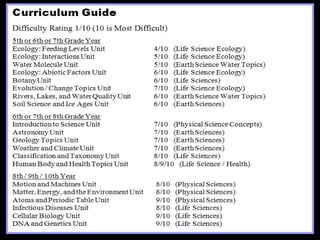
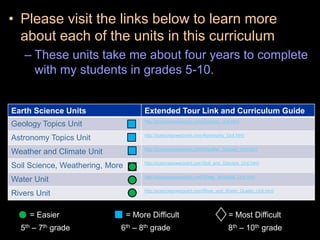
• Please visit the links below to learn more
about each of the units in this curriculum
– These units take me about four years to complete
with my students in grades 5-10.
Earth Science Units Extended Tour Link and Curriculum Guide
Geology Topics Unit http://sciencepowerpoint.com/Geology_Unit.html
Astronomy Topics Unit http://sciencepowerpoint.com/Astronomy_Unit.html
Weather and Climate Unit http://sciencepowerpoint.com/Weather_Climate_Unit.html
Soil Science, Weathering, More http://sciencepowerpoint.com/Soil_and_Glaciers_Unit.html
Water Unit http://sciencepowerpoint.com/Water_Molecule_Unit.html
Rivers Unit http://sciencepowerpoint.com/River_and_Water_Quality_Unit.html
= Easier = More Difficult = Most Difficult
5th – 7th grade 6th – 8th grade 8th – 10th grade
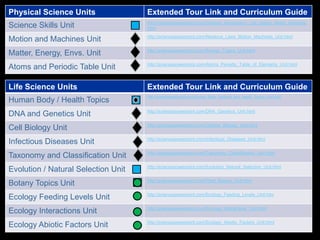
Physical Science Units Extended Tour Link and Curriculum Guide
Science Skills Unit http://sciencepowerpoint.com/Science_Introduction_Lab_Safety_Metric_Methods.
html
Motion and Machines Unit http://sciencepowerpoint.com/Newtons_Laws_Motion_Machines_Unit.html
Matter, Energy, Envs. Unit http://sciencepowerpoint.com/Energy_Topics_Unit.html
Atoms and Periodic Table Unit http://sciencepowerpoint.com/Atoms_Periodic_Table_of_Elements_Unit.html
Life Science Units Extended Tour Link and Curriculum Guide
Human Body / Health Topics
http://sciencepowerpoint.com/Human_Body_Systems_and_Health_Topics_Unit.html
DNA and Genetics Unit http://sciencepowerpoint.com/DNA_Genetics_Unit.html
Cell Biology Unit http://sciencepowerpoint.com/Cellular_Biology_Unit.html
Infectious Diseases Unit http://sciencepowerpoint.com/Infectious_Diseases_Unit.html
Taxonomy and Classification Unit http://sciencepowerpoint.com/Taxonomy_Classification_Unit.html
Evolution / Natural Selection Unit http://sciencepowerpoint.com/Evolution_Natural_Selection_Unit.html
Botany Topics Unit http://sciencepowerpoint.com/Plant_Botany_Unit.html
Ecology Feeding Levels Unit http://sciencepowerpoint.com/Ecology_Feeding_Levels_Unit.htm
Ecology Interactions Unit http://sciencepowerpoint.com/Ecology_Interactions_Unit.html
Ecology Abiotic Factors Unit http://sciencepowerpoint.com/Ecology_Abiotic_Factors_Unit.html
• The entire four year curriculum can be found at...
http://sciencepowerpoint.com/ Please feel free to
contact me with any questions you may have.
Thank you for your interest in this curriculum.
Sincerely,
Ryan Murphy M.Ed
www.sciencepowerpoint@gmail.com
http://www.teacherspaytea
chers.com/Product/Physical
-Science-Curriculum-
596485
http://www.teacherspayt
eachers.com/Product/Life
-Science-Curriculum-
601267
http://www.teacherspayt
eachers.com/Product/Eart
h-Science-Curriculum-
590950
• http://sciencepowerpoint.com/

Temperature Lesson PowerPoint

  • 1.
    • Conduction: Themovement of heat from one molecule to another. Copyright © 2010 Ryan P. Murphy
  • 3.
    • RED SLIDE:These are notes that are very important and should be recorded in your science journal. • BLACK SLIDE: Pay attention, follow directions, complete projects as described and answer required questions neatly. Copyright © 2010 Ryan P. Murphy
  • 4.
    -Please make noteslegible and use indentations when appropriate. -Example of indent. -Skip a line between topics -Don’t skip pages -Make visuals clear and well drawn. Please label
  • 5.
  • 7.
     New Areaof Focus: Temperature. Copyright © 2010 Ryan P. Murphy
  • 8.
     Temperature: Thedegree of hotness or coldness of a body or environment.  Corresponds to its molecular activity. Copyright © 2010 Ryan P. Murphy
  • 9.
     Temperature: Thedegree of hotness or coldness of a body or environment.  Corresponds to its molecular activity. Copyright © 2010 Ryan P. Murphy
  • 10.
    • Which ofthe pictures below represents hot and cold on a molecular level? Copyright © 2010 Ryan P. Murphy A B
  • 11.
    • Answer: Moleculesmove faster when hot, and slower when cold. Hot Cold Copyright © 2010 Ryan P. Murphy A B
  • 12.
    • This isreally cold. – Absolute zero has no molecular motion. – Never been reached. Copyright © 2010 Ryan P. Murphy
  • 13.
    • This isreally cold. – Absolute zero has no molecular motion. – Never been reached. Copyright © 2010 Ryan P. Murphy Learn more: http://lamar.colostate.edu/~hillger/temps.htm
  • 17.
    • Which twoof the thermometers below represent units that follow the SI system? Copyright © 2010 Ryan P. MurphyCopyright © 2010 Ryan P. Murphy
  • 18.
    • Which twoof the thermometers below represent units that follow the SI system? Copyright © 2010 Ryan P. MurphyCopyright © 2010 Ryan P. Murphy
  • 19.
     Temperature:  - - Copyright © 2010 Ryan P. Murphy
  • 20.
     Measured indegrees Celsius. Copyright © 2010 Ryan P. Murphy
  • 21.
     0 DegreesCelsius is the freezing point of water. Copyright © 2010 Ryan P. Murphy
  • 22.
     0 DegreesCelsius is the freezing point of water.  100 degrees Celsius is the boiling point. Copyright © 2010 Ryan P. Murphy
  • 23.
    • When it’shot, the liquid inside the thermometer will expand and rise in the tube.
  • 24.
    • When it’shot, the liquid inside the thermometer will expand and rise in the tube.
  • 25.
    • When it’shot, the liquid inside the thermometer will expand and rise in the tube. – The opposite happens when it is cold.
  • 26.
    • When it’shot, the liquid inside the thermometer will expand and rise in the tube. – The opposite happens when it is cold.
  • 27.
    • Conduction: Themovement of heat from one molecule to another. Copyright © 2010 Ryan P. Murphy
  • 28.
    • Conduction: Themovement of heat from one molecule to another. Copyright © 2010 Ryan P. Murphy
  • 29.
    • Conduction: Themovement of heat from one molecule to another. Copyright © 2010 Ryan P. Murphy
  • 30.
    • Activity sheetavailable. Temperature and Conduction.
  • 31.
    • Please recordthe following spreadsheet into your journal. 3 x 16 Minutes Wax Paper Cup Temp (C) Styrofoam Cup Temp (C) 1 2 3 4 5 6 7 8 9 10 11 12 13 14 15
  • 32.
    • Activity! Conduction –Place a styrofoam cup and wax paper cup into two similar containers. – Place weights into each cup so the container cannot float. – Place thermometers in each cup at the same place. – Teacher to pour 100 ml of boiling water into graduated cylinders and then into container (not into cup with weights). • Caution! Water will be very hot. – Record temperature of each on spreadsheet.
  • 34.
    • Questions. – Whichcup was the better insulator of heat? Please use data in your response. – Please measure the temperature of the water on the outside of each container? • Record this temperature in your journal and discuss your findings? “Where did the heat go?” – How does this activity demonstrate conduction?
  • 35.
    • Questions. – Whichcup was the better insulator of heat? Please use data in your response.
  • 36.
    • Questions. – Whichcup was the better insulator of heat? Please use data in your response. – The styrofoam cup was the better insulator of heat because it was ____ degrees cooler than the wax paper cup.
  • 37.
    • Questions. – Pleasemeasure the temperature of the water on the outside of each container? • Record this temperature in your journal and discuss your findings? “Where did the heat go?”
  • 38.
    • Questions. – Pleasemeasure the temperature of the water on the outside of each container? • Record this temperature in your journal and discuss your findings? “Where did the heat go?” – The water on the outside of the wax paper cup was cooler because the thermal energy was transferred into the cup through conduction.
  • 39.
    • Questions. – Howdoes this activity demonstrate conduction?
  • 40.
    • Questions. – Howdoes this activity demonstrate conduction? – This activity demonstrates conduction because thermal energy moved through the molecules in the cup. This evidence in the recorded temperature changes.
  • 41.
    • Activity! Pleaseconvert 95 degrees Fahrenheit into degrees Celsius. – Formula is on the next slide. Copyright © 2010 Ryan P. Murphy
  • 42.
    • Activity! Pleaseconvert 95 degrees Fahrenheit into degrees Celsius. – Formula is on the next slide. “The Fahrenheit Scale makes me angry!” Copyright © 2010 Ryan P. Murphy
  • 43.
    • To convert95 degrees Fahrenheit temperatures into Celsius: – Begin by subtracting 32 from the Fahrenheit number. – Divide the answer by 9. – Then multiply that answer by 5. Copyright © 2010 Ryan P. Murphy
  • 44.
    95 - 32= 63. Copyright © 2010 Ryan P. Murphy
  • 45.
    95 - 32= 63. Then, 63 divided by 9 = 7 Copyright © 2010 Ryan P. Murphy
  • 46.
    95 - 32= 63. Then, 63 divided by 9 = 7 Finally, 7 times 5 is 35 degrees Celsius. Copyright © 2010 Ryan P. Murphy
  • 47.
    “Try it again youhot head” “Convert 55 degrees Fahrenheit into degrees Celsius.”
  • 48.
    “Try it again youhot head” “Convert 55 degrees Fahrenheit into degrees Celsius.” Begin by subtracting 32 from the Fahrenheit number (55).
  • 49.
    “Try it again youhot head” “Convert 55 degrees Fahrenheit into degrees Celsius.” Begin by subtracting 32 from the Fahrenheit number (55). Divide the answer by 9.
  • 50.
    “Try it again youhot head” “Convert 55 degrees Fahrenheit into degrees Celsius.” Begin by subtracting 32 from the Fahrenheit number (55). Divide the answer by 9. Then multiply that answer by 5.
  • 51.
    “The answer is 12.7degrees Celsius.”
  • 52.
    “The answer is 12.7degrees Celsius.” “55-32=23,
  • 53.
    “The answer is 12.7degrees Celsius.” “55-32=23, 23/9 =2.5,
  • 54.
    “The answer is 12.7degrees Celsius.” “55-32=23, 23/9 =2.5, 2.5 x 5=12.7 degrees C.”
  • 55.
    Copyright © 2010Ryan P. Murphy
  • 56.
    • Because manypeople have never learned the metric system. Copyright © 2010 Ryan P. Murphy
  • 57.
    • Because manypeople have never learned the metric system. Please convert 20 Degrees Celsius into Fahrenheit: Copyright © 2010 Ryan P. Murphy
  • 58.
    • Because manypeople have never learned the metric system. Please convert 20 Degrees Celsius into Fahrenheit: – Begin by multiplying the Celsius temperature by 9. Copyright © 2010 Ryan P. Murphy
  • 59.
    • Because manypeople have never learned the metric system. Please convert 20 Degrees Celsius into Fahrenheit: – Begin by multiplying the Celsius temperature by 9. – Divide the answer by 5. Copyright © 2010 Ryan P. Murphy
  • 60.
    • Because manypeople have never learned the metric system. Please convert 20 Degrees Celsius into Fahrenheit: – Begin by multiplying the Celsius temperature by 9. – Divide the answer by 5. – Now add 32. Copyright © 2010 Ryan P. Murphy
  • 61.
    • Answer: 68Degrees Fahrenheit. – Begin by multiplying the Celsius temperature (20) by 9. – Divide the answer by 5. – Now add 32. 20 X 9 = 180 180 / 5 = 36 36 +32 = 68 Copyright © 2010 Ryan P. Murphy
  • 62.
    • Answer: 68Degrees Fahrenheit. – Begin by multiplying the Celsius temperature (20) by 9. – Divide the answer by 5. – Now add 32. 20 X 9 = 180 180 / 5 = 36 36 +32 = 68 Copyright © 2010 Ryan P. Murphy
  • 63.
    • Answer: 68Degrees Fahrenheit. – Begin by multiplying the Celsius temperature (20) by 9. – Divide the answer by 5. – Now add 32. 20 X 9 = 180 180 / 5 = 36 36 +32 = 68 Copyright © 2010 Ryan P. Murphy
  • 64.
    • Answer: 68Degrees Fahrenheit. – Begin by multiplying the Celsius temperature (20) by 9. – Divide the answer by 5. – Now add 32. 20 X 9 = 180 180 / 5 = 36 36 +32 = 68 F Copyright © 2010 Ryan P. Murphy
  • 65.
  • 66.
    “Please convert 30 degrees Celsius into degrees Fahrenheit.” Beginby multiplying the Celsius temperature by 9. Divide the answer by 5. Now add 32.
  • 67.
    “Please convert 30 degrees Celsius into degrees Fahrenheit.” Beginby multiplying the Celsius temperature by 9. Divide the answer by 5. Now add 32.
  • 68.
    “The answer is 86Degrees Fahrenheit.” 30 x 9 / 5 + 32 = 86
  • 69.
    • What isthe temperature in Celsius?
  • 70.
    • What isthe temperature in Celsius? • 75 – 32 / 9 5 =
  • 71.
    • What isthe temperature in Celsius? • 75 – 32 / 9 5 = 23.8 degrees Celsius
  • 72.
    • What isthe temperature in Celsius? • 75 – 32 / 9 5 = 23.8 degrees Celsius
  • 73.
    • What isthe temperature in Celsius? • 75 – 32 / 9 5 = 23.8 degrees Celsius
  • 74.
    “To get Fahrenheit from Celsius”“You can also take the temperature in Celsius and multiply by 1.8 and then add 32 degrees.
  • 75.
    Please convert 35degrees Celsius into Fahrenheit. Copyright © 2010 Ryan P. Murphy
  • 76.
    Please convert 35degrees Celsius into Fahrenheit. 35 1.8 + 32 = Copyright © 2010 Ryan P. Murphy
  • 77.
    Please convert 35degrees Celsius into Fahrenheit. 35 1.8 + 32 = 95 F. Copyright © 2010 Ryan P. Murphy
  • 78.
     Kelvin Scale:Zero Kelvin is absolute zero where molecular motion stops. That is the coldest something can be. (Never been reached.)  Water freezes at 273.16K; water boils at 373.16K. K = C + 273.16° Copyright © 2010 Ryan P. Murphy
  • 79.
     Kelvin Scale:Zero Kelvin is absolute zero where molecular motion stops. That is the coldest something can be. (Never been reached.)  Water freezes at 273.16K; water boils at 373.16K. K = C + 273.16° Copyright © 2010 Ryan P. Murphy
  • 80.
    • Molecular motionstops at zero degrees K. Copyright © 2010 Ryan P. Murphy
  • 81.
    • Activity! RedLight, Green Light. Except it’s Zero K, Warm Again. Copyright © 2010 Ryan P. Murphy
  • 82.
    • Activity (Optional)Red Light Green Light
  • 83.
    • Activity (Optional)Red Light Green Light Zero K Warm Again
  • 84.
    • Activity (Optional)Red Light Green Light Warm Again Again
  • 85.
    • Activity (Optional)Red Light Green Light Zero K Warm Again
  • 86.
    • Activity (Optional)Red Light Green Light Warm Again Again
  • 87.
    • Activity (Optional)Red Light Green Light Zero K Warm Again • Students line up in a safe place. • Teacher creates finish line • When teachers spins and says Zero K you must freeze / stop. • When teacher says Warm Again and spins you may try and advance to the finish.
  • 88.
    • Activity! Pleaserecord the temperature in Celsius of the fluid in the three containers. – Draw picture and record temp next to drawing. In degrees Celsius. – Use two different thermometers. Copyright © 2010 Ryan P. Murphy
  • 89.
    • Activity! Pleasecreate the following in your journal and then set it up at your lab area. – Record the temp of the warm and then the cold. Temp____ C Temp____ C Temp____ C
  • 90.
    • Activity! Pleasecreate the following in your journal and then set it up at your lab area. – Record the temp of the warm and then the cold. – Make a prediction, mix, and then find Med. temp. Temp____ C Temp____ C Temp____ C
  • 91.
    • Raise yourhand when you think you know the picture beneath the boxes. – You only get one guess. Copyright © 2010 Ryan P. Murphy
  • 100.
  • 101.
    Begin by multiplying the Celsius(10) temperature by 9.
  • 102.
    Begin by multiplying the Celsius(10) temperature by 9. Divide the answer by 5.
  • 103.
    Begin by multiplying the Celsius(10) temperature by 9. Divide the answer by 5. Now add 32.
  • 104.
    Begin by multiplying the Celsius(10) temperature by 9. Divide the answer by 5. Now add 32.
  • 105.
    • You shouldbe close to page to page 10 of your bundled homework package.
  • 106.
    • You cannow add information to the white spaces around the following. – You can also color the sketches and text.
  • 107.
  • 108.
  • 109.
  • 110.
    Magnification: The act of expanding somethingin apparent size. King Henry Died While Drinking Chocolate Milk
  • 111.
    Magnification: The act of expanding somethingin apparent size. King Henry Died While Drinking Chocolate Milk
  • 112.
    Magnification: The act of expanding somethingin apparent size. King Henry Died While Drinking Chocolate Milk
  • 113.
    Magnification: The act of expanding somethingin apparent size. King Henry Died While Drinking Chocolate Milk
  • 114.
    Magnification: The act of expanding somethingin apparent size. King Henry Died While Drinking Chocolate Milk
  • 115.
    Magnification: The act of expanding somethingin apparent size. King Henry Died While Drinking Chocolate Milk
  • 116.
    Magnification: The act of expanding somethingin apparent size. King Henry Died While Drinking Chocolate Milk
  • 117.
    Magnification: The act of expanding somethingin apparent size. King Henry Died While Drinking Chocolate Milk
  • 118.
    Magnification: The act of expanding somethingin apparent size. King Henry Died While Drinking Chocolate Milk
  • 120.
    • “AYE” AdvanceYour Exploration ELA and Literacy Opportunity Worksheet – Visit some of the many provided links or.. – Articles can be found at (w/ membership to NABT and NSTA) • http://www.nabt.org/websites/institution/index.php?p= 1 • http://learningcenter.nsta.org/browse_journals.aspx?j ournal=tst Please visit at least one of the “learn more” educational links provided in this unit and complete this worksheet
  • 121.
    • “AYE” AdvanceYour Exploration ELA and Literacy Opportunity Worksheet – Visit some of the many provided links or.. – Articles can be found at (w/ membership to and NSTA) • http://www.sciencedaily.com/ • http://www.sciencemag.org/ • http://learningcenter.nsta.org/browse_journals.aspx?jo urnal=tst
  • 122.
  • 124.
    Areas of Focuswithin The Science Skills Unit: Lab Safety, Lab Safety Equipment, Magnification, Microscopes, Stereoscopes, Hand Lenses, Electron Microscopes, Compound Light Microscopes, Parts of a Compound Microscope, Metric System, International System of Units, Scientific Notation, Base Units, Mass, Volume, Density, Temperature, Time, Other SI Units, Observation, Inferences, Scientific Method, What is Science? What makes a good scientist? Types of Scientists, Branches of Science, Scientific Method, Hypothesis, Observations, Inferences. Hundreds of PowerPoint samples, the bundled homework package, unit notes, and much more can be previewed at… http://sciencepowerpoint.com/Science_Introduction_Lab_Safety_Metric_Methods. html
  • 128.
    • This PowerPointis on small part of my Science Skills Unit. This unit includes… • A Four Part 2,000+ Slide PowerPoint presentation full of class activities, review opportunities, project ideas, video linksm discussion questions, and much more. • 16 page bundled homework package that chronologically follows the PowerPoint slideshow. Modified version provided. • Worksheets, curriculum guide, Common Core worksheet. • 15 pages of unit notes with visuals for students who require assistance and support staff. • Many video and academic links • 1 PowerPoint review game with answer key. • Flashcards, rubrics, activity sheets, and much more. • http://sciencepowerpoint.com/Science_Introduction_Lab_Safety_Me tric_Methods.html
  • 130.
    • Please visitthe links below to learn more about each of the units in this curriculum – These units take me about four years to complete with my students in grades 5-10. Earth Science Units Extended Tour Link and Curriculum Guide Geology Topics Unit http://sciencepowerpoint.com/Geology_Unit.html Astronomy Topics Unit http://sciencepowerpoint.com/Astronomy_Unit.html Weather and Climate Unit http://sciencepowerpoint.com/Weather_Climate_Unit.html Soil Science, Weathering, More http://sciencepowerpoint.com/Soil_and_Glaciers_Unit.html Water Unit http://sciencepowerpoint.com/Water_Molecule_Unit.html Rivers Unit http://sciencepowerpoint.com/River_and_Water_Quality_Unit.html = Easier = More Difficult = Most Difficult 5th – 7th grade 6th – 8th grade 8th – 10th grade
  • 131.
    Physical Science UnitsExtended Tour Link and Curriculum Guide Science Skills Unit http://sciencepowerpoint.com/Science_Introduction_Lab_Safety_Metric_Methods. html Motion and Machines Unit http://sciencepowerpoint.com/Newtons_Laws_Motion_Machines_Unit.html Matter, Energy, Envs. Unit http://sciencepowerpoint.com/Energy_Topics_Unit.html Atoms and Periodic Table Unit http://sciencepowerpoint.com/Atoms_Periodic_Table_of_Elements_Unit.html Life Science Units Extended Tour Link and Curriculum Guide Human Body / Health Topics http://sciencepowerpoint.com/Human_Body_Systems_and_Health_Topics_Unit.html DNA and Genetics Unit http://sciencepowerpoint.com/DNA_Genetics_Unit.html Cell Biology Unit http://sciencepowerpoint.com/Cellular_Biology_Unit.html Infectious Diseases Unit http://sciencepowerpoint.com/Infectious_Diseases_Unit.html Taxonomy and Classification Unit http://sciencepowerpoint.com/Taxonomy_Classification_Unit.html Evolution / Natural Selection Unit http://sciencepowerpoint.com/Evolution_Natural_Selection_Unit.html Botany Topics Unit http://sciencepowerpoint.com/Plant_Botany_Unit.html Ecology Feeding Levels Unit http://sciencepowerpoint.com/Ecology_Feeding_Levels_Unit.htm Ecology Interactions Unit http://sciencepowerpoint.com/Ecology_Interactions_Unit.html Ecology Abiotic Factors Unit http://sciencepowerpoint.com/Ecology_Abiotic_Factors_Unit.html
  • 132.
    • The entirefour year curriculum can be found at... http://sciencepowerpoint.com/ Please feel free to contact me with any questions you may have. Thank you for your interest in this curriculum. Sincerely, Ryan Murphy M.Ed www.sciencepowerpoint@gmail.com
  • 133.
  • 134.