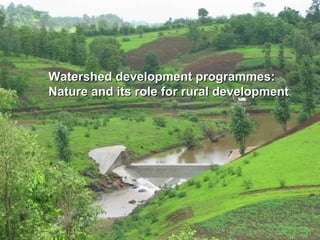
Watershed development programmes:Watershed development programmes:
Nature and its role for rural developmentNature and its role for rural development
Presented by:-
 Jayraj -140110119114
 Uttam Trasadiya -140110119115
 Nisarg Trivedi -140110119116
Branch:-mechanical
Subject:- elements of civil engineering
Batch:- 2D19
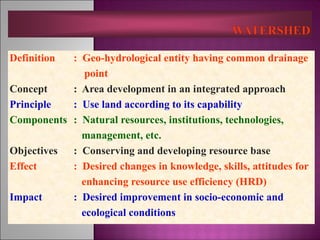
Definition : Geo-hydrological entity having common drainage
point
Concept : Area development in an integrated approach
Principle : Use land according to its capability
Components : Natural resources, institutions, technologies,
management, etc.
Objectives : Conserving and developing resource base
Effect : Desired changes in knowledge, skills, attitudes for
enhancing resource use efficiency (HRD)
Impact : Desired improvement in socio-economic and
ecological conditions
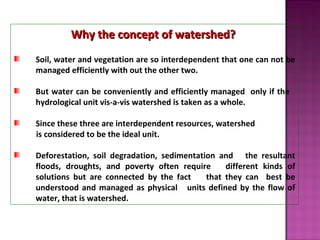
Why the concept of watershed?Why the concept of watershed?
Soil, water and vegetation are so interdependent that one can not be
managed efficiently with out the other two.
But water can be conveniently and efficiently managed only if the
hydrological unit vis-a-vis watershed is taken as a whole.
Since these three are interdependent resources, watershed
is considered to be the ideal unit.
Deforestation, soil degradation, sedimentation and the resultant
floods, droughts, and poverty often require different kinds of
solutions but are connected by the fact that they can best be
understood and managed as physical units defined by the flow of
water, that is watershed.
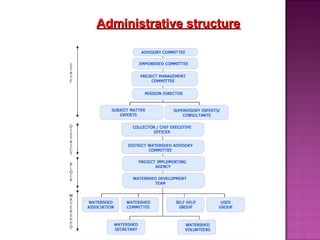
Administrative structureAdministrative structure
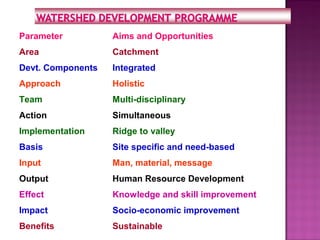
Parameter Aims and Opportunities
Area Catchment
Devt. Components Integrated
Approach Holistic
Team Multi-disciplinary
Action Simultaneous
Implementation Ridge to valley
Basis Site specific and need-based
Input Man, material, message
Output Human Resource Development
Effect Knowledge and skill improvement
Impact Socio-economic improvement
Benefits Sustainable
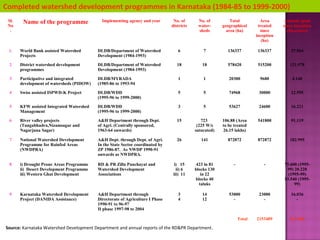
Completed watershed development programmes in Karnataka (1984-85 to 1999-2000)
Sl.
No
.
Name of the programme Implementing agency and year No. of
districts
No. of
water-
sheds
Total
geographical
area (ha)
Area
treated
since
inception
(ha)
Amount spent
since inception
(Rs.crores)
1. World Bank assisted Watershed
Projects
DLDB/Department of Watershed
Development (1984-1993)
6 7 136337 136337 37.564
2 District watershed development
programmes
DLDB/Department of Watershed
Development (1984-1993)
18 18 578420 515200 121.978
3 Participative and integrated
development of watersheds (PIDOW)
DLDB/MYRADA
(1985-86 to 1993-94
1 1 20300 9680 4.140
4 Swiss assisted ISPWD-K Project DLDB/WDD
(1995-96 to 1999-2000)
5 5 74968 30000 12.595
5 KFW assisted Integrated Watershed
Management
DLDB/WDD
(1995-96 to 1999-2000)
3 5 53627 24600 16.221
6 River valley projects
(Tungabhadra,Nizamsagar and
Nagarjuna Sagar)
A&H Department through Dept.
of Agri. (Centrally sponsored,
1963-64 onwards)
15 723
(225 W/s
saturated)
106.88 (Area
to be treated
26.15 lakhs)
541800 91.119
7 National Watershed Development
Programme for Rainfed Areas
(NWDPRA)
A&H Dept. through Dept. of Agri.
In the State Sector coordinated by
ZP 1986-87. As NWDP 1990-91
onwards as NWDPRA.
26 141 872872 872872 182.995
8 i) Drought Prone Areas Programme
ii) Desert Development Programme
iii) Western Ghat Development
RD & PR Zilla Panchayat and
Watershed Development
Associations
i) 15
ii) 6
iii) 11
423 in 81
blocks 130
in 22
blocks 40
taluks
- - 75.600 (1995-
99) 20.220
(1995-99)
53.540 (1995-
99)
9 Karnataka Watershed Development
Project (DANIDA Assistance)
A&H Department through
Directorate of Agriculture I Phase
1990-91 to 96-97
II phase 1997-98 to 2004
3
4
14
12
53000
-
23000
-
16.036
-
Total 2153489 632.008
Source: Karnataka Watershed Development Department and annual reports of the RD&PR Department.
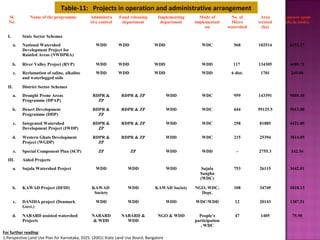
Table-11: Projects in operation and administrative arrangement
Sl.
No.
Name of the programme Administra
tive control
Fund releasing
department
Implementing
department
Mode of
implementati
on
No. of
Micro
watershed
Area
treated
(ha)
Amount spent
(Rs.in lakhs)
I. State Sector Schemes
a. National Watershed
Development Project for
Rainfed Areas (NWDPRA)
WDD WDD WDD WDC 568 102514 6353.17
b. River Valley Project (RVP) WDD WDD WDD WDD 117 134305 4489.71
c. Reclamation of saline, alkaline
and waterlogged soils
WDD WDD WDD WDD 6 dist. 1701 249.00
II. District Sector Schemes
a. Drought Prone Areas
Programme (DPAP)
RDPR &
ZP
RDPR & ZP WDD WDC 959 143391 9880.48
b. Desert Development
Programme (DDP)
RDPR &
ZP
RDPR & ZP WDD WDC 644 59125.5 5013.88
c. Integrated Watershed
Development Project (IWDP)
RDPR &
ZP
RDPR & ZP WDD WDC 258 81885 4421.89
d. Western Ghats Development
Project (WGDP)
RDPR &
ZP
RDPR & ZP WDD WDC 215 25394 3814.85
e. Special Component Plan (SCP) ZP ZP WDD WDD - 2755.3 142.36
III. Aided Projects
a. Sujala Watershed Project WDD WDD WDD Sujala
Sangha
(WDC)
753 26115 3442.01
b. KAWAD Project (DFID) KAWAD
Society
WDD KAWAD Society NGO, WDC,
Dept.
108 34749 1818.13
c. DANIDA project (Denmark
Govt.)
WDD WDD WDD WDC/WDD 12 20143 1387.51
d. NABARD assisted watershed
Projects
NABARD
& WDD
NABARD &
WDD
NGO & WDD People’s
participation
, WDC
47 1405 75.90
For further reading:
1.Perspective Land Use Plan for Karnataka, 2025. (2001) State Land Use Board, Bangalore
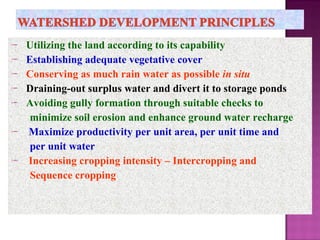
 Utilizing the land according to its capability
 Establishing adequate vegetative cover
 Conserving as much rain water as possible in situ
 Draining-out surplus water and divert it to storage ponds
 Avoiding gully formation through suitable checks to
minimize soil erosion and enhance ground water recharge
 Maximize productivity per unit area, per unit time and
per unit water
 Increasing cropping intensity – Intercropping and
Sequence cropping
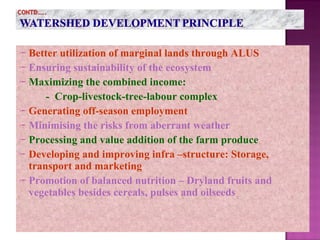
 Better utilization of marginal lands through ALUS
 Ensuring sustainability of the ecosystem
 Maximizing the combined income:
- Crop-livestock-tree-labour complex
 Generating off-season employment
 Minimising the risks from aberrant weather
 Processing and value addition of the farm produce
 Developing and improving infra –structure: Storage,
transport and marketing
 Promotion of balanced nutrition – Dryland fruits and
vegetables besides cereals, pulses and oilseeds
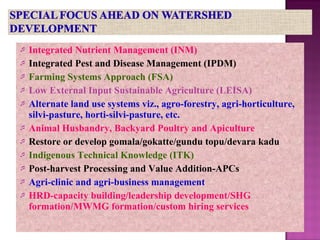
 Integrated Nutrient Management (INM)
 Integrated Pest and Disease Management (IPDM)
 Farming Systems Approach (FSA)
 Low External Input Sustainable Agriculture (LEISA)
 Alternate land use systems viz., agro-forestry, agri-horticulture,
silvi-pasture, horti-silvi-pasture, etc.
 Animal Husbandry, Backyard Poultry and Apiculture
 Restore or develop gomala/gokatte/gundu topu/devara kadu
 Indigenous Technical Knowledge (ITK)
 Post-harvest Processing and Value Addition-APCs
 Agri-clinic and agri-business management
 HRD-capacity building/leadership development/SHG
formation/MWMG formation/custom hiring services
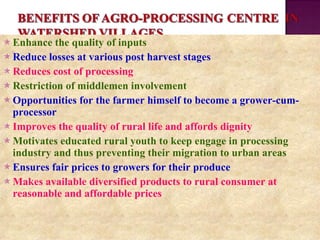
 Enhance the quality of inputs
 Reduce losses at various post harvest stages
 Reduces cost of processing
 Restriction of middlemen involvement
 Opportunities for the farmer himself to become a grower-cum-
processor
 Improves the quality of rural life and affords dignity
 Motivates educated rural youth to keep engage in processing
industry and thus preventing their migration to urban areas
 Ensures fair prices to growers for their produce
 Makes available diversified products to rural consumer at
reasonable and affordable prices
     
 Sujala is a Watershed Development Project
designed by the Government of Karnataka and
implemented by the Watershed Development
Department of Government of Karnataka
 The World Bank through International
Development Association provided major portion
of plan outlay as a loan to Government of India
and in turn loan to Government of Karnataka.
It is being implemented
in seven districts,
namely Kolar,
Chikkabalapur, Tumkur,
Madhugiri, Chitradurga,
Haveri and Dharwad of
Karnataka covering 4.29
lakhs hectare. of land
spread over in 77 sub-
watersheds and 1270
villages benefiting nearly
4.0 lakhs households
including landless.
 The Government of Karnataka finances some
portion of the budget and the Watershed
Communities contribute some portion.
 Sujala a community driven watershed development
project with a total budget of Rs.557 crores,
 As planned, the project period started from
10.09.2001 and likely to end by 31.03.2009.
 To improve the productive potential of
selected watersheds and their associated
natural resource base.
 Strengthen community and institutional
arrangements for natural resource
management.
 An associated objective is to strengthen the
capacity of communities in the project
districts for participatory involvement in
planning, implementation, social and
environmental management and maintenance.
 The implementing department operates
in a more socially inclusive manner,
with in the frame work of a convergent
watershed development plan.
 This will be achieved through having the
community groups implement the
project, the project’s collaborative
approach and capacity building
initiatives.
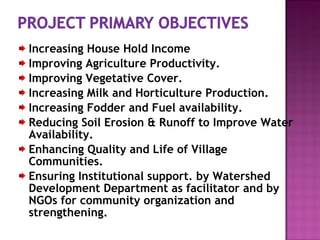
Increasing House Hold Income
Improving Agriculture Productivity.
Improving Vegetative Cover.
Increasing Milk and Horticulture Production.
Increasing Fodder and Fuel availability.
Reducing Soil Erosion & Runoff to Improve Water
Availability.
Enhancing Quality and Life of Village
Communities.
Ensuring Institutional support. by Watershed
Development Department as facilitator and by
NGOs for community organization and
strengthening.
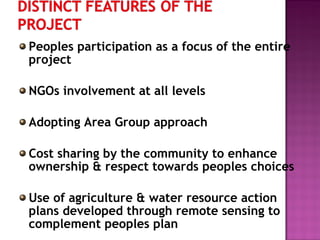
Peoples participation as a focus of the entire
project
NGOs involvement at all levels
Adopting Area Group approach
Cost sharing by the community to enhance
ownership & respect towards peoples choices
Use of agriculture & water resource action
plans developed through remote sensing to
complement peoples plan
Involvement of various resource agencies for
provision of specialized inputs
Monitoring & Evaluation is inbuilt within the
project implementation structure & process
Effective accountability & transparency by
adopting appropriate financial management
systems at all levels
Adopting ESA (Environmental & Social impact
assessment)
Involvement of PRIs (Panchayat Raj Institution)
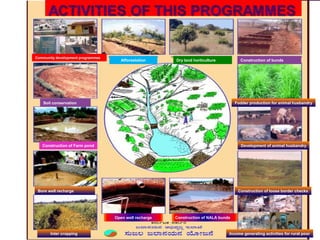
Community development programmesCommunity development programmes
Afforestation Dry land horticulture Construction of bunds
Soil conservation
Construction of Farm pond
Bore well recharge
Inter cropping
Construction of loose border checks
Fodder production for animal husbandry
Income generating activities for rural poor
Development of animal husbandry
Open well recharge Construction of NALA bunds
Use of land, water and vegetation accordingUse of land, water and vegetation according
to its capability we can changes into its capability we can changes in
knowledge, skills, attitudes for enhancingknowledge, skills, attitudes for enhancing
resource use efficiency and improvementresource use efficiency and improvement
in socio-economic and ecologicalin socio-economic and ecological
conditionsconditions
THANK YOUTHANK YOU

Watershed development (civil)

  • 1.
    Watershed development programmes:Watersheddevelopment programmes: Nature and its role for rural developmentNature and its role for rural development
  • 2.
    Presented by:-  Jayraj-140110119114  Uttam Trasadiya -140110119115  Nisarg Trivedi -140110119116 Branch:-mechanical Subject:- elements of civil engineering Batch:- 2D19
  • 3.
    Definition : Geo-hydrologicalentity having common drainage point Concept : Area development in an integrated approach Principle : Use land according to its capability Components : Natural resources, institutions, technologies, management, etc. Objectives : Conserving and developing resource base Effect : Desired changes in knowledge, skills, attitudes for enhancing resource use efficiency (HRD) Impact : Desired improvement in socio-economic and ecological conditions
  • 4.
    Why the conceptof watershed?Why the concept of watershed? Soil, water and vegetation are so interdependent that one can not be managed efficiently with out the other two. But water can be conveniently and efficiently managed only if the hydrological unit vis-a-vis watershed is taken as a whole. Since these three are interdependent resources, watershed is considered to be the ideal unit. Deforestation, soil degradation, sedimentation and the resultant floods, droughts, and poverty often require different kinds of solutions but are connected by the fact that they can best be understood and managed as physical units defined by the flow of water, that is watershed.
  • 5.
  • 6.
    Parameter Aims andOpportunities Area Catchment Devt. Components Integrated Approach Holistic Team Multi-disciplinary Action Simultaneous Implementation Ridge to valley Basis Site specific and need-based Input Man, material, message Output Human Resource Development Effect Knowledge and skill improvement Impact Socio-economic improvement Benefits Sustainable
  • 7.
    Completed watershed developmentprogrammes in Karnataka (1984-85 to 1999-2000) Sl. No . Name of the programme Implementing agency and year No. of districts No. of water- sheds Total geographical area (ha) Area treated since inception (ha) Amount spent since inception (Rs.crores) 1. World Bank assisted Watershed Projects DLDB/Department of Watershed Development (1984-1993) 6 7 136337 136337 37.564 2 District watershed development programmes DLDB/Department of Watershed Development (1984-1993) 18 18 578420 515200 121.978 3 Participative and integrated development of watersheds (PIDOW) DLDB/MYRADA (1985-86 to 1993-94 1 1 20300 9680 4.140 4 Swiss assisted ISPWD-K Project DLDB/WDD (1995-96 to 1999-2000) 5 5 74968 30000 12.595 5 KFW assisted Integrated Watershed Management DLDB/WDD (1995-96 to 1999-2000) 3 5 53627 24600 16.221 6 River valley projects (Tungabhadra,Nizamsagar and Nagarjuna Sagar) A&H Department through Dept. of Agri. (Centrally sponsored, 1963-64 onwards) 15 723 (225 W/s saturated) 106.88 (Area to be treated 26.15 lakhs) 541800 91.119 7 National Watershed Development Programme for Rainfed Areas (NWDPRA) A&H Dept. through Dept. of Agri. In the State Sector coordinated by ZP 1986-87. As NWDP 1990-91 onwards as NWDPRA. 26 141 872872 872872 182.995 8 i) Drought Prone Areas Programme ii) Desert Development Programme iii) Western Ghat Development RD & PR Zilla Panchayat and Watershed Development Associations i) 15 ii) 6 iii) 11 423 in 81 blocks 130 in 22 blocks 40 taluks - - 75.600 (1995- 99) 20.220 (1995-99) 53.540 (1995- 99) 9 Karnataka Watershed Development Project (DANIDA Assistance) A&H Department through Directorate of Agriculture I Phase 1990-91 to 96-97 II phase 1997-98 to 2004 3 4 14 12 53000 - 23000 - 16.036 - Total 2153489 632.008 Source: Karnataka Watershed Development Department and annual reports of the RD&PR Department.
  • 8.
    Table-11: Projects inoperation and administrative arrangement Sl. No. Name of the programme Administra tive control Fund releasing department Implementing department Mode of implementati on No. of Micro watershed Area treated (ha) Amount spent (Rs.in lakhs) I. State Sector Schemes a. National Watershed Development Project for Rainfed Areas (NWDPRA) WDD WDD WDD WDC 568 102514 6353.17 b. River Valley Project (RVP) WDD WDD WDD WDD 117 134305 4489.71 c. Reclamation of saline, alkaline and waterlogged soils WDD WDD WDD WDD 6 dist. 1701 249.00 II. District Sector Schemes a. Drought Prone Areas Programme (DPAP) RDPR & ZP RDPR & ZP WDD WDC 959 143391 9880.48 b. Desert Development Programme (DDP) RDPR & ZP RDPR & ZP WDD WDC 644 59125.5 5013.88 c. Integrated Watershed Development Project (IWDP) RDPR & ZP RDPR & ZP WDD WDC 258 81885 4421.89 d. Western Ghats Development Project (WGDP) RDPR & ZP RDPR & ZP WDD WDC 215 25394 3814.85 e. Special Component Plan (SCP) ZP ZP WDD WDD - 2755.3 142.36 III. Aided Projects a. Sujala Watershed Project WDD WDD WDD Sujala Sangha (WDC) 753 26115 3442.01 b. KAWAD Project (DFID) KAWAD Society WDD KAWAD Society NGO, WDC, Dept. 108 34749 1818.13 c. DANIDA project (Denmark Govt.) WDD WDD WDD WDC/WDD 12 20143 1387.51 d. NABARD assisted watershed Projects NABARD & WDD NABARD & WDD NGO & WDD People’s participation , WDC 47 1405 75.90 For further reading: 1.Perspective Land Use Plan for Karnataka, 2025. (2001) State Land Use Board, Bangalore
  • 9.
     Utilizing theland according to its capability  Establishing adequate vegetative cover  Conserving as much rain water as possible in situ  Draining-out surplus water and divert it to storage ponds  Avoiding gully formation through suitable checks to minimize soil erosion and enhance ground water recharge  Maximize productivity per unit area, per unit time and per unit water  Increasing cropping intensity – Intercropping and Sequence cropping
  • 10.
     Better utilizationof marginal lands through ALUS  Ensuring sustainability of the ecosystem  Maximizing the combined income: - Crop-livestock-tree-labour complex  Generating off-season employment  Minimising the risks from aberrant weather  Processing and value addition of the farm produce  Developing and improving infra –structure: Storage, transport and marketing  Promotion of balanced nutrition – Dryland fruits and vegetables besides cereals, pulses and oilseeds
  • 11.
     Integrated NutrientManagement (INM)  Integrated Pest and Disease Management (IPDM)  Farming Systems Approach (FSA)  Low External Input Sustainable Agriculture (LEISA)  Alternate land use systems viz., agro-forestry, agri-horticulture, silvi-pasture, horti-silvi-pasture, etc.  Animal Husbandry, Backyard Poultry and Apiculture  Restore or develop gomala/gokatte/gundu topu/devara kadu  Indigenous Technical Knowledge (ITK)  Post-harvest Processing and Value Addition-APCs  Agri-clinic and agri-business management  HRD-capacity building/leadership development/SHG formation/MWMG formation/custom hiring services
  • 12.
     Enhance thequality of inputs  Reduce losses at various post harvest stages  Reduces cost of processing  Restriction of middlemen involvement  Opportunities for the farmer himself to become a grower-cum- processor  Improves the quality of rural life and affords dignity  Motivates educated rural youth to keep engage in processing industry and thus preventing their migration to urban areas  Ensures fair prices to growers for their produce  Makes available diversified products to rural consumer at reasonable and affordable prices
  • 13.
           Sujala isa Watershed Development Project designed by the Government of Karnataka and implemented by the Watershed Development Department of Government of Karnataka  The World Bank through International Development Association provided major portion of plan outlay as a loan to Government of India and in turn loan to Government of Karnataka.
  • 14.
    It is beingimplemented in seven districts, namely Kolar, Chikkabalapur, Tumkur, Madhugiri, Chitradurga, Haveri and Dharwad of Karnataka covering 4.29 lakhs hectare. of land spread over in 77 sub- watersheds and 1270 villages benefiting nearly 4.0 lakhs households including landless.
  • 15.
     The Governmentof Karnataka finances some portion of the budget and the Watershed Communities contribute some portion.  Sujala a community driven watershed development project with a total budget of Rs.557 crores,  As planned, the project period started from 10.09.2001 and likely to end by 31.03.2009.
  • 16.
     To improvethe productive potential of selected watersheds and their associated natural resource base.  Strengthen community and institutional arrangements for natural resource management.  An associated objective is to strengthen the capacity of communities in the project districts for participatory involvement in planning, implementation, social and environmental management and maintenance.
  • 17.
     The implementingdepartment operates in a more socially inclusive manner, with in the frame work of a convergent watershed development plan.  This will be achieved through having the community groups implement the project, the project’s collaborative approach and capacity building initiatives.
  • 20.
    Increasing House HoldIncome Improving Agriculture Productivity. Improving Vegetative Cover. Increasing Milk and Horticulture Production. Increasing Fodder and Fuel availability. Reducing Soil Erosion & Runoff to Improve Water Availability. Enhancing Quality and Life of Village Communities. Ensuring Institutional support. by Watershed Development Department as facilitator and by NGOs for community organization and strengthening.
  • 21.
    Peoples participation asa focus of the entire project NGOs involvement at all levels Adopting Area Group approach Cost sharing by the community to enhance ownership & respect towards peoples choices Use of agriculture & water resource action plans developed through remote sensing to complement peoples plan
  • 22.
    Involvement of variousresource agencies for provision of specialized inputs Monitoring & Evaluation is inbuilt within the project implementation structure & process Effective accountability & transparency by adopting appropriate financial management systems at all levels Adopting ESA (Environmental & Social impact assessment) Involvement of PRIs (Panchayat Raj Institution)
  • 23.
    Community development programmesCommunitydevelopment programmes Afforestation Dry land horticulture Construction of bunds Soil conservation Construction of Farm pond Bore well recharge Inter cropping Construction of loose border checks Fodder production for animal husbandry Income generating activities for rural poor Development of animal husbandry Open well recharge Construction of NALA bunds
  • 24.
    Use of land,water and vegetation accordingUse of land, water and vegetation according to its capability we can changes into its capability we can changes in knowledge, skills, attitudes for enhancingknowledge, skills, attitudes for enhancing resource use efficiency and improvementresource use efficiency and improvement in socio-economic and ecologicalin socio-economic and ecological conditionsconditions
  • 25.