Temperature

A2 Level Physics


Mukesh N. Tekwani
mukeshtekwani@hotmail.com
Thermodynamics
   A branch of physics in which thermal
    effects are studied using macroscopic
    quantities.
   Macroscopic quantities are:
    • Pressure
    • Temperature
    • Volume
    • Internal energy

                                            2
Kinetic Theory
   Kinetic theory is also concerned with
    thermal effects.
   But here we assume the existence of
    atoms and molecules.
   The laws of mechanics and statistics are
    applied to a large number of these
    molecules.
   Microscopic level
                                           3
Thermal Equilibrium
   If a body (X) at a higher temperature is in
    contact with a body (Y) at a lower temperature,
    then X will transfer heat energy to the lower
    temp object (Y)
   This process will continue till the objects attain
    the same temperature.
   The temp of both objects will become same.
   This thermal state in which both bodies are at
    the same temp is called thermal equilibrium.
                                                   4
Using Physical Properties to
            Measure Temperature
   Many physical properties change with
    temperature
    •   Change   in   volume (e.g. expansion of a liquid)
    •   Change   in   length of a mercury column
    •   Change   in   resistance of a wire
    •   Change   in   pressure of a gas at constant volume
   All these properties can be used in different
    types of thermometers
   A thermometer is an instrument for
    measurement of temperature.
                                                             5
Imp Definitions
   The physical property on which a particular
    thermometer is based is called the
    thermometric property.
   Thermometric substance is the material used in
    the thermometer, whose property varies with
    temperature
   Thermometric property should vary linearly
    with temp over a reasonable range of temp
   The range of linearity of the thermometric
    property is called the thermometric range.
   E.g., mercury is a thermometric substance
                                               6
Temperature Scales
   Each type of thermometer can be used to
    establish its own temp scale.
   How is this done?
    • Every substance changes state at a fixed
      temperature. E.g., solid-to-liquid OR liquid-
      to-gas
    • These fixed temperatures can be used to
      define reference temperatures. These
      reference temperatures are called fixed
      points.
                                                  7
Temperature Scales
   We take the value of the thermometric
    property at the two fixed points and
    divide the range into a number of EQUAL
    steps or degrees.
   This way we set up an “empirical scale”
    of thermometer.
   Empirical => ‘derived from experiment’

                                         8
Temperature Scales
   E.g., suppose we consider the fixed
    points as the melting point of ice (00) and
    boiling point of water (1000)
   Divide the range from 0 to 100 into 100
    equal degrees. This gives the empirical
    scale of temperature for that
    thermometer.


                                            9
Disagreement between Thermometers
   The choice of thermometric susbstance
    and thermometric property and the
    assumed relation between the property
    and temperature leads to an individual
    temp scale.
   Measurements made with such a
    thermometer may not agree with
    measurements made by any other temp
    scale
                                        10
Disagreement between Thermometers
   This disagreement is removed by the
    following:
    • Using a particular thermometric substance
    • Using a particular thermometric property
    • A particular relation between that property
      and the temp scale. E.g., a linear relation
      between length of a mercury column and
      temp

                                                11
Determining an unknown Temp
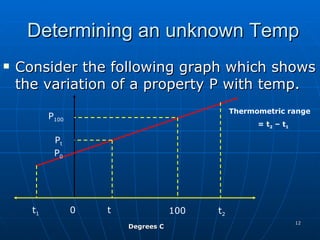
   Consider the following graph which shows
    the variation of a property P with temp.
                                                 Thermometric range
           P100
                                                       = t2 – t1

            Pt
            P0


      t1          0   t               100   t2
                                                                   12
                          Degrees C
Determining an unknown Temp
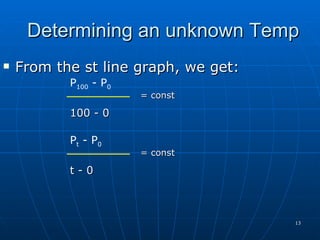
   From the st line graph, we get:
           P100 - P0
                       = const

           100 - 0

           Pt - P0
                       = const

           t-0


                                      13
Determining an unknown Temp

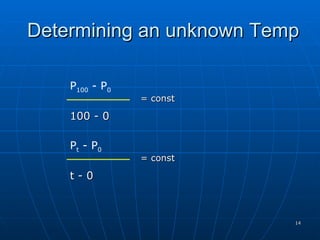
    P100 - P0
                = const

    100 - 0

    Pt - P0
                = const

    t-0


                          14
Determining an unknown Temp
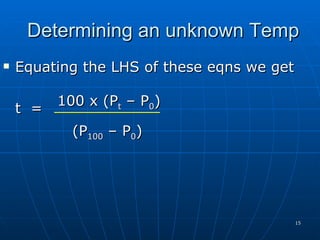
   Equating the LHS of these eqns we get

          100 x (Pt – P0)
    t =
            (P100 – P0)


                                            15
Thermometric Properties
   Length varies linearly with temperature
    • Give formula
    • Used in liquid-in-glass thermometers
   Pressure varies linearly with temperature
    • Give formula
    • Used in constant volume gas thermometers
   Volume varies linearly with temperature
    • Give formula
    • Used in constant pressure gas thermometers
                                             16
Thermometric Properties
   Resistance varies linearly with temp
    • Give formula
    • Used platinum resistance thermometers


                                              17
Thermometers
   Factors to consider while choosing a thermometer
     • Accuracy
     • Sensitivity (distance between divisions on the scale)
     • Range of temps it can measure
     • Speed of response – measure rapidly varying
       temperatures
     • Sensitive part of the thermometer should be small so
       that it does not absorb much heat from the object
     • It shuld be easy to read – no complicated
       calibrations / settings

                                                        18
Platinum Wire Thermometers
   These are based on the variation of electrical resistance
    due to temperature
   Resistance of a metal wire increases with increase in
    temp.
                      Rt = R0 ( 1 + α t)
   Range of temp they can measure is from -260 C to
    1700 C
   Temp sensor or material is a coil of fine platinum wire


                                                         19
Platinum Wire Thermometers
   Advantages of platinum resistance thermometers:
    • High accuracy
    • L ow drift
    • Wide operating range


   Disadvantages of Platinum Thermometers
    • Not very sensitive to small changes in temp
    • Slow response time


                                                      20
Thermistor
   A thermistor is a type of resistor whose resisatnce
    changes with temperature
   Therm (heat / temp) + Resistor = Thermistor
   Semiconductors are used in these devices
   The electrical resistance decreases very rapidly with
    increasing temp.
   Thus, we say that thermistors have a negative temp
    coeff. of resistance (NTC)


                                                        21
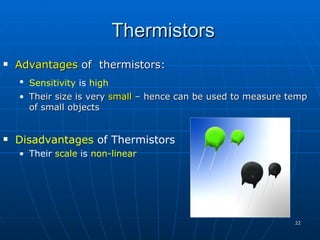
Thermistors
   Advantages of thermistors:
    • Sensitivity is high
    • Their size is very small – hence can be used to measure temp
      of small objects


   Disadvantages of Thermistors
    • Their scale is non-linear


                                                               22
Thermocouple
   This makes use of the thermoelectric effect
   Thermoelectric device - A thermoelectric device creates a
    voltage when there is a different temperature on each side
   When the junctions of two different conductors, such as copper
    and constantan wire are at different temperatures, an emf
    (voltage) is developed.
   The relation between emf and temp diff is not linear.
   The emf generated is small – typically about 5 mV for a temp diff
    of 100 C
   Advantages:
    • Can be used to measure rapidly changing temps.
    • Can be used to measure temp of small objects

                                                                 23

Thermometers

  • 1.
    Temperature A2 Level Physics MukeshN. Tekwani mukeshtekwani@hotmail.com
  • 2.
    Thermodynamics  A branch of physics in which thermal effects are studied using macroscopic quantities.  Macroscopic quantities are: • Pressure • Temperature • Volume • Internal energy 2
  • 3.
    Kinetic Theory  Kinetic theory is also concerned with thermal effects.  But here we assume the existence of atoms and molecules.  The laws of mechanics and statistics are applied to a large number of these molecules.  Microscopic level 3
  • 4.
    Thermal Equilibrium  If a body (X) at a higher temperature is in contact with a body (Y) at a lower temperature, then X will transfer heat energy to the lower temp object (Y)  This process will continue till the objects attain the same temperature.  The temp of both objects will become same.  This thermal state in which both bodies are at the same temp is called thermal equilibrium. 4
  • 5.
    Using Physical Propertiesto Measure Temperature  Many physical properties change with temperature • Change in volume (e.g. expansion of a liquid) • Change in length of a mercury column • Change in resistance of a wire • Change in pressure of a gas at constant volume  All these properties can be used in different types of thermometers  A thermometer is an instrument for measurement of temperature. 5
  • 6.
    Imp Definitions  The physical property on which a particular thermometer is based is called the thermometric property.  Thermometric substance is the material used in the thermometer, whose property varies with temperature  Thermometric property should vary linearly with temp over a reasonable range of temp  The range of linearity of the thermometric property is called the thermometric range.  E.g., mercury is a thermometric substance 6
  • 7.
    Temperature Scales  Each type of thermometer can be used to establish its own temp scale.  How is this done? • Every substance changes state at a fixed temperature. E.g., solid-to-liquid OR liquid- to-gas • These fixed temperatures can be used to define reference temperatures. These reference temperatures are called fixed points. 7
  • 8.
    Temperature Scales  We take the value of the thermometric property at the two fixed points and divide the range into a number of EQUAL steps or degrees.  This way we set up an “empirical scale” of thermometer.  Empirical => ‘derived from experiment’ 8
  • 9.
    Temperature Scales  E.g., suppose we consider the fixed points as the melting point of ice (00) and boiling point of water (1000)  Divide the range from 0 to 100 into 100 equal degrees. This gives the empirical scale of temperature for that thermometer. 9
  • 10.
    Disagreement between Thermometers  The choice of thermometric susbstance and thermometric property and the assumed relation between the property and temperature leads to an individual temp scale.  Measurements made with such a thermometer may not agree with measurements made by any other temp scale 10
  • 11.
    Disagreement between Thermometers  This disagreement is removed by the following: • Using a particular thermometric substance • Using a particular thermometric property • A particular relation between that property and the temp scale. E.g., a linear relation between length of a mercury column and temp 11
  • 12.
    Determining an unknownTemp  Consider the following graph which shows the variation of a property P with temp. Thermometric range P100 = t2 – t1 Pt P0 t1 0 t 100 t2 12 Degrees C
  • 13.
    Determining an unknownTemp  From the st line graph, we get: P100 - P0 = const 100 - 0 Pt - P0 = const t-0 13
  • 14.
    Determining an unknownTemp P100 - P0 = const 100 - 0 Pt - P0 = const t-0 14
  • 15.
    Determining an unknownTemp  Equating the LHS of these eqns we get 100 x (Pt – P0) t = (P100 – P0) 15
  • 16.
    Thermometric Properties  Length varies linearly with temperature • Give formula • Used in liquid-in-glass thermometers  Pressure varies linearly with temperature • Give formula • Used in constant volume gas thermometers  Volume varies linearly with temperature • Give formula • Used in constant pressure gas thermometers 16
  • 17.
    Thermometric Properties  Resistance varies linearly with temp • Give formula • Used platinum resistance thermometers 17
  • 18.
    Thermometers  Factors to consider while choosing a thermometer • Accuracy • Sensitivity (distance between divisions on the scale) • Range of temps it can measure • Speed of response – measure rapidly varying temperatures • Sensitive part of the thermometer should be small so that it does not absorb much heat from the object • It shuld be easy to read – no complicated calibrations / settings 18
  • 19.
    Platinum Wire Thermometers  These are based on the variation of electrical resistance due to temperature  Resistance of a metal wire increases with increase in temp. Rt = R0 ( 1 + α t)  Range of temp they can measure is from -260 C to 1700 C  Temp sensor or material is a coil of fine platinum wire 19
  • 20.
    Platinum Wire Thermometers  Advantages of platinum resistance thermometers: • High accuracy • L ow drift • Wide operating range  Disadvantages of Platinum Thermometers • Not very sensitive to small changes in temp • Slow response time 20
  • 21.
    Thermistor  A thermistor is a type of resistor whose resisatnce changes with temperature  Therm (heat / temp) + Resistor = Thermistor  Semiconductors are used in these devices  The electrical resistance decreases very rapidly with increasing temp.  Thus, we say that thermistors have a negative temp coeff. of resistance (NTC) 21
  • 22.
    Thermistors  Advantages of thermistors: • Sensitivity is high • Their size is very small – hence can be used to measure temp of small objects  Disadvantages of Thermistors • Their scale is non-linear 22
  • 23.
    Thermocouple  This makes use of the thermoelectric effect  Thermoelectric device - A thermoelectric device creates a voltage when there is a different temperature on each side  When the junctions of two different conductors, such as copper and constantan wire are at different temperatures, an emf (voltage) is developed.  The relation between emf and temp diff is not linear.  The emf generated is small – typically about 5 mV for a temp diff of 100 C  Advantages: • Can be used to measure rapidly changing temps. • Can be used to measure temp of small objects 23