MECHANICAL TEMPERATURE
MEASURING DEVICES
PRINCIPLES OF OERATION AND
PROPERTIES
2/3/2015Mechanical Temprature Mesurement
1
Temperature Measurement
• Temperature measurement in today’s industrial
environment has a wide variety of needs and applications.
• It is a very critical and widely measured variable for most
mechanical engineers.
• The industry has developed a large number of sensors and
devices to handle this demand.
2/3/2015Mechanical Temprature Mesurement
2
Types of Temperature Measurement
• Temperature can be measured in a diverse array of
sensors.
• All of them infer temperature by sensing some change in
physical characteristic.
• Four basic types of temperature measurement include:
1) Mechanical
2) Thermojunctive
3) Thermoresistive
4) Radiative
2/3/2015Mechanical Temprature Mesurement
3
Mechanical Temperature measurement
• In the absence of electronics, early temperature sensors
were based on the mechanical effects of temperature.
• While the mechanical temperature sensing technologies
are decades or centuries old, they are still in widespread
use.
• They meet the needs of many common applications in a
reliable and cost-effective manner.
2/3/2015Mechanical Temprature Mesurement
4
Principle of operation
• A change in temperature causes some kind of mechanical
motion, typically due to the fact that most materials
expand with a rise in temperature.
• Mechanical thermometers can be constructed that use
liquids, solids, or even gases as the temperature-sensitive
material.
• The mechanical motion is read on a physical scale to infer
the temperature.
2/3/2015Mechanical Temprature Mesurement
5
Mechanical temperature measuring devices
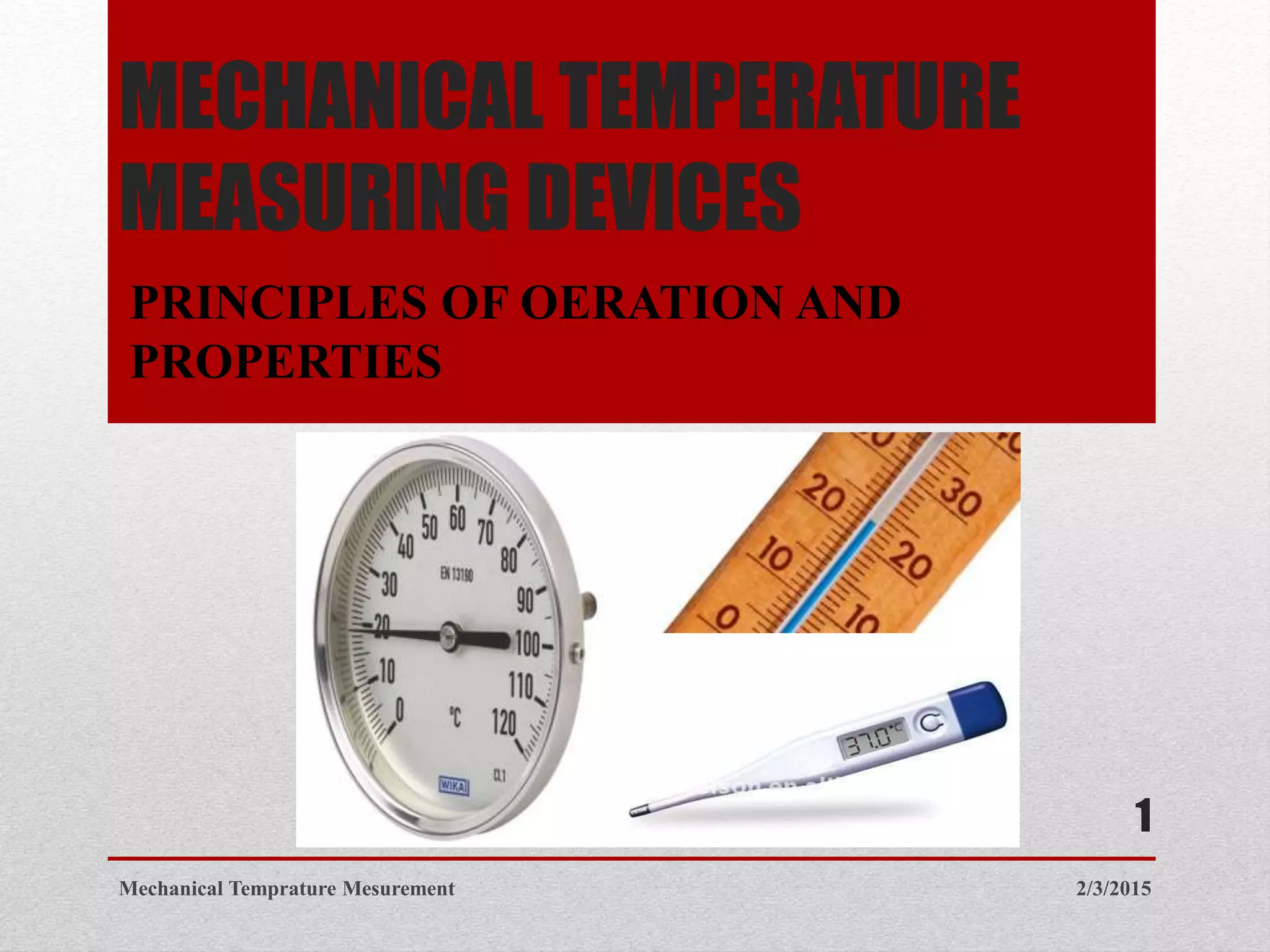
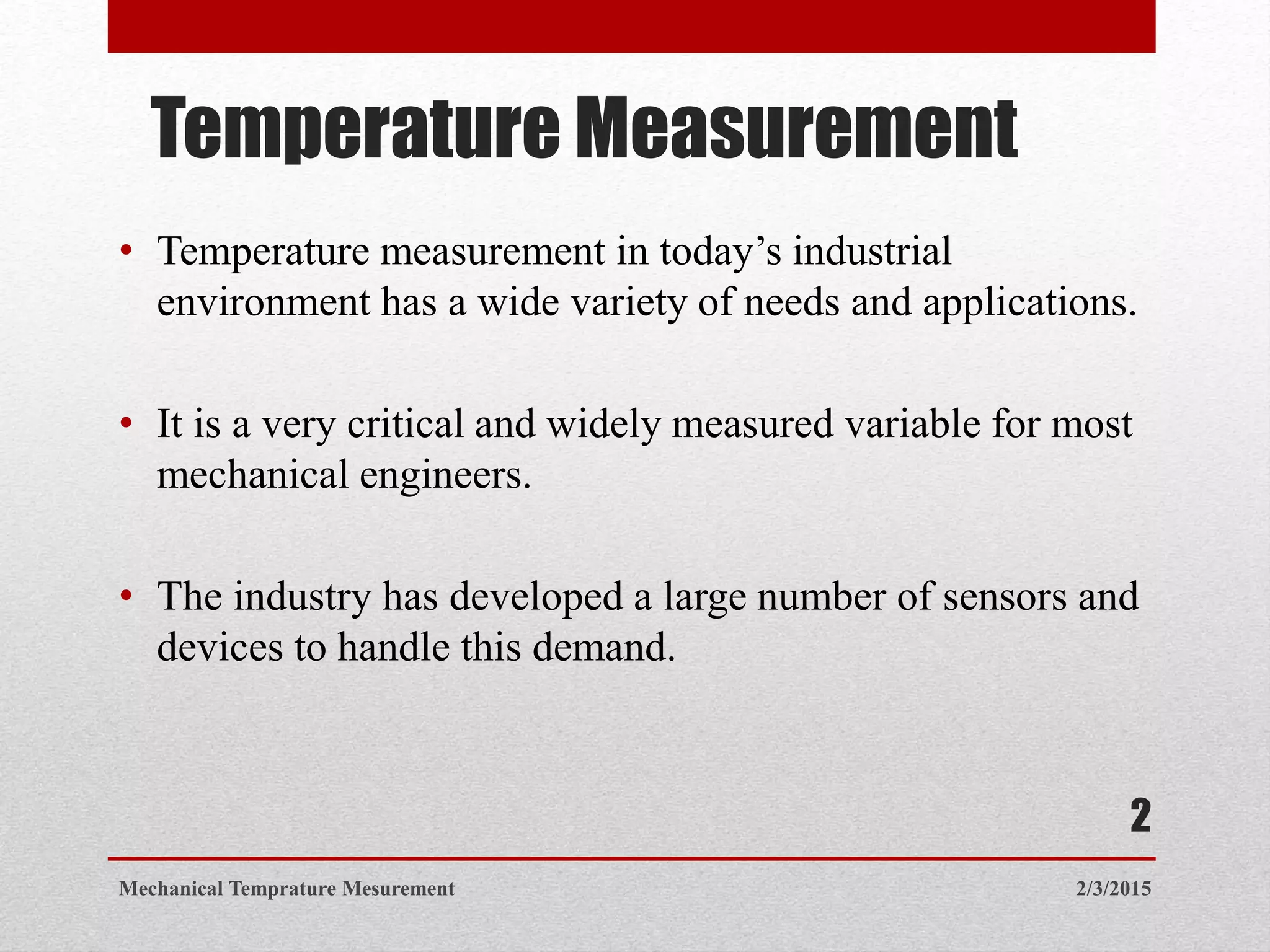
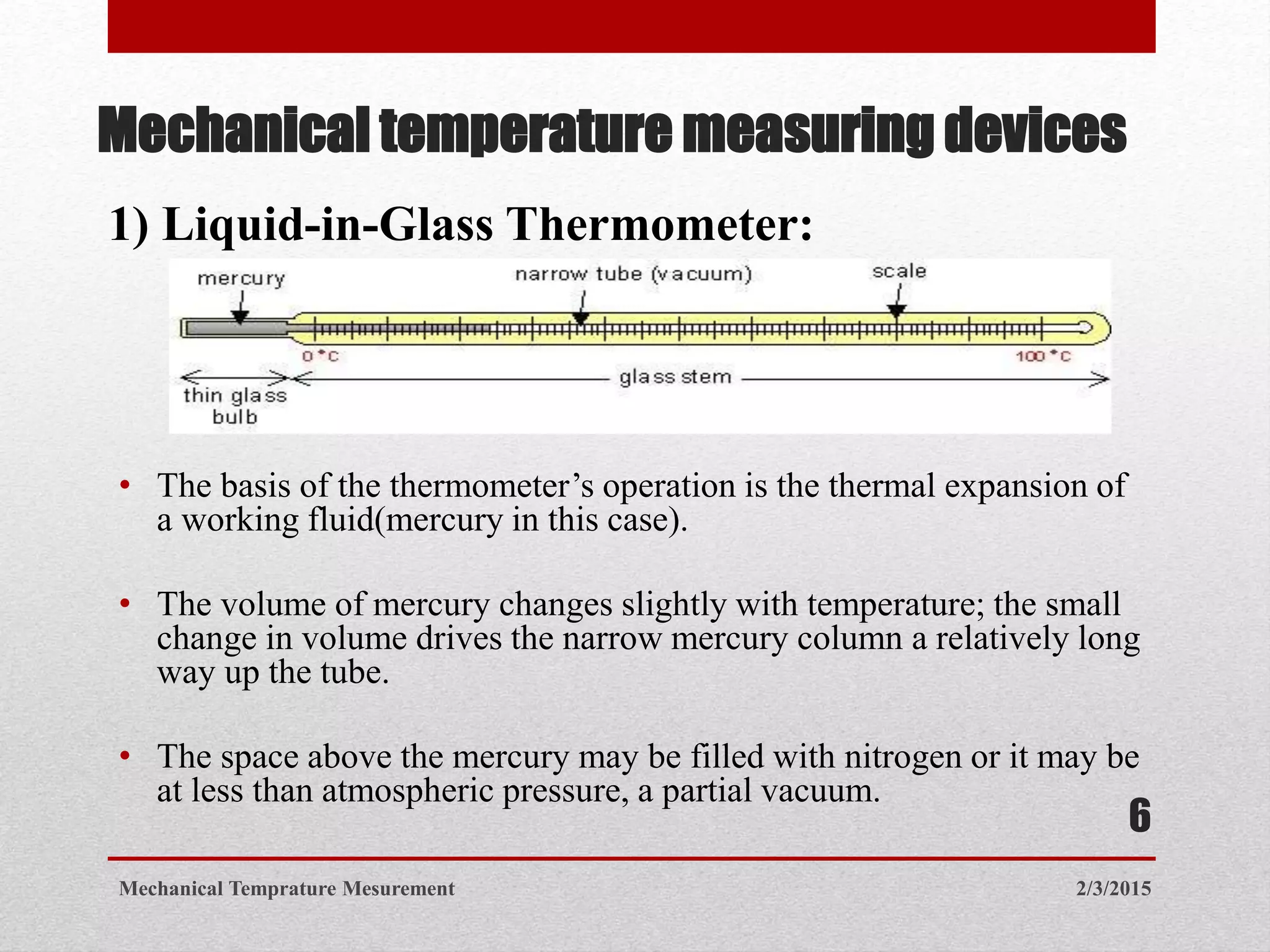
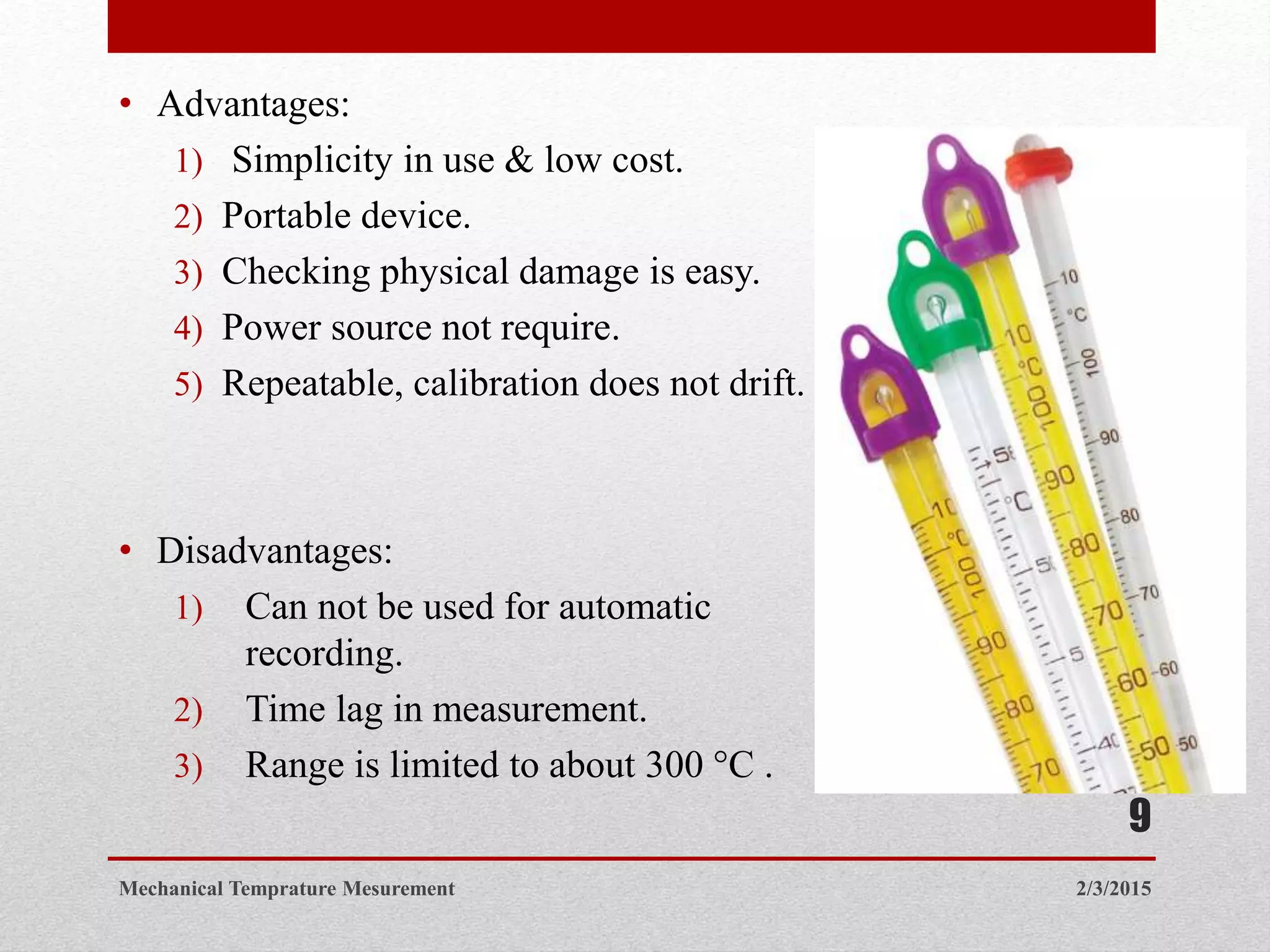
• The basis of the thermometer’s operation is the thermal expansion of
a working fluid(mercury in this case).
• The volume of mercury changes slightly with temperature; the small
change in volume drives the narrow mercury column a relatively long
way up the tube.
• The space above the mercury may be filled with nitrogen or it may be
at less than atmospheric pressure, a partial vacuum.
1) Liquid-in-Glass Thermometer:
2/3/2015Mechanical Temprature Mesurement
6
• The scale is calibrated to read temperature directly.
• The range of a thermometer and it reading accuracy is
dependent on the size of the hole, the length of the tube
and the fluid in the thermometer.
• Typically the smaller the reading increment, the less
range it will have.
• The accuracy of a thermometer is greatly dependent on
the manufacturing process, but also can be affected by
usage.
2/3/2015Mechanical Temprature Mesurement
7
Applications:
• Aircrafts use thermometers and hygrometers to determine
if atmospheric icing conditions exist along their flight path.
• They are also applied in meteorological and oceanographic
applications. These measurements are used to
initialize weather forecast models.
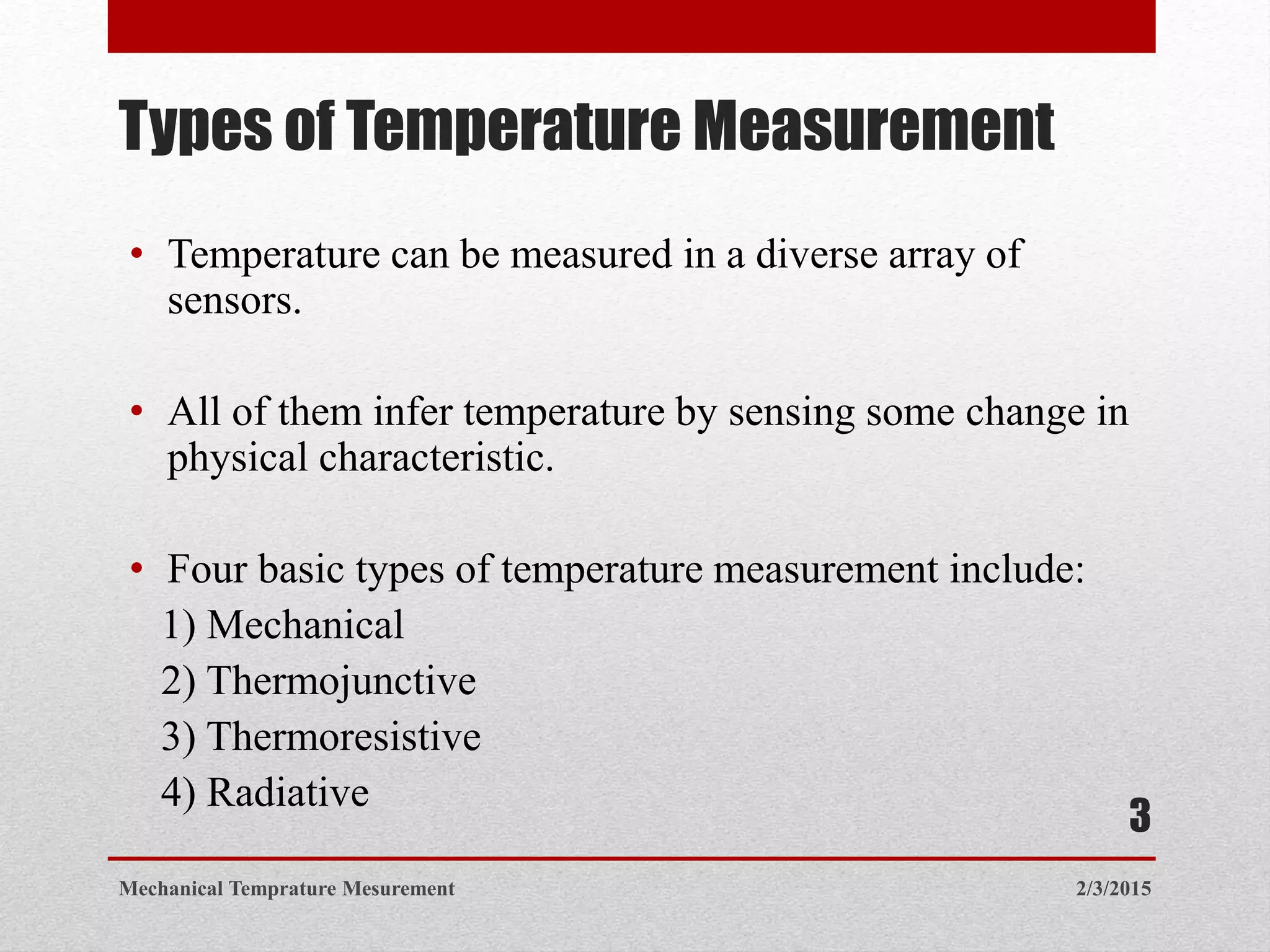
• Used in household, hospitals, etc., for body temperature
measurement.
• They are also used in indoor climate control systems.
2/3/2015Mechanical Temprature Mesurement
8
• Advantages:
1) Simplicity in use & low cost.
2) Portable device.
3) Checking physical damage is easy.
4) Power source not require.
5) Repeatable, calibration does not drift.
• Disadvantages:
1) Can not be used for automatic
recording.
2) Time lag in measurement.
3) Range is limited to about 300 °C .
2/3/2015Mechanical Temprature Mesurement
9
2) Pressure thermometer:
• A pressure thermometer operates by the expansion of a
gas or a liquid.
• Its types are:
1) Liquid Pressure Thermometer
2) Vapour Pressure Thermometer
• A pressure thermometer measures temperature indirectly
by measuring pressure.
• The gauge is a pressure gauge, but is typically calibrated
in units of temperature instead.
2/3/2015Mechanical Temprature Mesurement
10
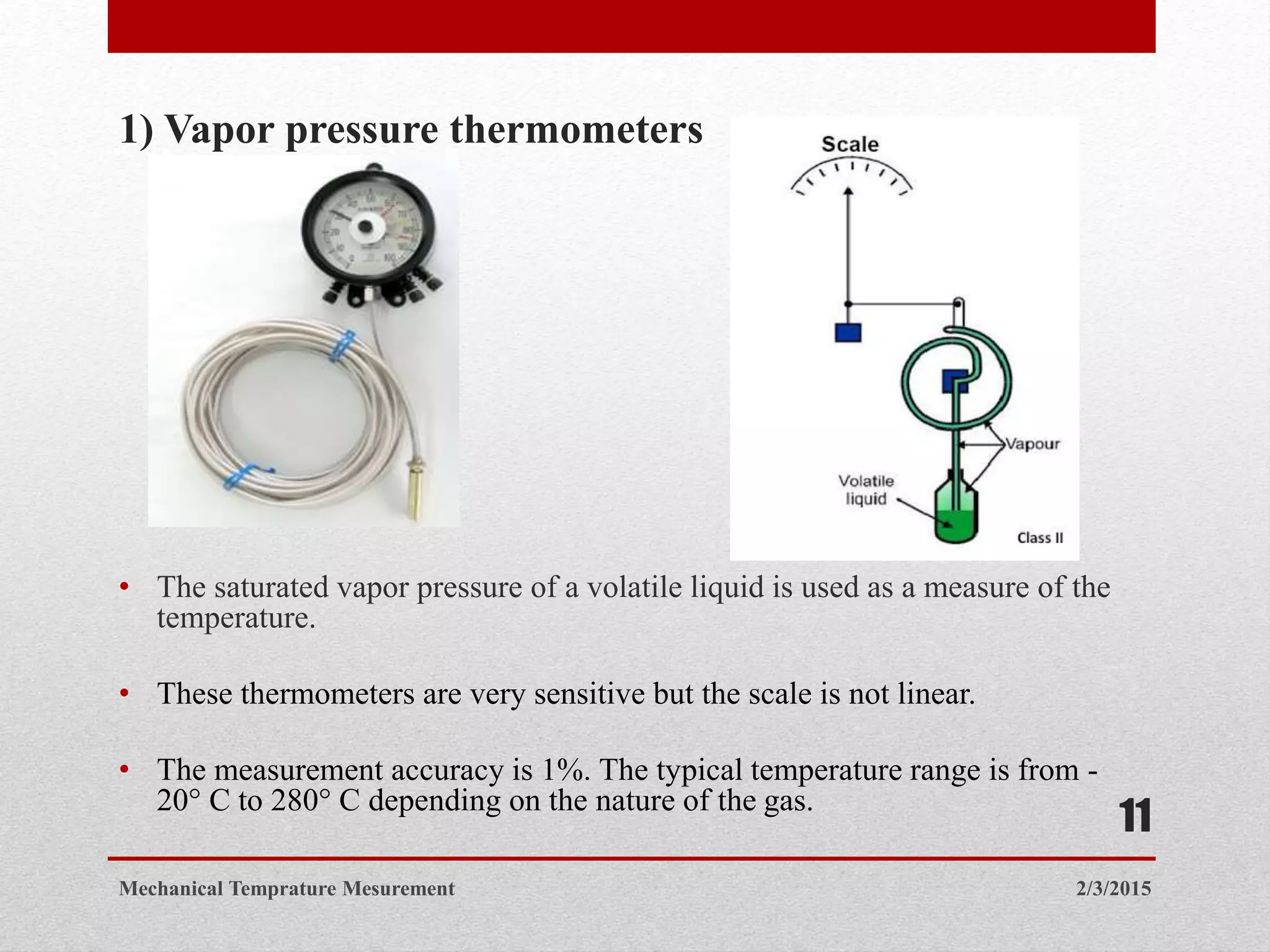
1) Vapor pressure thermometers
• The saturated vapor pressure of a volatile liquid is used as a measure of the
temperature.
• These thermometers are very sensitive but the scale is not linear.
• The measurement accuracy is 1%. The typical temperature range is from -
20° C to 280° C depending on the nature of the gas.
2/3/2015Mechanical Temprature Mesurement
11
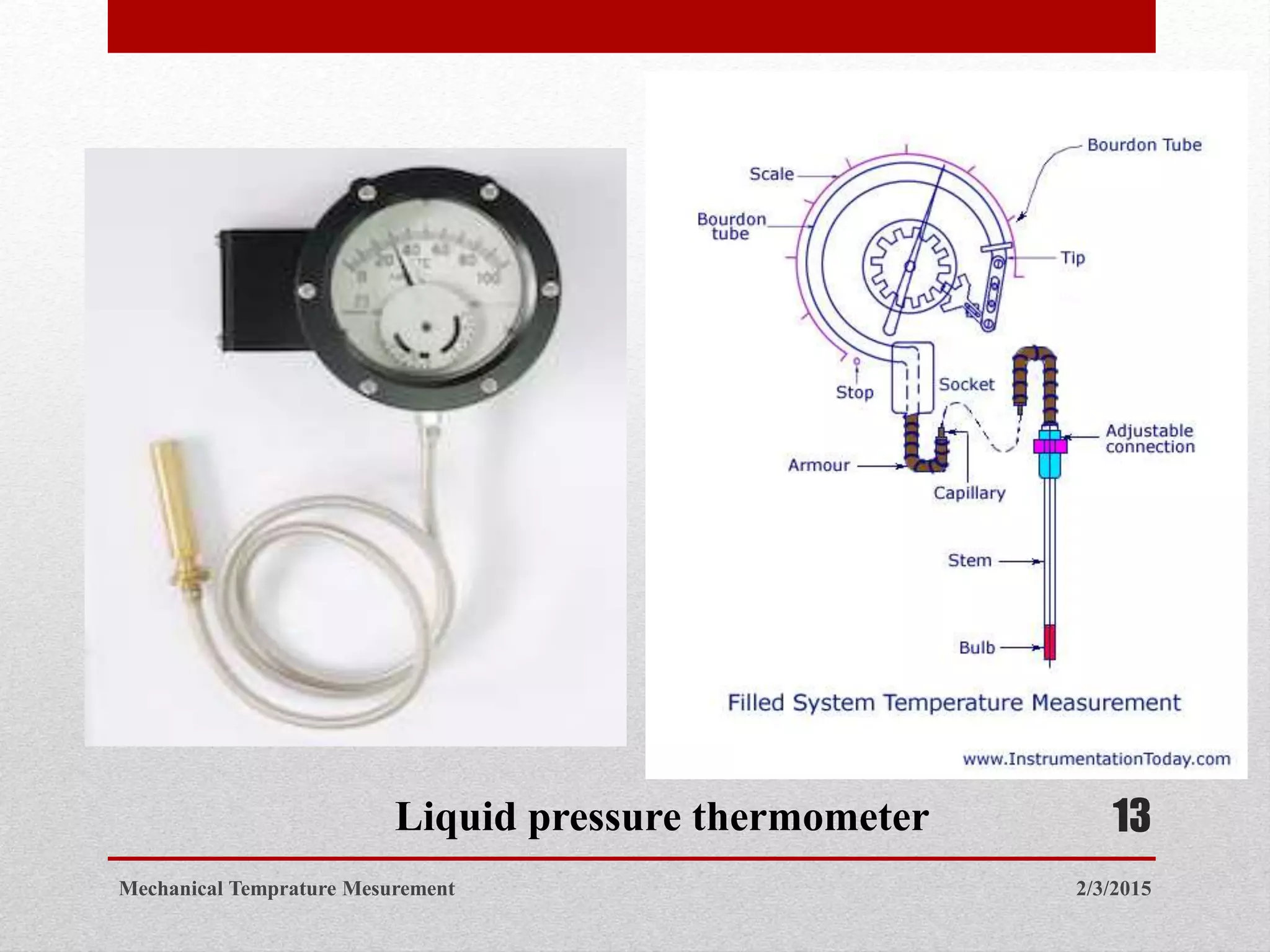
2) Liquid pressure thermometer:
• It’s a temperature measuring device whose operation is based on
thermal expansion of a liquid.
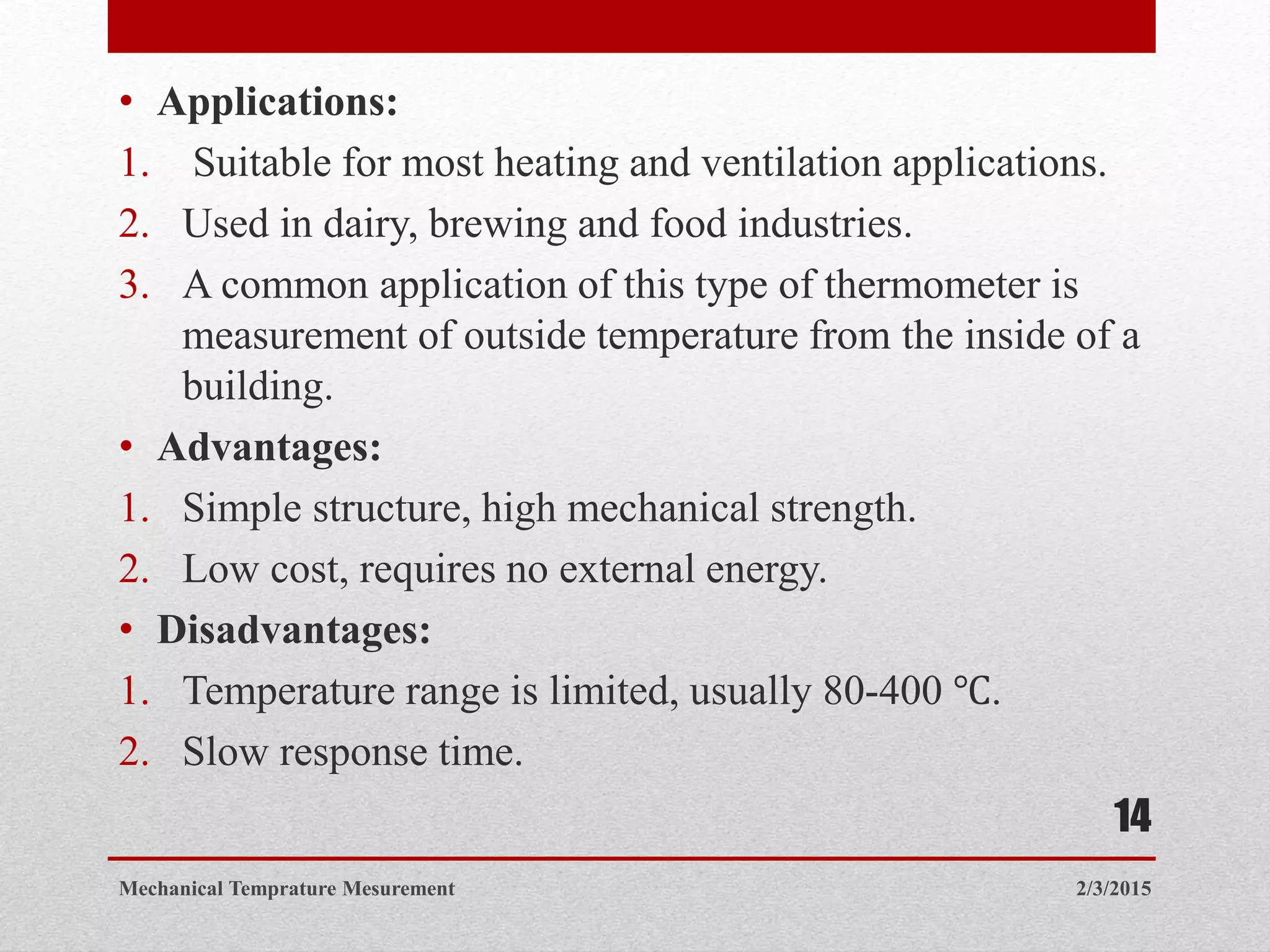
• The insides of the thermo-sensor cylinder, capillary, and Bourdon tube
are filled with liquid which changes volume with varying temperature.
• The liquid in the thermo-sensor cylinder is expanded and contracted as
the temperature changes, and the pressure change in the Bourdon tube
that is transmitted through the capillary is indicated as a temperature.
• Liquid filled thermometers have scales
with divisions from 10° to 0.01°C.
• The measurement accuracy depends on the depth of immersion of the
thermometer in the medium to be measured.
2/3/2015Mechanical Temprature Mesurement
12
Liquid pressure thermometer
2/3/2015Mechanical Temprature Mesurement
13
• Applications:
1. Suitable for most heating and ventilation applications.
2. Used in dairy, brewing and food industries.
3. A common application of this type of thermometer is
measurement of outside temperature from the inside of a
building.
• Advantages:
1. Simple structure, high mechanical strength.
2. Low cost, requires no external energy.
• Disadvantages:
1. Temperature range is limited, usually 80-400 ℃.
2. Slow response time.
2/3/2015Mechanical Temprature Mesurement
14
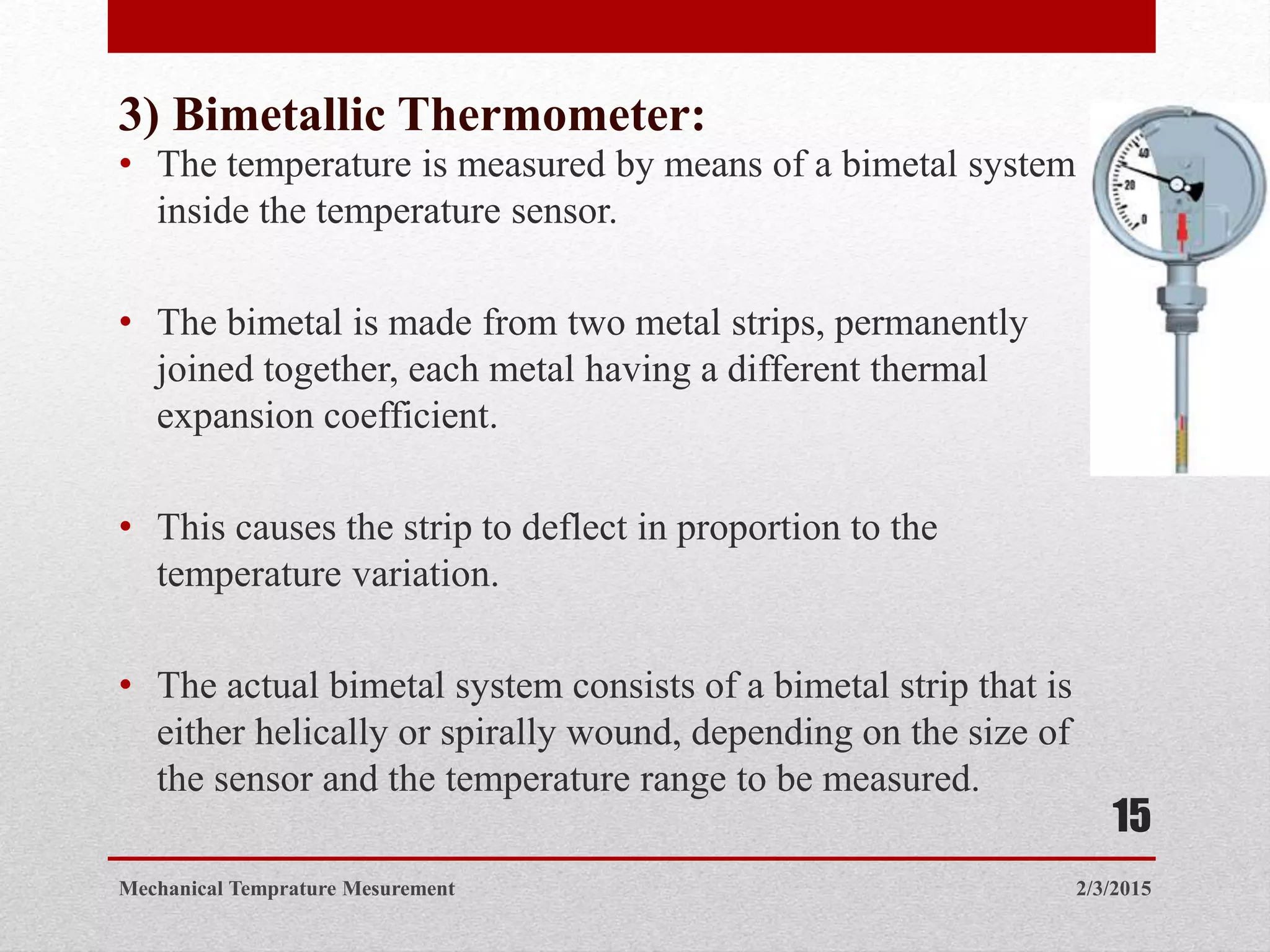
3) Bimetallic Thermometer:
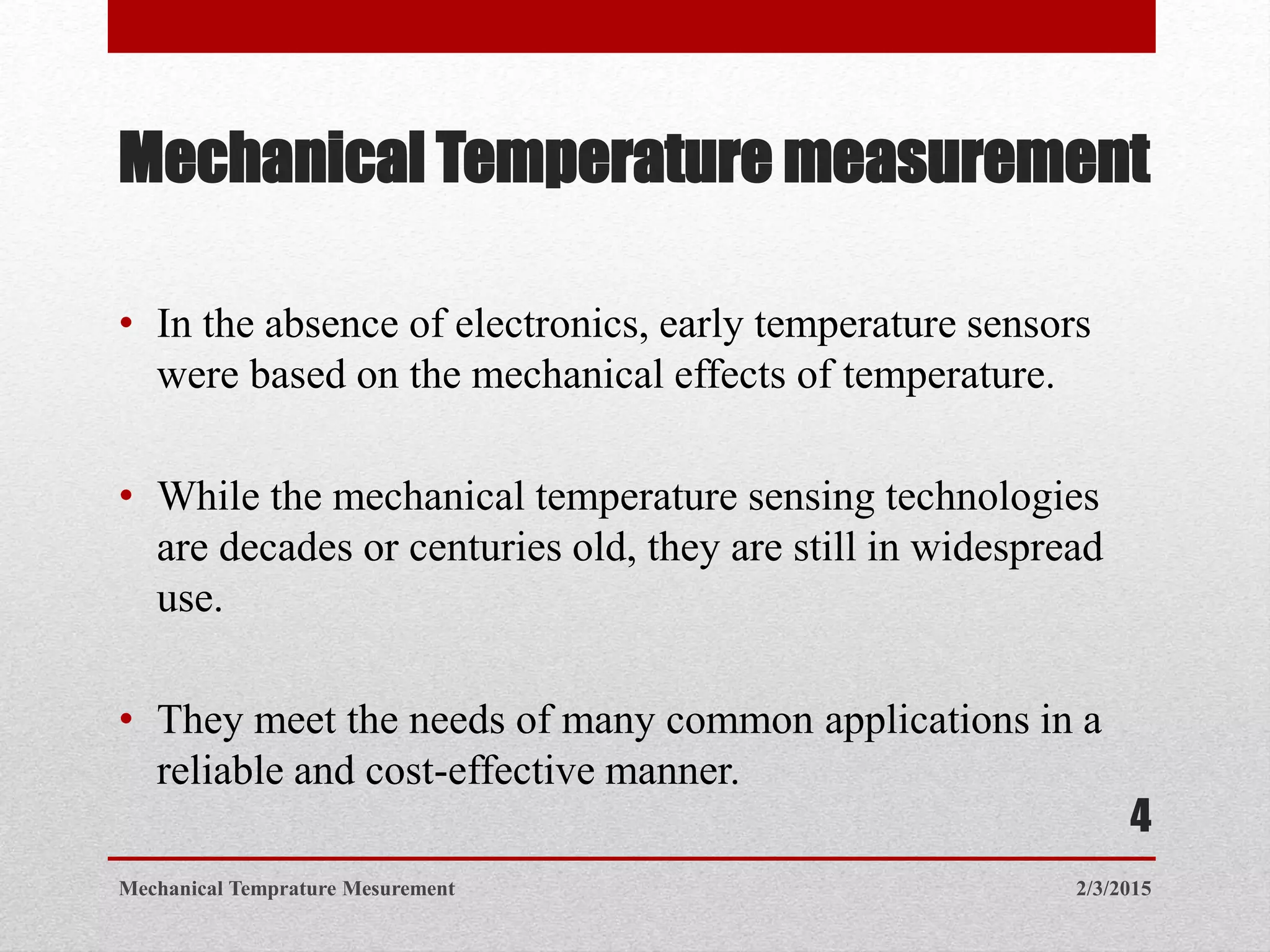
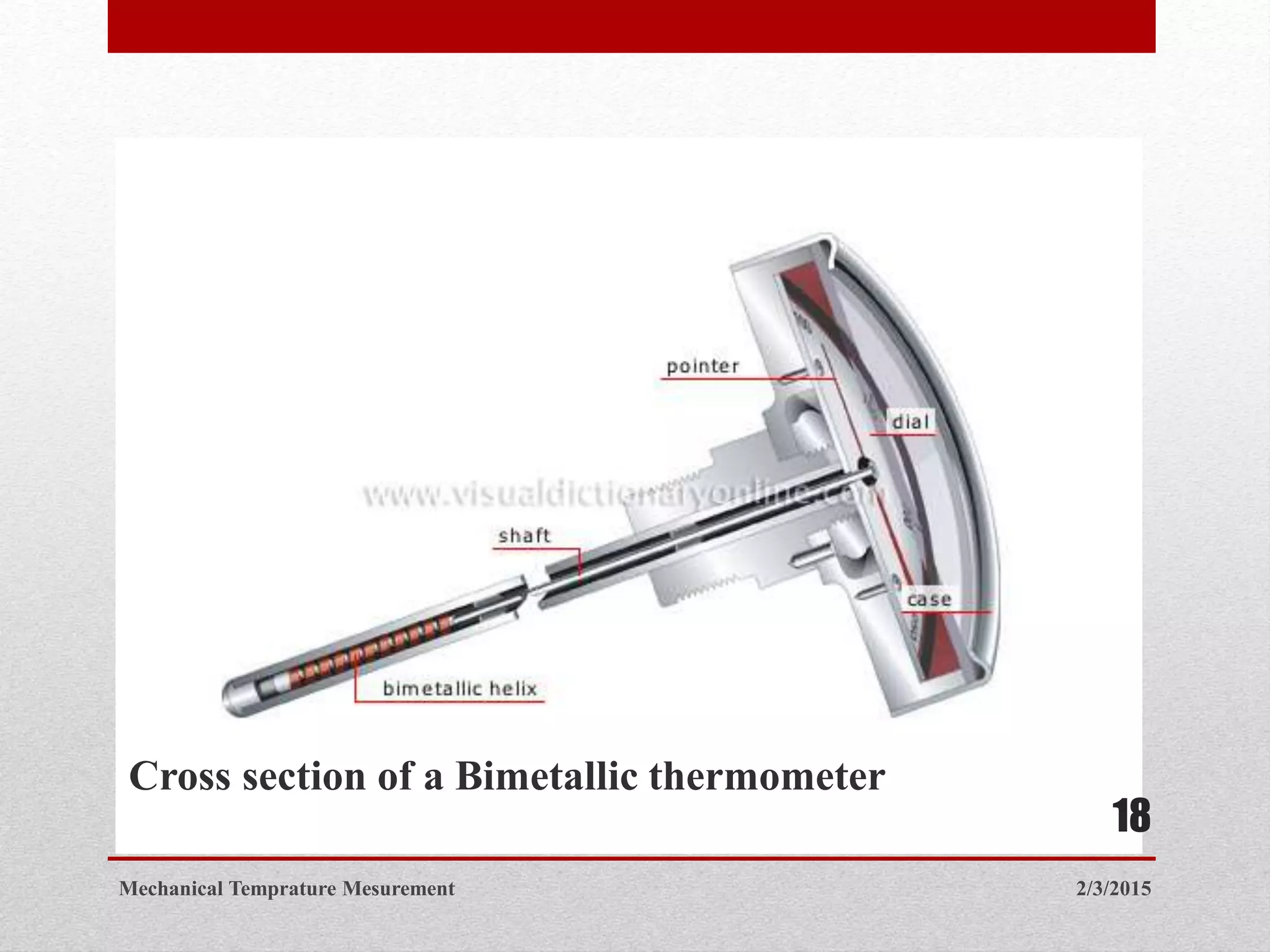
• The temperature is measured by means of a bimetal system
inside the temperature sensor.
• The bimetal is made from two metal strips, permanently
joined together, each metal having a different thermal
expansion coefficient.
• This causes the strip to deflect in proportion to the
temperature variation.
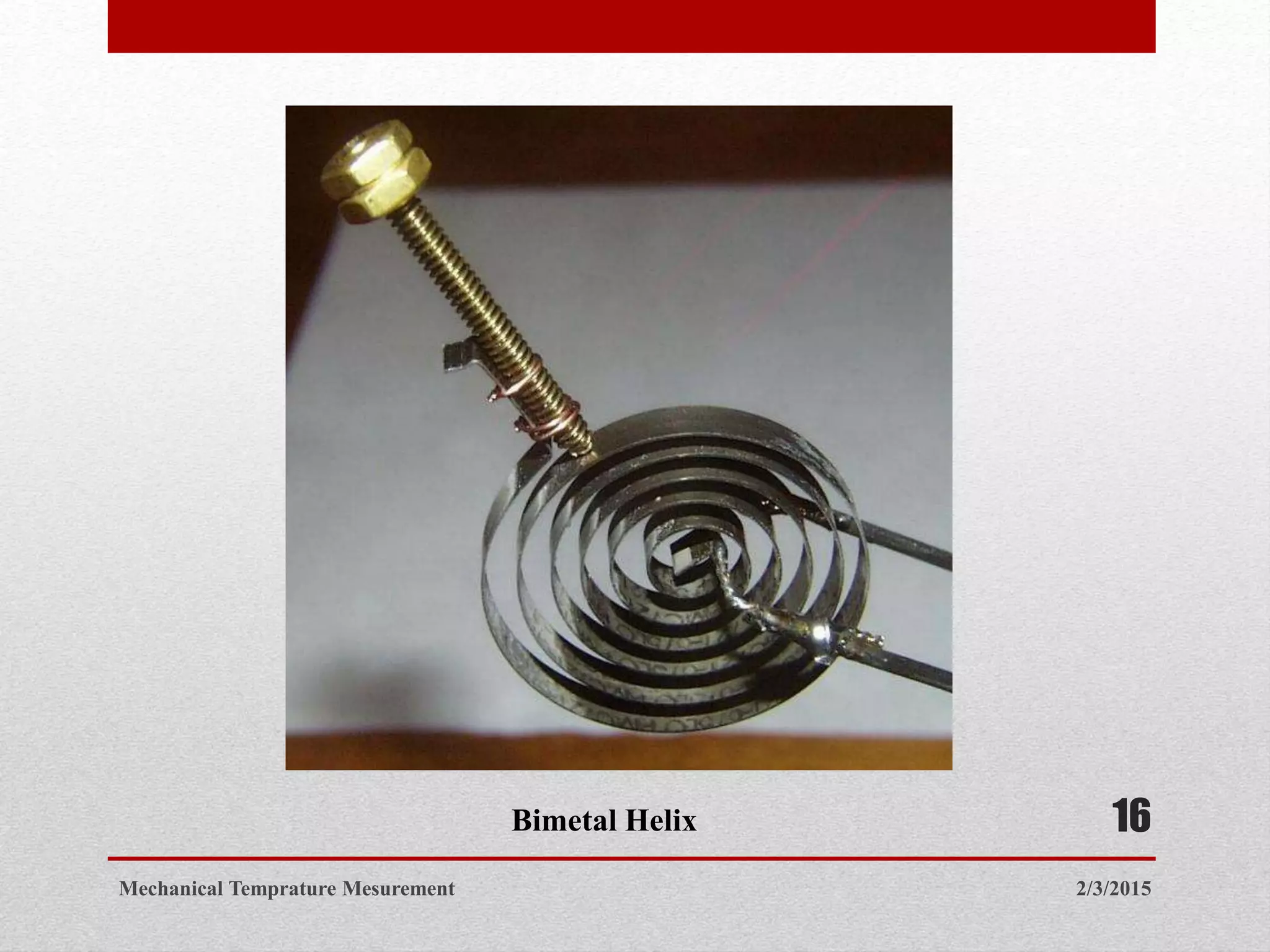
• The actual bimetal system consists of a bimetal strip that is
either helically or spirally wound, depending on the size of
the sensor and the temperature range to be measured.
2/3/2015Mechanical Temprature Mesurement
15
2/3/2015Mechanical Temprature Mesurement
16Bimetal Helix
• Any temperature variation causes the bimetal to rotate an attached
spindle and it is indicated by a pointer on a dial.
• Bimetal thermometers are available for temperature ranges from -70
to +600 °C
• Ranges as high as 1000° F are possible, however ranges around the
500° F value are more common.
Dial
2/3/2015Mechanical Temprature Mesurement
17
Cross section of a Bimetallic thermometer
2/3/2015Mechanical Temprature Mesurement
18
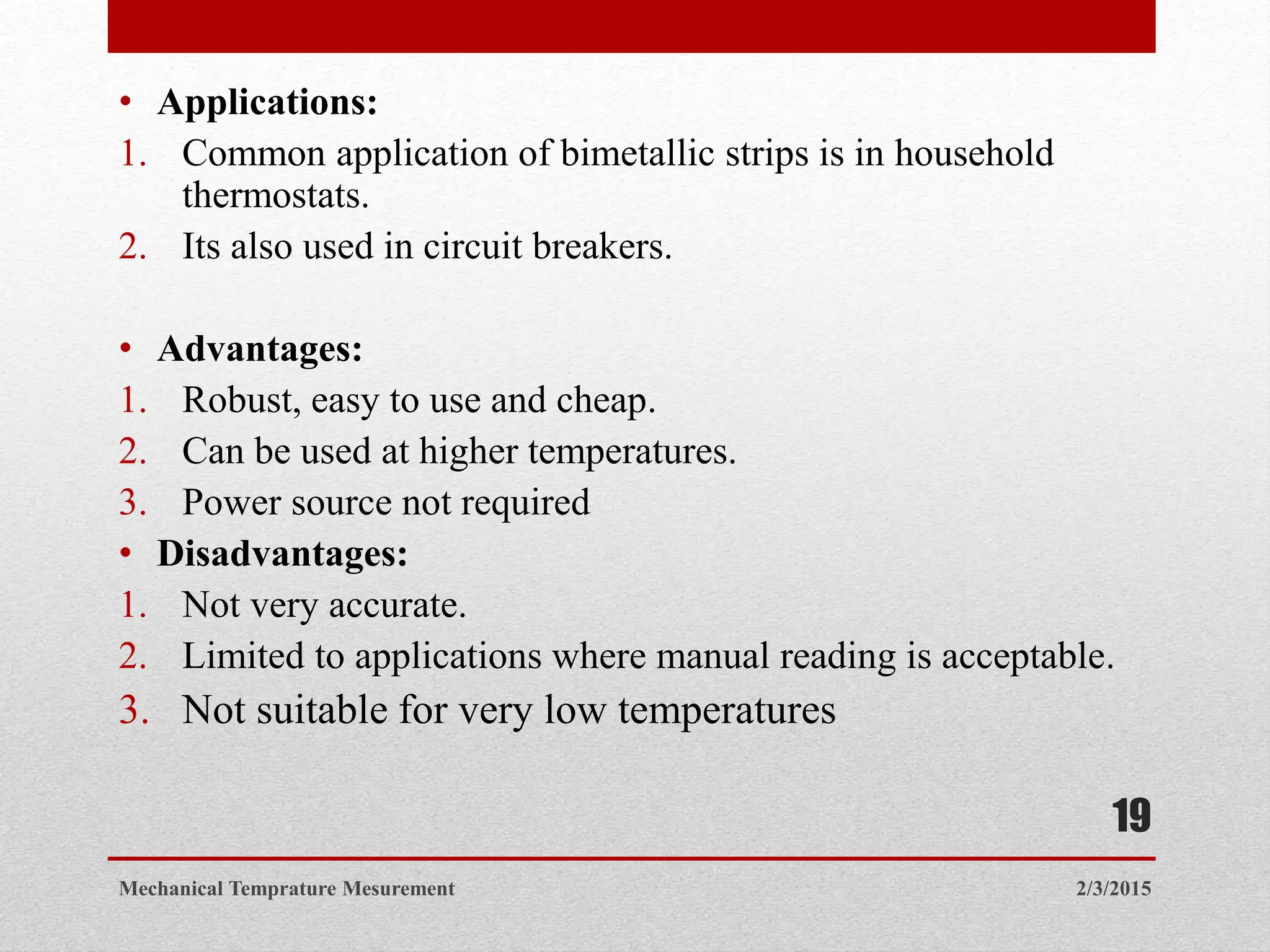
• Applications:
1. Common application of bimetallic strips is in household
thermostats.
2. Its also used in circuit breakers.
• Advantages:
1. Robust, easy to use and cheap.
2. Can be used at higher temperatures.
3. Power source not required
• Disadvantages:
1. Not very accurate.
2. Limited to applications where manual reading is acceptable.
3. Not suitable for very low temperatures
2/3/2015Mechanical Temprature Mesurement
19
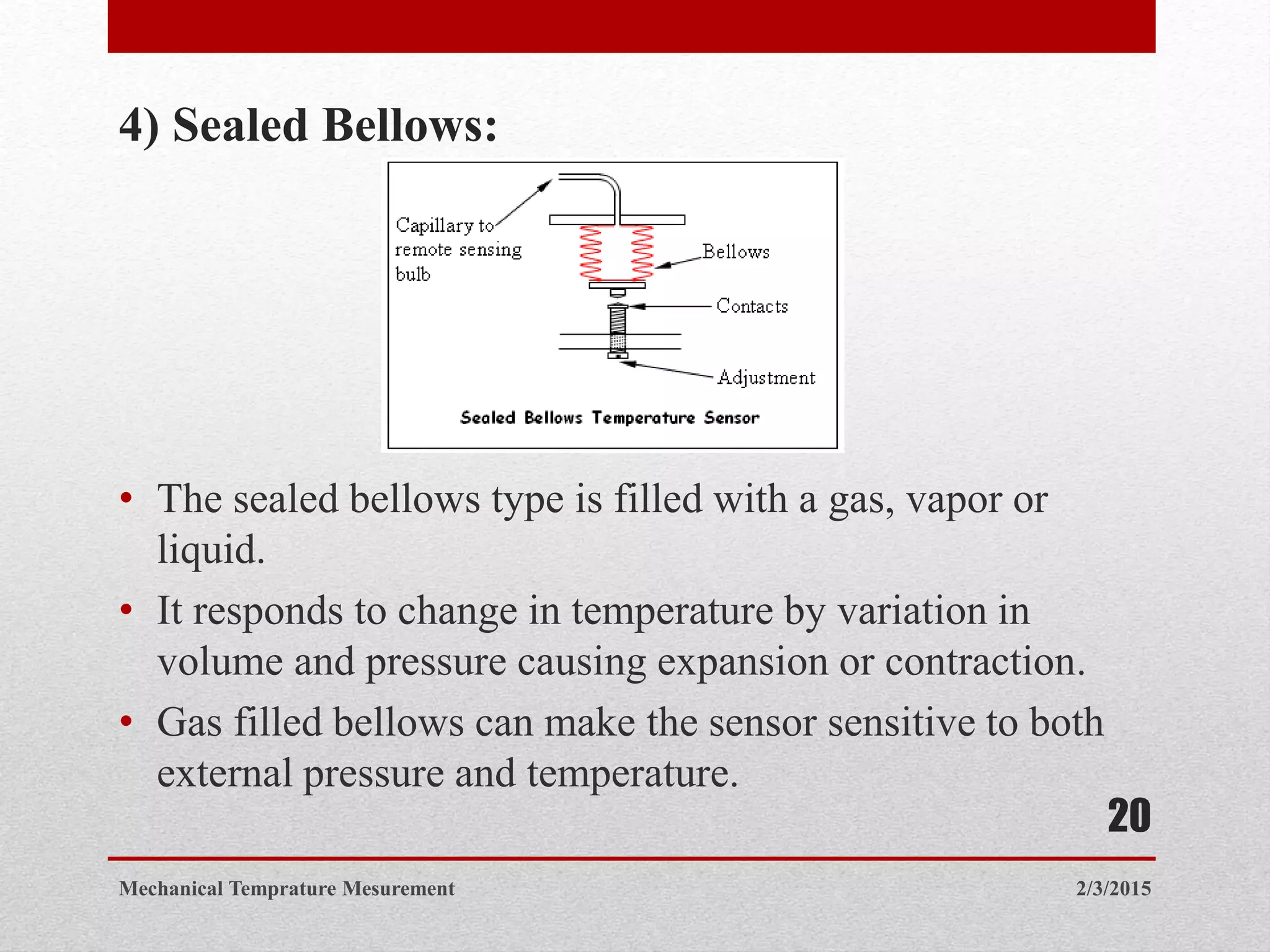
4) Sealed Bellows:
• The sealed bellows type is filled with a gas, vapor or
liquid.
• It responds to change in temperature by variation in
volume and pressure causing expansion or contraction.
• Gas filled bellows can make the sensor sensitive to both
external pressure and temperature.
2/3/2015Mechanical Temprature Mesurement
20
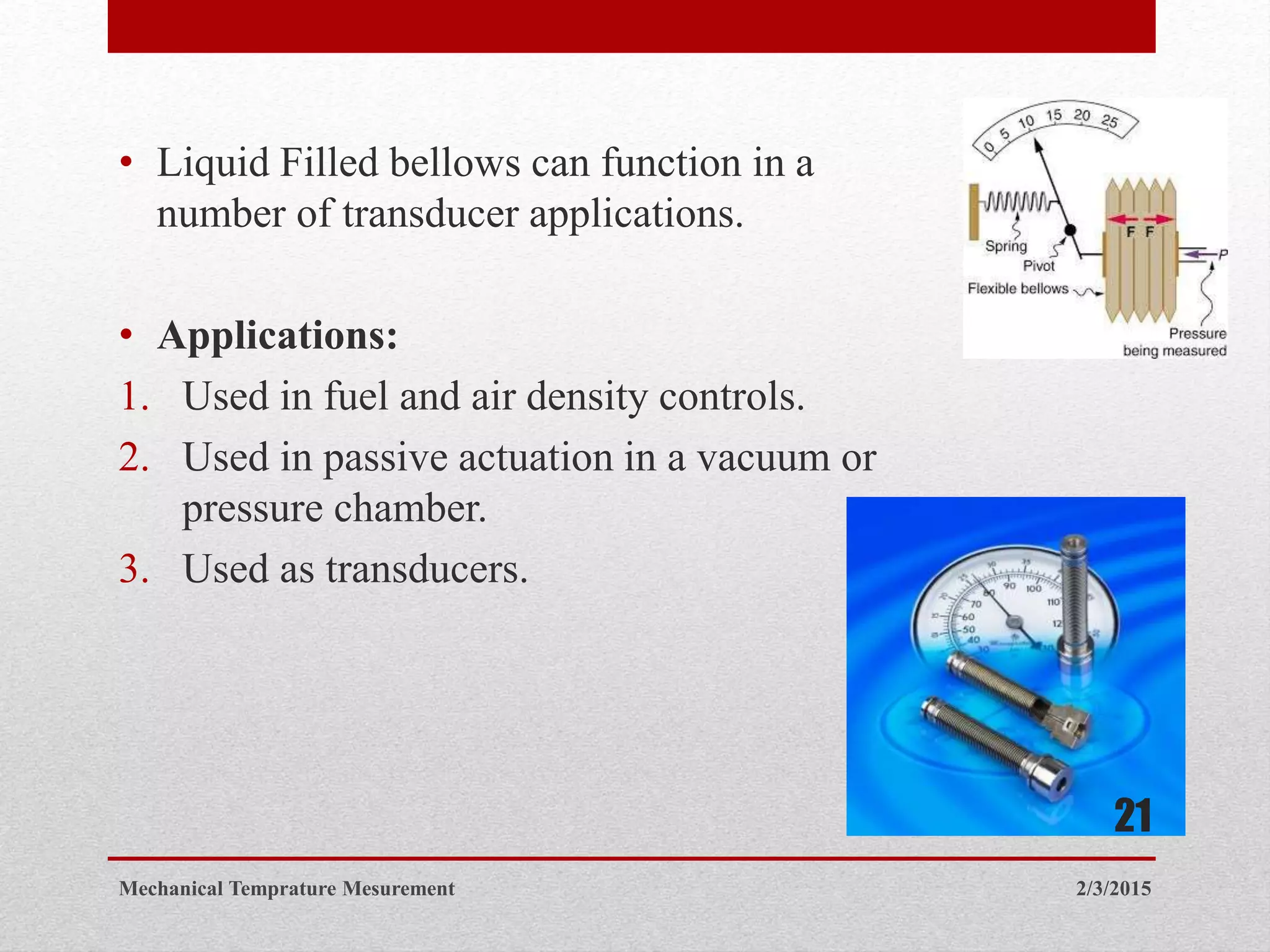
• Liquid Filled bellows can function in a
number of transducer applications.
• Applications:
1. Used in fuel and air density controls.
2. Used in passive actuation in a vacuum or
pressure chamber.
3. Used as transducers.
2/3/2015Mechanical Temprature Mesurement
21
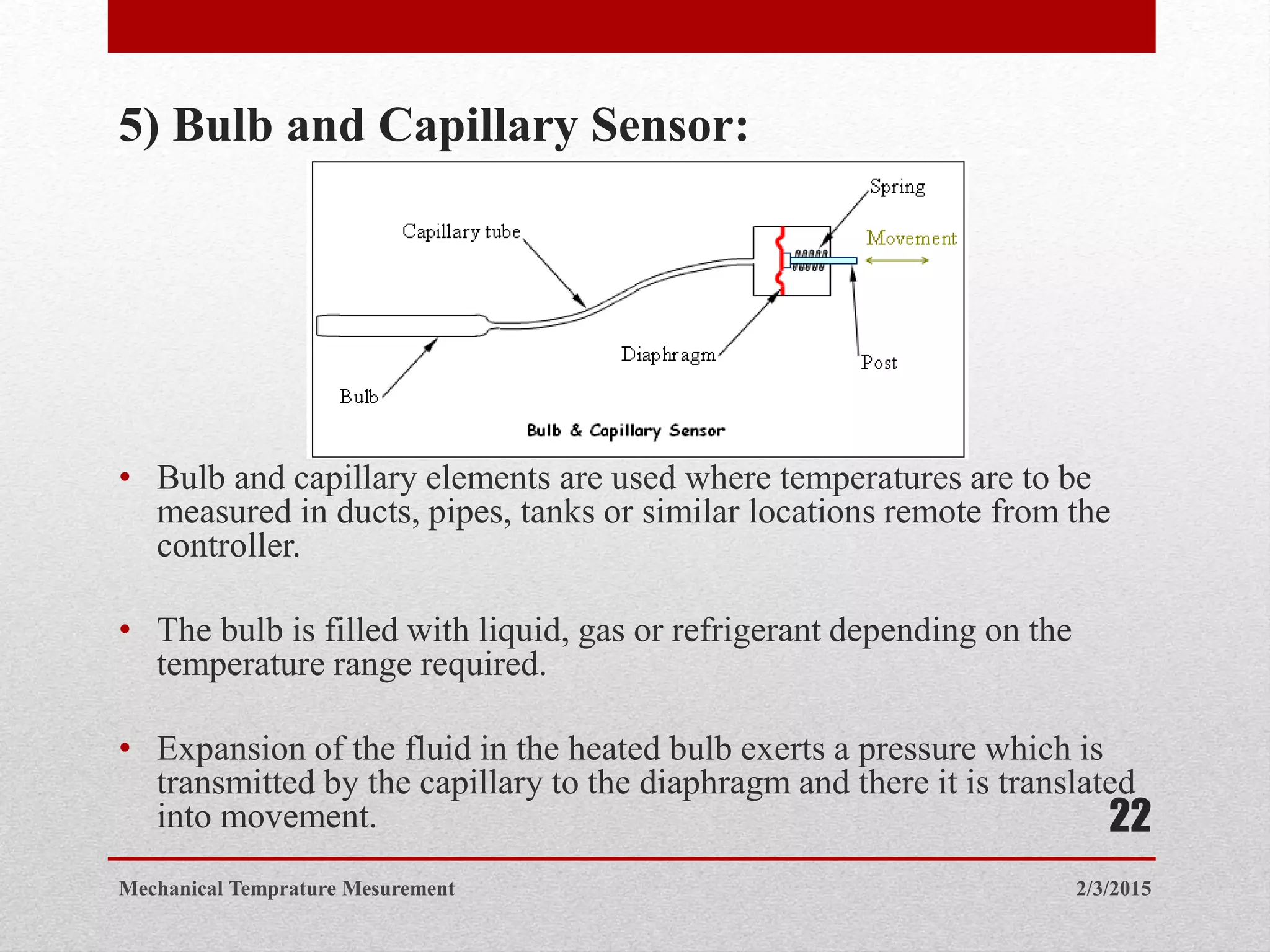
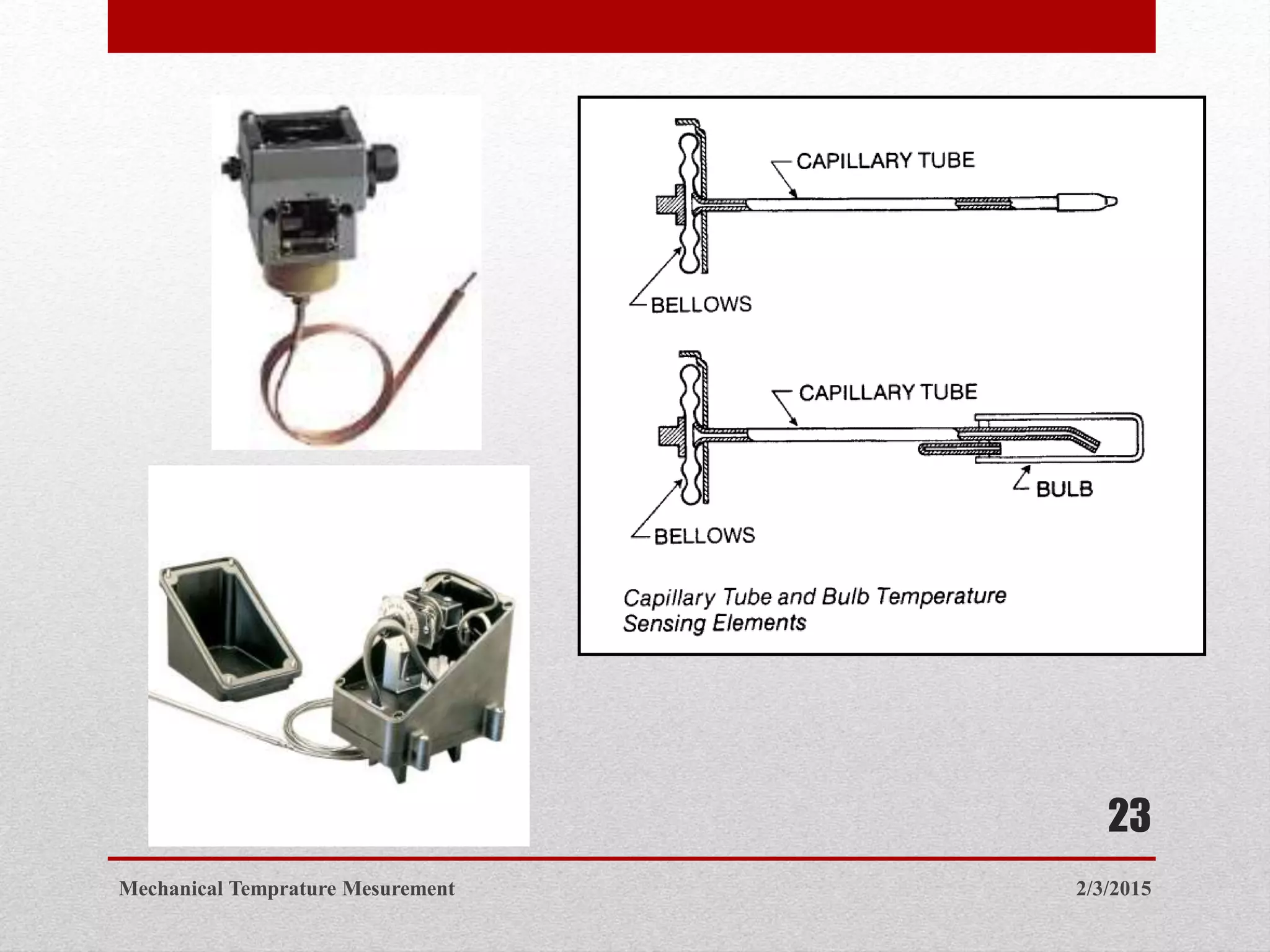
5) Bulb and Capillary Sensor:
• Bulb and capillary elements are used where temperatures are to be
measured in ducts, pipes, tanks or similar locations remote from the
controller.
• The bulb is filled with liquid, gas or refrigerant depending on the
temperature range required.
• Expansion of the fluid in the heated bulb exerts a pressure which is
transmitted by the capillary to the diaphragm and there it is translated
into movement.
2/3/2015Mechanical Temprature Mesurement
22
2/3/2015Mechanical Temprature Mesurement
23
• The linear movement is directionally proportional to the
temperature.
• Advantages:
1. Typically inexpensive
2. Easily understood wiring
• Disadvantages:
1. Sensing bulb must be perfectly horizontal, which is difficult
to set.
2. Diaphragm case must be mounted in a separate, warmer
location for effective operation.
2/3/2015Mechanical Temprature Mesurement
24
Thank You
2/3/2015Mechanical Temprature Mesurement
25

Mechanical temperature measuring devices and their applications

  • 1.
    MECHANICAL TEMPERATURE MEASURING DEVICES PRINCIPLESOF OERATION AND PROPERTIES 2/3/2015Mechanical Temprature Mesurement 1
  • 2.
    Temperature Measurement • Temperaturemeasurement in today’s industrial environment has a wide variety of needs and applications. • It is a very critical and widely measured variable for most mechanical engineers. • The industry has developed a large number of sensors and devices to handle this demand. 2/3/2015Mechanical Temprature Mesurement 2
  • 3.
    Types of TemperatureMeasurement • Temperature can be measured in a diverse array of sensors. • All of them infer temperature by sensing some change in physical characteristic. • Four basic types of temperature measurement include: 1) Mechanical 2) Thermojunctive 3) Thermoresistive 4) Radiative 2/3/2015Mechanical Temprature Mesurement 3
  • 4.
    Mechanical Temperature measurement •In the absence of electronics, early temperature sensors were based on the mechanical effects of temperature. • While the mechanical temperature sensing technologies are decades or centuries old, they are still in widespread use. • They meet the needs of many common applications in a reliable and cost-effective manner. 2/3/2015Mechanical Temprature Mesurement 4
  • 5.
    Principle of operation •A change in temperature causes some kind of mechanical motion, typically due to the fact that most materials expand with a rise in temperature. • Mechanical thermometers can be constructed that use liquids, solids, or even gases as the temperature-sensitive material. • The mechanical motion is read on a physical scale to infer the temperature. 2/3/2015Mechanical Temprature Mesurement 5
  • 6.
    Mechanical temperature measuringdevices • The basis of the thermometer’s operation is the thermal expansion of a working fluid(mercury in this case). • The volume of mercury changes slightly with temperature; the small change in volume drives the narrow mercury column a relatively long way up the tube. • The space above the mercury may be filled with nitrogen or it may be at less than atmospheric pressure, a partial vacuum. 1) Liquid-in-Glass Thermometer: 2/3/2015Mechanical Temprature Mesurement 6
  • 7.
    • The scaleis calibrated to read temperature directly. • The range of a thermometer and it reading accuracy is dependent on the size of the hole, the length of the tube and the fluid in the thermometer. • Typically the smaller the reading increment, the less range it will have. • The accuracy of a thermometer is greatly dependent on the manufacturing process, but also can be affected by usage. 2/3/2015Mechanical Temprature Mesurement 7
  • 8.
    Applications: • Aircrafts usethermometers and hygrometers to determine if atmospheric icing conditions exist along their flight path. • They are also applied in meteorological and oceanographic applications. These measurements are used to initialize weather forecast models. • Used in household, hospitals, etc., for body temperature measurement. • They are also used in indoor climate control systems. 2/3/2015Mechanical Temprature Mesurement 8
  • 9.
    • Advantages: 1) Simplicityin use & low cost. 2) Portable device. 3) Checking physical damage is easy. 4) Power source not require. 5) Repeatable, calibration does not drift. • Disadvantages: 1) Can not be used for automatic recording. 2) Time lag in measurement. 3) Range is limited to about 300 °C . 2/3/2015Mechanical Temprature Mesurement 9
  • 10.
    2) Pressure thermometer: •A pressure thermometer operates by the expansion of a gas or a liquid. • Its types are: 1) Liquid Pressure Thermometer 2) Vapour Pressure Thermometer • A pressure thermometer measures temperature indirectly by measuring pressure. • The gauge is a pressure gauge, but is typically calibrated in units of temperature instead. 2/3/2015Mechanical Temprature Mesurement 10
  • 11.
    1) Vapor pressurethermometers • The saturated vapor pressure of a volatile liquid is used as a measure of the temperature. • These thermometers are very sensitive but the scale is not linear. • The measurement accuracy is 1%. The typical temperature range is from - 20° C to 280° C depending on the nature of the gas. 2/3/2015Mechanical Temprature Mesurement 11
  • 12.
    2) Liquid pressurethermometer: • It’s a temperature measuring device whose operation is based on thermal expansion of a liquid. • The insides of the thermo-sensor cylinder, capillary, and Bourdon tube are filled with liquid which changes volume with varying temperature. • The liquid in the thermo-sensor cylinder is expanded and contracted as the temperature changes, and the pressure change in the Bourdon tube that is transmitted through the capillary is indicated as a temperature. • Liquid filled thermometers have scales with divisions from 10° to 0.01°C. • The measurement accuracy depends on the depth of immersion of the thermometer in the medium to be measured. 2/3/2015Mechanical Temprature Mesurement 12
  • 13.
  • 14.
    • Applications: 1. Suitablefor most heating and ventilation applications. 2. Used in dairy, brewing and food industries. 3. A common application of this type of thermometer is measurement of outside temperature from the inside of a building. • Advantages: 1. Simple structure, high mechanical strength. 2. Low cost, requires no external energy. • Disadvantages: 1. Temperature range is limited, usually 80-400 ℃. 2. Slow response time. 2/3/2015Mechanical Temprature Mesurement 14
  • 15.
    3) Bimetallic Thermometer: •The temperature is measured by means of a bimetal system inside the temperature sensor. • The bimetal is made from two metal strips, permanently joined together, each metal having a different thermal expansion coefficient. • This causes the strip to deflect in proportion to the temperature variation. • The actual bimetal system consists of a bimetal strip that is either helically or spirally wound, depending on the size of the sensor and the temperature range to be measured. 2/3/2015Mechanical Temprature Mesurement 15
  • 16.
  • 17.
    • Any temperaturevariation causes the bimetal to rotate an attached spindle and it is indicated by a pointer on a dial. • Bimetal thermometers are available for temperature ranges from -70 to +600 °C • Ranges as high as 1000° F are possible, however ranges around the 500° F value are more common. Dial 2/3/2015Mechanical Temprature Mesurement 17
  • 18.
    Cross section ofa Bimetallic thermometer 2/3/2015Mechanical Temprature Mesurement 18
  • 19.
    • Applications: 1. Commonapplication of bimetallic strips is in household thermostats. 2. Its also used in circuit breakers. • Advantages: 1. Robust, easy to use and cheap. 2. Can be used at higher temperatures. 3. Power source not required • Disadvantages: 1. Not very accurate. 2. Limited to applications where manual reading is acceptable. 3. Not suitable for very low temperatures 2/3/2015Mechanical Temprature Mesurement 19
  • 20.
    4) Sealed Bellows: •The sealed bellows type is filled with a gas, vapor or liquid. • It responds to change in temperature by variation in volume and pressure causing expansion or contraction. • Gas filled bellows can make the sensor sensitive to both external pressure and temperature. 2/3/2015Mechanical Temprature Mesurement 20
  • 21.
    • Liquid Filledbellows can function in a number of transducer applications. • Applications: 1. Used in fuel and air density controls. 2. Used in passive actuation in a vacuum or pressure chamber. 3. Used as transducers. 2/3/2015Mechanical Temprature Mesurement 21
  • 22.
    5) Bulb andCapillary Sensor: • Bulb and capillary elements are used where temperatures are to be measured in ducts, pipes, tanks or similar locations remote from the controller. • The bulb is filled with liquid, gas or refrigerant depending on the temperature range required. • Expansion of the fluid in the heated bulb exerts a pressure which is transmitted by the capillary to the diaphragm and there it is translated into movement. 2/3/2015Mechanical Temprature Mesurement 22
  • 23.
  • 24.
    • The linearmovement is directionally proportional to the temperature. • Advantages: 1. Typically inexpensive 2. Easily understood wiring • Disadvantages: 1. Sensing bulb must be perfectly horizontal, which is difficult to set. 2. Diaphragm case must be mounted in a separate, warmer location for effective operation. 2/3/2015Mechanical Temprature Mesurement 24
  • 25.