Temperature Basic Concepts, Controls and Global Patterns
Overview Temperature Relevance to Physical Geography Temperature Scales Temperature Controls Latitude Altitude Clouds Continents and Oceans Global Patterns Urban Microclimate
Temperature The average kinetic energy of particles of matter (atoms, molecules) A direct consequence of insolation A major component of  climate Increases moisture content of air Increases availability of water (rainfall; weather) Differentiates biomes Sculpts landscapes Increases rates of chemical reactions Weathering (creation of landforms) Decomposition (soil formation, nutrient cycling)
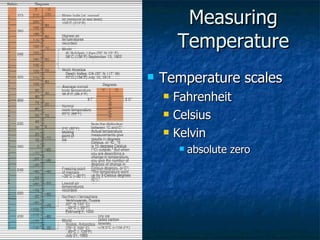
Measuring Temperature Temperature scales Fahrenheit Celsius Kelvin absolute zero
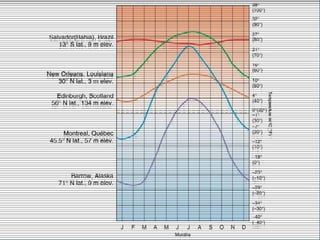
Representing Temperature The measures below are used in the assessment of climate for a given area.  Notice that each builds on the other. Daily Mean Temperature Average of the high est and lowest temperature on a given day Monthly Mean Temperature A verage of daily mean temperatures in a given month Annual Temperature Range The mathematical difference between the highest and lowest monthly mean temperature in a year
Principle Temperature Controls Latitude Insolation Daylength, sun angle Altitude Normal lapse rate (6.4 C o /km) Lower average temperatures Greater difference between daytime maximum and nighttime minimum temperatures Increased nighttime cooling Clouds Albedo reduces daytime maximum temperature Greenhouse effect raises the nighttime low temperature
 
 
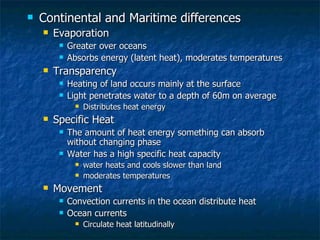
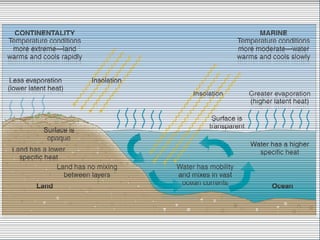
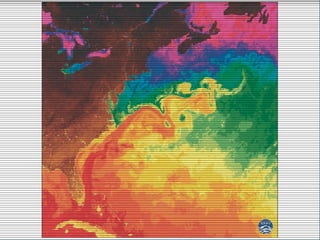
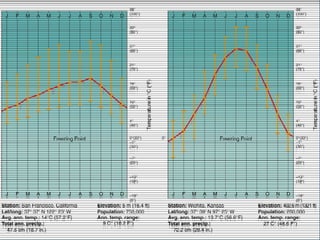
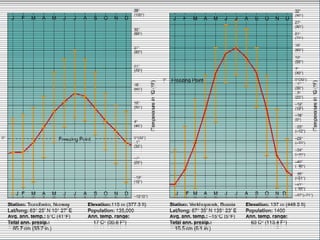
Continental and Maritime differences Evaporation Greater over oceans Absorbs energy (latent heat), moderates temperatures Transparency Heating of land occurs mainly at the surface Light penetrates water to a depth of 60m on average Distributes heat energy  Specific Heat The amount of heat energy something can absorb without changing phase Water has a high specific heat capacity water heats and cools slower than land moderates temperatures Movement Convection currents in the ocean distribute heat Ocean currents  Circulate heat latitudinally
 
 
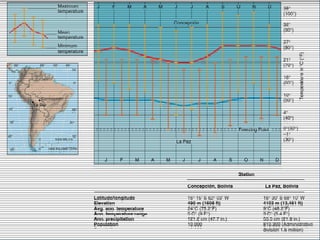
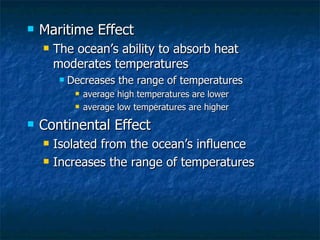
Maritime Effect The ocean’s ability to absorb heat moderates temperatures Decreases the range of temperatures average high temperatures are lower average low temperatures are higher Continental Effect Isolated from the ocean’s influence Increases the range of temperatures
 
 
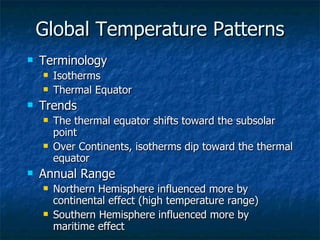
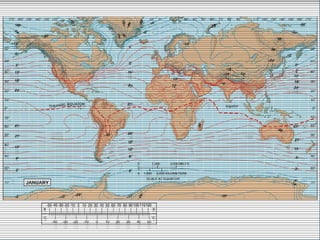
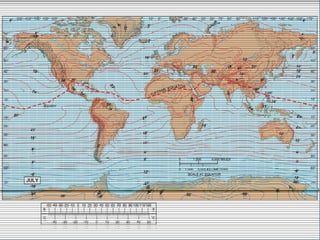
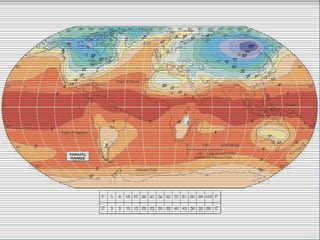
Global Temperature Patterns Terminology Isotherms Thermal Equator Trends The thermal equator shifts toward the subsolar point Over Continents, isotherms dip toward the thermal equator Annual Range Northern Hemisphere influenced more by continental effect (high temperature range) Southern Hemisphere influenced more by maritime effect


Temperature

  • 1.
    Temperature Basic Concepts,Controls and Global Patterns
  • 2.
    Overview Temperature Relevanceto Physical Geography Temperature Scales Temperature Controls Latitude Altitude Clouds Continents and Oceans Global Patterns Urban Microclimate
  • 3.
    Temperature The averagekinetic energy of particles of matter (atoms, molecules) A direct consequence of insolation A major component of climate Increases moisture content of air Increases availability of water (rainfall; weather) Differentiates biomes Sculpts landscapes Increases rates of chemical reactions Weathering (creation of landforms) Decomposition (soil formation, nutrient cycling)
  • 4.
    Measuring Temperature Temperaturescales Fahrenheit Celsius Kelvin absolute zero
  • 5.
    Representing Temperature Themeasures below are used in the assessment of climate for a given area. Notice that each builds on the other. Daily Mean Temperature Average of the high est and lowest temperature on a given day Monthly Mean Temperature A verage of daily mean temperatures in a given month Annual Temperature Range The mathematical difference between the highest and lowest monthly mean temperature in a year
  • 6.
    Principle Temperature ControlsLatitude Insolation Daylength, sun angle Altitude Normal lapse rate (6.4 C o /km) Lower average temperatures Greater difference between daytime maximum and nighttime minimum temperatures Increased nighttime cooling Clouds Albedo reduces daytime maximum temperature Greenhouse effect raises the nighttime low temperature
  • 7.
  • 8.
  • 9.
    Continental and Maritimedifferences Evaporation Greater over oceans Absorbs energy (latent heat), moderates temperatures Transparency Heating of land occurs mainly at the surface Light penetrates water to a depth of 60m on average Distributes heat energy Specific Heat The amount of heat energy something can absorb without changing phase Water has a high specific heat capacity water heats and cools slower than land moderates temperatures Movement Convection currents in the ocean distribute heat Ocean currents Circulate heat latitudinally
  • 10.
  • 11.
  • 12.
    Maritime Effect Theocean’s ability to absorb heat moderates temperatures Decreases the range of temperatures average high temperatures are lower average low temperatures are higher Continental Effect Isolated from the ocean’s influence Increases the range of temperatures
  • 13.
  • 14.
  • 15.
    Global Temperature PatternsTerminology Isotherms Thermal Equator Trends The thermal equator shifts toward the subsolar point Over Continents, isotherms dip toward the thermal equator Annual Range Northern Hemisphere influenced more by continental effect (high temperature range) Southern Hemisphere influenced more by maritime effect
  • 16.
  • 17.
  • 18.