What are the factors
responsible for the
changes in weather
and climate?
http://www.sciencecourseware.org/eec/GlobalWar
ming/EnergyBalance/index.html
How Does Each Element
Influences Weather &
Climate?
• The nature of both weather and
climate is expressed using the same
basic elements.
• Changes in these elements are
responsible for the variation we
experience in our weather.
INFLUENCE OF TEMPERATURE
• Temperature is the variation in the presence
or absence of heat (hotness or coldness).
• What determines the temperature of a place?
– It is determined by the amount of heat absorbed
and reabsorbed from the ground upwards.
• What therefore influences the amount of heat
places receive?
THE EARTH’S HEAT (ENERGY)
BUDGET
FACTORS INFLUENCING
TEMPERATURE
• Latitude
• Earth’s Revolution
• Distance from the sea
• Ocean currents
• Altitude
• Cloud cover
• Microclimates
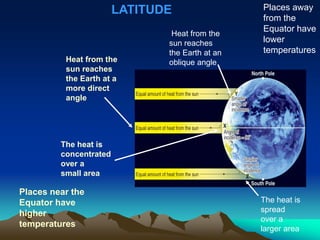
Places away
from the
Equator have
lower
temperatures
Heat from the
sun reaches
the Earth at an
oblique angle
The heat is
spread
over a
larger area
Heat from the
sun reaches
the Earth at a
more direct
angle
Places near the
Equator have
higher
temperatures
The heat is
concentrated
over a
small area
LATITUDE
EARTH’S REVOLUTION
EARTH’S REVOLUTION
Places that are tilted
towards the sun
experience
warmer
temperatures.
This is Summer time
around June in
the Northern
Hemisphere
Places at the Arctic
experience 24 hrs.
of sun light at this
time in the Northern
Hemisphere.
Six months later,
places in the
Northern
Hemisphere
is tilted away from
the sun. This is
Winter time.
Places at the
Arctic experience
24 hrs. of
darkness at this
time in the
Northern
Hemisphere.
DISTANCE FROM THE SEA
• The sea moderates the
temperatures of places nearby
• In summer, the sea heats up
slower than the land.
- Cooling effect on land
along the coast.
• In winter, the sea loses heat
slower than the land.
-Warming effect on the
coastal areas.
• Temperatures of places
farther inland are not
moderated by the sea
- These places experience
more extreme variations
in temperature.
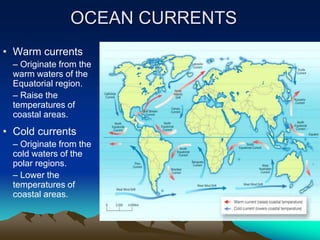
OCEAN CURRENTS
• Warm currents
– Originate from the
warm waters of the
Equatorial region.
– Raise the
temperatures of
coastal areas.
• Cold currents
– Originate from the
cold waters of the
polar regions.
– Lower the
temperatures of
coastal areas.
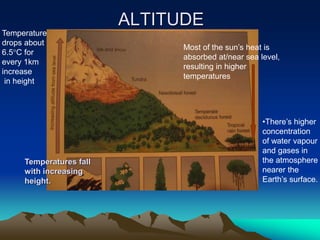
ALTITUDE
Temperatures fall
with increasing
height.
Temperature
drops about
6.5C for
every 1km
increase
in height
•There’s higher
concentration
of water vapour
and gases in
the atmosphere
nearer the
Earth’s surface.
Most of the sun’s heat is
absorbed at/near sea level,
resulting in higher
temperatures
CLOUDCOVER
During the day, clouds
reflect solar radiation
and help to cool the
land
• At night, clouds prevent
loss of heat from the
ground and help to warm
the land
(The higher the humidity,
the greater the cloud
cover)
COOL LAND
REFLECTION
WARM SURFACE
MICROCLIMATES
• These are factors that affect the climate on a small (local) scale.
For example:-
Aspect
– Direction a slope faces in relation to the sun
– In the northern hemisphere, south-facing slopes are
warmer and vice versa for the southern hemisphere.
Albedo
- This is the ability of a surface to absorb solar radiation.
- The colour of surfaces and objects influences the
amount of radiation absorbed or reflected.
- Dark colours absorb more radiation, while light colours
reflect. Ex. Snow, clouds, etc.
MICROCLIMATES
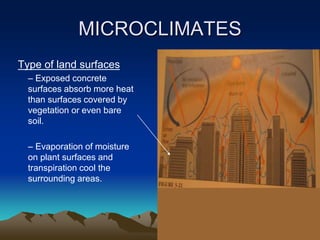
Type of land surfaces
– Exposed concrete
surfaces absorb more heat
than surfaces covered by
vegetation or even bare
soil.
– Evaporation of moisture
on plant surfaces and
transpiration cool the
surrounding areas.
MEASUREMENT OF
TEMPERATURE
The Maximum
& Minimum
Thermometer
WAYS OF EXPRESSING AND
DESCRIBING TEMPERATURE
Diurnal range of temperature
• Difference between the maximum and minimum
temperatures of a place for any one day.
• Calculation:
-
Maximum
temperature for
the day
Minimum
temperature for
the day
WAYS OF EXPRESSING AND
DESCRIBING TEMPERATURE
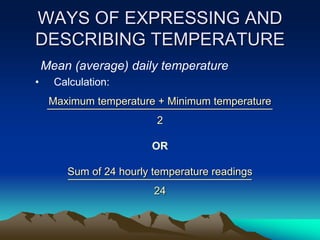
Mean (average) daily temperature
• Calculation:
Maximum temperature + Minimum temperature
––––––––––––––––––––––––––––––––––––––
2
OR
Sum of 24 hourly temperature readings
–––––––––––––––––––––––––––––––
24
WAYS OF EXPRESSING AND
DESCRIBING TEMPERATURE
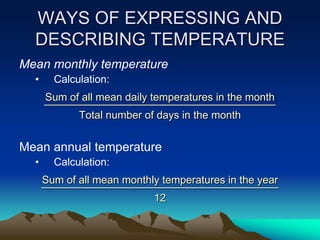
Mean monthly temperature
• Calculation:
Sum of all mean daily temperatures in the month
–––––––––––––––––––––––––––––––––––––––
Total number of days in the month
Mean annual temperature
• Calculation:
Sum of all mean monthly temperatures in the year
––––––––––––––––––––––––––––––––––––––––
12
WAYS OF EXPRESSING AND
DESCRIBING TEMPERATURE
Annual range of temperature
• Knowing the annual temperature range of a place
will help you deduce the climatic zone that it is
located in.
• Calculation:
-Highest mean monthly
temperature in the year
Lowest mean monthly
temperature in the year
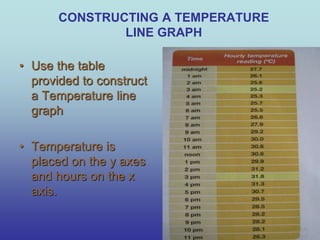
CONSTRUCTING A TEMPERATURE
LINE GRAPH
• Use the table
provided to construct
a Temperature line
graph
• Temperature is
placed on the y axes
and hours on the x
axis.
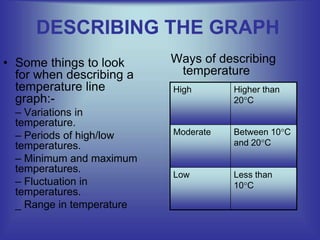
DESCRIBING THE GRAPH
• Some things to look
for when describing a
temperature line
graph:-
– Variations in
temperature.
– Periods of high/low
temperatures.
– Minimum and maximum
temperatures.
– Fluctuation in
temperatures.
_ Range in temperature
Ways of describing
temperature
High Higher than
20C
Moderate Between 10C
and 20C
Low Less than
10C

Temperature &

  • 1.
    What are thefactors responsible for the changes in weather and climate? http://www.sciencecourseware.org/eec/GlobalWar ming/EnergyBalance/index.html
  • 2.
    How Does EachElement Influences Weather & Climate? • The nature of both weather and climate is expressed using the same basic elements. • Changes in these elements are responsible for the variation we experience in our weather.
  • 3.
    INFLUENCE OF TEMPERATURE •Temperature is the variation in the presence or absence of heat (hotness or coldness). • What determines the temperature of a place? – It is determined by the amount of heat absorbed and reabsorbed from the ground upwards. • What therefore influences the amount of heat places receive?
  • 4.
    THE EARTH’S HEAT(ENERGY) BUDGET
  • 5.
    FACTORS INFLUENCING TEMPERATURE • Latitude •Earth’s Revolution • Distance from the sea • Ocean currents • Altitude • Cloud cover • Microclimates
  • 6.
    Places away from the Equatorhave lower temperatures Heat from the sun reaches the Earth at an oblique angle The heat is spread over a larger area Heat from the sun reaches the Earth at a more direct angle Places near the Equator have higher temperatures The heat is concentrated over a small area LATITUDE
  • 7.
  • 8.
    EARTH’S REVOLUTION Places thatare tilted towards the sun experience warmer temperatures. This is Summer time around June in the Northern Hemisphere Places at the Arctic experience 24 hrs. of sun light at this time in the Northern Hemisphere. Six months later, places in the Northern Hemisphere is tilted away from the sun. This is Winter time. Places at the Arctic experience 24 hrs. of darkness at this time in the Northern Hemisphere.
  • 9.
    DISTANCE FROM THESEA • The sea moderates the temperatures of places nearby • In summer, the sea heats up slower than the land. - Cooling effect on land along the coast. • In winter, the sea loses heat slower than the land. -Warming effect on the coastal areas. • Temperatures of places farther inland are not moderated by the sea - These places experience more extreme variations in temperature.
  • 10.
    OCEAN CURRENTS • Warmcurrents – Originate from the warm waters of the Equatorial region. – Raise the temperatures of coastal areas. • Cold currents – Originate from the cold waters of the polar regions. – Lower the temperatures of coastal areas.
  • 11.
    ALTITUDE Temperatures fall with increasing height. Temperature dropsabout 6.5C for every 1km increase in height •There’s higher concentration of water vapour and gases in the atmosphere nearer the Earth’s surface. Most of the sun’s heat is absorbed at/near sea level, resulting in higher temperatures
  • 12.
    CLOUDCOVER During the day,clouds reflect solar radiation and help to cool the land • At night, clouds prevent loss of heat from the ground and help to warm the land (The higher the humidity, the greater the cloud cover) COOL LAND REFLECTION WARM SURFACE
  • 13.
    MICROCLIMATES • These arefactors that affect the climate on a small (local) scale. For example:- Aspect – Direction a slope faces in relation to the sun – In the northern hemisphere, south-facing slopes are warmer and vice versa for the southern hemisphere. Albedo - This is the ability of a surface to absorb solar radiation. - The colour of surfaces and objects influences the amount of radiation absorbed or reflected. - Dark colours absorb more radiation, while light colours reflect. Ex. Snow, clouds, etc.
  • 14.
    MICROCLIMATES Type of landsurfaces – Exposed concrete surfaces absorb more heat than surfaces covered by vegetation or even bare soil. – Evaporation of moisture on plant surfaces and transpiration cool the surrounding areas.
  • 15.
  • 16.
    WAYS OF EXPRESSINGAND DESCRIBING TEMPERATURE Diurnal range of temperature • Difference between the maximum and minimum temperatures of a place for any one day. • Calculation: - Maximum temperature for the day Minimum temperature for the day
  • 17.
    WAYS OF EXPRESSINGAND DESCRIBING TEMPERATURE Mean (average) daily temperature • Calculation: Maximum temperature + Minimum temperature –––––––––––––––––––––––––––––––––––––– 2 OR Sum of 24 hourly temperature readings ––––––––––––––––––––––––––––––– 24
  • 18.
    WAYS OF EXPRESSINGAND DESCRIBING TEMPERATURE Mean monthly temperature • Calculation: Sum of all mean daily temperatures in the month ––––––––––––––––––––––––––––––––––––––– Total number of days in the month Mean annual temperature • Calculation: Sum of all mean monthly temperatures in the year –––––––––––––––––––––––––––––––––––––––– 12
  • 19.
    WAYS OF EXPRESSINGAND DESCRIBING TEMPERATURE Annual range of temperature • Knowing the annual temperature range of a place will help you deduce the climatic zone that it is located in. • Calculation: -Highest mean monthly temperature in the year Lowest mean monthly temperature in the year
  • 20.
    CONSTRUCTING A TEMPERATURE LINEGRAPH • Use the table provided to construct a Temperature line graph • Temperature is placed on the y axes and hours on the x axis.
  • 21.
    DESCRIBING THE GRAPH •Some things to look for when describing a temperature line graph:- – Variations in temperature. – Periods of high/low temperatures. – Minimum and maximum temperatures. – Fluctuation in temperatures. _ Range in temperature Ways of describing temperature High Higher than 20C Moderate Between 10C and 20C Low Less than 10C