DBN 163 :
Building
Environment (I)
CLIMATE
PUAN BALKHIZ BINTI ISMAIL
Department of Building
Faculty of Architecture, Planning & Surveying
UiTM Sarawak
Overview
Not every building has the same weather
exposure. Regional climate conditions, macro
environment and micro environment all affect
the risk of moisture damage, and must be taken
into account in design.
2
Weather
DEFINED AS;
 general atmospheric conditions at a given
place and a given time with respect to
temperature, humidity, precipitation,
wind, radiation and other meteorological
events.
OR
 a collection of atmospheric phenomena that
occur over some place for a short period of
time (few hours, a week).
3
Weather (cont’d)
 A dynamic process, changing from moment
to moment, from day to night and from
season to season.
 The phenomenon – movement of air, the
presence of water vapor, pressure of the
atmosphere and transfer of thermal energy
 Described using air temperature, moisture
content/humidity, wind, pressure, cloud
and precipitation.
4
5
6
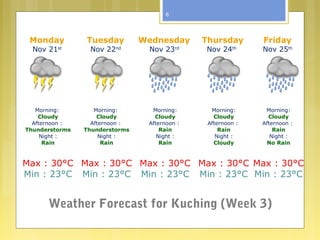
Monday
Nov 21st
Tuesday
Nov 22nd
Wednesday
Nov 23rd
Thursday
Nov 24th
Friday
Nov 25th
Morning:
Cloudy
Afternoon :
Thunderstorms
Night :
Rain
Morning:
Cloudy
Afternoon :
Thunderstorms
Night :
Rain
Morning:
Cloudy
Afternoon :
Rain
Night :
Rain
Morning:
Cloudy
Afternoon :
Rain
Night :
Cloudy
Morning:
Cloudy
Afternoon :
Rain
Night :
No Rain
Max : 30°C
Min : 23°C
Max : 30°C
Min : 23°C
Max : 30°C
Min : 23°C
Max : 30°C
Min : 23°C
Max : 30°C
Min : 23°C
Weather Forecast for Kuching (Week 3)
Climate
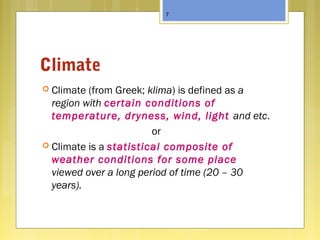
 Climate (from Greek; klima) is defined as a
region with certain conditions of
temperature, dryness, wind, light and etc.
or
 Climate is a statistical composite of
weather conditions for some place
viewed over a long period of time (20 – 30
years).
7
Climate (cont’d)
 More scientific definition of climate is an
integration in time of the physical states
of the atmospheric environment, characteristic
of a certain geographical location.
8
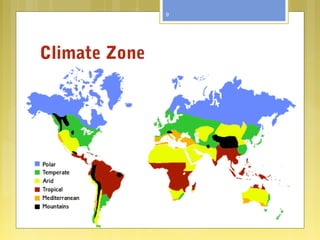
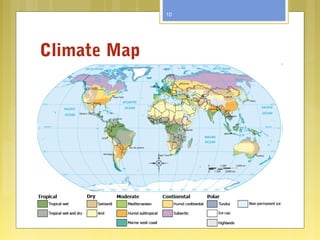
Climate Zone
9
Climate Map
10
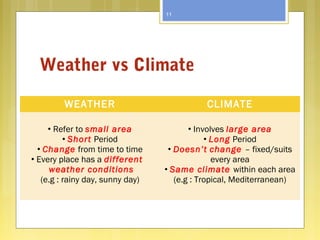
WEATHER CLIMATE
• Refer to small area
• Short Period
• Change from time to time
• Every place has a different
weather conditions
(e.g : rainy day, sunny day)
• Involves large area
• Long Period
• Doesn’t change – fixed/suits
every area
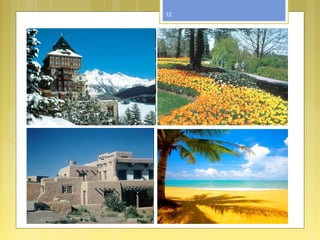
• Same climate within each area
(e.g : Tropical, Mediterranean)
Weather vs Climate
11
12
FACTORS OF SHAPING
THE GLOBAL SCALE
CLIMATE
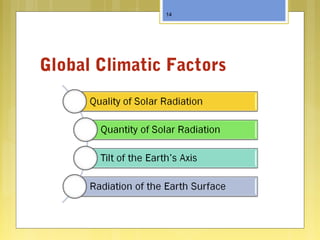
Global Climatic Factors
14
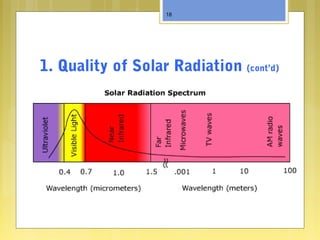
1. Quality of Solar Radiation
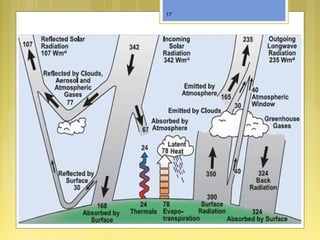
 The earth receives almost all its energy from
the sun in the form of radiations.
 Thus, the SUN is the dominating influence
on climate.
 Some of the shorter wave length are
absorbed by the atmosphere and radiated
at much longer wave length
15
1. Quality of Solar Radiation (cont’d)
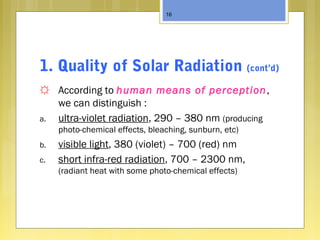
☼ According to human means of perception,
we can distinguish :
a. ultra-violet radiation, 290 – 380 nm (producing
photo-chemical effects, bleaching, sunburn, etc)
b. visible light, 380 (violet) – 700 (red) nm
c. short infra-red radiation, 700 – 2300 nm,
(radiant heat with some photo-chemical effects)
16
17
1. Quality of Solar Radiation (cont’d)
18
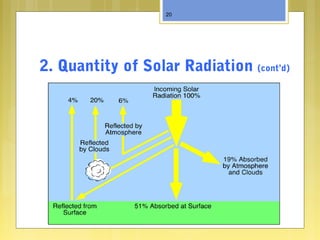
2. Quantity of Solar Radiation
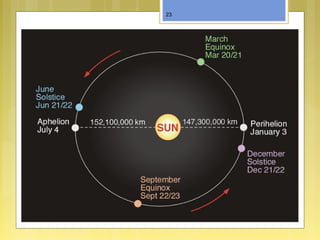
 The intensity of radiation reaching the upper
surface of the atmosphere is taken as the
solar constant
 The earth moves around the sun in a slightly
elliptical orbit.
19
2. Quantity of Solar Radiation (cont’d)
20
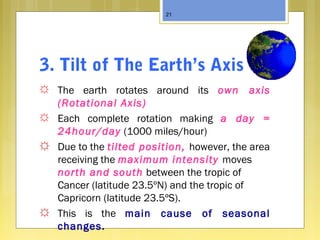
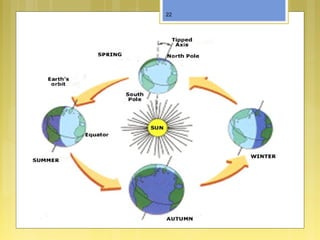
3. Tilt of The Earth’s Axis
☼ The earth rotates around its own axis
(Rotational Axis)
☼ Each complete rotation making a day =
24hour/day (1000 miles/hour)
☼ Due to the tilted position, however, the area
receiving the maximum intensity moves
north and south between the tropic of
Cancer (latitude 23.5ºN) and the tropic of
Capricorn (latitude 23.5ºS).
☼ This is the main cause of seasonal
changes.
21
22
23
4. Radiation at The Earth’s
Surface
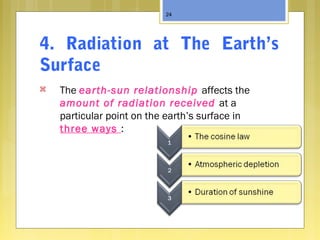
 The earth-sun relationship affects the
amount of radiation received at a
particular point on the earth’s surface in
three ways :
24
4. Radiation at The Earth’s
Surface
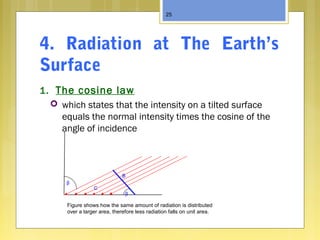
1. The cosine law
 which states that the intensity on a tilted surface
equals the normal intensity times the cosine of the
angle of incidence
25
β
β
B
C
Figure shows how the same amount of radiation is distributed
over a larger area, therefore less radiation falls on unit area.
4. Radiation at The Earth’s
Surface (cont’d)
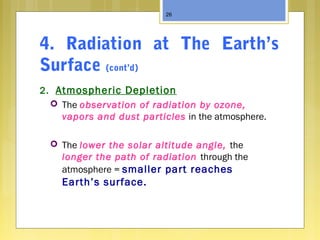
2. Atmospheric Depletion
 The observation of radiation by ozone,
vapors and dust particles in the atmosphere.
 The lower the solar altitude angle, the
longer the path of radiation through the
atmosphere = smaller part reaches
Earth’s surface.
26
4. Radiation at The Earth’s
Surface (cont’d)
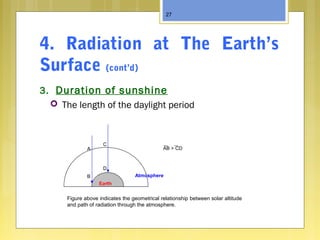
3. Duration of sunshine
 The length of the daylight period
27
C
A
B
D
AB > CD
Earth
Atmosphere
Figure above indicates the geometrical relationship between solar altitude
and path of radiation through the atmosphere.
28
Reflection
 Can you define climate and weather?
 What are the differences of climate and
weather?
 Named and explain global climatic factors.
29

Climate vs Weather

  • 1.
    DBN 163 : Building Environment(I) CLIMATE PUAN BALKHIZ BINTI ISMAIL Department of Building Faculty of Architecture, Planning & Surveying UiTM Sarawak
  • 2.
    Overview Not every buildinghas the same weather exposure. Regional climate conditions, macro environment and micro environment all affect the risk of moisture damage, and must be taken into account in design. 2
  • 3.
    Weather DEFINED AS;  generalatmospheric conditions at a given place and a given time with respect to temperature, humidity, precipitation, wind, radiation and other meteorological events. OR  a collection of atmospheric phenomena that occur over some place for a short period of time (few hours, a week). 3
  • 4.
    Weather (cont’d)  Adynamic process, changing from moment to moment, from day to night and from season to season.  The phenomenon – movement of air, the presence of water vapor, pressure of the atmosphere and transfer of thermal energy  Described using air temperature, moisture content/humidity, wind, pressure, cloud and precipitation. 4
  • 5.
  • 6.
    6 Monday Nov 21st Tuesday Nov 22nd Wednesday Nov23rd Thursday Nov 24th Friday Nov 25th Morning: Cloudy Afternoon : Thunderstorms Night : Rain Morning: Cloudy Afternoon : Thunderstorms Night : Rain Morning: Cloudy Afternoon : Rain Night : Rain Morning: Cloudy Afternoon : Rain Night : Cloudy Morning: Cloudy Afternoon : Rain Night : No Rain Max : 30°C Min : 23°C Max : 30°C Min : 23°C Max : 30°C Min : 23°C Max : 30°C Min : 23°C Max : 30°C Min : 23°C Weather Forecast for Kuching (Week 3)
  • 7.
    Climate  Climate (fromGreek; klima) is defined as a region with certain conditions of temperature, dryness, wind, light and etc. or  Climate is a statistical composite of weather conditions for some place viewed over a long period of time (20 – 30 years). 7
  • 8.
    Climate (cont’d)  Morescientific definition of climate is an integration in time of the physical states of the atmospheric environment, characteristic of a certain geographical location. 8
  • 9.
  • 10.
  • 11.
    WEATHER CLIMATE • Referto small area • Short Period • Change from time to time • Every place has a different weather conditions (e.g : rainy day, sunny day) • Involves large area • Long Period • Doesn’t change – fixed/suits every area • Same climate within each area (e.g : Tropical, Mediterranean) Weather vs Climate 11
  • 12.
  • 13.
    FACTORS OF SHAPING THEGLOBAL SCALE CLIMATE
  • 14.
  • 15.
    1. Quality ofSolar Radiation  The earth receives almost all its energy from the sun in the form of radiations.  Thus, the SUN is the dominating influence on climate.  Some of the shorter wave length are absorbed by the atmosphere and radiated at much longer wave length 15
  • 16.
    1. Quality ofSolar Radiation (cont’d) ☼ According to human means of perception, we can distinguish : a. ultra-violet radiation, 290 – 380 nm (producing photo-chemical effects, bleaching, sunburn, etc) b. visible light, 380 (violet) – 700 (red) nm c. short infra-red radiation, 700 – 2300 nm, (radiant heat with some photo-chemical effects) 16
  • 17.
  • 18.
    1. Quality ofSolar Radiation (cont’d) 18
  • 19.
    2. Quantity ofSolar Radiation  The intensity of radiation reaching the upper surface of the atmosphere is taken as the solar constant  The earth moves around the sun in a slightly elliptical orbit. 19
  • 20.
    2. Quantity ofSolar Radiation (cont’d) 20
  • 21.
    3. Tilt ofThe Earth’s Axis ☼ The earth rotates around its own axis (Rotational Axis) ☼ Each complete rotation making a day = 24hour/day (1000 miles/hour) ☼ Due to the tilted position, however, the area receiving the maximum intensity moves north and south between the tropic of Cancer (latitude 23.5ºN) and the tropic of Capricorn (latitude 23.5ºS). ☼ This is the main cause of seasonal changes. 21
  • 22.
  • 23.
  • 24.
    4. Radiation atThe Earth’s Surface  The earth-sun relationship affects the amount of radiation received at a particular point on the earth’s surface in three ways : 24
  • 25.
    4. Radiation atThe Earth’s Surface 1. The cosine law  which states that the intensity on a tilted surface equals the normal intensity times the cosine of the angle of incidence 25 β β B C Figure shows how the same amount of radiation is distributed over a larger area, therefore less radiation falls on unit area.
  • 26.
    4. Radiation atThe Earth’s Surface (cont’d) 2. Atmospheric Depletion  The observation of radiation by ozone, vapors and dust particles in the atmosphere.  The lower the solar altitude angle, the longer the path of radiation through the atmosphere = smaller part reaches Earth’s surface. 26
  • 27.
    4. Radiation atThe Earth’s Surface (cont’d) 3. Duration of sunshine  The length of the daylight period 27 C A B D AB > CD Earth Atmosphere Figure above indicates the geometrical relationship between solar altitude and path of radiation through the atmosphere.
  • 28.
  • 29.
    Reflection  Can youdefine climate and weather?  What are the differences of climate and weather?  Named and explain global climatic factors. 29

Editor's Notes

  • #14 Balkhiz Ismail. UiTM Sarawak
  • #30 Balkhiz Ismail. UiTM Sarawak