Group Members:
Athena Lyttle
Savita Stephenson
Carlesa Duncan
Antonio Phillips
Ariana Charran
Sharai Harris
Layout of this presentation
 Definition of the Forest Biome
The three main types of Forest
Where the Forest types can be found?
Species present in the types of Forest
Abiotic characteristics of the Forest biomes
Structure of the Forest
Importance of the Forest
Threats
Conclusion
References
What is the Forest Biome
 Forest biomes - are defined as biological
communities that are dominated by trees and
other woody vegetation that can be classified
according to numerous characteristics with
seasonality being the most widely used. (
Spurr and Barnes 1980).
The Three Main Types of Forest
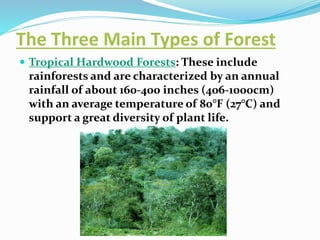
 Tropical Hardwood Forests: These include
rainforests and are characterized by an annual
rainfall of about 160-400 inches (406-1000cm)
with an average temperature of 80°F (27°C) and
support a great diversity of plant life.
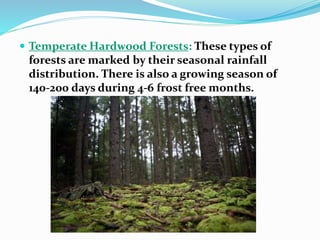
 Temperate Hardwood Forests: These types of
forests are marked by their seasonal rainfall
distribution. There is also a growing season of
140-200 days during 4-6 frost free months.
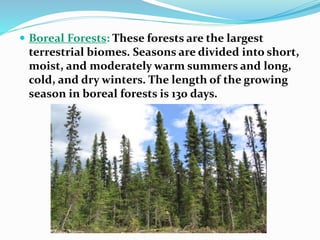
 Boreal Forests: These forests are the largest
terrestrial biomes. Seasons are divided into short,
moist, and moderately warm summers and long,
cold, and dry winters. The length of the growing
season in boreal forests is 130 days.
Where the types can be found?
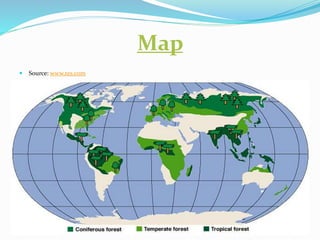
 Tropical Hardwood Forests: This type of forest is found
between the Tropics of Cancer ad the Tropics of
Capricorn forming a belt of green-life.
 Temperate Hardwood Forests: They are found in areas
with warm, moist summers and mild winters. Mostly in
the Northern Hemisphere: Eastern North America, East
Asia, Europe and small areas in Australia and South
America.
 Boreal Forests: This type of forest extends in broad bands
across North America and Eurasia. In North America it
covers most of inland Canada and Alaska. In Eurasia it
covers most of Sweden, Finland and Norway
Map
 Source: www.tes.com
Species present in the types of
Forest
Boreal Forest
Animals Plants
Raven Shrubs and wildflowers
Wolves Conifers (fir and pine)
Squirrels Small leaved deciduous trees
(willow and alder)
Moose Trees (oak, elm and maple)
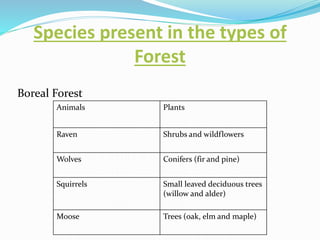
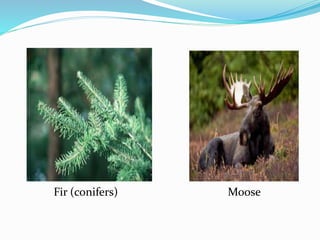
Fir (conifers) Moose
Tropical Hardwood Forest
Animals Plants
Vampire Bat Coconut trees
Toco Tucan Mangrove forests
Chimpanzee Bengal bamboo
Proboscis Monkey Epiphytes
Orangutan Buttress roots
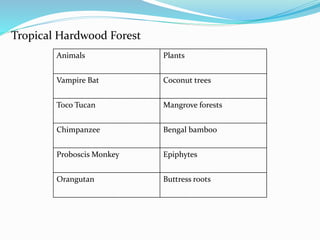
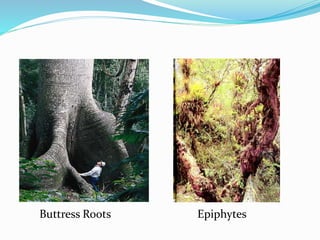
Buttress Roots Epiphytes
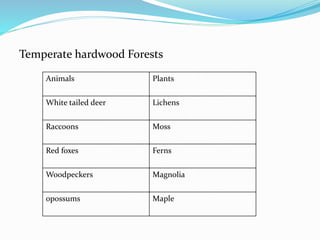
Temperate hardwood Forests
Animals Plants
White tailed deer Lichens
Raccoons Moss
Red foxes Ferns
Woodpeckers Magnolia
opossums Maple
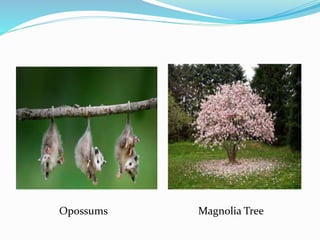
Opossums Magnolia Tree
Abiotic characteristics of the
Forest Biomes
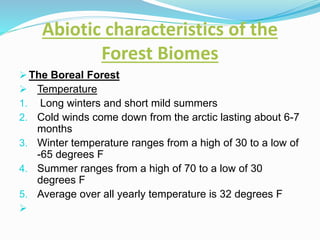
 The Boreal Forest
 Temperature
1. Long winters and short mild summers
2. Cold winds come down from the arctic lasting about 6-7
months
3. Winter temperature ranges from a high of 30 to a low of
-65 degrees F
4. Summer ranges from a high of 70 to a low of 30
degrees F
5. Average over all yearly temperature is 32 degrees F

Abiotic characteristics of the
Forest Biomes
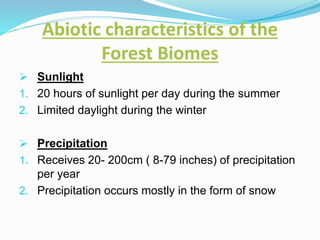
 Sunlight
1. 20 hours of sunlight per day during the summer
2. Limited daylight during the winter
 Precipitation
1. Receives 20- 200cm ( 8-79 inches) of precipitation
per year
2. Precipitation occurs mostly in the form of snow
Abiotic characteristics of the
Forest Biomes
Soil Conditions
1. The soil is acidic
2. It is poor in nutrients
3. The ground is swampy and marshy in many parts
of the forest
Abiotic characteristics of the
Forest Biomes
Tropical Hardwood Forest
 Temperature
1. Temperature is on an average of 20- 25 degrees C
 Precipitation
1. Precipitation is evenly distributed throughout the
year.
2. There is an average of 50- 260 inches ( 125- 660
cm) of rain falls yearly.
Abiotic characteristics of the
Forest Biomes
Soil Conditions
1. Soil is nutrient poor and acidic.
2. Decomposition is rapid.
3. Soils are subject to heavy leaching.
Abiotic characteristics of the
Forest Biomes
Temperate Hardwood Forest
 Temperature
1. Temperature varies from – 30 degrees C to 30
degrees C
 Precipitation
1. Precipitation ( 75- 150cm) is distributed evenly
throughout the year.
 Soil Conditions
1. Soil is fertile and enriched with decaying litter.
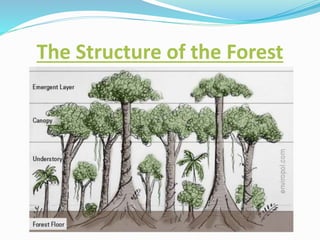
The Structure of the Forest
There are four basic structure of the forest, namely:
1. The Emergent Layer
2. The Canopy Layer
3. The Understory
4. The Forest Floor
The Structure of the Forest
Importance of the Forest
There are many reasons why the Forest biome is
important however some of these reasons are:
1. It forms Habitats and Ecosystems
2. It serves as a Watershed
3. It is considered the lungs of the earth
4. Climate control
5. It has economic benefits
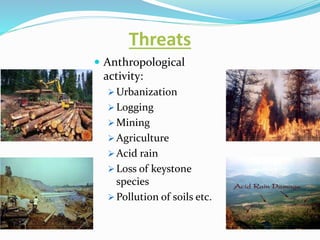
Threats
 Anthropological
activity:
 Urbanization
 Logging
 Mining
 Agriculture
 Acid rain
 Loss of keystone
species
 Pollution of soils etc.
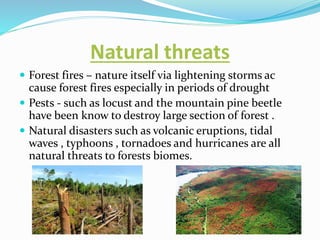
Natural threats
 Forest fires – nature itself via lightening storms ac
cause forest fires especially in periods of drought
 Pests - such as locust and the mountain pine beetle
have been know to destroy large section of forest .
 Natural disasters such as volcanic eruptions, tidal
waves , typhoons , tornadoes and hurricanes are all
natural threats to forests biomes.
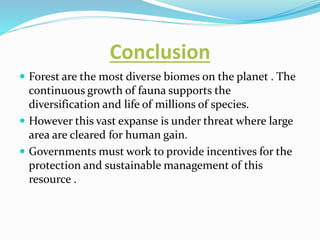
Conclusion
 Forest are the most diverse biomes on the planet . The
continuous growth of fauna supports the
diversification and life of millions of species.
 However this vast expanse is under threat where large
area are cleared for human gain.
 Governments must work to provide incentives for the
protection and sustainable management of this
resource .
References
 http://enviropol.com/index.php/forest-structure
 http://eschooltoday.com/forests/importance-of-forests.html
 http://www.brighthub.com/environment/science-
environmental/articles/81812.aspx
http://www.ucmp.berkeley.edu/exhibits/biomes/forests.php
 http://www.ucmp.berkeley.edu/exhibits/biomes/forests.php
 http://www.infoplease.com/encyclopedia/science/forest-types-
forests.html
 http://www.nhptv.org/natureworks/nwep8c.htm

Forest biomes , a college tutorial

  • 1.
    Group Members: Athena Lyttle SavitaStephenson Carlesa Duncan Antonio Phillips Ariana Charran Sharai Harris
  • 2.
    Layout of thispresentation  Definition of the Forest Biome The three main types of Forest Where the Forest types can be found? Species present in the types of Forest Abiotic characteristics of the Forest biomes Structure of the Forest Importance of the Forest Threats Conclusion References
  • 3.
    What is theForest Biome  Forest biomes - are defined as biological communities that are dominated by trees and other woody vegetation that can be classified according to numerous characteristics with seasonality being the most widely used. ( Spurr and Barnes 1980).
  • 4.
    The Three MainTypes of Forest  Tropical Hardwood Forests: These include rainforests and are characterized by an annual rainfall of about 160-400 inches (406-1000cm) with an average temperature of 80°F (27°C) and support a great diversity of plant life.
  • 5.
     Temperate HardwoodForests: These types of forests are marked by their seasonal rainfall distribution. There is also a growing season of 140-200 days during 4-6 frost free months.
  • 6.
     Boreal Forests:These forests are the largest terrestrial biomes. Seasons are divided into short, moist, and moderately warm summers and long, cold, and dry winters. The length of the growing season in boreal forests is 130 days.
  • 7.
    Where the typescan be found?  Tropical Hardwood Forests: This type of forest is found between the Tropics of Cancer ad the Tropics of Capricorn forming a belt of green-life.  Temperate Hardwood Forests: They are found in areas with warm, moist summers and mild winters. Mostly in the Northern Hemisphere: Eastern North America, East Asia, Europe and small areas in Australia and South America.  Boreal Forests: This type of forest extends in broad bands across North America and Eurasia. In North America it covers most of inland Canada and Alaska. In Eurasia it covers most of Sweden, Finland and Norway
  • 8.
  • 9.
    Species present inthe types of Forest Boreal Forest Animals Plants Raven Shrubs and wildflowers Wolves Conifers (fir and pine) Squirrels Small leaved deciduous trees (willow and alder) Moose Trees (oak, elm and maple)
  • 10.
  • 11.
    Tropical Hardwood Forest AnimalsPlants Vampire Bat Coconut trees Toco Tucan Mangrove forests Chimpanzee Bengal bamboo Proboscis Monkey Epiphytes Orangutan Buttress roots
  • 12.
  • 13.
    Temperate hardwood Forests AnimalsPlants White tailed deer Lichens Raccoons Moss Red foxes Ferns Woodpeckers Magnolia opossums Maple
  • 14.
  • 15.
    Abiotic characteristics ofthe Forest Biomes  The Boreal Forest  Temperature 1. Long winters and short mild summers 2. Cold winds come down from the arctic lasting about 6-7 months 3. Winter temperature ranges from a high of 30 to a low of -65 degrees F 4. Summer ranges from a high of 70 to a low of 30 degrees F 5. Average over all yearly temperature is 32 degrees F 
  • 16.
    Abiotic characteristics ofthe Forest Biomes  Sunlight 1. 20 hours of sunlight per day during the summer 2. Limited daylight during the winter  Precipitation 1. Receives 20- 200cm ( 8-79 inches) of precipitation per year 2. Precipitation occurs mostly in the form of snow
  • 17.
    Abiotic characteristics ofthe Forest Biomes Soil Conditions 1. The soil is acidic 2. It is poor in nutrients 3. The ground is swampy and marshy in many parts of the forest
  • 18.
    Abiotic characteristics ofthe Forest Biomes Tropical Hardwood Forest  Temperature 1. Temperature is on an average of 20- 25 degrees C  Precipitation 1. Precipitation is evenly distributed throughout the year. 2. There is an average of 50- 260 inches ( 125- 660 cm) of rain falls yearly.
  • 19.
    Abiotic characteristics ofthe Forest Biomes Soil Conditions 1. Soil is nutrient poor and acidic. 2. Decomposition is rapid. 3. Soils are subject to heavy leaching.
  • 20.
    Abiotic characteristics ofthe Forest Biomes Temperate Hardwood Forest  Temperature 1. Temperature varies from – 30 degrees C to 30 degrees C  Precipitation 1. Precipitation ( 75- 150cm) is distributed evenly throughout the year.  Soil Conditions 1. Soil is fertile and enriched with decaying litter.
  • 21.
    The Structure ofthe Forest There are four basic structure of the forest, namely: 1. The Emergent Layer 2. The Canopy Layer 3. The Understory 4. The Forest Floor
  • 22.
    The Structure ofthe Forest
  • 23.
    Importance of theForest There are many reasons why the Forest biome is important however some of these reasons are: 1. It forms Habitats and Ecosystems 2. It serves as a Watershed 3. It is considered the lungs of the earth 4. Climate control 5. It has economic benefits
  • 24.
    Threats  Anthropological activity:  Urbanization Logging  Mining  Agriculture  Acid rain  Loss of keystone species  Pollution of soils etc.
  • 25.
    Natural threats  Forestfires – nature itself via lightening storms ac cause forest fires especially in periods of drought  Pests - such as locust and the mountain pine beetle have been know to destroy large section of forest .  Natural disasters such as volcanic eruptions, tidal waves , typhoons , tornadoes and hurricanes are all natural threats to forests biomes.
  • 26.
    Conclusion  Forest arethe most diverse biomes on the planet . The continuous growth of fauna supports the diversification and life of millions of species.  However this vast expanse is under threat where large area are cleared for human gain.  Governments must work to provide incentives for the protection and sustainable management of this resource .
  • 27.
    References  http://enviropol.com/index.php/forest-structure  http://eschooltoday.com/forests/importance-of-forests.html http://www.brighthub.com/environment/science- environmental/articles/81812.aspx http://www.ucmp.berkeley.edu/exhibits/biomes/forests.php  http://www.ucmp.berkeley.edu/exhibits/biomes/forests.php  http://www.infoplease.com/encyclopedia/science/forest-types- forests.html  http://www.nhptv.org/natureworks/nwep8c.htm