NATURAL VEGETATION


http://www.slideshare.net/TanBK/chapter-11-weather-and-climate-lesson-slides-published
You will learn:
 about the relationship between climate and

 vegetation
 the global distribution of the different types of
 forests
 the characteristics of the different types of
 forests
 the benefits of natural vegetation to people

 the case study of tropical rainforest in

 Singapore
Today’s lesson, You will learn:


 what is natural vegetation
 what are primary and secondary vegetation

 what are the three major types and seven

 different sub-types of natural vegetation in
 the world
 how do climate affect the types of natural
 vegetation in the world
What is Natural Vegetation?


 Natural vegetation refers to
plants which have grown
naturally and not planted
by people.
Primary and Secondary Vegetation

 Primary Vegetation
refers to untouched, unspoiled forest that
exists in its original condition
 Secondary Vegetation

Refers to forest that has been disturbed in
some way, naturally or unnaturally
Areas with secondary vegetation have fewer
varieties of plants
Primary and Secondary Vegetation
Types of Natural Vegetation
    There are many types of natural vegetation and
    they can be grouped into three main major types

     Forests
     Grasslands

     Deserts


    Each major type of natural vegetation can be
    subdivided into various sub -types
Types of natural vegetation


        Forests                                               Deserts
                                                             Vegetation
                                  Grasslands


*Tropical rainforests
*Temperate deciduous forests    *Tropical savannahs     *Hot Desert vegetation
*Temperate coniferous forests   *Temperate grasslands   *Cold tundra vegetation
Distribution of Major Climatic types
            in the World
Distribution of Natural Vegetation
            in the World
Forests
 As you can see from the map:
      Tropical rain forests are found mainly along the
      equator between 23.5°N and 23.5°S of the
      equator).

     Temperate forests can be found mainly farther away
      from the equator mainly 23.5oN and 66.5oN, and
      between 23.5oS and 66.5oS.

     Coniferous forests can be found mainly far from
      the equator in the northern hemisphere (between
      60°N and 70°N of the equator).
Tropical rainforest
Temperate deciduous and coniferous
              forest
Why different types of natural
    vegetation exist in different parts
              of the Earth?


   Temperature affects vegetation because if it is
    too cold (less than 6°C), few plants can grow. On
    the other hand, warm temperatures (above 20°C)
    allow abundant plant growth
Why different types of natural
vegetation exist in different parts
          of the Earth?
   Precipitation (rainfall) also affect vegetation
    because all plants require water to grow.

   Most trees require more water to grow than
    grass.
Why different types of natural
    vegetation exist in different parts
              of the Earth?
   Hence, most forests grow in areas with high
    rainfall (above 1000 mm a year).
   In areas with moderate precipitation of between
    200 mm and 1000 mm, grasslands are more
    common.
   In areas with less than 200 mm of rain, deserts are
    found.
Climate – Vegetation
          Relationship
In summary:
Natural vegetation is influenced mainly by climate
 A climate-vegetation relationship exists because

 rainfall and temperature determine the type of
 natural vegetation found in a place
           High rainfall      -   forests
           Moderate rainfall - grasslands
           Low rainfall       - desert vegetation
Climate – Vegetation
           Relationship
In summary:
 Climate is a major factor that influences the
 distribution of natural vegetation.
 Other factors like the type of soil and altitude can
 also affect its distribution.
Forests

 Forests refer to large areas of land that consist
  mainly of trees and a variety of other plants
 They are usually found:
       Distribution                 Climate
                        Temperature     Rainfall (mm)
                             o
                               C
Between latitudes of      -12 to 30  300 mm to 2000 mm
    o           o
66.5 S and 66.5 N
Tropical Rainforests

You will learn:
 where are tropical rainforests found

 what are the characteristics of a tropical
  rainforest
a) The different layers of a tropical rainforest
b) The different types of plants found in the
    different layers
c) At least one of the adaptations of the tropical
    rainforest
Location of Tropical Rainforests

  Distribution          Climate               Location

                 Temperature      Rainfall
                     o
                       C           (mm)
Between           High            High • Amazon Basin in
latitudes of     Between          1000    South America,
     o
23.5 N and       20 to 30         mm to • Malaysia and
      o
23.5. S of the                    2000    Indonesia in
Equator which                      mm     Southeast Asia,
has a tropical                          • the Congo Basin
climate                                   in Africa
Tropical Rainforests
Characteristics of Tropical Rainforests
1. Trees grow very close to each other, making the
   forest very dense.


2. Plants grow in 3 distinct layers.
   • Emergent
   • Canopy
   • Undergrowth
The THREE LAYERS


                   Undergrowth
Characteristics of Tropical Rainforests
                  EMERGENT LAYER
                  • Reach heights of 40 to 50 metres
                  • Grow to receive more sunlight.
                  • Often have buttress roots to support the
                  tall and heavy trunks.


                    CANOPY LAYER
                    • Reach about 15 to 30 metres
                    • Crowns of trees interlock to form
                    continuous leaf cover (canopy)
                    • Cool and moist interior – blocks out
                    70% of sunlight
                    • Lianas are common – woody climbing
                    plants that hang down.
                    • Epiphytes are common – plants that
                    grow on other trees to get more sunlight
Characteristics of Tropical Rainforests


                   EMERGENT LAYER


                     CANOPY LAYER


                   }
                        UNDERGROWTH
                        • Made up of shrubs, grasses,
                        ferns, mosses and fungi.
                        • Plant growth is sparse
                        because of the lack of sunlight
Characteristics of Tropical Rainforests
• Some plants, called epiphytes overcome the
  shortage of sunlight by growing high up on
  tree branches to get sunlight (examples:
  ferns, orchids).
• Other plants, known as lianas, grow upwards
  to get more sunlight by winding around tree
  trunks.
Adaptation??
Tropical rainforests: Leaves

   Tropical forest trees are evergreens as the
    leaves remain green throughout the year.
   This is unlike deciduous trees, which shed
    their leaves in the autumn or in the dry
    seasons.
   The leaves are also broad to absorb as much as
    much sunlight as possible.
   They are also waxy and have drip tips to allow
    water to drain off.
Tropical rainforests: Leaves

   The bark of trees in the tropical rainforest is
    thin because they are not required to protect
    the trees from dry or cold conditions.
   Branches are also located in the top one-
    third portion of the trunks and they are
    shaped like umbrellas to capture as much
    sunlight as possible.
Tropical rainforests: Roots
   Roots of tropical forest trees are
    shallow because they do not need to
    reach deep into the soil for water.

   This also allows the roots to tap the
    abundant nutrients found in the layer
    of leaf litter of on the ground.
                                              Tree roots
                                               near the
   Some of the tallest trees have buttress    surface,
                                               Malaysia
    roots to support their great weight and
    prevent them from falling over.
The Shrinking Rainforests

 The world loses about 100 000 sq km of
  rainforests each year
 Forests are cleared for growing crops and
  building houses and roads, and logged every
  day
 We must do our part to save the remaining
  rainforests
The Shrinking Rainforests
Impacts of deforestation:

   Flooding
   Landslide due to soil erosion
   Loss of biodiversity of plants and animals
   Decrease in oxygen and increase in
    carbon dioxide
Temperate Coniferous Forests
CLIMATE AND DISTRIBUTION


Distribution           Climate          Location
               Temperature Rainfall
                   o
                    C          (mm)
Only            -12 to 10   300mm to • Japan
between                      750mm • China
latitudes of                         • Europe
     o
23.5 N and                           • North
      o
66.5. N of                             America
the Equator
Temperate Coniferous Forests
CHARACTERISITICS
1. Cone Shaped tree
  (think Christmas Tree!)

  • Allows snow to slide off the
    tree branches easily.
  • Prevents increase weight of
    the snow on the branches
    which can cause them to
    break.
Temperate Coniferous Forests
CHARACTERISITICS
2. Trees are evergreen
  • They adapt to extreme conditions instead of
    shedding their leaves.
3. Forests have only one variety of tree in each
  area. Example: Pine, Fir, Spruce
4. Only have one layer of vegetation
5. Very little undergrowth except for moss,
lichen and leaf litter on the forest floor.
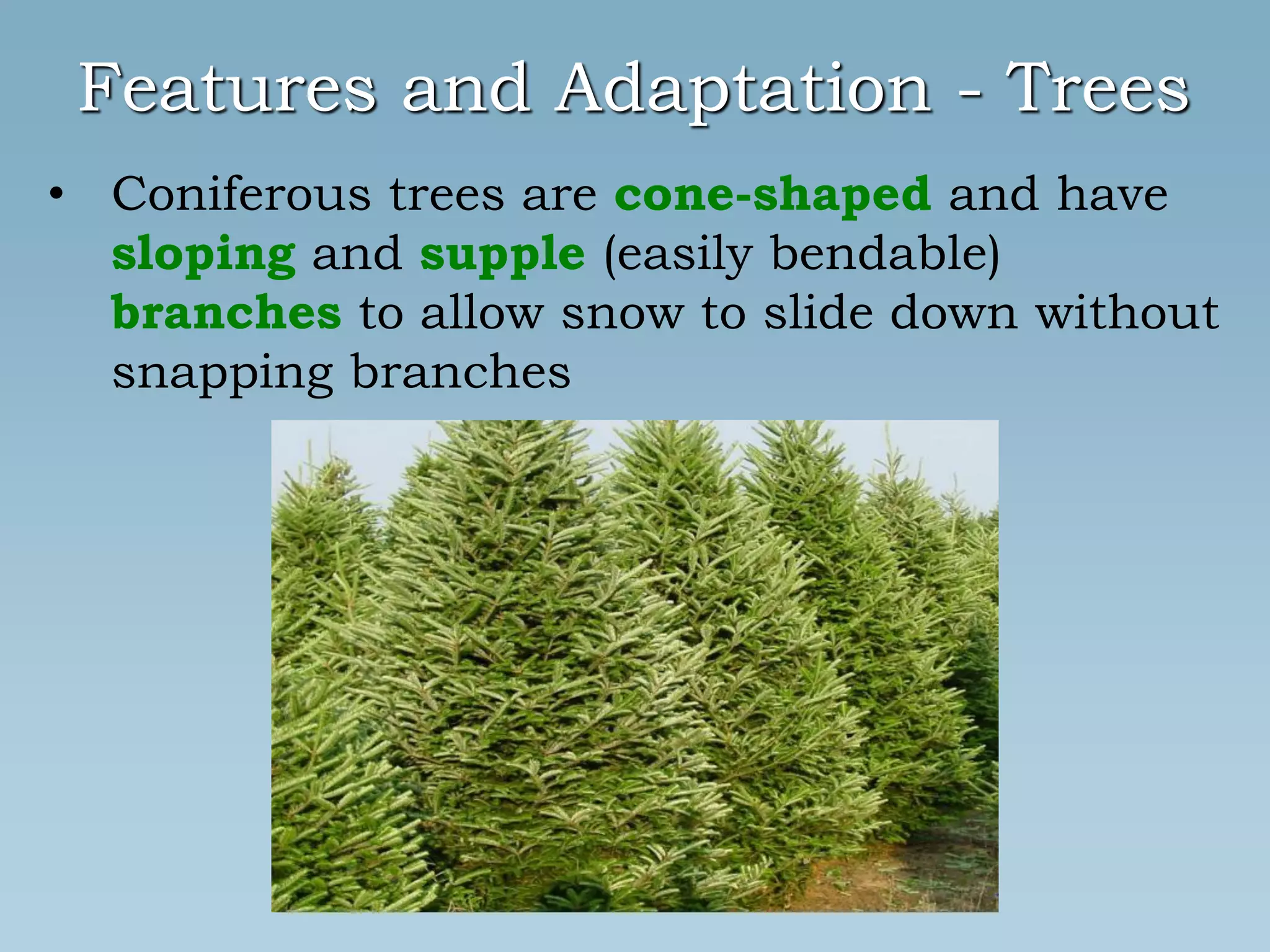
Features and Adaptation - Trees
• Coniferous trees are cone-shaped and have
  sloping and supple (easily bendable)
  branches to allow snow to slide down without
  snapping branches
Features and Adaptation - Leaves
                • The leaves are
                  small, needle-
                  shaped, waxy &
                  leathery to:
                • Minimise water
                  loss
                • Prevent the
                  accumulation of
                  snow
Features and Adaptation – Barks

                • Barks are
                  rough, tough &
                  contains resin
                  (thick, sticky
                  liquid) to protect
                  against cold and
                  to conserve
                  moisture
Features and Adaptation – Roots

• Coniferous trees have shallow spreading roots
  which enable them to absorb water from the
  surface during the short warm months.

• Roots do not go deep as the ground there may
  be permanently frozen, even during the summer.
Features and Adaptation – Roots

• Coniferous trees have shallow spreading roots
  which enable them to absorb water from the
  surface during the short warm months.

• Roots do not go deep as the ground there may
  be permanently frozen, even during the summer.
Quiz Time:

• State one difference and one similarity in the
  characteristics of the natural vegetation found in
  a Tropical Rainforest and a Temperate Coniferous
  forest.

• Explain how these characteristics help the plants
  to adapt to the living conditions in which they
  are found.
BENEFITS OF FORESTS

You will learn:
   what are some of the benefits of the
    natural vegetation to the Earth and
    humans.
BENEFITS OF FORESTS
Oxygen in the atmosphere:
•   Plants play an important role in
    maintaining the amount of oxygen in the air
Formation of rain:
• Plants add to the amount of water vapour in
  the air through transpiration and hence
  rainfall is usually high in places populated
  by many plants
BENEFITS OF FORESTS
Natural resource:
• The hardwood trees in
  rainforests provide wood
  required to make things like
  furniture and houses
 Medicinal value:
 • Many plants that grow in
   tropical rainforests have
   medicinal properties
BENEFITS OF FORESTS
Recreation:
A place where nature lovers can relax
BENEFITS OF FORESTS

Natural habitats:
• Loss of natural vegetation will result in
  the loss of food and habitat for animals
Prevents erosion of soil
•   Plants can prevent soil erosion
Case Study:
      Bukit Timah Nature Reserve
In Singapore, only a few small areas of
rainforests are left.
The government has set aside areas covered
by rainforests as Nature Reserves are part of
conservation efforts.
• Bukit Timah Nature Reserve is 164
hectares in size.
• Believed to be only 0.2% of the rainforest
originally in Singapore.
• Last 1% of primary rainforest in Singapore.
Case Study:
          Bukit Timah Nature Reserve
CHARACTERISTICS OF BUKIT TIMAH NATURE RESERVE
1. Tall trees (+30m) due to hot and wet climate
2. Trees have buttress roots to support themselves
3. Trees are evergreen and grow closely together.
4. Crowns interlock to form canopy that
   prevents sunlight from reaching the forest floor.
5. Dark and damp forest floor.
6. Wide variety of trees and other plants.
   • Different hardwood trees: seraya, meranti and nemusi
   • Species of climbing palms: rattan
Case Study:
        Bukit Timah Nature Reserve
VALUE OF TROPICAL RAINFORESTS
1.Medicinal Properties
2.Water Catchment areas
  • When rain falls, the rainwater is trapped by
    the leaves and falls to the ground. The
    water will drain slowly into the ground and
    eventually into nearby reservoirs.
Case Study:
       Bukit Timah Nature Reserve
VALUE OF TROPICAL RAINFORESTS
3. Recreational Activities
  • Such as trekking and jogging
4. National Heritage
  • Part of our history and our national
    heritage.
  • Singapore is on of the only two cities to
    have a sizeable amount of rainforest in a
    built up area.

Chapter 12 Natural Vegetation

  • 1.
  • 2.
    You will learn: about the relationship between climate and vegetation  the global distribution of the different types of forests  the characteristics of the different types of forests  the benefits of natural vegetation to people  the case study of tropical rainforest in Singapore
  • 3.
    Today’s lesson, Youwill learn:  what is natural vegetation  what are primary and secondary vegetation  what are the three major types and seven different sub-types of natural vegetation in the world  how do climate affect the types of natural vegetation in the world
  • 4.
    What is NaturalVegetation?  Natural vegetation refers to plants which have grown naturally and not planted by people.
  • 5.
    Primary and SecondaryVegetation  Primary Vegetation refers to untouched, unspoiled forest that exists in its original condition  Secondary Vegetation Refers to forest that has been disturbed in some way, naturally or unnaturally Areas with secondary vegetation have fewer varieties of plants
  • 6.
  • 7.
    Types of NaturalVegetation  There are many types of natural vegetation and they can be grouped into three main major types  Forests  Grasslands  Deserts  Each major type of natural vegetation can be subdivided into various sub -types
  • 8.
    Types of naturalvegetation Forests Deserts Vegetation Grasslands *Tropical rainforests *Temperate deciduous forests *Tropical savannahs *Hot Desert vegetation *Temperate coniferous forests *Temperate grasslands *Cold tundra vegetation
  • 9.
    Distribution of MajorClimatic types in the World
  • 10.
    Distribution of NaturalVegetation in the World
  • 11.
    Forests  As youcan see from the map:  Tropical rain forests are found mainly along the equator between 23.5°N and 23.5°S of the equator).  Temperate forests can be found mainly farther away from the equator mainly 23.5oN and 66.5oN, and between 23.5oS and 66.5oS.  Coniferous forests can be found mainly far from the equator in the northern hemisphere (between 60°N and 70°N of the equator).
  • 12.
  • 13.
    Temperate deciduous andconiferous forest
  • 14.
    Why different typesof natural vegetation exist in different parts of the Earth?  Temperature affects vegetation because if it is too cold (less than 6°C), few plants can grow. On the other hand, warm temperatures (above 20°C) allow abundant plant growth
  • 15.
    Why different typesof natural vegetation exist in different parts of the Earth?  Precipitation (rainfall) also affect vegetation because all plants require water to grow.  Most trees require more water to grow than grass.
  • 16.
    Why different typesof natural vegetation exist in different parts of the Earth?  Hence, most forests grow in areas with high rainfall (above 1000 mm a year).  In areas with moderate precipitation of between 200 mm and 1000 mm, grasslands are more common.  In areas with less than 200 mm of rain, deserts are found.
  • 17.
    Climate – Vegetation Relationship In summary: Natural vegetation is influenced mainly by climate  A climate-vegetation relationship exists because rainfall and temperature determine the type of natural vegetation found in a place High rainfall - forests Moderate rainfall - grasslands Low rainfall - desert vegetation
  • 18.
    Climate – Vegetation Relationship In summary:  Climate is a major factor that influences the distribution of natural vegetation.  Other factors like the type of soil and altitude can also affect its distribution.
  • 19.
    Forests  Forests referto large areas of land that consist mainly of trees and a variety of other plants  They are usually found: Distribution Climate Temperature Rainfall (mm) o C Between latitudes of -12 to 30 300 mm to 2000 mm o o 66.5 S and 66.5 N
  • 20.
    Tropical Rainforests You willlearn:  where are tropical rainforests found  what are the characteristics of a tropical rainforest a) The different layers of a tropical rainforest b) The different types of plants found in the different layers c) At least one of the adaptations of the tropical rainforest
  • 21.
    Location of TropicalRainforests Distribution Climate Location Temperature Rainfall o C (mm) Between High High • Amazon Basin in latitudes of Between 1000 South America, o 23.5 N and 20 to 30 mm to • Malaysia and o 23.5. S of the 2000 Indonesia in Equator which mm Southeast Asia, has a tropical • the Congo Basin climate in Africa
  • 22.
  • 23.
    Characteristics of TropicalRainforests 1. Trees grow very close to each other, making the forest very dense. 2. Plants grow in 3 distinct layers. • Emergent • Canopy • Undergrowth
  • 24.
    The THREE LAYERS Undergrowth
  • 25.
    Characteristics of TropicalRainforests EMERGENT LAYER • Reach heights of 40 to 50 metres • Grow to receive more sunlight. • Often have buttress roots to support the tall and heavy trunks. CANOPY LAYER • Reach about 15 to 30 metres • Crowns of trees interlock to form continuous leaf cover (canopy) • Cool and moist interior – blocks out 70% of sunlight • Lianas are common – woody climbing plants that hang down. • Epiphytes are common – plants that grow on other trees to get more sunlight
  • 26.
    Characteristics of TropicalRainforests EMERGENT LAYER CANOPY LAYER } UNDERGROWTH • Made up of shrubs, grasses, ferns, mosses and fungi. • Plant growth is sparse because of the lack of sunlight
  • 27.
    Characteristics of TropicalRainforests • Some plants, called epiphytes overcome the shortage of sunlight by growing high up on tree branches to get sunlight (examples: ferns, orchids). • Other plants, known as lianas, grow upwards to get more sunlight by winding around tree trunks.
  • 28.
  • 29.
    Tropical rainforests: Leaves  Tropical forest trees are evergreens as the leaves remain green throughout the year.  This is unlike deciduous trees, which shed their leaves in the autumn or in the dry seasons.  The leaves are also broad to absorb as much as much sunlight as possible.  They are also waxy and have drip tips to allow water to drain off.
  • 30.
    Tropical rainforests: Leaves  The bark of trees in the tropical rainforest is thin because they are not required to protect the trees from dry or cold conditions.  Branches are also located in the top one- third portion of the trunks and they are shaped like umbrellas to capture as much sunlight as possible.
  • 31.
    Tropical rainforests: Roots  Roots of tropical forest trees are shallow because they do not need to reach deep into the soil for water.  This also allows the roots to tap the abundant nutrients found in the layer of leaf litter of on the ground. Tree roots near the  Some of the tallest trees have buttress surface, Malaysia roots to support their great weight and prevent them from falling over.
  • 32.
    The Shrinking Rainforests The world loses about 100 000 sq km of rainforests each year  Forests are cleared for growing crops and building houses and roads, and logged every day  We must do our part to save the remaining rainforests
  • 33.
    The Shrinking Rainforests Impactsof deforestation:  Flooding  Landslide due to soil erosion  Loss of biodiversity of plants and animals  Decrease in oxygen and increase in carbon dioxide
  • 34.
    Temperate Coniferous Forests CLIMATEAND DISTRIBUTION Distribution Climate Location Temperature Rainfall o C (mm) Only -12 to 10 300mm to • Japan between 750mm • China latitudes of • Europe o 23.5 N and • North o 66.5. N of America the Equator
  • 36.
    Temperate Coniferous Forests CHARACTERISITICS 1.Cone Shaped tree (think Christmas Tree!) • Allows snow to slide off the tree branches easily. • Prevents increase weight of the snow on the branches which can cause them to break.
  • 37.
    Temperate Coniferous Forests CHARACTERISITICS 2.Trees are evergreen • They adapt to extreme conditions instead of shedding their leaves. 3. Forests have only one variety of tree in each area. Example: Pine, Fir, Spruce 4. Only have one layer of vegetation 5. Very little undergrowth except for moss, lichen and leaf litter on the forest floor.
  • 38.
    Features and Adaptation- Trees • Coniferous trees are cone-shaped and have sloping and supple (easily bendable) branches to allow snow to slide down without snapping branches
  • 39.
    Features and Adaptation- Leaves • The leaves are small, needle- shaped, waxy & leathery to: • Minimise water loss • Prevent the accumulation of snow
  • 40.
    Features and Adaptation– Barks • Barks are rough, tough & contains resin (thick, sticky liquid) to protect against cold and to conserve moisture
  • 41.
  • 42.
    Features and Adaptation– Roots • Coniferous trees have shallow spreading roots which enable them to absorb water from the surface during the short warm months. • Roots do not go deep as the ground there may be permanently frozen, even during the summer.
  • 43.
    Features and Adaptation– Roots • Coniferous trees have shallow spreading roots which enable them to absorb water from the surface during the short warm months. • Roots do not go deep as the ground there may be permanently frozen, even during the summer.
  • 44.
    Quiz Time: • Stateone difference and one similarity in the characteristics of the natural vegetation found in a Tropical Rainforest and a Temperate Coniferous forest. • Explain how these characteristics help the plants to adapt to the living conditions in which they are found.
  • 45.
    BENEFITS OF FORESTS Youwill learn:  what are some of the benefits of the natural vegetation to the Earth and humans.
  • 46.
    BENEFITS OF FORESTS Oxygenin the atmosphere: • Plants play an important role in maintaining the amount of oxygen in the air Formation of rain: • Plants add to the amount of water vapour in the air through transpiration and hence rainfall is usually high in places populated by many plants
  • 47.
    BENEFITS OF FORESTS Naturalresource: • The hardwood trees in rainforests provide wood required to make things like furniture and houses Medicinal value: • Many plants that grow in tropical rainforests have medicinal properties
  • 48.
    BENEFITS OF FORESTS Recreation: Aplace where nature lovers can relax
  • 49.
    BENEFITS OF FORESTS Naturalhabitats: • Loss of natural vegetation will result in the loss of food and habitat for animals Prevents erosion of soil • Plants can prevent soil erosion
  • 50.
    Case Study: Bukit Timah Nature Reserve In Singapore, only a few small areas of rainforests are left. The government has set aside areas covered by rainforests as Nature Reserves are part of conservation efforts. • Bukit Timah Nature Reserve is 164 hectares in size. • Believed to be only 0.2% of the rainforest originally in Singapore. • Last 1% of primary rainforest in Singapore.
  • 51.
    Case Study: Bukit Timah Nature Reserve CHARACTERISTICS OF BUKIT TIMAH NATURE RESERVE 1. Tall trees (+30m) due to hot and wet climate 2. Trees have buttress roots to support themselves 3. Trees are evergreen and grow closely together. 4. Crowns interlock to form canopy that prevents sunlight from reaching the forest floor. 5. Dark and damp forest floor. 6. Wide variety of trees and other plants. • Different hardwood trees: seraya, meranti and nemusi • Species of climbing palms: rattan
  • 52.
    Case Study: Bukit Timah Nature Reserve VALUE OF TROPICAL RAINFORESTS 1.Medicinal Properties 2.Water Catchment areas • When rain falls, the rainwater is trapped by the leaves and falls to the ground. The water will drain slowly into the ground and eventually into nearby reservoirs.
  • 53.
    Case Study: Bukit Timah Nature Reserve VALUE OF TROPICAL RAINFORESTS 3. Recreational Activities • Such as trekking and jogging 4. National Heritage • Part of our history and our national heritage. • Singapore is on of the only two cities to have a sizeable amount of rainforest in a built up area.