Sam higginbottom university of
agriculture,technology and sciences
ASSIGNMENT ON TYPES OF FORESTS
BIOL-537
SUBMITTED TO-DR.RICHA SHARMA
SUBMITTED BY-SHARA NAQVI
17BSLSCFS030
TYPES OF FORESTS
FOREST
A forest is a large area dominated by trees.
They covered 4 billion hectares or approximately
30 percent of the world's land area in 2006.
Forests are the dominant terrestrial ecosystem of
Earth, and are distributed around the globe.
Forests account for 75% of the gross primary
production of the Earth's biosphere, and contain
80% of the Earth's plant biomass.
EVOLUTIONARY HISTORY OF
FOREST
The first known forests on Earth arose in the Late
Devonian (approximately 380 million years ago),
with the evolution of Archaeopteris.They quickly
spread throughout the world, from the equator
to subpolar latitudes.Archaeopteris formed the
first forest by being the first known species to
cast shade due to its fronds and forming soil
from its roots. The shed organic matter altered
the freshwater environment, slowing it down
and providing food. This promoted freshwater
fish.
Each layer has a different set of plants and animals
depending upon the availability of sunlight, moisture and
food.
• Forest floor contains decomposing leaves, animal
droppings, and dead trees.The forest floor supports ferns,
grasses, mushroom and tree seedlings.
• Understory is made up of bushes, shrubs, and young
trees that are adapted to living in the shades of the
canopy.
• Canopy is formed by the mass of intertwined branches,
twigs and leaves of the mature trees. The canopy forms a
shady, protective "umbrella" over the rest of the forest.
• Emergent layer exists in the tropical rain forest and is
composed of a few scattered trees that tower over the
canopy.
LAYERS OF THE FOREST
TYPES OF FORESTS
The six types of forest are:
1. Equatorial Moist Evergreen or Rainforest
2. Tropical Deciduous Forest
3. Mediterranean Forests
4. Temperate Broad-leaved Deciduous and
Mixed Forest
5. Warm Temperate Broad-leaved Deciduous
Forest
6. Coniferous Forest.
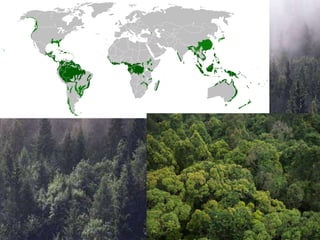
This evergreen hardwood forest is the natural
vegetation of low-latitude high precipitation
zone. This vegetation generally occur in
between 10° N. and S. of equator where
annual rainfall is very high and distributed
equitably throughout the year. The total
extent of tropical rainforest was 714 million
hectares in 1990, which is half of the world’s
forest cover.
Equatorial Moist Evergreen
or Rainforest
• this forest is distributed in three separate regions:
(a) South American Amazonia basin:
(b) Equatorial Africa:
(c) South-East Asia:
• Rainfall:
Convectional rainfall occur almost every-day. Mean
annual rainfall exceeds 200 cm. No well-marked dry
season is visible throughout the year.
• Temperature:
Average daily and annual temperature is very high,
around 30°C. The range of temperature is very low.
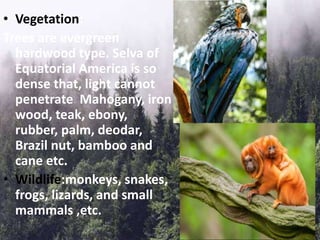
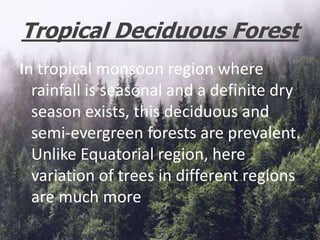
• Vegetation:
Trees are evergreen
hardwood type. Selva of
Equatorial America is so
dense that, light cannot
penetrate Mahogany, iron
wood, teak, ebony,
rubber, palm, deodar,
Brazil nut, bamboo and
cane etc.
• Wildlife:monkeys, snakes,
frogs, lizards, and small
mammals ,etc.
In tropical monsoon region where
rainfall is seasonal and a definite dry
season exists, this deciduous and
semi-evergreen forests are prevalent.
Unlike Equatorial region, here
variation of trees in different regions
are much more
Tropical Deciduous Forest
LOCATION
(a) India, Myanmar (Burma), Indonesia, Thailand, Laos,
Cambodia, South China, Philippines etc.(b) Northern
Australia.(c) Margins of tropical rainforest in Africa.(d)
Central South America.
Temperature:Average temperature of the year is higher,
ranging between 25°- 32°C. Lowest temperature in
winter is around 10°C. Trees shed their leaves in winter.
Rainfall:Average annual rainfall is very high, ranging
between 100-250 cm. Most of it occurs in rainy season.
This rainfall encourages trees of luxuriant growth.
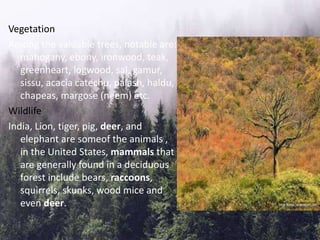
Vegetation
Among the valuable trees, notable are:
mahogany, ebony, ironwood, teak,
greenheart, logwood, sal, gamur,
sissu, acacia catechu, palash, haldu,
chapeas, margose (neem) etc.
Wildlife
India, Lion, tiger, pig, deer, and
elephant are someof the animals ,
in the United States, mammals that
are generally found in a deciduous
forest include bears, raccoons,
squirrels, skunks, wood mice and
even deer.
Mediterranean Forests:
Primarily found in the Mediterranean climate within
35°-45° North and South of the equator. This type of
vegetation covers an area of nearly 80 million
hectares of land.Characteristics of Vegetation:
Winter rainfall and dry summer separates
Mediterranean vegetation from all other vegetation
type. Lush green winter and pale brown summer is
typical. Though much of the original vegetation has
long been destroyed due to ruthless human
interference.
location (a) Adjacent regions of Mediterranean coast, extending east-
west over 2,500 kms covering countries like Portugal, Spain, France,
Italy, Albania, Greece, Turkey etc. (b) California in U.S.A. of N.
America. (c) Central Chile of S. America. (d) S-E and southern parts
of Australia. (e) Cape region of South Africa.
Temperature: Average annual temperature varies between 18° – 25°C.
Winters receive moderate temperature while summer months
remain hot.
Rainfall: The peculiar climatic characteristics of Mediterranean climate
is manifested by its winter rainfall. The region receives much of its
rainfall during winter, summer months remain dry and rainless.
Average annual rainfall varies between 50-100 cm
Present vegetation can be classified into three
broad groups: (a) Mediterranean Evergreen
vegetation = Oak, Cork, Eucalyptus, Redwood
etc. (b) Evergreen Coniferous Forest = Pine
including Aleppo Pine and Stone Pine, Fir,
Cypress etc. (c) Mediterranean Scrub and Bush
= Laurel, Myrtle, Lavender, Rose-merry.
Temperate Broad-leaved
Deciduous and Mixed Forest
:Location:In the eastern side of the continents, in
warm temperate region, this forest is located in:(i)
South China.(ii) South Japan.(iii) South Africa.(iv)
South-East Australia.(v) South Brazil.
Rainfall:all the year, minimum annual temperature
over 10°C.2. Due to heavy rainfall, evenly distributed
throughout the year, trees are evergreen, broad-
leaved and hard-wood type.
.Major Species:1. Koebrack in South-East Brazil.2.
Deodar.3. Eucalyptus.
Location:In warm temperate region, where
temperature remains above 6°C at least 6
months of the year. This forest developed
in central and north-west China, Korea,
Japan, New Zealand and Tasmania.
Characteristics:1. Trees shed their leaves
during spring.2. No layer in the leaves.
Major Species:Elm, Beach, Maple, Walnut
etc.
Warm Temperate Broad-leaved
Deciduous Forest
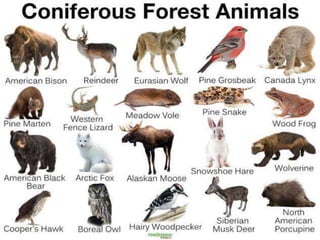
Coniferous Forest
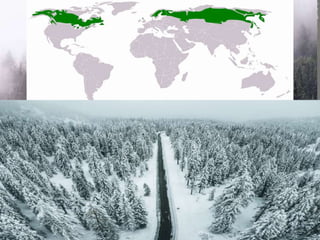
:Location:In both the hemisphere 50°-70° latitude, this
forest extends through Europe, Asia and North
America in Northern hemisphere and Chile,
Argentina and New Zealand in Southern hemisphere.
In Switzerland, Sweden, Norway and Finland in
Europe; North Japan, North China in Asia; C.I.S. in
Eurasia and Canada. In North America this coniferous
forest is known as Taiga.35% of the total global forest
extending over 1,200 million hectares is included in
the coniferous forest.
Climatic Characteristics:The winter temperature remains
very low. Sometimes it goes below -10°C. Winter experi-
ences heavy snowfall, summer very low snowfall.Annual
rainfall varies between 30-50 cm. 5°C isotherm line
demarcates its northern limit while 10°C isotherm line
delimits its southern limit in summer.The major climatic
characteristics are:(i) Prolonged winter.(ii) Mild short
summer.(iii) Scanty rainfall
:The major tree species in coniferous forest are:(i) Pine(ii)
Fir(iii) Birch(iv) Spruce(v) Willow(vi) Lirch(vii) Aspen(viii)
Alder(ix) Douglas.Pines and Firs are of different varieties
— White pine, Red pine, Scot pine, Douglas Fir, Bolson etc
.Geographical Distribution of Coniferous Forest in the Northern
Hemisphere:In Northern Hemisphere this forest can be divided into 5 sub-
regions:
(i) Western part of northern America:In U.S.A.’s north California,
Washington and South-West Oregon; British Columbia in Canada dense
and large forest has developed. The major trees in this region are
Douglas, Fir, Spruce and Redwood.
(ii) South U.S.A.:Despite warm and moist climate from Virginia to Texas,
coniferous trees like Pine, Ses-pine type of trees are found.
(iii) Central and Eastern region of North America:Due to dry and intense
continental climate as also shallow soil, widespread development of Taiga
forest is visible in and around Great Lake and Appalachian regions. Major
trees here are Spruce, White pine, Jack-pine, Hemlock, Bolson etc.
(iv) Europe:European forests are predominant in Norway, Sweden, Finland
and northern Russia. This forest has been worked out for a very long
period, so the scope for increasing output is supposed to be limited.
(v) Asian region:This sub-region of the coniferous forest extends from Ural
Mountain to Siberia. Also visible in Northern Japan, Manchuria, Northern
China and Himalayan mountain region.
TYPES OF FORESTS FOUND
IN INDIA
1. Coniferous Forests grow in the Himalayan
mountain region, where the temperatures
are low. These forests have tall stately trees
with needlelike leaves and downward sloping
branches so that the snow can slip off the
branches. They have cones instead of seeds
and are called Gymnosperms.
b) Broadleaved Forests have several types, such as
evergreen forests, deciduous forests, thorn forests, and
mangrove forests. Broadleaved forests have large
leaves of various shapes.
c) Evergreen Forests grow in the high rainfall areas of the
Western Ghats, North-Eastern India, and the Andaman
and Nicobar Islands. These forests grow in areas where
the monsoon lasts for several months.
The trees overlap with each other to form a continuous
canopy. Thus very little light penetrates down to the
forest floor.
The forest is rich in orchids and ferns. The barks of the
trees are covered in moss. The forest abounds in
animal life and is most rich in insect life
d) Wet Evergreen
Wet evergreen forests are found in the
south along the Western Ghats and the
Nicobar and Andaman Islands and all
along the north-eastern region.
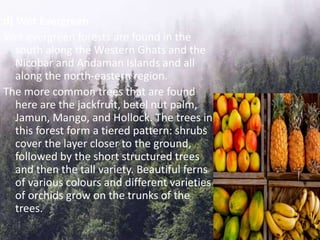
The more common trees that are found
here are the jackfruit, betel nut palm,
Jamun, Mango, and Hollock. The trees in
this forest form a tiered pattern: shrubs
cover the layer closer to the ground,
followed by the short structured trees
and then the tall variety. Beautiful ferns
of various colours and different varieties
of orchids grow on the trunks of the
trees.
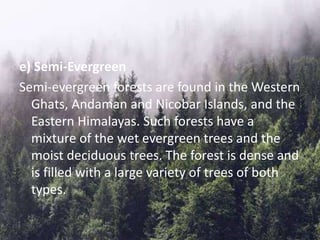
e) Semi-Evergreen
Semi-evergreen forests are found in the Western
Ghats, Andaman and Nicobar Islands, and the
Eastern Himalayas. Such forests have a
mixture of the wet evergreen trees and the
moist deciduous trees. The forest is dense and
is filled with a large variety of trees of both
types.
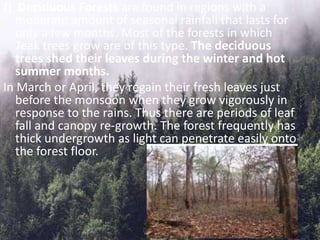
f) Deciduous Forests are found in regions with a
moderate amount of seasonal rainfall that lasts for
only a few months. Most of the forests in which
Teak trees grow are of this type. The deciduous
trees shed their leaves during the winter and hot
summer months.
In March or April, they regain their fresh leaves just
before the monsoon when they grow vigorously in
response to the rains. Thus there are periods of leaf
fall and canopy re-growth. The forest frequently has
thick undergrowth as light can penetrate easily onto
the forest floor.
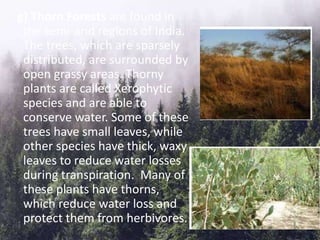
g) Thorn Forests are found in
the semi-arid regions of India.
The trees, which are sparsely
distributed, are surrounded by
open grassy areas. Thorny
plants are called Xerophytic
species and are able to
conserve water. Some of these
trees have small leaves, while
other species have thick, waxy
leaves to reduce water losses
during transpiration. Many of
these plants have thorns,
which reduce water loss and
protect them from herbivores.
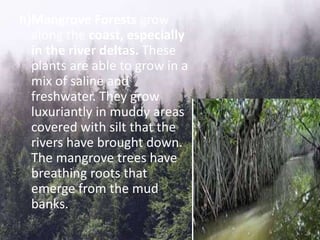
h)Mangrove Forests grow
along the coast, especially
in the river deltas. These
plants are able to grow in a
mix of saline and
freshwater. They grow
luxuriantly in muddy areas
covered with silt that the
rivers have brought down.
The mangrove trees have
breathing roots that
emerge from the mud
banks.
THANK YOU!

types of forest

  • 1.
    Sam higginbottom universityof agriculture,technology and sciences ASSIGNMENT ON TYPES OF FORESTS BIOL-537 SUBMITTED TO-DR.RICHA SHARMA SUBMITTED BY-SHARA NAQVI 17BSLSCFS030
  • 2.
  • 3.
    FOREST A forest isa large area dominated by trees. They covered 4 billion hectares or approximately 30 percent of the world's land area in 2006. Forests are the dominant terrestrial ecosystem of Earth, and are distributed around the globe. Forests account for 75% of the gross primary production of the Earth's biosphere, and contain 80% of the Earth's plant biomass.
  • 4.
    EVOLUTIONARY HISTORY OF FOREST Thefirst known forests on Earth arose in the Late Devonian (approximately 380 million years ago), with the evolution of Archaeopteris.They quickly spread throughout the world, from the equator to subpolar latitudes.Archaeopteris formed the first forest by being the first known species to cast shade due to its fronds and forming soil from its roots. The shed organic matter altered the freshwater environment, slowing it down and providing food. This promoted freshwater fish.
  • 5.
    Each layer hasa different set of plants and animals depending upon the availability of sunlight, moisture and food. • Forest floor contains decomposing leaves, animal droppings, and dead trees.The forest floor supports ferns, grasses, mushroom and tree seedlings. • Understory is made up of bushes, shrubs, and young trees that are adapted to living in the shades of the canopy. • Canopy is formed by the mass of intertwined branches, twigs and leaves of the mature trees. The canopy forms a shady, protective "umbrella" over the rest of the forest. • Emergent layer exists in the tropical rain forest and is composed of a few scattered trees that tower over the canopy. LAYERS OF THE FOREST
  • 6.
    TYPES OF FORESTS Thesix types of forest are: 1. Equatorial Moist Evergreen or Rainforest 2. Tropical Deciduous Forest 3. Mediterranean Forests 4. Temperate Broad-leaved Deciduous and Mixed Forest 5. Warm Temperate Broad-leaved Deciduous Forest 6. Coniferous Forest.
  • 7.
    This evergreen hardwoodforest is the natural vegetation of low-latitude high precipitation zone. This vegetation generally occur in between 10° N. and S. of equator where annual rainfall is very high and distributed equitably throughout the year. The total extent of tropical rainforest was 714 million hectares in 1990, which is half of the world’s forest cover. Equatorial Moist Evergreen or Rainforest
  • 8.
    • this forestis distributed in three separate regions: (a) South American Amazonia basin: (b) Equatorial Africa: (c) South-East Asia: • Rainfall: Convectional rainfall occur almost every-day. Mean annual rainfall exceeds 200 cm. No well-marked dry season is visible throughout the year. • Temperature: Average daily and annual temperature is very high, around 30°C. The range of temperature is very low.
  • 10.
    • Vegetation: Trees areevergreen hardwood type. Selva of Equatorial America is so dense that, light cannot penetrate Mahogany, iron wood, teak, ebony, rubber, palm, deodar, Brazil nut, bamboo and cane etc. • Wildlife:monkeys, snakes, frogs, lizards, and small mammals ,etc.
  • 11.
    In tropical monsoonregion where rainfall is seasonal and a definite dry season exists, this deciduous and semi-evergreen forests are prevalent. Unlike Equatorial region, here variation of trees in different regions are much more Tropical Deciduous Forest
  • 12.
    LOCATION (a) India, Myanmar(Burma), Indonesia, Thailand, Laos, Cambodia, South China, Philippines etc.(b) Northern Australia.(c) Margins of tropical rainforest in Africa.(d) Central South America. Temperature:Average temperature of the year is higher, ranging between 25°- 32°C. Lowest temperature in winter is around 10°C. Trees shed their leaves in winter. Rainfall:Average annual rainfall is very high, ranging between 100-250 cm. Most of it occurs in rainy season. This rainfall encourages trees of luxuriant growth.
  • 14.
    Vegetation Among the valuabletrees, notable are: mahogany, ebony, ironwood, teak, greenheart, logwood, sal, gamur, sissu, acacia catechu, palash, haldu, chapeas, margose (neem) etc. Wildlife India, Lion, tiger, pig, deer, and elephant are someof the animals , in the United States, mammals that are generally found in a deciduous forest include bears, raccoons, squirrels, skunks, wood mice and even deer.
  • 15.
    Mediterranean Forests: Primarily foundin the Mediterranean climate within 35°-45° North and South of the equator. This type of vegetation covers an area of nearly 80 million hectares of land.Characteristics of Vegetation: Winter rainfall and dry summer separates Mediterranean vegetation from all other vegetation type. Lush green winter and pale brown summer is typical. Though much of the original vegetation has long been destroyed due to ruthless human interference.
  • 16.
    location (a) Adjacentregions of Mediterranean coast, extending east- west over 2,500 kms covering countries like Portugal, Spain, France, Italy, Albania, Greece, Turkey etc. (b) California in U.S.A. of N. America. (c) Central Chile of S. America. (d) S-E and southern parts of Australia. (e) Cape region of South Africa. Temperature: Average annual temperature varies between 18° – 25°C. Winters receive moderate temperature while summer months remain hot. Rainfall: The peculiar climatic characteristics of Mediterranean climate is manifested by its winter rainfall. The region receives much of its rainfall during winter, summer months remain dry and rainless. Average annual rainfall varies between 50-100 cm
  • 17.
    Present vegetation canbe classified into three broad groups: (a) Mediterranean Evergreen vegetation = Oak, Cork, Eucalyptus, Redwood etc. (b) Evergreen Coniferous Forest = Pine including Aleppo Pine and Stone Pine, Fir, Cypress etc. (c) Mediterranean Scrub and Bush = Laurel, Myrtle, Lavender, Rose-merry.
  • 19.
    Temperate Broad-leaved Deciduous andMixed Forest :Location:In the eastern side of the continents, in warm temperate region, this forest is located in:(i) South China.(ii) South Japan.(iii) South Africa.(iv) South-East Australia.(v) South Brazil. Rainfall:all the year, minimum annual temperature over 10°C.2. Due to heavy rainfall, evenly distributed throughout the year, trees are evergreen, broad- leaved and hard-wood type. .Major Species:1. Koebrack in South-East Brazil.2. Deodar.3. Eucalyptus.
  • 20.
    Location:In warm temperateregion, where temperature remains above 6°C at least 6 months of the year. This forest developed in central and north-west China, Korea, Japan, New Zealand and Tasmania. Characteristics:1. Trees shed their leaves during spring.2. No layer in the leaves. Major Species:Elm, Beach, Maple, Walnut etc. Warm Temperate Broad-leaved Deciduous Forest
  • 21.
    Coniferous Forest :Location:In boththe hemisphere 50°-70° latitude, this forest extends through Europe, Asia and North America in Northern hemisphere and Chile, Argentina and New Zealand in Southern hemisphere. In Switzerland, Sweden, Norway and Finland in Europe; North Japan, North China in Asia; C.I.S. in Eurasia and Canada. In North America this coniferous forest is known as Taiga.35% of the total global forest extending over 1,200 million hectares is included in the coniferous forest.
  • 22.
    Climatic Characteristics:The wintertemperature remains very low. Sometimes it goes below -10°C. Winter experi- ences heavy snowfall, summer very low snowfall.Annual rainfall varies between 30-50 cm. 5°C isotherm line demarcates its northern limit while 10°C isotherm line delimits its southern limit in summer.The major climatic characteristics are:(i) Prolonged winter.(ii) Mild short summer.(iii) Scanty rainfall :The major tree species in coniferous forest are:(i) Pine(ii) Fir(iii) Birch(iv) Spruce(v) Willow(vi) Lirch(vii) Aspen(viii) Alder(ix) Douglas.Pines and Firs are of different varieties — White pine, Red pine, Scot pine, Douglas Fir, Bolson etc
  • 23.
    .Geographical Distribution ofConiferous Forest in the Northern Hemisphere:In Northern Hemisphere this forest can be divided into 5 sub- regions: (i) Western part of northern America:In U.S.A.’s north California, Washington and South-West Oregon; British Columbia in Canada dense and large forest has developed. The major trees in this region are Douglas, Fir, Spruce and Redwood. (ii) South U.S.A.:Despite warm and moist climate from Virginia to Texas, coniferous trees like Pine, Ses-pine type of trees are found. (iii) Central and Eastern region of North America:Due to dry and intense continental climate as also shallow soil, widespread development of Taiga forest is visible in and around Great Lake and Appalachian regions. Major trees here are Spruce, White pine, Jack-pine, Hemlock, Bolson etc. (iv) Europe:European forests are predominant in Norway, Sweden, Finland and northern Russia. This forest has been worked out for a very long period, so the scope for increasing output is supposed to be limited. (v) Asian region:This sub-region of the coniferous forest extends from Ural Mountain to Siberia. Also visible in Northern Japan, Manchuria, Northern China and Himalayan mountain region.
  • 26.
    TYPES OF FORESTSFOUND IN INDIA 1. Coniferous Forests grow in the Himalayan mountain region, where the temperatures are low. These forests have tall stately trees with needlelike leaves and downward sloping branches so that the snow can slip off the branches. They have cones instead of seeds and are called Gymnosperms.
  • 27.
    b) Broadleaved Forestshave several types, such as evergreen forests, deciduous forests, thorn forests, and mangrove forests. Broadleaved forests have large leaves of various shapes. c) Evergreen Forests grow in the high rainfall areas of the Western Ghats, North-Eastern India, and the Andaman and Nicobar Islands. These forests grow in areas where the monsoon lasts for several months. The trees overlap with each other to form a continuous canopy. Thus very little light penetrates down to the forest floor. The forest is rich in orchids and ferns. The barks of the trees are covered in moss. The forest abounds in animal life and is most rich in insect life
  • 28.
    d) Wet Evergreen Wetevergreen forests are found in the south along the Western Ghats and the Nicobar and Andaman Islands and all along the north-eastern region. The more common trees that are found here are the jackfruit, betel nut palm, Jamun, Mango, and Hollock. The trees in this forest form a tiered pattern: shrubs cover the layer closer to the ground, followed by the short structured trees and then the tall variety. Beautiful ferns of various colours and different varieties of orchids grow on the trunks of the trees.
  • 29.
    e) Semi-Evergreen Semi-evergreen forestsare found in the Western Ghats, Andaman and Nicobar Islands, and the Eastern Himalayas. Such forests have a mixture of the wet evergreen trees and the moist deciduous trees. The forest is dense and is filled with a large variety of trees of both types.
  • 30.
    f) Deciduous Forestsare found in regions with a moderate amount of seasonal rainfall that lasts for only a few months. Most of the forests in which Teak trees grow are of this type. The deciduous trees shed their leaves during the winter and hot summer months. In March or April, they regain their fresh leaves just before the monsoon when they grow vigorously in response to the rains. Thus there are periods of leaf fall and canopy re-growth. The forest frequently has thick undergrowth as light can penetrate easily onto the forest floor.
  • 31.
    g) Thorn Forestsare found in the semi-arid regions of India. The trees, which are sparsely distributed, are surrounded by open grassy areas. Thorny plants are called Xerophytic species and are able to conserve water. Some of these trees have small leaves, while other species have thick, waxy leaves to reduce water losses during transpiration. Many of these plants have thorns, which reduce water loss and protect them from herbivores.
  • 32.
    h)Mangrove Forests grow alongthe coast, especially in the river deltas. These plants are able to grow in a mix of saline and freshwater. They grow luxuriantly in muddy areas covered with silt that the rivers have brought down. The mangrove trees have breathing roots that emerge from the mud banks.
  • 33.