SNDT WOMEN’S UNIVERSITY
PRESENTATION ON TERRESTRIAL BIOMES
2019-2020
SUBMITTED BY- SROYONA DE
– DEPT. of GEOGRAPHY
– M.A Part I
– Roll No. 03
Introduction
• A biome is a community on a global scale, where habitats flank each other, and is
usually defined by the temperature, precipitation, and types of flora and fauna that
inhabit the area.
• The earth’s biomes are divided into two major types terrestrial biomes and aquatic
biomes.
• Terrestrial biomes are based on land, while aquatic biomes are based on both ocean
and freshwater biomes.
• Terrestrial biomes are of the following types-
1. Forest
2. Grassland
3. Desert
4. Tundra
5. Savannah
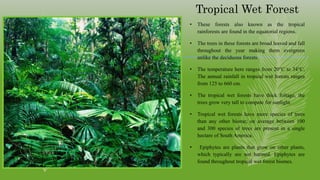
Tropical Wet Forest
• These forests also known as the tropical
rainforests are found in the equatorial regions.
• The trees in these forests are broad leaved and fall
throughout the year making them evergreen
unlike the deciduous forests.
• The temperature here ranges from 20°C to 34°C,
The annual rainfall in tropical wet forests ranges
from 125 to 660 cm.
• The tropical wet forests have thick foliage, the
trees grow very tall to compete for sunlight.
• Tropical wet forests have more species of trees
than any other biome; on average between 100
and 300 species of trees are present in a single
hectare of South America.
• Epiphytes are plants that grow on other plants,
which typically are not harmed. Epiphytes are
found throughout tropical wet forest biomes.
Temperate Forests
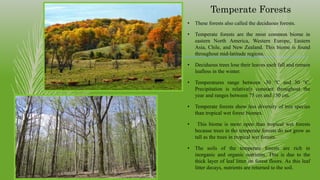
• These forests also called the deciduous forests.
• Temperate forests are the most common biome in
eastern North America, Western Europe, Eastern
Asia, Chile, and New Zealand. This biome is found
throughout mid-latitude regions.
• Deciduous trees lose their leaves each fall and remain
leafless in the winter.
• Temperatures range between -30 °C and 30 °C,
Precipitation is relatively constant throughout the
year and ranges between 75 cm and 150 cm.
• Temperate forests show less diversity of tree species
than tropical wet forest biomes.
• This biome is more open than tropical wet forests
because trees in the temperate forests do not grow as
tall as the trees in tropical wet forests.
• The soils of the temperate forests are rich in
inorganic and organic nutrients. This is due to the
thick layer of leaf litter on forest floors. As this leaf
litter decays, nutrients are returned to the soil.
Subtropical Deserts
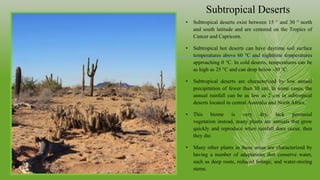
• Subtropical deserts exist between 15 ° and 30 ° north
and south latitude and are centered on the Tropics of
Cancer and Capricorn.
• Subtropical hot deserts can have daytime soil surface
temperatures above 60 °C and nighttime temperatures
approaching 0 °C. In cold deserts, temperatures can be
as high as 25 °C and can drop below -30 °C.
• Subtropical deserts are characterized by low annual
precipitation of fewer than 30 cm. In some cases, the
annual rainfall can be as low as 2 cm in subtropical
deserts located in central Australia and North Africa.
• This biome is very dry, lack perennial
vegetation instead, many plants are annuals that grow
quickly and reproduce when rainfall does occur, then
they die.
• Many other plants in these areas are characterized by
having a number of adaptations that conserve water,
such as deep roots, reduced foliage, and water-storing
stems.
Chapparal
• The chaparral is also called the scrub forest
and is found in California, along the
Mediterranean Sea, and along the southern
coast of Australia.
• The annual rainfall in this biome ranges
from 65 cm to 75 cm.
• Summers are very dry and many chaparral
plants are dormant during the
summertime.
• The chaparral vegetation, is dominated by
shrubs and is adapted to periodic fires, with
some plants producing seeds that only
germinate after a hot fire.
• The ashes left behind after a fire are rich in
nutrients like nitrogen that fertilize the soil
and promote plant regrowth.
Temperate Grassland
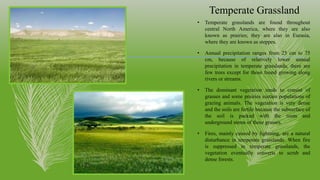
• Temperate grasslands are found throughout
central North America, where they are also
known as prairies; they are also in Eurasia,
where they are known as steppes.
• Annual precipitation ranges from 25 cm to 75
cm, because of relatively lower annual
precipitation in temperate grasslands, there are
few trees except for those found growing along
rivers or streams.
• The dominant vegetation tends to consist of
grasses and some prairies sustain populations of
grazing animals. The vegetation is very dense
and the soils are fertile because the subsurface of
the soil is packed with the roots and
underground stems of these grasses.
• Fires, mainly caused by lightning, are a natural
disturbance in temperate grasslands. When fire
is suppressed in temperate grasslands, the
vegetation eventually converts to scrub and
dense forests.
Boreal Forests
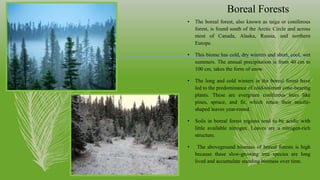
• The boreal forest, also known as taiga or coniferous
forest, is found south of the Arctic Circle and across
most of Canada, Alaska, Russia, and northern
Europe.
• This biome has cold, dry winters and short, cool, wet
summers. The annual precipitation is from 40 cm to
100 cm, takes the form of snow.
• The long and cold winters in the boreal forest have
led to the predominance of cold-tolerant cone-bearing
plants. These are evergreen coniferous trees like
pines, spruce, and fir, which retain their needle-
shaped leaves year-round.
• Soils in boreal forest regions tend to be acidic with
little available nitrogen. Leaves are a nitrogen-rich
structure.
• The aboveground biomass of boreal forests is high
because these slow-growing tree species are long
lived and accumulate standing biomass over time.
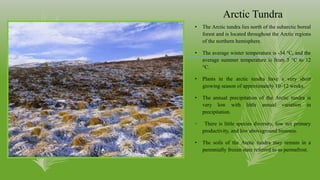
Arctic Tundra
• The Arctic tundra lies north of the subarctic boreal
forest and is located throughout the Arctic regions
of the northern hemisphere.
• The average winter temperature is -34 °C, and the
average summer temperature is from 3 °C to 12
°C.
• Plants in the arctic tundra have a very short
growing season of approximately 10–12 weeks.
• The annual precipitation of the Arctic tundra is
very low with little annual variation in
precipitation.
• There is little species diversity, low net primary
productivity, and low aboveground biomass.
• The soils of the Arctic tundra may remain in a
perennially frozen state referred to as permafrost.
THANK YOU

Biogeography Presentation.pptx

  • 1.
    SNDT WOMEN’S UNIVERSITY PRESENTATIONON TERRESTRIAL BIOMES 2019-2020 SUBMITTED BY- SROYONA DE – DEPT. of GEOGRAPHY – M.A Part I – Roll No. 03
  • 2.
    Introduction • A biomeis a community on a global scale, where habitats flank each other, and is usually defined by the temperature, precipitation, and types of flora and fauna that inhabit the area. • The earth’s biomes are divided into two major types terrestrial biomes and aquatic biomes. • Terrestrial biomes are based on land, while aquatic biomes are based on both ocean and freshwater biomes. • Terrestrial biomes are of the following types- 1. Forest 2. Grassland 3. Desert 4. Tundra 5. Savannah
  • 3.
    Tropical Wet Forest •These forests also known as the tropical rainforests are found in the equatorial regions. • The trees in these forests are broad leaved and fall throughout the year making them evergreen unlike the deciduous forests. • The temperature here ranges from 20°C to 34°C, The annual rainfall in tropical wet forests ranges from 125 to 660 cm. • The tropical wet forests have thick foliage, the trees grow very tall to compete for sunlight. • Tropical wet forests have more species of trees than any other biome; on average between 100 and 300 species of trees are present in a single hectare of South America. • Epiphytes are plants that grow on other plants, which typically are not harmed. Epiphytes are found throughout tropical wet forest biomes.
  • 4.
    Temperate Forests • Theseforests also called the deciduous forests. • Temperate forests are the most common biome in eastern North America, Western Europe, Eastern Asia, Chile, and New Zealand. This biome is found throughout mid-latitude regions. • Deciduous trees lose their leaves each fall and remain leafless in the winter. • Temperatures range between -30 °C and 30 °C, Precipitation is relatively constant throughout the year and ranges between 75 cm and 150 cm. • Temperate forests show less diversity of tree species than tropical wet forest biomes. • This biome is more open than tropical wet forests because trees in the temperate forests do not grow as tall as the trees in tropical wet forests. • The soils of the temperate forests are rich in inorganic and organic nutrients. This is due to the thick layer of leaf litter on forest floors. As this leaf litter decays, nutrients are returned to the soil.
  • 5.
    Subtropical Deserts • Subtropicaldeserts exist between 15 ° and 30 ° north and south latitude and are centered on the Tropics of Cancer and Capricorn. • Subtropical hot deserts can have daytime soil surface temperatures above 60 °C and nighttime temperatures approaching 0 °C. In cold deserts, temperatures can be as high as 25 °C and can drop below -30 °C. • Subtropical deserts are characterized by low annual precipitation of fewer than 30 cm. In some cases, the annual rainfall can be as low as 2 cm in subtropical deserts located in central Australia and North Africa. • This biome is very dry, lack perennial vegetation instead, many plants are annuals that grow quickly and reproduce when rainfall does occur, then they die. • Many other plants in these areas are characterized by having a number of adaptations that conserve water, such as deep roots, reduced foliage, and water-storing stems.
  • 6.
    Chapparal • The chaparralis also called the scrub forest and is found in California, along the Mediterranean Sea, and along the southern coast of Australia. • The annual rainfall in this biome ranges from 65 cm to 75 cm. • Summers are very dry and many chaparral plants are dormant during the summertime. • The chaparral vegetation, is dominated by shrubs and is adapted to periodic fires, with some plants producing seeds that only germinate after a hot fire. • The ashes left behind after a fire are rich in nutrients like nitrogen that fertilize the soil and promote plant regrowth.
  • 7.
    Temperate Grassland • Temperategrasslands are found throughout central North America, where they are also known as prairies; they are also in Eurasia, where they are known as steppes. • Annual precipitation ranges from 25 cm to 75 cm, because of relatively lower annual precipitation in temperate grasslands, there are few trees except for those found growing along rivers or streams. • The dominant vegetation tends to consist of grasses and some prairies sustain populations of grazing animals. The vegetation is very dense and the soils are fertile because the subsurface of the soil is packed with the roots and underground stems of these grasses. • Fires, mainly caused by lightning, are a natural disturbance in temperate grasslands. When fire is suppressed in temperate grasslands, the vegetation eventually converts to scrub and dense forests.
  • 8.
    Boreal Forests • Theboreal forest, also known as taiga or coniferous forest, is found south of the Arctic Circle and across most of Canada, Alaska, Russia, and northern Europe. • This biome has cold, dry winters and short, cool, wet summers. The annual precipitation is from 40 cm to 100 cm, takes the form of snow. • The long and cold winters in the boreal forest have led to the predominance of cold-tolerant cone-bearing plants. These are evergreen coniferous trees like pines, spruce, and fir, which retain their needle- shaped leaves year-round. • Soils in boreal forest regions tend to be acidic with little available nitrogen. Leaves are a nitrogen-rich structure. • The aboveground biomass of boreal forests is high because these slow-growing tree species are long lived and accumulate standing biomass over time.
  • 9.
    Arctic Tundra • TheArctic tundra lies north of the subarctic boreal forest and is located throughout the Arctic regions of the northern hemisphere. • The average winter temperature is -34 °C, and the average summer temperature is from 3 °C to 12 °C. • Plants in the arctic tundra have a very short growing season of approximately 10–12 weeks. • The annual precipitation of the Arctic tundra is very low with little annual variation in precipitation. • There is little species diversity, low net primary productivity, and low aboveground biomass. • The soils of the Arctic tundra may remain in a perennially frozen state referred to as permafrost.
  • 10.