Using E-Learning to leverage Learning Strategy
How does E-Learning Value Add? A successful E-Learning strategy creates an optimum supply chain of Learning within organization. It connects the knowledge consumers with the knowledge providers in an organization through channels that minimize efforts.  Some Outcomes of successful e-learning strategy are: To create a knowledge sharing culture within an organization To create relevance of Learning to Strategy by  Just-In-Time  delivery systems To ensure ‘ Bang for Bucks ’ in training delivery through multiple modes
How does e-learning help The most notable advantages of e-learning are flexibility, convenience and the ability to work at your own pace.  Adaptability to learners needs as individual based learning curriculum can be defined. Unlike classrooms  Reinforcement Cost   of knowledge is almost ‘zero’ Online learning is an affordable way to reaching at every level and every location of the organization – increasing touch points Ensuring standardized training delivery across the organisation Logistical Issues made irrelevant Easy tracking of Learning Process within the organization.  A Balance Sheet of  Identified Needs Vs Learning Delivered  can be created  Knowledge can be delivered in more than just lectures & exercises  Making all training available to everyone leading to  ‘one virtual company’
What broad outcomes should be aimed at Making learning  Flexible Learn at your ones own pace- Choose from a bouquet of classrooms, virtual classrooms, online modules and assessments.  Mobile Learning - ‘Check in on the latest updates while on the move’ Using the strength of each mode of learning Using classrooms for personal interventions and e-learning for concepts Blended Learning – Different modes of learning. E-learning supporting classroom and vice versa.  Making Learning Collaborative Share & Learn – What I know I share, What I don’t know I get to learn Leveraging on SMEs from across the organization and industries
Different Modes of Learning Delivery
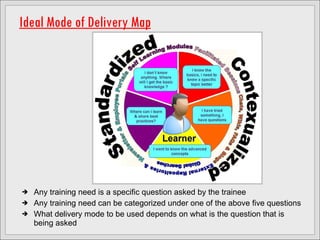
Ideal Mode of Delivery Map Any training need is a specific question asked by the trainee Any training need can be categorized under one of the above five questions What delivery mode to be used depends on what is the question that is being asked
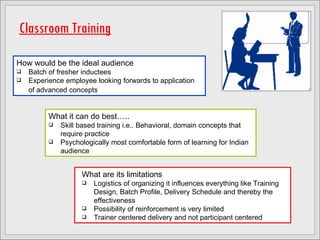
Classroom Training What it can do best….. Skill based training i.e.. Behavioral, domain concepts that require practice Psychologically most comfortable form of learning for Indian audience How would be the ideal audience Batch of fresher inductees  Experience employee looking forwards to application of advanced concepts   What are its limitations Logistics of organizing it influences everything like Training Design, Batch Profile, Delivery Schedule and thereby the effectiveness Possibility of reinforcement is very limited Trainer centered delivery and not participant centered
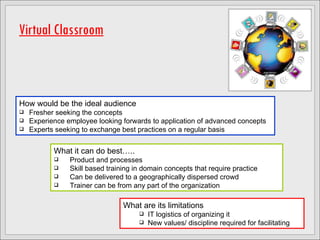
Virtual Classroom What it can do best….. Product and processes Skill based training in domain concepts that require practice Can be delivered to a geographically dispersed crowd  Trainer can be from any part of the organization What are its limitations IT logistics of organizing it New values/ discipline required for facilitating How would be the ideal audience Fresher seeking the concepts  Experience employee looking forwards to application of advanced concepts  Experts seeking to exchange best practices on a regular basis
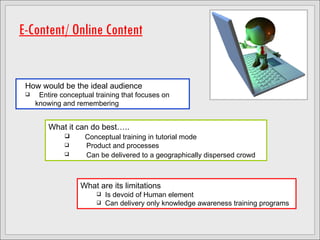
E-Content/ Online Content What it can do best….. Conceptual training in tutorial mode Product and processes Can be delivered to a geographically dispersed crowd   How would be the ideal audience Entire conceptual training that focuses on knowing and remembering What are its limitations Is devoid of Human element Can delivery only knowledge awareness training programs
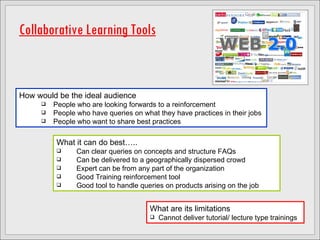
Collaborative Learning Tools What it can do best….. Can clear queries on concepts and structure FAQs  Can be delivered to a geographically dispersed crowd  Expert can be from any part of the organization Good Training reinforcement tool Good tool to handle queries on products arising on the job How would be the ideal audience People who are looking forwards to a reinforcement People who have queries on what they have practices in their jobs People who want to share best practices What are its limitations Cannot deliver tutorial/ lecture type trainings
Seminar & Conferences What it can do best….. Expert Forums where knowledge and best practices are shared How would be the ideal audience People who seek to share knowledge and not just gain it. What are its limitations Not cost effective, Can hardly be held within the organization Mostly external nominations
Newsletters What it can do best….. Create common opinions  Share best practices Showcase champions How would be the ideal audience Everyone who can contribute What are its limitations Both contributions and reading would be voluntary
Matching Learner Profile to Delivery Modes
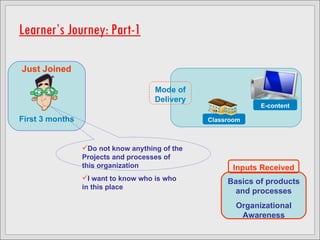
Learner’s Journey: Part-1 Do not know anything of the Projects and processes of this organization I want to know who is who in this place Basics of products and processes Organizational Awareness Inputs Received Just Joined First 3 months E-content Classroom Mode of Delivery
Learner’s Journey: Part-2 Reinforcement of products and processes training Performance Support Inputs Received Seen the first battle First 12 months I have questions on what I have practiced I need more inputs on concepts Virtual Classroom Collaborative Tools  Mode of Delivery
Learner’s Journey: Part-3 I need to specialize in the domain knowledge I have experience and knowledge that I can share Seen life here Post 12 months Sharing knowledge from experience Meeting experts to gain knowledge Inputs Received Mentors Seminar Newsletter Mode of Delivery
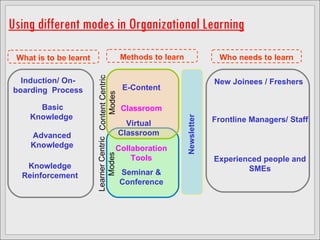
Using different modes in Organizational Learning New Joinees / Freshers  Frontline Managers/ Staff Experienced people and SMEs Induction/ On-boarding  Process Advanced Knowledge Basic Knowledge  Knowledge Reinforcement What is to be learnt Who needs to learn Classroom Virtual Classroom Collaboration Tools E-Content Seminar & Conference Newsletter Methods to learn Learner Centric Modes Content Centric Modes
Expected Ideal Results
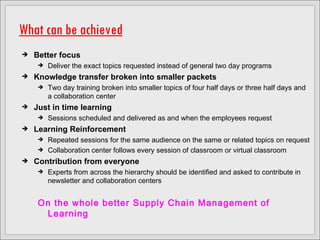
What can be achieved Better focus   Deliver the exact topics requested instead of general two day programs Knowledge transfer broken into smaller packets Two day training broken into smaller topics of four half days or three half days and a collaboration center Just in time learning Sessions scheduled and delivered as and when the employees request Learning Reinforcement Repeated sessions for the same audience on the same or related topics on request Collaboration center follows every session of classroom or virtual classroom Contribution from everyone Experts from across the hierarchy should be identified and asked to contribute in newsletter and collaboration centers On the whole better Supply Chain Management of Learning

Technology enhanced Learning Strategy

  • 1.
    Using E-Learning toleverage Learning Strategy
  • 2.
    How does E-LearningValue Add? A successful E-Learning strategy creates an optimum supply chain of Learning within organization. It connects the knowledge consumers with the knowledge providers in an organization through channels that minimize efforts. Some Outcomes of successful e-learning strategy are: To create a knowledge sharing culture within an organization To create relevance of Learning to Strategy by Just-In-Time delivery systems To ensure ‘ Bang for Bucks ’ in training delivery through multiple modes
  • 3.
    How does e-learninghelp The most notable advantages of e-learning are flexibility, convenience and the ability to work at your own pace. Adaptability to learners needs as individual based learning curriculum can be defined. Unlike classrooms Reinforcement Cost of knowledge is almost ‘zero’ Online learning is an affordable way to reaching at every level and every location of the organization – increasing touch points Ensuring standardized training delivery across the organisation Logistical Issues made irrelevant Easy tracking of Learning Process within the organization. A Balance Sheet of Identified Needs Vs Learning Delivered can be created Knowledge can be delivered in more than just lectures & exercises Making all training available to everyone leading to ‘one virtual company’
  • 4.
    What broad outcomesshould be aimed at Making learning Flexible Learn at your ones own pace- Choose from a bouquet of classrooms, virtual classrooms, online modules and assessments. Mobile Learning - ‘Check in on the latest updates while on the move’ Using the strength of each mode of learning Using classrooms for personal interventions and e-learning for concepts Blended Learning – Different modes of learning. E-learning supporting classroom and vice versa. Making Learning Collaborative Share & Learn – What I know I share, What I don’t know I get to learn Leveraging on SMEs from across the organization and industries
  • 5.
    Different Modes ofLearning Delivery
  • 6.
    Ideal Mode ofDelivery Map Any training need is a specific question asked by the trainee Any training need can be categorized under one of the above five questions What delivery mode to be used depends on what is the question that is being asked
  • 7.
    Classroom Training Whatit can do best….. Skill based training i.e.. Behavioral, domain concepts that require practice Psychologically most comfortable form of learning for Indian audience How would be the ideal audience Batch of fresher inductees Experience employee looking forwards to application of advanced concepts What are its limitations Logistics of organizing it influences everything like Training Design, Batch Profile, Delivery Schedule and thereby the effectiveness Possibility of reinforcement is very limited Trainer centered delivery and not participant centered
  • 8.
    Virtual Classroom Whatit can do best….. Product and processes Skill based training in domain concepts that require practice Can be delivered to a geographically dispersed crowd Trainer can be from any part of the organization What are its limitations IT logistics of organizing it New values/ discipline required for facilitating How would be the ideal audience Fresher seeking the concepts Experience employee looking forwards to application of advanced concepts Experts seeking to exchange best practices on a regular basis
  • 9.
    E-Content/ Online ContentWhat it can do best….. Conceptual training in tutorial mode Product and processes Can be delivered to a geographically dispersed crowd How would be the ideal audience Entire conceptual training that focuses on knowing and remembering What are its limitations Is devoid of Human element Can delivery only knowledge awareness training programs
  • 10.
    Collaborative Learning ToolsWhat it can do best….. Can clear queries on concepts and structure FAQs Can be delivered to a geographically dispersed crowd Expert can be from any part of the organization Good Training reinforcement tool Good tool to handle queries on products arising on the job How would be the ideal audience People who are looking forwards to a reinforcement People who have queries on what they have practices in their jobs People who want to share best practices What are its limitations Cannot deliver tutorial/ lecture type trainings
  • 11.
    Seminar & ConferencesWhat it can do best….. Expert Forums where knowledge and best practices are shared How would be the ideal audience People who seek to share knowledge and not just gain it. What are its limitations Not cost effective, Can hardly be held within the organization Mostly external nominations
  • 12.
    Newsletters What itcan do best….. Create common opinions Share best practices Showcase champions How would be the ideal audience Everyone who can contribute What are its limitations Both contributions and reading would be voluntary
  • 13.
    Matching Learner Profileto Delivery Modes
  • 14.
    Learner’s Journey: Part-1Do not know anything of the Projects and processes of this organization I want to know who is who in this place Basics of products and processes Organizational Awareness Inputs Received Just Joined First 3 months E-content Classroom Mode of Delivery
  • 15.
    Learner’s Journey: Part-2Reinforcement of products and processes training Performance Support Inputs Received Seen the first battle First 12 months I have questions on what I have practiced I need more inputs on concepts Virtual Classroom Collaborative Tools Mode of Delivery
  • 16.
    Learner’s Journey: Part-3I need to specialize in the domain knowledge I have experience and knowledge that I can share Seen life here Post 12 months Sharing knowledge from experience Meeting experts to gain knowledge Inputs Received Mentors Seminar Newsletter Mode of Delivery
  • 17.
    Using different modesin Organizational Learning New Joinees / Freshers Frontline Managers/ Staff Experienced people and SMEs Induction/ On-boarding Process Advanced Knowledge Basic Knowledge Knowledge Reinforcement What is to be learnt Who needs to learn Classroom Virtual Classroom Collaboration Tools E-Content Seminar & Conference Newsletter Methods to learn Learner Centric Modes Content Centric Modes
  • 18.
  • 19.
    What can beachieved Better focus Deliver the exact topics requested instead of general two day programs Knowledge transfer broken into smaller packets Two day training broken into smaller topics of four half days or three half days and a collaboration center Just in time learning Sessions scheduled and delivered as and when the employees request Learning Reinforcement Repeated sessions for the same audience on the same or related topics on request Collaboration center follows every session of classroom or virtual classroom Contribution from everyone Experts from across the hierarchy should be identified and asked to contribute in newsletter and collaboration centers On the whole better Supply Chain Management of Learning