



















Recent developments in Learning & Developmentby Toronto Training and HR February 2011
	3-4 Introduction to Toronto 	Training and HR	5-6	Maintaining training for all in difficult times	7-8	Using training evaluation results	9-10	Calculating the return on Learning & 			Development	11-13	Re-engineering Learning & Development	14-15	Financial education	16-17	Causes of knowledge gaps	18-20	Learning styles21-23	Integrating learning into workflow24-28	Enterprise learning	29-35	Social media and social learning	36-39	Mobile learning40-41	Drill42-44	Making development work45-53	Leadership development54-60	Talent management	61-63	Using your intuition	64-75	Case studies76-77	Conclusion and questionsContentsPage 2
Page 3Introduction
Page 4Introduction to Toronto Training and HRToronto Training and HRis a specialist training and human resources consultancy headed by Timothy Holden 10 years in banking10 years in training and human resourcesFreelance practitioner since 2006The core services provided by Toronto Training and HR are:Training course design
Training course delivery-  Reducing costsSaving time
Improving employee engagement & morale
Services for job seekersPage 5Maintaining training for all in difficult times
Page 6Maintaining training for all in difficult timesUnderstand what drives profitability in the organizationRefocus your budget to where it matters mostCreate more informal opportunities for learningIdentify the skills needed by employees to help the organization thrive when the financial situation improves, and the training required to develop themHelp senior managers to understand the value of coaching to encourage a culture of employee development
Page 7Using training evaluation results
Page 8Using training evaluation resultsTo improve training contentTo refine training methodsTo identify training gapsTo inform training strategyTo prove worth of trainingTo select/deselect external trainersTo assess the business case for trainingTo measure return on investment
Page 9Calculating the return on Learning & Development
Page 10Calculating the return on Learning & DevelopmentEstablish the prime purposeUnderstand complianceFocus on core skillsGain competitive advantageMeasure L & D effectivenessUse ROI to compare different programs
Page 11Re-engineering learning & development
Page 12Re-engineering learning & development 1 of 2Involve the team in designing and implementing the changes that are neededDon’t be afraid to ask the “stupid questions”-challenge pre-conceptions about the way things are currently donePut performance consulting at the core of all learning solutionsSecure commitment, engagement and participation from key stakeholdersHarness new learning technologies to create the optimal learning solutions
Page 13Re-engineering learning & development 2 of 2Allow people to make mistakes to create an innovation cultureMeasure, and then heavily communicate, business impactIdentify key champions and agents of change in learning & developmentBe strong and have faith in your team and strategyDon’t be afraid to make the changes needed for the ultimate benefit of the organization, L&D and individuals
Page 14Financial education
Page 15Financial educationHave a dry run of the seminar or online course so it can be tweaked as necessaryConsider capturing seminars on videoPromote the campaignOffer private places and computers if online tools or workbooks are requiredCollect feedbackAllow employees to take part in financial literacy education  activities in paid work time
Page 16Causes of knowledge gaps
Page 17Causes of knowledge gapsLack of knowledge managementLack of frequency in trainingInformation overloadLack of trainee attentionLack of relevanceLack of confidenceLack of satisfaction
Page 18Learning styles
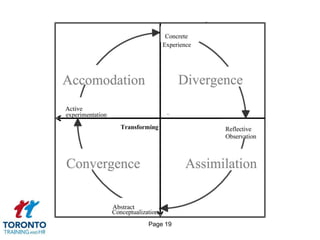
Page 19Learning styles
Page 20Learning styles 2 of 2CULTURAL VALUES AND LEARNING STYLE PREFERENCESIndependent variablesPower distanceIndividualism/collectivismMasculinityUncertainty avoidanceLong-term orientationControl variables
Page 21Integrating learning into workflow
Page 22Integrating learning into workflow 1 of 2Work with business to understand the live work environment - what activities and tools the individual needs to do in their job.When developing e-learning, set tasks that need to be worked out in the live/work environment.Use a range of formats to suit the audience (e.g. video, Flash, reading).Provide job aids within the learning that can be used back at work, e.g. checklists.Provide a choice of webinars for individuals to provide opportunities for interaction.
Page 23Integrating learning into workflow 2 of 2Don't force individuals to use your solution in a linear manner - create paths for staff to achieve their goals.Allocate more time than you think necessary to usability issues-particularly if your audience comes from a varied background.Analyse individual activity to provide on-going recommendations for learning.Position learning as an integral part of individual's journey in their job role.Use analytics to understand where workflows can be redesigned.
Page 24Enterprise learning
Page 25Enterprise learning 1 of 4CREATING AND MAINTAINING A COMPETITIVE ADVANTAGEThe efficiency and effectiveness of current organizational and worker performance in winning in the current marketThe ability to predict future market needs and behaviours, set appropriate goals, and develop a strategy and performance system that aligns with goals to create a future competitive advantageThe ability to implement systemic change from the current performance to future state, while keeping everyone fully engaged.
Page 26Enterprise learning 2 of 4WHAT CAN A WELL-RUN LEARNING FUNCTION DO?Help attract and retain talent by showing organizational commitment to developmentHelp leaders discover and improve environmental factors associated with performanceReduce siloed thinking that can lead to costly redundancy, in turn, identifying common cross-functional needs, and sharing solutions and efficienciesConsolidate and focus spendingProvide accountability for the investments made
Page 27Enterprise learning 3 of 4PURPOSE OF ENTERPRISE LEARNINGTo provide effective learning experiences to help individuals develop the strategically important skills necessary for them to perform their job both today and in the futureTo work with leaders to ensure that these skills are being applied within the performance system to create a competitive advantage
Page 28Enterprise learning 4 of 4OUTCOMES TO ACHIEVE REGARDING COMPETITIVE ADVANTAGENeeds to be capable of identifying the strategically important skills of individuals in critical job roles fortoday and tomorrowIdentifying or creating effective learning tools thatdevelop skills in those who need themEnsuring that the new skills are applied back on thejob, or are poised for application whenchange occurs
Page 29Social media and social learning
Page 30Social media and social learning  1 of 6TYPESOnline simulations Mobile learningSocial networks Podcasts Wikis Virtual worlds
Page 31Social media and social learning 2 of 6COMPETENCIES NEEDED TO IMPLEMENTSubject matter expertiseInformation technologyProject managementInstructional designSpecific tool expertiseFacilitation expertise
Page 32Social media and social learning 3 of 6COMPETENCIES NEEDED TO IMPLEMENTJob and task analysisSpecialized productionProgramming expertisePurchasing and contractsDedicated administrative support
Page 33Social media and social learning 4 of 6LEARNING LEADERS ARE WELL SERVED IF THEY…Reformulate their learning strategy to become a combination of formal, informal, and social in natureDemonstrate by example that social learning can work and is important to the entire learning cycleRally the organization around social learning as a way to improve employee connections andengagement
Page 34Social media and social learning 5 of 6BUT I HAVE A DECREASING BUDGET…IT departmentVendorsFormal instructor-led trainingStealth pilot
Page 35Social media and social learning 6 of 6MEASURESAssess the value of a business impact studyAlign support and stakeholdersIdentify strategic goalsDetermine metricsCollect the dataCalculate the business impactImprove the impact for future investments
Page 36Mobile learning
Page 37Mobile learning 1 of 3What is it?Three distinct typesBenefitsTrade-offsTracking expectations
Page 38Mobile learning 2 of 3STAGES TO FOLLOW:Evaluate and plan for the business needs for mobile learning.Understand the targeted end-users and their contexts.Know the limitations and capabilities of the technologies involved.Develop the appropriate mobile learning content or experiences.
Page 39Mobile learning 3 of 3STAGES TO FOLLOW:Design the interaction flow and graphical user interface for ease of navigation.Program functional prototypes or use authoring tools to build the mobile learning application.Test and evaluate the mobile learning application using target mobile devices.
Page 40Drill
Page 41Drill
Page 42Making development work
Page 43Making development work 1 of 2Development works best as a form of natural social learning, in small groups providing meaning to managers’ experiences.Development has to enable managers to become seriously reflective in the context of taking action.Companies and other organizations function most effectively as communities of human beings; development programs should be designed to enhance this.Middle managers are key to this as development can build their confidence and commitment alongside their capabilities, especially in being able to grow strategies from the middle out.
Page 44Making development work 2 of 2DEVELOPMENT ROIFinancial returnOpportunity costEmotional return
Page 45Leadership development
Page 46Leadership development 1 of 8GAPS IN LEADERSHIP SKILLSPerformance managementCoaching/mentoring/developing staffLeading people and people managementLeading and managing changeBusiness and commercial acumenCommunication/interpersonal skillsMotivational skillsTo prepare managers for leading across culturesInnovationTo help develop global business
Page 47Leadership development 2 of 8FOCUS OF ACTIVITIES IN 2011Addressing the current underperformance of leadersImproving relationships with external or partner organizationsChanging the leadership style across the organizationTo help develop global businessTo help prepare managers for leading across culturesImproving the skills of leaders to think in a more strategic and future-focused wayEnabling the achievement of the organization’s strategic goals
Page 48Leadership development 3 of 8FOCUS OF ACTIVITIES IN 2011To help prepare managers for international assignmentsAccelerating change within the organizationChanging the prevailing organizational cultureProducing a common standard of behaviour for those in leadership rolesDeveloping high-potential individuals valued by the organizationImproving the skills of leaders to think in a more strategic and future-focused way
Page 49Leadership development 4 of 8CHALLENGES TO BE ADDRESSEDStrategic issues-creating an integrated and systematic process for identifying, assessing, developing, and retaining talent for critical rolesAlignment challenges-ensuring that leadership is in step with an organization’s strategy and that the competencies being groomed across the leadership pipeline are indeed those that will deliver the capabilities required and the business results desired
Page 50Leadership development 5 of 8CHALLENGES TO BE ADDRESSEDTalent areas-building a steady and ready deep bench of leaders available to fill any gaps that surfacePerformance aspects-ensuring that leaders are effectively and efficiently producing the goods and services that meet and exceed customer needs
Page 51Leadership development 6 of 8THE BUSINESS OF LEADER DEVELOPMENTBusiness imperativesOrganization capabilitiesLeader competenciesBusiness outcomes
Page 52Leadership development 7 of 8DRIVERS OF LEADER TALENT DEVELOPMENTThe capabilities in which an organizationneeds to excel to drive to those outcomesThe essential competencies required to achieve themThe varied impact of the leader’s role
Page 53Leadership development 8 of 8AN INTEGRATED LEADER DEVELOPMENT APPROACHLeaderLeadingLeadership
Page 54Talent management
Page 55Talent management 1 of 6OBJECTIVESDeveloping high potential employeesGrowing future senior managers and leadersRetaining key peopleEnabling the achievement of the organization’s strategic goalsMeeting the future skills requirements of the organization
Page 56Talent management 2 of 6OBJECTIVESAttracting and recruiting key individuals to the organizationSupporting changes in the organizational structure or business environmentAssisting organizational resource planningAddressing skills shortagesRedeployment of workers to other roles
Page 57Talent management 3 of 6WAYS TO MEASURE EFFECTIVENESS OF INITIATIVESClear success criteria identified at the outset Formal annual (or other regular) evaluation process for talent management at an organization-wide levelTime and cost to fill key rolesEmployee attitude surveys
Page 58Talent management 4 of 6WAYS TO MEASURE EFFECTIVENESS OF INITIATIVESFeedback from employees involved in talentmanagement initiativesFeedback from line managers Implementation of formal succession plans Retention of those identified as 'high potential' The number of people promoted internally Anecdotally – observation of changes
Page 59Talent management 5 of 6TYPES OF ACTIVITYCoachingIn-house development programsHigh-potential development schemes360-degree feedbackInternal secondmentsMentoring and buddying schemesJob rotation and shadowingAction learning sets
Page 60Talent management 6 of 6TYPES OF ACTIVITYCourses at external institutionsDevelopment centresCross-functional project assignmentsGraduate development programsCourses leading to amanagement/business qualificationAssessment centresExternal secondments
Page 14Using your intuition
Page 62Using your intuition 1 of 2Sensing when a problem might exist-for example, when someone’s story doesn’t stack up or there’s an ethical dilemmaPerforming well-learned behaviour patterns rapidly. We can often simply go ahead and do something in a situation that’s familiar, rather than think too much about itIf expectations are violated. When we expect a situation to go a certain way but it doesn’t, this can set off our intuitive alarm bell
Page 63Using your intuition 2 of 2Synthesising the big picture. When faced with several isolated pieces of information, intuition lets us stand back avoid “analysis paralysis” and sense how the pieces might fit togetherChecking out the results of rational analysis. Sensing when hard data doesn’t feel quite right, intuition can sound the alarm for us to seek more information or look at what data we do have from a different angle
Page 64Case study A
Page 65Case study A
Page 66Case study B
Page 67Case study B
Page 68Case study C
Page 69Case study C
Page 70Case study D
Page 71Case study D
Page 72Case study E
Page 73Case study E
Page 74Case study F
Page 75Case study F

Recent developments in Learning & Development February 2011

  • 1.
    Recent developments inLearning & Developmentby Toronto Training and HR February 2011
  • 2.
    3-4 Introduction toToronto Training and HR 5-6 Maintaining training for all in difficult times 7-8 Using training evaluation results 9-10 Calculating the return on Learning & Development 11-13 Re-engineering Learning & Development 14-15 Financial education 16-17 Causes of knowledge gaps 18-20 Learning styles21-23 Integrating learning into workflow24-28 Enterprise learning 29-35 Social media and social learning 36-39 Mobile learning40-41 Drill42-44 Making development work45-53 Leadership development54-60 Talent management 61-63 Using your intuition 64-75 Case studies76-77 Conclusion and questionsContentsPage 2
  • 3.
  • 4.
    Page 4Introduction toToronto Training and HRToronto Training and HRis a specialist training and human resources consultancy headed by Timothy Holden 10 years in banking10 years in training and human resourcesFreelance practitioner since 2006The core services provided by Toronto Training and HR are:Training course design
  • 5.
    Training course delivery- Reducing costsSaving time
  • 6.
  • 7.
    Services for jobseekersPage 5Maintaining training for all in difficult times
  • 8.
    Page 6Maintaining trainingfor all in difficult timesUnderstand what drives profitability in the organizationRefocus your budget to where it matters mostCreate more informal opportunities for learningIdentify the skills needed by employees to help the organization thrive when the financial situation improves, and the training required to develop themHelp senior managers to understand the value of coaching to encourage a culture of employee development
  • 9.
    Page 7Using trainingevaluation results
  • 10.
    Page 8Using trainingevaluation resultsTo improve training contentTo refine training methodsTo identify training gapsTo inform training strategyTo prove worth of trainingTo select/deselect external trainersTo assess the business case for trainingTo measure return on investment
  • 11.
    Page 9Calculating thereturn on Learning & Development
  • 12.
    Page 10Calculating thereturn on Learning & DevelopmentEstablish the prime purposeUnderstand complianceFocus on core skillsGain competitive advantageMeasure L & D effectivenessUse ROI to compare different programs
  • 13.
  • 14.
    Page 12Re-engineering learning& development 1 of 2Involve the team in designing and implementing the changes that are neededDon’t be afraid to ask the “stupid questions”-challenge pre-conceptions about the way things are currently donePut performance consulting at the core of all learning solutionsSecure commitment, engagement and participation from key stakeholdersHarness new learning technologies to create the optimal learning solutions
  • 15.
    Page 13Re-engineering learning& development 2 of 2Allow people to make mistakes to create an innovation cultureMeasure, and then heavily communicate, business impactIdentify key champions and agents of change in learning & developmentBe strong and have faith in your team and strategyDon’t be afraid to make the changes needed for the ultimate benefit of the organization, L&D and individuals
  • 16.
  • 17.
    Page 15Financial educationHavea dry run of the seminar or online course so it can be tweaked as necessaryConsider capturing seminars on videoPromote the campaignOffer private places and computers if online tools or workbooks are requiredCollect feedbackAllow employees to take part in financial literacy education activities in paid work time
  • 18.
    Page 16Causes ofknowledge gaps
  • 19.
    Page 17Causes ofknowledge gapsLack of knowledge managementLack of frequency in trainingInformation overloadLack of trainee attentionLack of relevanceLack of confidenceLack of satisfaction
  • 20.
  • 21.
  • 22.
    Page 20Learning styles2 of 2CULTURAL VALUES AND LEARNING STYLE PREFERENCESIndependent variablesPower distanceIndividualism/collectivismMasculinityUncertainty avoidanceLong-term orientationControl variables
  • 23.
  • 24.
    Page 22Integrating learninginto workflow 1 of 2Work with business to understand the live work environment - what activities and tools the individual needs to do in their job.When developing e-learning, set tasks that need to be worked out in the live/work environment.Use a range of formats to suit the audience (e.g. video, Flash, reading).Provide job aids within the learning that can be used back at work, e.g. checklists.Provide a choice of webinars for individuals to provide opportunities for interaction.
  • 25.
    Page 23Integrating learninginto workflow 2 of 2Don't force individuals to use your solution in a linear manner - create paths for staff to achieve their goals.Allocate more time than you think necessary to usability issues-particularly if your audience comes from a varied background.Analyse individual activity to provide on-going recommendations for learning.Position learning as an integral part of individual's journey in their job role.Use analytics to understand where workflows can be redesigned.
  • 26.
  • 27.
    Page 25Enterprise learning1 of 4CREATING AND MAINTAINING A COMPETITIVE ADVANTAGEThe efficiency and effectiveness of current organizational and worker performance in winning in the current marketThe ability to predict future market needs and behaviours, set appropriate goals, and develop a strategy and performance system that aligns with goals to create a future competitive advantageThe ability to implement systemic change from the current performance to future state, while keeping everyone fully engaged.
  • 28.
    Page 26Enterprise learning2 of 4WHAT CAN A WELL-RUN LEARNING FUNCTION DO?Help attract and retain talent by showing organizational commitment to developmentHelp leaders discover and improve environmental factors associated with performanceReduce siloed thinking that can lead to costly redundancy, in turn, identifying common cross-functional needs, and sharing solutions and efficienciesConsolidate and focus spendingProvide accountability for the investments made
  • 29.
    Page 27Enterprise learning3 of 4PURPOSE OF ENTERPRISE LEARNINGTo provide effective learning experiences to help individuals develop the strategically important skills necessary for them to perform their job both today and in the futureTo work with leaders to ensure that these skills are being applied within the performance system to create a competitive advantage
  • 30.
    Page 28Enterprise learning4 of 4OUTCOMES TO ACHIEVE REGARDING COMPETITIVE ADVANTAGENeeds to be capable of identifying the strategically important skills of individuals in critical job roles fortoday and tomorrowIdentifying or creating effective learning tools thatdevelop skills in those who need themEnsuring that the new skills are applied back on thejob, or are poised for application whenchange occurs
  • 31.
    Page 29Social mediaand social learning
  • 32.
    Page 30Social mediaand social learning 1 of 6TYPESOnline simulations Mobile learningSocial networks Podcasts Wikis Virtual worlds
  • 33.
    Page 31Social mediaand social learning 2 of 6COMPETENCIES NEEDED TO IMPLEMENTSubject matter expertiseInformation technologyProject managementInstructional designSpecific tool expertiseFacilitation expertise
  • 34.
    Page 32Social mediaand social learning 3 of 6COMPETENCIES NEEDED TO IMPLEMENTJob and task analysisSpecialized productionProgramming expertisePurchasing and contractsDedicated administrative support
  • 35.
    Page 33Social mediaand social learning 4 of 6LEARNING LEADERS ARE WELL SERVED IF THEY…Reformulate their learning strategy to become a combination of formal, informal, and social in natureDemonstrate by example that social learning can work and is important to the entire learning cycleRally the organization around social learning as a way to improve employee connections andengagement
  • 36.
    Page 34Social mediaand social learning 5 of 6BUT I HAVE A DECREASING BUDGET…IT departmentVendorsFormal instructor-led trainingStealth pilot
  • 37.
    Page 35Social mediaand social learning 6 of 6MEASURESAssess the value of a business impact studyAlign support and stakeholdersIdentify strategic goalsDetermine metricsCollect the dataCalculate the business impactImprove the impact for future investments
  • 38.
  • 39.
    Page 37Mobile learning1 of 3What is it?Three distinct typesBenefitsTrade-offsTracking expectations
  • 40.
    Page 38Mobile learning2 of 3STAGES TO FOLLOW:Evaluate and plan for the business needs for mobile learning.Understand the targeted end-users and their contexts.Know the limitations and capabilities of the technologies involved.Develop the appropriate mobile learning content or experiences.
  • 41.
    Page 39Mobile learning3 of 3STAGES TO FOLLOW:Design the interaction flow and graphical user interface for ease of navigation.Program functional prototypes or use authoring tools to build the mobile learning application.Test and evaluate the mobile learning application using target mobile devices.
  • 42.
  • 43.
  • 44.
  • 45.
    Page 43Making developmentwork 1 of 2Development works best as a form of natural social learning, in small groups providing meaning to managers’ experiences.Development has to enable managers to become seriously reflective in the context of taking action.Companies and other organizations function most effectively as communities of human beings; development programs should be designed to enhance this.Middle managers are key to this as development can build their confidence and commitment alongside their capabilities, especially in being able to grow strategies from the middle out.
  • 46.
    Page 44Making developmentwork 2 of 2DEVELOPMENT ROIFinancial returnOpportunity costEmotional return
  • 47.
  • 48.
    Page 46Leadership development1 of 8GAPS IN LEADERSHIP SKILLSPerformance managementCoaching/mentoring/developing staffLeading people and people managementLeading and managing changeBusiness and commercial acumenCommunication/interpersonal skillsMotivational skillsTo prepare managers for leading across culturesInnovationTo help develop global business
  • 49.
    Page 47Leadership development2 of 8FOCUS OF ACTIVITIES IN 2011Addressing the current underperformance of leadersImproving relationships with external or partner organizationsChanging the leadership style across the organizationTo help develop global businessTo help prepare managers for leading across culturesImproving the skills of leaders to think in a more strategic and future-focused wayEnabling the achievement of the organization’s strategic goals
  • 50.
    Page 48Leadership development3 of 8FOCUS OF ACTIVITIES IN 2011To help prepare managers for international assignmentsAccelerating change within the organizationChanging the prevailing organizational cultureProducing a common standard of behaviour for those in leadership rolesDeveloping high-potential individuals valued by the organizationImproving the skills of leaders to think in a more strategic and future-focused way
  • 51.
    Page 49Leadership development4 of 8CHALLENGES TO BE ADDRESSEDStrategic issues-creating an integrated and systematic process for identifying, assessing, developing, and retaining talent for critical rolesAlignment challenges-ensuring that leadership is in step with an organization’s strategy and that the competencies being groomed across the leadership pipeline are indeed those that will deliver the capabilities required and the business results desired
  • 52.
    Page 50Leadership development5 of 8CHALLENGES TO BE ADDRESSEDTalent areas-building a steady and ready deep bench of leaders available to fill any gaps that surfacePerformance aspects-ensuring that leaders are effectively and efficiently producing the goods and services that meet and exceed customer needs
  • 53.
    Page 51Leadership development6 of 8THE BUSINESS OF LEADER DEVELOPMENTBusiness imperativesOrganization capabilitiesLeader competenciesBusiness outcomes
  • 54.
    Page 52Leadership development7 of 8DRIVERS OF LEADER TALENT DEVELOPMENTThe capabilities in which an organizationneeds to excel to drive to those outcomesThe essential competencies required to achieve themThe varied impact of the leader’s role
  • 55.
    Page 53Leadership development8 of 8AN INTEGRATED LEADER DEVELOPMENT APPROACHLeaderLeadingLeadership
  • 56.
  • 57.
    Page 55Talent management1 of 6OBJECTIVESDeveloping high potential employeesGrowing future senior managers and leadersRetaining key peopleEnabling the achievement of the organization’s strategic goalsMeeting the future skills requirements of the organization
  • 58.
    Page 56Talent management2 of 6OBJECTIVESAttracting and recruiting key individuals to the organizationSupporting changes in the organizational structure or business environmentAssisting organizational resource planningAddressing skills shortagesRedeployment of workers to other roles
  • 59.
    Page 57Talent management3 of 6WAYS TO MEASURE EFFECTIVENESS OF INITIATIVESClear success criteria identified at the outset Formal annual (or other regular) evaluation process for talent management at an organization-wide levelTime and cost to fill key rolesEmployee attitude surveys
  • 60.
    Page 58Talent management4 of 6WAYS TO MEASURE EFFECTIVENESS OF INITIATIVESFeedback from employees involved in talentmanagement initiativesFeedback from line managers Implementation of formal succession plans Retention of those identified as 'high potential' The number of people promoted internally Anecdotally – observation of changes
  • 61.
    Page 59Talent management5 of 6TYPES OF ACTIVITYCoachingIn-house development programsHigh-potential development schemes360-degree feedbackInternal secondmentsMentoring and buddying schemesJob rotation and shadowingAction learning sets
  • 62.
    Page 60Talent management6 of 6TYPES OF ACTIVITYCourses at external institutionsDevelopment centresCross-functional project assignmentsGraduate development programsCourses leading to amanagement/business qualificationAssessment centresExternal secondments
  • 63.
  • 64.
    Page 62Using yourintuition 1 of 2Sensing when a problem might exist-for example, when someone’s story doesn’t stack up or there’s an ethical dilemmaPerforming well-learned behaviour patterns rapidly. We can often simply go ahead and do something in a situation that’s familiar, rather than think too much about itIf expectations are violated. When we expect a situation to go a certain way but it doesn’t, this can set off our intuitive alarm bell
  • 65.
    Page 63Using yourintuition 2 of 2Synthesising the big picture. When faced with several isolated pieces of information, intuition lets us stand back avoid “analysis paralysis” and sense how the pieces might fit togetherChecking out the results of rational analysis. Sensing when hard data doesn’t feel quite right, intuition can sound the alarm for us to seek more information or look at what data we do have from a different angle
  • 66.
  • 67.
  • 68.
  • 69.
  • 70.
  • 71.
  • 72.
  • 73.
  • 74.
  • 75.
  • 76.
  • 77.