

December 13, 20171
Employee Training
And
Development
Technology-Based
Training Methods
Chapter 8
December 13, 2017 1
Introduction
Technology is having a major impact on the delivery of training
programs.
Using technology for training requires collaboration among the areas
of:
 Training
 Information technology
 Top management
December13,2017
2
Technology Based Training Methods
December13,2017
3
Technology Based Training (TBT) is a computer-based training methodology
that includes web-based, intranet-based, DVD- and CD-based training on
any topic. It is the practice of training and learning material between an
instructor and learners, either individuals or groups. Instructors can also be
referred to as facilitators who may be knowledgeable and experienced in the
learning material, or may be selected more for their facilitation skills and
ability to deliver material to learners.
December13,2017
4
Technologies Influence on Training and Learning
 Employees can gain control over when and where they receive training
 Employees can access knowledge and expert systems
 Employees can choose the type of media that they want to use in a training
program
 Course enrollment, testing, and training records can be handled
electronically
 Employees' accomplishments during training can be monitored
December13,2017
5
Technology and Collaboration
Digital Collaboration - The use of technology to enhance and extend
employees' abilities to work together regardless of their geographic
Proximity. Digital collaboration can be:
Synchronous Communication - Trainers, experts, and learners interact
with each other live and in real time
Asynchronous Communication - Non-Real-Time interactions
December13,2017
6
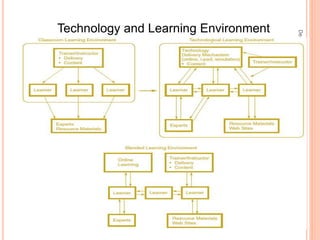
Technology and Learning Environment
December13,2017
7
Technology has allowed learning to become a more dynamic process:
 The learning environment has expanded to include greater interaction
between learners and the training content
 There is greater interaction between learners and the instructor
 Instruction is primarily delivered to the learners online using the internet
Learning occurs through:
 Communicating with other learners
 Exchanging ideas
 Interacting with experts
 Discovering ideas and applications using hyperlinks
Experts and resource materials are part of the learning environment
December13,2017
8
Computer Based Training, Online learning, Web
based learning, E-Learning
Computer-based training (CBT): It is an interactive training experience
in which:
 The computer provides the learning stimulus.
 The trainee must respond, and
 The computer analyzes the responses and provides feedback to the
trainee
Online learning, Web based learning, E-Learning
These trainings all include delivery of instruction using the internet or web.
The training program can be accessed using a password through the public
Internet or the company’s private intranet
December 13, 20179
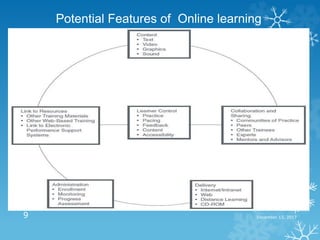
Potential Features of Online learning
December 13, 201710
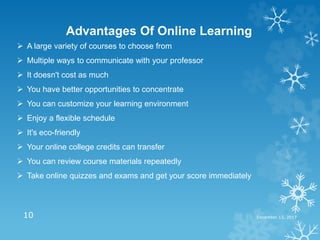
Advantages Of Online Learning
 A large variety of courses to choose from
 Multiple ways to communicate with your professor
 It doesn't cost as much
 You have better opportunities to concentrate
 You can customize your learning environment
 Enjoy a flexible schedule
 It's eco-friendly
 Your online college credits can transfer
 You can review course materials repeatedly
 Take online quizzes and exams and get your score immediately
December 13, 201711
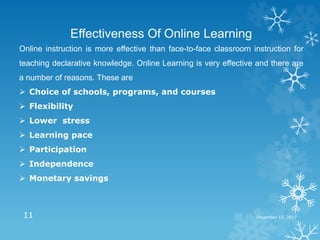
Effectiveness Of Online Learning
Online instruction is more effective than face-to-face classroom instruction for
teaching declarative knowledge. Online Learning is very effective and there are
a number of reasons. These are
 Choice of schools, programs, and courses
 Flexibility
 Lower stress
 Learning pace
 Participation
 Independence
 Monetary savings
December 13, 201712
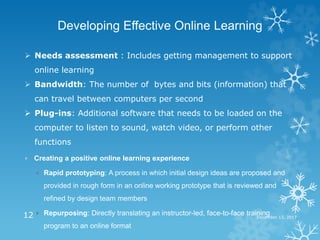
Developing Effective Online Learning
 Needs assessment : Includes getting management to support
online learning
 Bandwidth: The number of bytes and bits (information) that
can travel between computers per second
 Plug-ins: Additional software that needs to be loaded on the
computer to listen to sound, watch video, or perform other
functions
 Creating a positive online learning experience
 Rapid prototyping: A process in which initial design ideas are proposed and
provided in rough form in an online working prototype that is reviewed and
refined by design team members
 Repurposing: Directly translating an instructor-led, face-to-face training
program to an online format
December 13, 201713
Developing Effective Online Learning(Cont.)
Learner control: Giving trainees the option to learn actively
through:
 Self-pacing
 Exercises
 Exploring links to other material
 Conversations with other trainees and experts
Providing Time and Space for Online Learning
Given the work demands that employees face, trainees need
incentives to complete online learning
 Presenting cash awards
 Certifying programs to ensure that online courses are completed
December 13, 201714
Developing Effective Online Learning
Technology for Collaboration and Linking
 Hyperlinks: Links that allow a trainee to access other websites
that include:
 Printed materials
 Communications links to experts, trainers, and other learners
 Learning with and creating a network with peers an important
aspect for some employees
 Prefer instructor-led face-to-face instruction over online
learning
December13,2017
15
Social Media: Wikis, Blogs, Micro-blogs, and
Social Networks
 Online and mobile technology used to create interactive communications
allowing the creation and exchange of user-generated content
 Useful for:
 Providing links to resources related to new learning content
 Helping determine future training needs reinforcing and sustaining
learning
 Being used as a coaching and mentoring tool
 Linking learners through a formal training event
 Providing content before a face-to-face learning event
December13,2017
16
Social Media: Blogs-
A webpage where an author posts entries and readers can comment
• Personal blogs
• Company blogs
• Topic blogs
Social Media: Wikis and Micro-blogs
Wiki: A website that allows many users to create, edit, and update content and
share knowledge
Micro-blog: Software tools like Twitter
Shared media: Audio or video such as YouTube
December13,2017
17
Blended Learning
Combines online learning, face-to-face instruction, and other methods for
distributing learning content and instruction
 Provides increased learner control
 Requires learners to take more responsibility for their learning
 More face-to-face social interaction
 Ensures a dedicated learning environment
December13,2017
18
Simulations and Games
 Virtual Reality
A computer-based technology that provides trainees with a three-
dimensional learning experience
 Virtual Worlds
Computer-based, simulated online three-dimensional representations of the
real world where learning programs or experiences can be hosted
December13,2017
19
Mobile Technology & Learning
Consists of:
 Wireless transmission systems - Wi-Fi and Bluetooth
 Mobile devices - PDAs, smartphones
 Software applications related to processing audio files, word
processing, spreadsheets, Internet, e-mail, and instant messaging
Learning
Training delivered using a mobile device such as a smartphone, netbook,
notebook computer, or i-Pad
Apps: Applications designed specifically for smartphones and tablet
computers.
December13,2017
20
Intelligent Tutoring Systems ( ITS )
Instructional systems that use artificial intelligence
Three types of ITS environments:
 Tutoring - Increases trainee understanding of a content domain.
 Coaching - Provides trainees with flexibility to practice skills in artificial
environments.
 Empowering - Refers to the student’s ability to explore the content of the
training program freely.
December13,2017
21
Distance Learning
Involves two types of technology:
1. Teleconferencing
2. Virtual classroom
Distance Learning: Used by geographically dispersed companies to
provide information about new products, policies, or procedures, as well as
deliver skills training and expert lectures to field location. There are two way
of distance learning.
1. Interactive distance learning (IDL) and
2. Webcasting
December 13, 2017 22
Technologies for Training Support
Expert systems: Technology (usually software) that organizes and applies
the knowledge of human experts to specific problems.
Electronic Performance Support Systems (EPSS):
An electronic infrastructure that captures, stores, and distributes individual
and corporate knowledge assets throughout an organization.
December 13, 2017 23
Limitations Of TBT
o Lack of Control
o Technology Issues (undeveloped)
o Lack of Staff Computer Skills
o Less face-to-face interaction
o No control over motivation, involvement and course management by
learners
o No direct contacts with learner
o E-learning content occasionally difficult to design for training in highly
specific fields
December 13, 2017 24
Recommendations
Here are the recommendations to overcome the Limitations
 Take Quizzes
 Small group discussions
 Delivering Case studies
 Asking for short summaries by group
 Arrange Informal question-and-answer sessions
 By role-playing in the workplace
 Give Demonstrations practically
December 13, 2017 25
Conclusions
Technology Based Training Method (TBT) provides the reader an
understanding of the various “new technologies” that have changed the way
we deliver training. It is important to know these state-of-the-art modes of
facilitating learning. They are typically interactive with the learner and
experiential in nature. Advantages and disadvantages are described for
each of the new technologies as are its uses.
December 13, 2017 26
Thank You All

Employee training and development

  • 1.
    December 13, 20171 EmployeeTraining And Development Technology-Based Training Methods Chapter 8 December 13, 2017 1
  • 2.
    Introduction Technology is havinga major impact on the delivery of training programs. Using technology for training requires collaboration among the areas of:  Training  Information technology  Top management December13,2017 2
  • 3.
    Technology Based TrainingMethods December13,2017 3 Technology Based Training (TBT) is a computer-based training methodology that includes web-based, intranet-based, DVD- and CD-based training on any topic. It is the practice of training and learning material between an instructor and learners, either individuals or groups. Instructors can also be referred to as facilitators who may be knowledgeable and experienced in the learning material, or may be selected more for their facilitation skills and ability to deliver material to learners.
  • 4.
    December13,2017 4 Technologies Influence onTraining and Learning  Employees can gain control over when and where they receive training  Employees can access knowledge and expert systems  Employees can choose the type of media that they want to use in a training program  Course enrollment, testing, and training records can be handled electronically  Employees' accomplishments during training can be monitored
  • 5.
    December13,2017 5 Technology and Collaboration DigitalCollaboration - The use of technology to enhance and extend employees' abilities to work together regardless of their geographic Proximity. Digital collaboration can be: Synchronous Communication - Trainers, experts, and learners interact with each other live and in real time Asynchronous Communication - Non-Real-Time interactions
  • 6.
  • 7.
    December13,2017 7 Technology has allowedlearning to become a more dynamic process:  The learning environment has expanded to include greater interaction between learners and the training content  There is greater interaction between learners and the instructor  Instruction is primarily delivered to the learners online using the internet Learning occurs through:  Communicating with other learners  Exchanging ideas  Interacting with experts  Discovering ideas and applications using hyperlinks Experts and resource materials are part of the learning environment
  • 8.
    December13,2017 8 Computer Based Training,Online learning, Web based learning, E-Learning Computer-based training (CBT): It is an interactive training experience in which:  The computer provides the learning stimulus.  The trainee must respond, and  The computer analyzes the responses and provides feedback to the trainee Online learning, Web based learning, E-Learning These trainings all include delivery of instruction using the internet or web. The training program can be accessed using a password through the public Internet or the company’s private intranet
  • 9.
    December 13, 20179 PotentialFeatures of Online learning
  • 10.
    December 13, 201710 AdvantagesOf Online Learning  A large variety of courses to choose from  Multiple ways to communicate with your professor  It doesn't cost as much  You have better opportunities to concentrate  You can customize your learning environment  Enjoy a flexible schedule  It's eco-friendly  Your online college credits can transfer  You can review course materials repeatedly  Take online quizzes and exams and get your score immediately
  • 11.
    December 13, 201711 EffectivenessOf Online Learning Online instruction is more effective than face-to-face classroom instruction for teaching declarative knowledge. Online Learning is very effective and there are a number of reasons. These are  Choice of schools, programs, and courses  Flexibility  Lower stress  Learning pace  Participation  Independence  Monetary savings
  • 12.
    December 13, 201712 DevelopingEffective Online Learning  Needs assessment : Includes getting management to support online learning  Bandwidth: The number of bytes and bits (information) that can travel between computers per second  Plug-ins: Additional software that needs to be loaded on the computer to listen to sound, watch video, or perform other functions  Creating a positive online learning experience  Rapid prototyping: A process in which initial design ideas are proposed and provided in rough form in an online working prototype that is reviewed and refined by design team members  Repurposing: Directly translating an instructor-led, face-to-face training program to an online format
  • 13.
    December 13, 201713 DevelopingEffective Online Learning(Cont.) Learner control: Giving trainees the option to learn actively through:  Self-pacing  Exercises  Exploring links to other material  Conversations with other trainees and experts Providing Time and Space for Online Learning Given the work demands that employees face, trainees need incentives to complete online learning  Presenting cash awards  Certifying programs to ensure that online courses are completed
  • 14.
    December 13, 201714 DevelopingEffective Online Learning Technology for Collaboration and Linking  Hyperlinks: Links that allow a trainee to access other websites that include:  Printed materials  Communications links to experts, trainers, and other learners  Learning with and creating a network with peers an important aspect for some employees  Prefer instructor-led face-to-face instruction over online learning
  • 15.
    December13,2017 15 Social Media: Wikis,Blogs, Micro-blogs, and Social Networks  Online and mobile technology used to create interactive communications allowing the creation and exchange of user-generated content  Useful for:  Providing links to resources related to new learning content  Helping determine future training needs reinforcing and sustaining learning  Being used as a coaching and mentoring tool  Linking learners through a formal training event  Providing content before a face-to-face learning event
  • 16.
    December13,2017 16 Social Media: Blogs- Awebpage where an author posts entries and readers can comment • Personal blogs • Company blogs • Topic blogs Social Media: Wikis and Micro-blogs Wiki: A website that allows many users to create, edit, and update content and share knowledge Micro-blog: Software tools like Twitter Shared media: Audio or video such as YouTube
  • 17.
    December13,2017 17 Blended Learning Combines onlinelearning, face-to-face instruction, and other methods for distributing learning content and instruction  Provides increased learner control  Requires learners to take more responsibility for their learning  More face-to-face social interaction  Ensures a dedicated learning environment
  • 18.
    December13,2017 18 Simulations and Games Virtual Reality A computer-based technology that provides trainees with a three- dimensional learning experience  Virtual Worlds Computer-based, simulated online three-dimensional representations of the real world where learning programs or experiences can be hosted
  • 19.
    December13,2017 19 Mobile Technology &Learning Consists of:  Wireless transmission systems - Wi-Fi and Bluetooth  Mobile devices - PDAs, smartphones  Software applications related to processing audio files, word processing, spreadsheets, Internet, e-mail, and instant messaging Learning Training delivered using a mobile device such as a smartphone, netbook, notebook computer, or i-Pad Apps: Applications designed specifically for smartphones and tablet computers.
  • 20.
    December13,2017 20 Intelligent Tutoring Systems( ITS ) Instructional systems that use artificial intelligence Three types of ITS environments:  Tutoring - Increases trainee understanding of a content domain.  Coaching - Provides trainees with flexibility to practice skills in artificial environments.  Empowering - Refers to the student’s ability to explore the content of the training program freely.
  • 21.
    December13,2017 21 Distance Learning Involves twotypes of technology: 1. Teleconferencing 2. Virtual classroom Distance Learning: Used by geographically dispersed companies to provide information about new products, policies, or procedures, as well as deliver skills training and expert lectures to field location. There are two way of distance learning. 1. Interactive distance learning (IDL) and 2. Webcasting
  • 22.
    December 13, 201722 Technologies for Training Support Expert systems: Technology (usually software) that organizes and applies the knowledge of human experts to specific problems. Electronic Performance Support Systems (EPSS): An electronic infrastructure that captures, stores, and distributes individual and corporate knowledge assets throughout an organization.
  • 23.
    December 13, 201723 Limitations Of TBT o Lack of Control o Technology Issues (undeveloped) o Lack of Staff Computer Skills o Less face-to-face interaction o No control over motivation, involvement and course management by learners o No direct contacts with learner o E-learning content occasionally difficult to design for training in highly specific fields
  • 24.
    December 13, 201724 Recommendations Here are the recommendations to overcome the Limitations  Take Quizzes  Small group discussions  Delivering Case studies  Asking for short summaries by group  Arrange Informal question-and-answer sessions  By role-playing in the workplace  Give Demonstrations practically
  • 25.
    December 13, 201725 Conclusions Technology Based Training Method (TBT) provides the reader an understanding of the various “new technologies” that have changed the way we deliver training. It is important to know these state-of-the-art modes of facilitating learning. They are typically interactive with the learner and experiential in nature. Advantages and disadvantages are described for each of the new technologies as are its uses.
  • 26.
    December 13, 201726 Thank You All