Learning more about Learning &
         Development


      by Toronto Training and HR

             March 2012
3-4     Introduction to Toronto Training and HR
           5-7     Types of learning
Contents   8-9
           10-11
                   Models of learning
                   Aligning measures with mission
           12-13   Adding value in Learning & Development
           14-16   Virtual training
           17-18   Roles and social learning
           19-20   Training for agility
           21-22   Accelerating leadership development
           23-24   Key failings in leadership development
           25-26   Emotional intelligence
           27-28   Understanding learning and the learners
           29-30   Issues of power and politics
           31-32   Breaking in new recruits
           33-34   Establishing and maintaining business
                   partnerships
           35-36   Issues in workplace learning
           37-38   Knowledge management
           39-40   Impact points of learning
           41-42   Identifying a program’s learning outcomes
           43-44   Business education; the top trends
           45-50   Case studies
           51-52   Conclusion and questions
Introduction


     Page 3
Introduction to Toronto Training
            and HR
• Toronto Training and HR is a specialist training and human
  resources consultancy headed by Timothy Holden
• 10 years in banking
• 10 years in training and human resources
• Freelance practitioner since 2006
• The core services provided by Toronto Training and HR are:
              - Training event design
              - Training event delivery
              - Reducing costs
              - Saving time
              - Improving employee engagement & morale
              - Services for job seekers

                            Page 4
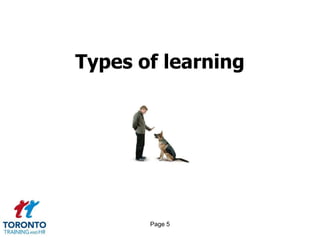
Types of learning


       Page 5
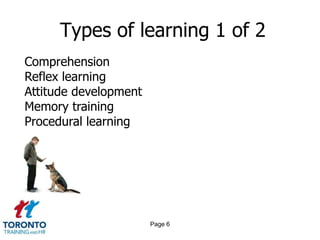
Types of learning 1 of 2
Comprehension
Reflex learning
Attitude development
Memory training
Procedural learning


                       Page 6
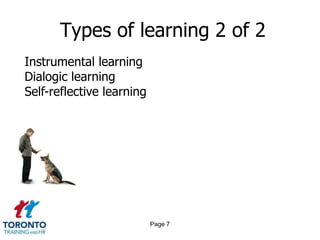
Types of learning 2 of 2
Instrumental learning
Dialogic learning
Self-reflective learning


                           Page 7
Models of learning


        Page 8
Models of learning
Behaviourist theory
Experimental psychology
Experiential learning
Learning styles
Learning cycle


                     Page 9
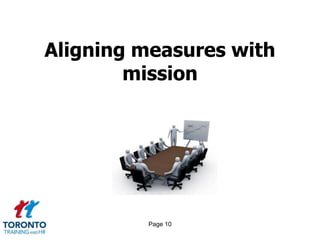
Aligning measures with
        mission


         Page 10
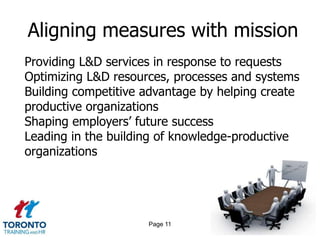
Aligning measures with mission
Providing L&D services in response to requests
Optimizing L&D resources, processes and systems
Building competitive advantage by helping create
productive organizations
Shaping employers’ future success
Leading in the building of knowledge-productive
organizations


                     Page 11
Adding value in Learning &
      Development


           Page 12
Adding value in Learning &
         Development
Align
Engage
Measure


              Page 13
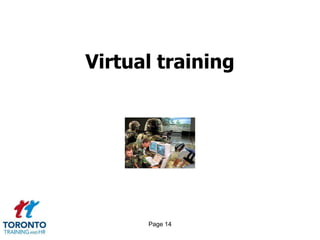
Virtual training


      Page 14
Virtual training 1 of 2
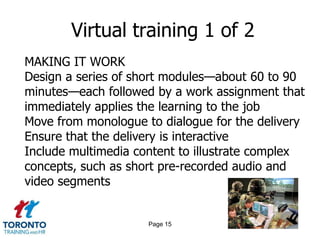
MAKING IT WORK
Design a series of short modules—about 60 to 90
minutes—each followed by a work assignment that
immediately applies the learning to the job
Move from monologue to dialogue for the delivery
Ensure that the delivery is interactive
Include multimedia content to illustrate complex
concepts, such as short pre-recorded audio and
video segments


                     Page 15
Virtual training 2 of 2
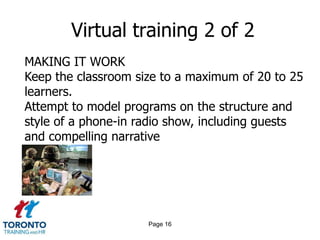
MAKING IT WORK
Keep the classroom size to a maximum of 20 to 25
learners.
Attempt to model programs on the structure and
style of a phone-in radio show, including guests
and compelling narrative


                     Page 16
Roles and social learning


           Page 17
Roles and social learning
Role
Status
Social structure
Institution
Norm
Primary group
Reference group
Significant other
Generalized other


                    Page 18
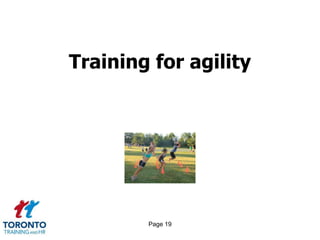
Training for agility


        Page 19
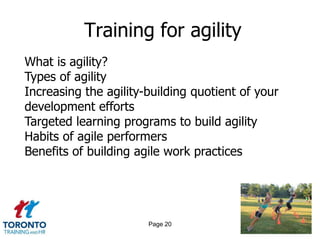
Training for agility
What is agility?
Types of agility
Increasing the agility-building quotient of your
development efforts
Targeted learning programs to build agility
Habits of agile performers
Benefits of building agile work practices


                       Page 20
Accelerating leadership
     development


          Page 21
Accelerating leadership
           development
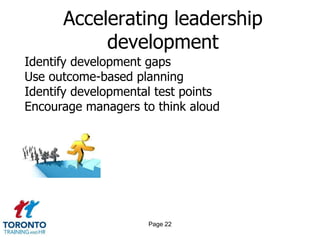
Identify development gaps
Use outcome-based planning
Identify developmental test points
Encourage managers to think aloud


                     Page 22
Key failings in leadership
      development


           Page 23
Key failings in leadership
           development
Lack of appropriate leadership development
strategies
Poor implementation of leadership development
programs
Lack of effective succession planning
Neglect of multinational leaders
Poor partnership between HR and corporate
leaders


                     Page 24
Emotional intelligence


         Page 25
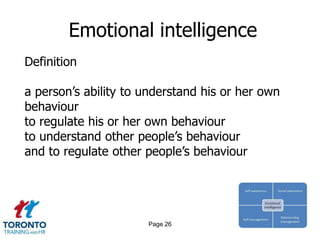
Emotional intelligence
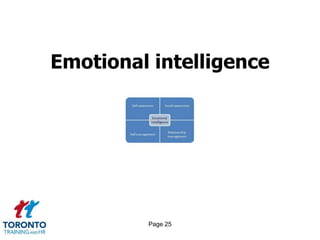
Definition

a person’s ability to understand his or her own
behaviour
to regulate his or her own behaviour
to understand other people’s behaviour
and to regulate other people’s behaviour


                      Page 26
Understanding learning
   and the learners


         Page 27
Understanding learning and the
           learners
The age of the trainer
The age of the learner
Knowledge workers
Learning technologies


                         Page 28
Issues of power and
      politics


        Page 29
Issues of power and politics
Resource
Position
Expertise


               Page 30
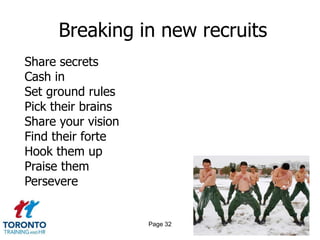
Breaking in new recruits


          Page 31
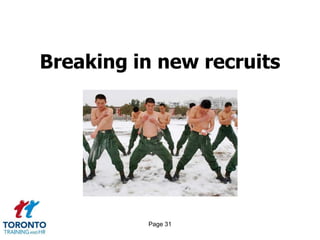
Breaking in new recruits
Share secrets
Cash in
Set ground rules
Pick their brains
Share your vision
Find their forte
Hook them up
Praise them
Persevere


                    Page 32
Establishing and
maintaining business
   partnerships


        Page 33
Establishing and maintaining
     business partnerships
Partner others
Achieve results
Raise awareness
Travel around
Never be complacent
Ensure ethical practice
Recognize the importance of context


                     Page 34
Issues in workplace
     learning


        Page 35
Issues in workplace learning
Experiential cycle of learning
Learning styles
Reflection
Tacit knowledge and explicit knowledge
The learning organization


                     Page 36
Knowledge management


         Page 37
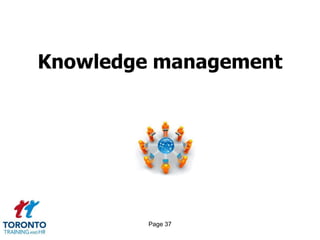
Knowledge management
Definition
Questions to ask
Objectives of knowledge management tools
Roles in knowledge management
Challenges for HR


                    Page 38
Impact points of learning


           Page 39
Impact points of learning
Planning
Classroom training or learning
Behaviour change
Results/effects of training


                      Page 40
Identifying a program’s
  learning outcomes


          Page 41
Identifying a program’s learning
            outcomes
Identify the objectives of the organizational unit
Identify the desired on-the-job behaviours of
participants
Write learning objectives
Determine content, delivery mode and schedule


                       Page 42
Business education: the
      top trends


          Page 43
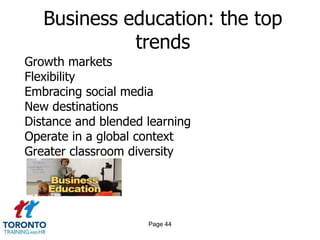
Business education: the top
             trends
Growth markets
Flexibility
Embracing social media
New destinations
Distance and blended learning
Operate in a global context
Greater classroom diversity


                     Page 44
Case study A


    Page 45
Case study A


    Page 46
Case study B


    Page 47
Case study B


    Page 48
Case study C


    Page 49
Case study C


    Page 50
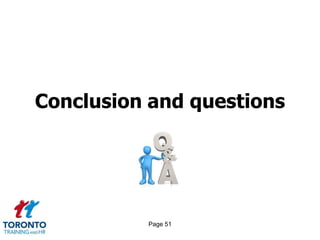
Conclusion and questions


          Page 51
Conclusion and questions
Summary
Videos
Questions


               Page 52

Learning more about Learning & Development March 2012

  • 1.
    Learning more aboutLearning & Development by Toronto Training and HR March 2012
  • 2.
    3-4 Introduction to Toronto Training and HR 5-7 Types of learning Contents 8-9 10-11 Models of learning Aligning measures with mission 12-13 Adding value in Learning & Development 14-16 Virtual training 17-18 Roles and social learning 19-20 Training for agility 21-22 Accelerating leadership development 23-24 Key failings in leadership development 25-26 Emotional intelligence 27-28 Understanding learning and the learners 29-30 Issues of power and politics 31-32 Breaking in new recruits 33-34 Establishing and maintaining business partnerships 35-36 Issues in workplace learning 37-38 Knowledge management 39-40 Impact points of learning 41-42 Identifying a program’s learning outcomes 43-44 Business education; the top trends 45-50 Case studies 51-52 Conclusion and questions
  • 3.
  • 4.
    Introduction to TorontoTraining and HR • Toronto Training and HR is a specialist training and human resources consultancy headed by Timothy Holden • 10 years in banking • 10 years in training and human resources • Freelance practitioner since 2006 • The core services provided by Toronto Training and HR are: - Training event design - Training event delivery - Reducing costs - Saving time - Improving employee engagement & morale - Services for job seekers Page 4
  • 5.
  • 6.
    Types of learning1 of 2 Comprehension Reflex learning Attitude development Memory training Procedural learning Page 6
  • 7.
    Types of learning2 of 2 Instrumental learning Dialogic learning Self-reflective learning Page 7
  • 8.
  • 9.
    Models of learning Behaviouristtheory Experimental psychology Experiential learning Learning styles Learning cycle Page 9
  • 10.
    Aligning measures with mission Page 10
  • 11.
    Aligning measures withmission Providing L&D services in response to requests Optimizing L&D resources, processes and systems Building competitive advantage by helping create productive organizations Shaping employers’ future success Leading in the building of knowledge-productive organizations Page 11
  • 12.
    Adding value inLearning & Development Page 12
  • 13.
    Adding value inLearning & Development Align Engage Measure Page 13
  • 14.
  • 15.
    Virtual training 1of 2 MAKING IT WORK Design a series of short modules—about 60 to 90 minutes—each followed by a work assignment that immediately applies the learning to the job Move from monologue to dialogue for the delivery Ensure that the delivery is interactive Include multimedia content to illustrate complex concepts, such as short pre-recorded audio and video segments Page 15
  • 16.
    Virtual training 2of 2 MAKING IT WORK Keep the classroom size to a maximum of 20 to 25 learners. Attempt to model programs on the structure and style of a phone-in radio show, including guests and compelling narrative Page 16
  • 17.
    Roles and sociallearning Page 17
  • 18.
    Roles and sociallearning Role Status Social structure Institution Norm Primary group Reference group Significant other Generalized other Page 18
  • 19.
  • 20.
    Training for agility Whatis agility? Types of agility Increasing the agility-building quotient of your development efforts Targeted learning programs to build agility Habits of agile performers Benefits of building agile work practices Page 20
  • 21.
    Accelerating leadership development Page 21
  • 22.
    Accelerating leadership development Identify development gaps Use outcome-based planning Identify developmental test points Encourage managers to think aloud Page 22
  • 23.
    Key failings inleadership development Page 23
  • 24.
    Key failings inleadership development Lack of appropriate leadership development strategies Poor implementation of leadership development programs Lack of effective succession planning Neglect of multinational leaders Poor partnership between HR and corporate leaders Page 24
  • 25.
  • 26.
    Emotional intelligence Definition a person’sability to understand his or her own behaviour to regulate his or her own behaviour to understand other people’s behaviour and to regulate other people’s behaviour Page 26
  • 27.
    Understanding learning and the learners Page 27
  • 28.
    Understanding learning andthe learners The age of the trainer The age of the learner Knowledge workers Learning technologies Page 28
  • 29.
    Issues of powerand politics Page 29
  • 30.
    Issues of powerand politics Resource Position Expertise Page 30
  • 31.
    Breaking in newrecruits Page 31
  • 32.
    Breaking in newrecruits Share secrets Cash in Set ground rules Pick their brains Share your vision Find their forte Hook them up Praise them Persevere Page 32
  • 33.
  • 34.
    Establishing and maintaining business partnerships Partner others Achieve results Raise awareness Travel around Never be complacent Ensure ethical practice Recognize the importance of context Page 34
  • 35.
    Issues in workplace learning Page 35
  • 36.
    Issues in workplacelearning Experiential cycle of learning Learning styles Reflection Tacit knowledge and explicit knowledge The learning organization Page 36
  • 37.
  • 38.
    Knowledge management Definition Questions toask Objectives of knowledge management tools Roles in knowledge management Challenges for HR Page 38
  • 39.
    Impact points oflearning Page 39
  • 40.
    Impact points oflearning Planning Classroom training or learning Behaviour change Results/effects of training Page 40
  • 41.
    Identifying a program’s learning outcomes Page 41
  • 42.
    Identifying a program’slearning outcomes Identify the objectives of the organizational unit Identify the desired on-the-job behaviours of participants Write learning objectives Determine content, delivery mode and schedule Page 42
  • 43.
    Business education: the top trends Page 43
  • 44.
    Business education: thetop trends Growth markets Flexibility Embracing social media New destinations Distance and blended learning Operate in a global context Greater classroom diversity Page 44
  • 45.
  • 46.
  • 47.
  • 48.
  • 49.
  • 50.
  • 51.
  • 52.