Lillian White
CUR 532
Gregory Jackson
Welcome
Today begins your journey as a Heart Share Children
Services Supervisor Training Team.
You will embark upon a 3-day module training provided
by the Heart Share Corporation.
So, sit back, relax, and lets get ready to take a learning
experience like never before.
My Name Is Lillian White
I will be your facilitator training host. My purpose is to
lead you to the path of effective facilitation which I hope
will empower you to with the knowledge and skill to
train others to be the backbone of the Heart Share
Corporation.
If at any time you need to reach me, feel free to contact
me via
 phone (252)505-2779 (call or text)
 Email – lilly27970@email.phoenix.edu
 or Skype - Lillian B. Jonesy
Table Of Contents
Facilitator Training Program
Synchronous 3-Day Module
Module 1
Part 1 – Vital Information in the Facilitator Training
1.1 Training program audience
1.2 Training program goals
1.3 Training program objectives
1.4 Summative assessment of trainee learning
1.1 Training Program Audience
 Training Audience
 A common mistake with many facilitator training
programs is the assumption that all online facilitators
have the same level of development and experiences.
(Palloff & Pratt, 2011)
https://www.taxmantra.com
1.1 Training Program
Audience
Training Audience
Heart Share understands that
Supervisors come to this training
program at different phases of
development and training skills.
Many trainers may come at this
novice level, never having taught
online/distance education training.
That’s OK,
 Currently the Supervisor
Trainer Team possesses
basic computer literacy
skills such as Windows
Operating systems.
 Members of the team does
not have any previous
experiences with work
related distance education
training online.
 Several of the Supervisor
Trainer Team have a small
amount of knowledge
how to facilitate training
via their personal
experience when promoted
to their current position as
training Supervisor.
This training program is designed for the Heart Share Children
Services
Supervisor Trainer Team.
1.2 Training Program Goals
 The key skills that the Corporate trainer need to be
successful as a distance facilitator are;
 Adaptability
 Communication/Collaborative skills
 Creativity
 Provide Guidance
 https://daystead.wordpress.com/2012/04/25/the-
adaptable-teacher/
1.2 Training Program Goals
The participants of the Facilitator Training Program will
accomplish the following training goals;
1. Establish and maintain a learning community.
2. Acquire the knowledge and skill of online engagement
techniques.
3. Become proficient with using online tools and social
media tools.
4. Maintain an online presence.
1.3 Training Program Objectives
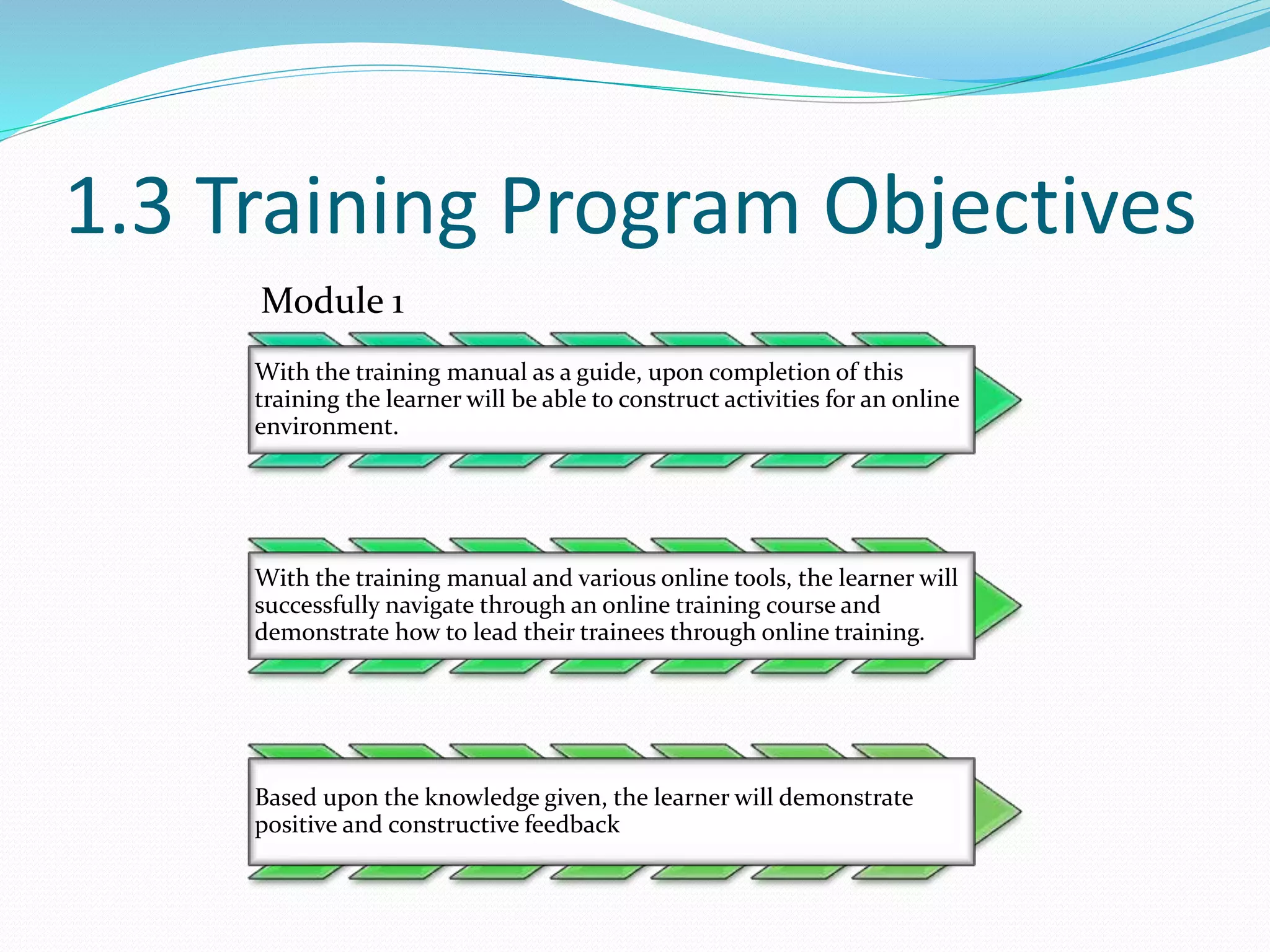
Module 1
With the training manual as a guide, upon completion of this
training the learner will be able to construct activities for an online
environment.
With the training manual and various online tools, the learner will
successfully navigate through an online training course and
demonstrate how to lead their trainees through online training.
Based upon the knowledge given, the learner will demonstrate
positive and constructive feedback
1.3 Training Program Objectives
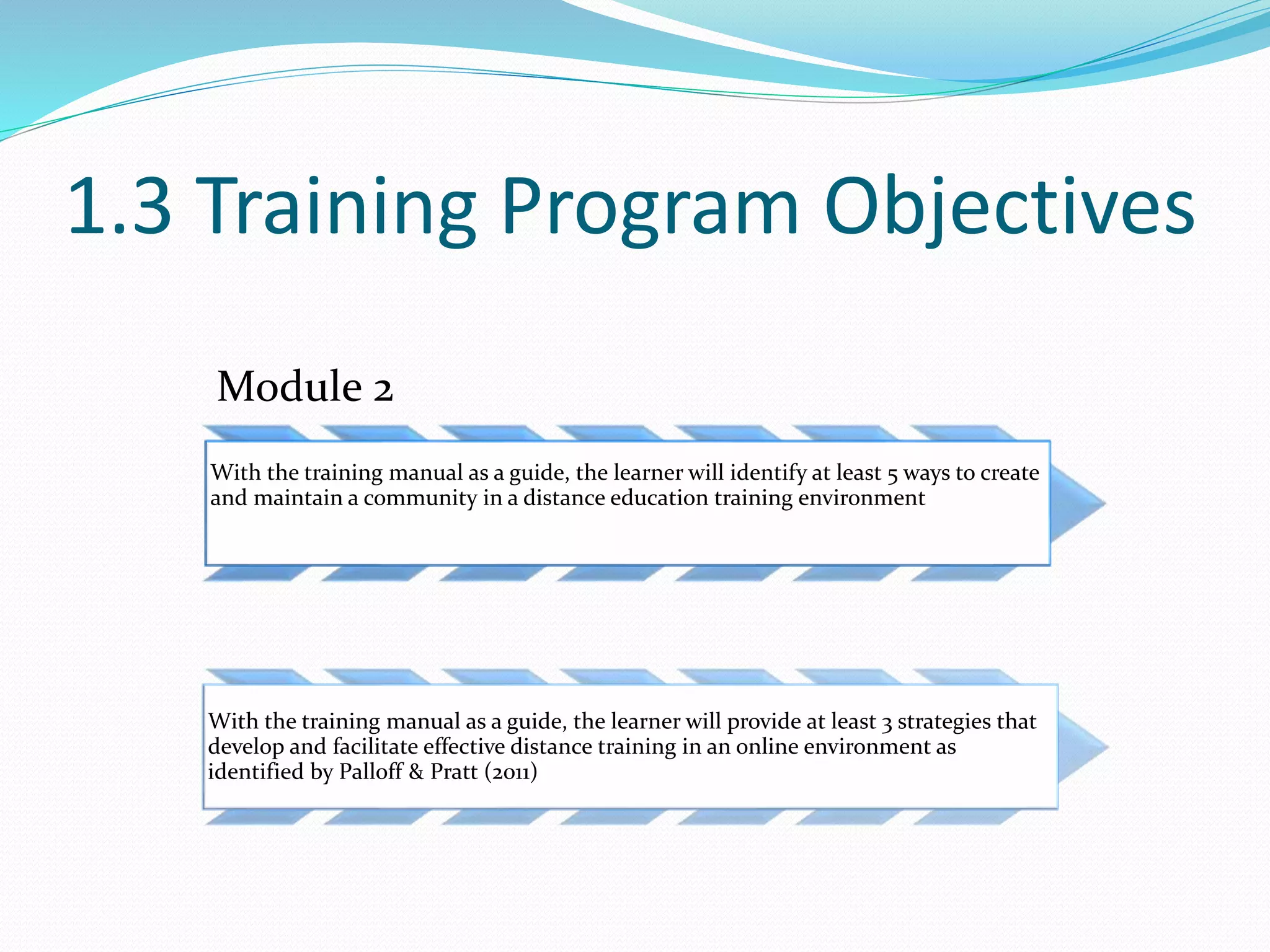
Module 2
With the training manual as a guide, the learner will identify at least 5 ways to create
and maintain a community in a distance education training environment
With the training manual as a guide, the learner will provide at least 3 strategies that
develop and facilitate effective distance training in an online environment as
identified by Palloff & Pratt (2011)
1.3 Training Program Objectives
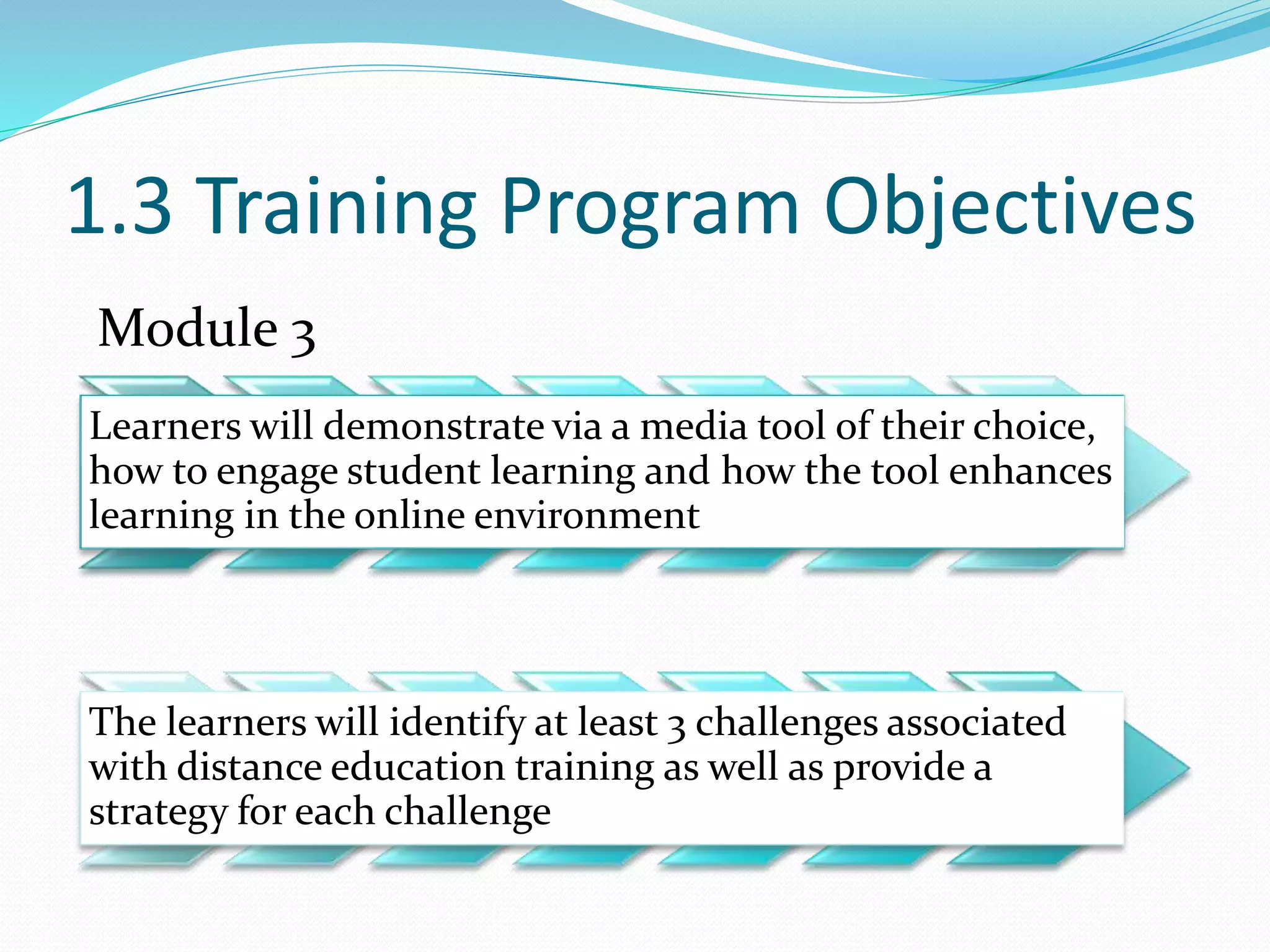
Module 3
Learners will demonstrate via a media tool of their choice,
how to engage student learning and how the tool enhances
learning in the online environment
The learners will identify at least 3 challenges associated
with distance education training as well as provide a
strategy for each challenge
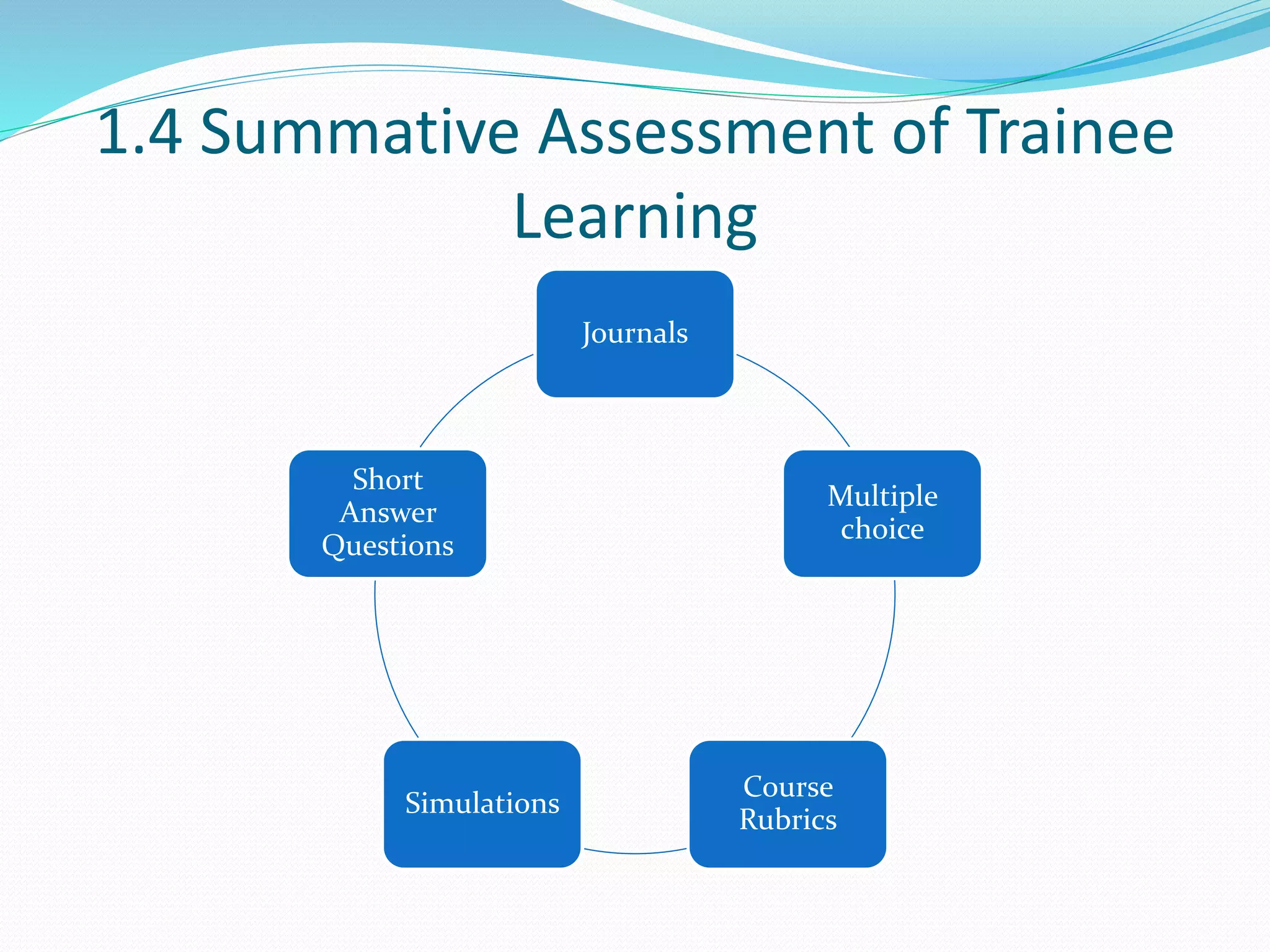
1.4 Summative Assessment of Trainee
Learning
Journals
Multiple
choice
Course
Rubrics
Simulations
Short
Answer
Questions
1.4 Summative Assessment of Trainee
Learning
 Trainees will complete informal assessments within
each training module and at the end of each module
based on course rubrics.
 Upon completion of the Facilitator Training Program,
trainee will be assessed in order to determine the
trainee’s ability to satisfy the course objectives
 Trainees will demonstrate their newly acquired
knowledge and skill through journal reflections,
simulations, and peer collaboration.
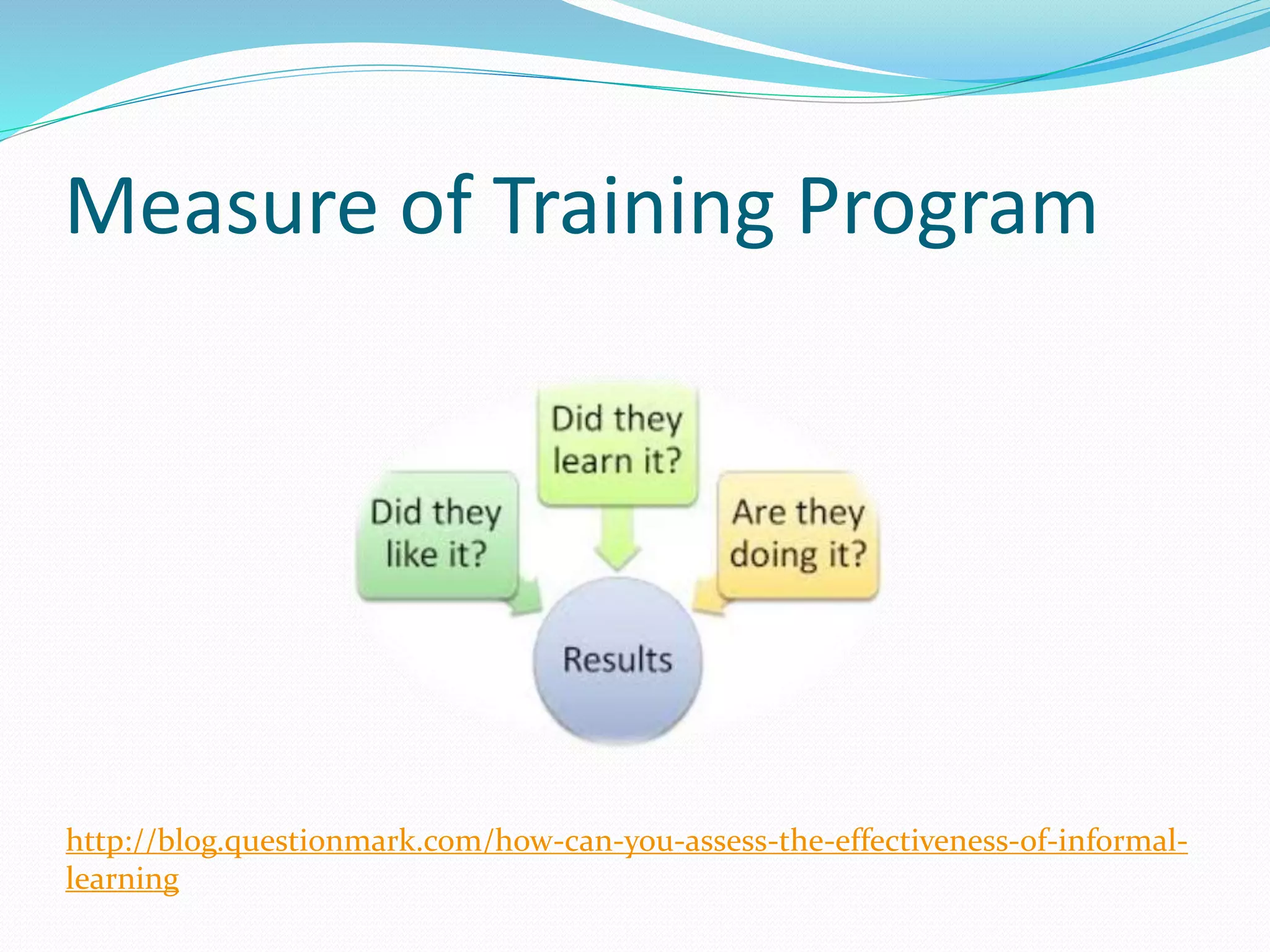
Measure of Training Program
http://blog.questionmark.com/how-can-you-assess-the-effectiveness-of-informal-
learning
Measure of Training Program
 Information pertaining to the effectiveness of the
training program will be gathered via surveys of the
trainees.
 Trainees will complete participant evaluations upon
completion. The evaluations will serve as an indicator
of participants satisfaction scored numerically.
 A post-training assessment will occur 6 months after
training completion date.
 This assessment will be comprised of short answers
and multiple choice.
Table of Contents
Facilitator Training Program
Synchronous 3-Day Module
Module 1
 Part II – Facilitator Skills and Instructional Materials
 2.1 – Training materials
 2.2 – Describe the phases of development for
distance learning facilitators
 2.3 – Identify the theories of distance learning
 2.4 – Describe the theories for engaging distance
learners
2.1 Training Material
Skills Needed for Effective Distance Learning
Facilitators
 Communicate clearly the requirements of the course
requirements
 Develop training activities that includes trainee to trainee
and facilitator to trainee interaction
 Create a training/learning community online
 Facilitate and maintain online discussions
 Adaptation of training material and tools
 Assess trainee learning
 Provide feedback
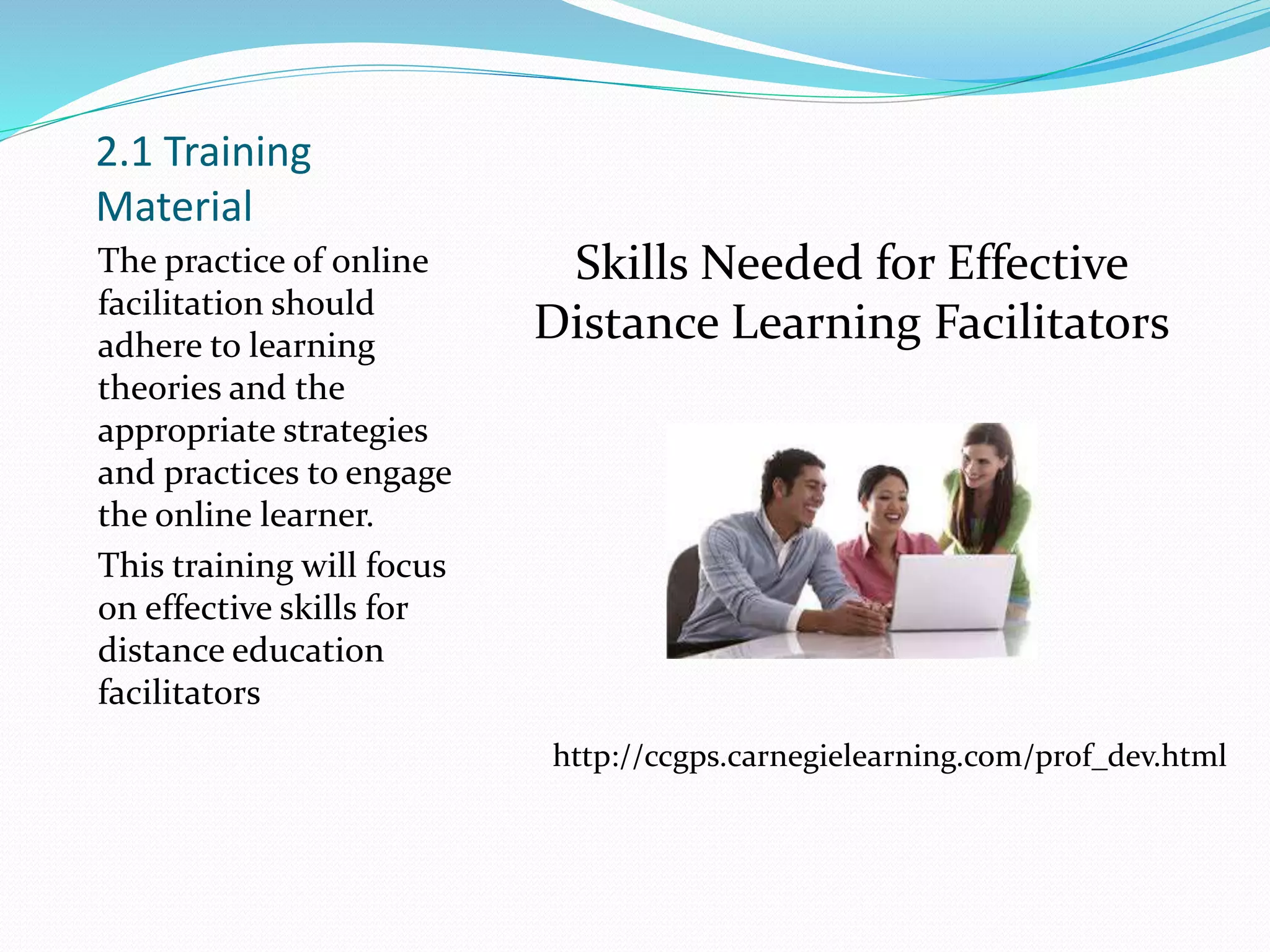
2.1 Training
Material
The practice of online
facilitation should
adhere to learning
theories and the
appropriate strategies
and practices to engage
the online learner.
This training will focus
on effective skills for
distance education
facilitators
Skills Needed for Effective
Distance Learning Facilitators
http://ccgps.carnegielearning.com/prof_dev.html
2.1 Training Material
Strategies To Present Skills To Facilitators
 Discussion boards
 Icebreaker – give name, location, and number of years with
corporation, 2-3 sentences of feeling about online training, respond
to at least 2 other participant’s post
 Establish an online chat
 via a social network site - Present a corporate safety issue and
have trainees chat as to how they would solve the issue.
 Divide into Groups
 Allow groups participants to voluntarily lead a discussion
based on any of the module topics
2.2 Phases of Development for Distance
Learning/Training Facilitators
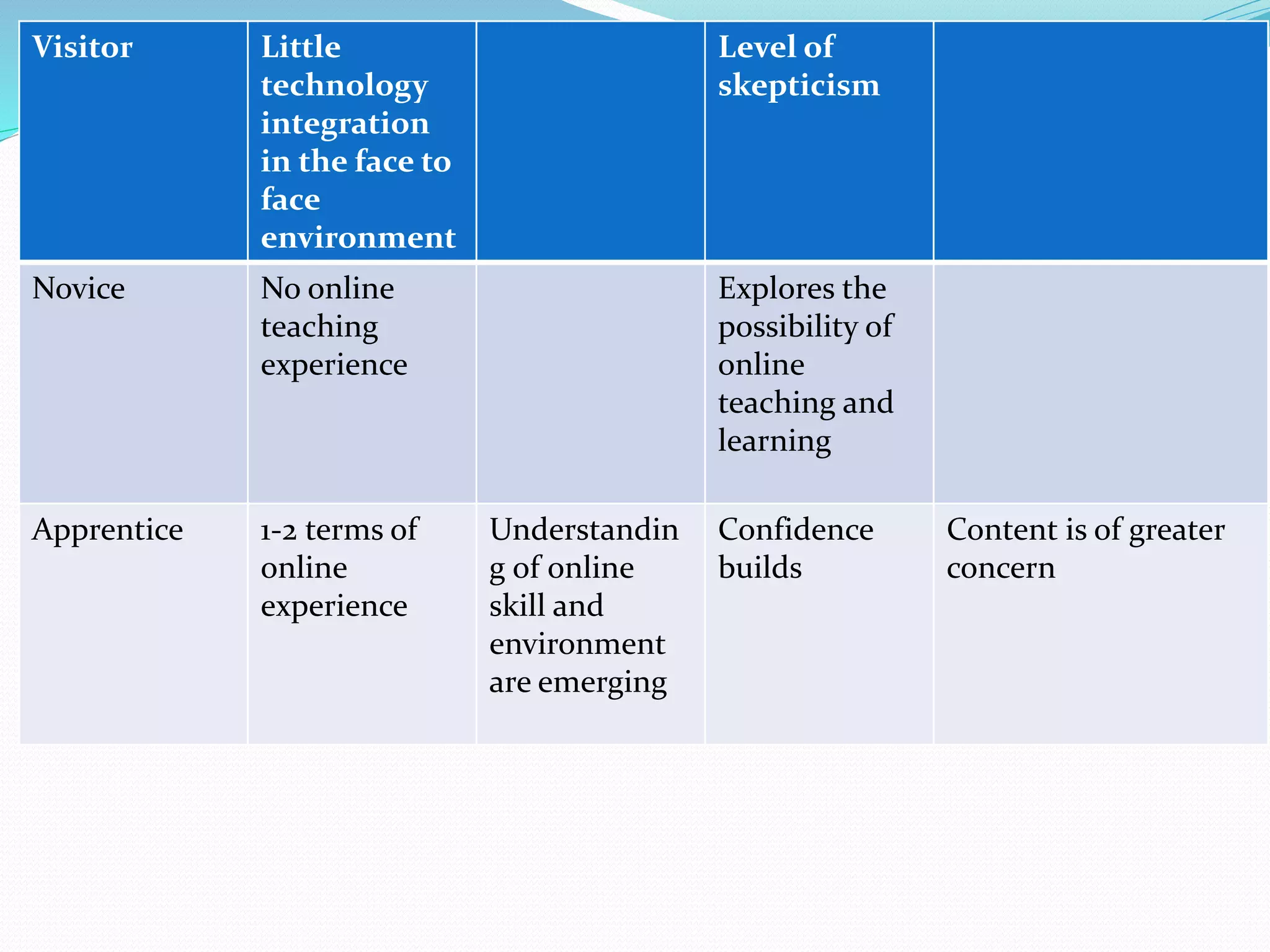
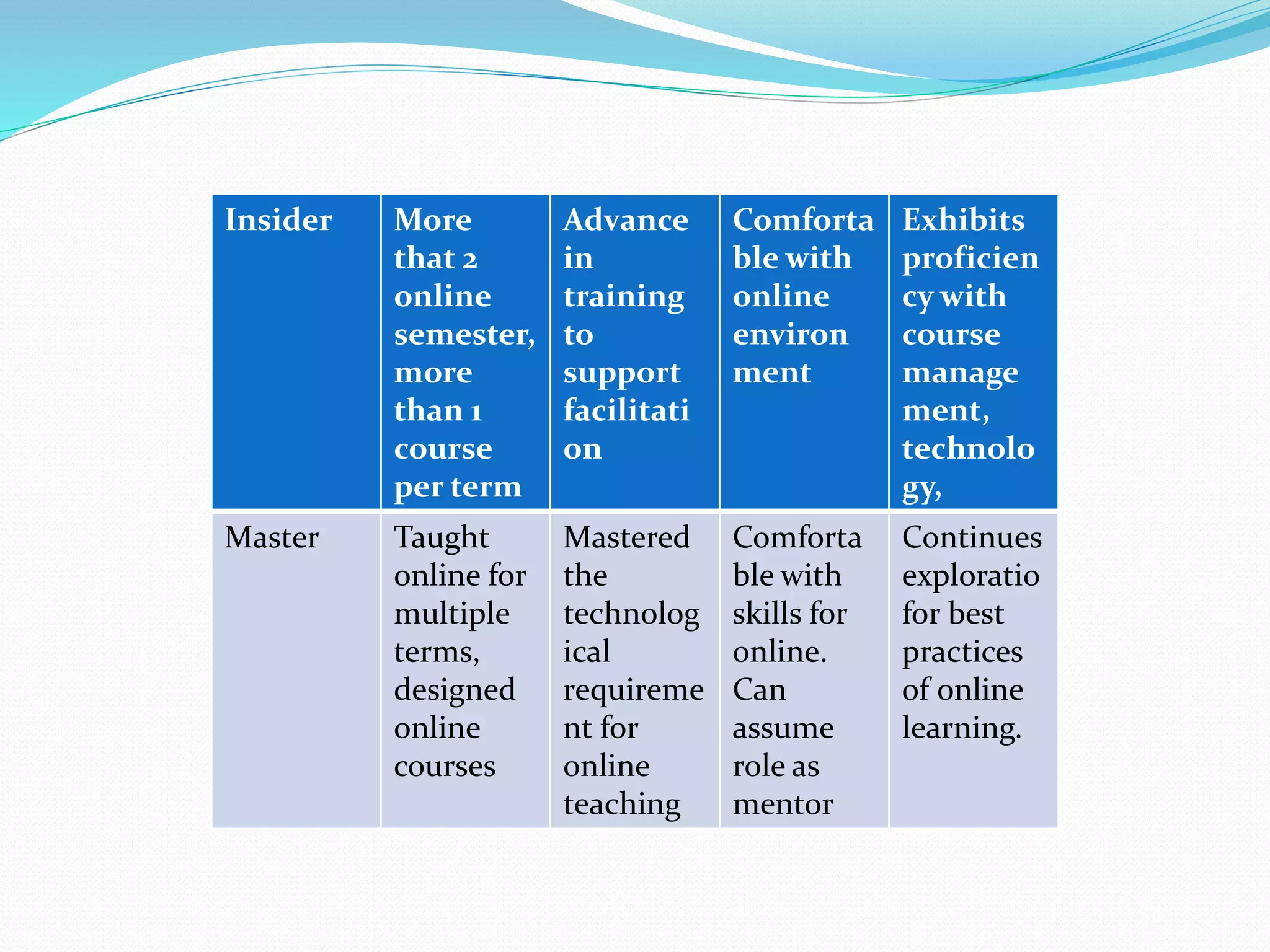
 According to Palloff & Pratt (2011) the online facilitator
goes through 5 distinct phases of development.
 Palloff & Pratt assumes that what makes the online
facilitator an excellent facilitator is not so much their
expertise in his or her discipline.
2.2 Phases of Development for Distance
learning/Training Facilitators
The excellent online facilitator has to migrate to the level
of excellence as they make the connection between the
learning outcomes they hope to achieve and the
utilization of technology required to achieve those
outcomes.
Visitor Little
technology
integration
in the face to
face
environment
Level of
skepticism
Novice No online
teaching
experience
Explores the
possibility of
online
teaching and
learning
Apprentice 1-2 terms of
online
experience
Understandin
g of online
skill and
environment
are emerging
Confidence
builds
Content is of greater
concern
Insider More
that 2
online
semester,
more
than 1
course
per term
Advance
in
training
to
support
facilitati
on
Comforta
ble with
online
environ
ment
Exhibits
proficien
cy with
course
manage
ment,
technolo
gy,
Master Taught
online for
multiple
terms,
designed
online
courses
Mastered
the
technolog
ical
requireme
nt for
online
teaching
Comforta
ble with
skills for
online.
Can
assume
role as
mentor
Continues
exploratio
for best
practices
of online
learning.
2.3 Identify Theories of Distance
Learning
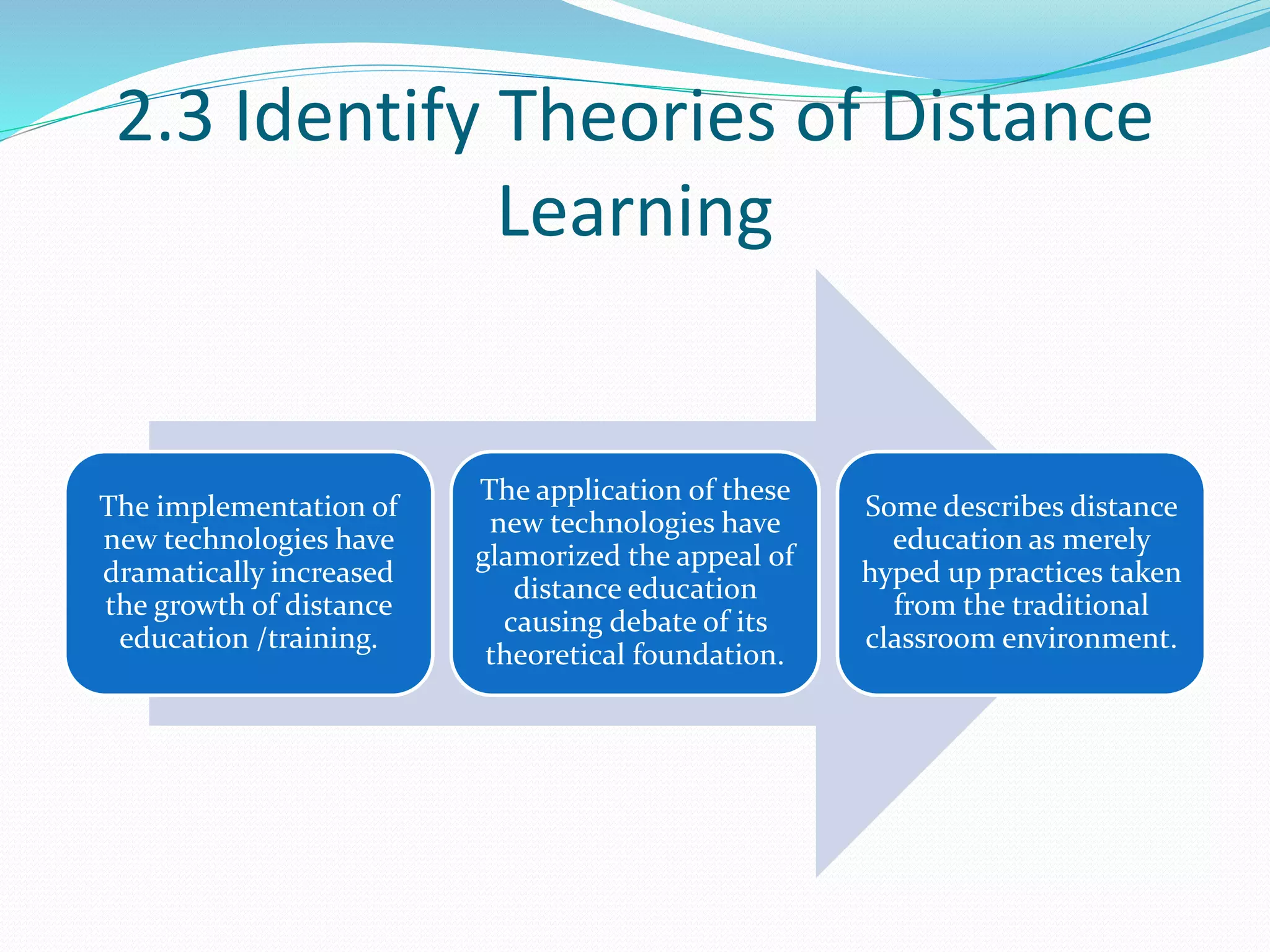
The implementation of
new technologies have
dramatically increased
the growth of distance
education /training.
The application of these
new technologies have
glamorized the appeal of
distance education
causing debate of its
theoretical foundation.
Some describes distance
education as merely
hyped up practices taken
from the traditional
classroom environment.
2.3 Identify Theories of Distance
Learning
To justify and explain the
phenomenon of the booming
elearning environment theoreticians
such as Holmberg, Keegan, &
Rumble foundational assumptions of
the differences between distance
education and traditional education.
2.3 Identify Theories of Distance
Learning
The following brief descriptions of
elearning theories are included in this
training manual not only to enlighten
facilitators of how students learn, but to
help facilitators understand the argument
some experts pose that some theories fail
to see the significant differences that exists
in the elearning environment (Haythornwaite & Andrews, 2011)
2.3 Identify Theories of Distance
Learning
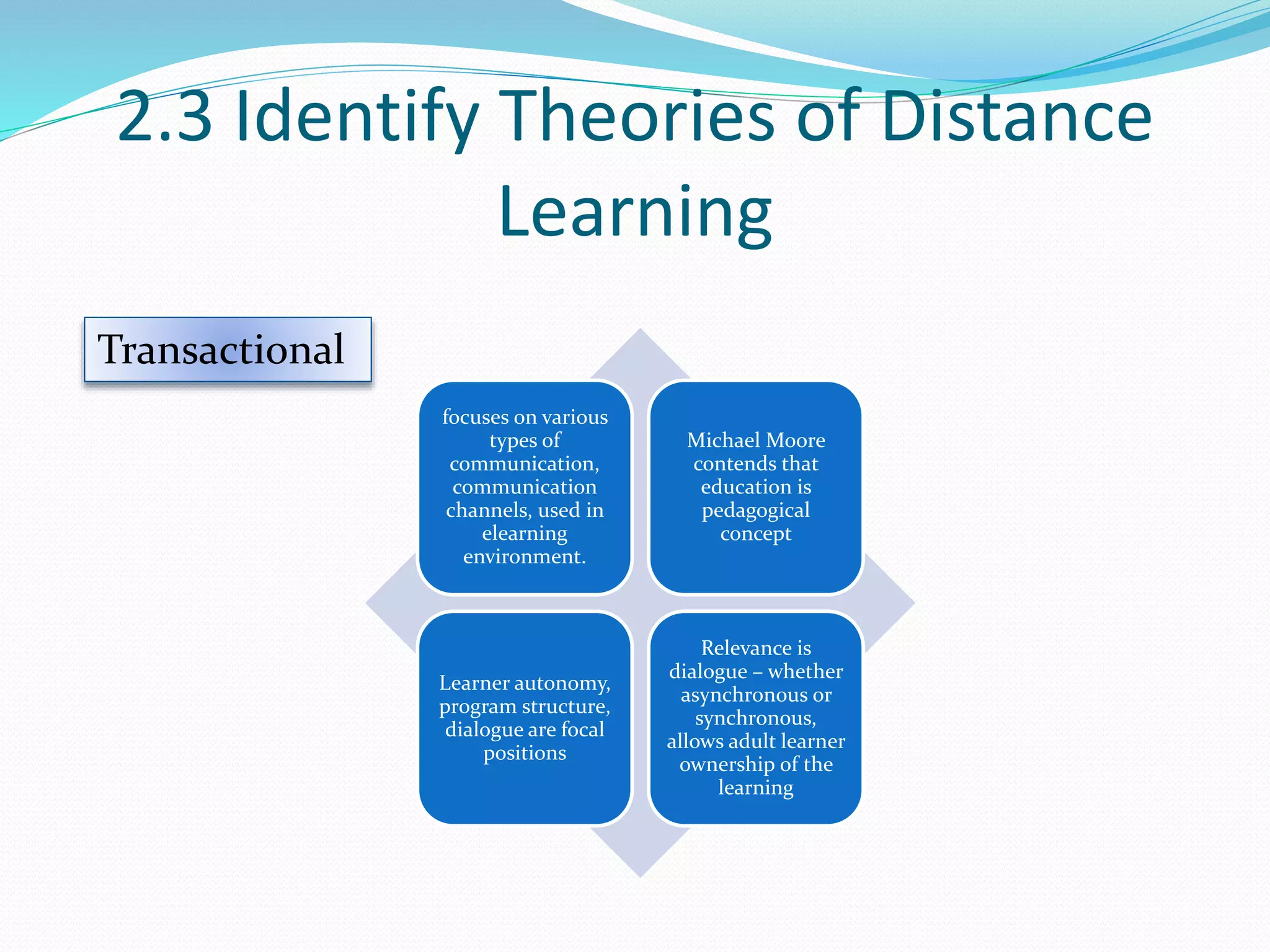
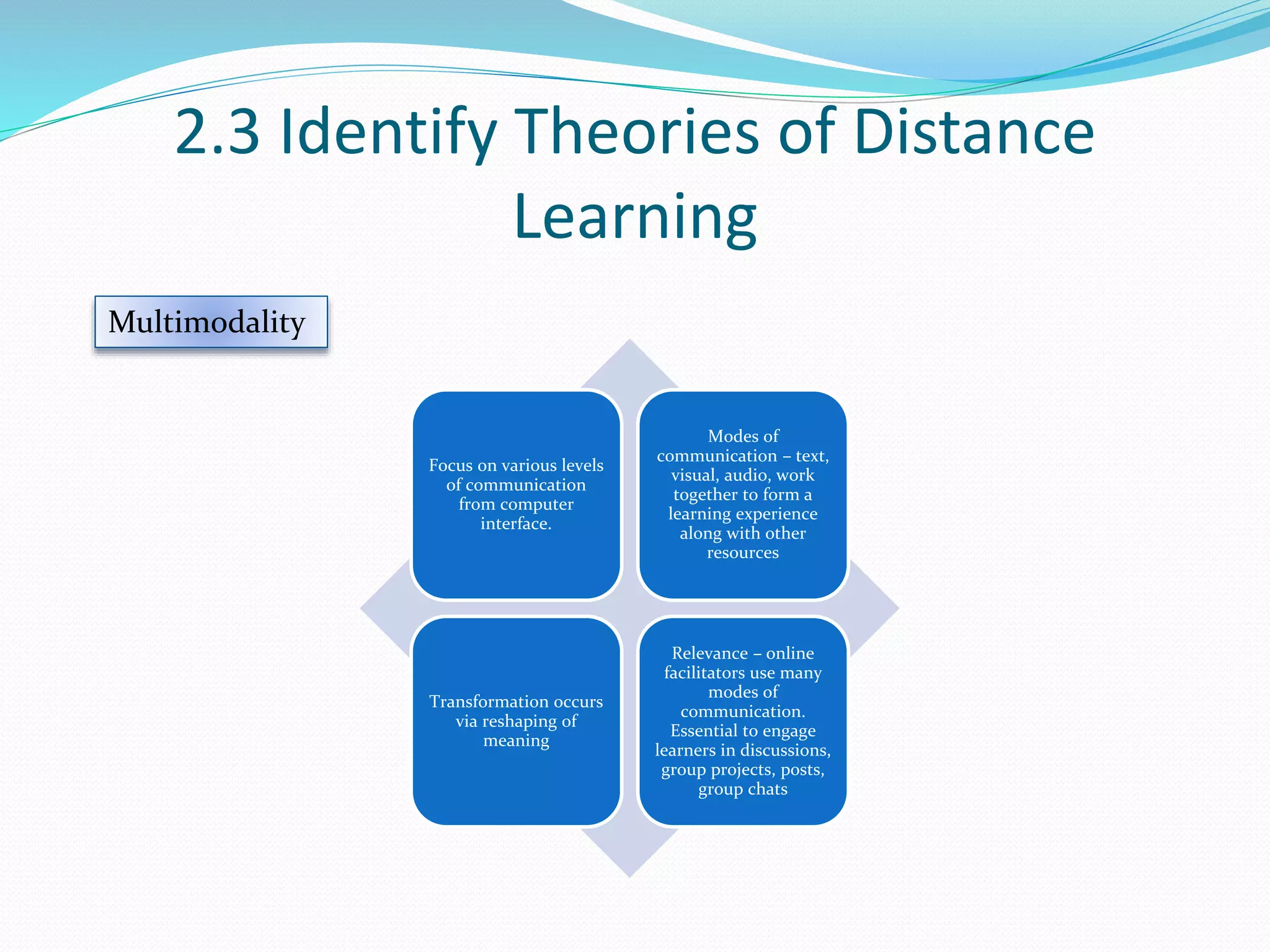
focuses on various
types of
communication,
communication
channels, used in
elearning
environment.
Michael Moore
contends that
education is
pedagogical
concept
Learner autonomy,
program structure,
dialogue are focal
positions
Relevance is
dialogue – whether
asynchronous or
synchronous,
allows adult learner
ownership of the
learning
Transactional
2.3 Identify Theories of Distance
Learning
Focus on various levels
of communication
from computer
interface.
Modes of
communication – text,
visual, audio, work
together to form a
learning experience
along with other
resources
Transformation occurs
via reshaping of
meaning
Relevance – online
facilitators use many
modes of
communication.
Essential to engage
learners in discussions,
group projects, posts,
group chats
Multimodality
2.3 Identify Theories of Distance
Learning
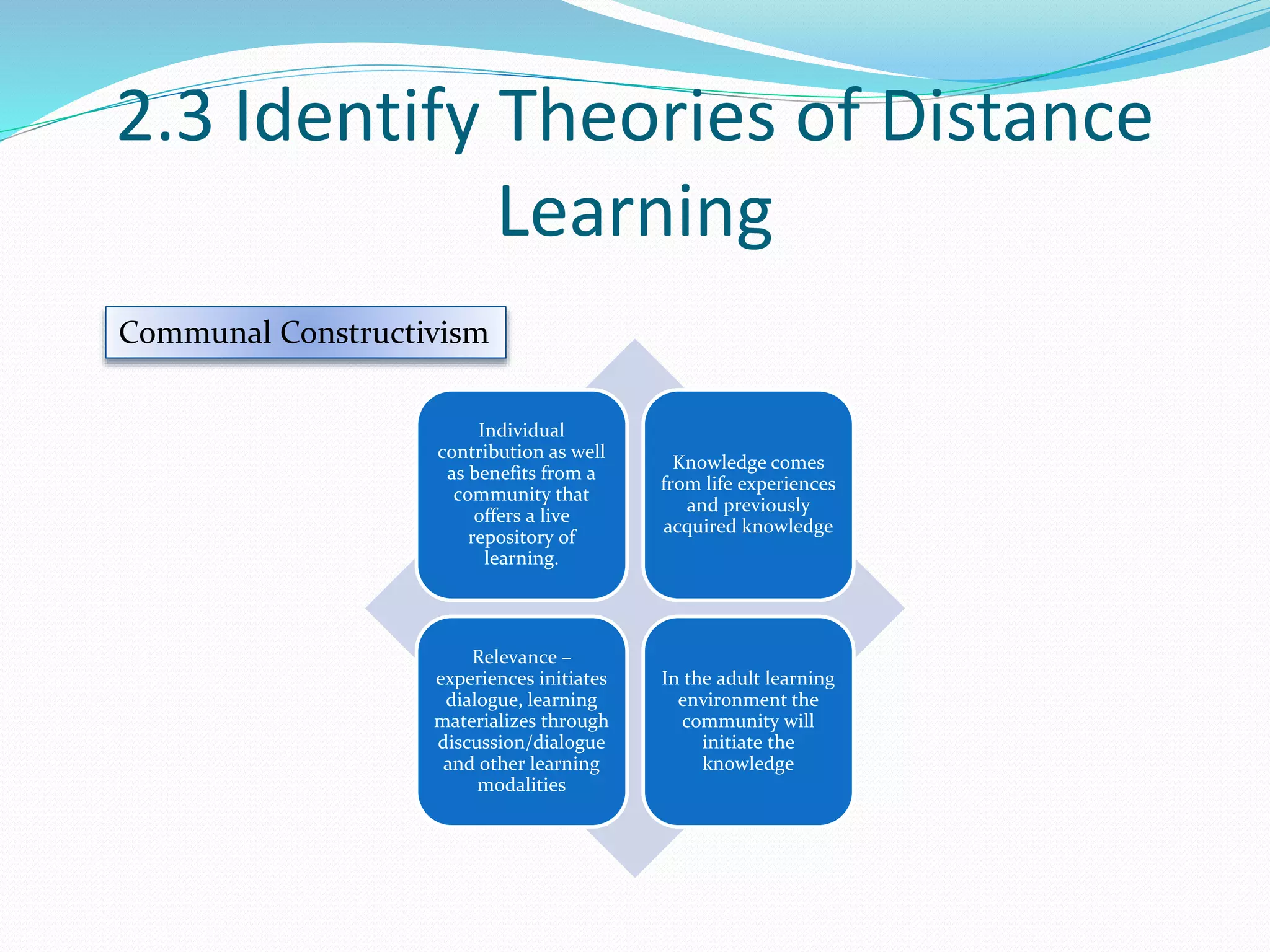
Individual
contribution as well
as benefits from a
community that
offers a live
repository of
learning.
Knowledge comes
from life experiences
and previously
acquired knowledge
Relevance –
experiences initiates
dialogue, learning
materializes through
discussion/dialogue
and other learning
modalities
In the adult learning
environment the
community will
initiate the
knowledge
Communal Constructivism
2.4 Theories for Engaging Distance
Learners
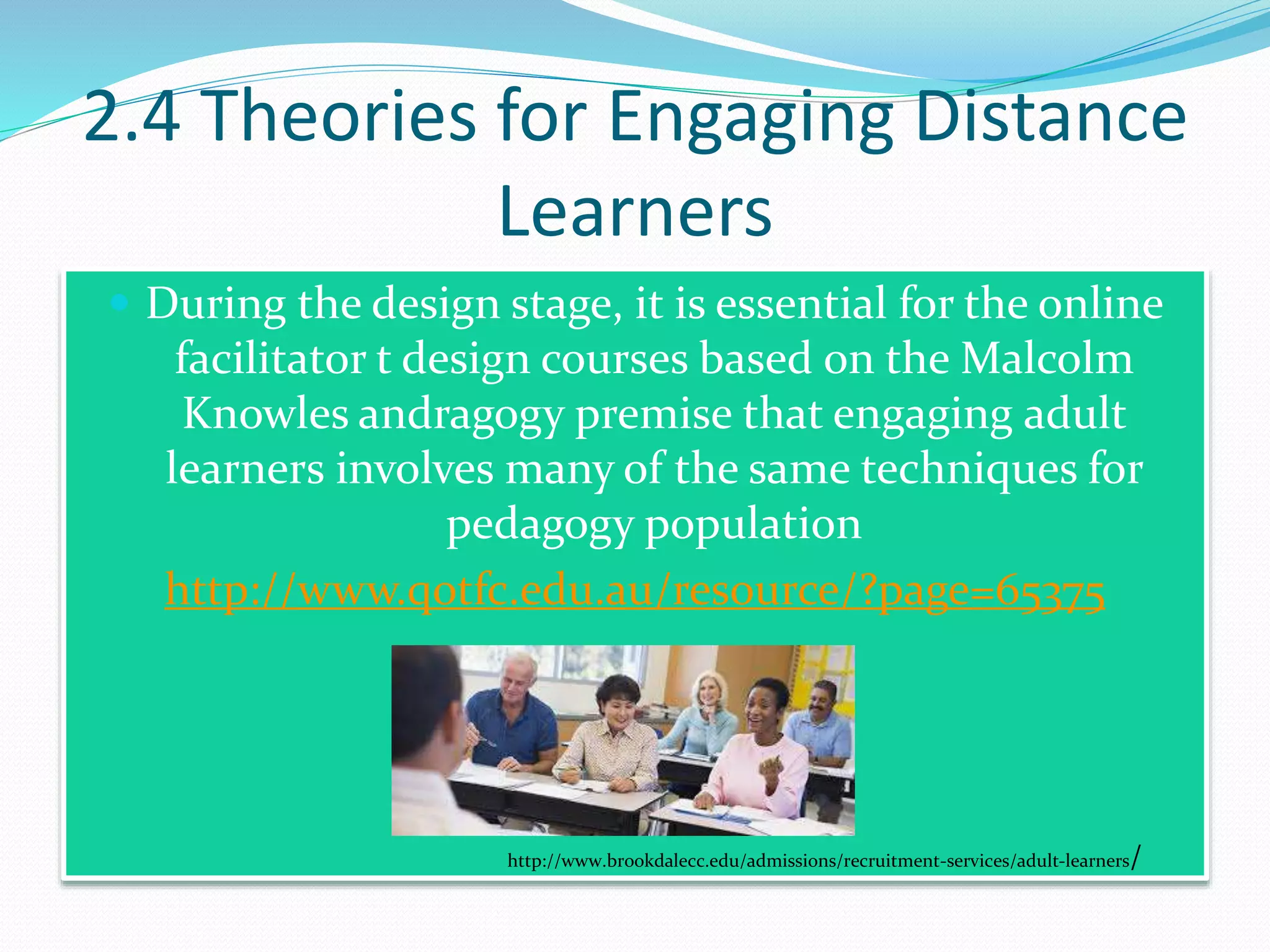
 During the design stage, it is essential for the online
facilitator t design courses based on the Malcolm
Knowles andragogy premise that engaging adult
learners involves many of the same techniques for
pedagogy population
http://www.qotfc.edu.au/resource/?page=65375
http://www.brookdalecc.edu/admissions/recruitment-services/adult-learners/
2.4 Theories For Engaging Distance
Learners
Knowles maintains
several adult learning
principles which should
serve as a guide when
incorporating
engagement techniques.
Based on our history of
facilitator training
programs we
recommend;
2.4 Theories for Engaging Distance
Learners
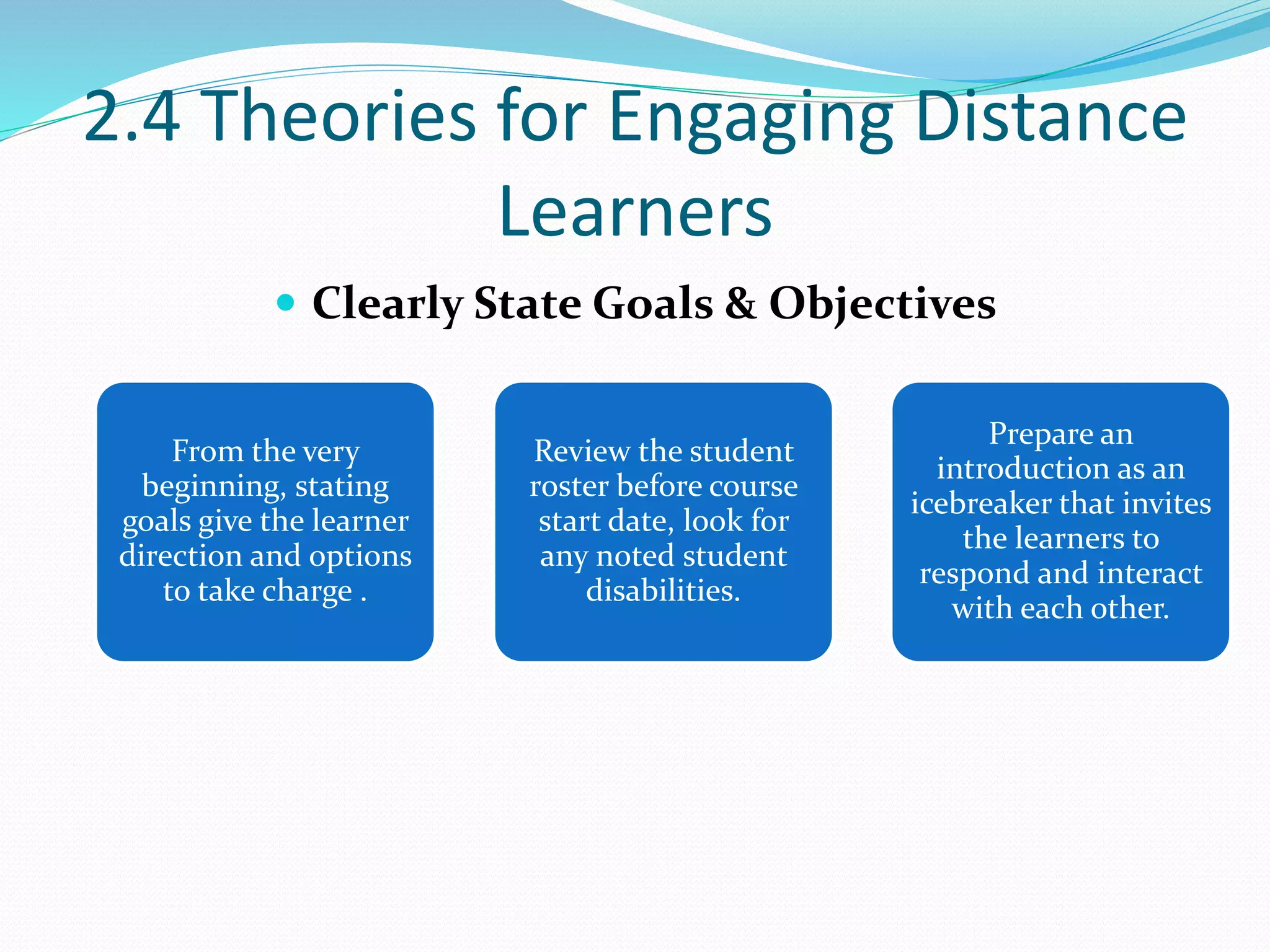
 Clearly State Goals & Objectives
From the very
beginning, stating
goals give the learner
direction and options
to take charge .
Review the student
roster before course
start date, look for
any noted student
disabilities.
Prepare an
introduction as an
icebreaker that invites
the learners to
respond and interact
with each other.
2.4 Theories for Engaging Distance
Learners
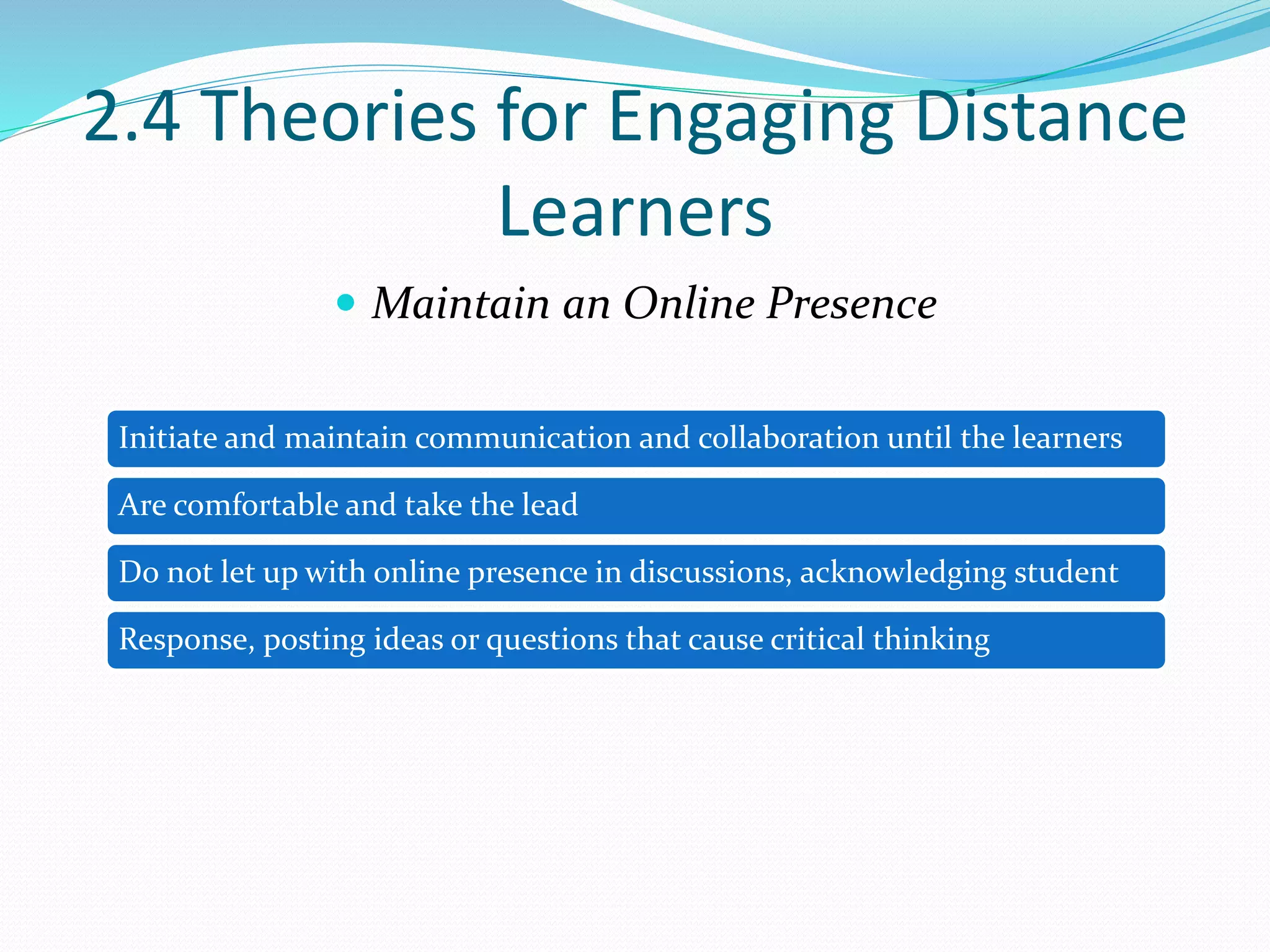
 Maintain an Online Presence
Initiate and maintain communication and collaboration until the learners
Are comfortable and take the lead
Do not let up with online presence in discussions, acknowledging student
Response, posting ideas or questions that cause critical thinking
2.4 Theories for Engaging Distance
Learners
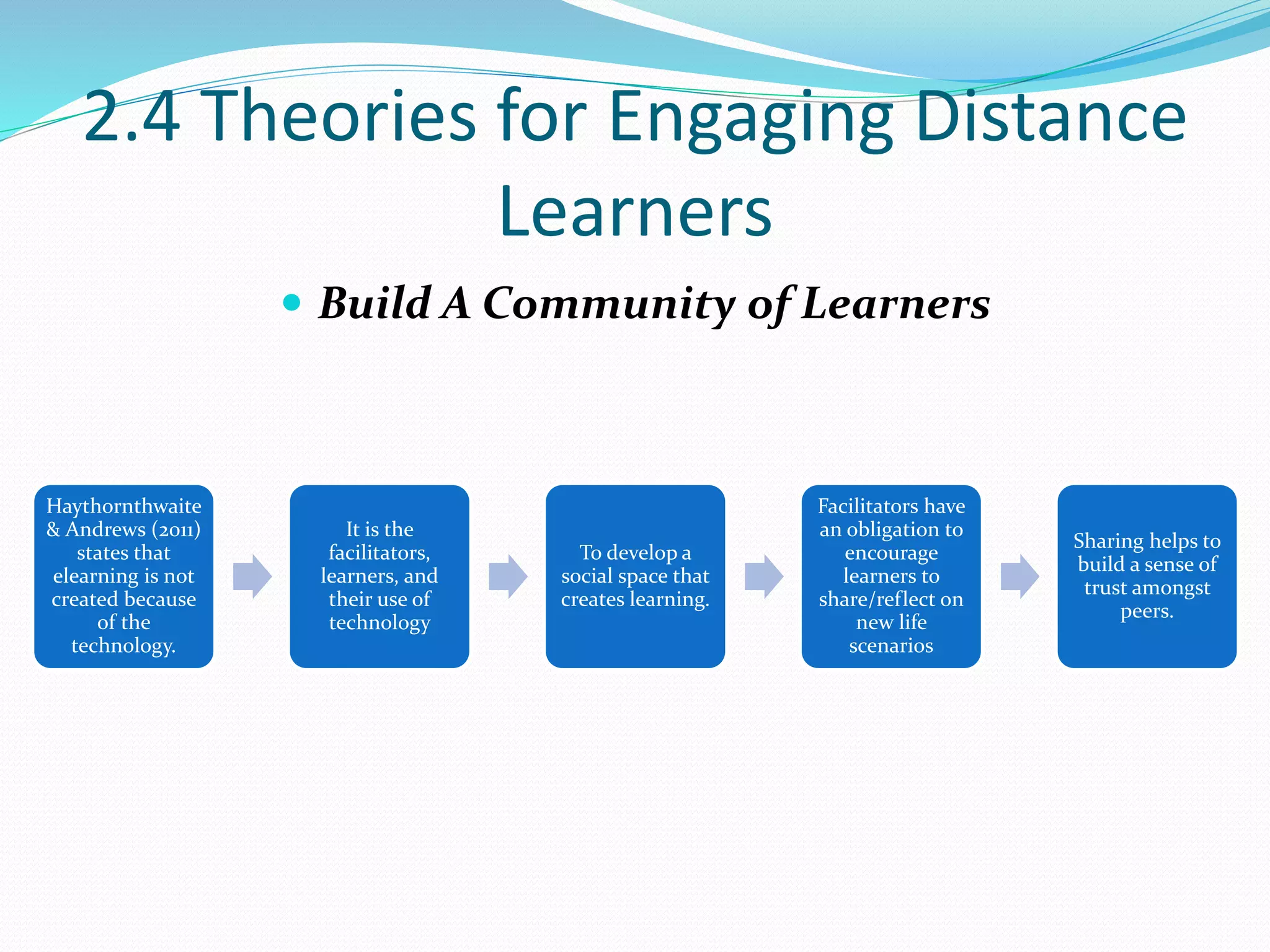
 Build A Community of Learners
Haythornthwaite
& Andrews (2011)
states that
elearning is not
created because
of the
technology.
It is the
facilitators,
learners, and
their use of
technology
To develop a
social space that
creates learning.
Facilitators have
an obligation to
encourage
learners to
share/reflect on
new life
scenarios
Sharing helps to
build a sense of
trust amongst
peers.
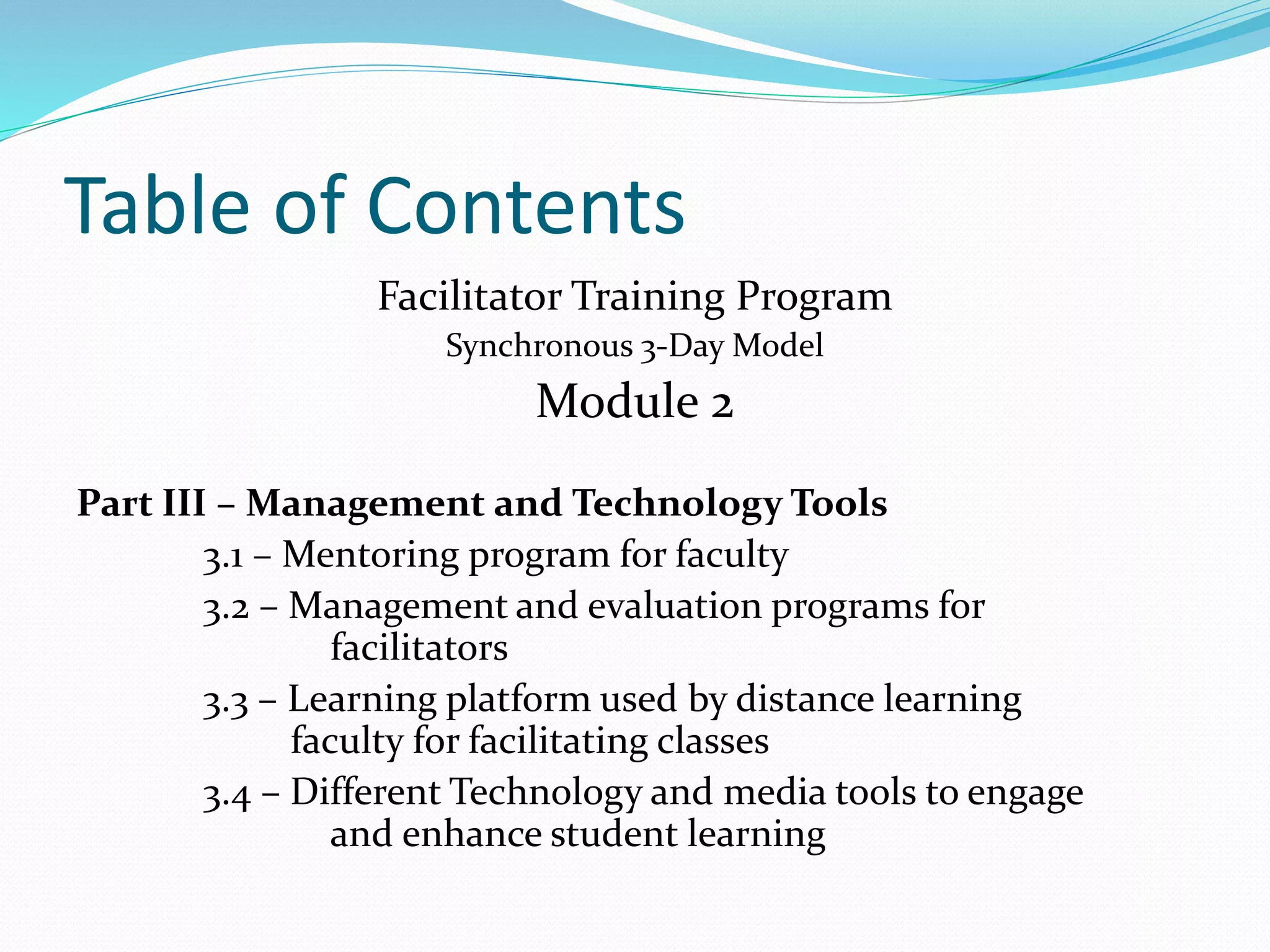
Table of Contents
Facilitator Training Program
Synchronous 3-Day Model
Module 2
Part III – Management and Technology Tools
3.1 – Mentoring program for faculty
3.2 – Management and evaluation programs for
facilitators
3.3 – Learning platform used by distance learning
faculty for facilitating classes
3.4 – Different Technology and media tools to engage
and enhance student learning
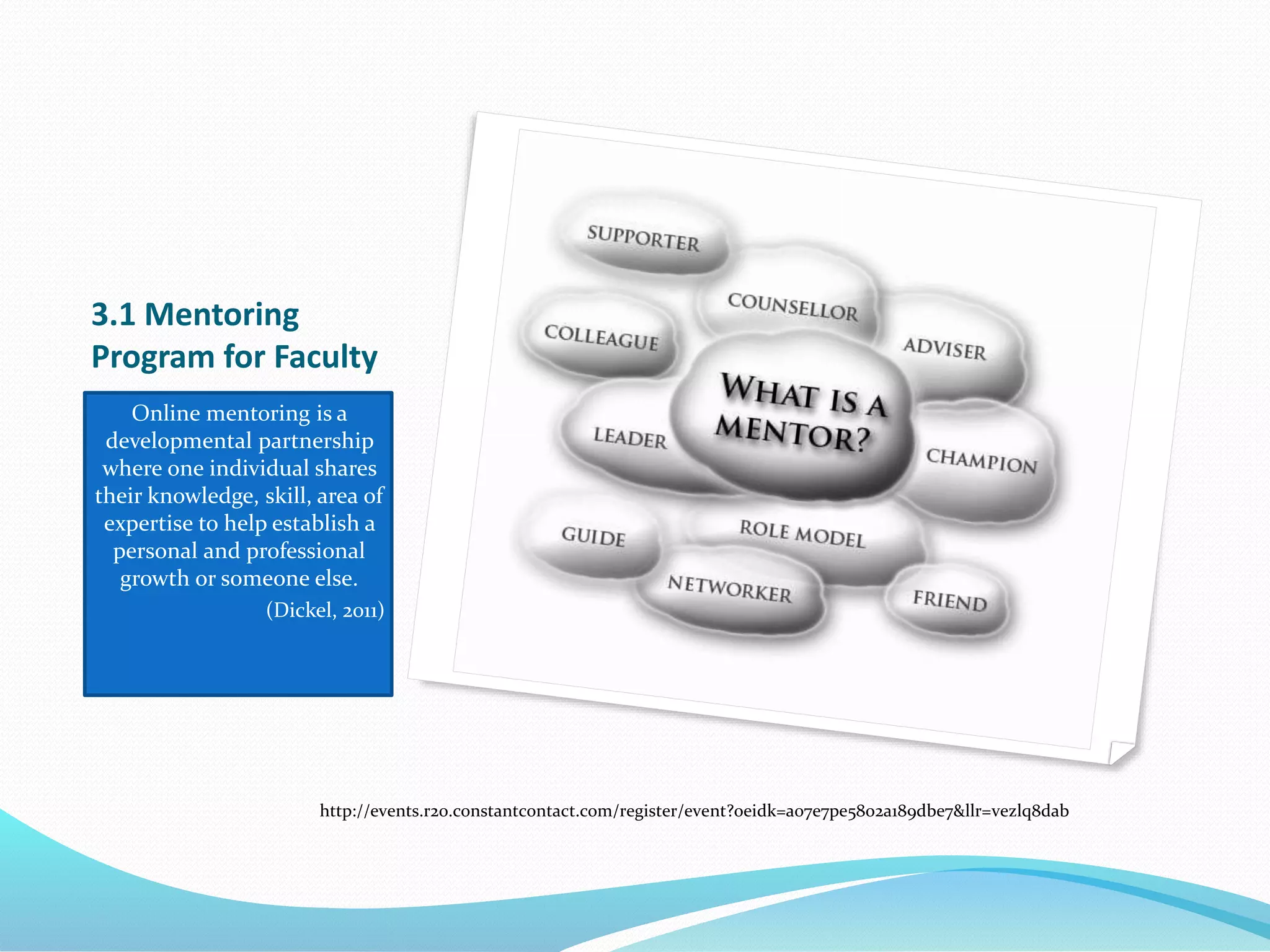
3.1 Mentoring
Program for Faculty
Online mentoring is a
developmental partnership
where one individual shares
their knowledge, skill, area of
expertise to help establish a
personal and professional
growth or someone else.
(Dickel, 2011)
http://events.r20.constantcontact.com/register/event?oeidk=a07e7pe58o2a189dbe7&llr=vezlq8dab
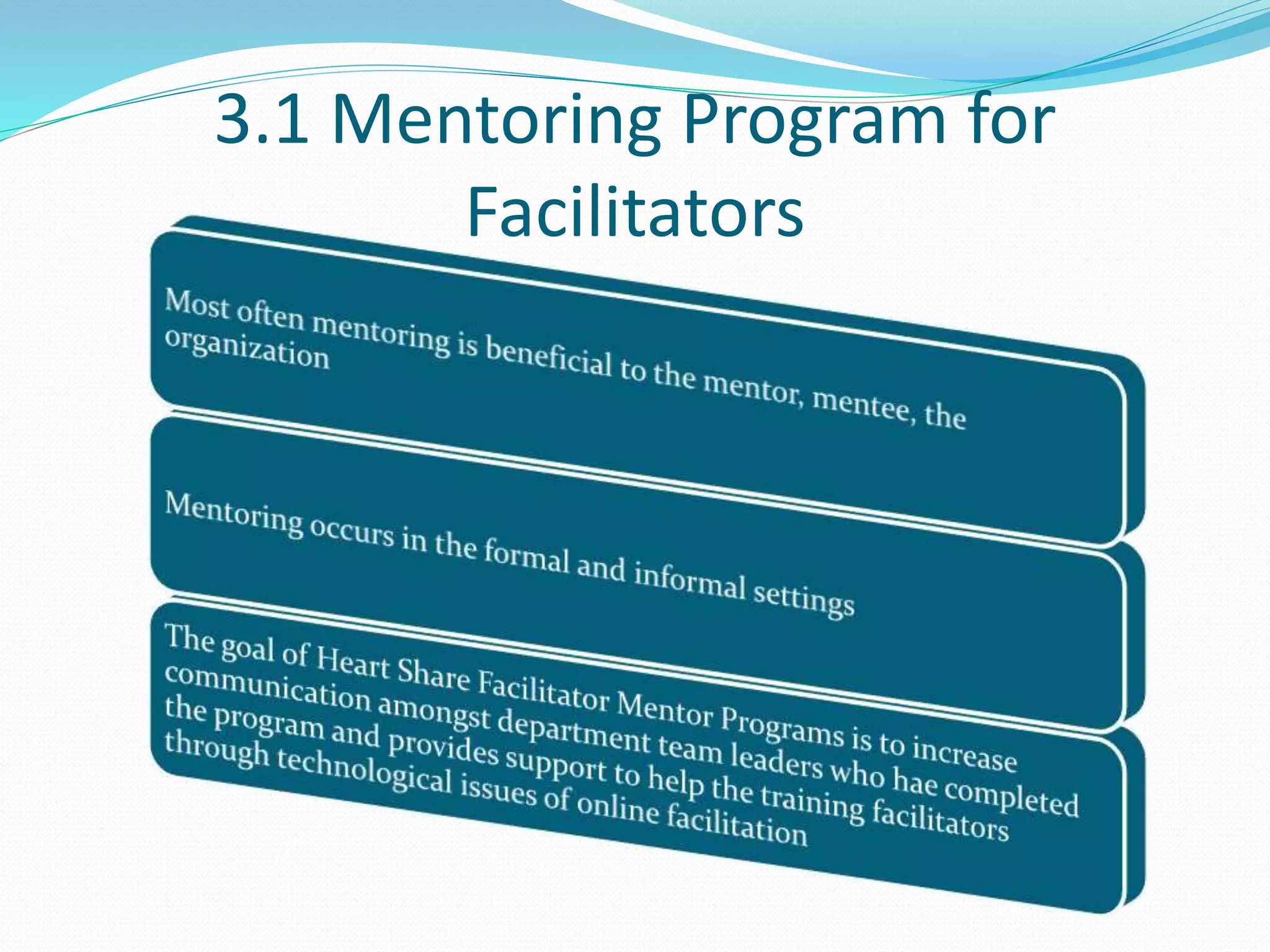
3.1 Mentoring Program for
Facilitators
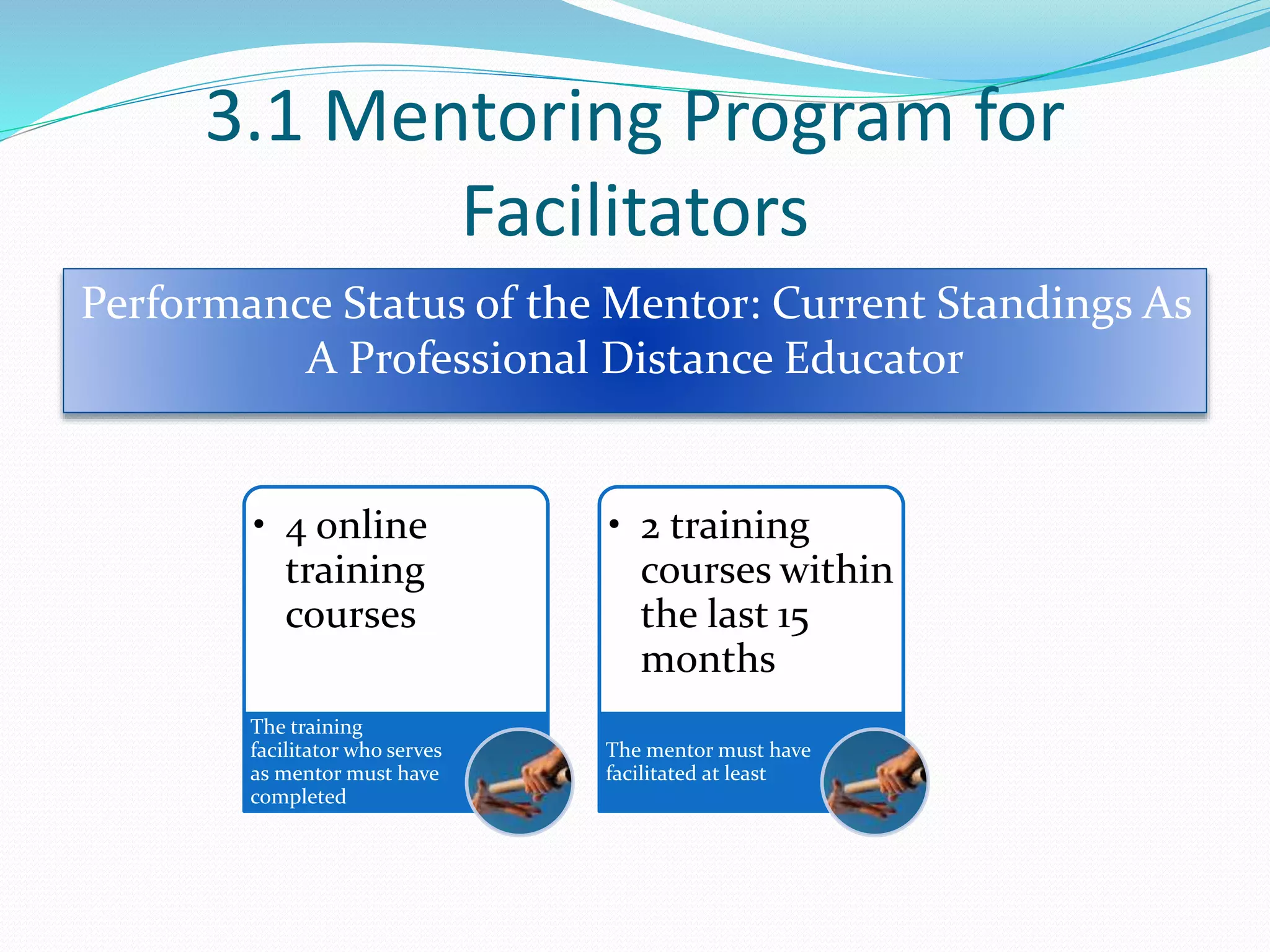
3.1 Mentoring Program for
Facilitators
Performance Status of the Mentor: Current Standings As
A Professional Distance Educator
• 4 online
training
courses
The training
facilitator who serves
as mentor must have
completed
• 2 training
courses within
the last 15
months
The mentor must have
facilitated at least
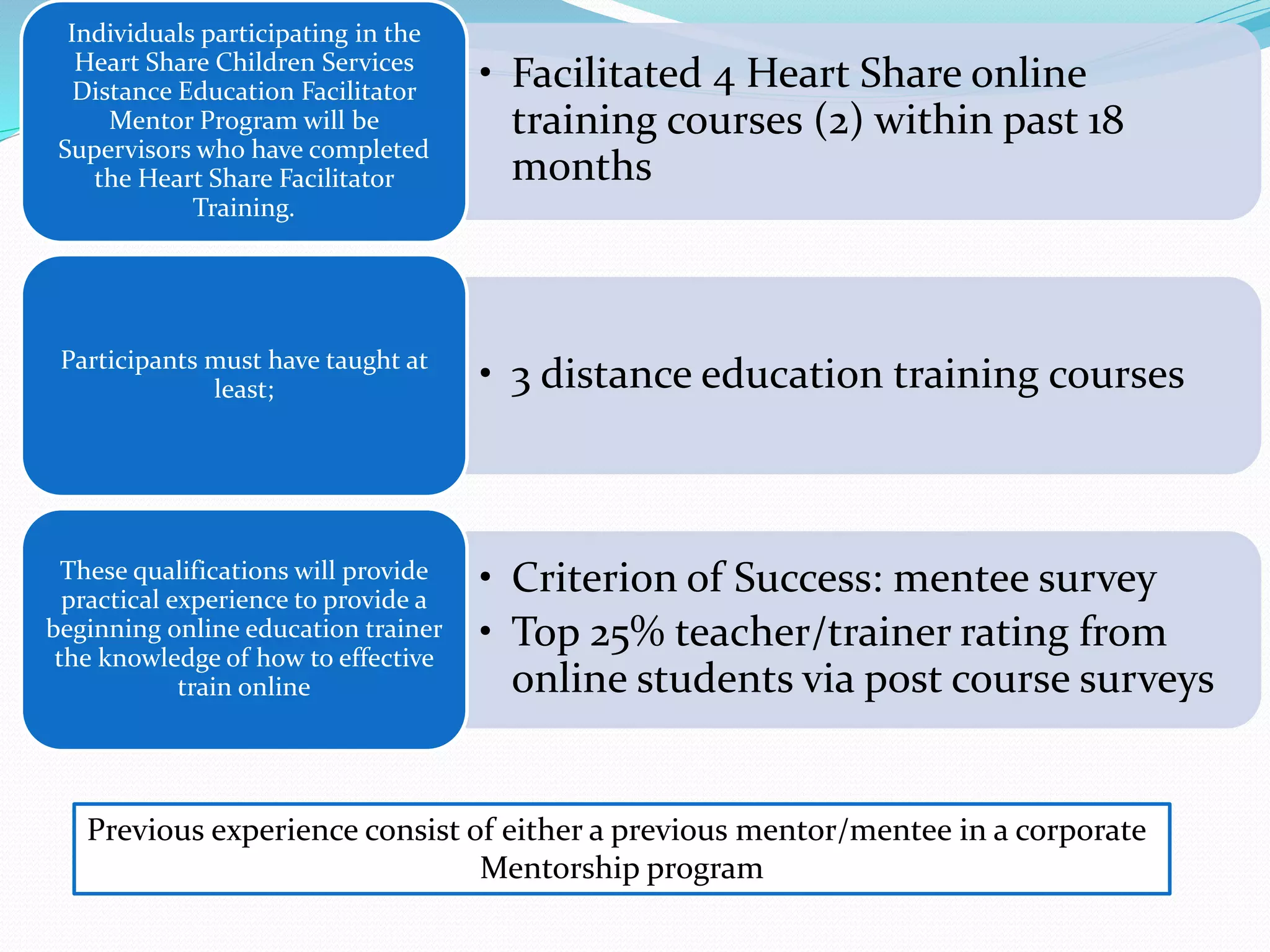
• Facilitated 4 Heart Share online
training courses (2) within past 18
months
Individuals participating in the
Heart Share Children Services
Distance Education Facilitator
Mentor Program will be
Supervisors who have completed
the Heart Share Facilitator
Training.
• 3 distance education training coursesParticipants must have taught at
least;
• Criterion of Success: mentee survey
• Top 25% teacher/trainer rating from
online students via post course surveys
These qualifications will provide
practical experience to provide a
beginning online education trainer
the knowledge of how to effective
train online
Previous experience consist of either a previous mentor/mentee in a corporate
Mentorship program
3.2 Management & Evaluation
Programs for Facilitators
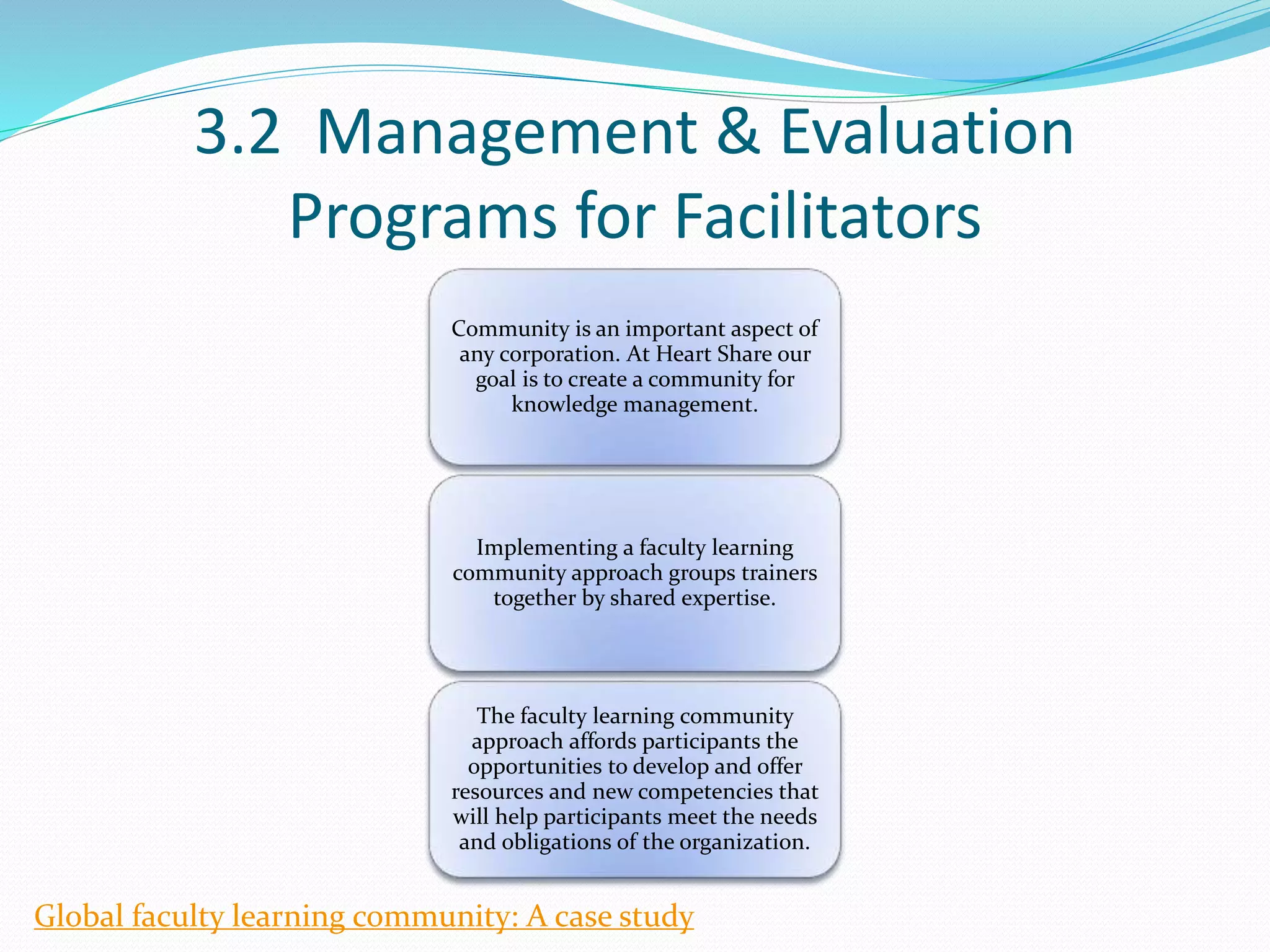
Community is an important aspect of
any corporation. At Heart Share our
goal is to create a community for
knowledge management.
Implementing a faculty learning
community approach groups trainers
together by shared expertise.
The faculty learning community
approach affords participants the
opportunities to develop and offer
resources and new competencies that
will help participants meet the needs
and obligations of the organization.
Global faculty learning community: A case study
3.2 Management & Evaluation
Programs for Facilitators
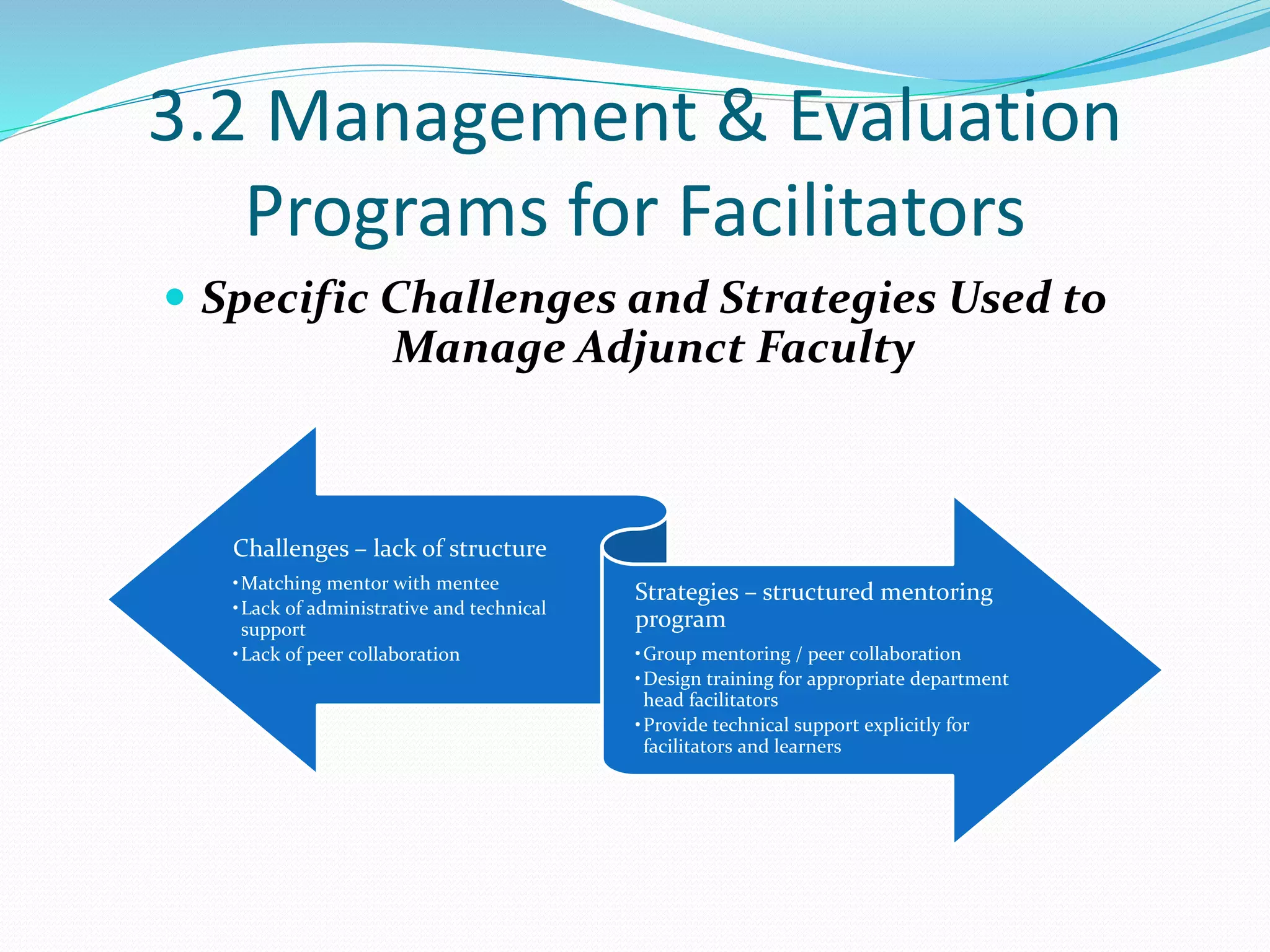
 Specific Challenges and Strategies Used to
Manage Adjunct Faculty
Challenges – lack of structure
•Matching mentor with mentee
•Lack of administrative and technical
support
•Lack of peer collaboration
Strategies – structured mentoring
program
•Group mentoring / peer collaboration
•Design training for appropriate department
head facilitators
•Provide technical support explicitly for
facilitators and learners
3.2 Management & Evaluation
Programs for Facilitators
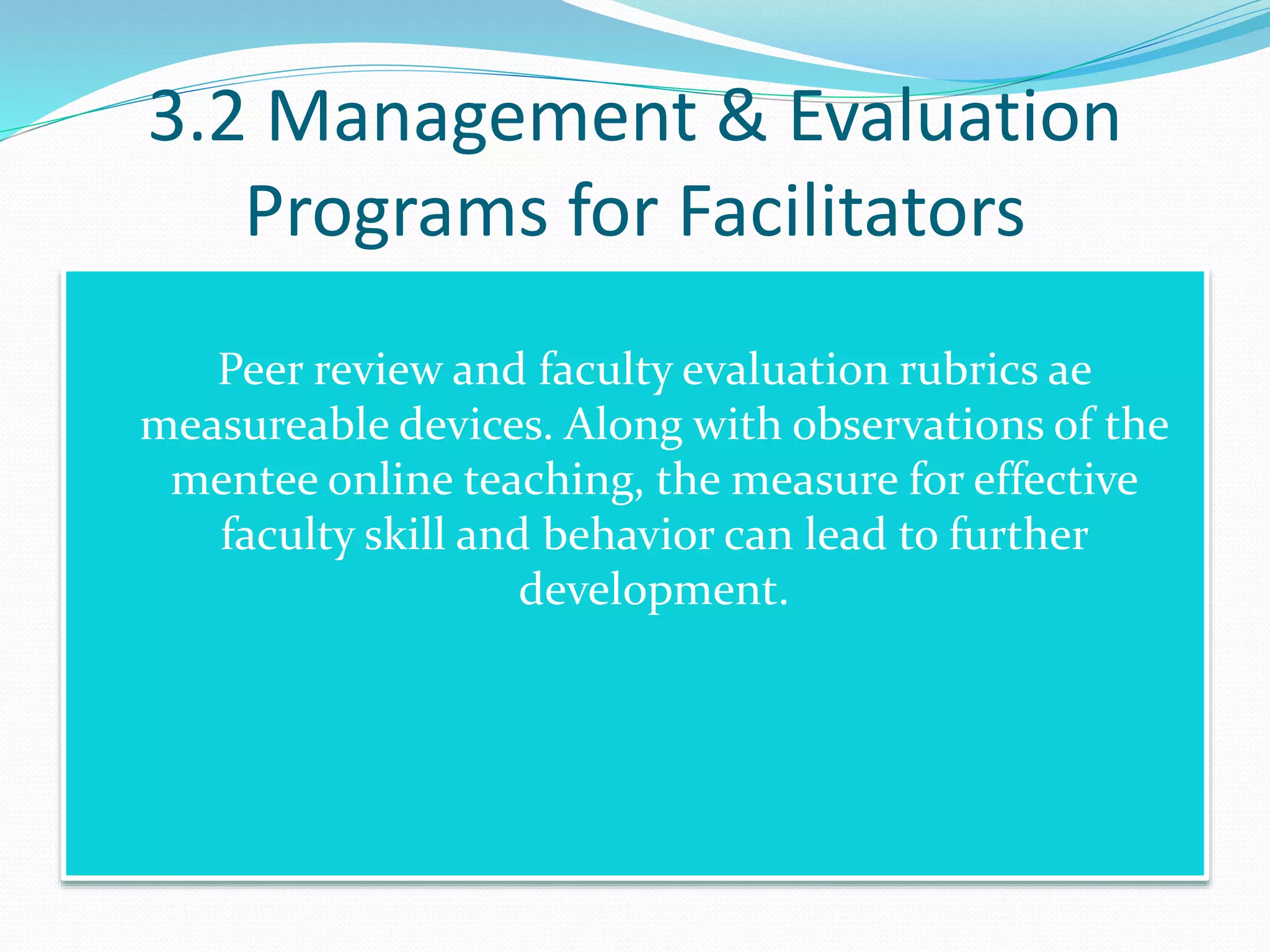
 Peer review and faculty evaluation rubrics ae
measureable devices. Along with observations of the
mentee online teaching, the measure for effective
faculty skill and behavior can lead to further
development.
3.3 Learning Platform LMS/CMS)
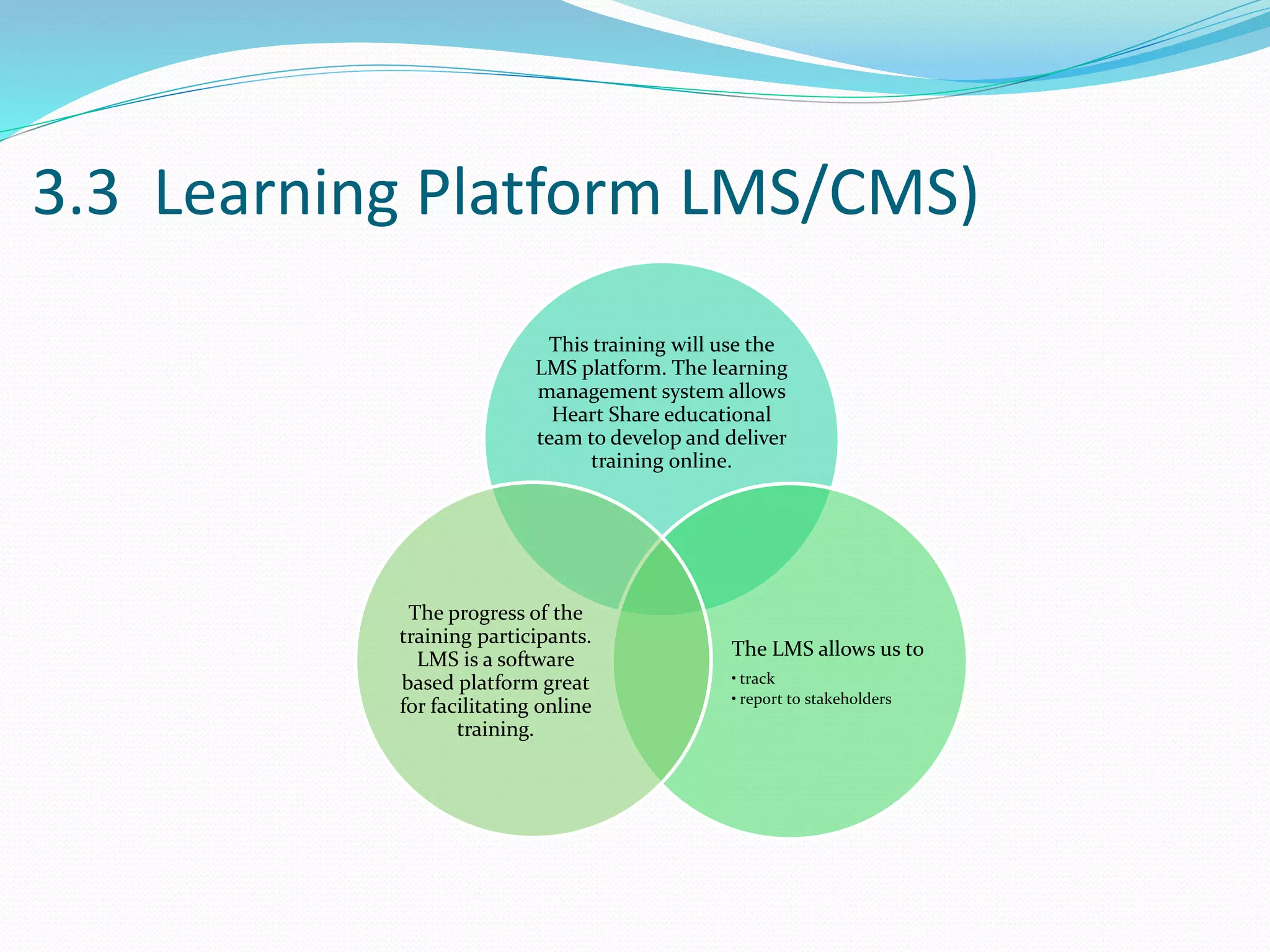
This training will use the
LMS platform. The learning
management system allows
Heart Share educational
team to develop and deliver
training online.
The LMS allows us to
• track
• report to stakeholders
The progress of the
training participants.
LMS is a software
based platform great
for facilitating online
training.
3.3 Learning Platform (LMS/CMS)
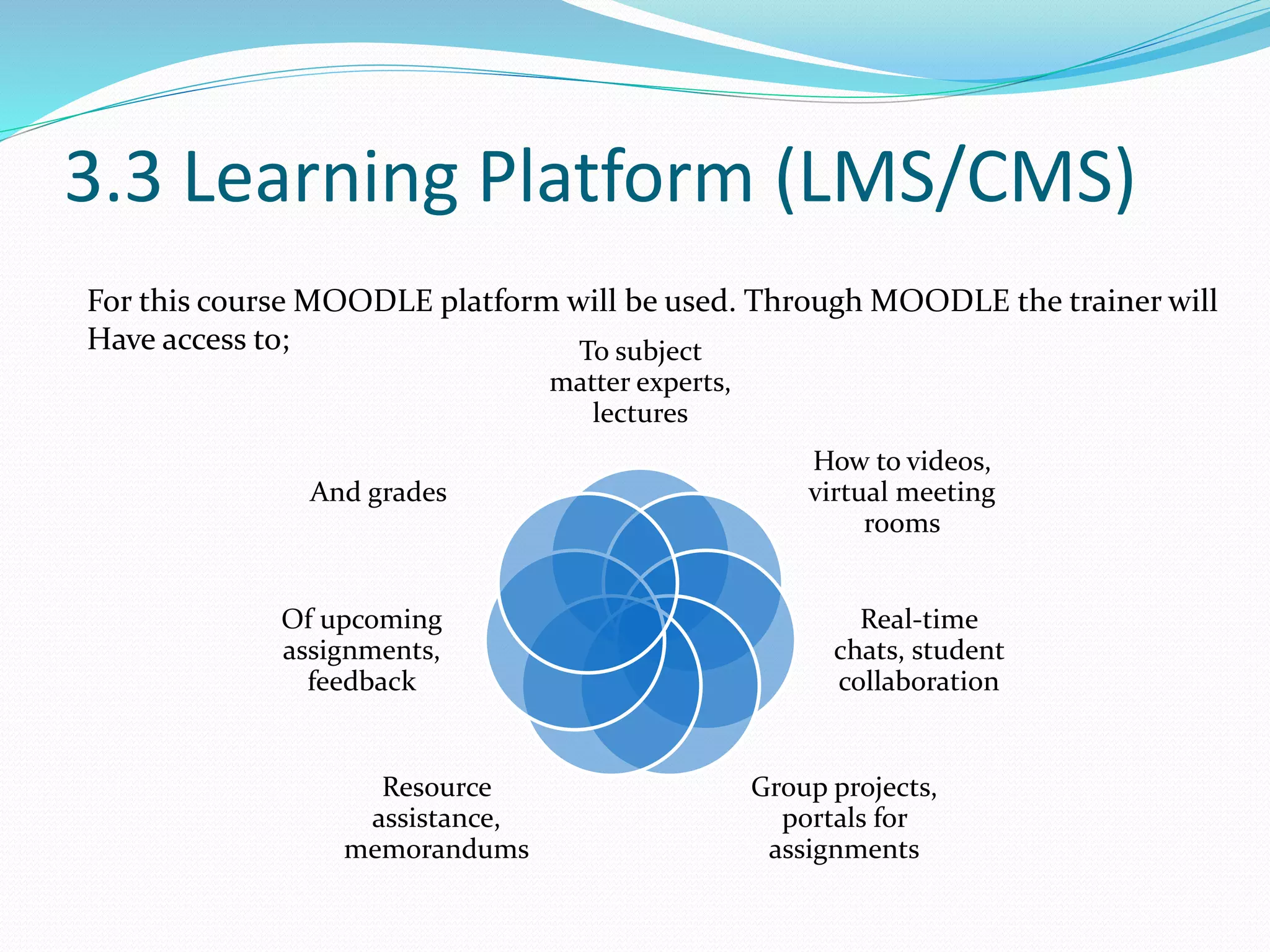
To subject
matter experts,
lectures
How to videos,
virtual meeting
rooms
Real-time
chats, student
collaboration
Group projects,
portals for
assignments
Resource
assistance,
memorandums
Of upcoming
assignments,
feedback
And grades
For this course MOODLE platform will be used. Through MOODLE the trainer will
Have access to;
3.4 Different Technology /Media Tools
Than Engage Student Learning
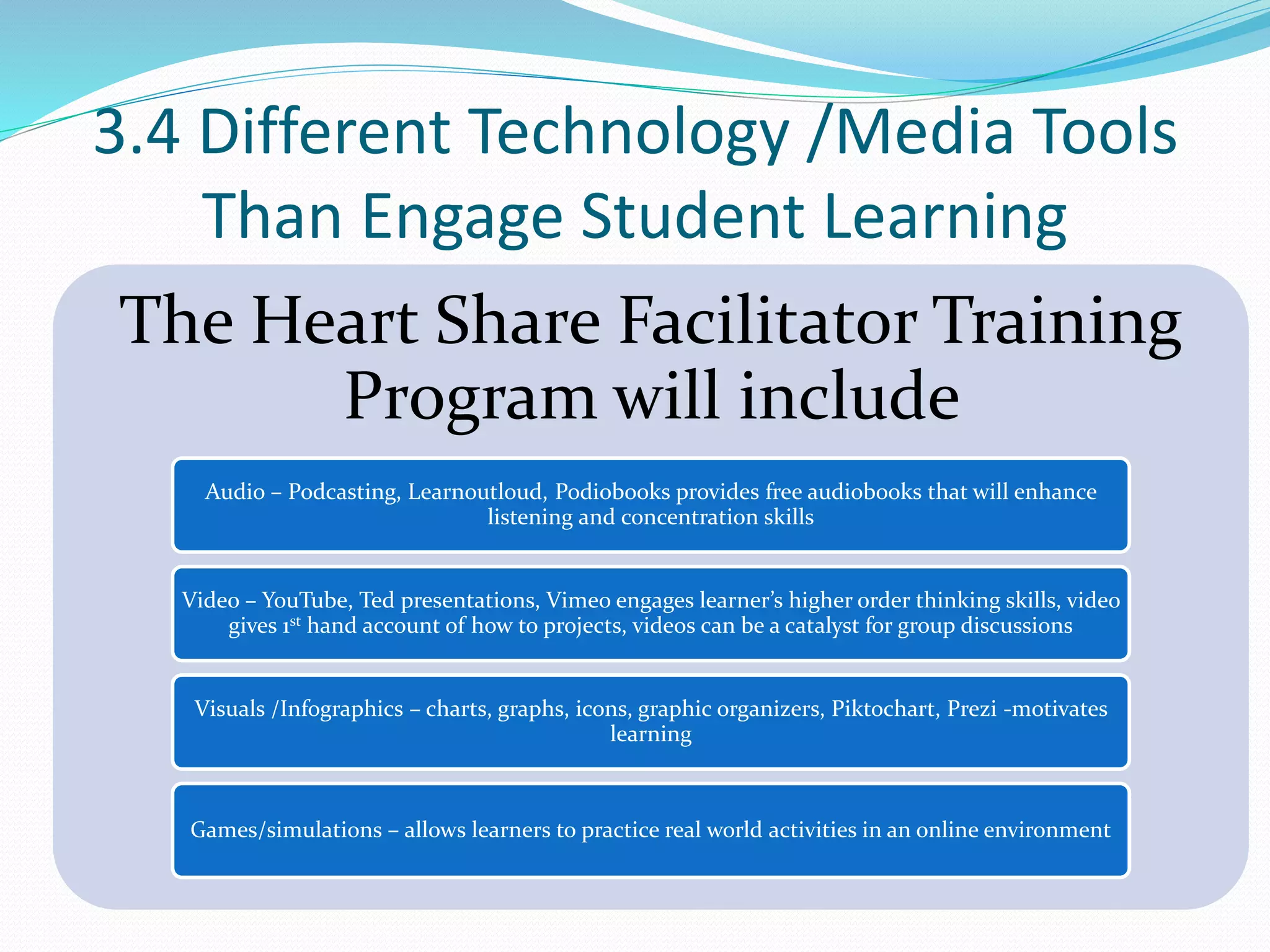
The Heart Share Facilitator Training
Program will include
Audio – Podcasting, Learnoutloud, Podiobooks provides free audiobooks that will enhance
listening and concentration skills
Video – YouTube, Ted presentations, Vimeo engages learner’s higher order thinking skills, video
gives 1st hand account of how to projects, videos can be a catalyst for group discussions
Visuals /Infographics – charts, graphs, icons, graphic organizers, Piktochart, Prezi -motivates
learning
Games/simulations – allows learners to practice real world activities in an online environment
Table of Contents
Facilitator Training Program
Synchronous 3-Day Module
Module 3
Part IV – Issues and Classroom Management
 4.1 – Different technology tools for student collaboration
 4.2 – A description of the different distance learners
 4.3 – The differences between synchronous and
asynchronous facilitation skills
 4.4 – Technology management issues and resolutions
 4.5 – Classroom management issues and resolutions
4.1 Different Technology Tools for
Student Collaboration
TutorsClass – Users collaboration based on a mutual schedule. An online platform for users
to sharing.
Capzle – The learning content applied to visuals, and narratives can be stored and accessed
by the group members via portals such as Face Book, iPhone apps and many others
Audioboo – Puts the learning content into audio files and clips. Groups can provide input
via mobile devices or personal computers.
FotoBabble – Allows groups to compile, interact, and share via Face Books.
Voice Thread – Groups can establish online conversation other than text based. Connects
with learners through video and voice. Learners can collaborate whenever and wherever.
4.2 Description of Different
Distance Learner
 Cultural - Experiential Prior - Learning
Experiences
In order to fulfill the training needs, a trainee profile is necessary. The profile of
The different learners examines the trainee’s competencies, limitations, and
Level of understanding of the subject at hand.
4.2 Description of Different
Distance learner
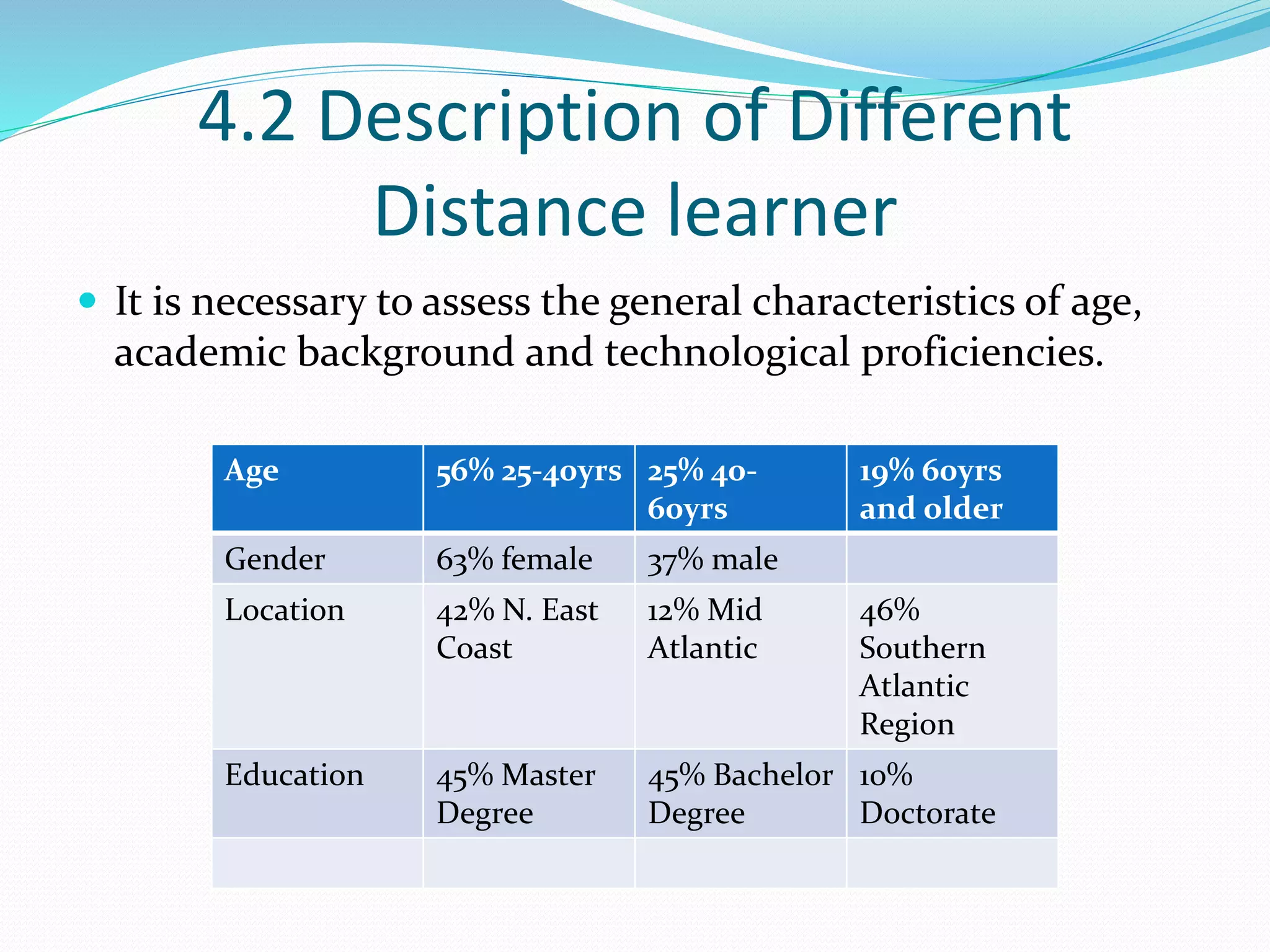
 It is necessary to assess the general characteristics of age,
academic background and technological proficiencies.
Age 56% 25-40yrs 25% 40-
60yrs
19% 60yrs
and older
Gender 63% female 37% male
Location 42% N. East
Coast
12% Mid
Atlantic
46%
Southern
Atlantic
Region
Education 45% Master
Degree
45% Bachelor
Degree
10%
Doctorate
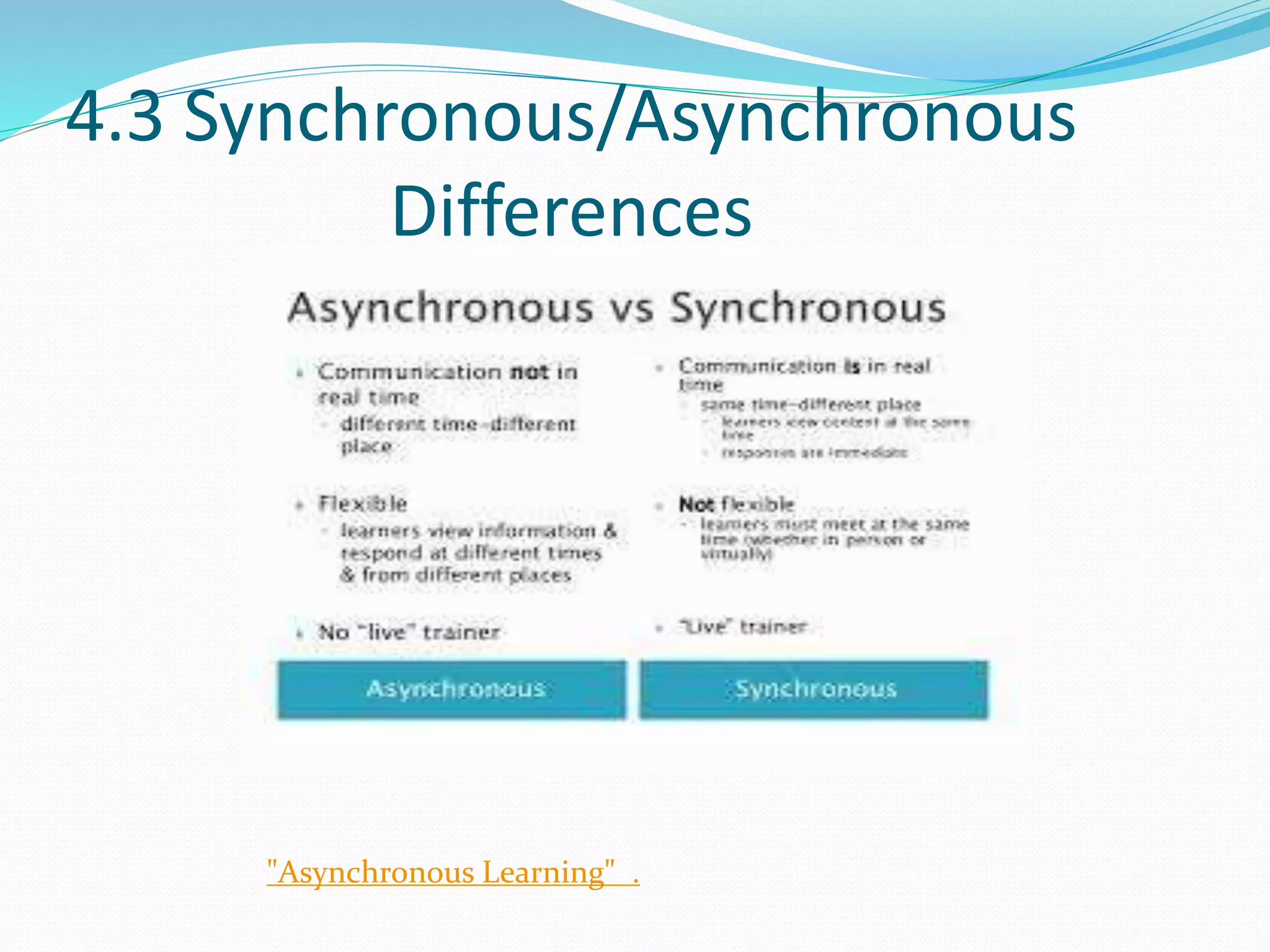
4.3 Synchronous/Asynchronous
Differences
"Asynchronous Learning" .
4.4 Technology Management
Issues and Resolutions
Issues Resolutions
 Difficulty using LMS
 Virus/Security Breach
 Inoperable Links
 Tutorials via Moodle and
company portals
 Virus management systems
such as McAfee
 Refresh links before start of
training and before
assignments. Have available
resources which offer the
same material.
4.5 Classroom Management Issues
and Resolutions
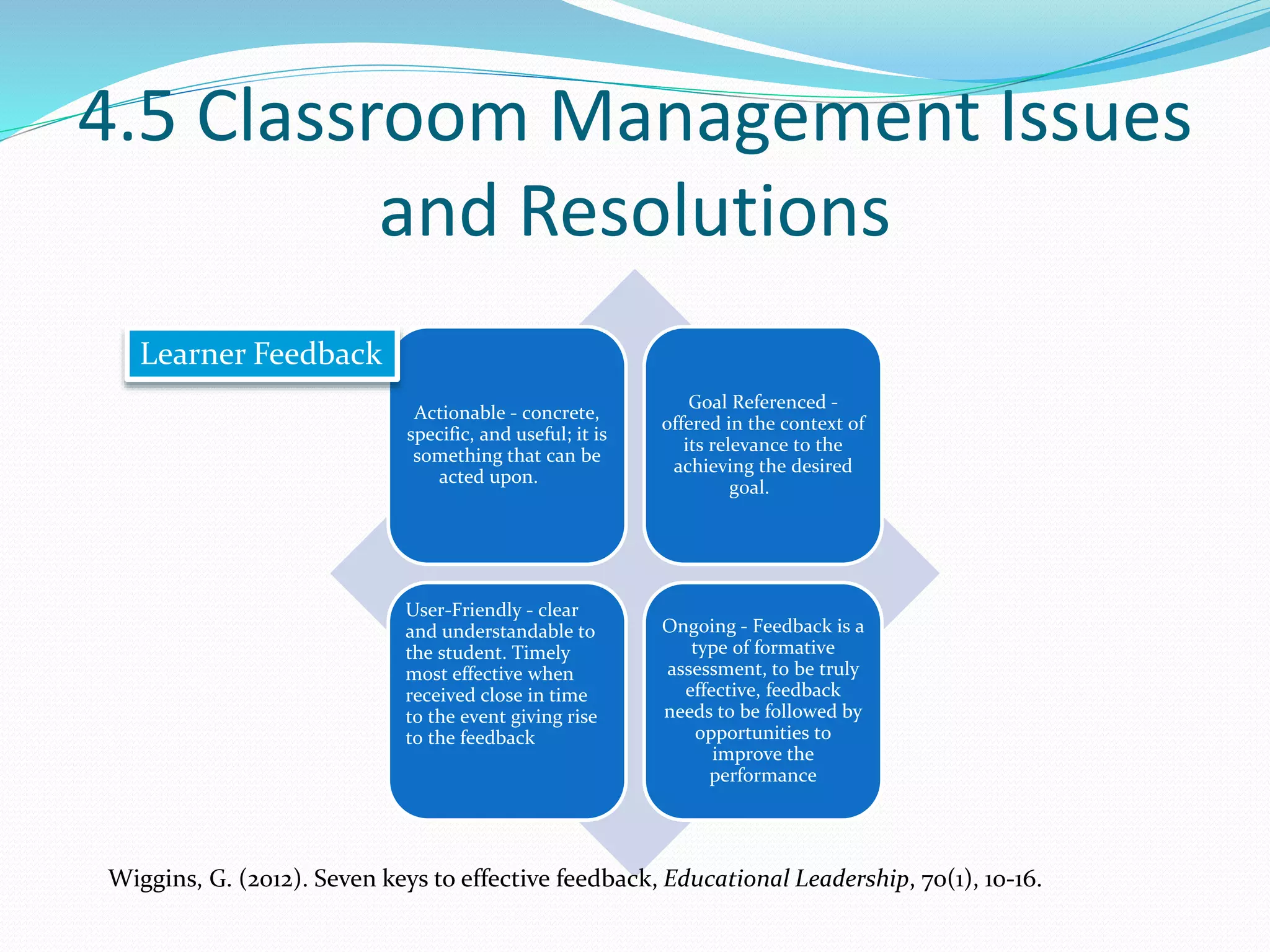
Goal Referenced -
offered in the context of
its relevance to the
achieving the desired
goal.
Actionable - concrete,
specific, and useful; it is
something that can be
acted upon.
Ongoing - Feedback is a
type of formative
assessment, to be truly
effective, feedback
needs to be followed by
opportunities to
improve the
performance
User-Friendly - clear
and understandable to
the student. Timely
most effective when
received close in time
to the event giving rise
to the feedback
Learner Feedback
Wiggins, G. (2012). Seven keys to effective feedback, Educational Leadership, 70(1), 10-16.
4.5 Classroom Management Issues
and Resolutions
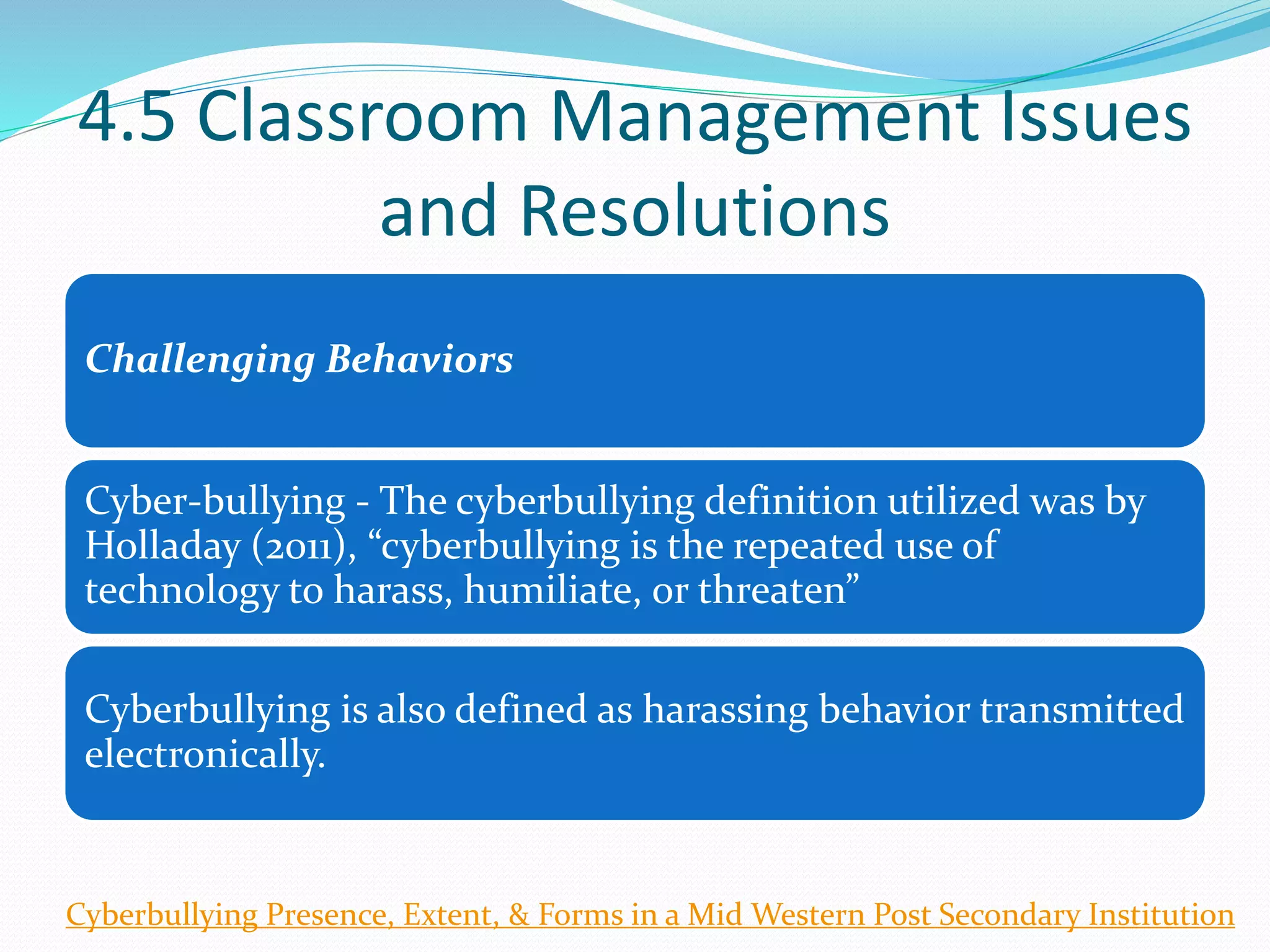
Challenging Behaviors
Cyber-bullying - The cyberbullying definition utilized was by
Holladay (2011), “cyberbullying is the repeated use of
technology to harass, humiliate, or threaten”
Cyberbullying is also defined as harassing behavior transmitted
electronically.
Cyberbullying Presence, Extent, & Forms in a Mid Western Post Secondary Institution
4.5 Classroom Management Issues
and Resolutions
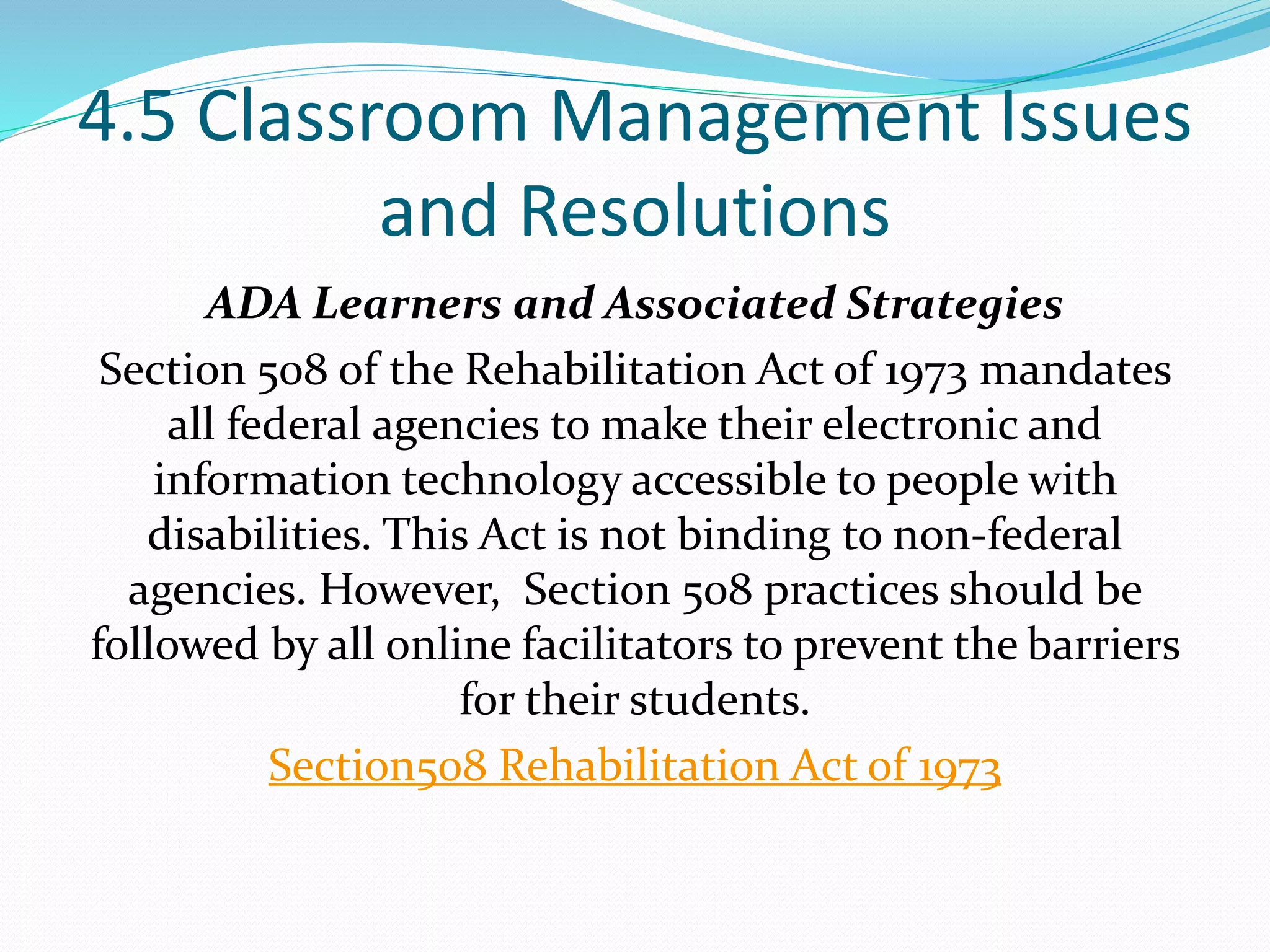
ADA Learners and Associated Strategies
Section 508 of the Rehabilitation Act of 1973 mandates
all federal agencies to make their electronic and
information technology accessible to people with
disabilities. This Act is not binding to non-federal
agencies. However, Section 508 practices should be
followed by all online facilitators to prevent the barriers
for their students.
Section508 Rehabilitation Act of 1973
Conclusion
 This concludes the Facilitator Training Program.
 We thank you for your time and effort put forth to make
this training a success.
 We will be following up with all participants with final
grades, reviews, post training evaluation, and any
suggestion you may want to offer.
 Again, We Say Thank You
http://gratitudehabitat.com/6-tips-to-composing-heartfelt-th
you-notes/
References
 Haythornthwaite, C., & Andrews, R. (2011). E-Learning
theory and practice. Thousand Oaks, CA: Sage
Publications Inc.
 Palloff, R. M., & Pratt, K. (2011). The excellent online
instructor: Strategies for professional
development. San Francisco, CA: John Wiley &
Sons Inc.

Cur 532 facilitator training program manual

  • 1.
  • 2.
    Welcome Today begins yourjourney as a Heart Share Children Services Supervisor Training Team. You will embark upon a 3-day module training provided by the Heart Share Corporation. So, sit back, relax, and lets get ready to take a learning experience like never before.
  • 3.
    My Name IsLillian White I will be your facilitator training host. My purpose is to lead you to the path of effective facilitation which I hope will empower you to with the knowledge and skill to train others to be the backbone of the Heart Share Corporation. If at any time you need to reach me, feel free to contact me via  phone (252)505-2779 (call or text)  Email – lilly27970@email.phoenix.edu  or Skype - Lillian B. Jonesy
  • 4.
    Table Of Contents FacilitatorTraining Program Synchronous 3-Day Module Module 1 Part 1 – Vital Information in the Facilitator Training 1.1 Training program audience 1.2 Training program goals 1.3 Training program objectives 1.4 Summative assessment of trainee learning
  • 5.
    1.1 Training ProgramAudience  Training Audience  A common mistake with many facilitator training programs is the assumption that all online facilitators have the same level of development and experiences. (Palloff & Pratt, 2011) https://www.taxmantra.com
  • 6.
    1.1 Training Program Audience TrainingAudience Heart Share understands that Supervisors come to this training program at different phases of development and training skills. Many trainers may come at this novice level, never having taught online/distance education training. That’s OK,
  • 7.
     Currently theSupervisor Trainer Team possesses basic computer literacy skills such as Windows Operating systems.  Members of the team does not have any previous experiences with work related distance education training online.  Several of the Supervisor Trainer Team have a small amount of knowledge how to facilitate training via their personal experience when promoted to their current position as training Supervisor. This training program is designed for the Heart Share Children Services Supervisor Trainer Team.
  • 8.
    1.2 Training ProgramGoals  The key skills that the Corporate trainer need to be successful as a distance facilitator are;  Adaptability  Communication/Collaborative skills  Creativity  Provide Guidance  https://daystead.wordpress.com/2012/04/25/the- adaptable-teacher/
  • 9.
    1.2 Training ProgramGoals The participants of the Facilitator Training Program will accomplish the following training goals; 1. Establish and maintain a learning community. 2. Acquire the knowledge and skill of online engagement techniques. 3. Become proficient with using online tools and social media tools. 4. Maintain an online presence.
  • 10.
    1.3 Training ProgramObjectives Module 1 With the training manual as a guide, upon completion of this training the learner will be able to construct activities for an online environment. With the training manual and various online tools, the learner will successfully navigate through an online training course and demonstrate how to lead their trainees through online training. Based upon the knowledge given, the learner will demonstrate positive and constructive feedback
  • 11.
    1.3 Training ProgramObjectives Module 2 With the training manual as a guide, the learner will identify at least 5 ways to create and maintain a community in a distance education training environment With the training manual as a guide, the learner will provide at least 3 strategies that develop and facilitate effective distance training in an online environment as identified by Palloff & Pratt (2011)
  • 12.
    1.3 Training ProgramObjectives Module 3 Learners will demonstrate via a media tool of their choice, how to engage student learning and how the tool enhances learning in the online environment The learners will identify at least 3 challenges associated with distance education training as well as provide a strategy for each challenge
  • 13.
    1.4 Summative Assessmentof Trainee Learning Journals Multiple choice Course Rubrics Simulations Short Answer Questions
  • 14.
    1.4 Summative Assessmentof Trainee Learning  Trainees will complete informal assessments within each training module and at the end of each module based on course rubrics.  Upon completion of the Facilitator Training Program, trainee will be assessed in order to determine the trainee’s ability to satisfy the course objectives  Trainees will demonstrate their newly acquired knowledge and skill through journal reflections, simulations, and peer collaboration.
  • 15.
    Measure of TrainingProgram http://blog.questionmark.com/how-can-you-assess-the-effectiveness-of-informal- learning
  • 16.
    Measure of TrainingProgram  Information pertaining to the effectiveness of the training program will be gathered via surveys of the trainees.  Trainees will complete participant evaluations upon completion. The evaluations will serve as an indicator of participants satisfaction scored numerically.  A post-training assessment will occur 6 months after training completion date.  This assessment will be comprised of short answers and multiple choice.
  • 17.
    Table of Contents FacilitatorTraining Program Synchronous 3-Day Module Module 1  Part II – Facilitator Skills and Instructional Materials  2.1 – Training materials  2.2 – Describe the phases of development for distance learning facilitators  2.3 – Identify the theories of distance learning  2.4 – Describe the theories for engaging distance learners
  • 18.
    2.1 Training Material SkillsNeeded for Effective Distance Learning Facilitators  Communicate clearly the requirements of the course requirements  Develop training activities that includes trainee to trainee and facilitator to trainee interaction  Create a training/learning community online  Facilitate and maintain online discussions  Adaptation of training material and tools  Assess trainee learning  Provide feedback
  • 19.
    2.1 Training Material The practiceof online facilitation should adhere to learning theories and the appropriate strategies and practices to engage the online learner. This training will focus on effective skills for distance education facilitators Skills Needed for Effective Distance Learning Facilitators http://ccgps.carnegielearning.com/prof_dev.html
  • 20.
    2.1 Training Material StrategiesTo Present Skills To Facilitators  Discussion boards  Icebreaker – give name, location, and number of years with corporation, 2-3 sentences of feeling about online training, respond to at least 2 other participant’s post  Establish an online chat  via a social network site - Present a corporate safety issue and have trainees chat as to how they would solve the issue.  Divide into Groups  Allow groups participants to voluntarily lead a discussion based on any of the module topics
  • 21.
    2.2 Phases ofDevelopment for Distance Learning/Training Facilitators  According to Palloff & Pratt (2011) the online facilitator goes through 5 distinct phases of development.  Palloff & Pratt assumes that what makes the online facilitator an excellent facilitator is not so much their expertise in his or her discipline.
  • 22.
    2.2 Phases ofDevelopment for Distance learning/Training Facilitators The excellent online facilitator has to migrate to the level of excellence as they make the connection between the learning outcomes they hope to achieve and the utilization of technology required to achieve those outcomes.
  • 23.
    Visitor Little technology integration in theface to face environment Level of skepticism Novice No online teaching experience Explores the possibility of online teaching and learning Apprentice 1-2 terms of online experience Understandin g of online skill and environment are emerging Confidence builds Content is of greater concern
  • 24.
    Insider More that 2 online semester, more than1 course per term Advance in training to support facilitati on Comforta ble with online environ ment Exhibits proficien cy with course manage ment, technolo gy, Master Taught online for multiple terms, designed online courses Mastered the technolog ical requireme nt for online teaching Comforta ble with skills for online. Can assume role as mentor Continues exploratio for best practices of online learning.
  • 25.
    2.3 Identify Theoriesof Distance Learning The implementation of new technologies have dramatically increased the growth of distance education /training. The application of these new technologies have glamorized the appeal of distance education causing debate of its theoretical foundation. Some describes distance education as merely hyped up practices taken from the traditional classroom environment.
  • 26.
    2.3 Identify Theoriesof Distance Learning To justify and explain the phenomenon of the booming elearning environment theoreticians such as Holmberg, Keegan, & Rumble foundational assumptions of the differences between distance education and traditional education.
  • 27.
    2.3 Identify Theoriesof Distance Learning The following brief descriptions of elearning theories are included in this training manual not only to enlighten facilitators of how students learn, but to help facilitators understand the argument some experts pose that some theories fail to see the significant differences that exists in the elearning environment (Haythornwaite & Andrews, 2011)
  • 28.
    2.3 Identify Theoriesof Distance Learning focuses on various types of communication, communication channels, used in elearning environment. Michael Moore contends that education is pedagogical concept Learner autonomy, program structure, dialogue are focal positions Relevance is dialogue – whether asynchronous or synchronous, allows adult learner ownership of the learning Transactional
  • 29.
    2.3 Identify Theoriesof Distance Learning Focus on various levels of communication from computer interface. Modes of communication – text, visual, audio, work together to form a learning experience along with other resources Transformation occurs via reshaping of meaning Relevance – online facilitators use many modes of communication. Essential to engage learners in discussions, group projects, posts, group chats Multimodality
  • 30.
    2.3 Identify Theoriesof Distance Learning Individual contribution as well as benefits from a community that offers a live repository of learning. Knowledge comes from life experiences and previously acquired knowledge Relevance – experiences initiates dialogue, learning materializes through discussion/dialogue and other learning modalities In the adult learning environment the community will initiate the knowledge Communal Constructivism
  • 31.
    2.4 Theories forEngaging Distance Learners  During the design stage, it is essential for the online facilitator t design courses based on the Malcolm Knowles andragogy premise that engaging adult learners involves many of the same techniques for pedagogy population http://www.qotfc.edu.au/resource/?page=65375 http://www.brookdalecc.edu/admissions/recruitment-services/adult-learners/
  • 32.
    2.4 Theories ForEngaging Distance Learners Knowles maintains several adult learning principles which should serve as a guide when incorporating engagement techniques. Based on our history of facilitator training programs we recommend;
  • 33.
    2.4 Theories forEngaging Distance Learners  Clearly State Goals & Objectives From the very beginning, stating goals give the learner direction and options to take charge . Review the student roster before course start date, look for any noted student disabilities. Prepare an introduction as an icebreaker that invites the learners to respond and interact with each other.
  • 34.
    2.4 Theories forEngaging Distance Learners  Maintain an Online Presence Initiate and maintain communication and collaboration until the learners Are comfortable and take the lead Do not let up with online presence in discussions, acknowledging student Response, posting ideas or questions that cause critical thinking
  • 35.
    2.4 Theories forEngaging Distance Learners  Build A Community of Learners Haythornthwaite & Andrews (2011) states that elearning is not created because of the technology. It is the facilitators, learners, and their use of technology To develop a social space that creates learning. Facilitators have an obligation to encourage learners to share/reflect on new life scenarios Sharing helps to build a sense of trust amongst peers.
  • 36.
    Table of Contents FacilitatorTraining Program Synchronous 3-Day Model Module 2 Part III – Management and Technology Tools 3.1 – Mentoring program for faculty 3.2 – Management and evaluation programs for facilitators 3.3 – Learning platform used by distance learning faculty for facilitating classes 3.4 – Different Technology and media tools to engage and enhance student learning
  • 37.
    3.1 Mentoring Program forFaculty Online mentoring is a developmental partnership where one individual shares their knowledge, skill, area of expertise to help establish a personal and professional growth or someone else. (Dickel, 2011) http://events.r20.constantcontact.com/register/event?oeidk=a07e7pe58o2a189dbe7&llr=vezlq8dab
  • 38.
    3.1 Mentoring Programfor Facilitators
  • 39.
    3.1 Mentoring Programfor Facilitators Performance Status of the Mentor: Current Standings As A Professional Distance Educator • 4 online training courses The training facilitator who serves as mentor must have completed • 2 training courses within the last 15 months The mentor must have facilitated at least
  • 40.
    • Facilitated 4Heart Share online training courses (2) within past 18 months Individuals participating in the Heart Share Children Services Distance Education Facilitator Mentor Program will be Supervisors who have completed the Heart Share Facilitator Training. • 3 distance education training coursesParticipants must have taught at least; • Criterion of Success: mentee survey • Top 25% teacher/trainer rating from online students via post course surveys These qualifications will provide practical experience to provide a beginning online education trainer the knowledge of how to effective train online Previous experience consist of either a previous mentor/mentee in a corporate Mentorship program
  • 41.
    3.2 Management &Evaluation Programs for Facilitators Community is an important aspect of any corporation. At Heart Share our goal is to create a community for knowledge management. Implementing a faculty learning community approach groups trainers together by shared expertise. The faculty learning community approach affords participants the opportunities to develop and offer resources and new competencies that will help participants meet the needs and obligations of the organization. Global faculty learning community: A case study
  • 42.
    3.2 Management &Evaluation Programs for Facilitators  Specific Challenges and Strategies Used to Manage Adjunct Faculty Challenges – lack of structure •Matching mentor with mentee •Lack of administrative and technical support •Lack of peer collaboration Strategies – structured mentoring program •Group mentoring / peer collaboration •Design training for appropriate department head facilitators •Provide technical support explicitly for facilitators and learners
  • 43.
    3.2 Management &Evaluation Programs for Facilitators  Peer review and faculty evaluation rubrics ae measureable devices. Along with observations of the mentee online teaching, the measure for effective faculty skill and behavior can lead to further development.
  • 44.
    3.3 Learning PlatformLMS/CMS) This training will use the LMS platform. The learning management system allows Heart Share educational team to develop and deliver training online. The LMS allows us to • track • report to stakeholders The progress of the training participants. LMS is a software based platform great for facilitating online training.
  • 45.
    3.3 Learning Platform(LMS/CMS) To subject matter experts, lectures How to videos, virtual meeting rooms Real-time chats, student collaboration Group projects, portals for assignments Resource assistance, memorandums Of upcoming assignments, feedback And grades For this course MOODLE platform will be used. Through MOODLE the trainer will Have access to;
  • 46.
    3.4 Different Technology/Media Tools Than Engage Student Learning The Heart Share Facilitator Training Program will include Audio – Podcasting, Learnoutloud, Podiobooks provides free audiobooks that will enhance listening and concentration skills Video – YouTube, Ted presentations, Vimeo engages learner’s higher order thinking skills, video gives 1st hand account of how to projects, videos can be a catalyst for group discussions Visuals /Infographics – charts, graphs, icons, graphic organizers, Piktochart, Prezi -motivates learning Games/simulations – allows learners to practice real world activities in an online environment
  • 47.
    Table of Contents FacilitatorTraining Program Synchronous 3-Day Module Module 3 Part IV – Issues and Classroom Management  4.1 – Different technology tools for student collaboration  4.2 – A description of the different distance learners  4.3 – The differences between synchronous and asynchronous facilitation skills  4.4 – Technology management issues and resolutions  4.5 – Classroom management issues and resolutions
  • 48.
    4.1 Different TechnologyTools for Student Collaboration TutorsClass – Users collaboration based on a mutual schedule. An online platform for users to sharing. Capzle – The learning content applied to visuals, and narratives can be stored and accessed by the group members via portals such as Face Book, iPhone apps and many others Audioboo – Puts the learning content into audio files and clips. Groups can provide input via mobile devices or personal computers. FotoBabble – Allows groups to compile, interact, and share via Face Books. Voice Thread – Groups can establish online conversation other than text based. Connects with learners through video and voice. Learners can collaborate whenever and wherever.
  • 49.
    4.2 Description ofDifferent Distance Learner  Cultural - Experiential Prior - Learning Experiences In order to fulfill the training needs, a trainee profile is necessary. The profile of The different learners examines the trainee’s competencies, limitations, and Level of understanding of the subject at hand.
  • 50.
    4.2 Description ofDifferent Distance learner  It is necessary to assess the general characteristics of age, academic background and technological proficiencies. Age 56% 25-40yrs 25% 40- 60yrs 19% 60yrs and older Gender 63% female 37% male Location 42% N. East Coast 12% Mid Atlantic 46% Southern Atlantic Region Education 45% Master Degree 45% Bachelor Degree 10% Doctorate
  • 51.
  • 52.
    4.4 Technology Management Issuesand Resolutions Issues Resolutions  Difficulty using LMS  Virus/Security Breach  Inoperable Links  Tutorials via Moodle and company portals  Virus management systems such as McAfee  Refresh links before start of training and before assignments. Have available resources which offer the same material.
  • 53.
    4.5 Classroom ManagementIssues and Resolutions Goal Referenced - offered in the context of its relevance to the achieving the desired goal. Actionable - concrete, specific, and useful; it is something that can be acted upon. Ongoing - Feedback is a type of formative assessment, to be truly effective, feedback needs to be followed by opportunities to improve the performance User-Friendly - clear and understandable to the student. Timely most effective when received close in time to the event giving rise to the feedback Learner Feedback Wiggins, G. (2012). Seven keys to effective feedback, Educational Leadership, 70(1), 10-16.
  • 54.
    4.5 Classroom ManagementIssues and Resolutions Challenging Behaviors Cyber-bullying - The cyberbullying definition utilized was by Holladay (2011), “cyberbullying is the repeated use of technology to harass, humiliate, or threaten” Cyberbullying is also defined as harassing behavior transmitted electronically. Cyberbullying Presence, Extent, & Forms in a Mid Western Post Secondary Institution
  • 55.
    4.5 Classroom ManagementIssues and Resolutions ADA Learners and Associated Strategies Section 508 of the Rehabilitation Act of 1973 mandates all federal agencies to make their electronic and information technology accessible to people with disabilities. This Act is not binding to non-federal agencies. However, Section 508 practices should be followed by all online facilitators to prevent the barriers for their students. Section508 Rehabilitation Act of 1973
  • 56.
    Conclusion  This concludesthe Facilitator Training Program.  We thank you for your time and effort put forth to make this training a success.  We will be following up with all participants with final grades, reviews, post training evaluation, and any suggestion you may want to offer.  Again, We Say Thank You http://gratitudehabitat.com/6-tips-to-composing-heartfelt-th you-notes/
  • 57.
    References  Haythornthwaite, C.,& Andrews, R. (2011). E-Learning theory and practice. Thousand Oaks, CA: Sage Publications Inc.  Palloff, R. M., & Pratt, K. (2011). The excellent online instructor: Strategies for professional development. San Francisco, CA: John Wiley & Sons Inc.

Editor's Notes

  • #3 Hear Share Logo www.coollogo.com