Borderless Learning
Innovating the ROI


                      Damien O’Donoghue
                        General Manager

                         GAC Corporate Academy
                          www.gacacademy.com
What happens if we spend money on training
       our people and they leave?
    What happens if we don’t and they stay?


2
Overview

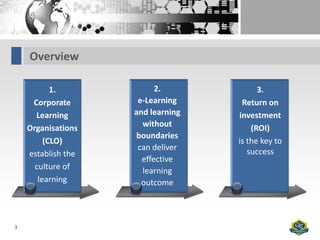
           1.             2.             3.
     Corporate       e-Learning     Return on
      Learning      and learning   investment
    Organisations     without          (ROI)
                    boundaries
         (CLO)                     is the key to
                     can deliver      success
    establish the
                      effective
      culture of      learning
       learning       outcome


3
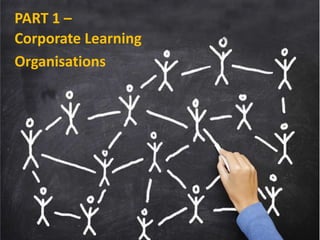
PART 1 –
Corporate Learning
Organisations
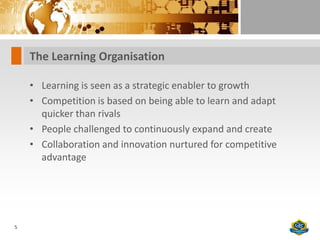
The Learning Organisation

    • Learning is seen as a strategic enabler to growth
    • Competition is based on being able to learn and adapt
      quicker than rivals
    • People challenged to continuously expand and create
    • Collaboration and innovation nurtured for competitive
      advantage


5
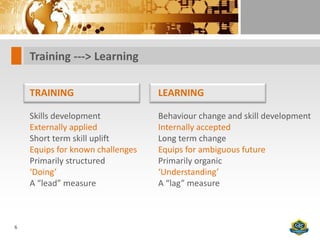
Training ---> Learning

    TRAINING                      LEARNING

    Skills development            Behaviour change and skill development
    Externally applied            Internally accepted
    Short term skill uplift       Long term change
    Equips for known challenges   Equips for ambiguous future
    Primarily structured          Primarily organic
    ‘Doing’                       ‘Understanding’
    A “lead” measure              A “lag” measure


6
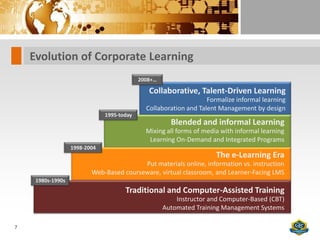
Evolution of Corporate Learning
                                            2008+…

                                               Collaborative, Talent-Driven Learning
                                                                   Formalize informal learning
                                              Collaboration and Talent Management by design
                               1995-today
                                                       Blended and informal Learning
                                              Mixing all forms of media with informal learning
                                               Learning On-Demand and Integrated Programs
                   1998-2004
                                                                      The e-Learning Era
                                          Put materials online, information vs. instruction
                          Web-Based courseware, virtual classroom, and Learner-Facing LMS
     1980s-1990s
                                      Traditional and Computer-Assisted Training
                                                         Instructor and Computer-Based (CBT)
                                                     Automated Training Management Systems

7
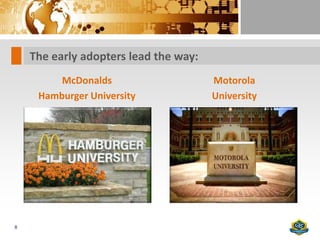
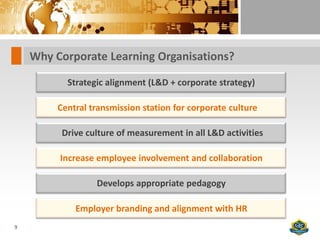
The early adopters lead the way:
         McDonalds                     Motorola
     Hamburger University              University


8
Why Corporate Learning Organisations?

           Strategic alignment (L&D + corporate strategy)

         Central transmission station for corporate culture

          Drive culture of measurement in all L&D activities

         Increase employee involvement and collaboration

                  Develops appropriate pedagogy

             Employer branding and alignment with HR
9
NOW


     Growth of Corporate Learning Organisations
       is estimated to be 200% faster than the
           vocational and academic sectors.


     Source: Corporate University Exchange


10
PART 2 –
Emergence of e-Learning and
Learning without Boundaries
A Quick Survey:
              e-Learning –vs- classroom education


     e-Learning is:

     1. less-effective than classroom education.

     2. an effective substitute for classroom education.

     3. superior to classroom education.

12
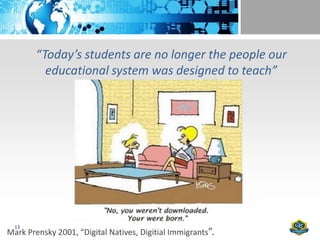
“Today’s students are no longer the people our
          educational system was designed to teach”


  13
Mark Prensky 2001, “Digital Natives, Digitial Immigrants”.
Cost effectiveness of e-Learning –vs- face to face
     corporate learning


     •   Travel costs eliminated
     •   Eliminates facilities and equipment
     •   Does not take participants out of work environment
     •   Enables out of hours learning
     •   Reduced instructor salaries
     •   Eliminates printing costs

14
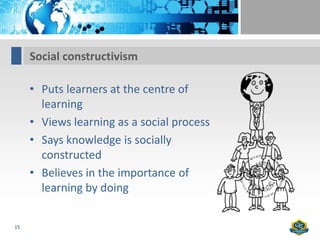
Social constructivism

     • Puts learners at the centre of
       learning
     • Views learning as a social process
     • Says knowledge is socially
       constructed
     • Believes in the importance of
       learning by doing

15
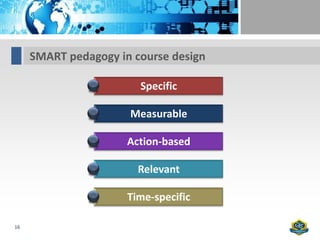
SMART pedagogy in course design

                        Specific

                      Measurable

                      Action-based

                        Relevant

                      Time-specific

16
Limitations of “off-the-shelf” e-Learning


     •   Poor pedagogy and user-engagement
     •   Competes with abundant internet information
     •   Unduly prescriptive
     •   Expensive
     •   Lack context
     •   No social engagement


17
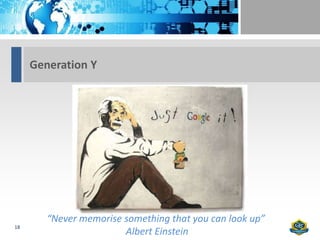
Generation Y


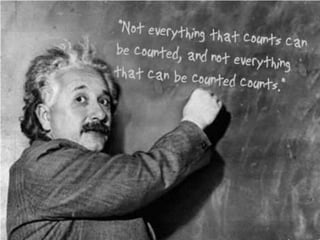
        “Never memorise something that you can look up”
18
                        Albert Einstein
Blending technology and social constructivism


     •   Teaching –vs- Facilitation, Student –vs- Participant
     •   Social engagement and learning from each other
     •   Building connections, establishing communities
     •   Moodle – an open source learning management
         system.


19
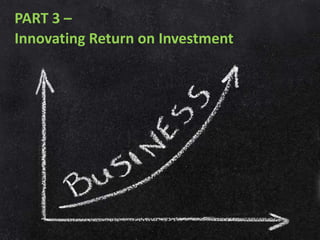
PART 3 –
Innovating Return on Investment
Possible benefits of corporate learning and
     development
     •   Improves employee performance
     •   Enhances company profits
     •   Saves money
     •   Improves a company's competitive edge.
     •   Increases worker productivity.
     •   Saves supervisory and administrative time and costs
     •   Improves customer satisfaction
     •   Improves employee satisfaction and retention
22
So what should
      we measure to
     find out how we
        are doing?

23
How we measure ROI
     depends on how the company
         VALUES the learning
             programme

24
The Value Continuum in Corporate Learning


        In general there are three points on the
        value continuum:
        Corporate learning as a publicity exercise
        Corporate learning brokering training
        Corporate learning as a strategic enabler


25
Costs of Corporate Learning


          Potential cost models:
          1. Corporate overhead
          2. Cost distribution
          3. 100% Cost recovery
          4. Profit centre


26
GCA’s ROI measurements

     GAC Strategic Objectives for GCA:
     • Learning organisation
     • Skillful and motivated people

     Measurement through:
     • CSF5: We must have motivated and trained personnel.
     • KPI: Number of training hours (target vs actual)
     • Employee Engagement Survey measuring perception of
       GAC people about progress towards these objectives
27
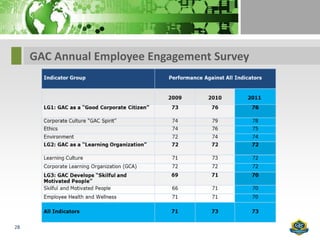
GAC Annual Employee Engagement Survey


28
GCA ROI Calculation

 • If the following conditions are met:
      – Full cost recovery, and
      – EES measures >= target, and
      – Training Hours >= target, then:
 • ROI is +ve


29
CONCLUSION
Corporate Learning Organisations

     e-Learning and learning without
                boundaries

          Return on Investment
31
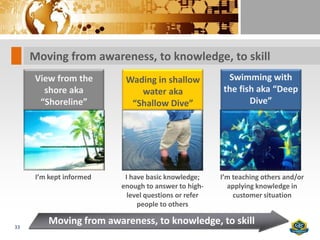
Moving from awareness, to knowledge, to skill
     View from the         Wading in shallow             Swimming with
       shore aka              water aka                 the fish aka “Deep
      “Shoreline”           “Shallow Dive”                     Dive”


      I’m kept informed    I have basic knowledge;     I’m teaching others and/or
                          enough to answer to high-      applying knowledge in
                            level questions or refer       customer situation
                               people to others

33
          Moving from awareness, to knowledge, to skill
How a corporation values its
      learning and development
     programs directly influences
             how it is run.

34
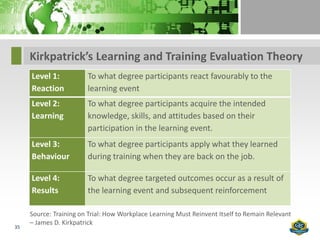
Kirkpatrick’s Learning and Training Evaluation Theory
     Level 1:           To what degree participants react favourably to the
     Reaction           learning event
     Level 2:           To what degree participants acquire the intended
     Learning           knowledge, skills, and attitudes based on their
                        participation in the learning event.
     Level 3:           To what degree participants apply what they learned
     Behaviour          during training when they are back on the job.

     Level 4:           To what degree targeted outcomes occur as a result of
     Results            the learning event and subsequent reinforcement

     Source: Training on Trial: How Workplace Learning Must Reinvent Itself to Remain Relevant
     – James D. Kirkpatrick
35
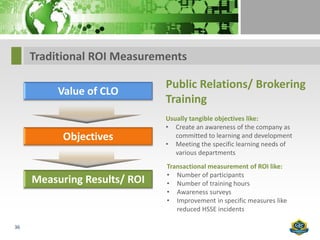
Traditional ROI Measurements

                              Public Relations/ Brokering
          Value of CLO
                              Training
                              Usually tangible objectives like:
                              • Create an awareness of the company as
           Objectives            committed to learning and development
                              • Meeting the specific learning needs of
                                 various departments
                              Transactional measurement of ROI like:
                              • Number of participants
     Measuring Results/ ROI   • Number of training hours
                              • Awareness surveys
                              • Improvement in specific measures like
                                 reduced HSSE incidents

36
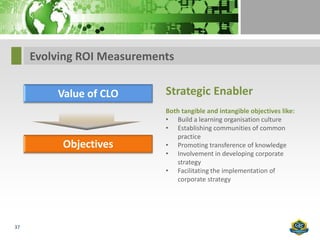
Evolving ROI Measurements

         Value of CLO       Strategic Enabler
                            Both tangible and intangible objectives like:
                            • Build a learning organisation culture
                            • Establishing communities of common
                               practice
          Objectives        • Promoting transference of knowledge
                            • Involvement in developing corporate
                               strategy
                            • Facilitating the implementation of
                               corporate strategy


37
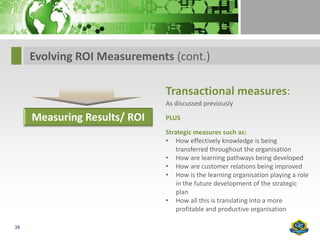
Evolving ROI Measurements (cont.)

                              Transactional measures:
                              As discussed previously

     Measuring Results/ ROI   PLUS

                              Strategic measures such as:
                              • How effectively knowledge is being
                                  transferred throughout the organisation
                              • How are learning pathways being developed
                              • How are customer relations being improved
                              • How is the learning organisation playing a role
                                  in the future development of the strategic
                                  plan
                              • How all this is translating into a more
                                  profitable and productive organisation

38

GAC Borderless Learning

  • 1.
    Borderless Learning Innovating theROI Damien O’Donoghue General Manager GAC Corporate Academy www.gacacademy.com
  • 2.
    What happens ifwe spend money on training our people and they leave? What happens if we don’t and they stay? 2
  • 3.
    Overview 1. 2. 3. Corporate e-Learning Return on Learning and learning investment Organisations without (ROI) boundaries (CLO) is the key to can deliver success establish the effective culture of learning learning outcome 3
  • 4.
    PART 1 – CorporateLearning Organisations
  • 5.
    The Learning Organisation • Learning is seen as a strategic enabler to growth • Competition is based on being able to learn and adapt quicker than rivals • People challenged to continuously expand and create • Collaboration and innovation nurtured for competitive advantage 5
  • 6.
    Training ---> Learning TRAINING LEARNING Skills development Behaviour change and skill development Externally applied Internally accepted Short term skill uplift Long term change Equips for known challenges Equips for ambiguous future Primarily structured Primarily organic ‘Doing’ ‘Understanding’ A “lead” measure A “lag” measure 6
  • 7.
    Evolution of CorporateLearning 2008+… Collaborative, Talent-Driven Learning Formalize informal learning Collaboration and Talent Management by design 1995-today Blended and informal Learning Mixing all forms of media with informal learning Learning On-Demand and Integrated Programs 1998-2004 The e-Learning Era Put materials online, information vs. instruction Web-Based courseware, virtual classroom, and Learner-Facing LMS 1980s-1990s Traditional and Computer-Assisted Training Instructor and Computer-Based (CBT) Automated Training Management Systems 7
  • 8.
    The early adopterslead the way: McDonalds Motorola Hamburger University University 8
  • 9.
    Why Corporate LearningOrganisations? Strategic alignment (L&D + corporate strategy) Central transmission station for corporate culture Drive culture of measurement in all L&D activities Increase employee involvement and collaboration Develops appropriate pedagogy Employer branding and alignment with HR 9
  • 10.
    NOW Growth of Corporate Learning Organisations is estimated to be 200% faster than the vocational and academic sectors. Source: Corporate University Exchange 10
  • 11.
    PART 2 – Emergenceof e-Learning and Learning without Boundaries
  • 12.
    A Quick Survey: e-Learning –vs- classroom education e-Learning is: 1. less-effective than classroom education. 2. an effective substitute for classroom education. 3. superior to classroom education. 12
  • 13.
    “Today’s students areno longer the people our educational system was designed to teach” 13 Mark Prensky 2001, “Digital Natives, Digitial Immigrants”.
  • 14.
    Cost effectiveness ofe-Learning –vs- face to face corporate learning • Travel costs eliminated • Eliminates facilities and equipment • Does not take participants out of work environment • Enables out of hours learning • Reduced instructor salaries • Eliminates printing costs 14
  • 15.
    Social constructivism • Puts learners at the centre of learning • Views learning as a social process • Says knowledge is socially constructed • Believes in the importance of learning by doing 15
  • 16.
    SMART pedagogy incourse design Specific Measurable Action-based Relevant Time-specific 16
  • 17.
    Limitations of “off-the-shelf”e-Learning • Poor pedagogy and user-engagement • Competes with abundant internet information • Unduly prescriptive • Expensive • Lack context • No social engagement 17
  • 18.
    Generation Y “Never memorise something that you can look up” 18 Albert Einstein
  • 19.
    Blending technology andsocial constructivism • Teaching –vs- Facilitation, Student –vs- Participant • Social engagement and learning from each other • Building connections, establishing communities • Moodle – an open source learning management system. 19
  • 20.
    PART 3 – InnovatingReturn on Investment
  • 22.
    Possible benefits ofcorporate learning and development • Improves employee performance • Enhances company profits • Saves money • Improves a company's competitive edge. • Increases worker productivity. • Saves supervisory and administrative time and costs • Improves customer satisfaction • Improves employee satisfaction and retention 22
  • 23.
    So what should we measure to find out how we are doing? 23
  • 24.
    How we measureROI depends on how the company VALUES the learning programme 24
  • 25.
    The Value Continuumin Corporate Learning In general there are three points on the value continuum: Corporate learning as a publicity exercise Corporate learning brokering training Corporate learning as a strategic enabler 25
  • 26.
    Costs of CorporateLearning Potential cost models: 1. Corporate overhead 2. Cost distribution 3. 100% Cost recovery 4. Profit centre 26
  • 27.
    GCA’s ROI measurements GAC Strategic Objectives for GCA: • Learning organisation • Skillful and motivated people Measurement through: • CSF5: We must have motivated and trained personnel. • KPI: Number of training hours (target vs actual) • Employee Engagement Survey measuring perception of GAC people about progress towards these objectives 27
  • 28.
    GAC Annual EmployeeEngagement Survey 28
  • 29.
    GCA ROI Calculation • If the following conditions are met: – Full cost recovery, and – EES measures >= target, and – Training Hours >= target, then: • ROI is +ve 29
  • 30.
  • 31.
    Corporate Learning Organisations e-Learning and learning without boundaries Return on Investment 31
  • 33.
    Moving from awareness,to knowledge, to skill View from the Wading in shallow Swimming with shore aka water aka the fish aka “Deep “Shoreline” “Shallow Dive” Dive” I’m kept informed I have basic knowledge; I’m teaching others and/or enough to answer to high- applying knowledge in level questions or refer customer situation people to others 33 Moving from awareness, to knowledge, to skill
  • 34.
    How a corporationvalues its learning and development programs directly influences how it is run. 34
  • 35.
    Kirkpatrick’s Learning andTraining Evaluation Theory Level 1: To what degree participants react favourably to the Reaction learning event Level 2: To what degree participants acquire the intended Learning knowledge, skills, and attitudes based on their participation in the learning event. Level 3: To what degree participants apply what they learned Behaviour during training when they are back on the job. Level 4: To what degree targeted outcomes occur as a result of Results the learning event and subsequent reinforcement Source: Training on Trial: How Workplace Learning Must Reinvent Itself to Remain Relevant – James D. Kirkpatrick 35
  • 36.
    Traditional ROI Measurements Public Relations/ Brokering Value of CLO Training Usually tangible objectives like: • Create an awareness of the company as Objectives committed to learning and development • Meeting the specific learning needs of various departments Transactional measurement of ROI like: • Number of participants Measuring Results/ ROI • Number of training hours • Awareness surveys • Improvement in specific measures like reduced HSSE incidents 36
  • 37.
    Evolving ROI Measurements Value of CLO Strategic Enabler Both tangible and intangible objectives like: • Build a learning organisation culture • Establishing communities of common practice Objectives • Promoting transference of knowledge • Involvement in developing corporate strategy • Facilitating the implementation of corporate strategy 37
  • 38.
    Evolving ROI Measurements(cont.) Transactional measures: As discussed previously Measuring Results/ ROI PLUS Strategic measures such as: • How effectively knowledge is being transferred throughout the organisation • How are learning pathways being developed • How are customer relations being improved • How is the learning organisation playing a role in the future development of the strategic plan • How all this is translating into a more profitable and productive organisation 38