Training Methods
BHMS4424 CareerPlanning and Employee Development
Effective training design is not just about imparting
knowledge; it's about creating an environment where
learning is applied, skills are developed, and growth is
fostered.
Intended Learning
Outcomes
By theend of this session, you will be able to:
• analyze the strengths and weaknesses of various traditional training
methods, such as lectures, hands-on approaches, and group
building techniques, and determine their suitability for different
learning objectives.
• explain how new technologies, including computer-based training,
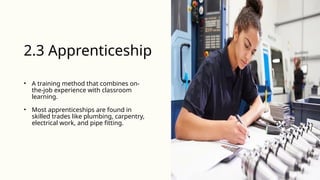
online learning, and social media, enhance the learning experience
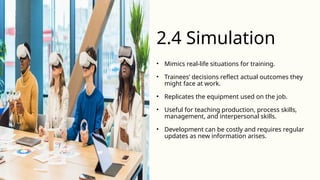
and transfer of skills compared to traditional methods.
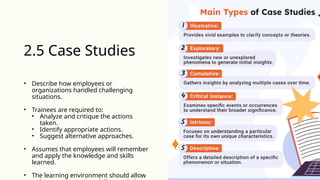
4.
Summary: Lecture 4
ProgrammeDesign
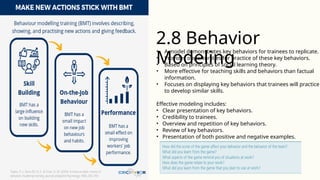
• Pre-training, learning event, and post-training.
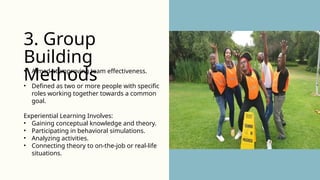
• Key points for designing effective learning programmes:
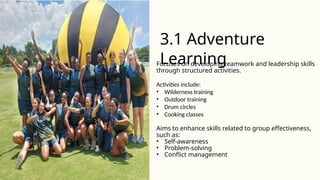
1. Selecting and preparing the training space: Comfort, accessibility, quiet
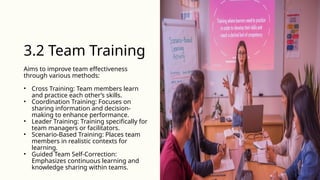
environment, adequate space, visibility.
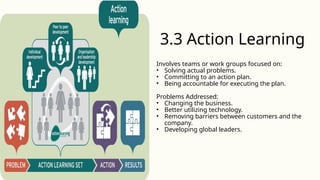
2. Choosing trainers: Qualifications, teaching skills, industry knowledge, adaptability,
interpersonal skills, feedback and evaluation.
3. Creating a positive learning environment: High collaboration, high vs low self-
direction, prepare materials, practice techniques, audience-centric design, pre-
training engagement.
4. Designing courses and lessons: curriculum, course program, course sequence, design
document, lesson plan.
5. Curriculum road map: Visual overview of the learner pathways, course sequence and
lesson plan.
6. Choosing training providers: Request for proposal (RFP)
7. Understanding transfer of training: Transfer focus, self-management, manager &
peers support, opportunities for application, and technological support.
5.
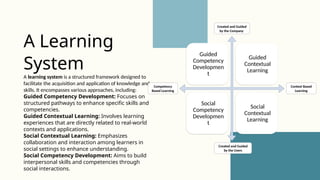
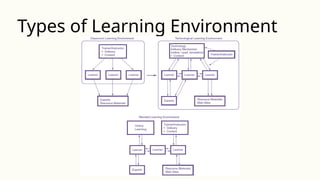
A learning systemis a structured framework designed to
facilitate the acquisition and application of knowledge and
skills. It encompasses various approaches, including:
Guided Competency Development: Focuses on
structured pathways to enhance specific skills and
competencies.
Guided Contextual Learning: Involves learning
experiences that are directly related to real-world
contexts and applications.
Social Contextual Learning: Emphasizes
collaboration and interaction among learners in
social settings to enhance understanding.
Social Competency Development: Aims to build
interpersonal skills and competencies through
social interactions.
A Learning
System
Guided
Competency
Developmen
t
Guided
Contextual
Learning
Social
Competency
Developmen
t
Social
Contextual
Learning
Created and Guided
by the Company
Created and Guided
by the Users
Context Based
Learning
Competency
Based Learning
6.
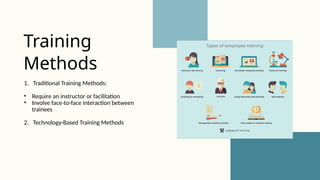
1. Traditional TrainingMethods:
• Require an instructor or facilitation
• Involve face-to-face interaction between
trainees
2. Technology-Based Training Methods
Training
Methods
7.
Traditional Training Methods
1.Presentation Methods:
• Lecture
• Audiovisual
2. Hands-On-Methods:
• On-the-job training (OJT)
• Self-directed learning
• Apprenticeship
• Simulations
• Case studies
• Business games
• Role plays
• Behavior modeling
3. Group Building Methods:
• Adventure learning
• Team training
• Action learning
8.
1. Trainees arepassive recipients of information,
which may include:
• Facts or information
• Processes
• Problem-solving methods
2. Includes lectures and audio-visual techniques
1. Presentation
Methods
9.
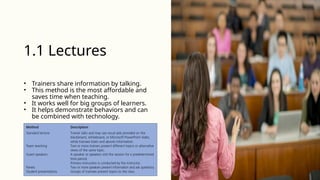
• Trainers shareinformation by talking.
• This method is the most affordable and
saves time when teaching.
• It works well for big groups of learners.
• It helps demonstrate behaviors and can
be combined with technology.
1.1 Lectures
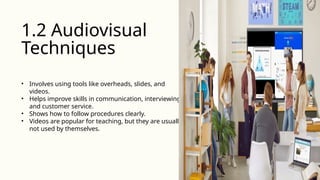
10.
• Involves usingtools like overheads, slides, and
videos.
• Helps improve skills in communication, interviewing,
and customer service.
• Shows how to follow procedures clearly.
• Videos are popular for teaching, but they are usually
not used by themselves.
1.2 Audiovisual
Techniques
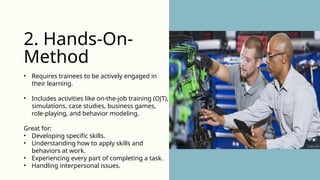
11.
• Requires traineesto be actively engaged in
their learning.
• Includes activities like on-the-job training (OJT),
simulations, case studies, business games,
role-playing, and behavior modeling.
Great for:
• Developing specific skills.
• Understanding how to apply skills and
behaviors at work.
• Experiencing every part of completing a task.
• Handling interpersonal issues.
2. Hands-On-
Method
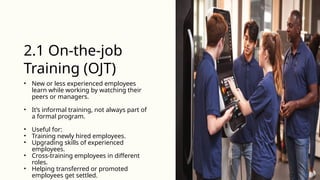
12.
• New orless experienced employees
learn while working by watching their
peers or managers.
• It’s informal training, not always part of
a formal program.
• Useful for:
• Training newly hired employees.
• Upgrading skills of experienced
employees.
• Cross-training employees in different
roles.
• Helping transferred or promoted
employees get settled.
2.1 On-the-job
Training (OJT)
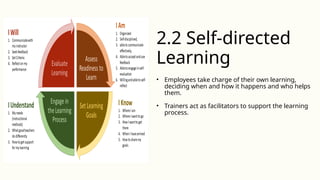
13.
• Employees takecharge of their own learning,
deciding when and how it happens and who helps
them.
• Trainers act as facilitators to support the learning
process.
2.2 Self-directed
Learning
14.
• A trainingmethod that combines on-
the-job experience with classroom
learning.
• Most apprenticeships are found in
skilled trades like plumbing, carpentry,
electrical work, and pipe fitting.
2.3 Apprenticeship
15.
• Mimics real-lifesituations for training.
• Trainees’ decisions reflect actual outcomes they
might face at work.
• Replicates the equipment used on the job.
• Useful for teaching production, process skills,
management, and interpersonal skills.
• Development can be costly and requires regular
updates as new information arises.
2.4 Simulation
16.
• Describe howemployees or
organizations handled challenging
situations.
• Trainees are required to:
• Analyze and critique the actions
taken.
• Identify appropriate actions.
• Suggest alternative approaches.
• Assumes that employees will remember
and apply the knowledge and skills
learned.
• The learning environment should allow
2.5 Case Studies
17.
• Trainees gatherinformation, analyze it, and make
decisions.
• Primarily focused on developing management skills.
• Mimic the competitive nature of business
environments.
• Designed to demonstrate understanding and
application of knowledge, skills, or behaviors.
• Offer multiple alternative courses of action for
trainees to explore.
2.6 Business
Games
18.
• Trainees actout assigned characters,
such as a manager, client, or
disgruntled employee.
• Commonly used in training programs
focused on interpersonal skills.
2.7 Role Plays
19.
• A modeldemonstrates key behaviors for trainees to replicate.
• Provides opportunities for practice of these key behaviors.
• Based on principles of social learning theory.
• More effective for teaching skills and behaviors than factual
information.
• Focuses on displaying key behaviors that trainees will practice
to develop similar skills.
Effective modeling includes:
• Clear presentation of key behaviors.
• Credibility to trainees.
• Overview and repetition of key behaviors.
• Review of key behaviors.
• Presentation of both positive and negative examples.
2.8 Behavior
Modeling
20.
• Aimed atimproving team effectiveness.
• Defined as two or more people with specific
roles working together towards a common
goal.
Experiential Learning Involves:
• Gaining conceptual knowledge and theory.
• Participating in behavioral simulations.
• Analyzing activities.
• Connecting theory to on-the-job or real-life
situations.
3. Group
Building
Methods
21.
Focuses on developingteamwork and leadership skills
through structured activities.
Activities include:
• Wilderness training
• Outdoor training
• Drum circles
• Cooking classes
Aims to enhance skills related to group effectiveness,
such as:
• Self-awareness
• Problem-solving
• Conflict management
3.1 Adventure
Learning
22.
Aims to improveteam effectiveness
through various methods:
• Cross Training: Team members learn
and practice each other’s skills.
• Coordination Training: Focuses on
sharing information and decision-
making to enhance performance.
• Leader Training: Training specifically for
team managers or facilitators.
• Scenario-Based Training: Places team
members in realistic contexts for
learning.
• Guided Team Self-Correction:
Emphasizes continuous learning and
knowledge sharing within teams.
3.2 Team Training
23.
Involves teams orwork groups focused on:
• Solving actual problems.
• Committing to an action plan.
• Being accountable for executing the plan.
Problems Addressed:
• Changing the business.
• Better utilizing technology.
• Removing barriers between customers and the
company.
• Developing global leaders.
3.3 Action Learning
24.
Choosing a TrainingMethod
Types of Learning Outcomes:
• Knowledge acquisition
• Skill development
• Behavioral change
Considerations:
• Learning: Assess how well the method promotes understanding.
• Transfer of Training: Evaluate how effectively skills are applied in real-world situations.
• Cost Evaluation: Analyze the costs associated with the training method.
• Effectiveness: Consider how effective the training method is in achieving desired outcomes.
Team Building activities: https://youtu.be/lcv4n9qK6ZQ?si=mtPZyPDMZHtlt2dZ
25.
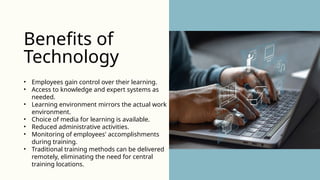
• Employees gaincontrol over their learning.
• Access to knowledge and expert systems as
needed.
• Learning environment mirrors the actual work
environment.
• Choice of media for learning is available.
• Reduced administrative activities.
• Monitoring of employees' accomplishments
during training.
• Traditional training methods can be delivered
remotely, eliminating the need for central
training locations.
Benefits of
Technology
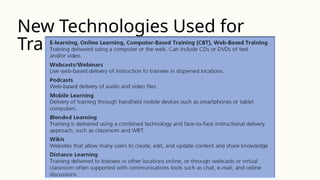
1. Computer-Based Training,Online Learning,
Web-Based Training, E-Learning
2. Social Media: Wikis, Blogs, Microblogs, and
Social Networks
3. Blended Learning
4. Mobile Technology and Learning
5. Distance Learning
Technology-
Based Training
Methods
30.
Refers to instructionand delivery of training by
computer through the internet or the web.
1. Computer-
Based Training
(CBT)
31.
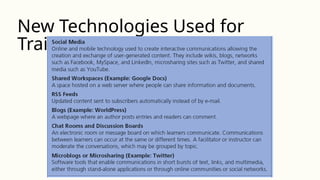
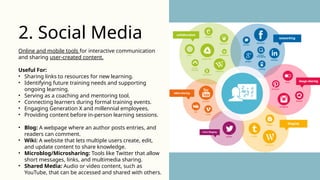
Online and mobiletools for interactive communication
and sharing user-created content.
Useful For:
• Sharing links to resources for new learning.
• Identifying future training needs and supporting
ongoing learning.
• Serving as a coaching and mentoring tool.
• Connecting learners during formal training events.
• Engaging Generation X and millennial employees.
• Providing content before in-person learning sessions.
• Blog: A webpage where an author posts entries, and
readers can comment.
• Wiki: A website that lets multiple users create, edit,
and update content to share knowledge.
• Microblog/Microsharing: Tools like Twitter that allow
short messages, links, and multimedia sharing.
• Shared Media: Audio or video content, such as
YouTube, that can be accessed and shared with others.
2. Social Media
32.
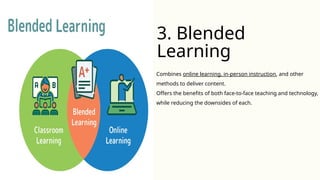
Combines online learning,in-person instruction, and other
methods to deliver content.
Offers the benefits of both face-to-face teaching and technology,
while reducing the downsides of each.
3. Blended
Learning
33.
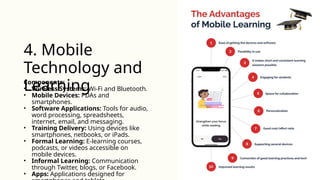
Components:
• Wireless Systems:Wi-Fi and Bluetooth.
• Mobile Devices: PDAs and
smartphones.
• Software Applications: Tools for audio,
word processing, spreadsheets,
internet, email, and messaging.
• Training Delivery: Using devices like
smartphones, netbooks, or iPads.
• Formal Learning: E-learning courses,
podcasts, or videos accessible on
mobile devices.
• Informal Learning: Communication
through Twitter, blogs, or Facebook.
• Apps: Applications designed for
4. Mobile
Technology and
Learning
34.
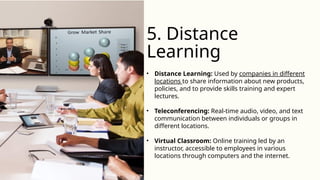
• Distance Learning:Used by companies in different
locations to share information about new products,
policies, and to provide skills training and expert
lectures.
• Teleconferencing: Real-time audio, video, and text
communication between individuals or groups in
different locations.
• Virtual Classroom: Online training led by an
instructor, accessible to employees in various
locations through computers and the internet.
5. Distance
Learning
35.
Advantages:
• Cost Savings:Training is accessible from home or
office.
• Fewer Trainers Needed: Reduces the number of
trainers required.
• Lower Travel Costs: Saves on airfare, food, and lodging
for employees.
Consider When:
• There’s a sufficient budget and resources.
• Trainees are in different locations.
• Trainees are comfortable with technology.
• It aligns with the company’s strategy and culture.
• There’s limited time for training.
Choosing New
Technology
Training
Methods