Technology Adoption Life
Cycle
Mr. Roshan Bhattarai
Kathmandu, Nepal
Technology Adoption Life Cycle
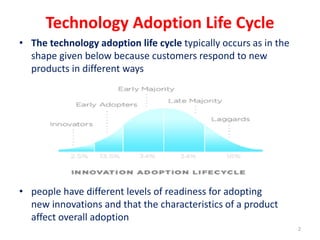
• The technology adoption life cycle typically occurs as in the
shape given below because customers respond to new
products in different ways
• people have different levels of readiness for adopting
new innovations and that the characteristics of a product
affect overall adoption
2
• Rogers classified individuals into five groups:
– innovators,
– early adopters,
– early majority,
– late majority, and
– laggards.
• In the curve, innovators occupy 2.5%, early adopters
13.5%, early majority 34%, late majority 34%, and
laggards 16%
3
Adopter category
Innovators
• Innovators are :
– willing to take risks,
– have the highest social status,
– have financial liquidity,
– have closest contact to scientific sources and interaction
with other innovators
• Their risk tolerance allows them to adopt technologies
that may ultimately fail
• Financial resources help absorb these failures
4
Early adopters
• These individuals have the highest degree of opinion
leadership among the adopter categories
• They have:
– higher social status,
– financial liquidity,
– advanced education
• more socially forward than late adopters
• more tactful in adoption choices than innovators
5
Early Majority
• They adopt an innovation after significantly longer time
than the innovators and early adopters
• Early Majority have
– above average social status,
– contact with early adopters and
– relatively hold lower positions of opinion leadership in a
system
6
Late Majority
• They adopt an innovation after the average participant
• approach an innovation with a high degree of doubt and
after the majority of society has adopted the innovation
• They are typically
– doubtful about an innovation,
– have below average social status,
– little financial liquidity,
– in contact with others in late majority and early majority and
– very little opinion leadership
7
Laggards
• They are the last to adopt an innovation
• individuals in this category show no opinion leadership
• These individuals typically have
– an hatred to change-agents
– tend to be focused on "traditions",
– lowest social status,
– lowest financial liquidity,
– oldest among adopters, and
– in contact with only family and close friends
8

Technology Adoption Life Cycle

  • 1.
    Technology Adoption Life Cycle Mr.Roshan Bhattarai Kathmandu, Nepal
  • 2.
    Technology Adoption LifeCycle • The technology adoption life cycle typically occurs as in the shape given below because customers respond to new products in different ways • people have different levels of readiness for adopting new innovations and that the characteristics of a product affect overall adoption 2
  • 3.
    • Rogers classifiedindividuals into five groups: – innovators, – early adopters, – early majority, – late majority, and – laggards. • In the curve, innovators occupy 2.5%, early adopters 13.5%, early majority 34%, late majority 34%, and laggards 16% 3
  • 4.
    Adopter category Innovators • Innovatorsare : – willing to take risks, – have the highest social status, – have financial liquidity, – have closest contact to scientific sources and interaction with other innovators • Their risk tolerance allows them to adopt technologies that may ultimately fail • Financial resources help absorb these failures 4
  • 5.
    Early adopters • Theseindividuals have the highest degree of opinion leadership among the adopter categories • They have: – higher social status, – financial liquidity, – advanced education • more socially forward than late adopters • more tactful in adoption choices than innovators 5
  • 6.
    Early Majority • Theyadopt an innovation after significantly longer time than the innovators and early adopters • Early Majority have – above average social status, – contact with early adopters and – relatively hold lower positions of opinion leadership in a system 6
  • 7.
    Late Majority • Theyadopt an innovation after the average participant • approach an innovation with a high degree of doubt and after the majority of society has adopted the innovation • They are typically – doubtful about an innovation, – have below average social status, – little financial liquidity, – in contact with others in late majority and early majority and – very little opinion leadership 7
  • 8.
    Laggards • They arethe last to adopt an innovation • individuals in this category show no opinion leadership • These individuals typically have – an hatred to change-agents – tend to be focused on "traditions", – lowest social status, – lowest financial liquidity, – oldest among adopters, and – in contact with only family and close friends 8