STP
Segmentation
Targeting
Positioning Presented By -
Miss. Akansha Poswal
Miss. Prerna Singh
Miss. Ritika Singh
Mr. Saif Ur Rahman
SEGMENTATION
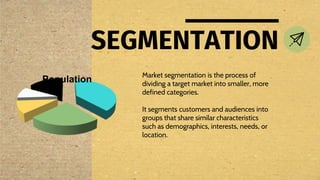
Market segmentation is the process of
dividing a target market into smaller, more
defined categories.
It segments customers and audiences into
groups that share similar characteristics
such as demographics, interests, needs, or
location.
Population
BASIS OF SEGMENTATION
DEMOGRAPHICS GEOGRAPHIC
Behavioural
Benefit
Segmentation
Region, state, district,
urban/rural, etc.
Occasions, benefits
sought, user status,
etc.
01 02
04 05
Psychographic
Values, system, belief,
interest, attitude, etc.
03
Age, gender,
status, culture, etc.
DEMOGRAPHIC SEGMENTATION
Examples of Demographic Segmentation
GEOGRAPHICAL SEGMENTATION
PSYCHOGRAPHIC SEGMENTATION
EXAMPLE
ADVANTAGES
1. Helps distinguish one customer group from another within a given market.
2. Facilitates proper choice of target market.
3. Facilitates effective tapping of the market.
4. Helps divide the markets and conquer them.
5. Helps crystallize the needs of the target buyers.
6. Makes the marketing effort more efficient and economic.
EFFECTIVE MARKET
SEGMENTATION
1. Measurability (In terms of size and purchasing power)
2. Accessibility (Reached and served through suitable means of distribution of promotion)
3. Substantiality (Large and profitable)
4. Differentiability (Clearly distinguishable)
5. Action ability (To be effective makers of segmentation should be compatible with the
manpower, financial and managerial resources)
MARKET
TARGETING
MARKET TARGETING
Targeting is a strategy that breaks a large market into smaller
segments to concentrate on a specific group of customers
within that audience.
Instead to trying to reach an entire market, a brand uses target
marketing to put their energy into connecting within a
specific, defined group within that market.
TARGETING STRATEGIES
Undifferentiated Strategy
Concentrated Strategy
Differentiated Strategy
Micro – marketing Strategy
Mass Marketing
Niche Marketing
Segmented Marketing
Individual Marketing
Entire Market
Target Market
Segment 1, Segment 2
Individual
Mckinsey Matrix
POSITIONING
MARKET
POSITIONING
MARKETING
Positioning refers to the place that a brand
occupies in the minds of the customers and how it
is distinguished from the products of the
competitors and different from the concept of
brand awareness.
WHY POSITIONING?
1. To create a distinct place of product & service or corporate in the
minds of customer.
2. To provide a competitive edge to a product or an attempt to
convey attractiveness of the product to the target market.
3. To give the target market reason of buying our product/service
and then formulation of all strategies according to the customer
perception.
STRATEGIES OF POSITIONING
1. UNIQUE SELLING PROPOSITION
2. DUAL BENEFIT POSITIONING
• Product features
• Services attributes
• Channel attributes
• Pricing attributes
• Product Benefits
• Other attributes
THE FINAL STEPS OF FRAMEWORK
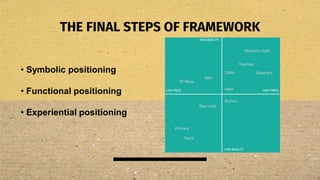
• Symbolic positioning
• Functional positioning
• Experiential positioning
STP EXAMPLE
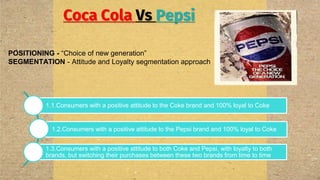
Coca Cola Vs Pepsi
1.1.Consumers with a positive attitude to the Coke brand and 100% loyal to Coke
1.2.Consumers with a positive attitude to the Pepsi brand and 100% loyal to Coke
1.3.Consumers with a positive attitude to both Coke and Pepsi, with loyalty to both
brands, but switching their purchases between these two brands from time to time
POSITIONING - “Choice of new generation”
SEGMENTATION - Attitude and Loyalty segmentation approach
350$ Million
per annum
COKE
$200 Million
PEPSI
$150 Million
Combined Budget
Change in Target Market selection of Pepsi -
TARGET
MARKET
• Loyal Coke drinkers
• Youth
POSITIONING
• Reason that Coca-Cola replaced their Classic Coca-Cola with
new Coke
THANKS
MBA, 2nd semester,
JIMS,
DELHI

Segmentation, Targeting and Positioning (STP)

  • 1.
    STP Segmentation Targeting Positioning Presented By- Miss. Akansha Poswal Miss. Prerna Singh Miss. Ritika Singh Mr. Saif Ur Rahman
  • 2.
    SEGMENTATION Market segmentation isthe process of dividing a target market into smaller, more defined categories. It segments customers and audiences into groups that share similar characteristics such as demographics, interests, needs, or location. Population
  • 4.
    BASIS OF SEGMENTATION DEMOGRAPHICSGEOGRAPHIC Behavioural Benefit Segmentation Region, state, district, urban/rural, etc. Occasions, benefits sought, user status, etc. 01 02 04 05 Psychographic Values, system, belief, interest, attitude, etc. 03 Age, gender, status, culture, etc.
  • 5.
  • 6.
  • 7.
  • 8.
  • 9.
  • 10.
    ADVANTAGES 1. Helps distinguishone customer group from another within a given market. 2. Facilitates proper choice of target market. 3. Facilitates effective tapping of the market. 4. Helps divide the markets and conquer them. 5. Helps crystallize the needs of the target buyers. 6. Makes the marketing effort more efficient and economic.
  • 11.
    EFFECTIVE MARKET SEGMENTATION 1. Measurability(In terms of size and purchasing power) 2. Accessibility (Reached and served through suitable means of distribution of promotion) 3. Substantiality (Large and profitable) 4. Differentiability (Clearly distinguishable) 5. Action ability (To be effective makers of segmentation should be compatible with the manpower, financial and managerial resources)
  • 12.
  • 13.
    MARKET TARGETING Targeting isa strategy that breaks a large market into smaller segments to concentrate on a specific group of customers within that audience. Instead to trying to reach an entire market, a brand uses target marketing to put their energy into connecting within a specific, defined group within that market.
  • 14.
    TARGETING STRATEGIES Undifferentiated Strategy ConcentratedStrategy Differentiated Strategy Micro – marketing Strategy Mass Marketing Niche Marketing Segmented Marketing Individual Marketing Entire Market Target Market Segment 1, Segment 2 Individual
  • 15.
  • 16.
  • 17.
    POSITIONING MARKETING Positioning refers tothe place that a brand occupies in the minds of the customers and how it is distinguished from the products of the competitors and different from the concept of brand awareness.
  • 18.
    WHY POSITIONING? 1. Tocreate a distinct place of product & service or corporate in the minds of customer. 2. To provide a competitive edge to a product or an attempt to convey attractiveness of the product to the target market. 3. To give the target market reason of buying our product/service and then formulation of all strategies according to the customer perception.
  • 19.
    STRATEGIES OF POSITIONING 1.UNIQUE SELLING PROPOSITION 2. DUAL BENEFIT POSITIONING • Product features • Services attributes • Channel attributes • Pricing attributes • Product Benefits • Other attributes
  • 20.
    THE FINAL STEPSOF FRAMEWORK • Symbolic positioning • Functional positioning • Experiential positioning
  • 21.
  • 22.
    Coca Cola VsPepsi 1.1.Consumers with a positive attitude to the Coke brand and 100% loyal to Coke 1.2.Consumers with a positive attitude to the Pepsi brand and 100% loyal to Coke 1.3.Consumers with a positive attitude to both Coke and Pepsi, with loyalty to both brands, but switching their purchases between these two brands from time to time POSITIONING - “Choice of new generation” SEGMENTATION - Attitude and Loyalty segmentation approach
  • 23.
    350$ Million per annum COKE $200Million PEPSI $150 Million Combined Budget
  • 24.
    Change in TargetMarket selection of Pepsi - TARGET MARKET • Loyal Coke drinkers • Youth POSITIONING • Reason that Coca-Cola replaced their Classic Coca-Cola with new Coke
  • 25.