The Innovation Decision
Process
Submitted by :Harmeen Kaur
L-2010-H.sc-13-BVI
The Innovation Decision Process
Rogers described the innovation-decision
process as “an information-seeking and
information-processing activity, where an
individual is motivated to reduce uncertainty
about the advantages and disadvantages of an
innovation”.
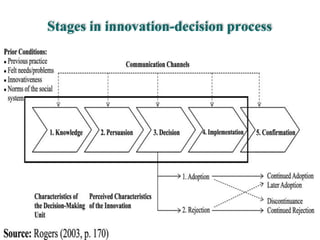
” For Rogers, the innovation-decision process
involves five steps: (1) knowledge, (2)
persuasion, (3) decision, (4) implementation, and
(5) confirmation. These stages typically follow
each other in a time-ordered manner.
Stages in innovation-decision process
1. KnowledgeThe innovation-decision process starts with the
knowledge stage. In this stage, an individual
learns about the existence of innovation and
seeks information about the innovation.
“What?,” “how?,” and “why?” are the critical
questions asked in the knowledge phase. During
this phase, the individual attempts to
determine “what the innovation is and why and
how it works”?
2. PersuasionThe persuasion step occurs when the individual
has a negative or positive attitude toward the
innovation, but “the formation of a favourable
or unfavourable attitude toward an innovation
does not always lead to an adoption or
rejection". The individual shapes his or her
attitude after he or she knows about the
innovation, so the persuasion stage follows the
knowledge stage in the innovation-decision
process.
3. DecisionAt the decision stage in the innovation-decision
process, the individual chooses to adopt or
reject the innovation where adoption refers to
“full use of an innovation as the best course of
action available,” and rejection means “not to
adopt an innovation”.
4. ImplementationAt the implementation stage, an innovation is
put into practice. However, an innovation brings
the newness in which “some degree of
uncertainty
is
involved
in
diffusion”.
Uncertainty about the outcomes of the
innovation still can be a problem at this stage.
5. ConfirmationThe innovation-decision already has been made,
but at the confirmation stage the individual
looks for support for his or her decision.
According to Rogers, this decision can be
reversed if the individual is “exposed to
conflicting messages about the innovation”.
However, the individual tends to stay away
from these messages and seeks supportive
messages that confirm his or her decision.
Thus, attitudes become more crucial at the
confirmation stage.
Innovativeness and Adopter Categories
Innovativeness is the degree to which an
individual or other unit of adoption is relatively
earlier in adopting new ideas than other
members of a system” . “For Rogers,
innovativeness helped in understanding the
desired and main behaviour in the innovationdecision process.
Rogers defined the adopter categories as “the
classifications of members of a social system
on the basis of innovativeness” . Thus, he
categorizes the adopters based on
innovativeness.
Five Adopter Categories are:-

 Innovators
 Early Adopters
 Early Majority
 Late Majority
 Laggards
 Innovators
For Rogers, innovators were willing to
experience new ideas. Thus, they should be
prepared to cope with unprofitable and
unsuccessful innovations, and a certain level of
uncertainty about the innovation. Also,
Innovators are the gatekeepers bringing the
innovation in from outside of the system.They
constitute about 2.5% of the total.
 Early Adopters
Compared to innovators, early adopters are
more limited with the boundaries of the social
system and are about 13.5% individuals. Early
adopters are more likely to hold leadership
roles in the social system, other members come
to them to get advice or information about the
innovation.
 Early Majority
The early majority adopts the innovation just
before the other half of their peers adopts it.
They are deliberate in adopting an innovation
and they are neither the first nor the last to
adopt it and are about 34% . Thus, their
innovation decision usually takes more time than
it takes innovators and early adopters. The
early majority have a good interaction with
other members of the social system, they do
not have the leadership role that early
adopters have.
 Late Majority
Similar to the early majority they are 34% in
total and, the late majority includes one-third
of all members of the social system who wait
until most of their peers adopt the innovation.
Although they are sceptical about the
innovation and its outcomes, economic necessity
and peer pressure may lead them to the
adoption of the innovation.
 Laggards
Laggards have the traditional view and they are
more sceptical about innovations and change
agents than the late majority. They constitute
about 16% in the social system. They do not
have a leadership role. Because of the limited
resources and the lack of awareness-knowledge
of innovations, they first want to make sure
that an innovation works before they adopt.
REFERENCES
• The Turkish Online Journal of Educational
Technology – TOJET April 2006 ISSN:
1303-6521 volume 5 Issue 2 Article 3
• Everett Rogers, The Diffusion of
Innovations, Fifth Edition
The innovation decision process

The innovation decision process

  • 1.
    The Innovation Decision Process Submittedby :Harmeen Kaur L-2010-H.sc-13-BVI
  • 2.
    The Innovation DecisionProcess Rogers described the innovation-decision process as “an information-seeking and information-processing activity, where an individual is motivated to reduce uncertainty about the advantages and disadvantages of an innovation”.
  • 3.
    ” For Rogers,the innovation-decision process involves five steps: (1) knowledge, (2) persuasion, (3) decision, (4) implementation, and (5) confirmation. These stages typically follow each other in a time-ordered manner.
  • 4.
  • 5.
    1. KnowledgeThe innovation-decisionprocess starts with the knowledge stage. In this stage, an individual learns about the existence of innovation and seeks information about the innovation. “What?,” “how?,” and “why?” are the critical questions asked in the knowledge phase. During this phase, the individual attempts to determine “what the innovation is and why and how it works”?
  • 6.
    2. PersuasionThe persuasionstep occurs when the individual has a negative or positive attitude toward the innovation, but “the formation of a favourable or unfavourable attitude toward an innovation does not always lead to an adoption or rejection". The individual shapes his or her attitude after he or she knows about the innovation, so the persuasion stage follows the knowledge stage in the innovation-decision process.
  • 7.
    3. DecisionAt thedecision stage in the innovation-decision process, the individual chooses to adopt or reject the innovation where adoption refers to “full use of an innovation as the best course of action available,” and rejection means “not to adopt an innovation”.
  • 8.
    4. ImplementationAt theimplementation stage, an innovation is put into practice. However, an innovation brings the newness in which “some degree of uncertainty is involved in diffusion”. Uncertainty about the outcomes of the innovation still can be a problem at this stage.
  • 9.
    5. ConfirmationThe innovation-decisionalready has been made, but at the confirmation stage the individual looks for support for his or her decision. According to Rogers, this decision can be reversed if the individual is “exposed to conflicting messages about the innovation”. However, the individual tends to stay away from these messages and seeks supportive messages that confirm his or her decision. Thus, attitudes become more crucial at the confirmation stage.
  • 10.
    Innovativeness and AdopterCategories Innovativeness is the degree to which an individual or other unit of adoption is relatively earlier in adopting new ideas than other members of a system” . “For Rogers, innovativeness helped in understanding the desired and main behaviour in the innovationdecision process. Rogers defined the adopter categories as “the classifications of members of a social system on the basis of innovativeness” . Thus, he categorizes the adopters based on innovativeness.
  • 11.
    Five Adopter Categoriesare:-  Innovators  Early Adopters  Early Majority  Late Majority  Laggards
  • 12.
     Innovators For Rogers,innovators were willing to experience new ideas. Thus, they should be prepared to cope with unprofitable and unsuccessful innovations, and a certain level of uncertainty about the innovation. Also, Innovators are the gatekeepers bringing the innovation in from outside of the system.They constitute about 2.5% of the total.
  • 13.
     Early Adopters Comparedto innovators, early adopters are more limited with the boundaries of the social system and are about 13.5% individuals. Early adopters are more likely to hold leadership roles in the social system, other members come to them to get advice or information about the innovation.
  • 14.
     Early Majority Theearly majority adopts the innovation just before the other half of their peers adopts it. They are deliberate in adopting an innovation and they are neither the first nor the last to adopt it and are about 34% . Thus, their innovation decision usually takes more time than it takes innovators and early adopters. The early majority have a good interaction with other members of the social system, they do not have the leadership role that early adopters have.
  • 15.
     Late Majority Similarto the early majority they are 34% in total and, the late majority includes one-third of all members of the social system who wait until most of their peers adopt the innovation. Although they are sceptical about the innovation and its outcomes, economic necessity and peer pressure may lead them to the adoption of the innovation.
  • 16.
     Laggards Laggards havethe traditional view and they are more sceptical about innovations and change agents than the late majority. They constitute about 16% in the social system. They do not have a leadership role. Because of the limited resources and the lack of awareness-knowledge of innovations, they first want to make sure that an innovation works before they adopt.
  • 18.
    REFERENCES • The TurkishOnline Journal of Educational Technology – TOJET April 2006 ISSN: 1303-6521 volume 5 Issue 2 Article 3 • Everett Rogers, The Diffusion of Innovations, Fifth Edition