International Market
Segmentation
Dr. Gopal Thapa
International Market
Segmentation
 Different countriescan vary greatly in their
economic, cultural, and political makeup.
 Thus, international firms need to group their
world markets into segments with distinct
buying needs and behaviors.
12/15/2022 Copy right reserved 2
Bases for Market Segmentation
 Geographical factors
 Europe, America, Asia, or Africa
 Economic factors
 Income level, economic development, economic
structure
 Political legal factors
 Stability of government, receptivity to foreign firms,
monetary regulations, and amount of bureaucracy
 Cultural factors
 Languages, religions, values and attitudes, customs, and
behavioral patterns.
12/15/2022 Copy right reserved 3
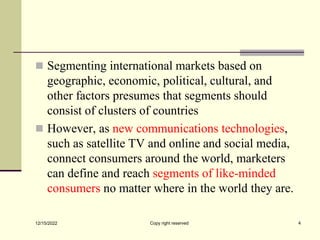
 Segmenting international markets based on
geographic, economic, political, cultural, and
other factors presumes that segments should
consist of clusters of countries
 However, as new communications technologies,
such as satellite TV and online and social media,
connect consumers around the world, marketers
can define and reach segments of like-minded
consumers no matter where in the world they are.
12/15/2022 Copy right reserved 4
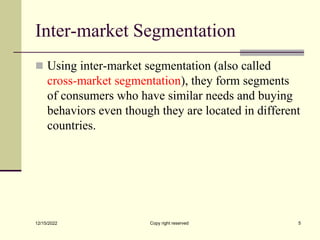
Inter-market Segmentation
 Using inter-market segmentation (also called
cross-market segmentation), they form segments
of consumers who have similar needs and buying
behaviors even though they are located in different
countries.
12/15/2022 Copy right reserved 5

International market segmentation.ppt

  • 1.
  • 2.
    International Market Segmentation  Differentcountriescan vary greatly in their economic, cultural, and political makeup.  Thus, international firms need to group their world markets into segments with distinct buying needs and behaviors. 12/15/2022 Copy right reserved 2
  • 3.
    Bases for MarketSegmentation  Geographical factors  Europe, America, Asia, or Africa  Economic factors  Income level, economic development, economic structure  Political legal factors  Stability of government, receptivity to foreign firms, monetary regulations, and amount of bureaucracy  Cultural factors  Languages, religions, values and attitudes, customs, and behavioral patterns. 12/15/2022 Copy right reserved 3
  • 4.
     Segmenting internationalmarkets based on geographic, economic, political, cultural, and other factors presumes that segments should consist of clusters of countries  However, as new communications technologies, such as satellite TV and online and social media, connect consumers around the world, marketers can define and reach segments of like-minded consumers no matter where in the world they are. 12/15/2022 Copy right reserved 4
  • 5.
    Inter-market Segmentation  Usinginter-market segmentation (also called cross-market segmentation), they form segments of consumers who have similar needs and buying behaviors even though they are located in different countries. 12/15/2022 Copy right reserved 5