STRATEGY MANAGEMENT
     ADL - MATRIX

          SUMMITED BY:    GRO
          NITISH GOEL
          SANTOSH GHILDIYAL
          ANKIT PHARTIYAL
          LAISHRAM ARNOLD SING
          DHEERAJ KUMAR
• Developed in the late 1970s by the highly
  respected consultancy co, Arthur D Little.
• The co. is based in Boston, Massachusetts and
  founded by Arthur Dehon Little.
• Use for developing business strategies, as well as
  for strategizing marketing plans for a particular
   product line or for a single product
• Helps a business to plan its strategies based on:
   Competitive Position – How strong is strategic
    position.
   Industry Maturity – At what stage of its lifecycle
   is the business unit.
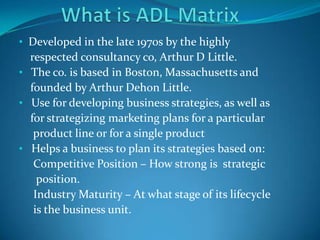
 Four steps in creating ADL Matrix:


      1. Determining the SBUs of the company (strategic
         segmentation done by clearly defined procedures)

      2. Identifying phases of industrial maturity for each
         SBU (this should be done for each business in all
         SBUs)

      3. Determine SBUs competitive position (company's
         competiveness in specific, narrow defined industry)

      4. Plotting sizes and positions of SBUs on ADL Matrix


2/13/2013          SM_ADL MATRIX_GROUP 7                       3
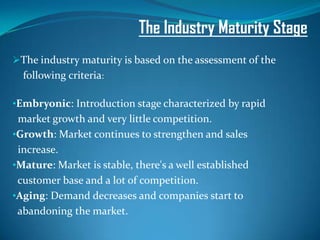
The Industry Maturity Stage
The industry maturity is based on the assessment of the
  following criteria:

•Embryonic: Introduction stage characterized by rapid
 market growth and very little competition.
•Growth: Market continues to strengthen and sales
 increase.
•Mature: Market is stable, there's a well established
 customer base and a lot of competition.
•Aging: Demand decreases and companies start to
 abandoning the market.
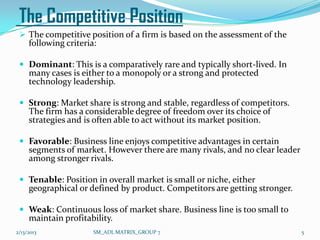
The Competitive Position
  The competitive position of a firm is based on the assessment of the
     following criteria:

  Dominant: This is a comparatively rare and typically short-lived. In
     many cases is either to a monopoly or a strong and protected
     technology leadership.

  Strong: Market share is strong and stable, regardless of competitors.
     The firm has a considerable degree of freedom over its choice of
     strategies and is often able to act without its market position.

  Favorable: Business line enjoys competitive advantages in certain
     segments of market. However there are many rivals, and no clear leader
     among stronger rivals.

  Tenable: Position in overall market is small or niche, either
     geographical or defined by product. Competitors are getting stronger.

  Weak: Continuous loss of market share. Business line is too small to
     maintain profitability.
2/13/2013              SM_ADL MATRIX_GROUP 7                                  5
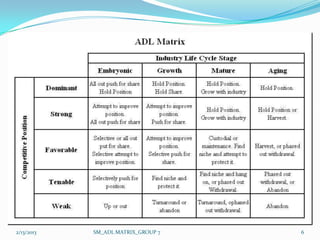
2/13/2013   SM_ADL MATRIX_GROUP 7   6
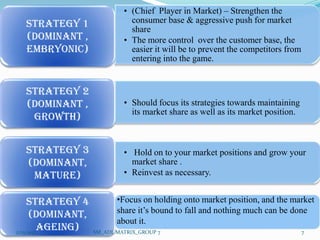
• (Chief Player in Market) – Strengthen the
  Strategy 1                  consumer base & aggressive push for market
                              share
  (dominant ,               • The more control over the customer base, the
  Embryonic)                  easier it will be to prevent the competitors from
                              entering into the game.


  Strategy 2
  (DOMINANT ,               • Should focus its strategies towards maintaining
                              its market share as well as its market position.
   GROWTH)


  STRATEGY 3                • Hold on to your market positions and grow your
  (DOMINANT,                  market share .
   MATURE)                  • Reinvest as necessary.


     STRATEGY 4           •Focus on holding onto market position, and the market
                          share it’s bound to fall and nothing much can be done
      (DOMINANT,
                          about it.
2/13/2013
         AGEING)   SM_ADL MATRIX_GROUP 7                                          7
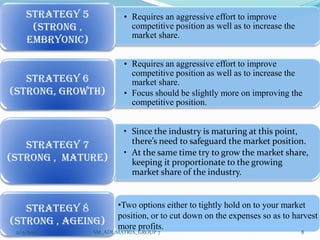
Strategy 5            • Requires an aggressive effort to improve
      (STRONG ,              competitive position as well as to increase the
                             market share.
     Embryonic)

                           • Requires an aggressive effort to improve
                             competitive position as well as to increase the
   Strategy 6                market share.
(STRONG, GROWTH)           • Focus should be slightly more on improving the
                             competitive position.


                           • Since the industry is maturing at this point,
   STRATEGY 7                there’s need to safeguard the market position.
                           • At the same time try to grow the market share,
(STRONG , MATURE)            keeping it proportionate to the growing
                             market share of the industry.


   STRATEGY 8            •Two options either to tightly hold on to your market
                         position, or to cut down on the expenses so as to harvest
(STRONG , AGEING)        more profits.
 2/13/2013        SM_ADL MATRIX_GROUP 7                                        8
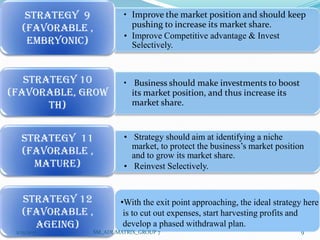
Strategy 9         • Improve the market position and should keep
   (FAVORABLE ,          pushing to increase its market share.
                       • Improve Competitive advantage & Invest
    Embryonic)           Selectively.


   Strategy 10         • Business should make investments to boost
(FAVORABLE, GROW         its market position, and thus increase its
       TH)               market share.


   STRATEGY 11         • Strategy should aim at identifying a niche
                         market, to protect the business’s market position
   (FAVORABLE ,          and to grow its market share.
     MATURE)           • Reinvest Selectively.


   STRATEGY 12        •With the exit point approaching, the ideal strategy here
   (FAVORABLE ,        is to cut out expenses, start harvesting profits and
     AGEING)           develop a phased withdrawal plan.
 2/13/2013    SM_ADL MATRIX_GROUP 7                                      9
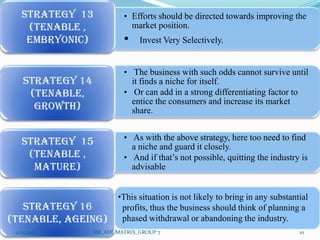
Strategy 13             • Efforts should be directed towards improving the
    (TENABLE ,               market position.
    Embryonic)             •    Invest Very Selectively.


                           • The business with such odds cannot survive until
    Strategy 14              it finds a niche for itself.
     (TENABLE,             • Or can add in a strong differentiating factor to
                             entice the consumers and increase its market
      GROWTH)                share.


                           • As with the above strategy, here too need to find
   STRATEGY 15               a niche and guard it closely.
    (TENABLE ,             • And if that’s not possible, quitting the industry is
     MATURE)                 advisable


                         •This situation is not likely to bring in any substantial
   STRATEGY 16            profits, thus the business should think of planning a
(TENABLE, AGEING)         phased withdrawal or abandoning the industry.
 2/13/2013        SM_ADL MATRIX_GROUP 7                                        10
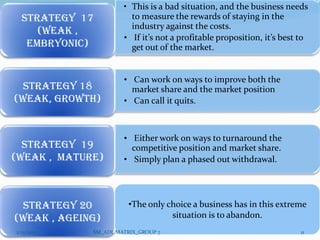
• This is a bad situation, and the business needs
  Strategy 17           to measure the rewards of staying in the
                        industry against the costs.
     (WEAK ,
                      • If it’s not a profitable proposition, it’s best to
   Embryonic)           get out of the market.


                      • Can work on ways to improve both the
  Strategy 18           market share and the market position
(WEAK, GROWTH)        • Can call it quits.


                      • Either work on ways to turnaround the
  STRATEGY 19           competitive position and market share.
(WEAK , MATURE)       • Simply plan a phased out withdrawal.


 STRATEGY 20           •The only choice a business has in this extreme
(WEAK , AGEING)                   situation is to abandon.
2/13/2013    SM_ADL MATRIX_GROUP 7                                     11
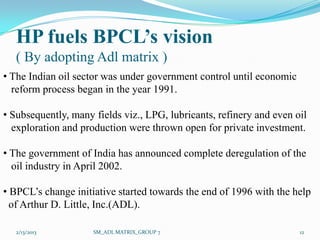
HP fuels BPCL’s vision
   ( By adopting Adl matrix )
• The Indian oil sector was under government control until economic
  reform process began in the year 1991.

• Subsequently, many fields viz., LPG, lubricants, refinery and even oil
  exploration and production were thrown open for private investment.

• The government of India has announced complete deregulation of the
  oil industry in April 2002.

• BPCL’s change initiative started towards the end of 1996 with the help
  of Arthur D. Little, Inc.(ADL).

   2/13/2013         SM_ADL MATRIX_GROUP 7                            12
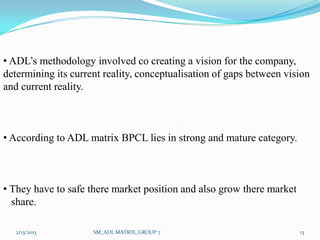
• ADL’s methodology involved co creating a vision for the company,
determining its current reality, conceptualisation of gaps between vision
and current reality.


• According to ADL matrix BPCL lies in strong and mature category.


• They have to safe there market position and also grow there market
  share.

   2/13/2013         SM_ADL MATRIX_GROUP 7                             13
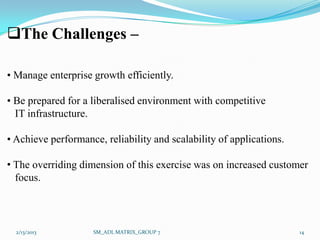
The Challenges –

• Manage enterprise growth efficiently.

• Be prepared for a liberalised environment with competitive
  IT infrastructure.

• Achieve performance, reliability and scalability of applications.

• The overriding dimension of this exercise was on increased customer
  focus.


  2/13/2013         SM_ADL MATRIX_GROUP 7                             14
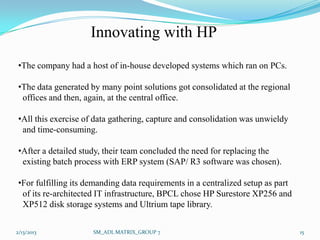
Innovating with HP
•The company had a host of in-house developed systems which ran on PCs.

•The data generated by many point solutions got consolidated at the regional
 offices and then, again, at the central office.

•All this exercise of data gathering, capture and consolidation was unwieldy
 and time-consuming.

•After a detailed study, their team concluded the need for replacing the
 existing batch process with ERP system (SAP/ R3 software was chosen).

•For fulfilling its demanding data requirements in a centralized setup as part
 of its re-architected IT infrastructure, BPCL chose HP Surestore XP256 and
 XP512 disk storage systems and Ultrium tape library.


2/13/2013            SM_ADL MATRIX_GROUP 7                                       15
Benefits--
  • The deployment of HP’s storage boxes has made the
    management of enterprise wide data easier and faster .

  • Reduction in process hierarchy.

  • Future initiatives such as its Petro card debit cards can leverage
    on the IT infrastructure.

  • Enhanced operational competitiveness through best-in- class
    technology.


2/13/2013          SM_ADL MATRIX_GROUP 7                                 16
THANK - YOU


2/13/2013    SM_ADL MATRIX_GROUP 7   17

Adl matrix (1)

  • 1.
    STRATEGY MANAGEMENT ADL - MATRIX SUMMITED BY: GRO NITISH GOEL SANTOSH GHILDIYAL ANKIT PHARTIYAL LAISHRAM ARNOLD SING DHEERAJ KUMAR
  • 2.
    • Developed inthe late 1970s by the highly respected consultancy co, Arthur D Little. • The co. is based in Boston, Massachusetts and founded by Arthur Dehon Little. • Use for developing business strategies, as well as for strategizing marketing plans for a particular product line or for a single product • Helps a business to plan its strategies based on: Competitive Position – How strong is strategic position. Industry Maturity – At what stage of its lifecycle is the business unit.
  • 3.
     Four stepsin creating ADL Matrix: 1. Determining the SBUs of the company (strategic segmentation done by clearly defined procedures) 2. Identifying phases of industrial maturity for each SBU (this should be done for each business in all SBUs) 3. Determine SBUs competitive position (company's competiveness in specific, narrow defined industry) 4. Plotting sizes and positions of SBUs on ADL Matrix 2/13/2013 SM_ADL MATRIX_GROUP 7 3
  • 4.
    The Industry MaturityStage The industry maturity is based on the assessment of the following criteria: •Embryonic: Introduction stage characterized by rapid market growth and very little competition. •Growth: Market continues to strengthen and sales increase. •Mature: Market is stable, there's a well established customer base and a lot of competition. •Aging: Demand decreases and companies start to abandoning the market.
  • 5.
    The Competitive Position  The competitive position of a firm is based on the assessment of the following criteria:  Dominant: This is a comparatively rare and typically short-lived. In many cases is either to a monopoly or a strong and protected technology leadership.  Strong: Market share is strong and stable, regardless of competitors. The firm has a considerable degree of freedom over its choice of strategies and is often able to act without its market position.  Favorable: Business line enjoys competitive advantages in certain segments of market. However there are many rivals, and no clear leader among stronger rivals.  Tenable: Position in overall market is small or niche, either geographical or defined by product. Competitors are getting stronger.  Weak: Continuous loss of market share. Business line is too small to maintain profitability. 2/13/2013 SM_ADL MATRIX_GROUP 7 5
  • 6.
    2/13/2013 SM_ADL MATRIX_GROUP 7 6
  • 7.
    • (Chief Playerin Market) – Strengthen the Strategy 1 consumer base & aggressive push for market share (dominant , • The more control over the customer base, the Embryonic) easier it will be to prevent the competitors from entering into the game. Strategy 2 (DOMINANT , • Should focus its strategies towards maintaining its market share as well as its market position. GROWTH) STRATEGY 3 • Hold on to your market positions and grow your (DOMINANT, market share . MATURE) • Reinvest as necessary. STRATEGY 4 •Focus on holding onto market position, and the market share it’s bound to fall and nothing much can be done (DOMINANT, about it. 2/13/2013 AGEING) SM_ADL MATRIX_GROUP 7 7
  • 8.
    Strategy 5 • Requires an aggressive effort to improve (STRONG , competitive position as well as to increase the market share. Embryonic) • Requires an aggressive effort to improve competitive position as well as to increase the Strategy 6 market share. (STRONG, GROWTH) • Focus should be slightly more on improving the competitive position. • Since the industry is maturing at this point, STRATEGY 7 there’s need to safeguard the market position. • At the same time try to grow the market share, (STRONG , MATURE) keeping it proportionate to the growing market share of the industry. STRATEGY 8 •Two options either to tightly hold on to your market position, or to cut down on the expenses so as to harvest (STRONG , AGEING) more profits. 2/13/2013 SM_ADL MATRIX_GROUP 7 8
  • 9.
    Strategy 9 • Improve the market position and should keep (FAVORABLE , pushing to increase its market share. • Improve Competitive advantage & Invest Embryonic) Selectively. Strategy 10 • Business should make investments to boost (FAVORABLE, GROW its market position, and thus increase its TH) market share. STRATEGY 11 • Strategy should aim at identifying a niche market, to protect the business’s market position (FAVORABLE , and to grow its market share. MATURE) • Reinvest Selectively. STRATEGY 12 •With the exit point approaching, the ideal strategy here (FAVORABLE , is to cut out expenses, start harvesting profits and AGEING) develop a phased withdrawal plan. 2/13/2013 SM_ADL MATRIX_GROUP 7 9
  • 10.
    Strategy 13 • Efforts should be directed towards improving the (TENABLE , market position. Embryonic) • Invest Very Selectively. • The business with such odds cannot survive until Strategy 14 it finds a niche for itself. (TENABLE, • Or can add in a strong differentiating factor to entice the consumers and increase its market GROWTH) share. • As with the above strategy, here too need to find STRATEGY 15 a niche and guard it closely. (TENABLE , • And if that’s not possible, quitting the industry is MATURE) advisable •This situation is not likely to bring in any substantial STRATEGY 16 profits, thus the business should think of planning a (TENABLE, AGEING) phased withdrawal or abandoning the industry. 2/13/2013 SM_ADL MATRIX_GROUP 7 10
  • 11.
    • This isa bad situation, and the business needs Strategy 17 to measure the rewards of staying in the industry against the costs. (WEAK , • If it’s not a profitable proposition, it’s best to Embryonic) get out of the market. • Can work on ways to improve both the Strategy 18 market share and the market position (WEAK, GROWTH) • Can call it quits. • Either work on ways to turnaround the STRATEGY 19 competitive position and market share. (WEAK , MATURE) • Simply plan a phased out withdrawal. STRATEGY 20 •The only choice a business has in this extreme (WEAK , AGEING) situation is to abandon. 2/13/2013 SM_ADL MATRIX_GROUP 7 11
  • 12.
    HP fuels BPCL’svision ( By adopting Adl matrix ) • The Indian oil sector was under government control until economic reform process began in the year 1991. • Subsequently, many fields viz., LPG, lubricants, refinery and even oil exploration and production were thrown open for private investment. • The government of India has announced complete deregulation of the oil industry in April 2002. • BPCL’s change initiative started towards the end of 1996 with the help of Arthur D. Little, Inc.(ADL). 2/13/2013 SM_ADL MATRIX_GROUP 7 12
  • 13.
    • ADL’s methodologyinvolved co creating a vision for the company, determining its current reality, conceptualisation of gaps between vision and current reality. • According to ADL matrix BPCL lies in strong and mature category. • They have to safe there market position and also grow there market share. 2/13/2013 SM_ADL MATRIX_GROUP 7 13
  • 14.
    The Challenges – •Manage enterprise growth efficiently. • Be prepared for a liberalised environment with competitive IT infrastructure. • Achieve performance, reliability and scalability of applications. • The overriding dimension of this exercise was on increased customer focus. 2/13/2013 SM_ADL MATRIX_GROUP 7 14
  • 15.
    Innovating with HP •Thecompany had a host of in-house developed systems which ran on PCs. •The data generated by many point solutions got consolidated at the regional offices and then, again, at the central office. •All this exercise of data gathering, capture and consolidation was unwieldy and time-consuming. •After a detailed study, their team concluded the need for replacing the existing batch process with ERP system (SAP/ R3 software was chosen). •For fulfilling its demanding data requirements in a centralized setup as part of its re-architected IT infrastructure, BPCL chose HP Surestore XP256 and XP512 disk storage systems and Ultrium tape library. 2/13/2013 SM_ADL MATRIX_GROUP 7 15
  • 16.
    Benefits-- •The deployment of HP’s storage boxes has made the management of enterprise wide data easier and faster . • Reduction in process hierarchy. • Future initiatives such as its Petro card debit cards can leverage on the IT infrastructure. • Enhanced operational competitiveness through best-in- class technology. 2/13/2013 SM_ADL MATRIX_GROUP 7 16
  • 17.
    THANK - YOU 2/13/2013 SM_ADL MATRIX_GROUP 7 17