What is a Market? 
• Place where there are many buyers and sellers . 
• Actively engaged in buying and selling acts. 
• Contact through different means of communication like 
letters, telephone etc. 
• Thus, It does not mean a particular place but the entire 
area where buyers and sellers of a commodity are in 
close contact and they have one price of same 
commodity.
What is Market Structure? 
It is therefore understood as those characteristics of a 
market that influence the behavior and results of the 
firms working in that market. 
According to J.C. Edwards, “ A market is that mechanism 
by which buyers and sellers are bought together. It is not 
necessarily a fixed place.”
• Area: A market does not mean a particular place but the 
whole region where sellers and buyers of a product are 
spread. Modern modes of communication and transport 
have made the market area for a product very wide. 
• Buyers & Sellers: For exchange at least 1 buyer and 
1 seller are needed. In the modem age, the physical 
presence of buyers and sellers is not necessary in the market 
because they can do transactions of goods through letters, 
telephones, internet, etc.
• One Commodity: A market is not related to a place 
but to a particular product. Hence, there are separate markets 
for various commodities. 
• Free Competition: There should be free competition 
among buyers and sellers in the market. It is in relation to the 
price determination of a product among buyers and sellers. 
• One Price: The price of the product is same in the market 
because of free competition among buyers and sellers.
ON THE BASIS OF : 
• Area or Region 
• Time 
• Functions 
• Nature of Commodity 
• Legality
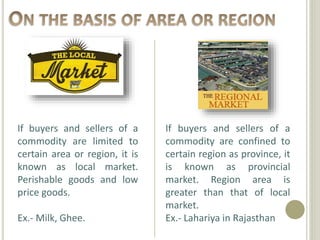
If buyers and sellers of a 
commodity are limited to 
certain area or region, it is 
known as local market. 
Perishable goods and low 
price goods. 
Ex.- Milk, Ghee. 
If buyers and sellers of a 
commodity are confined to 
certain region as province, it 
is known as provincial 
market. Region area is 
greater than that of local 
market. 
Ex.- Lahariya in Rajasthan
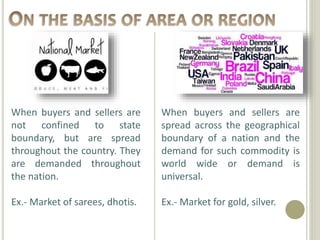
When buyers and sellers are 
not confined to state 
boundary, but are spread 
throughout the country. They 
are demanded throughout 
the nation. 
Ex.- Market of sarees, dhotis. 
When buyers and sellers are 
spread across the geographical 
boundary of a nation and the 
demand for such commodity is 
world wide or demand is 
universal. 
Ex.- Market for gold, silver.
• Very short period market: It can be classified into 
Daily(perishable products) or weekly market(on any specific 
day of week). It is which takes part in transaction for a short 
period of time as for few hours or a day. In this supply of 
product can not be increased. 
• Short period market: In this supply of product can be 
increased but we can not make any change in production 
plant according to changed demand.
• Long period market: It is in which we can make 
necessary changes in plant and machinery as well increase 
supply of product according to its demand. 
• Very long period market: There can be large 
change in supply of the product. And demand also increases 
because of change in population, habits, taste, customs etc.
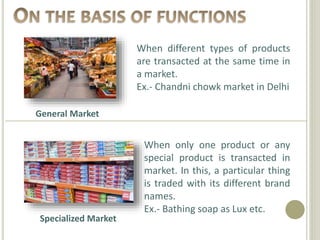
General Market 
Specialized Market 
When different types of products 
are transacted at the same time in 
a market. 
Ex.- Chandni chowk market in Delhi 
When only one product or any 
special product is transacted in 
market. In this, a particular thing 
is traded with its different brand 
names. 
Ex.- Bathing soap as Lux etc.
Marketing by Samples 
Marketing by Grading 
In this the firms need not show 
whole of their product as they 
only send samples through their 
agents. 
Ex.- in case of wool, paints etc. 
In this, the product is first graded 
according to its quality and then 
put forth for selling. 
Ex.- Agricultural product market.
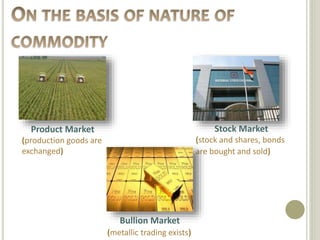
Product Market 
(production goods are 
exchanged) 
Stock Market 
(stock and shares, bonds 
are bought and sold) 
Bullion Market 
(metallic trading exists)
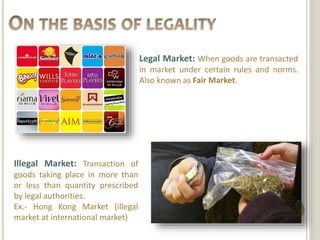
Legal Market: When goods are transacted 
in market under certain rules and norms. 
Also known as Fair Market. 
Illegal Market: Transaction of 
goods taking place in more than 
or less than quantity prescribed 
by legal authorities. 
Ex.- Hong Kong Market (illegal 
market at international market)
• Perfect Competition 
• Monopoly Competition 
• Monopolistic Competition 
• Oligopoly Competition
• It is such a market structure where there are 
large numbers of sellers and buyers. 
• Homogeneous product . 
• The price of the product is determined by the 
industry . 
• One price prevails in the market and all the 
firms sell the product at the prevailing price .
• Large number of buyers and sellers 
• Homogeneous product 
• No barriers to entry 
• Perfect knowledge of the market 
• No transportation cost 
• Perfect mobility of factors of production
• It is a market structure in which there is 
only a single seller of the product . 
• One firm has full control over the supply of 
the product . 
• Example : Indian Railways , Rajasthan State 
Electricity Board etc.
• Sole supplier of the product 
• Large number of buyers 
• No close substitutes 
• One firm industry 
• Varies from industry to industry 
• Absence of entry 
• Monopolist is price maker
• It is a mid-way between perfect 
competition and monopoly . 
• In this the number of buyers and 
sellers is relatively low .
• Large number of firms 
• Product differentiation 
• Freedom of entry and exit 
• Non price competition 
• Price policy 
• Less mobility 
• No perfect knowledge 
• Selling cost 
• Close substitutes
• It is a market structure in which there are few 
sellers of a product selling identical or 
differentiated products . 
• If they are selling identical products, it’s a case 
of Pure Oligopoly. 
• If they are selling differentiated products, it’s a 
case of Differentiated Oligopoly .
• Relatively small number of sellers 
• Interdependence of the firms 
• Price rigidity and price war 
• Difficulty in entry and exit 
• Selling Costs 
• Indeterminateness of the demand curve 
• Complex market structure
By- 
Aayushi Chhabra

Economics - Market Structure

  • 2.
    What is aMarket? • Place where there are many buyers and sellers . • Actively engaged in buying and selling acts. • Contact through different means of communication like letters, telephone etc. • Thus, It does not mean a particular place but the entire area where buyers and sellers of a commodity are in close contact and they have one price of same commodity.
  • 3.
    What is MarketStructure? It is therefore understood as those characteristics of a market that influence the behavior and results of the firms working in that market. According to J.C. Edwards, “ A market is that mechanism by which buyers and sellers are bought together. It is not necessarily a fixed place.”
  • 4.
    • Area: Amarket does not mean a particular place but the whole region where sellers and buyers of a product are spread. Modern modes of communication and transport have made the market area for a product very wide. • Buyers & Sellers: For exchange at least 1 buyer and 1 seller are needed. In the modem age, the physical presence of buyers and sellers is not necessary in the market because they can do transactions of goods through letters, telephones, internet, etc.
  • 5.
    • One Commodity:A market is not related to a place but to a particular product. Hence, there are separate markets for various commodities. • Free Competition: There should be free competition among buyers and sellers in the market. It is in relation to the price determination of a product among buyers and sellers. • One Price: The price of the product is same in the market because of free competition among buyers and sellers.
  • 6.
    ON THE BASISOF : • Area or Region • Time • Functions • Nature of Commodity • Legality
  • 7.
    If buyers andsellers of a commodity are limited to certain area or region, it is known as local market. Perishable goods and low price goods. Ex.- Milk, Ghee. If buyers and sellers of a commodity are confined to certain region as province, it is known as provincial market. Region area is greater than that of local market. Ex.- Lahariya in Rajasthan
  • 8.
    When buyers andsellers are not confined to state boundary, but are spread throughout the country. They are demanded throughout the nation. Ex.- Market of sarees, dhotis. When buyers and sellers are spread across the geographical boundary of a nation and the demand for such commodity is world wide or demand is universal. Ex.- Market for gold, silver.
  • 9.
    • Very shortperiod market: It can be classified into Daily(perishable products) or weekly market(on any specific day of week). It is which takes part in transaction for a short period of time as for few hours or a day. In this supply of product can not be increased. • Short period market: In this supply of product can be increased but we can not make any change in production plant according to changed demand.
  • 10.
    • Long periodmarket: It is in which we can make necessary changes in plant and machinery as well increase supply of product according to its demand. • Very long period market: There can be large change in supply of the product. And demand also increases because of change in population, habits, taste, customs etc.
  • 11.
    General Market SpecializedMarket When different types of products are transacted at the same time in a market. Ex.- Chandni chowk market in Delhi When only one product or any special product is transacted in market. In this, a particular thing is traded with its different brand names. Ex.- Bathing soap as Lux etc.
  • 12.
    Marketing by Samples Marketing by Grading In this the firms need not show whole of their product as they only send samples through their agents. Ex.- in case of wool, paints etc. In this, the product is first graded according to its quality and then put forth for selling. Ex.- Agricultural product market.
  • 13.
    Product Market (productiongoods are exchanged) Stock Market (stock and shares, bonds are bought and sold) Bullion Market (metallic trading exists)
  • 14.
    Legal Market: Whengoods are transacted in market under certain rules and norms. Also known as Fair Market. Illegal Market: Transaction of goods taking place in more than or less than quantity prescribed by legal authorities. Ex.- Hong Kong Market (illegal market at international market)
  • 15.
    • Perfect Competition • Monopoly Competition • Monopolistic Competition • Oligopoly Competition
  • 16.
    • It issuch a market structure where there are large numbers of sellers and buyers. • Homogeneous product . • The price of the product is determined by the industry . • One price prevails in the market and all the firms sell the product at the prevailing price .
  • 17.
    • Large numberof buyers and sellers • Homogeneous product • No barriers to entry • Perfect knowledge of the market • No transportation cost • Perfect mobility of factors of production
  • 18.
    • It isa market structure in which there is only a single seller of the product . • One firm has full control over the supply of the product . • Example : Indian Railways , Rajasthan State Electricity Board etc.
  • 19.
    • Sole supplierof the product • Large number of buyers • No close substitutes • One firm industry • Varies from industry to industry • Absence of entry • Monopolist is price maker
  • 20.
    • It isa mid-way between perfect competition and monopoly . • In this the number of buyers and sellers is relatively low .
  • 21.
    • Large numberof firms • Product differentiation • Freedom of entry and exit • Non price competition • Price policy • Less mobility • No perfect knowledge • Selling cost • Close substitutes
  • 22.
    • It isa market structure in which there are few sellers of a product selling identical or differentiated products . • If they are selling identical products, it’s a case of Pure Oligopoly. • If they are selling differentiated products, it’s a case of Differentiated Oligopoly .
  • 23.
    • Relatively smallnumber of sellers • Interdependence of the firms • Price rigidity and price war • Difficulty in entry and exit • Selling Costs • Indeterminateness of the demand curve • Complex market structure
  • 24.