CONSUMER BEHAVIOUR
     PRESENTATION
           ON
DIFFUSION OF INNOVATION
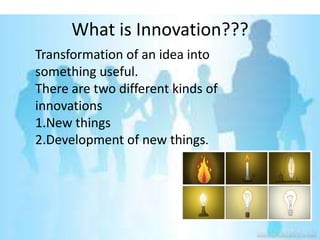
What is Innovation???
Transformation of an idea into
something useful.
There are two different kinds of
innovations
1.New things
2.Development of new things.
Diffusion of Innovation
• The diffusion of innovations theory seeks to
  explain how and why new ideas and practices
  are adopted, with timelines potentially spread
  out over long periods.
• It is designed in two process:
1. Diffusion
2. Adoption
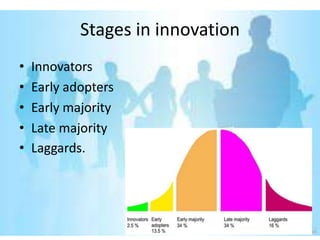
Stages in innovation
•   Innovators
•   Early adopters
•   Early majority
•   Late majority
•   Laggards.
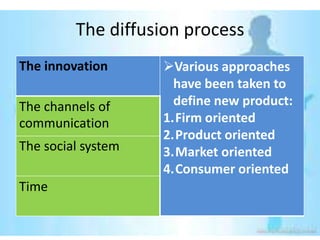
The diffusion process
The innovation      Various approaches
                      have been taken to
The channels of       define new product:
communication       1.Firm oriented
                    2.Product oriented
The social system   3.Market oriented
                    4.Consumer oriented
Time
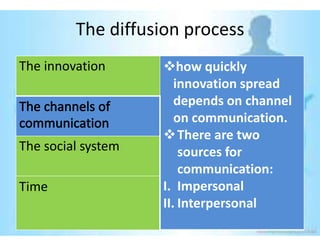
The diffusion process
The innovation      how quickly
                       innovation spread
                       depends on channel
                       on communication.
                    There are two
The social system       sources for
                        communication:
Time                I. Impersonal
                    II. Interpersonal
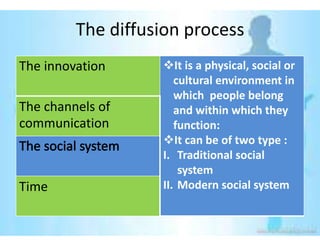
The diffusion process
The innovation     It is a physical, social or
                      cultural environment in
                      which people belong
The channels of       and within which they
communication         function:
                   It can be of two type :
                   I. Traditional social
                       system
Time               II. Modern social system
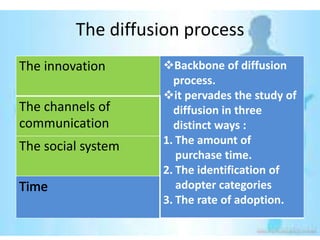
The diffusion process
The innovation      Backbone of diffusion
                      process.
                    it pervades the study of
The channels of       diffusion in three
communication         distinct ways :
                    1. The amount of
The social system
                       purchase time.
                    2. The identification of
                       adopter categories
                    3. The rate of adoption.
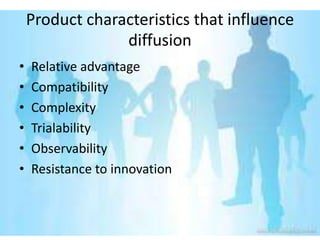
Product characteristics that influence
                 diffusion
•   Relative advantage
•   Compatibility
•   Complexity
•   Trialability
•   Observability
•   Resistance to innovation
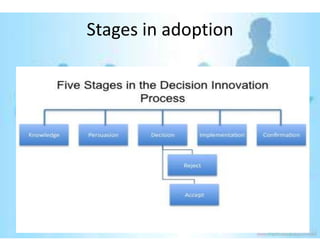
Stages in adoption
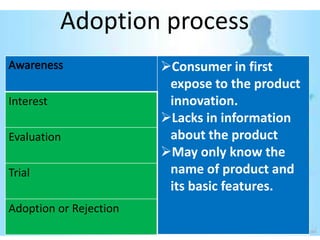
Adoption process
                        Consumer in first
                         expose to the product
Interest                 innovation.
                        Lacks in information
Evaluation               about the product
                        May only know the
Trial                    name of product and
                         its basic features.
Adoption or Rejection
Adoption process
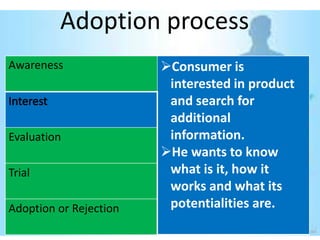
Awareness               Consumer is
                         interested in product
                         and search for
                         additional
Evaluation               information.
                        He wants to know
Trial                    what is it, how it
                         works and what its
Adoption or Rejection    potentialities are.
Adoption process
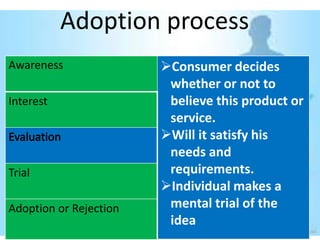
Awareness               Consumer decides
                         whether or not to
Interest                 believe this product or
                         service.
                        Will it satisfy his
                         needs and
Trial                    requirements.
                        Individual makes a
Adoption or Rejection    mental trial of the
                         idea
Adoption process
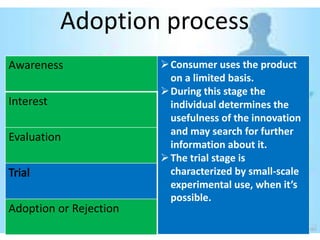
Awareness                Consumer uses the product
                          on a limited basis.
                         During this stage the
Interest                  individual determines the
                          usefulness of the innovation
                          and may search for further
Evaluation
                          information about it.
                         The trial stage is
                          characterized by small-scale
                          experimental use, when it’s
                          possible.
Adoption or Rejection
Adoption process
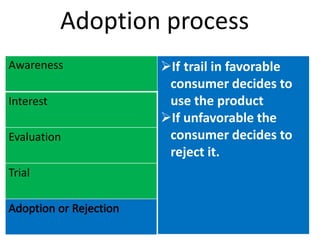
Awareness          If trail in favorable
                    consumer decides to
Interest            use the product
                   If unfavorable the
Evaluation          consumer decides to
                    reject it.
Trial
Consumer innovator
• Small group of consumer who are the earliest
  purchase of the new product.
• Earliest customer can be defined in may ways :
First 2.5% of the social system
Status of the new product investigation
Innovativeness .
Opinion leader
• Individual whose ideas and behavior serve as
  a model to others.
• The innovator is an opinion leader.
• When innovators are enthusiastic they might
  encourage other to buy it.
• For products that do not generate much
  excitement consumer innovators might not be
  sufficiently motivated to advice it.
Market mavens
• Special category of consumer influencer.
• Posses a wide range of information about
  different type of products, retail outlet etc.
• Like to shop and share shopping.
• Not primarily concerned with price.
Personality traits
• Personality traits that have been useful in
  differentiating consumer innovators and non
  innovators include:
Consumer innovativeness
Dogmatism
Social character
Need for uniqueness
Optimum stimulation level
Change leaders
• Also know as high-tech innovators.
• Such individuals tend to embrace and
  popularize many of the innovation that are
  ultimately excepted by mane frame
  population such as computer, fax machine etc.
• They fall into two distinct group:
1. Younger group
2. Middle-aged group
Technophiles
• Those individuals who purchase
  technologically advance product soon after
  their market debut.
• They tend to be technically curious people.
• These consumers are typically younger, better
  educated and more affluent.
Managerial application
• Marketing research
• Development of new product
• Reviews of product
References
1. Consumer Behaviour by Leon G. Schiffman
   and Lesile Lazar Kanuk.
2. Marketing Innovation by Davila
   Estein,Shelton
3. Consumer Behavior in Indian perspective by
   Suja nair
Thank you

Diffusion of innovation

  • 1.
    CONSUMER BEHAVIOUR PRESENTATION ON DIFFUSION OF INNOVATION
  • 2.
    What is Innovation??? Transformationof an idea into something useful. There are two different kinds of innovations 1.New things 2.Development of new things.
  • 3.
    Diffusion of Innovation •The diffusion of innovations theory seeks to explain how and why new ideas and practices are adopted, with timelines potentially spread out over long periods. • It is designed in two process: 1. Diffusion 2. Adoption
  • 4.
    Stages in innovation • Innovators • Early adopters • Early majority • Late majority • Laggards.
  • 5.
    The diffusion process Theinnovation Various approaches have been taken to The channels of define new product: communication 1.Firm oriented 2.Product oriented The social system 3.Market oriented 4.Consumer oriented Time
  • 6.
    The diffusion process Theinnovation how quickly innovation spread depends on channel on communication. There are two The social system sources for communication: Time I. Impersonal II. Interpersonal
  • 7.
    The diffusion process Theinnovation It is a physical, social or cultural environment in which people belong The channels of and within which they communication function: It can be of two type : I. Traditional social system Time II. Modern social system
  • 8.
    The diffusion process Theinnovation Backbone of diffusion process. it pervades the study of The channels of diffusion in three communication distinct ways : 1. The amount of The social system purchase time. 2. The identification of adopter categories 3. The rate of adoption.
  • 9.
    Product characteristics thatinfluence diffusion • Relative advantage • Compatibility • Complexity • Trialability • Observability • Resistance to innovation
  • 10.
  • 11.
    Adoption process Consumer in first expose to the product Interest innovation. Lacks in information Evaluation about the product May only know the Trial name of product and its basic features. Adoption or Rejection
  • 12.
    Adoption process Awareness Consumer is interested in product and search for additional Evaluation information. He wants to know Trial what is it, how it works and what its Adoption or Rejection potentialities are.
  • 13.
    Adoption process Awareness Consumer decides whether or not to Interest believe this product or service. Will it satisfy his needs and Trial requirements. Individual makes a Adoption or Rejection mental trial of the idea
  • 14.
    Adoption process Awareness  Consumer uses the product on a limited basis.  During this stage the Interest individual determines the usefulness of the innovation and may search for further Evaluation information about it.  The trial stage is characterized by small-scale experimental use, when it’s possible. Adoption or Rejection
  • 15.
    Adoption process Awareness If trail in favorable consumer decides to Interest use the product If unfavorable the Evaluation consumer decides to reject it. Trial
  • 16.
    Consumer innovator • Smallgroup of consumer who are the earliest purchase of the new product. • Earliest customer can be defined in may ways : First 2.5% of the social system Status of the new product investigation Innovativeness .
  • 17.
    Opinion leader • Individualwhose ideas and behavior serve as a model to others. • The innovator is an opinion leader. • When innovators are enthusiastic they might encourage other to buy it. • For products that do not generate much excitement consumer innovators might not be sufficiently motivated to advice it.
  • 18.
    Market mavens • Specialcategory of consumer influencer. • Posses a wide range of information about different type of products, retail outlet etc. • Like to shop and share shopping. • Not primarily concerned with price.
  • 19.
    Personality traits • Personalitytraits that have been useful in differentiating consumer innovators and non innovators include: Consumer innovativeness Dogmatism Social character Need for uniqueness Optimum stimulation level
  • 20.
    Change leaders • Alsoknow as high-tech innovators. • Such individuals tend to embrace and popularize many of the innovation that are ultimately excepted by mane frame population such as computer, fax machine etc. • They fall into two distinct group: 1. Younger group 2. Middle-aged group
  • 21.
    Technophiles • Those individualswho purchase technologically advance product soon after their market debut. • They tend to be technically curious people. • These consumers are typically younger, better educated and more affluent.
  • 22.
    Managerial application • Marketingresearch • Development of new product • Reviews of product
  • 23.
    References 1. Consumer Behaviourby Leon G. Schiffman and Lesile Lazar Kanuk. 2. Marketing Innovation by Davila Estein,Shelton 3. Consumer Behavior in Indian perspective by Suja nair
  • 24.