STRATEGIC DECISION
     MAKING
        CHANDRA SHEKHAR PANDEY
What is Decision Making?

    Decision making
    The act of choosing one alternative
    from among a set of alternatives


            www.managepedia.blogspot.com
Dimensions of Strategic
Decisions
     • Top management Decisions
     • Are future oriented
     • Require Large amount of resources
     • Affect long term prosperity of the
       firm
     • Usually have multifunctional
       consequences
             www.managepedia.blogspot.com
Characteristics of Strategic
         Decisions
   They are elusive problems that are difficult to define precisely.
   They require an understanding of the problem to find a viable solution.
   They rarely have one best solution, but often a series of possible solutions.
   Questions about trade-offs and priorities appear in the solutions.
   Solution benefits are difficult to assess as to their effectiveness, in part because
they lack a clear final end point against which effectiveness can be judged.
   Other problems in the organization are connected to solutions for a focal
problem.
   High levels of ambiguity and uncertainty are associated with solutions.
   Realizing hoped for benefits has considerable risk.
   Strategic decisions have competing interests that prompt key players to use
political pressure to ensure that a choice aligns with their preferences.


                           www.managepedia.blogspot.com
Types of Decision Making

    1.Programmed decision
    A decision that is fairly structured or
    Recurs with some frequency (or both)
    2.Non programmed decision
    A decision that is relatively
    unstructured and occurs much less
    often than a programmed decision
            www.managepedia.blogspot.com
Decision Making Conditions


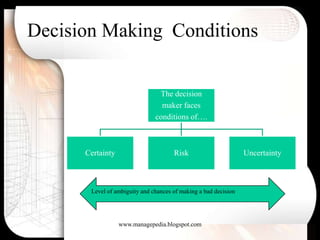
                                The decision
                                 maker faces
                               conditions of….


      Certainty                       Risk                       Uncertainty


       Level of ambiguity and chances of making a bad decision


                  www.managepedia.blogspot.com
Perspectives/models of Decision
Making
     1. Classical or Rational Model-
     Managers are logical and rational and
       that they make decisions that are in
       the best interests of the organization.
     2. Behavioral Model :-
     Managers are not always logical and
       they use intuition, and personal
       judgements in making decisions
              www.managepedia.blogspot.com
Assumptions of Rational Model
    • 1. Decision makers have complete
      information about the decision
      situation and possible alternatives.
    • 2. They can effectively eliminate
      uncertainty to achieve a decision
      condition of certainty.
    • 3. They evaluate all aspects of the
      decision situation logically and
      rationally.
            www.managepedia.blogspot.com
Steps in Rational Decision
Making Process
     • Objectives to be achieved are
       determined.
     • Alternative ways of achieving these
       objectives are identified.
     • Each alternative is evaluated.
     • The best alternative is chosen


             www.managepedia.blogspot.com
Behavioral Model of Decision
Making
     1. Administrative Model:- Managers
     (1)use incomplete and imperfect
        information,
     (2) constrained by bounded rationality,
     (3) tend to “satisfice” when making
     decisions

             www.managepedia.blogspot.com
• Bounded rationality
A concept suggesting that decision
makers are limited by their values and
unconscious reflexes, skills, and habits


        www.managepedia.blogspot.com
• Satisfying
The tendency to search for alternatives
only until one is found that meets
  some     minimum      standard     of
  sufficiency


        www.managepedia.blogspot.com
Because of the inherent imperfection of
  information, bounded rationality, and
  satisficing, the decisions made by a manager
  may or may not actually be in the best interests
  of the organization. A manager may choose a
  particular location for the new plant because it
  offers the lowest price and best availability of
  utilities and transportation. Or she may choose
  the location because it is located in a community
  where she wants to live.

           www.managepedia.blogspot.com
Intuition

     • An innate belief about something,
     without conscious consideration


             www.managepedia.blogspot.com
Escalation of commitment

     • A decision maker’s staying with a
       decision even when it appears to be
       wrong


             www.managepedia.blogspot.com
Scope of Strategic Decision
Making


           www.managepedia.blogspot.com
Advance issues in Strategic
Decision Making???????
     To be
      continued…………………………
      …………….


           www.managepedia.blogspot.com

Strategic decision making

  • 1.
    STRATEGIC DECISION MAKING CHANDRA SHEKHAR PANDEY
  • 2.
    What is DecisionMaking? Decision making The act of choosing one alternative from among a set of alternatives www.managepedia.blogspot.com
  • 3.
    Dimensions of Strategic Decisions • Top management Decisions • Are future oriented • Require Large amount of resources • Affect long term prosperity of the firm • Usually have multifunctional consequences www.managepedia.blogspot.com
  • 4.
    Characteristics of Strategic Decisions They are elusive problems that are difficult to define precisely. They require an understanding of the problem to find a viable solution. They rarely have one best solution, but often a series of possible solutions. Questions about trade-offs and priorities appear in the solutions. Solution benefits are difficult to assess as to their effectiveness, in part because they lack a clear final end point against which effectiveness can be judged. Other problems in the organization are connected to solutions for a focal problem. High levels of ambiguity and uncertainty are associated with solutions. Realizing hoped for benefits has considerable risk. Strategic decisions have competing interests that prompt key players to use political pressure to ensure that a choice aligns with their preferences. www.managepedia.blogspot.com
  • 5.
    Types of DecisionMaking 1.Programmed decision A decision that is fairly structured or Recurs with some frequency (or both) 2.Non programmed decision A decision that is relatively unstructured and occurs much less often than a programmed decision www.managepedia.blogspot.com
  • 6.
    Decision Making Conditions The decision maker faces conditions of…. Certainty Risk Uncertainty Level of ambiguity and chances of making a bad decision www.managepedia.blogspot.com
  • 7.
    Perspectives/models of Decision Making 1. Classical or Rational Model- Managers are logical and rational and that they make decisions that are in the best interests of the organization. 2. Behavioral Model :- Managers are not always logical and they use intuition, and personal judgements in making decisions www.managepedia.blogspot.com
  • 8.
    Assumptions of RationalModel • 1. Decision makers have complete information about the decision situation and possible alternatives. • 2. They can effectively eliminate uncertainty to achieve a decision condition of certainty. • 3. They evaluate all aspects of the decision situation logically and rationally. www.managepedia.blogspot.com
  • 9.
    Steps in RationalDecision Making Process • Objectives to be achieved are determined. • Alternative ways of achieving these objectives are identified. • Each alternative is evaluated. • The best alternative is chosen www.managepedia.blogspot.com
  • 10.
    Behavioral Model ofDecision Making 1. Administrative Model:- Managers (1)use incomplete and imperfect information, (2) constrained by bounded rationality, (3) tend to “satisfice” when making decisions www.managepedia.blogspot.com
  • 11.
    • Bounded rationality Aconcept suggesting that decision makers are limited by their values and unconscious reflexes, skills, and habits www.managepedia.blogspot.com
  • 12.
    • Satisfying The tendencyto search for alternatives only until one is found that meets some minimum standard of sufficiency www.managepedia.blogspot.com
  • 13.
    Because of theinherent imperfection of information, bounded rationality, and satisficing, the decisions made by a manager may or may not actually be in the best interests of the organization. A manager may choose a particular location for the new plant because it offers the lowest price and best availability of utilities and transportation. Or she may choose the location because it is located in a community where she wants to live. www.managepedia.blogspot.com
  • 14.
    Intuition • An innate belief about something, without conscious consideration www.managepedia.blogspot.com
  • 15.
    Escalation of commitment • A decision maker’s staying with a decision even when it appears to be wrong www.managepedia.blogspot.com
  • 16.
    Scope of StrategicDecision Making www.managepedia.blogspot.com
  • 17.
    Advance issues inStrategic Decision Making??????? To be continued………………………… ……………. www.managepedia.blogspot.com