UNIT IIIUNIT III
PART-IPART-I
INTRODUCTION TOINTRODUCTION TO
MARKET STRUCTURESMARKET STRUCTURES
ANDAND
PRICING POLICIESPRICING POLICIES
What is a Market?
Market is defined as a place or point at
which buyers and sellers negotiate their
exchange of well-defined products or
services.
Market is a place where buyer and seller
meet, goods and services are offered for
the sale and transfer of ownership occurs
Definition of Market
Market is any area over which buyers and
sellers are in close touch with one another,
either directly or through dealers, that the
price obtainable in one part of the market
affects the prices paid in other parts.
- Benham
COMPONENTS AND MARKET
STRUCTURE
As seen from the definition of market, the
components of a market are:
1. Sellers (Producer)
2. Buyers (Customers)
3. Nature of product (Types of Product)
4. Conditions of entry and exit
5. Negotiation (Price)
6. Transfer of Ownership and Product
7. Transfer of Money or Equal Value
COMPETITIVE BASED MARKET
STRUCTURE
The less the power an individual firm has
to influence the market in which it operates,
the more competitive that market is.
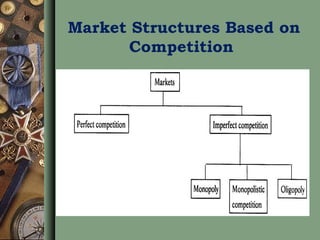
Types of Competition
I. Perfect Competition Markets
II. Imperfect Competition Markets
Market Structures Based on
Competition
PERFECT COMPETITION
MARKET
A market structure in which all firms in an
industry are price takers and in which
there is freedom of entry into and exit
from the industry is called Perfect
Competition.
FEATURES OF
PERFECT COMPETITON MARKET
• A Large Number of Buyers and Sellers
• Price Taker (market price)
• Homogeneous Products (same product)
• The firms are Free to Entry or Exit
• No Individual Preferences (buyer/seller)
• Each buyer and seller operates under the
conditions of certainty
• Mobility of Factors of Production – move
freely from industry to industry and firm
to firm
IMPERFECT COMPETITION
1. Monopoly Market
2. Monopolistic Market
3. Duopoly Market
4. Oligopoly Market
5. Monopsony Market
6. Duopsony Market
7. Oligopsony Market
MONOPOLY
A pure monopoly exists if one and only one
firm produces and sells a particular
commodity in the market.
The single firm producing the product is
itself both the firm and the industry.
E.g.: Railways, Nokia, DOT, APSRTC
FEATURES OF MONOPOLY
COMPETITIVE MARKET
• Only one firm sells the commodity having
no rivals or direct competition
• Price Maker
• Indirect rivalry may exist in the form of
Existence of substitute products
• No other seller can enter the market, else
monopoly would cease to exist.
• The product is distinct i.e., inelastic
demand
CAUSES OF MONOPOLY
 Patent Rights give legal monopoly
 Govt. policies such as granting licenses
 Ownership and control of some strategic
raw materials.
 Exclusive knowledge of technology by the
firm.
 Size of the market may accommodate only a
single firm
 Limit pricing policy adopted to prevent new
entrants.
“which represents a more realistic picture of the
actual market structure and the nature of competition
which is existing right now in the market”
“which represents a more realistic picture of the
actual market structure and the nature of competition
which is existing right now in the market”
MONOPOLISTIC COMPETITION
Monopolistic Competition refers to a
situation where there are many sellers of a
differentiated product.
There is competition which is not perfect,
between many firms making very similar
products which are close but not perfect
substitutes.
Monopolistic market exhibits characteristic
of both perfect competition and monopoly
FEATURES OF MONOPOLISTIC
COMPETITION
1. Large number of sellers/producers
2. Large number of buyers
3. Product Differentiation (Tooth paste)
4. Higher selling cost (Promotion cost)
5. Imperfect knowledge (Buyers)
6. Freedom of entry and exist
7. Higher elasticity of demand. (Price
sensitivity market)
DUOPOLY
If there are two sellers, duopoly is said to
exist.
OLIGOPOLY
If there is a competition among a few sellers,
oligopoly is said to exist
MONOPSONY
If there is only one buyer, monopsony
market is said to exist.
DUOPSONY
If there are two buyers, duopsony is said
to exist.
OLIGOPSONY
If there are few buyers, oligopsony is
said to exist.
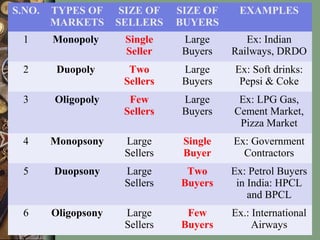
S.NO. TYPES OF
MARKETS
SIZE OF
SELLERS
SIZE OF
BUYERS
EXAMPLES
1 Monopoly Single
Seller
Large
Buyers
Ex: Indian
Railways, DRDO
2 Duopoly Two
Sellers
Large
Buyers
Ex: Soft drinks:
Pepsi & Coke
3 Oligopoly Few
Sellers
Large
Buyers
Ex: LPG Gas,
Cement Market,
Pizza Market
4 Monopsony Large
Sellers
Single
Buyer
Ex: Government
Contractors
5 Duopsony Large
Sellers
Two
Buyers
Ex: Petrol Buyers
in India: HPCL
and BPCL
6 Oligopsony Large
Sellers
Few
Buyers
Ex.: International
Airways
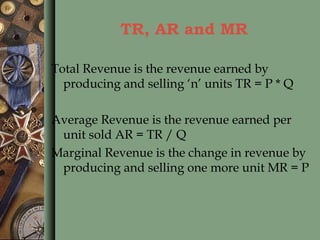
TR, AR and MR
Total Revenue is the revenue earned by
producing and selling ‘n’ units TR = P * Q
Average Revenue is the revenue earned per
unit sold AR = TR / Q
Marginal Revenue is the change in revenue by
producing and selling one more unit MR = P
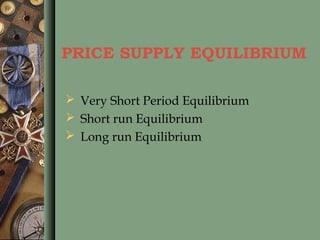
PRICE SUPPLY EQUILIBRIUM
 Very Short Period Equilibrium
 Short run Equilibrium
 Long run Equilibrium
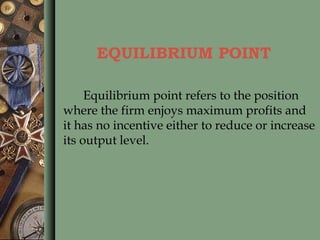
EQUILIBRIUM POINT
Equilibrium point refers to the position
where the firm enjoys maximum profits and
it has no incentive either to reduce or increase
its output level.
EQUILIBRIUM POINT – PERFECT
COMPETITION
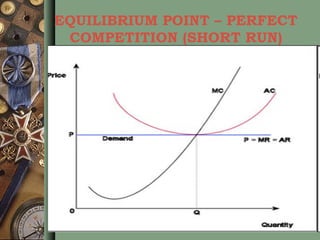
MR = MC
MC curve should cut the MR curve from
below
EQUILIBRIUM POINT – PERFECT
COMPETITION (SHORT RUN)
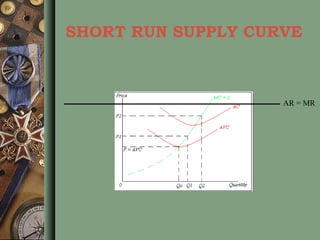
SHORT RUN SUPPLY CURVE
AR = MR
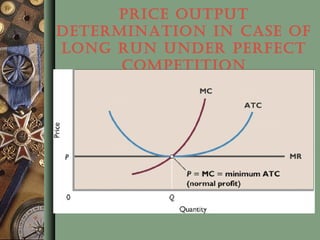
PRICE OUTPUT
DETERMINATION IN CASE OF
LONG RUN UNDER PERFECT
COMPETITION
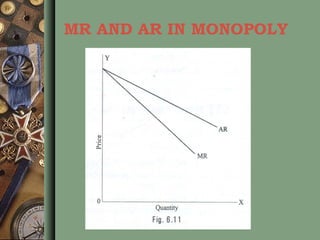
MR AND AR IN MONOPOLY
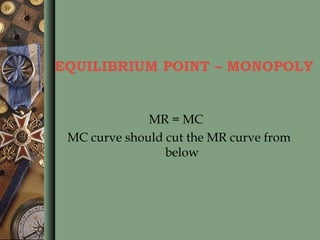
EQUILIBRIUM POINT – MONOPOLY
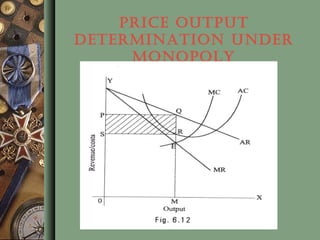
MR = MC
MC curve should cut the MR curve from
below
PRICE OUTPUT
DETERMINATION UNDER
MONOPOLY
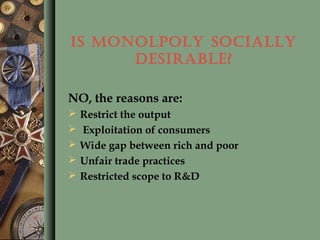
IS MONOLPOLY SOCIALLY
DESIRABLE?
NO, the reasons are:
 Restrict the output
 Exploitation of consumers
 Wide gap between rich and poor
 Unfair trade practices
 Restricted scope to R&D
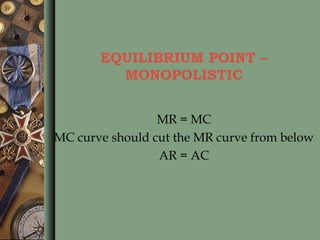
EQUILIBRIUM POINT –
MONOPOLISTIC
MR = MC
MC curve should cut the MR curve from below
AR = AC
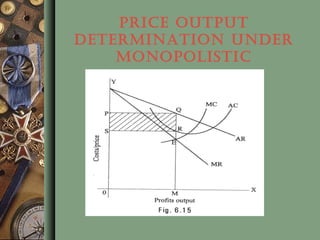
PRICE OUTPUT
DETERMINATION UNDER
MONOPOLISTIC
PRICE DISCRIMINATION
When a firm sells its products to its
customers of different profile at different
prices with no corresponding change in
cost, price discrimination is said to exist.
1. Purchasing power
2. Quantity bought
3. Customers from different market conditions
ADVANTAGES OF PRICE
DISCRIMINATION
• Helps to meet the competition
• Surplus production can be disposed off
• Customer base increases
• Production costs decreases as volume increases
• Long run profits
PRICING
There are no cut and dried rules for
pricing, since each firm, product and market
situation have some features that are
unique.
Under pricing will result in losses and
over pricing will make the customers run
away.
PRICING OBJECTIVES
• Maximize profits
• Increase sales
• Increase market share
• Satisfy customers
• Meet the competition
PRICING METHODS
 Cost Based Pricing Methods
 Cost plus pricing
 Marginal cost pricing
 Competition Oriented Pricing
 Sealed bid pricing
 Going rate pricing
 Demand Oriented Pricing
 Price Discrimination
 Perceived value pricing
PRICING METHODS
 Strategy Based Pricing Methods
 Market Skimming
 Market Penetration
 Two part pricing
 Block pricing
 Commodity Bundling
 Peak load pricing
 Cross Subsidisation
 Transfer pricing
PRICING STRATEGIES IN THE
CASE OF STIFF PRICE
COMPETITION
 Price Matching
 Promoting Brand loyalty
 Time to time pricing
 Promotional pricing
 Target pricing
Market structures and price determination

Market structures and price determination

  • 1.
    UNIT IIIUNIT III PART-IPART-I INTRODUCTIONTOINTRODUCTION TO MARKET STRUCTURESMARKET STRUCTURES ANDAND PRICING POLICIESPRICING POLICIES
  • 2.
    What is aMarket? Market is defined as a place or point at which buyers and sellers negotiate their exchange of well-defined products or services. Market is a place where buyer and seller meet, goods and services are offered for the sale and transfer of ownership occurs
  • 3.
    Definition of Market Marketis any area over which buyers and sellers are in close touch with one another, either directly or through dealers, that the price obtainable in one part of the market affects the prices paid in other parts. - Benham
  • 4.
    COMPONENTS AND MARKET STRUCTURE Asseen from the definition of market, the components of a market are: 1. Sellers (Producer) 2. Buyers (Customers) 3. Nature of product (Types of Product) 4. Conditions of entry and exit 5. Negotiation (Price) 6. Transfer of Ownership and Product 7. Transfer of Money or Equal Value
  • 5.
    COMPETITIVE BASED MARKET STRUCTURE Theless the power an individual firm has to influence the market in which it operates, the more competitive that market is. Types of Competition I. Perfect Competition Markets II. Imperfect Competition Markets
  • 6.
  • 7.
    PERFECT COMPETITION MARKET A marketstructure in which all firms in an industry are price takers and in which there is freedom of entry into and exit from the industry is called Perfect Competition.
  • 8.
    FEATURES OF PERFECT COMPETITONMARKET • A Large Number of Buyers and Sellers • Price Taker (market price) • Homogeneous Products (same product) • The firms are Free to Entry or Exit • No Individual Preferences (buyer/seller) • Each buyer and seller operates under the conditions of certainty • Mobility of Factors of Production – move freely from industry to industry and firm to firm
  • 9.
    IMPERFECT COMPETITION 1. MonopolyMarket 2. Monopolistic Market 3. Duopoly Market 4. Oligopoly Market 5. Monopsony Market 6. Duopsony Market 7. Oligopsony Market
  • 10.
    MONOPOLY A pure monopolyexists if one and only one firm produces and sells a particular commodity in the market. The single firm producing the product is itself both the firm and the industry. E.g.: Railways, Nokia, DOT, APSRTC
  • 11.
    FEATURES OF MONOPOLY COMPETITIVEMARKET • Only one firm sells the commodity having no rivals or direct competition • Price Maker • Indirect rivalry may exist in the form of Existence of substitute products • No other seller can enter the market, else monopoly would cease to exist. • The product is distinct i.e., inelastic demand
  • 12.
    CAUSES OF MONOPOLY Patent Rights give legal monopoly  Govt. policies such as granting licenses  Ownership and control of some strategic raw materials.  Exclusive knowledge of technology by the firm.  Size of the market may accommodate only a single firm  Limit pricing policy adopted to prevent new entrants.
  • 13.
    “which represents amore realistic picture of the actual market structure and the nature of competition which is existing right now in the market” “which represents a more realistic picture of the actual market structure and the nature of competition which is existing right now in the market”
  • 14.
    MONOPOLISTIC COMPETITION Monopolistic Competitionrefers to a situation where there are many sellers of a differentiated product. There is competition which is not perfect, between many firms making very similar products which are close but not perfect substitutes. Monopolistic market exhibits characteristic of both perfect competition and monopoly
  • 15.
    FEATURES OF MONOPOLISTIC COMPETITION 1.Large number of sellers/producers 2. Large number of buyers 3. Product Differentiation (Tooth paste) 4. Higher selling cost (Promotion cost) 5. Imperfect knowledge (Buyers) 6. Freedom of entry and exist 7. Higher elasticity of demand. (Price sensitivity market)
  • 16.
    DUOPOLY If there aretwo sellers, duopoly is said to exist. OLIGOPOLY If there is a competition among a few sellers, oligopoly is said to exist
  • 17.
    MONOPSONY If there isonly one buyer, monopsony market is said to exist. DUOPSONY If there are two buyers, duopsony is said to exist. OLIGOPSONY If there are few buyers, oligopsony is said to exist.
  • 18.
    S.NO. TYPES OF MARKETS SIZEOF SELLERS SIZE OF BUYERS EXAMPLES 1 Monopoly Single Seller Large Buyers Ex: Indian Railways, DRDO 2 Duopoly Two Sellers Large Buyers Ex: Soft drinks: Pepsi & Coke 3 Oligopoly Few Sellers Large Buyers Ex: LPG Gas, Cement Market, Pizza Market 4 Monopsony Large Sellers Single Buyer Ex: Government Contractors 5 Duopsony Large Sellers Two Buyers Ex: Petrol Buyers in India: HPCL and BPCL 6 Oligopsony Large Sellers Few Buyers Ex.: International Airways
  • 19.
    TR, AR andMR Total Revenue is the revenue earned by producing and selling ‘n’ units TR = P * Q Average Revenue is the revenue earned per unit sold AR = TR / Q Marginal Revenue is the change in revenue by producing and selling one more unit MR = P
  • 20.
    PRICE SUPPLY EQUILIBRIUM Very Short Period Equilibrium  Short run Equilibrium  Long run Equilibrium
  • 21.
    EQUILIBRIUM POINT Equilibrium pointrefers to the position where the firm enjoys maximum profits and it has no incentive either to reduce or increase its output level.
  • 22.
    EQUILIBRIUM POINT –PERFECT COMPETITION MR = MC MC curve should cut the MR curve from below
  • 23.
    EQUILIBRIUM POINT –PERFECT COMPETITION (SHORT RUN)
  • 24.
    SHORT RUN SUPPLYCURVE AR = MR
  • 25.
    PRICE OUTPUT DETERMINATION INCASE OF LONG RUN UNDER PERFECT COMPETITION
  • 26.
    MR AND ARIN MONOPOLY
  • 27.
    EQUILIBRIUM POINT –MONOPOLY MR = MC MC curve should cut the MR curve from below
  • 28.
  • 29.
    IS MONOLPOLY SOCIALLY DESIRABLE? NO,the reasons are:  Restrict the output  Exploitation of consumers  Wide gap between rich and poor  Unfair trade practices  Restricted scope to R&D
  • 30.
    EQUILIBRIUM POINT – MONOPOLISTIC MR= MC MC curve should cut the MR curve from below AR = AC
  • 31.
  • 32.
    PRICE DISCRIMINATION When afirm sells its products to its customers of different profile at different prices with no corresponding change in cost, price discrimination is said to exist. 1. Purchasing power 2. Quantity bought 3. Customers from different market conditions
  • 33.
    ADVANTAGES OF PRICE DISCRIMINATION •Helps to meet the competition • Surplus production can be disposed off • Customer base increases • Production costs decreases as volume increases • Long run profits
  • 34.
    PRICING There are nocut and dried rules for pricing, since each firm, product and market situation have some features that are unique. Under pricing will result in losses and over pricing will make the customers run away.
  • 35.
    PRICING OBJECTIVES • Maximizeprofits • Increase sales • Increase market share • Satisfy customers • Meet the competition
  • 36.
    PRICING METHODS  CostBased Pricing Methods  Cost plus pricing  Marginal cost pricing  Competition Oriented Pricing  Sealed bid pricing  Going rate pricing  Demand Oriented Pricing  Price Discrimination  Perceived value pricing
  • 37.
    PRICING METHODS  StrategyBased Pricing Methods  Market Skimming  Market Penetration  Two part pricing  Block pricing  Commodity Bundling  Peak load pricing  Cross Subsidisation  Transfer pricing
  • 38.
    PRICING STRATEGIES INTHE CASE OF STIFF PRICE COMPETITION  Price Matching  Promoting Brand loyalty  Time to time pricing  Promotional pricing  Target pricing