NEW BUSINESS MODEL & STRATEGY
FOR INTERNET ECONOMY
1
Business Model
 A business model describes what a firm
will do, and how, to build and capture
wealth for stakeholders
 It is a plan for the successful operation
of a business, identifying sources of
revenue, the intended customer base,
products, and details of financing.
 Effective business models operationalize
good strategies - turning position and fit
into wealth
2
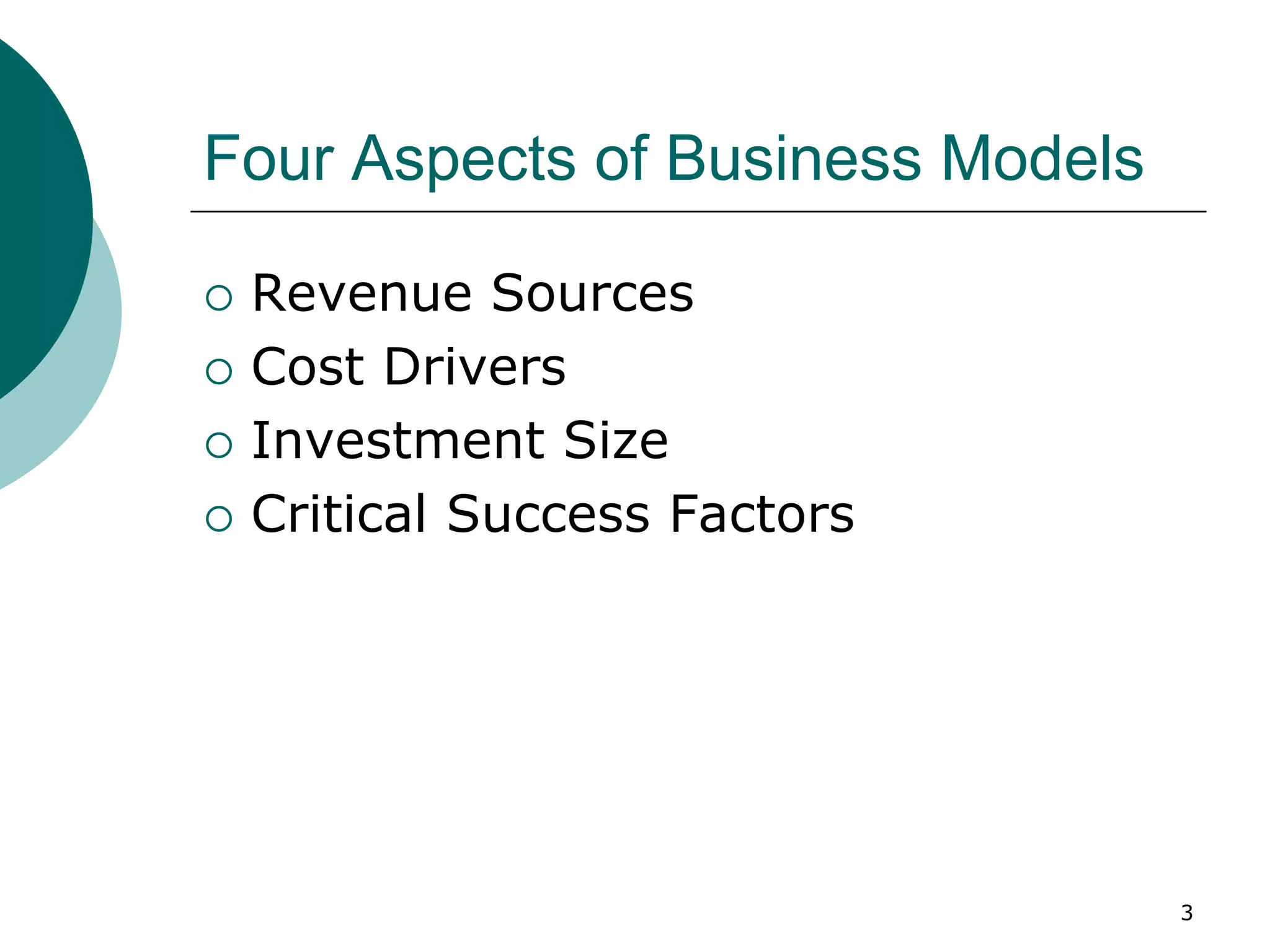
Four Aspects of Business Models
 Revenue Sources
 Cost Drivers
 Investment Size
 Critical Success Factors
3
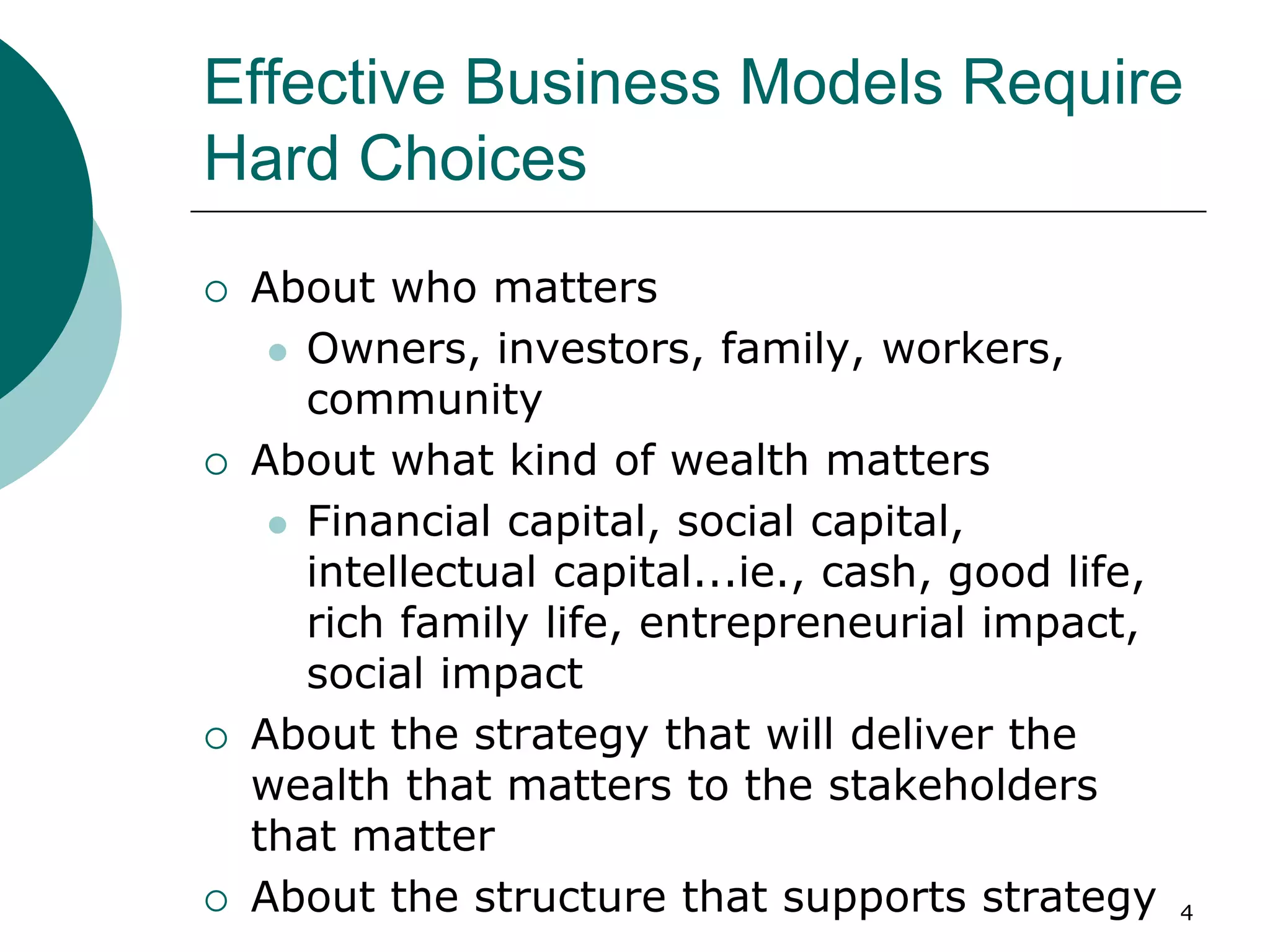
Effective Business Models Require
Hard Choices
 About who matters
 Owners, investors, family, workers,
community
 About what kind of wealth matters
 Financial capital, social capital,
intellectual capital...ie., cash, good life,
rich family life, entrepreneurial impact,
social impact
 About the strategy that will deliver the
wealth that matters to the stakeholders
that matter
 About the structure that supports strategy 4
Good Execution is More Important
than Good Strategy!
 Seeing a position or approach is
fundamentally creative
 Immersion, scenarios, future search,
 Constructing a strategy involves
careful analysis and planning
 Executing a strategy requires
relentless discipline
5
Business Model Template
6
Strategy for Internet Economy
7
Internet and e-commerce firms
Major groups of Internet and e-commerce
firms comprising the supply side include:
 Makers of specialized communications
components and equipment
 Providers of communications services
 Suppliers of computer components and
hardware
 Developers of specialized software
 E-commerce enterprises
8
9
The Web (Cluster/Platform) Strategy
 Webs – not the WWW, but ‘clusters of
companies collaborating around a
particular technology’
 Web – a new form of industrial
structure
 Webs create powerful new ways to
think about strategy, risk, technological
uncertainty and innovation
 Examples –Microsoft/Intel; Novell PC
networking system; SAP integrated IT
solutions; Netscape; Sony playstation
etc.
10
Economic Web
 Two compulsory conditions: Technological Standard
& Increasing Returns
 Tech standard – reduces risks allowing companies to
make irreversible investment decisions in face of
technological uncertainty
 Increasing Returns – create a mutual dependence
that strengthens the web by drawing in more and
more customers and producers
11
Characteristics of the Web
 Webs are not alliances – no formal relationships
between participants
 Different from virtual organisations
 The Pursuit of economic self-interest drives
behaviour
 Each company independent and prices, markets; and
sells products autonomously
 Webs are natural responses to risk and uncertainty
in turbulent environment
 The safety net of the web allows a firm to focus
exclusively on activities it can offer distinctive value
 Web reduces overall investment requirements; focus
investments on areas most likely to succeed;
promote multiple suppliers for bottleneck
components
12
Strategic Roles in Webs
 Shapers – Focus on fluidity and opportunities
to determine or influence outcomes; mold the
environment in ways enhancing their ability
to create values [define]
 Adapters – Deal with uncertainty by staying
one step ahead of other players in responding
to & anticipating environmental changes
 Profound implications for strategy and tactics
(e.g. Microsoft versus Dell)
13
Success Factors for Shapers
 Ownership of a key platform technology – shapes
broader architecture & long-term lock-in (IBM Versus
Microsoft/Intel)
 Reliance on economic incentives to mobilise other
web participants
 Active management of increasing returns dynamics
to accelerate web growth
14
Success Factors for Adapters
 Early participation in winning value webs –
establish pre-emptive position in attractive
market
 Aggressive competition for share within the
value web – strengthen relationship with
shapers for information
 Linking or diversifying position – linking
strategy with key shapers or straddle several
webs
15
What is Distinctive about Web Strategy
 New mindset required – new way of thinking about
industry structure, relationships between companies
and value creation
 Unbundling and out-sourcing of undifferentiated
business activities (what about transformational
outsourcing?)
 Maximising value for entire web by shapers – not just
the company (market share vs size of pie)
 Strategic decision - webs to join/form & roles to play
 New performance measurement
 Product design satisfy customers but also appeal to
providers of complimentary products & services
 Information systems – beyond the enterprise
Internet Business Model
 Information Sales
 Service Sales
 Brokerage
 Advertising
 Merchant
 Manufacturer (Direct)
 Affiliate Community
 Subscription
 Utility 16
Economic potential of
the internet revolution
 Reducing the cost
 Manage supply chain more effectively
 Easy communication
 Increasing competition
 Making prices more transparent
 Broadening markets for buyers and sellers
 Increasing the effectiveness of marketing
and pricing
 Increasing consumer choice, convenience
and satisfaction in a variety of ways.
17
Revenue Sources
 Advertising
 Subscribers
 Lead Gen / Affiliate
 Selling Data
 Freemium
 Royalties
18
19
Freemium
 Freemium is a business model, especially on the
Internet, whereby basic services are provided free of
charge while more advanced features must be paid
for.
20
Critical Success Factors
 Immediacy
 Proximity: Geolocation
 Communication
 Invest aggressively in R&D to win the
technological race against rivals
 Form strategic alliances to build consensus for
favoured technological approaches
 Acquire other companies with complementary
technological expertise
 Hedge firm’s bets by investing sufficient
resources in mastering one or more of the
competing technologies 21
Strategic drivers of the Internet
economy
 Important drivers of the Internet economy
include:
 The greatest added value for products and services of
all kinds is Information. Products and service products
are essentially at par with their competitors in relations
to a product’s features.
 Distance and size do not matter in the many types of
communications and transactions that can occur.
Whether the information is news, customer service, or
product availability, information is available all over the
world and accessible at any time.
 Flexibility and speed are of the quintessence. Flexibility
is required in everything from ways of responding to
customers and to business models.
22
Strategic drivers of the Internet
economy
 The key assets in Internet enterprises are people.
Innovation and creativity characterize companies
that are successful in the Internet era.
 A statement that has been part of technology
culture since Robert Metcalf, the developer of the
Ethernet is “growth in the network causes
exponential increase in value”.
 The Internet is many-to-many and not a one-to-
many network that allows marketers to deal with
customers on a one-on-one basis.
 Because markers are closer to the customer, it
allows for better forecasting through behavioral
data. What customers are doing is available to
marketers long before conventional marketing
research is collected. 23
Strategic drivers of the Internet
economy
 The Internet has changed the nature of transactions
in markets by shortening supply chains and making
it more efficient as cost patterns change.
Transactions and coordination costs are shrinking for
businesses and consumers are recognizing that
switching costs are low.
 Customers have power in information-rich channels.
Customers, consumers, and businesses have found
their voice on the Internet.
 An information economy is branded by choice and
plenty of abundance. Information is not uncommon
and is becoming more valuable as its consumers use
it.
24
Ecommerce Business
 Major Ecommerce Business
Classifications
 B2B Ecommerce
 B2C Ecommerce
 C2C Ecommerce
 C2B Ecommerce
 Government / Public
Administration Ecommerce
25
https://www.ecommerceceo.com/types-of-ecommerce-
business-models/
Ecommerce Business
 Types Of Ecommerce Business
Revenue Models
 Drop Shipping
 Wholesaling and Warehousing
 Private Labeling and Manufacturing
 White Labeling
 Subscription Ecommerce
26
https://www.ecommerceceo.com/types-of-ecommerce-
business-models/
Ecommerce Business
 Types Of Ecommerce Product
Revenue Models
 What Counts For Ecommerce
 Single Product Model
 Single Category
 Multiple Category
 Affiliate
 Hybrid [Single Category + Affiliate]
27
https://www.ecommerceceo.com/types-of-ecommerce-
business-models/

Unit v new business model and strategy for internet economy

  • 1.
    NEW BUSINESS MODEL& STRATEGY FOR INTERNET ECONOMY 1
  • 2.
    Business Model  Abusiness model describes what a firm will do, and how, to build and capture wealth for stakeholders  It is a plan for the successful operation of a business, identifying sources of revenue, the intended customer base, products, and details of financing.  Effective business models operationalize good strategies - turning position and fit into wealth 2
  • 3.
    Four Aspects ofBusiness Models  Revenue Sources  Cost Drivers  Investment Size  Critical Success Factors 3
  • 4.
    Effective Business ModelsRequire Hard Choices  About who matters  Owners, investors, family, workers, community  About what kind of wealth matters  Financial capital, social capital, intellectual capital...ie., cash, good life, rich family life, entrepreneurial impact, social impact  About the strategy that will deliver the wealth that matters to the stakeholders that matter  About the structure that supports strategy 4
  • 5.
    Good Execution isMore Important than Good Strategy!  Seeing a position or approach is fundamentally creative  Immersion, scenarios, future search,  Constructing a strategy involves careful analysis and planning  Executing a strategy requires relentless discipline 5
  • 6.
  • 7.
  • 8.
    Internet and e-commercefirms Major groups of Internet and e-commerce firms comprising the supply side include:  Makers of specialized communications components and equipment  Providers of communications services  Suppliers of computer components and hardware  Developers of specialized software  E-commerce enterprises 8
  • 9.
    9 The Web (Cluster/Platform)Strategy  Webs – not the WWW, but ‘clusters of companies collaborating around a particular technology’  Web – a new form of industrial structure  Webs create powerful new ways to think about strategy, risk, technological uncertainty and innovation  Examples –Microsoft/Intel; Novell PC networking system; SAP integrated IT solutions; Netscape; Sony playstation etc.
  • 10.
    10 Economic Web  Twocompulsory conditions: Technological Standard & Increasing Returns  Tech standard – reduces risks allowing companies to make irreversible investment decisions in face of technological uncertainty  Increasing Returns – create a mutual dependence that strengthens the web by drawing in more and more customers and producers
  • 11.
    11 Characteristics of theWeb  Webs are not alliances – no formal relationships between participants  Different from virtual organisations  The Pursuit of economic self-interest drives behaviour  Each company independent and prices, markets; and sells products autonomously  Webs are natural responses to risk and uncertainty in turbulent environment  The safety net of the web allows a firm to focus exclusively on activities it can offer distinctive value  Web reduces overall investment requirements; focus investments on areas most likely to succeed; promote multiple suppliers for bottleneck components
  • 12.
    12 Strategic Roles inWebs  Shapers – Focus on fluidity and opportunities to determine or influence outcomes; mold the environment in ways enhancing their ability to create values [define]  Adapters – Deal with uncertainty by staying one step ahead of other players in responding to & anticipating environmental changes  Profound implications for strategy and tactics (e.g. Microsoft versus Dell)
  • 13.
    13 Success Factors forShapers  Ownership of a key platform technology – shapes broader architecture & long-term lock-in (IBM Versus Microsoft/Intel)  Reliance on economic incentives to mobilise other web participants  Active management of increasing returns dynamics to accelerate web growth
  • 14.
    14 Success Factors forAdapters  Early participation in winning value webs – establish pre-emptive position in attractive market  Aggressive competition for share within the value web – strengthen relationship with shapers for information  Linking or diversifying position – linking strategy with key shapers or straddle several webs
  • 15.
    15 What is Distinctiveabout Web Strategy  New mindset required – new way of thinking about industry structure, relationships between companies and value creation  Unbundling and out-sourcing of undifferentiated business activities (what about transformational outsourcing?)  Maximising value for entire web by shapers – not just the company (market share vs size of pie)  Strategic decision - webs to join/form & roles to play  New performance measurement  Product design satisfy customers but also appeal to providers of complimentary products & services  Information systems – beyond the enterprise
  • 16.
    Internet Business Model Information Sales  Service Sales  Brokerage  Advertising  Merchant  Manufacturer (Direct)  Affiliate Community  Subscription  Utility 16
  • 17.
    Economic potential of theinternet revolution  Reducing the cost  Manage supply chain more effectively  Easy communication  Increasing competition  Making prices more transparent  Broadening markets for buyers and sellers  Increasing the effectiveness of marketing and pricing  Increasing consumer choice, convenience and satisfaction in a variety of ways. 17
  • 18.
    Revenue Sources  Advertising Subscribers  Lead Gen / Affiliate  Selling Data  Freemium  Royalties 18
  • 19.
  • 20.
    Freemium  Freemium isa business model, especially on the Internet, whereby basic services are provided free of charge while more advanced features must be paid for. 20
  • 21.
    Critical Success Factors Immediacy  Proximity: Geolocation  Communication  Invest aggressively in R&D to win the technological race against rivals  Form strategic alliances to build consensus for favoured technological approaches  Acquire other companies with complementary technological expertise  Hedge firm’s bets by investing sufficient resources in mastering one or more of the competing technologies 21
  • 22.
    Strategic drivers ofthe Internet economy  Important drivers of the Internet economy include:  The greatest added value for products and services of all kinds is Information. Products and service products are essentially at par with their competitors in relations to a product’s features.  Distance and size do not matter in the many types of communications and transactions that can occur. Whether the information is news, customer service, or product availability, information is available all over the world and accessible at any time.  Flexibility and speed are of the quintessence. Flexibility is required in everything from ways of responding to customers and to business models. 22
  • 23.
    Strategic drivers ofthe Internet economy  The key assets in Internet enterprises are people. Innovation and creativity characterize companies that are successful in the Internet era.  A statement that has been part of technology culture since Robert Metcalf, the developer of the Ethernet is “growth in the network causes exponential increase in value”.  The Internet is many-to-many and not a one-to- many network that allows marketers to deal with customers on a one-on-one basis.  Because markers are closer to the customer, it allows for better forecasting through behavioral data. What customers are doing is available to marketers long before conventional marketing research is collected. 23
  • 24.
    Strategic drivers ofthe Internet economy  The Internet has changed the nature of transactions in markets by shortening supply chains and making it more efficient as cost patterns change. Transactions and coordination costs are shrinking for businesses and consumers are recognizing that switching costs are low.  Customers have power in information-rich channels. Customers, consumers, and businesses have found their voice on the Internet.  An information economy is branded by choice and plenty of abundance. Information is not uncommon and is becoming more valuable as its consumers use it. 24
  • 25.
    Ecommerce Business  MajorEcommerce Business Classifications  B2B Ecommerce  B2C Ecommerce  C2C Ecommerce  C2B Ecommerce  Government / Public Administration Ecommerce 25 https://www.ecommerceceo.com/types-of-ecommerce- business-models/
  • 26.
    Ecommerce Business  TypesOf Ecommerce Business Revenue Models  Drop Shipping  Wholesaling and Warehousing  Private Labeling and Manufacturing  White Labeling  Subscription Ecommerce 26 https://www.ecommerceceo.com/types-of-ecommerce- business-models/
  • 27.
    Ecommerce Business  TypesOf Ecommerce Product Revenue Models  What Counts For Ecommerce  Single Product Model  Single Category  Multiple Category  Affiliate  Hybrid [Single Category + Affiliate] 27 https://www.ecommerceceo.com/types-of-ecommerce- business-models/