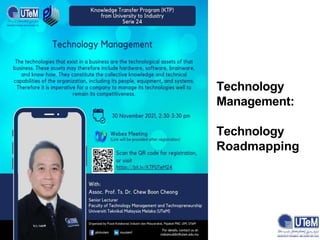

Technology
Management:
Technology
Roadmapping
Introduction
Introduction
• Technology is a key determining factor of a
company’s success and competitive advantage.
• These issues are becoming more critical as the
cost, complexity and rate of technology change
increase.
• The management of technology for business has to
ensure that the technological resources within the
organization are aligned with its needs-now and in
the future.
Introduction
• At the business level, the demand for new
technology is increasing. If a company does not
have the latest innovation (while the competitors
do), the business will suffer.
• Businesses today need a technology strategy. They
need to have a plan for how their internal and
external environment can effect the organization.
Thus, a technology roadmap is needed.
Technology Roadmap
• Technology roadmap is an essential business tool
because it helps customers and suppliers in
developing a shared vision for future technologies
(products, services, processes).
• A technology roadmap informed view of the future,
broken down into specific segments.
Technology Roadmap
• It is a plan, appears in graphic manner.
• It is constructed on a timeline/time-base with
milestones, projects, and tasks along the evolving
needs of a business.
• It comprises a layer or multiple layers.
• The roadmap puts the long-term goals of the
organization into specific milestones and deadlines.
• The company can utilize resources and time to
ensure the company goals are met.
• Road map can be business downsizing/business
expansion.
Technology Roadmap
• Roadmaps can be constructed as 6, 12, 18, 36, 60
month.
• Every roadmap will look different.
• Applies to a new product, a new service or a new
process on innovation and technological
development.
• It expresses where your company is, and where
your company hope to be (business trajectory)
• Taking in both the internal strengths/weaknesses vs
external opportunities/threats (global market,
regulatory).
1. Technology roadmapping fits into
-corporate strategic planning,
-technology planning (products, services,
processes)
-new market development
-business development
2. Define the conditions, scopes and boundaries
-Input and planning from several different parts of
the organization (internal/external)
Functions of a Technology Roadmap
3. Provide leadership for the development
-vision/mission setting
-time and resources commitment
4. Sustain competitiveness
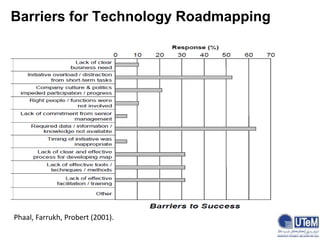
Barriers for Technology Roadmapping
Phaal, Farrukh, Probert (2001).
Technology Roadmapping
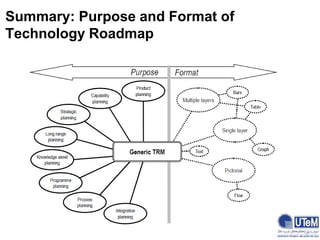
Purposes
Technology Roadmapping Purposes
-8 purposes
1. Product planning
2. Service/capability planning
3. Strategic planning
4. Long-range planning
5. Knowledge asset planning
6. Programme planning
7. Process planning
8. Integration planning
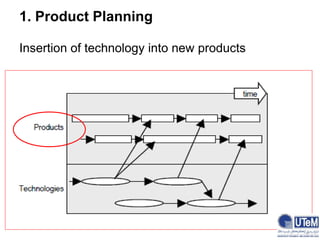
1. Product Planning
Insertion of technology into new products
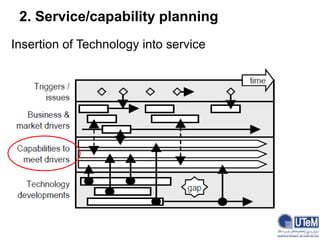
2. Service/capability planning
Insertion of Technology into service
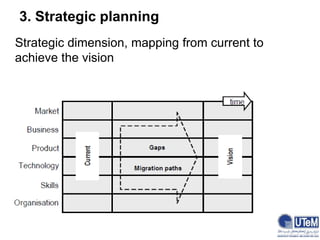
3. Strategic planning
Strategic dimension, mapping from current to
achieve the vision
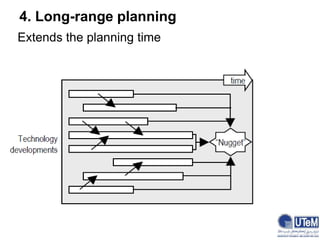
4. Long-range planning
Extends the planning time
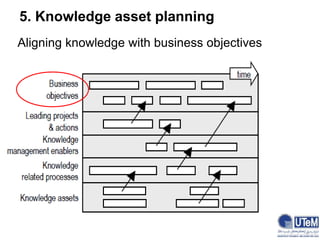
5. Knowledge asset planning
Aligning knowledge with business objectives
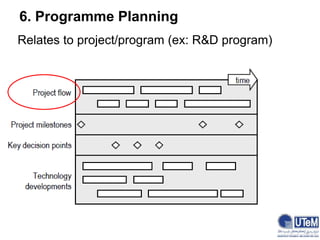
6. Programme Planning
Relates to project/program (ex: R&D program)
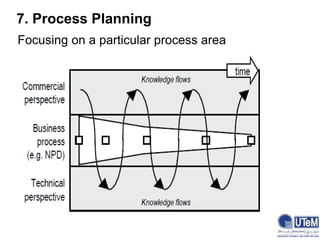
7. Process Planning
Focusing on a particular process area
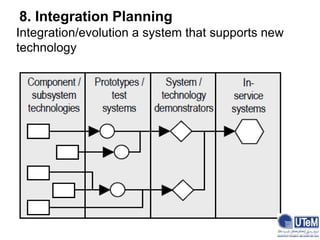
Integration/evolution a system that supports new
technology
8. Integration Planning
Technology Roadmapping
Format
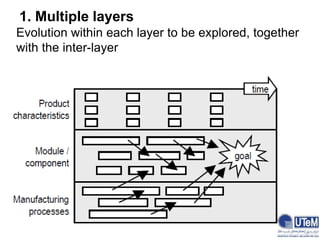
Evolution within each layer to be explored, together
with the inter-layer
1. Multiple layers
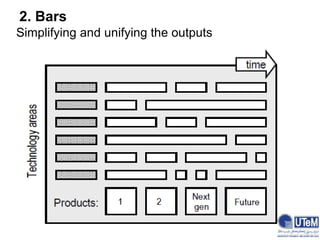
Simplifying and unifying the outputs
2. Bars
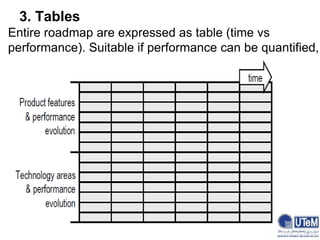
Entire roadmap are expressed as table (time vs
performance). Suitable if performance can be quantified,
3. Tables
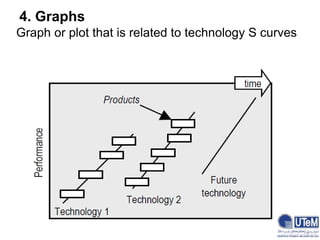
Graph or plot that is related to technology S curves
4. Graphs
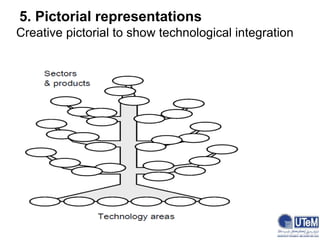
Creative pictorial to show technological integration
5. Pictorial representations
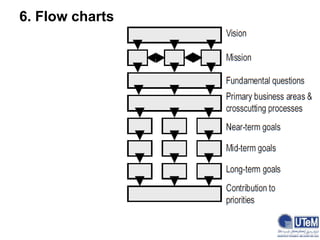
6. Flow charts
Summary: Purpose and Format of
Technology Roadmap
Develop a Technology
Roadmap
Develop a Technology Roadmap
The roadmap is a timeline in which:
(a) one end represents the current situation
(b) the other end of the timeline represents what
the situation will look like after the goal of the
roadmap is achieved.
(b) must break down your long-term goals into
short-term tasks, and milestones.
(c) Once tasks are listed, arrange them on the
timeline and assign resources.
Develop a Technology Roadmap
1. Set your company’s goals/target
2. Utilizing your data (historical data, financial
projection, statistics on current performance,
capacity, consumption)
3. Identify the new “technology” as the focus of the
roadmap. Product? Service? Process?
4. Specify key technology area(s) under such target.
5. Identify the resources required
6. Spread through the activities/resources on a specific
duration.
7. Build the technology roadmap.
8. Trade-offs can be made for different targets.
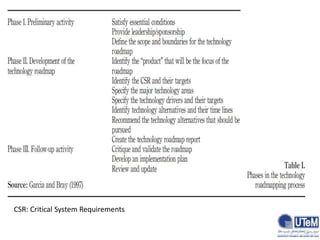
Step 3: Identify the new technology that will
be the focus of the roadmap
• New technology is identified and should be agreed
on by all the members of a company.
• In case of uncertainty of the new technology,
scenario-based planning can be used.
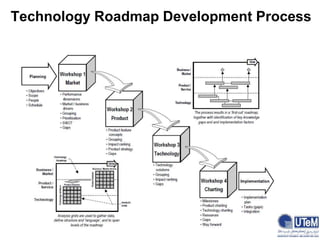
Technology Roadmap Development Process
CSR: Critical System Requirements
Technology Roadmap
• Roadmaps require updating and realigning every
6-12 months.
• Technology roadmap will keep business focuses
on its goal and constantly aware of the changing
nature of the industry, the market.
References
1. Phaal, R., Farrukh, C. and Probert, D. 2001.
Technology Roadmapping: Linking technology
resources to business objectives. University of
Cambridge.
2. Garcia, M. and Bray, O. 1997. Fundamentals of
Technology Roadmapping. Sandia National
Laboratories. Albuquerque, N. M.

Technology Management: Technology Roadmapping

  • 1.
  • 2.
  • 3.
    Introduction • Technology isa key determining factor of a company’s success and competitive advantage. • These issues are becoming more critical as the cost, complexity and rate of technology change increase. • The management of technology for business has to ensure that the technological resources within the organization are aligned with its needs-now and in the future.
  • 4.
    Introduction • At thebusiness level, the demand for new technology is increasing. If a company does not have the latest innovation (while the competitors do), the business will suffer. • Businesses today need a technology strategy. They need to have a plan for how their internal and external environment can effect the organization. Thus, a technology roadmap is needed.
  • 5.
    Technology Roadmap • Technologyroadmap is an essential business tool because it helps customers and suppliers in developing a shared vision for future technologies (products, services, processes). • A technology roadmap informed view of the future, broken down into specific segments.
  • 6.
    Technology Roadmap • Itis a plan, appears in graphic manner. • It is constructed on a timeline/time-base with milestones, projects, and tasks along the evolving needs of a business. • It comprises a layer or multiple layers. • The roadmap puts the long-term goals of the organization into specific milestones and deadlines. • The company can utilize resources and time to ensure the company goals are met. • Road map can be business downsizing/business expansion.
  • 7.
    Technology Roadmap • Roadmapscan be constructed as 6, 12, 18, 36, 60 month. • Every roadmap will look different. • Applies to a new product, a new service or a new process on innovation and technological development. • It expresses where your company is, and where your company hope to be (business trajectory) • Taking in both the internal strengths/weaknesses vs external opportunities/threats (global market, regulatory).
  • 8.
    1. Technology roadmappingfits into -corporate strategic planning, -technology planning (products, services, processes) -new market development -business development 2. Define the conditions, scopes and boundaries -Input and planning from several different parts of the organization (internal/external) Functions of a Technology Roadmap
  • 9.
    Functions of aTechnology Roadmap 3. Provide leadership for the development -vision/mission setting -time and resources commitment 4. Sustain competitiveness
  • 10.
    Barriers for TechnologyRoadmapping Phaal, Farrukh, Probert (2001).
  • 11.
  • 12.
    Technology Roadmapping Purposes -8purposes 1. Product planning 2. Service/capability planning 3. Strategic planning 4. Long-range planning 5. Knowledge asset planning 6. Programme planning 7. Process planning 8. Integration planning
  • 13.
    1. Product Planning Insertionof technology into new products
  • 14.
    2. Service/capability planning Insertionof Technology into service
  • 15.
    3. Strategic planning Strategicdimension, mapping from current to achieve the vision
  • 16.
  • 17.
    5. Knowledge assetplanning Aligning knowledge with business objectives
  • 18.
    6. Programme Planning Relatesto project/program (ex: R&D program)
  • 19.
    7. Process Planning Focusingon a particular process area
  • 20.
    Integration/evolution a systemthat supports new technology 8. Integration Planning
  • 21.
  • 22.
    Evolution within eachlayer to be explored, together with the inter-layer 1. Multiple layers
  • 23.
    Simplifying and unifyingthe outputs 2. Bars
  • 24.
    Entire roadmap areexpressed as table (time vs performance). Suitable if performance can be quantified, 3. Tables
  • 25.
    Graph or plotthat is related to technology S curves 4. Graphs
  • 26.
    Creative pictorial toshow technological integration 5. Pictorial representations
  • 27.
  • 28.
    Summary: Purpose andFormat of Technology Roadmap
  • 29.
  • 30.
    Develop a TechnologyRoadmap The roadmap is a timeline in which: (a) one end represents the current situation (b) the other end of the timeline represents what the situation will look like after the goal of the roadmap is achieved. (b) must break down your long-term goals into short-term tasks, and milestones. (c) Once tasks are listed, arrange them on the timeline and assign resources.
  • 31.
    Develop a TechnologyRoadmap 1. Set your company’s goals/target 2. Utilizing your data (historical data, financial projection, statistics on current performance, capacity, consumption) 3. Identify the new “technology” as the focus of the roadmap. Product? Service? Process? 4. Specify key technology area(s) under such target. 5. Identify the resources required 6. Spread through the activities/resources on a specific duration. 7. Build the technology roadmap. 8. Trade-offs can be made for different targets.
  • 32.
    Step 3: Identifythe new technology that will be the focus of the roadmap • New technology is identified and should be agreed on by all the members of a company. • In case of uncertainty of the new technology, scenario-based planning can be used.
  • 33.
  • 34.
  • 35.
    Technology Roadmap • Roadmapsrequire updating and realigning every 6-12 months. • Technology roadmap will keep business focuses on its goal and constantly aware of the changing nature of the industry, the market.
  • 36.
    References 1. Phaal, R.,Farrukh, C. and Probert, D. 2001. Technology Roadmapping: Linking technology resources to business objectives. University of Cambridge. 2. Garcia, M. and Bray, O. 1997. Fundamentals of Technology Roadmapping. Sandia National Laboratories. Albuquerque, N. M.