Presented by:Darshan Chandak
Shubham Metkar
Abhishek Agrawal


Why do companies use teams?
Satisfies the human social need to belong
Two heads are better than one
The whole can be greater than the sum of its

parts
Team members build trust and want to help
each other
Promotes better communication
Multiplies the potential of individual members
Produces positive peer pressure


Provides a framework that will increase
the ability of employees to participate in
planning, problem solving, and decision
making.


Makeup
Should be composed of people who are

most likely going to be able to satisfy the
team’s mission effectively.
Commitment to the team and its purpose.
Diversity of skills and personalities.


What are some traits that can contribute
to the success of a team?
Honesty/integrity
Selflessness
Dependability
Enthusiasm
Responsibility
Cooperativeness

Initiative
Patience
Resourcefulness
Punctuality
Tolerance/sensitivity
Perseverance


Roles and Responsibilities
Team Leader
Team Recorder
Team Quality Advisor
Team Member


Team Leader
Official contact between the team and the

rest of the organization
Official record keeper
Serve as a team member
Implement team recommendation
Will be the “coach” for the rest of the team


Coaching
Team leaders should facilitate team

development and continuous improvement
○ Give teams a clearly defined charter
○ Make team development and team building
○
○
○
○

constant activities
Mentor team members
Promote mutual respect between themselves
and team members
Positively promote diversity within the team
Employee empowerment


Team Recorder
Takes minutes during team meetings
Assists the team leader with other types of

correspondence that is generated by the
team


Team Quality Advisor
Focuses on team processes and how decisions

are made
Assists the team leader in breaking down tasks
into component parts and assigning those parts
to other team members
Helps the team leader prepare for meetings
Helps the team members learn to use the
scientific approach
Helps team members convert their
recommendations into presentations that can be
made to upper management


Team Charter
Team Mission
Ground Rules
Team Goals


Mission Statement
Broad, encompasses all activities, progress

can be measured and SIMPLICITY
Ex. The purpose of this team is to reduce
the time between when an order is taken
and when it is filled, while simultaneously
improving the quality of products shipped.


Ground Rules
Agreed upon by the whole team
Describes agreed upon actions and

characteristics of team members


Goals: reaching the mission
Ad Hoc Teams
Permanent Teams


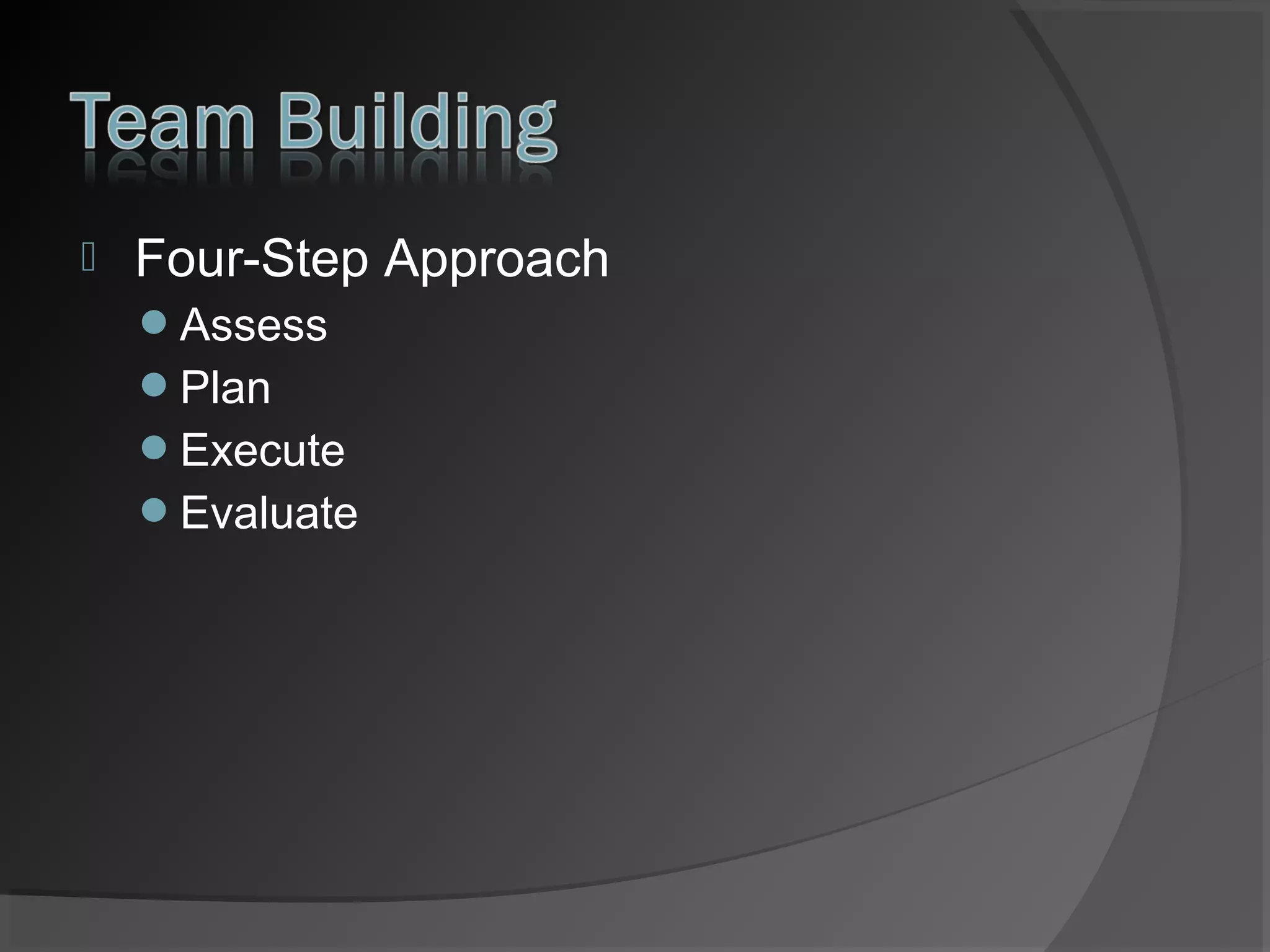
Four-Step Approach
Assess
Plan
Execute
Evaluate



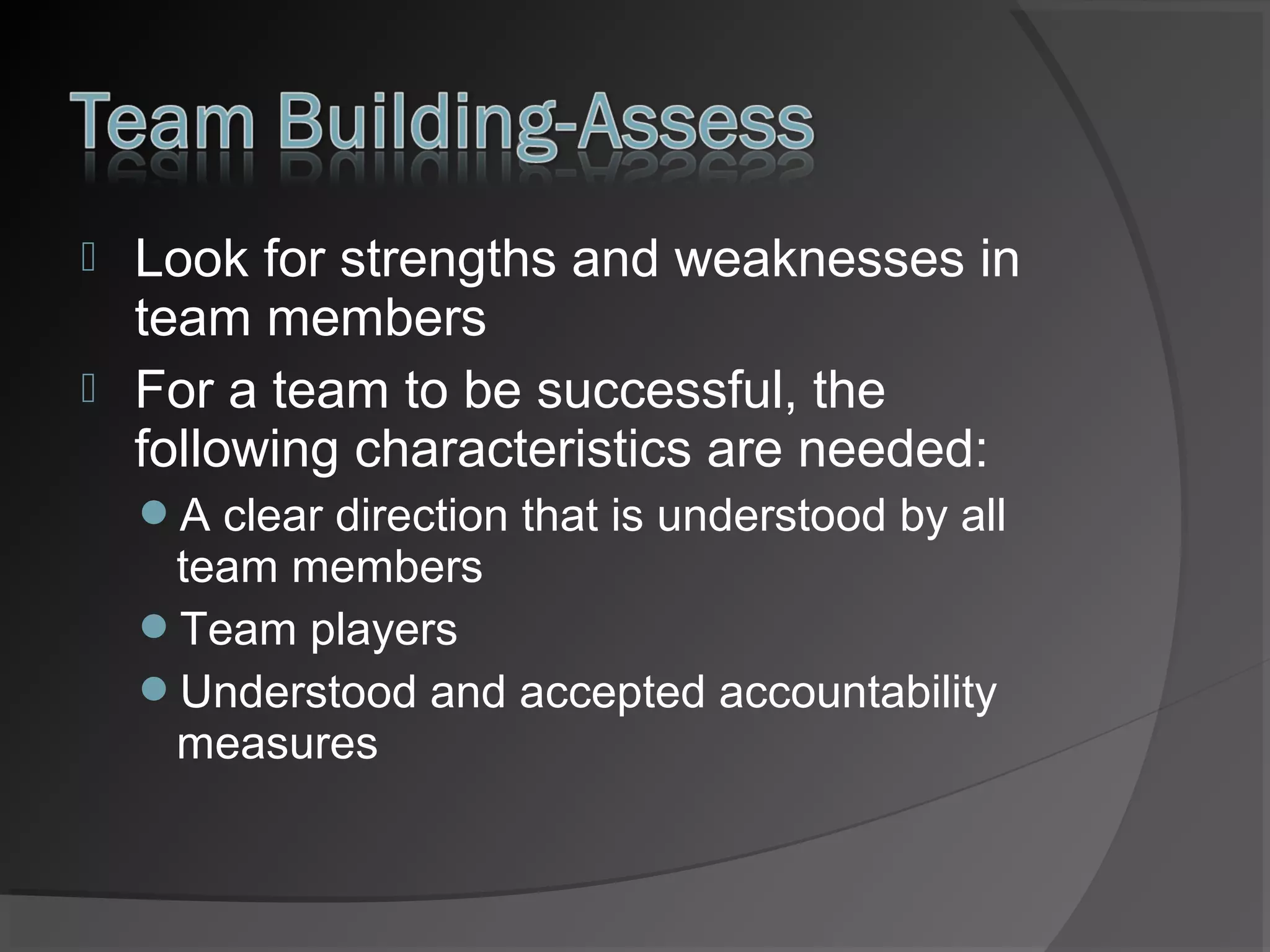
Look for strengths and weaknesses in
team members
For a team to be successful, the
following characteristics are needed:
A clear direction that is understood by all

team members
Team players
Understood and accepted accountability
measures


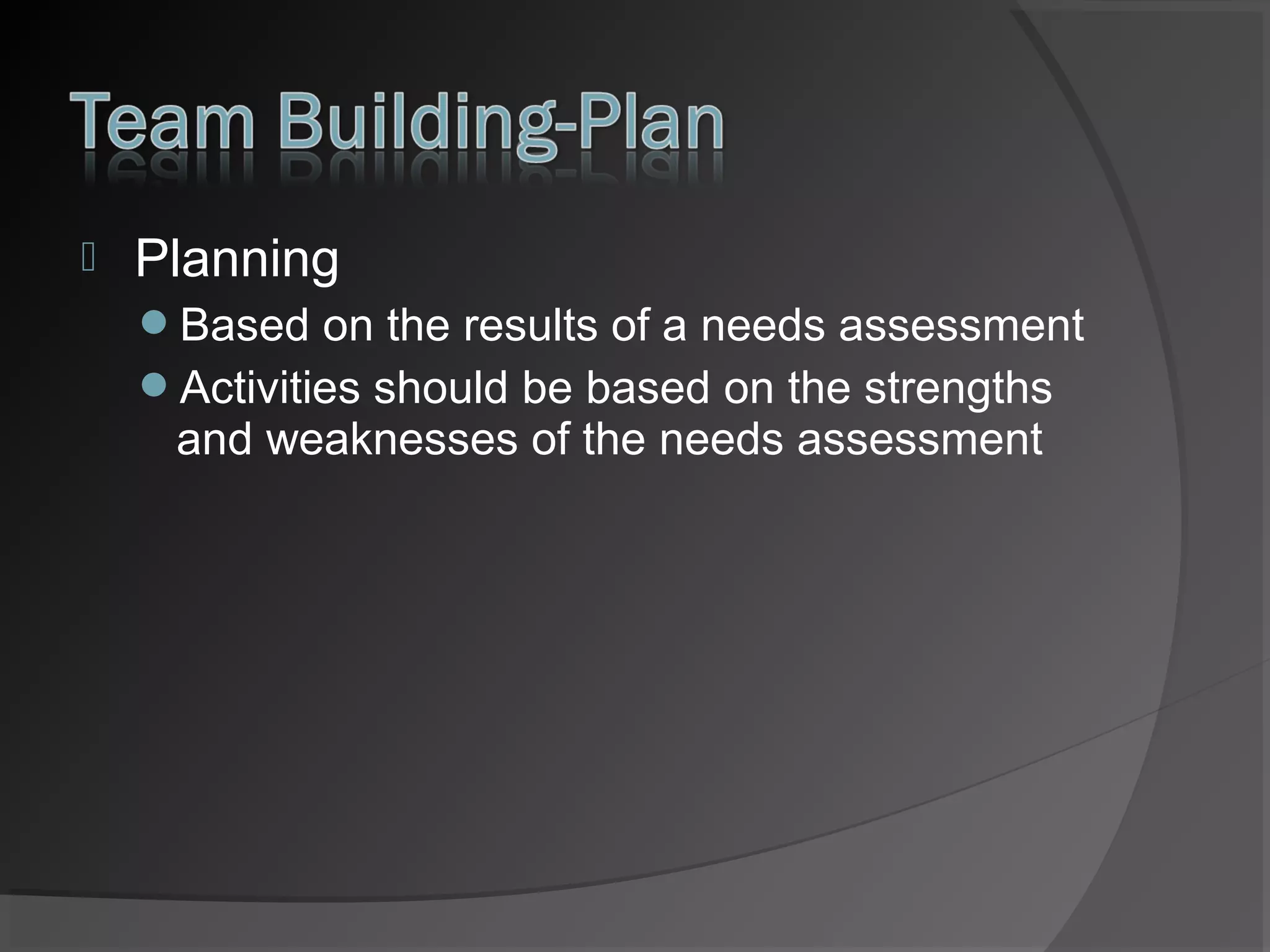
Planning
Based on the results of a needs assessment
Activities should be based on the strengths

and weaknesses of the needs assessment


Execution
Just-in-time
Continuous improvement


Evaluation
Effectiveness can be measured based on

how well weaknesses identified in the needs
assessment were strengthened.
Re-administer the needs assessment
Could result in additional team building
activities




Communication
Structure
Personal




Set a positive example of teamwork and
resolving conflicts at a company level
Identify and address the conflict
Turn into a positive experience
Increase employees communication and

interpersonal skills


Resolution Strategies:
Acknowledge that the conflict exists.
Gain common ground.
Seek to understand all angles.
Attack the issue not each other.
Develop an action plan.


Basic Requirements
The behaviors that are expected must be

communicated to all those affected so they
know exactly what is meant by rewardable
performance.
Both team leaders and team members must
be explicit about what behaviors are
expected, why they are necessary, and how
they will be recognized and rewarded.


Nonmonetary Rewards
Different people respond to different

incentives.
Organization should survey employees
before implementing nonmonetary
incentives.
Set up a system where the employee can
select the award that appeals to them.





One of the strongest motivators is
recognition.
There are many ways to ensure that
employees are recognized for their
accomplishments and their
contributions.
Above all, recognize and reward good
performance.





Write a letter to the employees family.
Arrange for a senior-level manager to
have lunch with the employee.
Have the CEO call the employee
personally to say thank you.
What are some other recognition
strategies?
Team building and teamwork

Team building and teamwork

  • 1.
    Presented by:Darshan Chandak ShubhamMetkar Abhishek Agrawal
  • 4.
     Why do companiesuse teams? Satisfies the human social need to belong Two heads are better than one The whole can be greater than the sum of its parts Team members build trust and want to help each other Promotes better communication Multiplies the potential of individual members Produces positive peer pressure
  • 5.
     Provides a frameworkthat will increase the ability of employees to participate in planning, problem solving, and decision making.
  • 6.
     Makeup Should be composedof people who are most likely going to be able to satisfy the team’s mission effectively. Commitment to the team and its purpose. Diversity of skills and personalities.
  • 7.
     What are sometraits that can contribute to the success of a team? Honesty/integrity Selflessness Dependability Enthusiasm Responsibility Cooperativeness Initiative Patience Resourcefulness Punctuality Tolerance/sensitivity Perseverance
  • 8.
     Roles and Responsibilities TeamLeader Team Recorder Team Quality Advisor Team Member
  • 9.
     Team Leader Official contactbetween the team and the rest of the organization Official record keeper Serve as a team member Implement team recommendation Will be the “coach” for the rest of the team
  • 10.
     Coaching Team leaders shouldfacilitate team development and continuous improvement ○ Give teams a clearly defined charter ○ Make team development and team building ○ ○ ○ ○ constant activities Mentor team members Promote mutual respect between themselves and team members Positively promote diversity within the team Employee empowerment
  • 11.
     Team Recorder Takes minutesduring team meetings Assists the team leader with other types of correspondence that is generated by the team
  • 12.
     Team Quality Advisor Focuseson team processes and how decisions are made Assists the team leader in breaking down tasks into component parts and assigning those parts to other team members Helps the team leader prepare for meetings Helps the team members learn to use the scientific approach Helps team members convert their recommendations into presentations that can be made to upper management
  • 13.
  • 14.
     Mission Statement Broad, encompassesall activities, progress can be measured and SIMPLICITY Ex. The purpose of this team is to reduce the time between when an order is taken and when it is filled, while simultaneously improving the quality of products shipped.
  • 15.
     Ground Rules Agreed uponby the whole team Describes agreed upon actions and characteristics of team members
  • 16.
     Goals: reaching themission Ad Hoc Teams Permanent Teams
  • 18.
  • 19.
      Look for strengthsand weaknesses in team members For a team to be successful, the following characteristics are needed: A clear direction that is understood by all team members Team players Understood and accepted accountability measures
  • 20.
     Planning Based on theresults of a needs assessment Activities should be based on the strengths and weaknesses of the needs assessment
  • 21.
  • 22.
     Evaluation Effectiveness can bemeasured based on how well weaknesses identified in the needs assessment were strengthened. Re-administer the needs assessment Could result in additional team building activities
  • 23.
  • 24.
       Set a positiveexample of teamwork and resolving conflicts at a company level Identify and address the conflict Turn into a positive experience Increase employees communication and interpersonal skills
  • 25.
     Resolution Strategies: Acknowledge thatthe conflict exists. Gain common ground. Seek to understand all angles. Attack the issue not each other. Develop an action plan.
  • 27.
     Basic Requirements The behaviorsthat are expected must be communicated to all those affected so they know exactly what is meant by rewardable performance. Both team leaders and team members must be explicit about what behaviors are expected, why they are necessary, and how they will be recognized and rewarded.
  • 29.
     Nonmonetary Rewards Different peoplerespond to different incentives. Organization should survey employees before implementing nonmonetary incentives. Set up a system where the employee can select the award that appeals to them.
  • 30.
       One of thestrongest motivators is recognition. There are many ways to ensure that employees are recognized for their accomplishments and their contributions. Above all, recognize and reward good performance.
  • 31.
        Write a letterto the employees family. Arrange for a senior-level manager to have lunch with the employee. Have the CEO call the employee personally to say thank you. What are some other recognition strategies?

Editor's Notes

  • #4 Rachel Book definition: A group of people with a common, collective goal. Everyone in the team must be aware of the goal and must work with other members of the team to achieve that goal.
  • #5 Rachel Teams are able to outperform individuals. In the context of Total Quality Management, teams are said to facilitate information sharing, problem solving, and to develop employee responsibility for managing quality performance. Team working is also seen to promote communication between employees and management, which in turn facilitates the integration of the organizational quality mission. Promotes communication and cooperation between employees in different areas of the organization, which facilitates problem solving.
  • #6 Rachel Better understanding of decisions More support for and participation in implementation of plans Increased contribution to problem solving and decision making More ownership of decision, processes, and changes
  • #7 Rachel All team efforts should be directed towards the same clear goals. This will rely heavily on communication throughout the team and relationships between team members. Team members should be able to utilize their strengths and be able to compensate for other weaknesses that are present within the team. Different personality types should be balanced and be able to compensate for each other.
  • #8 Rachel Facilitate Open Questions
  • #9 Rachel *Slide co-insides with activity: students should select role cards and find out their role within the company activity
  • #10 Rachel
  • #11 Rachel Coaches or team leaders should be specific in explaining the team’s mission and purpose to members of their team. Developing skills and building the team should be an ongoing process that is continually updated and perfected. Coaches should establish a caring nurturing relationship with team members. They should assist in developing the capabilities of team members, improving the contribution of individuals to the team, and help team members in advancing their careers. It is important for team members and team leaders to develop a mutual respect for each other. This is accomplished through trust, communication, and making team members feel like they are assets to the entire team and the organization. Team member must also develop this same respect with other members of the team. Promoting diversity can help to bring new ideas and varying perspectives that can assist the organization in gaining an advantage over competitors. Employees and team members that are physically, intellectually, and emotionally involved in their work will feel a stronger sense of ownership. They will feel more important to the company and feel like their input is really making a difference in the success of the group or of the company as a whole. This will result in better performance and higher levels of productivity.
  • #12 Rachel
  • #13 Rachel
  • #14 Nichole *This slide co-insides with the activity: explain creation of mission statement and have each company create their mission statement. Express some ground rules and team goals.
  • #15 Goes along with activity: Mission Statement: things to keep in mind are broadness, appropriate specificity and simplicity
  • #16 Characteristics include: honesty, trust, dependability, mutual support, responsibility, cooperation, patience, resourcefulness, punctuality, tolerance of and sensitivity to cultural differences, perseverance, conflict management.
  • #17 Ad Hoc teams: temporary, goals are a part of charter Permanent Teams: not included because they are ever evolving
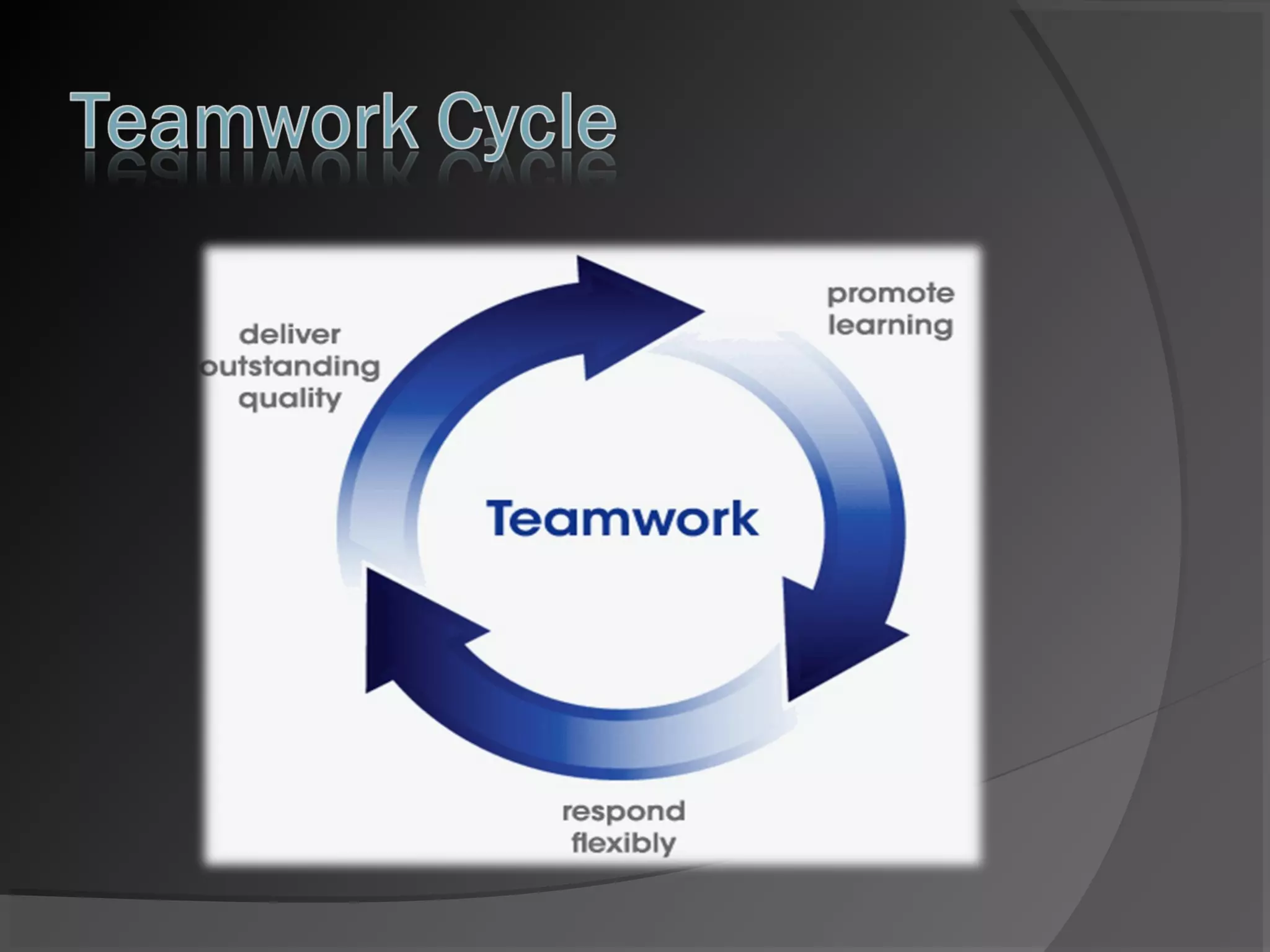
  • #18 Nichole Salford City College in the UK apart of their mission interesting relates to quality service By promoting learning to staff, respond to internal and external customers flexibly Continue to seek outstanding quality through servie
  • #19 Nichole
  • #20 Nichole Needs Assessment could be completed
  • #21 Nichole
  • #22 Nichole Best time is after a team has been formed and given its charter apply what they learn immediately Continue training and activities as a team grows it is an ongoing process
  • #23 Nichole If follow up is not conducted after team building activities, people will begin to think that these types of activities are a waste of their time. Results need to be clear and a course of action should be developed in order to show team members what the next steps are and how the team building activity is going to strengthen their team.
  • #24 Nichole Three most common reasons for conflict Barriers to communication are among the most important factors and can be a major source of misunderstanding. Communication barriers include poor listening skills; insufficient sharing of information; differences in interpretation and perception; and nonverbal cues being ignored or missed. Structural disagreements include the size of the organization, turnover rate, levels of participation, reward systems, and levels of interdependence among employees. Personal factors include things such as an individual's self-esteem, their personal goals, values and needs
  • #25 Nichole http://www.innovativeteambuilding.co.uk/pages/articles/conflicts.htm
  • #26 Nichole *everyone understands mission and goals
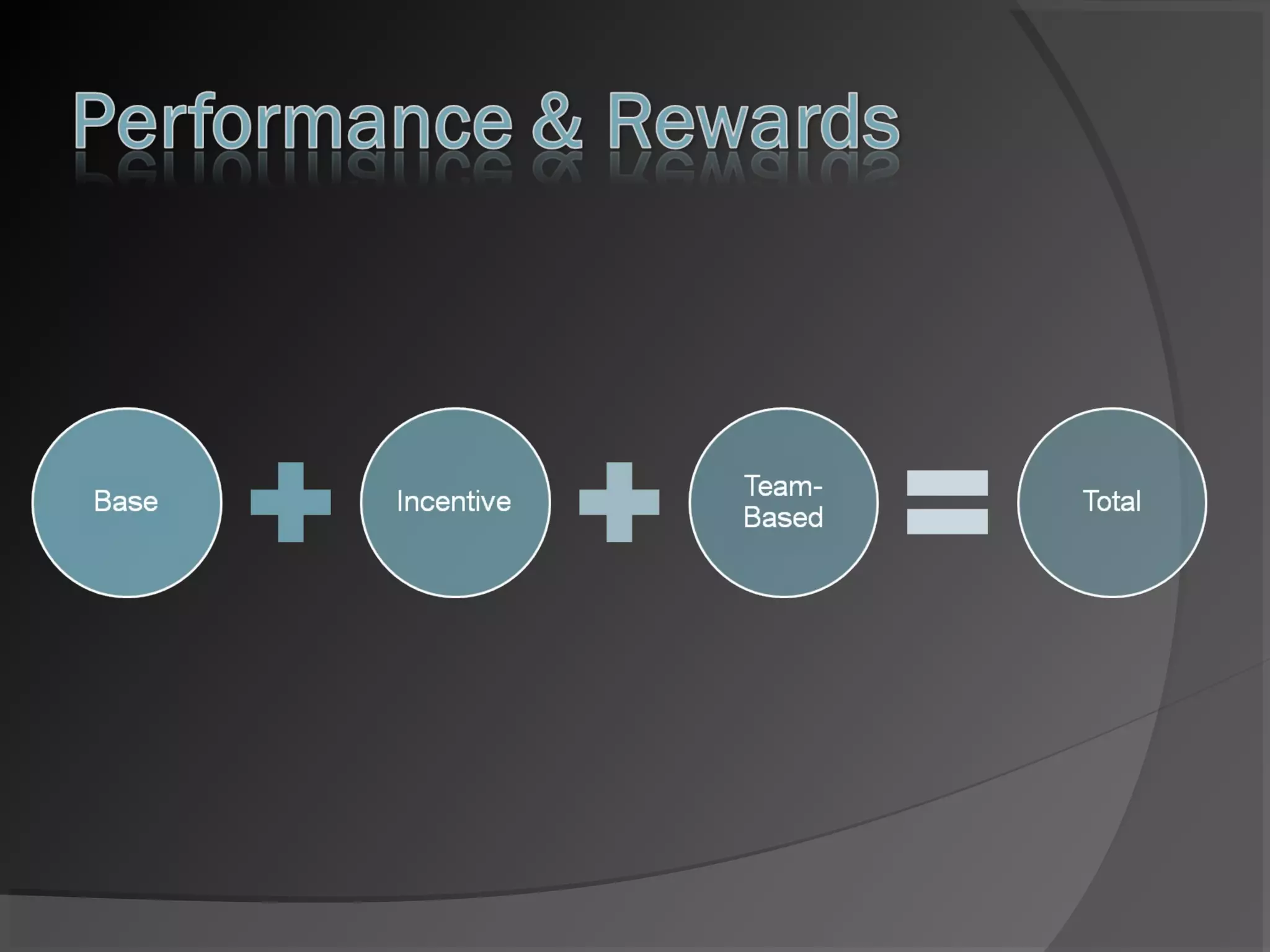
  • #27 Rachel Team Compensation Components Reinforces both team and individual performance This method rewards on individual efforts and achievement, as well as, on team-based initiatives and accomplishments.
  • #28 Rachel Difficult to implement because people are not used to a high degree of specificity in their communication.
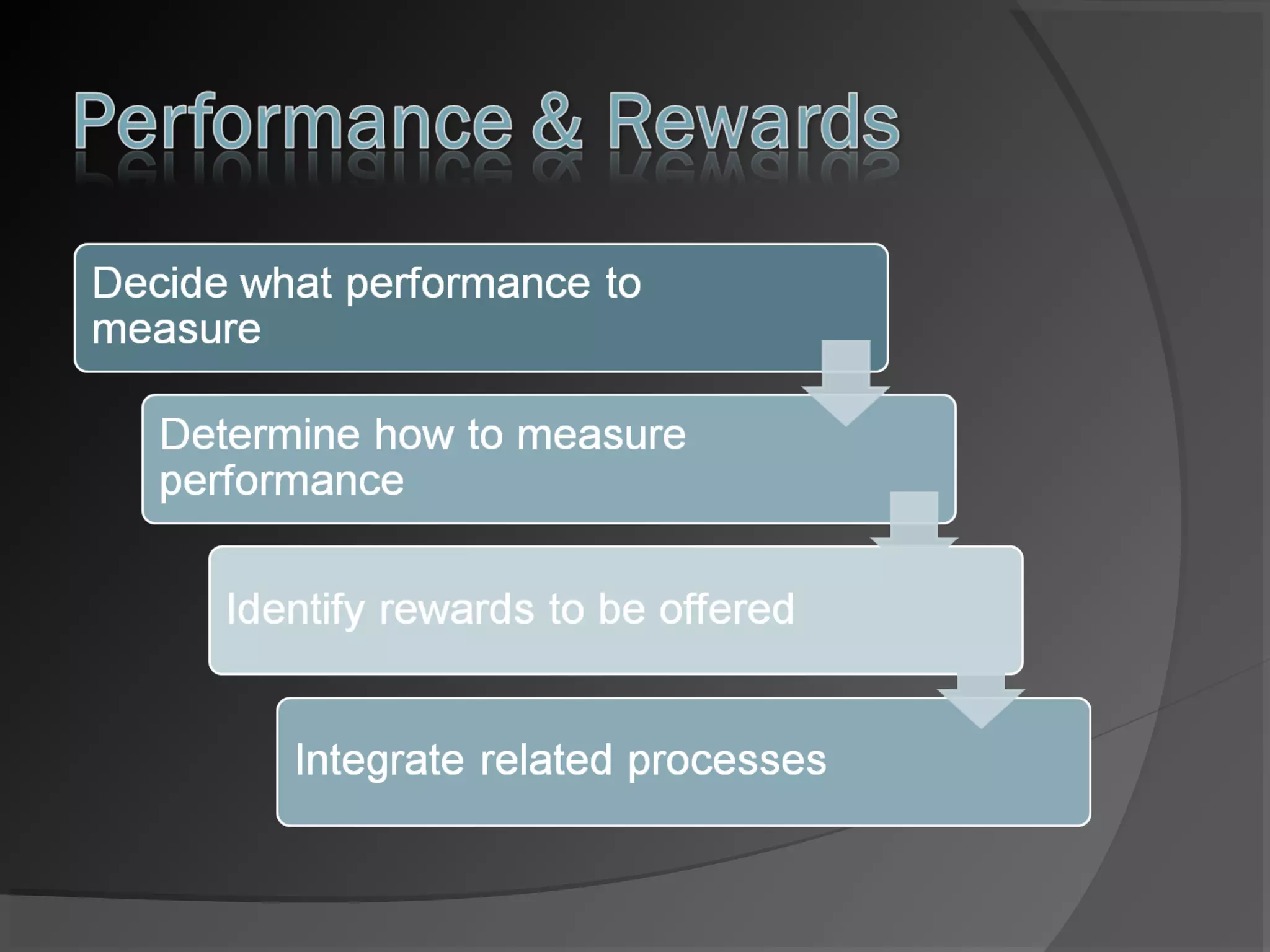
  • #29 Rachel Model for developing a team and individual compensation system
  • #30 Rachel Nonmonetary rewards could include free vacation days, event tickets, gift certificates, getaway weekends, other prizes such as electronics or household products. Continuing professional education and development is also a prime motivator.
  • #31 Rachel
  • #32 Rachel