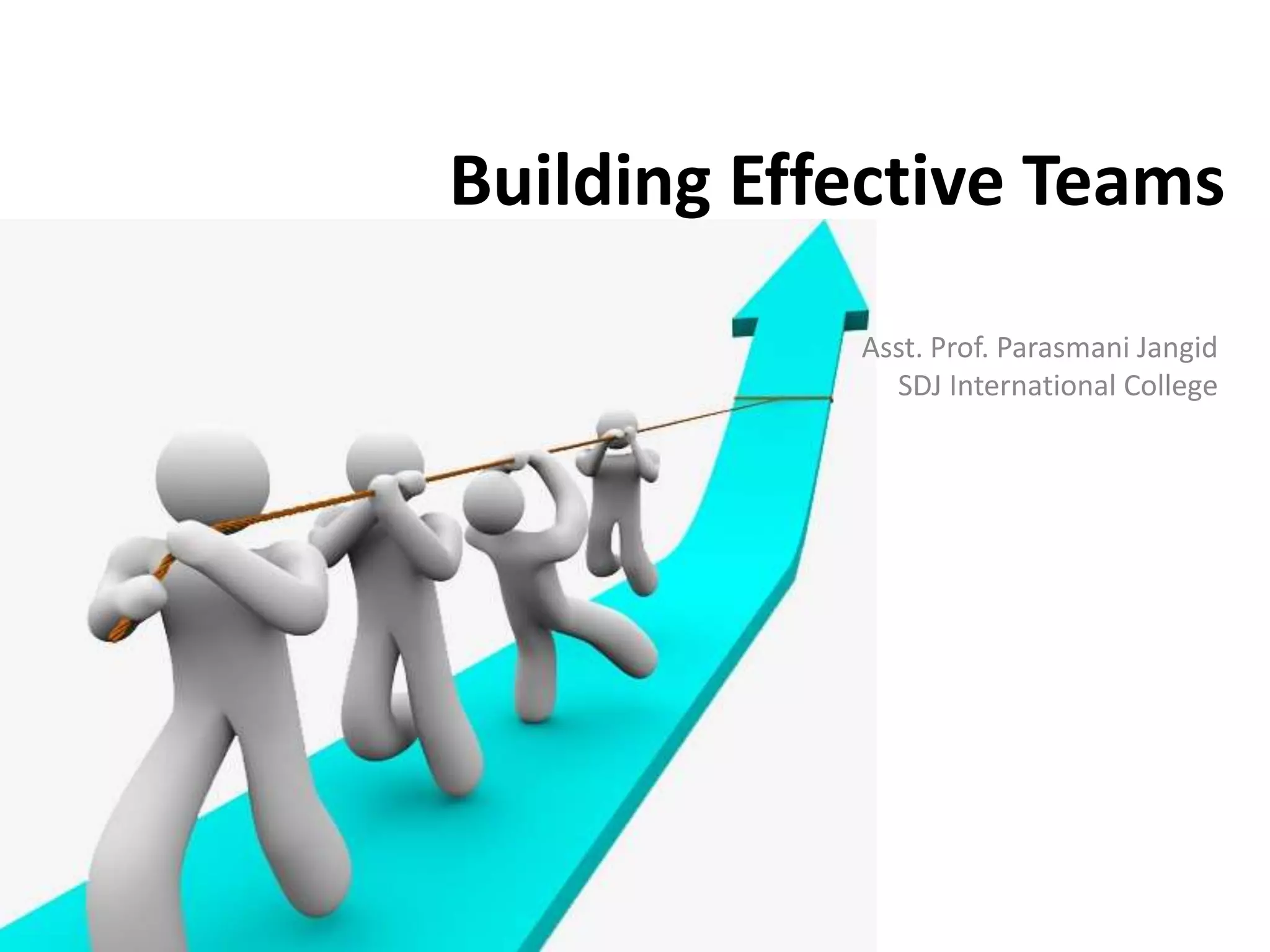
Building Effective Teams
Asst. Prof. Parasmani Jangid
SDJ International College
Meaning
• People come together as a team to achieve a
common goal.
• The combination of experienced, talented and
capable personnel from different department
forms a cross sectional team.
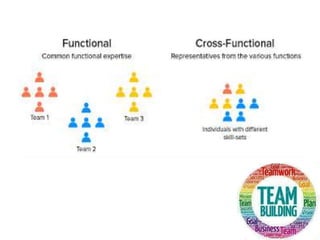
• four common team types - which are:
Functional, Cross-Functional, Virtual, and Self-
directed.
• A cross-functional team is a group of people
with different functional expertise working
toward a common goal. It may include people
from finance, marketing, operations, and
human resources departments. Typically, it
includes employees from all levels of an
organization.
• As defined by Professor Leigh Thompson of the Kellogg
School of Management, "a team is a group of people
who are interdependent with respect to information,
resources, knowledge and skills and who seek to
combine their efforts to achieve a common goal".
• A group does not necessarily constitute a team. Teams
normally have members with complementary skills and
generate synergy through a coordinated effort which
allows each member to maximize their strengths and
minimize their weaknesses
Definition of a Team
“A team is a small number of people with
complementary skills who are committed to a
common purpose, performance goals and
approach for which they hold themselves
mutually accountable.”
- J.R. Katzenbach & D.R. Smith
Characteristics
1. A small group of people
2. Complementary Skills
3. Commitment to common purpose, goal and
approach
4. Mutually Accountable
5. Voluntary Co-operation and support
6. Keep each other informed about the
performance
7. Team creates synergy
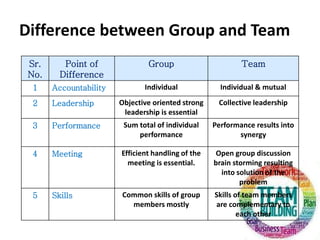
Difference between Group and Team
Sr.
No.
Point of
Difference
Group Team
1 Accountability Individual Individual & mutual
2 Leadership Objective oriented strong
leadership is essential
Collective leadership
3 Performance Sum total of individual
performance
Performance results into
synergy
4 Meeting Efficient handling of the
meeting is essential.
Open group discussion
brain storming resulting
into solution of the
problem
5 Skills Common skills of group
members mostly
Skills of team members
are complementary to
each other
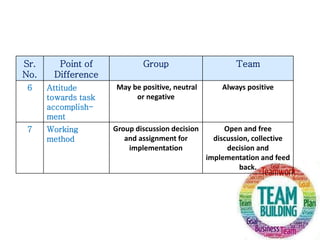
Sr.
No.
Point of
Difference
Group Team
6 Attitude
towards task
accomplish-
ment
May be positive, neutral
or negative
Always positive
7 Working
method
Group discussion decision
and assignment for
implementation
Open and free
discussion, collective
decision and
implementation and feed
back.
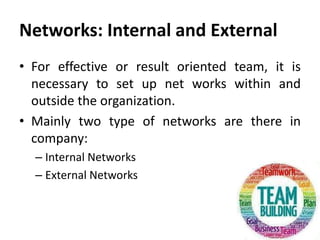
Networks: Internal and External
• For effective or result oriented team, it is
necessary to set up net works within and
outside the organization.
• Mainly two type of networks are there in
company:
– Internal Networks
– External Networks
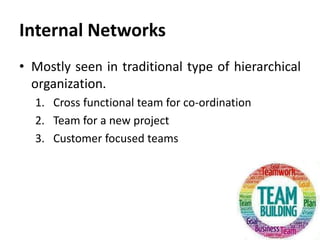
Internal Networks
• Mostly seen in traditional type of hierarchical
organization.
1. Cross functional team for co-ordination
2. Team for a new project
3. Customer focused teams
External Networks
• Formal external networks are important in order
to increase the effectiveness in business.
• Generally external networks are established with
suppliers, customers, bankers, local government
bodies, competitors, etc.
• Benefits
– Constant contact even at remote places
– Cheaper resources
– Strategic alliance
Dynamics of a Team
1. Internal Dynamics
2. External Dynamics
Internal Dynamics
• Internal team dynamics means how the team
members act and react what roles they are
playing, how do they communicate with each
other and how the main goal is achieved.
• It includes the different aspects of working in the
team
– Lifecycle of a team
– Perception of diversified roles and their importance
– Pattern of communication between team members
– Task and maintenance management
• Life cycle of a team
• By Tuckman the life cycle of team divided into
the following stages:
– Forming-Birth
– Storming-Childhood
– Norming-Youth
– Performing-Maturity
– Adjournment-Dissolution of the team
• Importance of Diversified Roles
• Skills would not be beneficial if one (member of the team)
does not able to perform diversified role. It’s motivate
them for goal achievement.
• Role of chairman-direction & co-ordination
• Role of architect – give shape to team performance
• Role of idea appraiser
• Role of resolving conflicts or deadlocks
• Role of expressing new ideas
• Role of connecting link with organization
• Role of administrator
• Role of leader insisting on completion of the task in time.
• Pattern of communication between members
• A good pattern of communication between
team members creates good understanding
and healthy relations between members and
leads to team spirit and co-operation.
• Pattern no. 1: No freedom for free exchange
of ideas & opinions between members. All
information are given through team leader.
Resultantly decisions are likely to be delayed.
• Pattern no. 2: some selected members are
allowed to exchange their ideas freely while some
are restricted to get informed through team
leader only. Unbalanced communication inhibits
team spirit.
• Pattern no. 3: any member of the team is free to
contact with the any other member of the team.
And this free & balanced communication leads to
mutual trust and team spirit building.
• Task and Maintenance Management
• Activities of the team is divided into 2 types-
• A) Task Activities: goal achievement activities, for e.g.
new product development activities, key customers
services activities etc.
• B) Maintenance Activities: activities to maintain the
team in healthy condition, for e.g. designing proper
communication network, manage action reaction
among members, removal of conflicts, motivate the
members for goal achievement, promote harmony
between technical and non-technical members.
External Dynamics
• It includes the different aspects of working in
the team:
– Goal setting
– Interface Management
– Performance Management
– Management of perceptions
• Goal setting
• Every team has its own goal to achieve and proper care must be
taken at the time of goal setting, otherwise team would prove
inefficient in goal achievement. Problems like:
• No Co-operation from the rest of the organization.
• When the team is in need of help and it is not available.
• Mindset is like “Team is temporary”, and thus showing loyalty to
department.
• Cross functional team focusses on customer, which is not liked by
traditional people of organizational.
• Department thinks that team is interfering.
• Goal setting process must involve key executive and employees to
be affected (by team work).
• Interface Management
• It is management of relations. For this support structure is
required. Some companies form the support structure with
team.
• Interface management is a
– process to assist in controlling the activities under task when
efforts are divided among parties (e.g. main executive, key
stake holders, experts, etc.)
– and/or to define and maintain compliance among the task that
should interoperate.
• Main Executive
• Key Stake Holders
• Experts
• Performance Measurement
• Old techniques-budgetary and accounting
• New techniques- market share, capturing of
new markets, customer satisfaction and
delight and also long term interest of the
business
• Rewards can be in the form of appreciation,
financial rewards, delegation of more
authority etc.
• Management of perceptions
• Success of team depends on its perception towards the
organization.
• Opinion depends on the perception and the goal.
• No superiority complex must exist within team
• No feeling of problem solvers or change agent, because it
ultimately leads to end of the very purpose of the team
goal.
• Organization may look at the team from 3 views:
– Rational (their thoughts)
– Political (different departments)
– Emotional (professional approach & their participation from
emotional angle)
The Process of Team Building
1. Identifying the problem
2. Collection of related information
3. Feed back of information to the team
4. Solution of the problem-operational plan
formulation
5. Implementation of the plan and follow up
Guiding Principles for Effective Team
Building
• Clarify the objectives
• Team size should small
• Diversification & complementary skills and roles
• Use internal & external networks
• Communication must be effective
• Encourage the team members & make them
committed to goals & performance.
• True understanding of the team & its links with
rest of the organization.
• Take the executives & employees into confidence.
• Get the co-operation of different dept. for the
working of the team.
• If the job is highly technical ensure availability of
services of experts in time.
• Make appraisal of team performance and reward
the team.
• Team should be accepted as an important part of
organization.
Thank You

Building Effective Teams

  • 1.
    Building Effective Teams Asst.Prof. Parasmani Jangid SDJ International College
  • 2.
    Meaning • People cometogether as a team to achieve a common goal. • The combination of experienced, talented and capable personnel from different department forms a cross sectional team. • four common team types - which are: Functional, Cross-Functional, Virtual, and Self- directed.
  • 3.
    • A cross-functionalteam is a group of people with different functional expertise working toward a common goal. It may include people from finance, marketing, operations, and human resources departments. Typically, it includes employees from all levels of an organization.
  • 5.
    • As definedby Professor Leigh Thompson of the Kellogg School of Management, "a team is a group of people who are interdependent with respect to information, resources, knowledge and skills and who seek to combine their efforts to achieve a common goal". • A group does not necessarily constitute a team. Teams normally have members with complementary skills and generate synergy through a coordinated effort which allows each member to maximize their strengths and minimize their weaknesses
  • 6.
    Definition of aTeam “A team is a small number of people with complementary skills who are committed to a common purpose, performance goals and approach for which they hold themselves mutually accountable.” - J.R. Katzenbach & D.R. Smith
  • 7.
    Characteristics 1. A smallgroup of people 2. Complementary Skills 3. Commitment to common purpose, goal and approach 4. Mutually Accountable 5. Voluntary Co-operation and support 6. Keep each other informed about the performance 7. Team creates synergy
  • 8.
    Difference between Groupand Team Sr. No. Point of Difference Group Team 1 Accountability Individual Individual & mutual 2 Leadership Objective oriented strong leadership is essential Collective leadership 3 Performance Sum total of individual performance Performance results into synergy 4 Meeting Efficient handling of the meeting is essential. Open group discussion brain storming resulting into solution of the problem 5 Skills Common skills of group members mostly Skills of team members are complementary to each other
  • 9.
    Sr. No. Point of Difference Group Team 6Attitude towards task accomplish- ment May be positive, neutral or negative Always positive 7 Working method Group discussion decision and assignment for implementation Open and free discussion, collective decision and implementation and feed back.
  • 10.
    Networks: Internal andExternal • For effective or result oriented team, it is necessary to set up net works within and outside the organization. • Mainly two type of networks are there in company: – Internal Networks – External Networks
  • 11.
    Internal Networks • Mostlyseen in traditional type of hierarchical organization. 1. Cross functional team for co-ordination 2. Team for a new project 3. Customer focused teams
  • 12.
    External Networks • Formalexternal networks are important in order to increase the effectiveness in business. • Generally external networks are established with suppliers, customers, bankers, local government bodies, competitors, etc. • Benefits – Constant contact even at remote places – Cheaper resources – Strategic alliance
  • 13.
    Dynamics of aTeam 1. Internal Dynamics 2. External Dynamics
  • 14.
    Internal Dynamics • Internalteam dynamics means how the team members act and react what roles they are playing, how do they communicate with each other and how the main goal is achieved. • It includes the different aspects of working in the team – Lifecycle of a team – Perception of diversified roles and their importance – Pattern of communication between team members – Task and maintenance management
  • 15.
    • Life cycleof a team • By Tuckman the life cycle of team divided into the following stages: – Forming-Birth – Storming-Childhood – Norming-Youth – Performing-Maturity – Adjournment-Dissolution of the team
  • 16.
    • Importance ofDiversified Roles • Skills would not be beneficial if one (member of the team) does not able to perform diversified role. It’s motivate them for goal achievement. • Role of chairman-direction & co-ordination • Role of architect – give shape to team performance • Role of idea appraiser • Role of resolving conflicts or deadlocks • Role of expressing new ideas • Role of connecting link with organization • Role of administrator • Role of leader insisting on completion of the task in time.
  • 17.
    • Pattern ofcommunication between members • A good pattern of communication between team members creates good understanding and healthy relations between members and leads to team spirit and co-operation. • Pattern no. 1: No freedom for free exchange of ideas & opinions between members. All information are given through team leader. Resultantly decisions are likely to be delayed.
  • 18.
    • Pattern no.2: some selected members are allowed to exchange their ideas freely while some are restricted to get informed through team leader only. Unbalanced communication inhibits team spirit. • Pattern no. 3: any member of the team is free to contact with the any other member of the team. And this free & balanced communication leads to mutual trust and team spirit building.
  • 19.
    • Task andMaintenance Management • Activities of the team is divided into 2 types- • A) Task Activities: goal achievement activities, for e.g. new product development activities, key customers services activities etc. • B) Maintenance Activities: activities to maintain the team in healthy condition, for e.g. designing proper communication network, manage action reaction among members, removal of conflicts, motivate the members for goal achievement, promote harmony between technical and non-technical members.
  • 20.
    External Dynamics • Itincludes the different aspects of working in the team: – Goal setting – Interface Management – Performance Management – Management of perceptions
  • 21.
    • Goal setting •Every team has its own goal to achieve and proper care must be taken at the time of goal setting, otherwise team would prove inefficient in goal achievement. Problems like: • No Co-operation from the rest of the organization. • When the team is in need of help and it is not available. • Mindset is like “Team is temporary”, and thus showing loyalty to department. • Cross functional team focusses on customer, which is not liked by traditional people of organizational. • Department thinks that team is interfering. • Goal setting process must involve key executive and employees to be affected (by team work).
  • 22.
    • Interface Management •It is management of relations. For this support structure is required. Some companies form the support structure with team. • Interface management is a – process to assist in controlling the activities under task when efforts are divided among parties (e.g. main executive, key stake holders, experts, etc.) – and/or to define and maintain compliance among the task that should interoperate. • Main Executive • Key Stake Holders • Experts
  • 23.
    • Performance Measurement •Old techniques-budgetary and accounting • New techniques- market share, capturing of new markets, customer satisfaction and delight and also long term interest of the business • Rewards can be in the form of appreciation, financial rewards, delegation of more authority etc.
  • 24.
    • Management ofperceptions • Success of team depends on its perception towards the organization. • Opinion depends on the perception and the goal. • No superiority complex must exist within team • No feeling of problem solvers or change agent, because it ultimately leads to end of the very purpose of the team goal. • Organization may look at the team from 3 views: – Rational (their thoughts) – Political (different departments) – Emotional (professional approach & their participation from emotional angle)
  • 25.
    The Process ofTeam Building 1. Identifying the problem 2. Collection of related information 3. Feed back of information to the team 4. Solution of the problem-operational plan formulation 5. Implementation of the plan and follow up
  • 26.
    Guiding Principles forEffective Team Building • Clarify the objectives • Team size should small • Diversification & complementary skills and roles • Use internal & external networks • Communication must be effective • Encourage the team members & make them committed to goals & performance. • True understanding of the team & its links with rest of the organization.
  • 27.
    • Take theexecutives & employees into confidence. • Get the co-operation of different dept. for the working of the team. • If the job is highly technical ensure availability of services of experts in time. • Make appraisal of team performance and reward the team. • Team should be accepted as an important part of organization.
  • 28.