PEOPLE MANAGEMENT
Fabio Palomba
lunedì 8 ottobre 12
How managing people
Why managing people
Choosing and keeping people
lunedì 8 ottobre 12
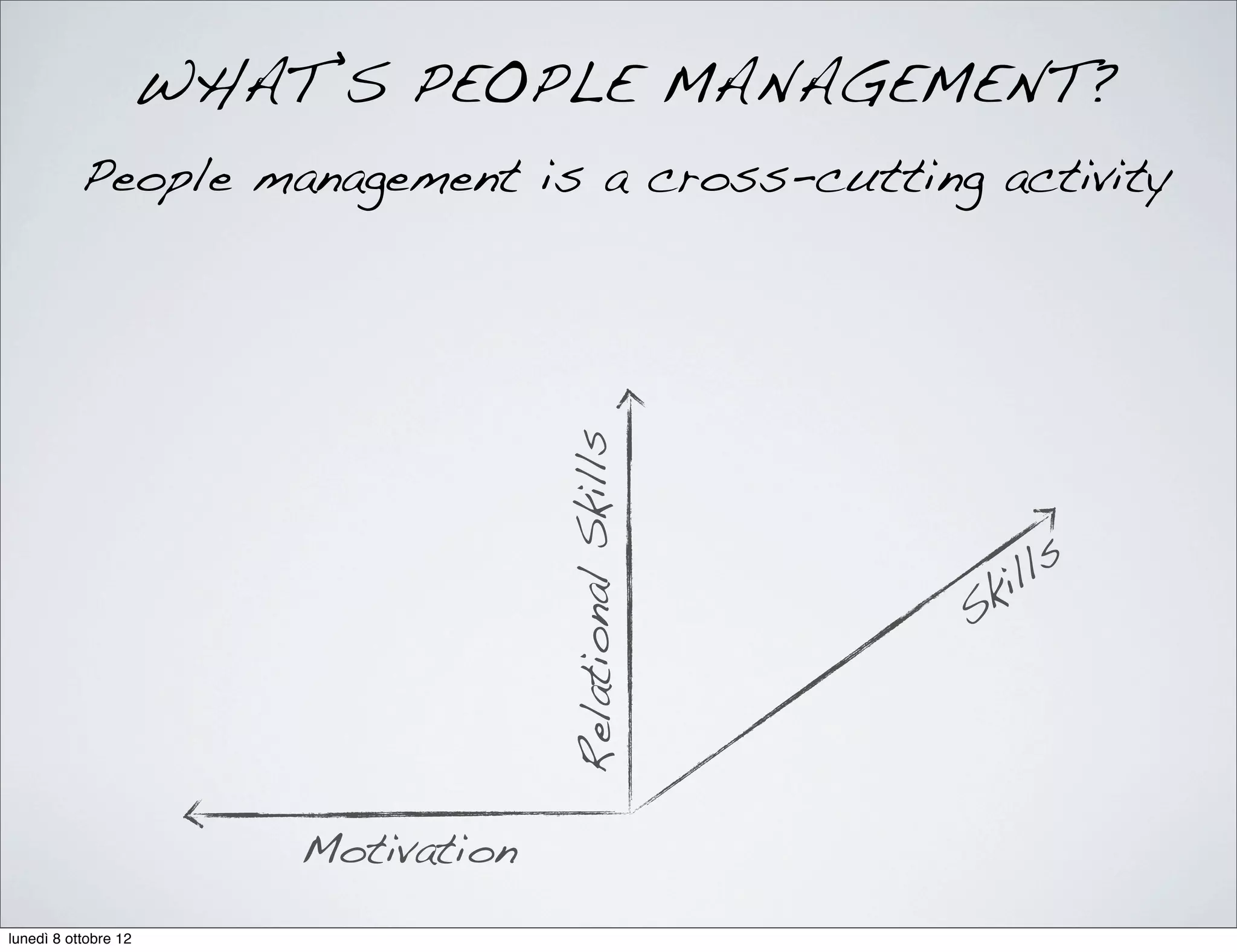
Motivation
Skills
RelationalSkills
People management is a cross-cutting activity
WHAT’S PEOPLE MANAGEMENT?
lunedì 8 ottobre 12
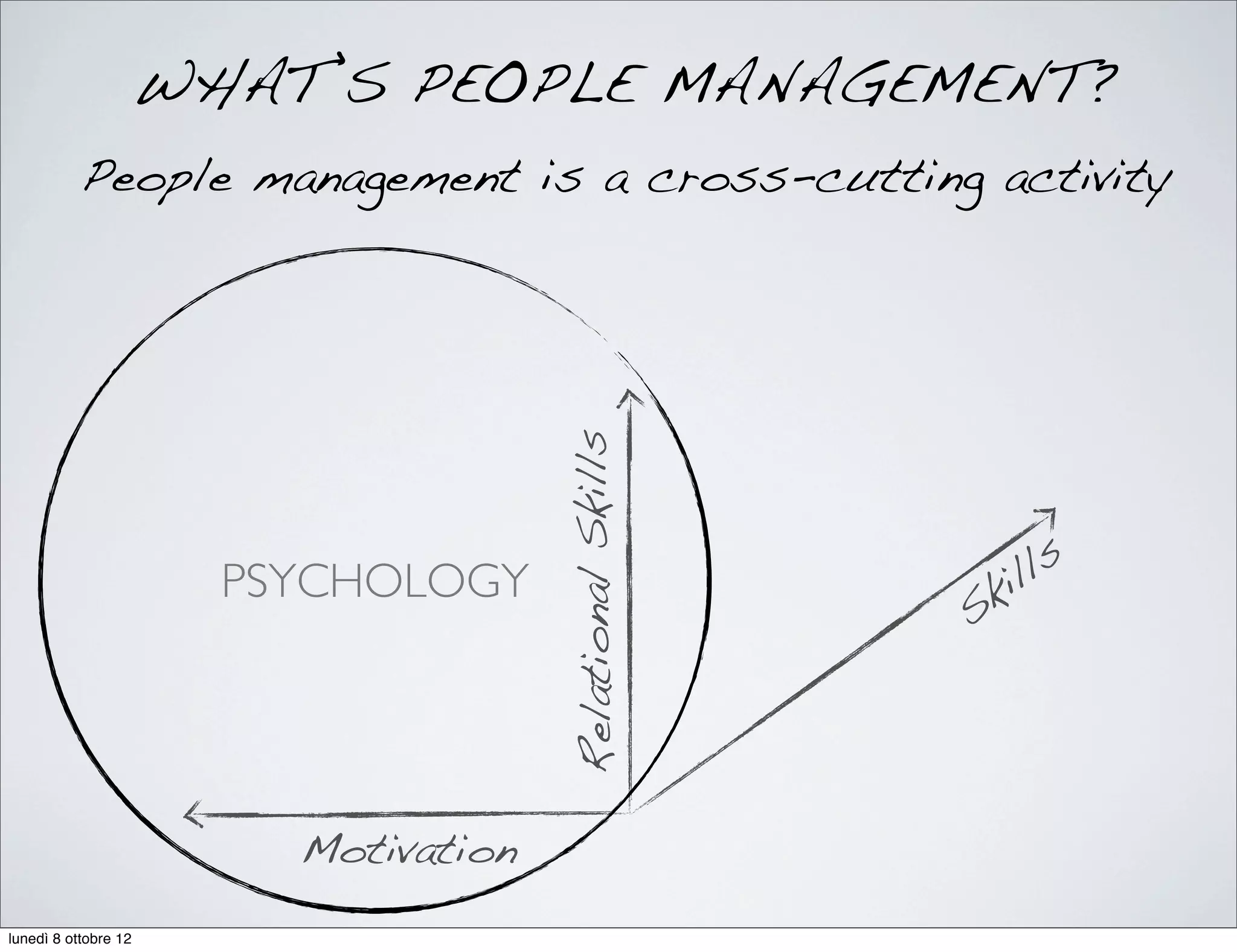
Motivation
Skills
RelationalSkills
People management is a cross-cutting activity
WHAT’S PEOPLE MANAGEMENT?
PSYCHOLOGY
lunedì 8 ottobre 12
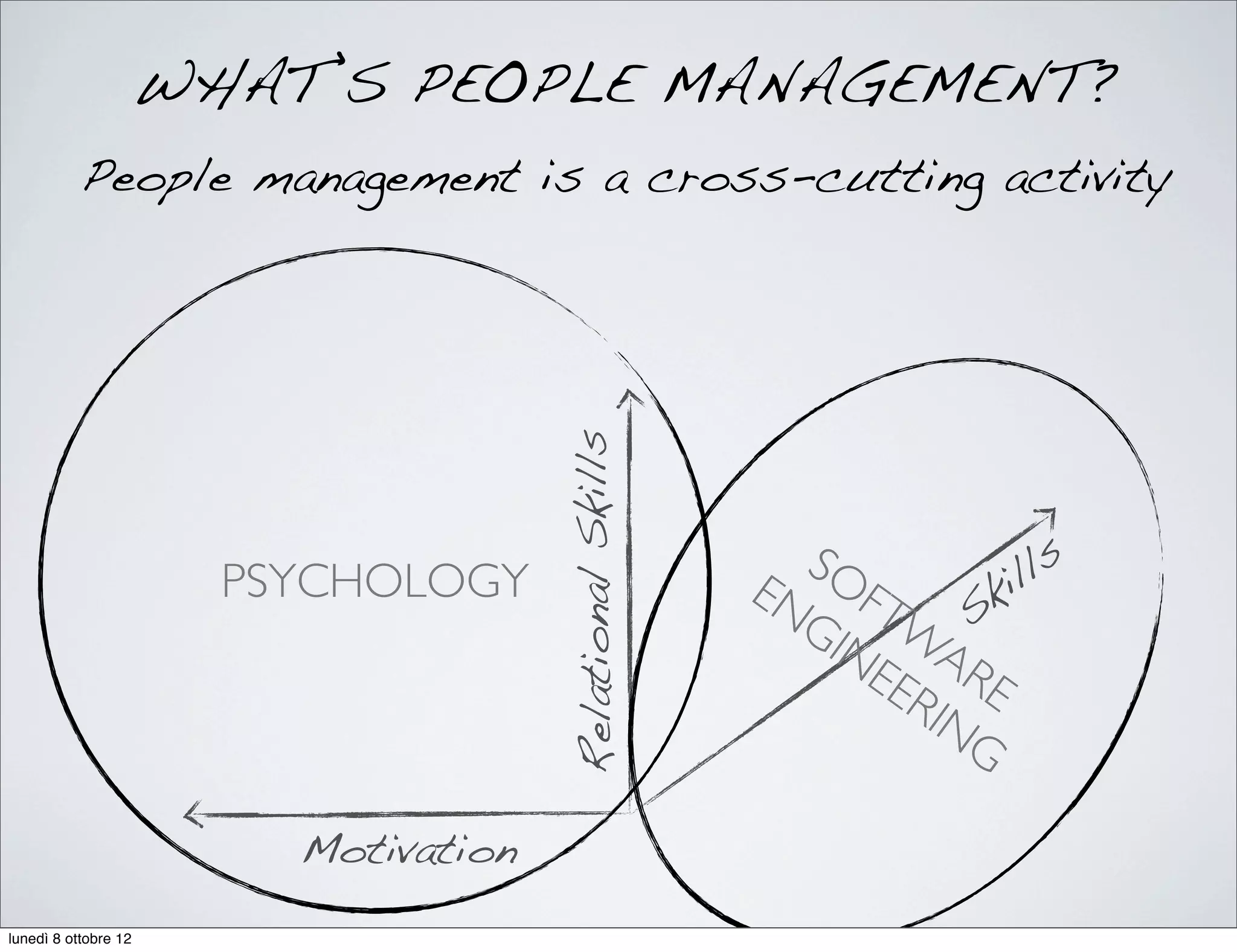
Motivation
Skills
RelationalSkills
People management is a cross-cutting activity
WHAT’S PEOPLE MANAGEMENT?
PSYCHOLOGY
SOFTW
ARE
ENGINEERING
lunedì 8 ottobre 12
“All management is people management.”
WHY MANAGING PEOPLE?
“A company is only as good as the people it
keeps.”
“The only way to get people to like working hard
is to motivate them. Today, people must
understand why they're working hard. Every
individual in an organization is motivated by
something different.”
lunedì 8 ottobre 12
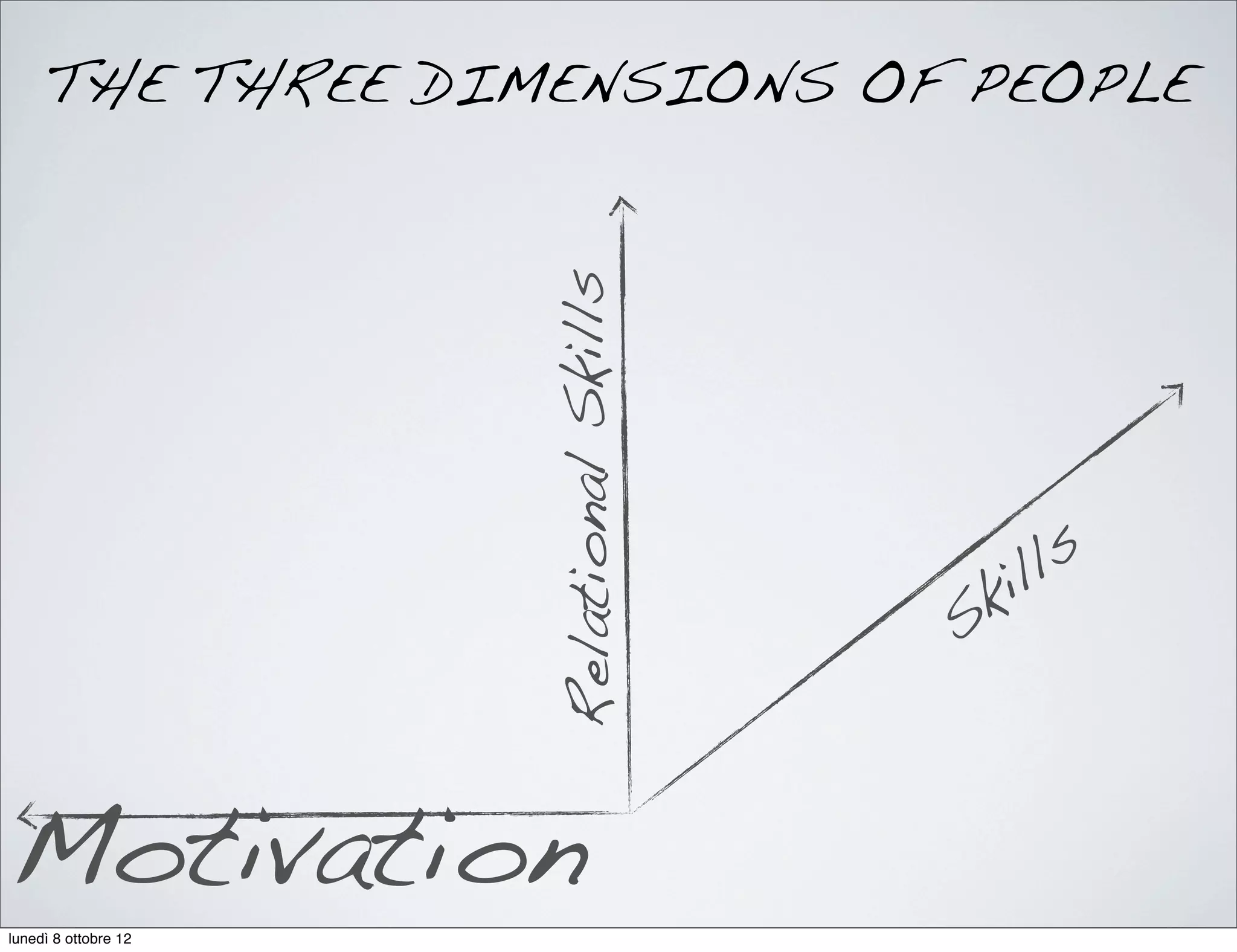
THE THREE DIMENSIONS OF PEOPLE
Motivation
Skills
RelationalSkills
lunedì 8 ottobre 12
THE THREE DIMENSIONS OF PEOPLE
Motivation
Skills
RelationalSkills
lunedì 8 ottobre 12
MOTIVATION
How managing people
Esteem needs
Social needs
Safety needs
Physiological needs
Motivating people is the
most important role of a
manager
Human Needs Hierarchy
Motivated people work
better!
lunedì 8 ottobre 12
Impact of People Management Practices on Business
Performance [Patterson et al.]
The impact of strategical human resource management on
Organizational Performance [Caliskan]
There’s an huge impact of
people management on
the success of a project
MOTIVATION
How managing people
lunedì 8 ottobre 12
MOTIVATION
How managing people
Esteem needs
Social needs
Safety needs
Physiological needs
Motivations depend on satisfying needs
It can be assumed that physiological and safety
needs are satisfied
Social, esteem and self-realization are most
significant from a managerial viewpoint
lunedì 8 ottobre 12
Esteem needs
Social needs
Safety needs
Physiological needs
MOTIVATION
How managing people
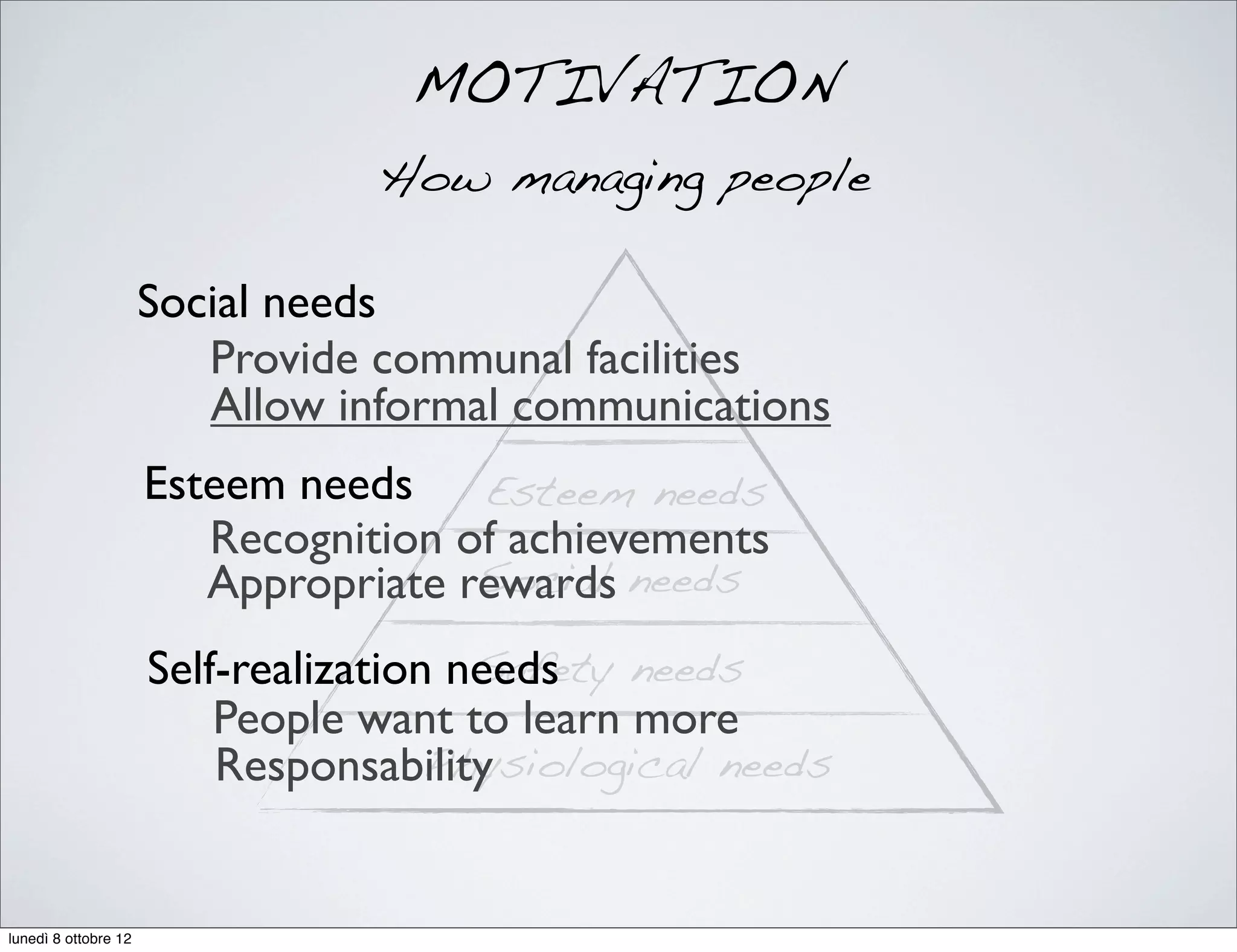
Social needs
Provide communal facilities
Allow informal communications
Esteem needs
Recognition of achievements
Appropriate rewards
Self-realization needs
People want to learn more
Responsability
lunedì 8 ottobre 12
MOTIVATION
How managing people
Listen, listen,
listen...
Rethink, review,
and reward
Be fair
Be flexible
Focus only on
solutions and not
on problems
Rid your mind of the
word “manager” and
replace it with
“leader”
Scorn in private,
praise in public
Include your
team in key
management
decisions
lunedì 8 ottobre 12
Motivation
Skills
RelationalSkills
THE THREE DIMENSIONS OF PEOPLE
lunedì 8 ottobre 12
Motivation
Skills
RelationalSkills
THE THREE DIMENSIONS OF PEOPLE
lunedì 8 ottobre 12
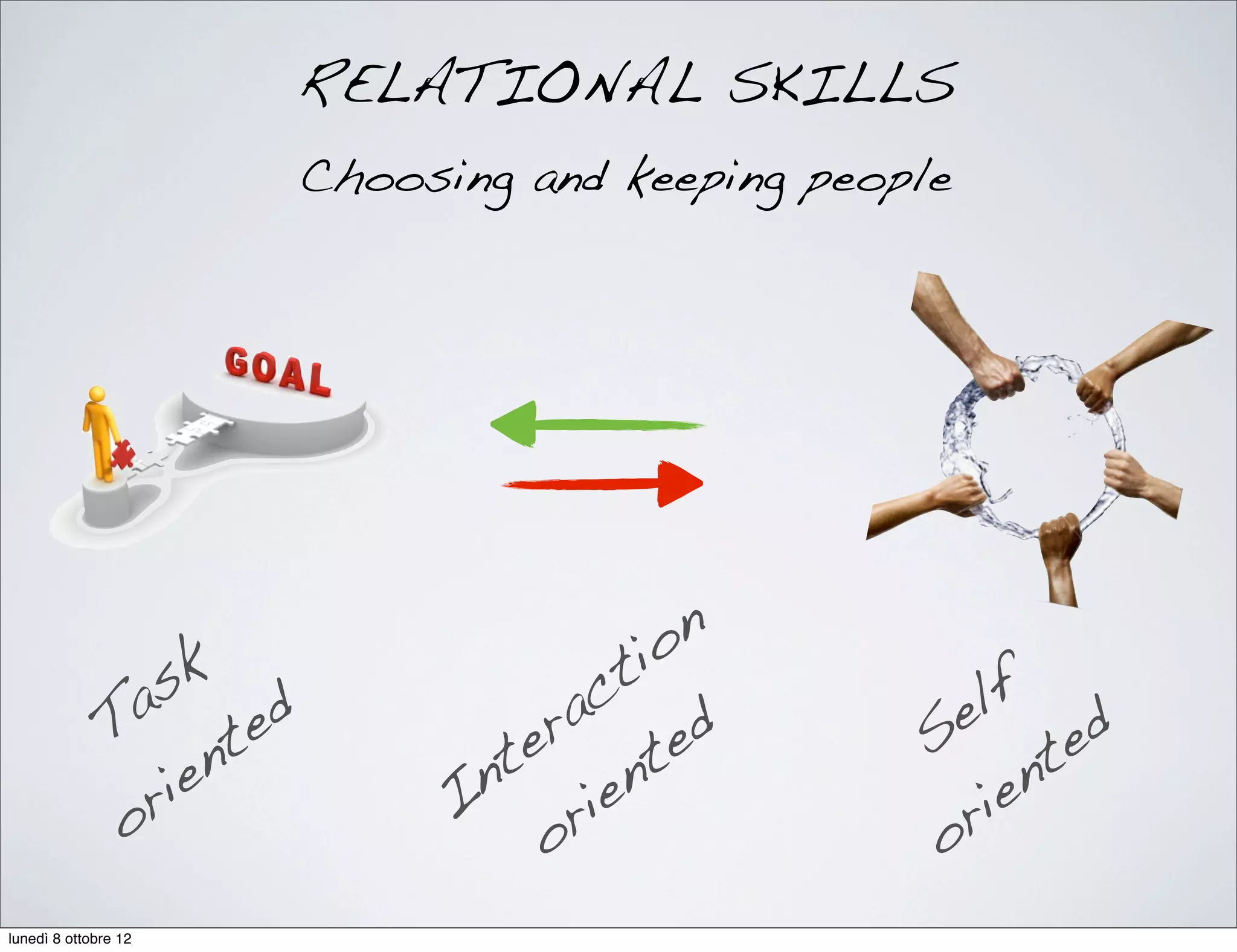
RELATIONAL SKILLS
Choosing and keeping people
Task
oriented
Interaction
oriented Self
oriented
lunedì 8 ottobre 12
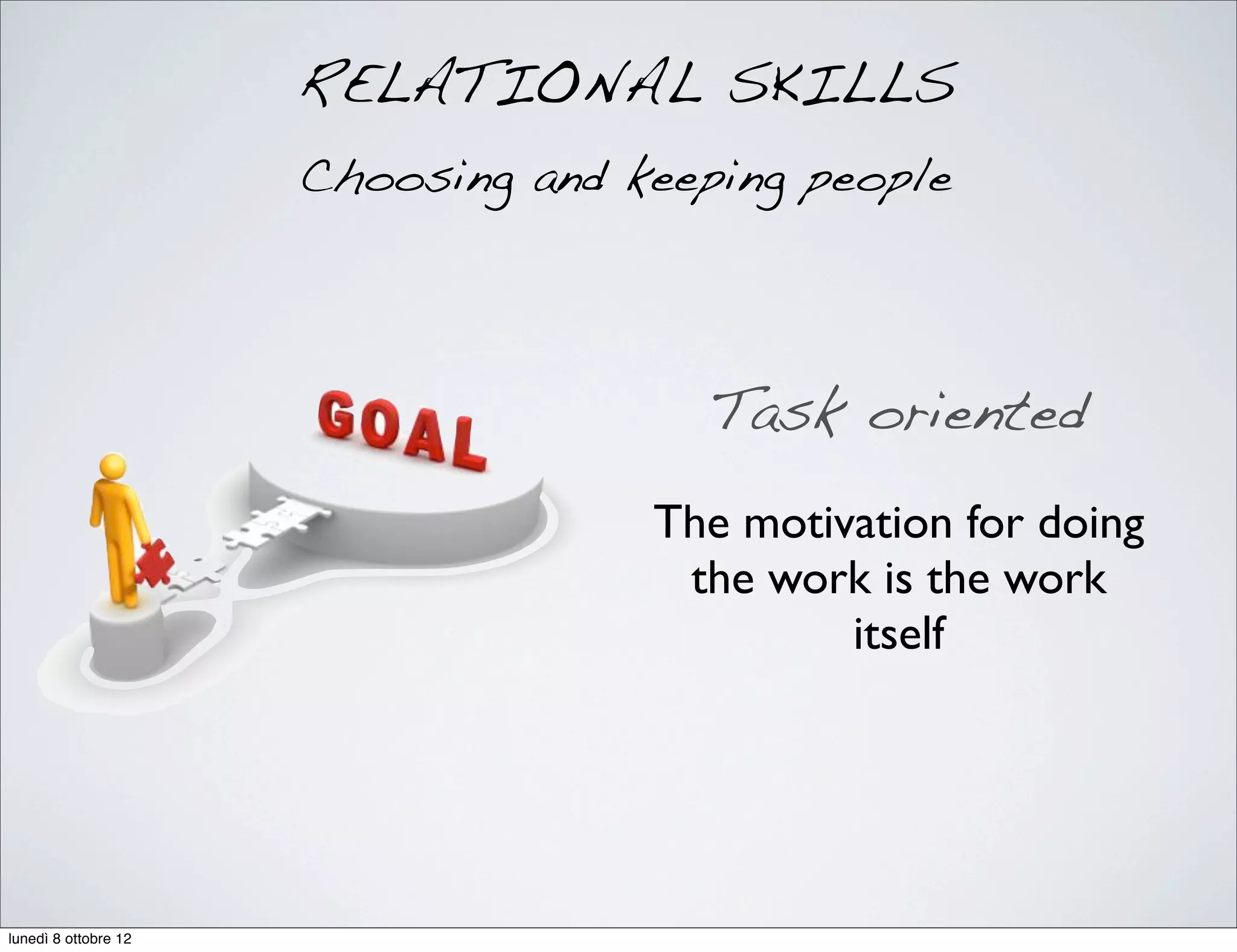
RELATIONAL SKILLS
Choosing and keeping people
Task oriented
The motivation for doing
the work is the work
itself
lunedì 8 ottobre 12
RELATIONAL SKILLS
Choosing and keeping people
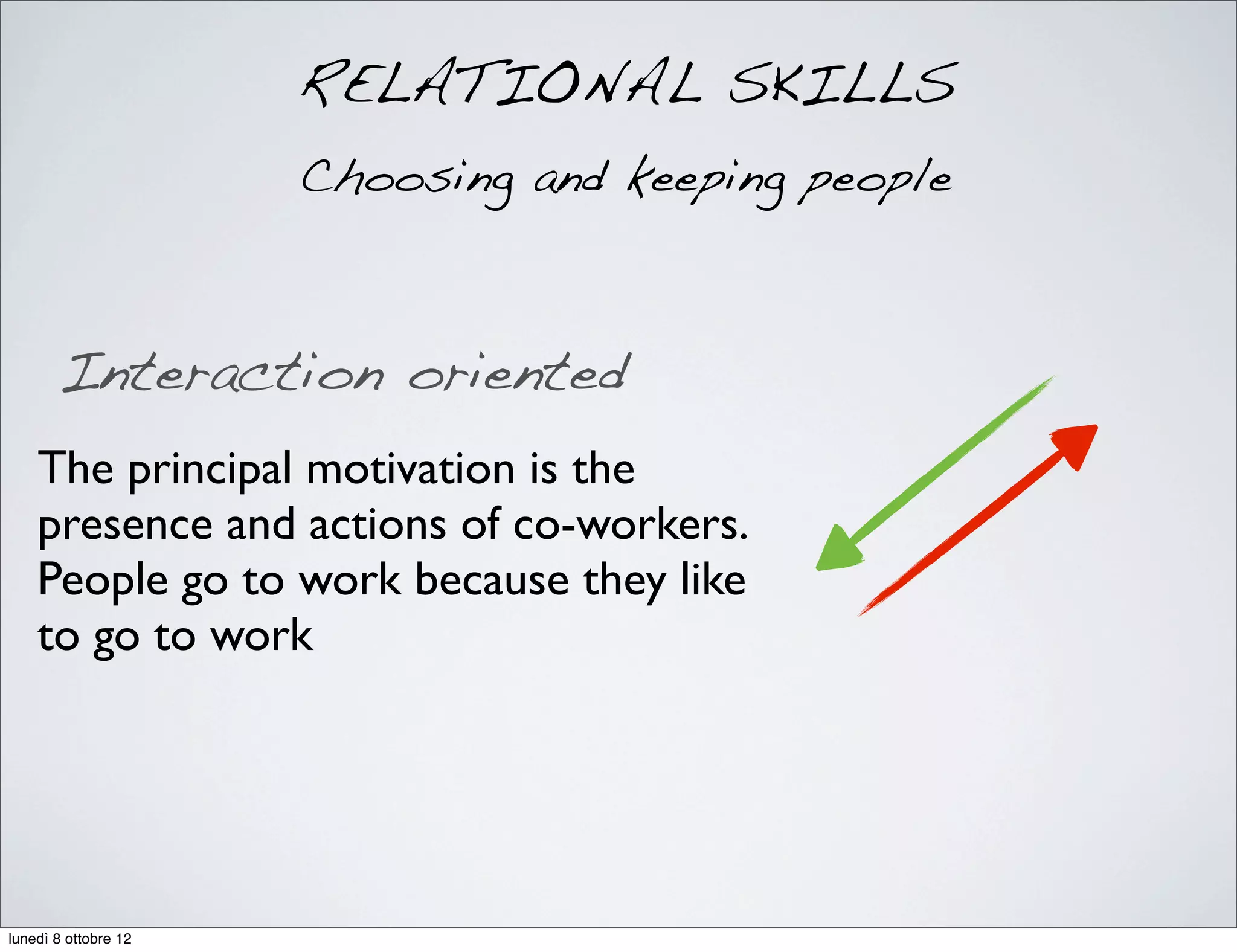
Interaction oriented
The principal motivation is the
presence and actions of co-workers.
People go to work because they like
to go to work
lunedì 8 ottobre 12
RELATIONAL SKILLS
Choosing and keeping people
Self oriented
The work is a means to an end
which is the achievement of
individual goals - e.g. to get rich, to
play tennis, to travel etc.
lunedì 8 ottobre 12
Group composed of members who share the same motivation can be problematic!
Task-oriented - everyone wants to do their own thing
Self-oriented - everyone wants to be the boss
Interaction-oriented - too much chatting, not enough work
An effective group has a balance of all types (can be difficult to achieve because
most engineers are task-oriented)
RELATIONAL SKILLS
Choosing and keeping people
lunedì 8 ottobre 12
OTHER ISSUES...
Group leadership, organization, communication...
lunedì 8 ottobre 12
GROUP LEADERSHIP
How to choose a good leader?
There may be both a technical and an
administrative leader
Democratic leadership is more effective
than autocratic leadership
A career path based on technical
competence should be supported
lunedì 8 ottobre 12
Sex composition and Leadership in Small Groups
[Eskilson et al.]
GROUP LEADERSHIP
How to choose a good leader?
Group
leadership
W
oman
leadership
lunedì 8 ottobre 12
GROUP ORGANIZATION
Types
Democratic Decentralised
Controlled Centralised
Controlled Decentralised
No permanent leader
Horizontal communication
A leader coordinates the activities
Horizontal communication
Collective decisions
High level decisions and coordination made by the leader
Vertical communication
lunedì 8 ottobre 12
GROUP ORGANIZATION
Democratic team organization
The group acts as a whole and comes to a consensus on decisions affecting the system
The group leader serves as the external interface of the group but does not allocate specific
work items
Rather, work is discussed by the group as a whole and tasks are allocated according to ability
and experience
This approach is successful for groups where
all members are experienced and competent
lunedì 8 ottobre 12
GROUP ORGANIZATION
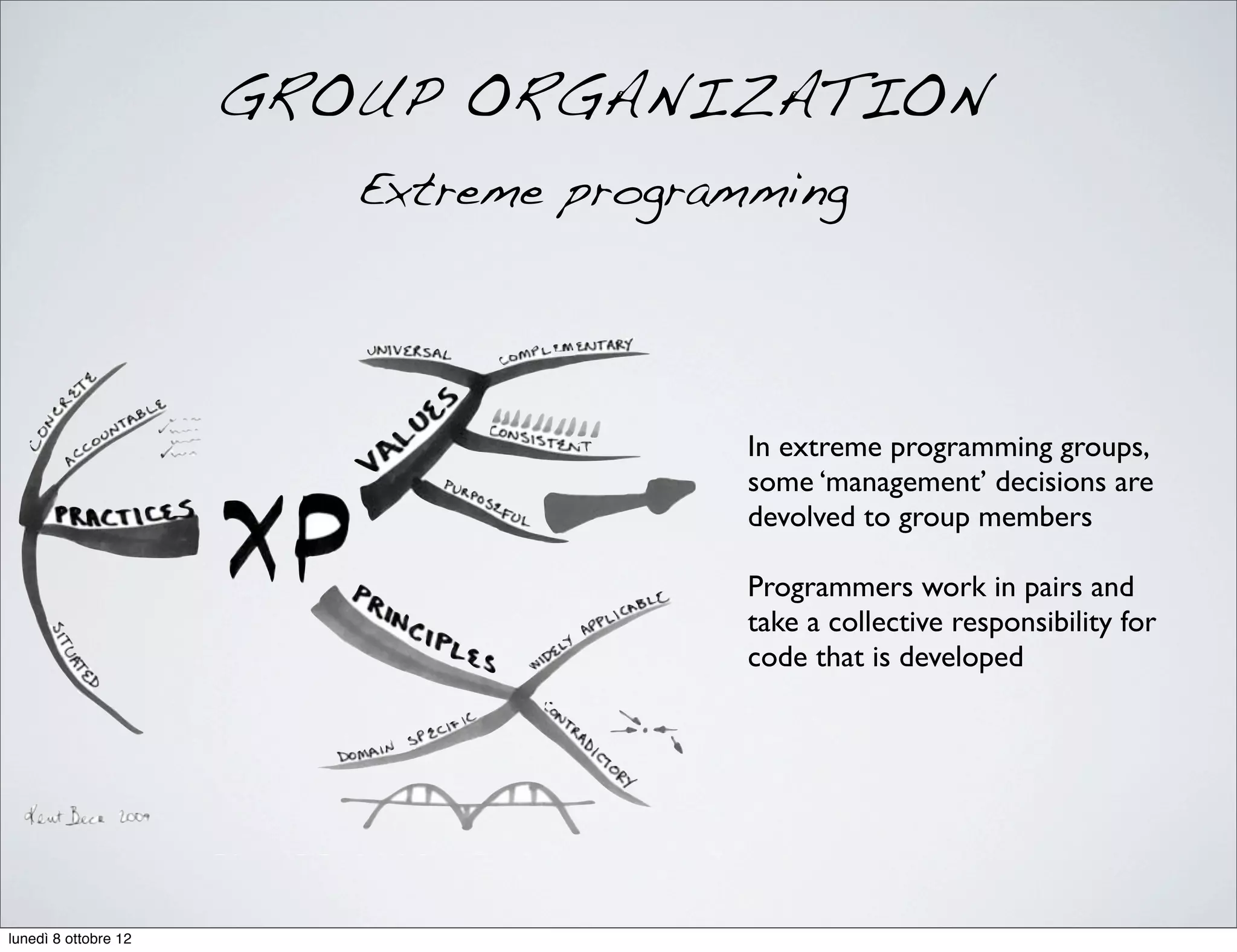
Extreme programming
In extreme programming groups,
some ‘management’ decisions are
devolved to group members
Programmers work in pairs and
take a collective responsibility for
code that is developed
lunedì 8 ottobre 12
GROUP ORGANIZATION
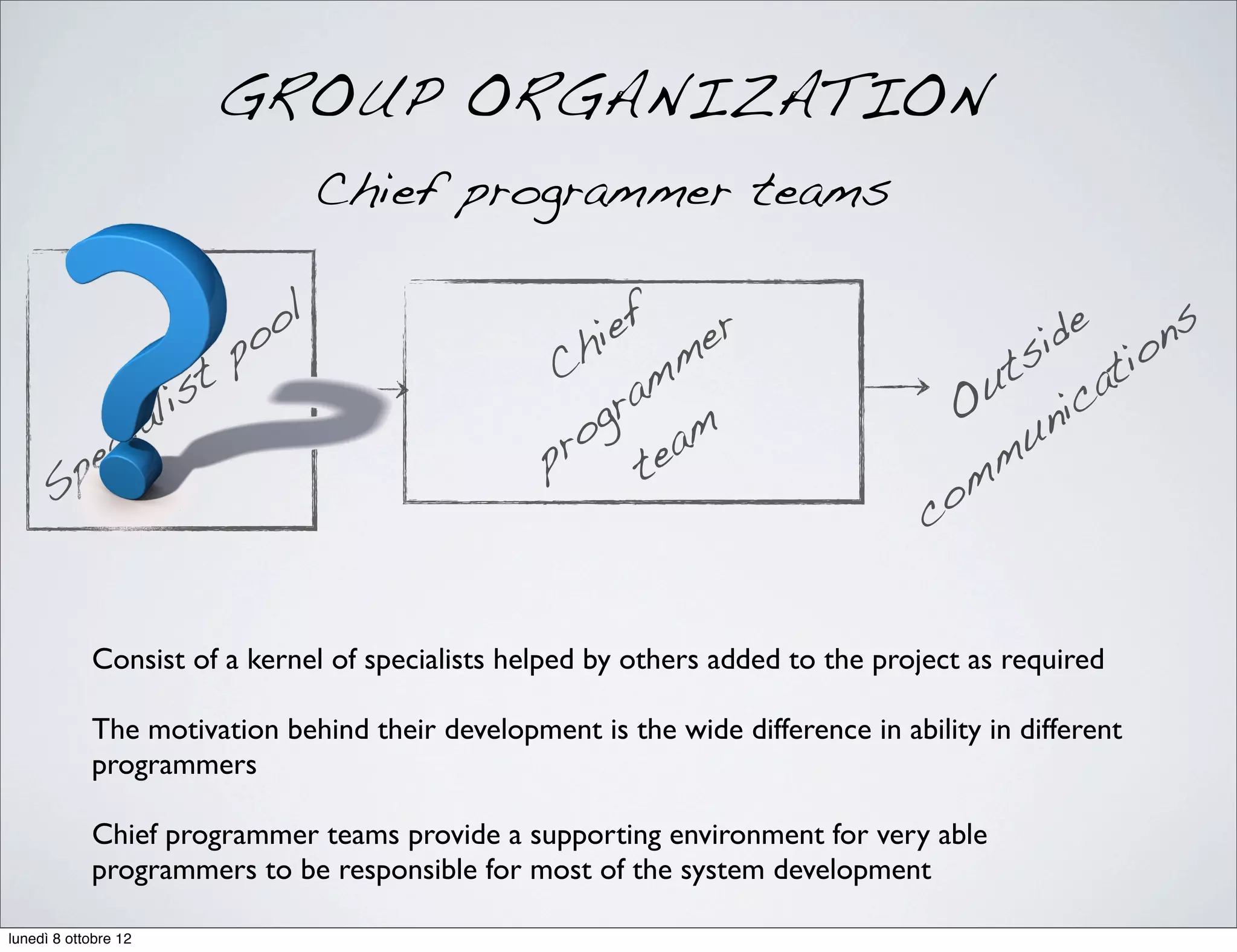
Chief programmer teams
Specialist
pool
Chief
programmer
team
Outside
communications
Consist of a kernel of specialists helped by others added to the project as required
The motivation behind their development is the wide difference in ability in different
programmers
Chief programmer teams provide a supporting environment for very able
programmers to be responsible for most of the system development
lunedì 8 ottobre 12
GROUP ORGANIZATION
Chief programmer teams
Specialist
pool
Chief
programmer
team
Outside
communications
Consist of a kernel of specialists helped by others added to the project as required
The motivation behind their development is the wide difference in ability in different
programmers
Chief programmer teams provide a supporting environment for very able
programmers to be responsible for most of the system development
lunedì 8 ottobre 12
GROUP COMMUNICATION
Types
Formal and impersonal strategies
Based on documents, software artefacts, project checkpoints, etc.
Formal and inter-personal procedures
Based on Software Quality Assurance, review meetings, audits, software
inspections
Informal and inter-personal procedures
Group meeting to disseminate information, to solve problems, to identify
requirements, and to assign tasks
Electronic communications
Inter-personal network
Informal discussion with team members and external people with greater
experience or who can provide a different viewpoint
lunedì 8 ottobre 12
GROUP COMMUNICATION
Factors of influence
Communication
channel
Sexual
composition of
group
Personalities in
groups
Status of group
member
lunedì 8 ottobre 12
TO DO...
Social events
Group
identity
lunedì 8 ottobre 12
TO DO...
Group members tend to be loyal to cohesive groups
'Groupthink' is preservation of group irrespective of technical or organizational
considerations
Management should act positively to avoid groupthink by forcing external involvement
with each group
lunedì 8 ottobre 12
PEOPLE CAPABILITY MATURITY
MODEL
Optimizing
Repeatable
Initial
Defined
Managed
Instill basic discipline into
workforce activities
Identify primary competencies and align workforce
activities with them
Quantitatively manage organizational growthin
workforce capabilities and establish competency-
based teams
Continuously improve methods for developing
personal and organizational competence
lunedì 8 ottobre 12
Thank you!
Questions and/or
comments
Fabio Palomba
0522500157
fabio.palomba.89@gmail.com
lunedì 8 ottobre 12

People management

  • 1.
  • 2.
    How managing people Whymanaging people Choosing and keeping people lunedì 8 ottobre 12
  • 3.
    Motivation Skills RelationalSkills People management isa cross-cutting activity WHAT’S PEOPLE MANAGEMENT? lunedì 8 ottobre 12
  • 4.
    Motivation Skills RelationalSkills People management isa cross-cutting activity WHAT’S PEOPLE MANAGEMENT? PSYCHOLOGY lunedì 8 ottobre 12
  • 5.
    Motivation Skills RelationalSkills People management isa cross-cutting activity WHAT’S PEOPLE MANAGEMENT? PSYCHOLOGY SOFTW ARE ENGINEERING lunedì 8 ottobre 12
  • 6.
    “All management ispeople management.” WHY MANAGING PEOPLE? “A company is only as good as the people it keeps.” “The only way to get people to like working hard is to motivate them. Today, people must understand why they're working hard. Every individual in an organization is motivated by something different.” lunedì 8 ottobre 12
  • 7.
    THE THREE DIMENSIONSOF PEOPLE Motivation Skills RelationalSkills lunedì 8 ottobre 12
  • 8.
    THE THREE DIMENSIONSOF PEOPLE Motivation Skills RelationalSkills lunedì 8 ottobre 12
  • 9.
    MOTIVATION How managing people Esteemneeds Social needs Safety needs Physiological needs Motivating people is the most important role of a manager Human Needs Hierarchy Motivated people work better! lunedì 8 ottobre 12
  • 10.
    Impact of PeopleManagement Practices on Business Performance [Patterson et al.] The impact of strategical human resource management on Organizational Performance [Caliskan] There’s an huge impact of people management on the success of a project MOTIVATION How managing people lunedì 8 ottobre 12
  • 11.
    MOTIVATION How managing people Esteemneeds Social needs Safety needs Physiological needs Motivations depend on satisfying needs It can be assumed that physiological and safety needs are satisfied Social, esteem and self-realization are most significant from a managerial viewpoint lunedì 8 ottobre 12
  • 12.
    Esteem needs Social needs Safetyneeds Physiological needs MOTIVATION How managing people Social needs Provide communal facilities Allow informal communications Esteem needs Recognition of achievements Appropriate rewards Self-realization needs People want to learn more Responsability lunedì 8 ottobre 12
  • 13.
    MOTIVATION How managing people Listen,listen, listen... Rethink, review, and reward Be fair Be flexible Focus only on solutions and not on problems Rid your mind of the word “manager” and replace it with “leader” Scorn in private, praise in public Include your team in key management decisions lunedì 8 ottobre 12
  • 14.
  • 15.
  • 16.
    RELATIONAL SKILLS Choosing andkeeping people Task oriented Interaction oriented Self oriented lunedì 8 ottobre 12
  • 17.
    RELATIONAL SKILLS Choosing andkeeping people Task oriented The motivation for doing the work is the work itself lunedì 8 ottobre 12
  • 18.
    RELATIONAL SKILLS Choosing andkeeping people Interaction oriented The principal motivation is the presence and actions of co-workers. People go to work because they like to go to work lunedì 8 ottobre 12
  • 19.
    RELATIONAL SKILLS Choosing andkeeping people Self oriented The work is a means to an end which is the achievement of individual goals - e.g. to get rich, to play tennis, to travel etc. lunedì 8 ottobre 12
  • 20.
    Group composed ofmembers who share the same motivation can be problematic! Task-oriented - everyone wants to do their own thing Self-oriented - everyone wants to be the boss Interaction-oriented - too much chatting, not enough work An effective group has a balance of all types (can be difficult to achieve because most engineers are task-oriented) RELATIONAL SKILLS Choosing and keeping people lunedì 8 ottobre 12
  • 21.
    OTHER ISSUES... Group leadership,organization, communication... lunedì 8 ottobre 12
  • 22.
    GROUP LEADERSHIP How tochoose a good leader? There may be both a technical and an administrative leader Democratic leadership is more effective than autocratic leadership A career path based on technical competence should be supported lunedì 8 ottobre 12
  • 23.
    Sex composition andLeadership in Small Groups [Eskilson et al.] GROUP LEADERSHIP How to choose a good leader? Group leadership W oman leadership lunedì 8 ottobre 12
  • 24.
    GROUP ORGANIZATION Types Democratic Decentralised ControlledCentralised Controlled Decentralised No permanent leader Horizontal communication A leader coordinates the activities Horizontal communication Collective decisions High level decisions and coordination made by the leader Vertical communication lunedì 8 ottobre 12
  • 25.
    GROUP ORGANIZATION Democratic teamorganization The group acts as a whole and comes to a consensus on decisions affecting the system The group leader serves as the external interface of the group but does not allocate specific work items Rather, work is discussed by the group as a whole and tasks are allocated according to ability and experience This approach is successful for groups where all members are experienced and competent lunedì 8 ottobre 12
  • 26.
    GROUP ORGANIZATION Extreme programming Inextreme programming groups, some ‘management’ decisions are devolved to group members Programmers work in pairs and take a collective responsibility for code that is developed lunedì 8 ottobre 12
  • 27.
    GROUP ORGANIZATION Chief programmerteams Specialist pool Chief programmer team Outside communications Consist of a kernel of specialists helped by others added to the project as required The motivation behind their development is the wide difference in ability in different programmers Chief programmer teams provide a supporting environment for very able programmers to be responsible for most of the system development lunedì 8 ottobre 12
  • 28.
    GROUP ORGANIZATION Chief programmerteams Specialist pool Chief programmer team Outside communications Consist of a kernel of specialists helped by others added to the project as required The motivation behind their development is the wide difference in ability in different programmers Chief programmer teams provide a supporting environment for very able programmers to be responsible for most of the system development lunedì 8 ottobre 12
  • 29.
    GROUP COMMUNICATION Types Formal andimpersonal strategies Based on documents, software artefacts, project checkpoints, etc. Formal and inter-personal procedures Based on Software Quality Assurance, review meetings, audits, software inspections Informal and inter-personal procedures Group meeting to disseminate information, to solve problems, to identify requirements, and to assign tasks Electronic communications Inter-personal network Informal discussion with team members and external people with greater experience or who can provide a different viewpoint lunedì 8 ottobre 12
  • 30.
    GROUP COMMUNICATION Factors ofinfluence Communication channel Sexual composition of group Personalities in groups Status of group member lunedì 8 ottobre 12
  • 31.
  • 32.
    TO DO... Group memberstend to be loyal to cohesive groups 'Groupthink' is preservation of group irrespective of technical or organizational considerations Management should act positively to avoid groupthink by forcing external involvement with each group lunedì 8 ottobre 12
  • 33.
    PEOPLE CAPABILITY MATURITY MODEL Optimizing Repeatable Initial Defined Managed Instillbasic discipline into workforce activities Identify primary competencies and align workforce activities with them Quantitatively manage organizational growthin workforce capabilities and establish competency- based teams Continuously improve methods for developing personal and organizational competence lunedì 8 ottobre 12
  • 34.
    Thank you! Questions and/or comments FabioPalomba 0522500157 fabio.palomba.89@gmail.com lunedì 8 ottobre 12