









Speaker:
Jason V. Castellano
TEAM
is a small number of
people with
complementary skills
who are committed to a
common goal for which
they are mutually
accountable
Group
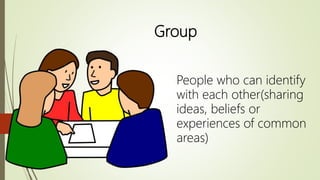
People who can identify
with each other(sharing
ideas, beliefs or
experiences of common
areas)
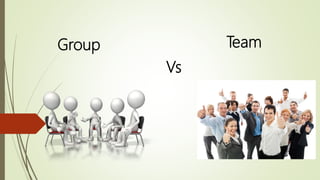
Group
Vs
Team
Types of groups
Work Groups
– a group within a workforce that
normally works together.
Neighborhood groups
- is a small voluntary association of poor
people, preferably from the same socio-
economic background.
Social Group
- is a collection of people who interact with each
other and share similar characteristics and a sense
of unity
Pressure groups
- a group that tries to influence public policy in
the interest of a particular cause.
Types of groups
Self-Help Group (SHG)
is a small voluntary association of poor people,
preferably from the same socio-economic
background
Types of groups
Formal Groups
Groups established by organizations to perform
organizational work
1. Command group
- comprised of employees who directly report to a
supervisor
2. Tasks groups
- employees work to accomplished a certain task
Informal Groups
- Natural Grouping of employees that form to fulfill
social needs.
1. Interest Groups
established to meet a mutual objective
2. Friendship groups
formed by members have something in common.
Roles in Society
Role
- A position that has to
be assumed and acted
by an individual in a
group.
Characteristics of Teams
Clear Goals
This is necessary so that all team members
understand the purpose and vision of the
team.
Defined Roles
It’s important for group members to understand
their job function and for leaders to tap into the
skills and talents of group members.
Open and Clear Communication
- This is one of the most important
characteristics for high functioning teams.
Effective Decision Making
awareness of various decision making methods can
help a team make efficient decisions.
Characteristics of Teams
Balanced Participation
This can be defined as full involvement. Team
members contribute when appropriate, and
member’s opinions are valued and sought
Valued Diversity Team
members are valued for their unique skills and talents.
A diversity of thinking, idea generating, problem
solving
Characteristics of Teams
Managed Conflict
This is essential to a team’s growth. It’s important
that issues aren’t ignored and avoided in a group
Positive Atmosphere
An effective team has an open climate where member’s
are comfortable with each other and aren’t afraid to
take risks.
Characteristics of Teams
Cooperative Relationships
Team members want to work together for the good
of the team and understand that combining the
skills of numerous people will produce something
that could not be created alone
Participative Leadership
Leadership is shared among team members at various
times.
Characteristics of Teams
TEAMWORK 10 EFFECTIVE STEPS
1. Consider each employee's ideas as valuable
2. Be aware of employees' unspoken feelings
3. Act as a harmonizing influence
4. Be clear when communicating
5. Encourage trust and cooperation among employees on
your team
TEAMWORK 10 EFFECTIVE STEPS
7. Delegate problem-solving tasks to the team
8. Facilitate communication
9. Establish team values and goals; evaluate team performance
Benefits of Teams
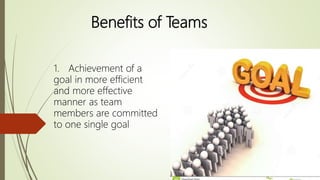
1. Achievement of a
goal in more efficient
and more effective
manner as team
members are committed
to one single goal
High level of productivity
through specialized work
processes and labor distribut
Benefits of Teams
People like to work with others due to social
satisfaction.
Benefits of Teams
Team members
communicate with each
other more often
Benefits of Teams
Social learning takes place
Benefits of Teams
Organizational flexibility
Benefits of Teams
Team building
is a process of deliberately
creating and effective team
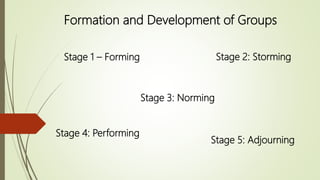
Formation and Development of Groups
Stage 1 – Forming Stage 2: Storming
Stage 3: Norming
Stage 4: Performing
Stage 5: Adjourning
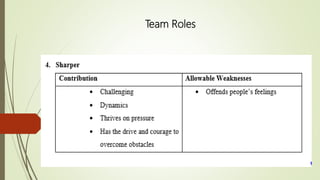
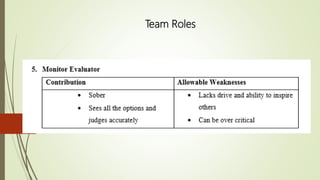
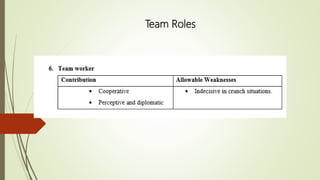
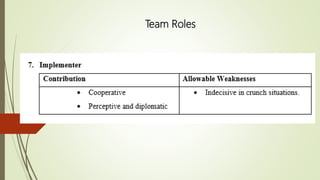
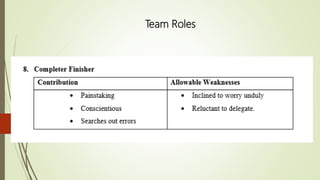
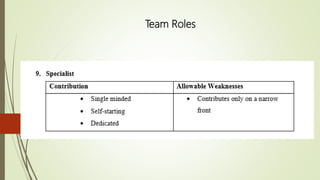
Team Roles
Team Roles
Team Roles
Team Roles
Team Roles
Team Roles
Team Roles
Team Roles
Team Roles
Teamwork and Team Building

Teamwork and Team Building

  • 1.
  • 2.
    TEAM is a smallnumber of people with complementary skills who are committed to a common goal for which they are mutually accountable
  • 4.
    Group People who canidentify with each other(sharing ideas, beliefs or experiences of common areas)
  • 5.
  • 6.
    Types of groups WorkGroups – a group within a workforce that normally works together. Neighborhood groups - is a small voluntary association of poor people, preferably from the same socio- economic background.
  • 7.
    Social Group - isa collection of people who interact with each other and share similar characteristics and a sense of unity Pressure groups - a group that tries to influence public policy in the interest of a particular cause. Types of groups
  • 8.
    Self-Help Group (SHG) isa small voluntary association of poor people, preferably from the same socio-economic background Types of groups
  • 9.
    Formal Groups Groups establishedby organizations to perform organizational work 1. Command group - comprised of employees who directly report to a supervisor 2. Tasks groups - employees work to accomplished a certain task
  • 10.
    Informal Groups - NaturalGrouping of employees that form to fulfill social needs. 1. Interest Groups established to meet a mutual objective 2. Friendship groups formed by members have something in common.
  • 11.
    Roles in Society Role -A position that has to be assumed and acted by an individual in a group.
  • 12.
    Characteristics of Teams ClearGoals This is necessary so that all team members understand the purpose and vision of the team. Defined Roles It’s important for group members to understand their job function and for leaders to tap into the skills and talents of group members.
  • 13.
    Open and ClearCommunication - This is one of the most important characteristics for high functioning teams. Effective Decision Making awareness of various decision making methods can help a team make efficient decisions. Characteristics of Teams
  • 14.
    Balanced Participation This canbe defined as full involvement. Team members contribute when appropriate, and member’s opinions are valued and sought Valued Diversity Team members are valued for their unique skills and talents. A diversity of thinking, idea generating, problem solving Characteristics of Teams
  • 15.
    Managed Conflict This isessential to a team’s growth. It’s important that issues aren’t ignored and avoided in a group Positive Atmosphere An effective team has an open climate where member’s are comfortable with each other and aren’t afraid to take risks. Characteristics of Teams
  • 16.
    Cooperative Relationships Team memberswant to work together for the good of the team and understand that combining the skills of numerous people will produce something that could not be created alone Participative Leadership Leadership is shared among team members at various times. Characteristics of Teams
  • 17.
    TEAMWORK 10 EFFECTIVESTEPS 1. Consider each employee's ideas as valuable 2. Be aware of employees' unspoken feelings 3. Act as a harmonizing influence 4. Be clear when communicating 5. Encourage trust and cooperation among employees on your team
  • 18.
    TEAMWORK 10 EFFECTIVESTEPS 7. Delegate problem-solving tasks to the team 8. Facilitate communication 9. Establish team values and goals; evaluate team performance
  • 19.
    Benefits of Teams 1.Achievement of a goal in more efficient and more effective manner as team members are committed to one single goal
  • 20.
    High level ofproductivity through specialized work processes and labor distribut Benefits of Teams
  • 21.
    People like towork with others due to social satisfaction. Benefits of Teams
  • 22.
    Team members communicate witheach other more often Benefits of Teams
  • 23.
    Social learning takesplace Benefits of Teams
  • 24.
  • 25.
    Team building is aprocess of deliberately creating and effective team
  • 26.
    Formation and Developmentof Groups Stage 1 – Forming Stage 2: Storming Stage 3: Norming Stage 4: Performing Stage 5: Adjourning
  • 27.
  • 28.
  • 29.
  • 30.
  • 31.
  • 32.
  • 33.
  • 34.
  • 35.