L/O/G/O
Teaching English to Young Learners
Practical Teaching
Technique
M. SAIFUDDIN
Contents
1. Teaching Technique for Listening
3. Teaching technique for Reading
2. Teaching Technique for Speaking
4. Teaching Technique for Writing
‘Listen and do activities’
‘Listen for information’
‘Listen and color’
Teaching Technique for Listening
It is quite clear that listening is the skill that children acquire first,
especially if they have not yet learnt to read.
 The most obvious ‘listen and do’ activity
which we can and should make use from
the moment we start the English lessons
is giving genuine instruction.
Example:
- Sit down, please
- Give this pen to Silvy, please
- Please, come to the white board
Listen and do activities
What you need and what to do?
• Prepare some imperative sentences related to
the topic of the lesson
• Write them down on a piece of paper
• Divide the students into some groups
Instruction:
• Ask one of the student of the group to take a
piece of paper randomly
• The teacher read aloud the sentences inside the
paper
• The students perform the activity based on the
instruction given in a turn
The advantages with this type of activity is
that you know at once if the children have
understood. You can check classroom
vocabulary, movement words, counting,
spelling.
They will still be able to do the activity by
watching the others.
Listen for information
It is really the umbrella heading which
covers a very wide range of listening
activities. We are taking it to mean
listening for detail, specific information.
These can often be used to check what the
children know, and also can give them
new information
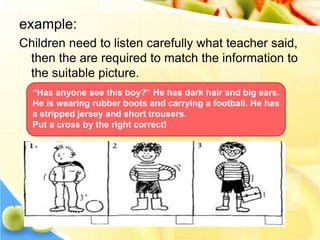
example:
Children need to listen carefully what teacher said,
then the are required to match the information to
the suitable picture.
“Has anyone see this boy?” He has dark hair and big ears.
He is wearing rubber boots and carrying a football. He has
a stripped jersey and short trousers.
Put a cross by the right correct!
Listen and color
• Children love coloring picture and we can
easily make this activity into a listening
activity.
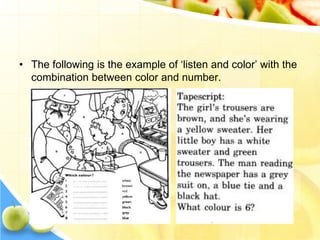
• The following is the example of ‘listen and color’ with the
combination between color and number.
Teaching technique for speaking
1
2
Pair Work
Group Work
Speaking is perhaps the most demanding skill for
the teacher to teach. In their own language
children are able to express emotions,
communicate intentions and reaction, explore the
language and make fun of it
Pair Work
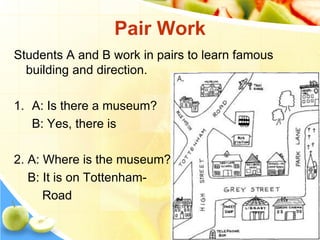
Students A and B work in pairs to learn famous
building and direction.
1. A: Is there a museum?
B: Yes, there is
2. A: Where is the museum?
B: It is on Tottenham-
Road
Group Work
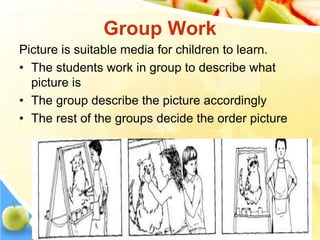
Picture is suitable media for children to learn.
• The students work in group to describe what
picture is
• The group describe the picture accordingly
• The rest of the groups decide the order picture
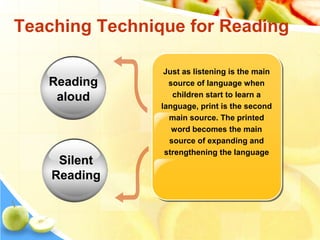
Teaching Technique for Reading
Just as listening is the main
source of language when
children start to learn a
language, print is the second
main source. The printed
word becomes the main
source of expanding and
strengthening the language
Reading
aloud
Silent
Reading
Reading aloud
Reading aloud can be very useful technique:
• Reading aloud to the teacher should be done
individually or in small groups. The reader then
has the teacher’s full attention.
• The teacher can use it as a means of training
and checking rhythm and pronunciation.
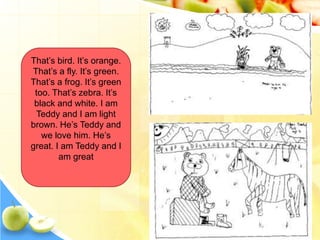
That’s bird. It’s orange.
That’s a fly. It’s green.
That’s a frog. It’s green
too. That’s zebra. It’s
black and white. I am
Teddy and I am light
brown. He’s Teddy and
we love him. He’s
great. I am Teddy and I
am great
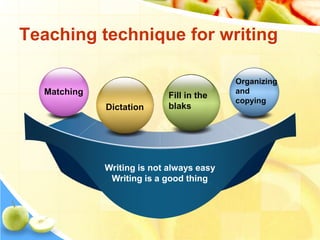
Teaching technique for writing
Writing is not always easy
Writing is a good thing
Matching
Organizing
and
copying
Dictation
Fill in the
blaks
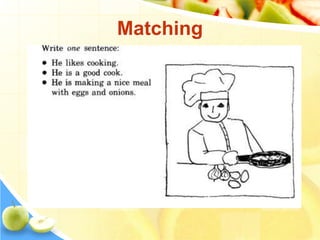
Matching
Dictation
• Be short
• Be made up of sentences which can be said in one
breath
• Have a purpose
• Be read or said at normal speed
Example:
Maria has a baker’s hat. She’s going to bring it to class
tomorrow. We are going to have a bakery shop
Fill in the Blank
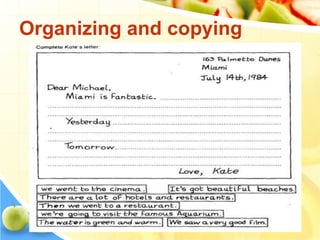
Organizing and copying

Practical teaching technique for Young Learners

  • 1.
    L/O/G/O Teaching English toYoung Learners Practical Teaching Technique M. SAIFUDDIN
  • 2.
    Contents 1. Teaching Techniquefor Listening 3. Teaching technique for Reading 2. Teaching Technique for Speaking 4. Teaching Technique for Writing
  • 3.
    ‘Listen and doactivities’ ‘Listen for information’ ‘Listen and color’ Teaching Technique for Listening It is quite clear that listening is the skill that children acquire first, especially if they have not yet learnt to read.
  • 4.
     The mostobvious ‘listen and do’ activity which we can and should make use from the moment we start the English lessons is giving genuine instruction. Example: - Sit down, please - Give this pen to Silvy, please - Please, come to the white board Listen and do activities
  • 5.
    What you needand what to do? • Prepare some imperative sentences related to the topic of the lesson • Write them down on a piece of paper • Divide the students into some groups Instruction: • Ask one of the student of the group to take a piece of paper randomly • The teacher read aloud the sentences inside the paper • The students perform the activity based on the instruction given in a turn
  • 6.
    The advantages withthis type of activity is that you know at once if the children have understood. You can check classroom vocabulary, movement words, counting, spelling. They will still be able to do the activity by watching the others.
  • 7.
    Listen for information Itis really the umbrella heading which covers a very wide range of listening activities. We are taking it to mean listening for detail, specific information. These can often be used to check what the children know, and also can give them new information
  • 8.
    example: Children need tolisten carefully what teacher said, then the are required to match the information to the suitable picture. “Has anyone see this boy?” He has dark hair and big ears. He is wearing rubber boots and carrying a football. He has a stripped jersey and short trousers. Put a cross by the right correct!
  • 9.
    Listen and color •Children love coloring picture and we can easily make this activity into a listening activity.
  • 10.
    • The followingis the example of ‘listen and color’ with the combination between color and number.
  • 11.
    Teaching technique forspeaking 1 2 Pair Work Group Work Speaking is perhaps the most demanding skill for the teacher to teach. In their own language children are able to express emotions, communicate intentions and reaction, explore the language and make fun of it
  • 12.
    Pair Work Students Aand B work in pairs to learn famous building and direction. 1. A: Is there a museum? B: Yes, there is 2. A: Where is the museum? B: It is on Tottenham- Road
  • 13.
    Group Work Picture issuitable media for children to learn. • The students work in group to describe what picture is • The group describe the picture accordingly • The rest of the groups decide the order picture
  • 14.
    Teaching Technique forReading Just as listening is the main source of language when children start to learn a language, print is the second main source. The printed word becomes the main source of expanding and strengthening the language Reading aloud Silent Reading
  • 15.
    Reading aloud Reading aloudcan be very useful technique: • Reading aloud to the teacher should be done individually or in small groups. The reader then has the teacher’s full attention. • The teacher can use it as a means of training and checking rhythm and pronunciation.
  • 16.
    That’s bird. It’sorange. That’s a fly. It’s green. That’s a frog. It’s green too. That’s zebra. It’s black and white. I am Teddy and I am light brown. He’s Teddy and we love him. He’s great. I am Teddy and I am great
  • 17.
    Teaching technique forwriting Writing is not always easy Writing is a good thing Matching Organizing and copying Dictation Fill in the blaks
  • 18.
  • 19.
    Dictation • Be short •Be made up of sentences which can be said in one breath • Have a purpose • Be read or said at normal speed Example: Maria has a baker’s hat. She’s going to bring it to class tomorrow. We are going to have a bakery shop
  • 20.
  • 21.