TEACHING ENGLISH TO YOUNG LEARNERS

By:
Sri Supiah Cahyati, M.Pd.
Sekolah Tinggi Keguruan & Ilmu Kependidikan
(STKIP Siliwangi) Bandung
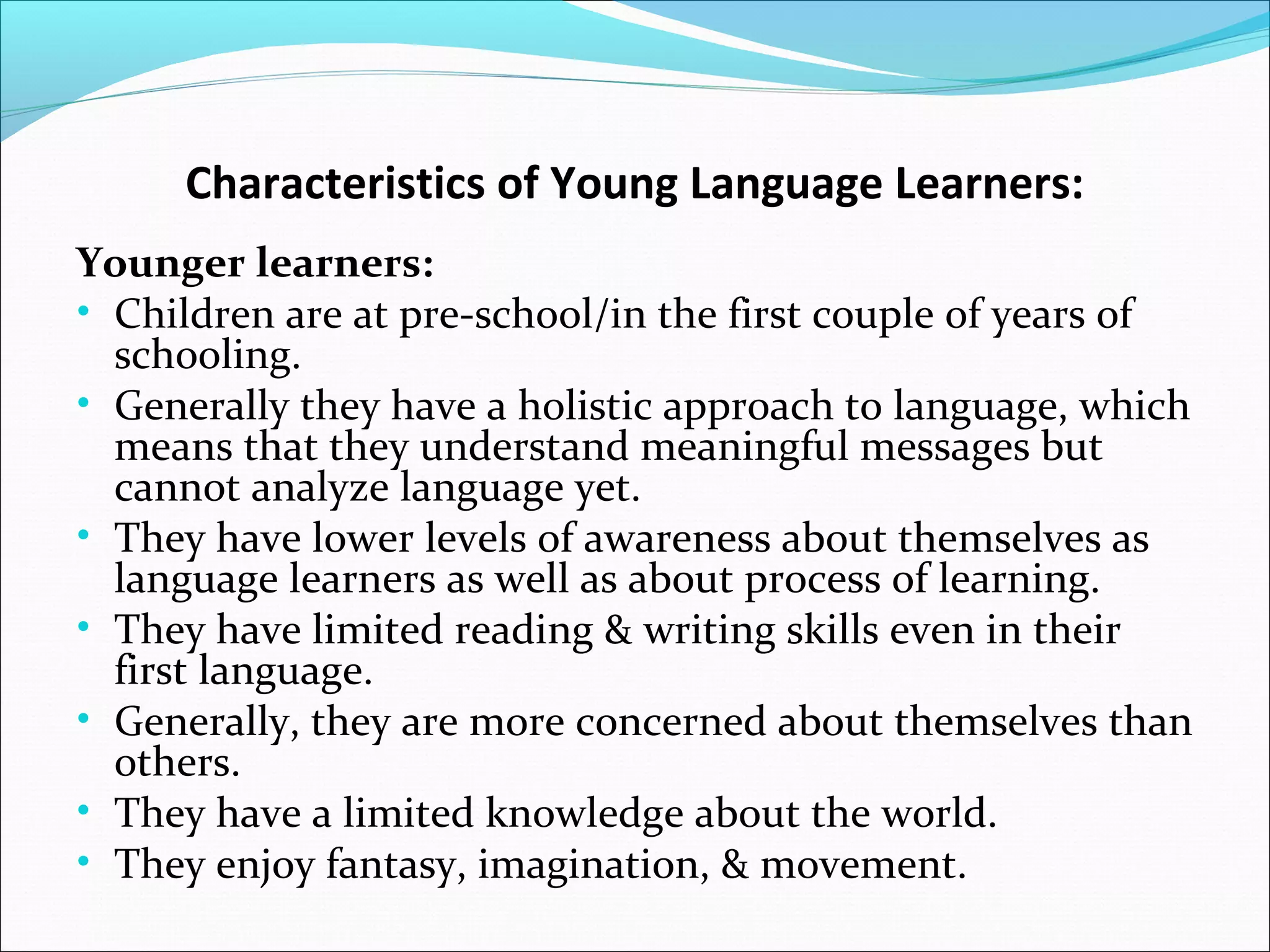
Characteristics of Young Language Learners:
Younger learners:
• Children are at pre-school/in the first couple of years of
schooling.
• Generally they have a holistic approach to language, which
means that they understand meaningful messages but
cannot analyze language yet.
• They have lower levels of awareness about themselves as
language learners as well as about process of learning.
• They have limited reading & writing skills even in their
first language.
• Generally, they are more concerned about themselves than
others.
• They have a limited knowledge about the world.
• They enjoy fantasy, imagination, & movement.
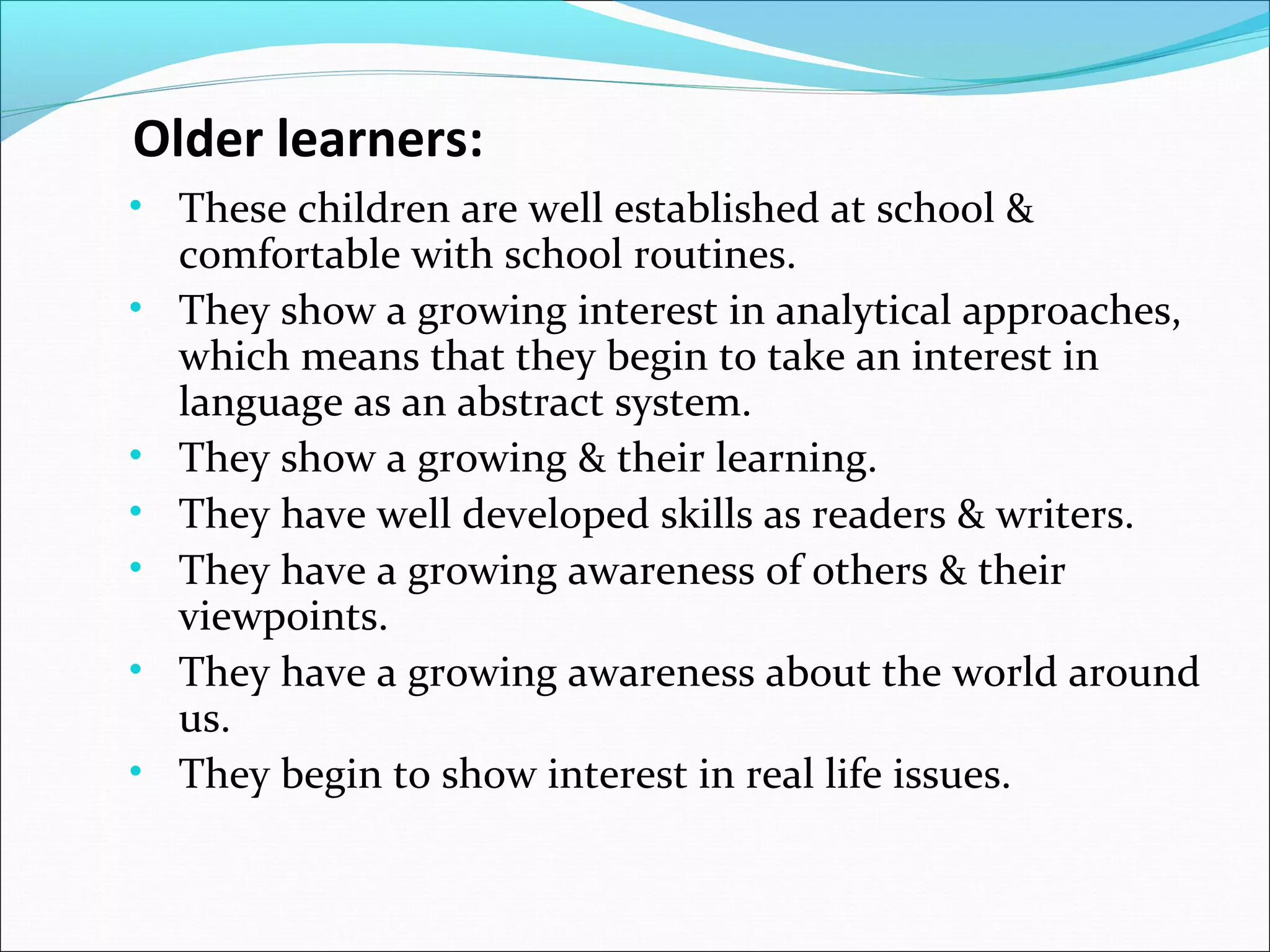
Older learners:
• These children are well established at school &
•

•
•
•
•
•

comfortable with school routines.
They show a growing interest in analytical approaches,
which means that they begin to take an interest in
language as an abstract system.
They show a growing & their learning.
They have well developed skills as readers & writers.
They have a growing awareness of others & their
viewpoints.
They have a growing awareness about the world around
us.
They begin to show interest in real life issues.
Skills should be taught first in TEYL:
As in mother tongue learning, English should start
with an emphasis on listening & then speaking
because children often cannot read & write at all
yet.
•
listening should precede speaking
(communicative skills should be the aim of
the
good language classroom).
•
reading and then writing will emerge when
the language learner is ready and should not
be forced.
•
comprehension of language should
precede production.
3. Jerome Bruner called is as Scaffolding: helping
children to learn by offering systematic support.
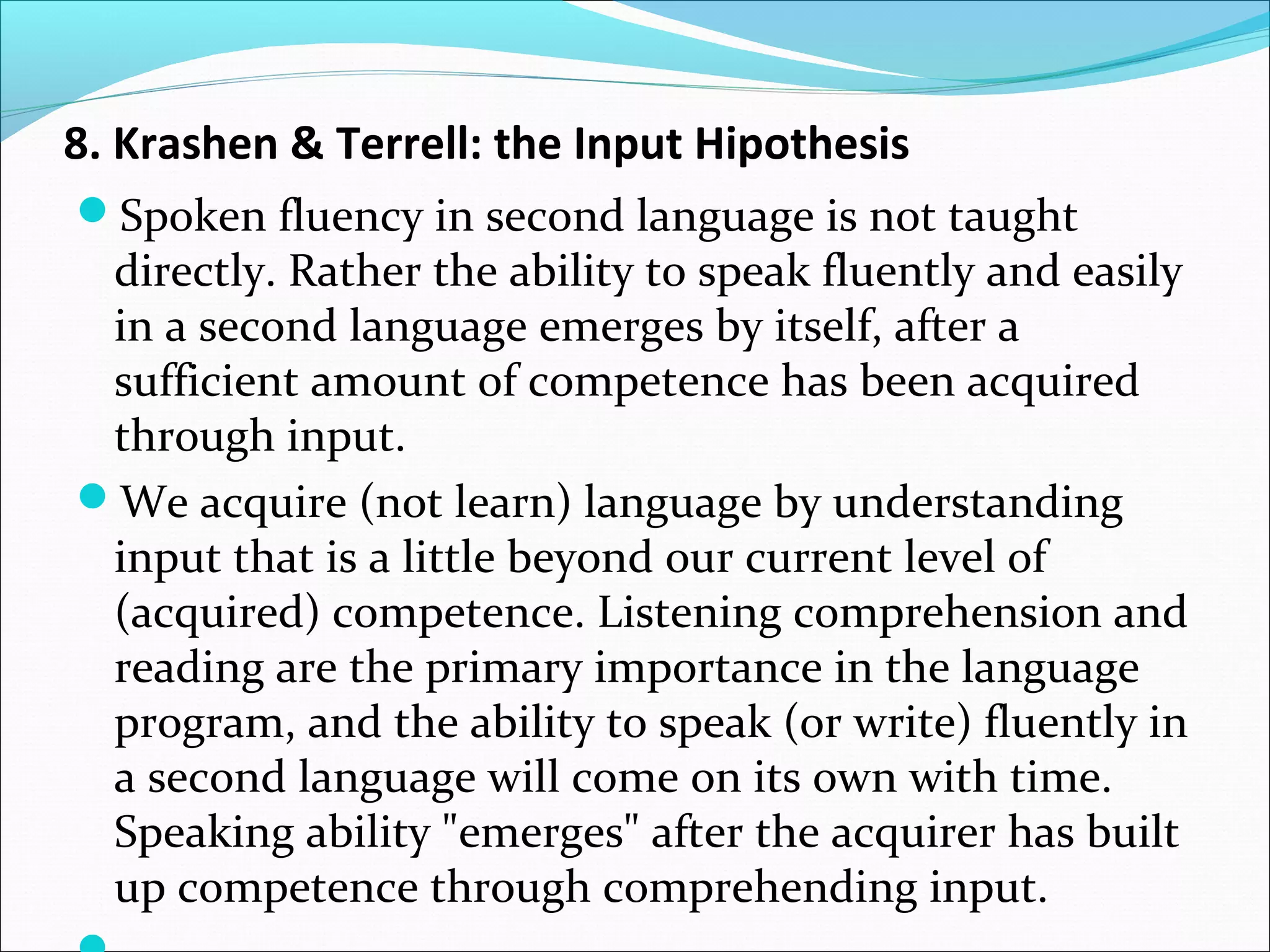
8. Krashen & Terrell: the Input Hipothesis
Spoken fluency in second language is not taught

directly. Rather the ability to speak fluently and easily
in a second language emerges by itself, after a
sufficient amount of competence has been acquired
through input.
We acquire (not learn) language by understanding
input that is a little beyond our current level of
(acquired) competence. Listening comprehension and
reading are the primary importance in the language
program, and the ability to speak (or write) fluently in
a second language will come on its own with time.
Speaking ability "emerges" after the acquirer has built
up competence through comprehending input.
The major points on the Input Hypothesis are:
•
it relates to acquisition, not to learning;
•
we acquire by understanding language a bit
beyond our current level of
competence. This is
done with the help of context;
•
spoken fluency emerges gradually and is not
taught directly;
•
when caretakers talk to acquirers so that the
acquirers understand the message, input
automatically contains "i+1", the grammatical
structures the acquirer is "ready" to acquire.
The implications for classroom practice:
- whatever helps comprehension is important;
- vocabulary is important. With more vocabulary,
there will be more comprehension, and there will be
more acquisition.
- in giving input, in talking to students, the teacher
needs to be concerned primarily with whether the
students understand the message.
A natural approach is required in language
teaching. Its main tenets are as follows:
communicative skills should be the aim of the
good language classroom; comprehension of
language should precede production
(listening should precede speaking); speaking
and then writing will emerge when the language
learner is ready and should not
be forced.
9. John Dewey:
Education should be child centered.
Education must be both active & interactive.
Education must involve the social world of the child

and the community.
Implication:
• Plan purposeful curriculum.
• Make sense of the world for children.
• ‘It’s fun’ is not enough.
10. Maria Montessori:
Children learn language and other significant life

skills, without conscious effort, from the
environments where they spend their time.
Children learn best through sensory experiences, by
doing & through repetition.
Children are capable of great concentration when
they are surrounded by many interesting things to do
& given the time and freedom to do them.
Children need more physical activity.
11. Erik Erikson:
How children develop the foundation for emotional &

social development & mental health.
Consider individual differences.
Focus curriculum on real things.

Stages of Psychosocial Development (“Eight Ages

of Man”); theory of emotional development,
which covers the life spans of human beings.
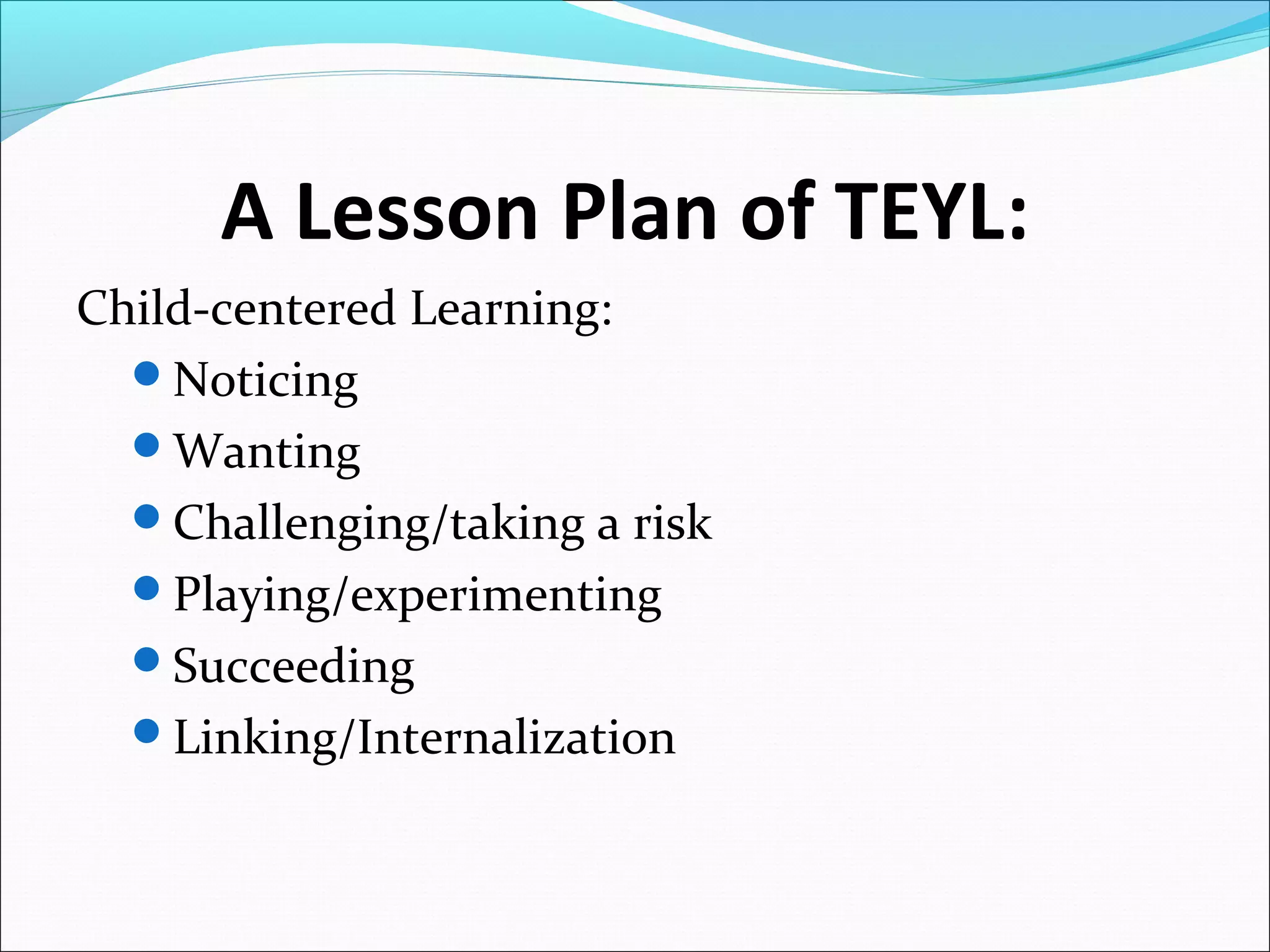
A Lesson Plan of TEYL:
Child-centered Learning:
Noticing
Wanting
Challenging/taking a risk
Playing/experimenting
Succeeding
Linking/Internalization
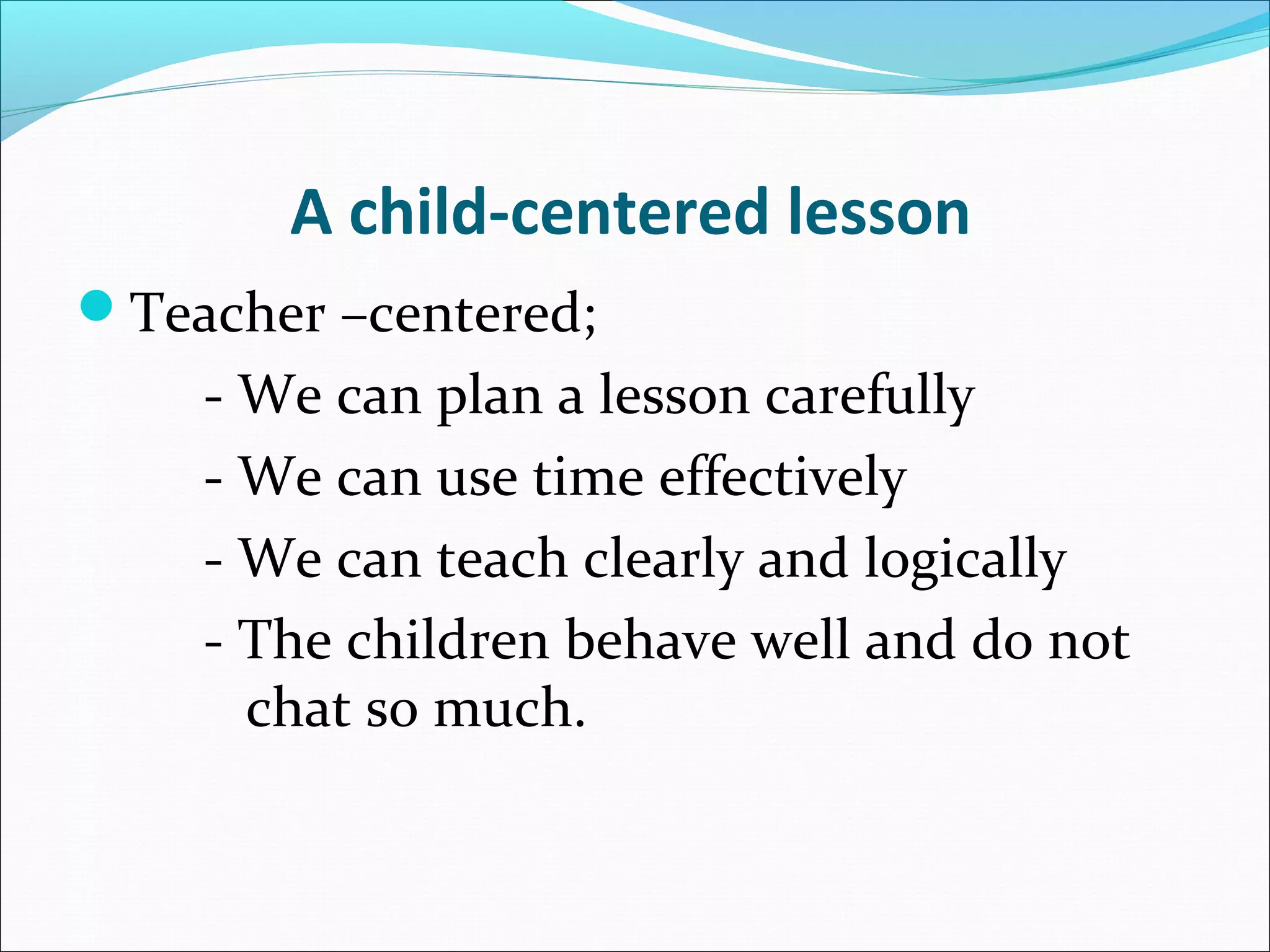
A child-centered lesson
Teacher –centered;

- We can plan a lesson carefully
- We can use time effectively
- We can teach clearly and logically
- The children behave well and do not
chat so much.
Child-centered:
-

The children enjoy themselves
They learn naturally and actively
They are spontaneous
Their eyes shine brightly
What can go wrong?
We do not give the children space to

notice
They do what we want them to do
They do not try for themselves
They do not experiment enough
They are unsuccessful
They do not make links
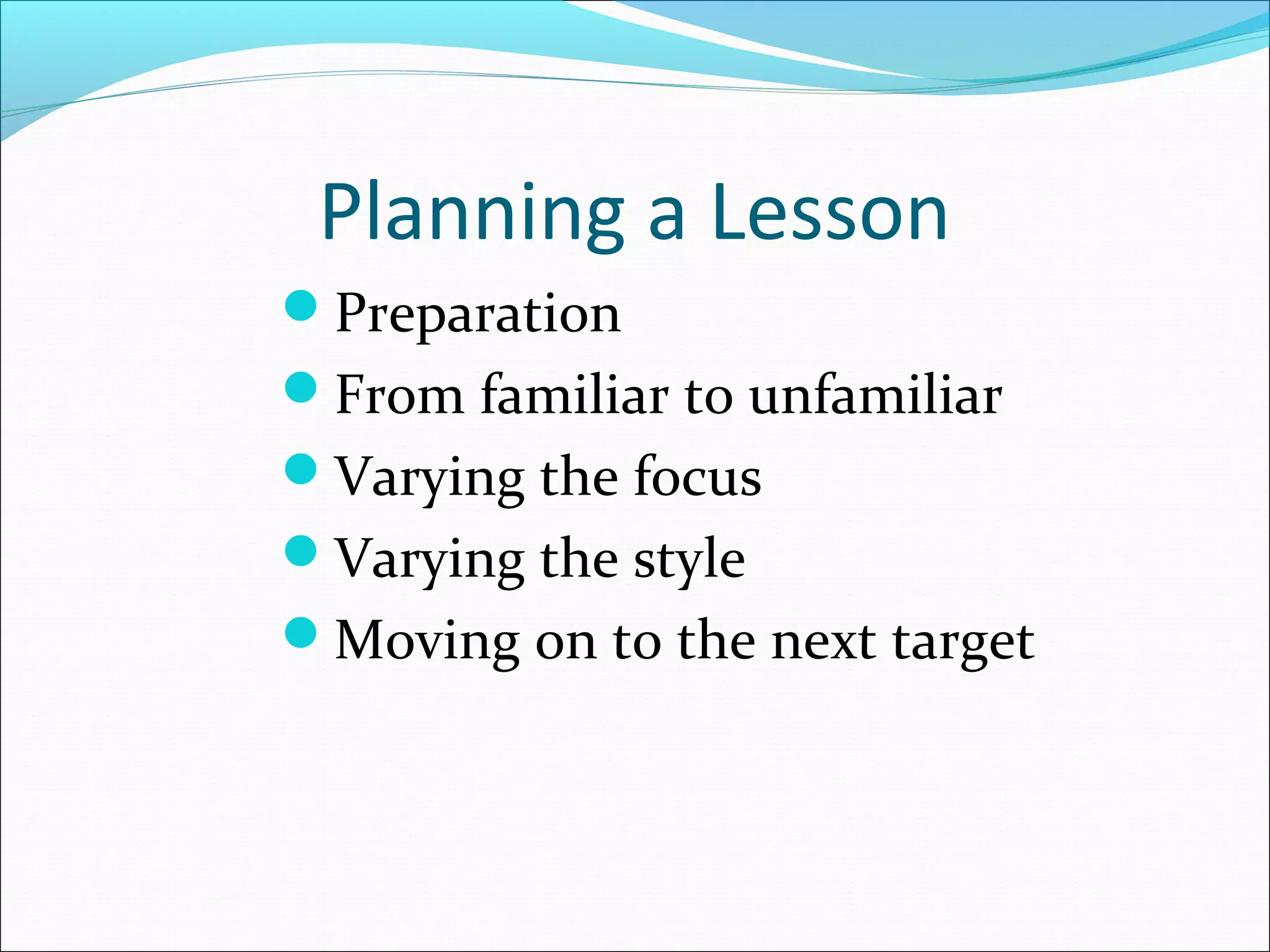
Planning a Lesson
Preparation
From familiar to unfamiliar
Varying the focus
Varying the style
Moving on to the next target
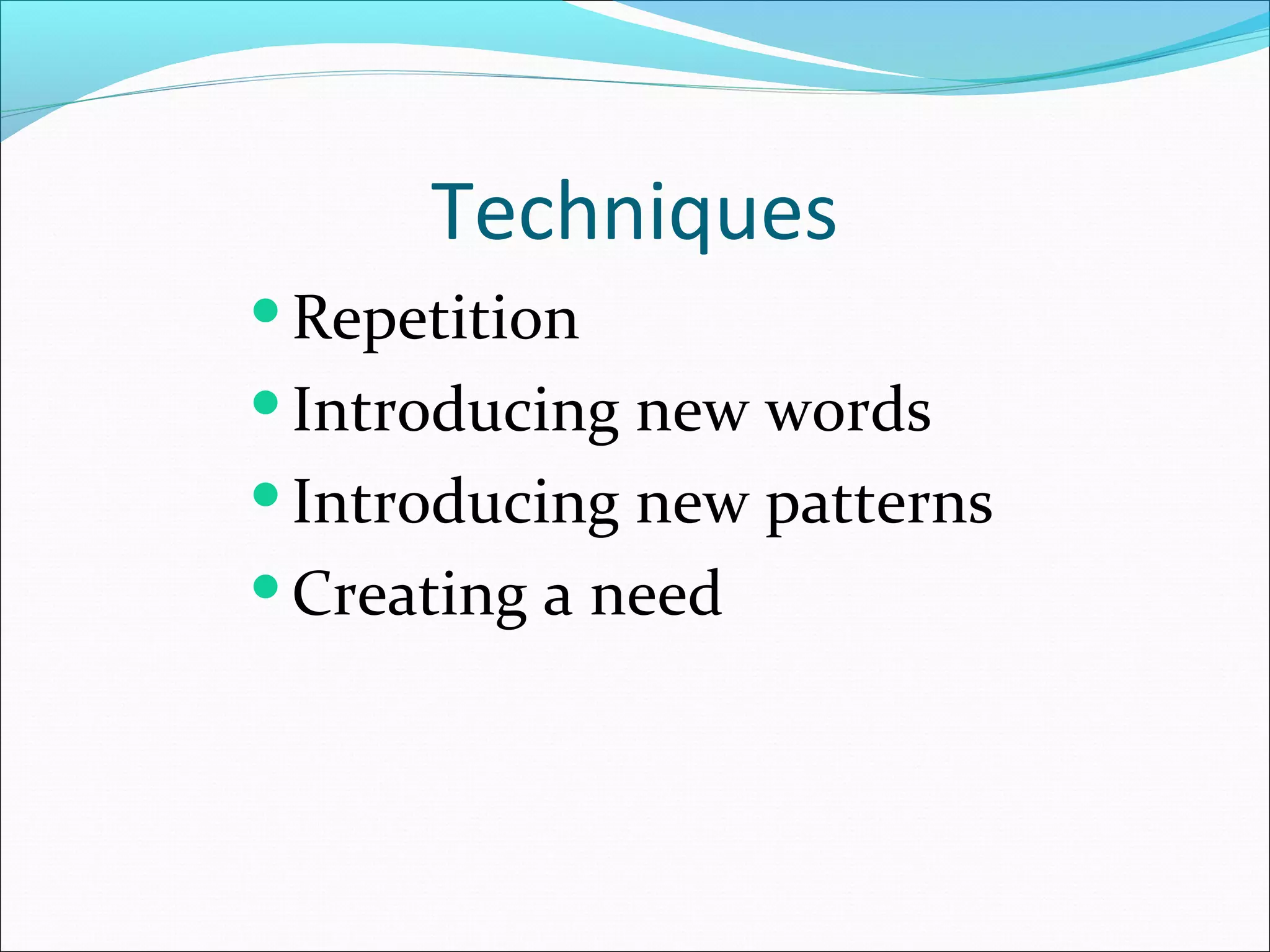
Techniques
Repetition
Introducing

new words
Introducing new patterns
Creating a need
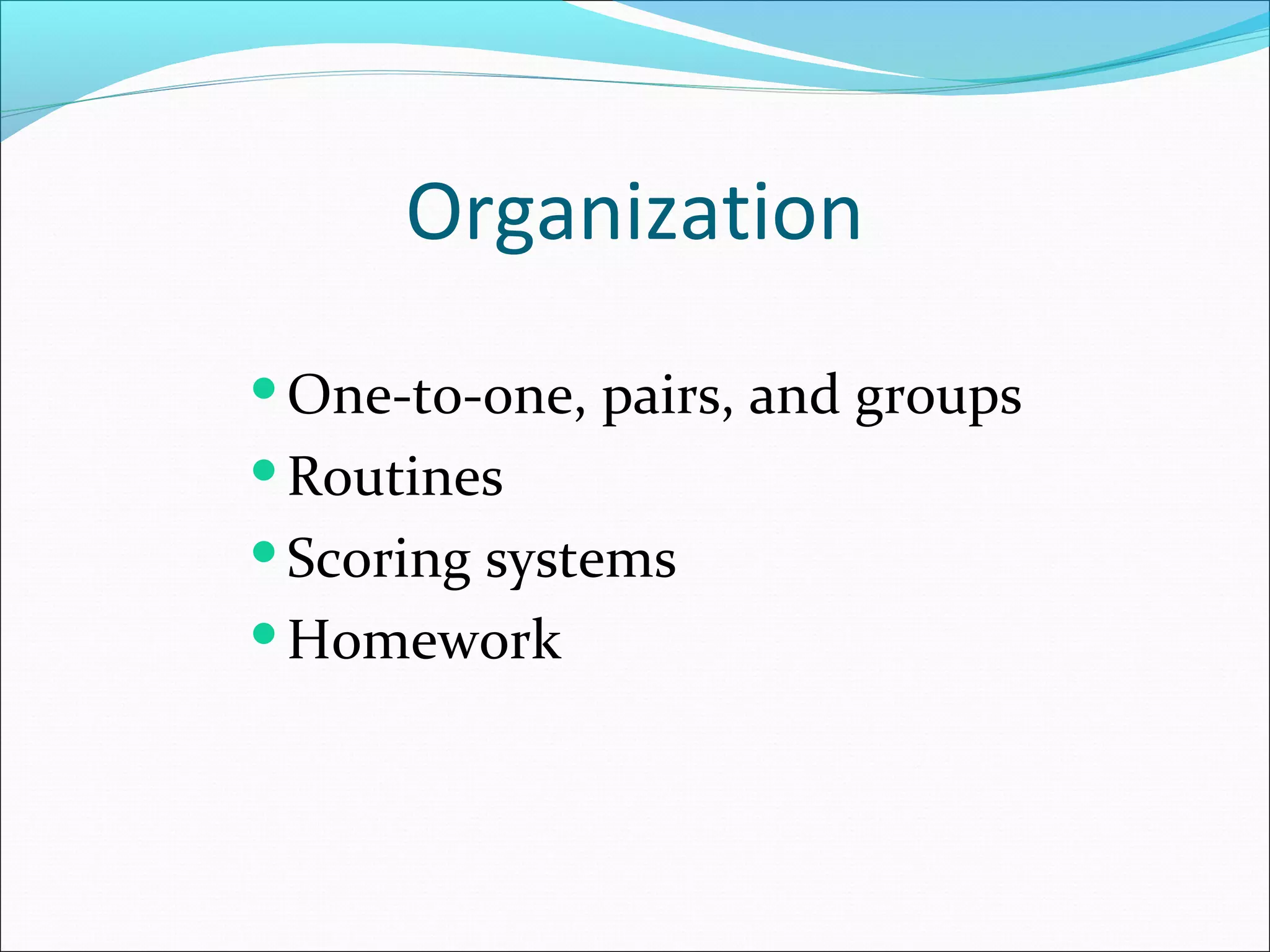
Organization
One-to-one,

pairs, and groups

Routines
Scoring

systems
Homework
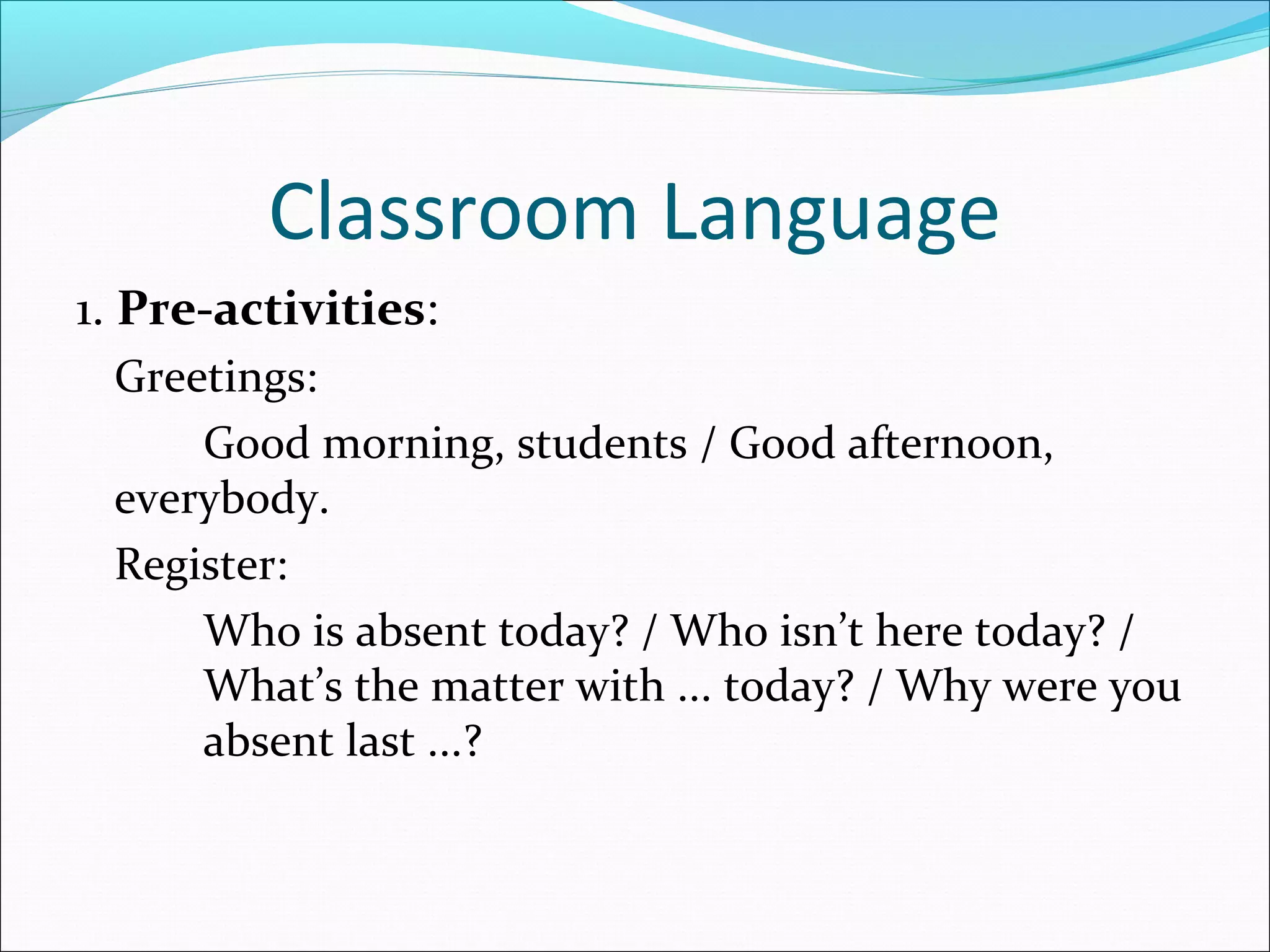
Classroom Language
1. Pre-activities:
Greetings:
Good morning, students / Good afternoon,
everybody.
Register:
Who is absent today? / Who isn’t here today? /
What’s the matter with ... today? / Why were you
absent last ...?
2. Whilst-activity:
a. Waiting to start:
I’m waiting for you tobe quiet / We won’t start
until everyone is quiet / Stop talking & be quiet.
b. Time to begin:
Let’ s begin our lesson now / Is everybody ready
to start? / Open your book at page...
c. Late:
Where have you been? / Did you oversleep?
d. Check Ss’ understanding :
Is there any questions? / Do you understand? /
Do you get it? / Are you with me?
2. Post-activity:
a. Time to stop:
It’s almost time to stop / We’ll have to stop here /
That’s all for today.
b. Next time:
We’ll do the rest of this chapter next time / We’ll
continue this chapter next…
c. Homework:
Do exercise … on page … for your homework.
d. Goodbye:
Goodbye, students. See you on… / See you again
next … / Have a good holiday.
TEYL in Indonesia Context
Requirements for effective TEYL:
a. English should be used all the time to ensure that
children have relatively much exposure to English.
b. Print-rich environment in English should be created
and around the classroom.
c. Teachers of EYL should use activity-based teachinglearning techniques such as TPR, games, & projects.
d. The teachers should use various techniques for short
periods of time to maintain the interest level of the
children in engaging the English lessons.
TEYL in Indonesia Context
d. The teachers should focus on functional English for
vocabulary development & for immediate
fulfillment of communicative needs of the learners.
e. The teachers should reiterate often to ensure the
acquisition of English expressions/vocabulary items.
f. The teachers should provide useful, acquisitionpromoting routines.
g. The teachers should have a good command of
English & have an ability to act as a role model
to the learners they teach.
That’s good

Motivating Expressions:

 You’re right
Good work
Great
That’s it
Excellent
Good remembering
Keep on trying
Keep up the good work
That kinds of work makes me happy
REFERENCES

 Hainstock, Elizabeth G. 1999. Metode Pengajaran Montessori untuk

Anak Pra-Sekolah. Jakarta: 1997.
 Mooney, Carol Garhart. 2000. Theories of Childhood: An Introduction
to Dewey, Montessori, Erikson, Piaget, and Vygotsky. USA:
Redleaf Press.
 Musthafa, Bachrudin. 2000. Teaching English to Young Learners:
Principles & Techniques. Bandung: Pasca Sarjana Universitas
Pendidikan Indonesia.
 Paul, David. 2003. Teaching English to Children in Asia. Hongkong;
Longman Asia ELT.
 Pinter, Annamaria. 2006. Teaching Young Language Learners. Oxford:
Oxford University Press.
 Slattery, Mary & Willis, Jane. English for Primary Teachers: A
Handbook
of Activities and Classroom Language. Oxford: Oxford
University
Press.

Teaching english to young learners

  • 1.
    TEACHING ENGLISH TOYOUNG LEARNERS By: Sri Supiah Cahyati, M.Pd. Sekolah Tinggi Keguruan & Ilmu Kependidikan (STKIP Siliwangi) Bandung
  • 2.
    Characteristics of YoungLanguage Learners: Younger learners: • Children are at pre-school/in the first couple of years of schooling. • Generally they have a holistic approach to language, which means that they understand meaningful messages but cannot analyze language yet. • They have lower levels of awareness about themselves as language learners as well as about process of learning. • They have limited reading & writing skills even in their first language. • Generally, they are more concerned about themselves than others. • They have a limited knowledge about the world. • They enjoy fantasy, imagination, & movement.
  • 3.
    Older learners: • Thesechildren are well established at school & • • • • • • comfortable with school routines. They show a growing interest in analytical approaches, which means that they begin to take an interest in language as an abstract system. They show a growing & their learning. They have well developed skills as readers & writers. They have a growing awareness of others & their viewpoints. They have a growing awareness about the world around us. They begin to show interest in real life issues.
  • 10.
    Skills should betaught first in TEYL: As in mother tongue learning, English should start with an emphasis on listening & then speaking because children often cannot read & write at all yet. • listening should precede speaking (communicative skills should be the aim of the good language classroom). • reading and then writing will emerge when the language learner is ready and should not be forced. • comprehension of language should precede production.
  • 15.
    3. Jerome Brunercalled is as Scaffolding: helping children to learn by offering systematic support.
  • 20.
    8. Krashen &Terrell: the Input Hipothesis Spoken fluency in second language is not taught directly. Rather the ability to speak fluently and easily in a second language emerges by itself, after a sufficient amount of competence has been acquired through input. We acquire (not learn) language by understanding input that is a little beyond our current level of (acquired) competence. Listening comprehension and reading are the primary importance in the language program, and the ability to speak (or write) fluently in a second language will come on its own with time. Speaking ability "emerges" after the acquirer has built up competence through comprehending input.
  • 21.
    The major pointson the Input Hypothesis are: • it relates to acquisition, not to learning; • we acquire by understanding language a bit beyond our current level of competence. This is done with the help of context; • spoken fluency emerges gradually and is not taught directly; • when caretakers talk to acquirers so that the acquirers understand the message, input automatically contains "i+1", the grammatical structures the acquirer is "ready" to acquire.
  • 22.
    The implications forclassroom practice: - whatever helps comprehension is important; - vocabulary is important. With more vocabulary, there will be more comprehension, and there will be more acquisition. - in giving input, in talking to students, the teacher needs to be concerned primarily with whether the students understand the message.
  • 23.
    A natural approachis required in language teaching. Its main tenets are as follows: communicative skills should be the aim of the good language classroom; comprehension of language should precede production (listening should precede speaking); speaking and then writing will emerge when the language learner is ready and should not be forced.
  • 24.
    9. John Dewey: Educationshould be child centered. Education must be both active & interactive. Education must involve the social world of the child and the community. Implication: • Plan purposeful curriculum. • Make sense of the world for children. • ‘It’s fun’ is not enough.
  • 25.
    10. Maria Montessori: Childrenlearn language and other significant life skills, without conscious effort, from the environments where they spend their time. Children learn best through sensory experiences, by doing & through repetition. Children are capable of great concentration when they are surrounded by many interesting things to do & given the time and freedom to do them. Children need more physical activity.
  • 26.
    11. Erik Erikson: Howchildren develop the foundation for emotional & social development & mental health. Consider individual differences. Focus curriculum on real things. Stages of Psychosocial Development (“Eight Ages of Man”); theory of emotional development, which covers the life spans of human beings.
  • 36.
    A Lesson Planof TEYL: Child-centered Learning: Noticing Wanting Challenging/taking a risk Playing/experimenting Succeeding Linking/Internalization
  • 37.
    A child-centered lesson Teacher–centered; - We can plan a lesson carefully - We can use time effectively - We can teach clearly and logically - The children behave well and do not chat so much.
  • 38.
    Child-centered: - The children enjoythemselves They learn naturally and actively They are spontaneous Their eyes shine brightly
  • 39.
    What can gowrong? We do not give the children space to notice They do what we want them to do They do not try for themselves They do not experiment enough They are unsuccessful They do not make links
  • 40.
    Planning a Lesson Preparation Fromfamiliar to unfamiliar Varying the focus Varying the style Moving on to the next target
  • 41.
  • 42.
  • 43.
    Classroom Language 1. Pre-activities: Greetings: Goodmorning, students / Good afternoon, everybody. Register: Who is absent today? / Who isn’t here today? / What’s the matter with ... today? / Why were you absent last ...?
  • 44.
    2. Whilst-activity: a. Waitingto start: I’m waiting for you tobe quiet / We won’t start until everyone is quiet / Stop talking & be quiet. b. Time to begin: Let’ s begin our lesson now / Is everybody ready to start? / Open your book at page... c. Late: Where have you been? / Did you oversleep? d. Check Ss’ understanding : Is there any questions? / Do you understand? / Do you get it? / Are you with me?
  • 45.
    2. Post-activity: a. Timeto stop: It’s almost time to stop / We’ll have to stop here / That’s all for today. b. Next time: We’ll do the rest of this chapter next time / We’ll continue this chapter next… c. Homework: Do exercise … on page … for your homework. d. Goodbye: Goodbye, students. See you on… / See you again next … / Have a good holiday.
  • 46.
    TEYL in IndonesiaContext Requirements for effective TEYL: a. English should be used all the time to ensure that children have relatively much exposure to English. b. Print-rich environment in English should be created and around the classroom. c. Teachers of EYL should use activity-based teachinglearning techniques such as TPR, games, & projects. d. The teachers should use various techniques for short periods of time to maintain the interest level of the children in engaging the English lessons.
  • 47.
    TEYL in IndonesiaContext d. The teachers should focus on functional English for vocabulary development & for immediate fulfillment of communicative needs of the learners. e. The teachers should reiterate often to ensure the acquisition of English expressions/vocabulary items. f. The teachers should provide useful, acquisitionpromoting routines. g. The teachers should have a good command of English & have an ability to act as a role model to the learners they teach.
  • 48.
    That’s good Motivating Expressions: You’re right Good work Great That’s it Excellent Good remembering Keep on trying Keep up the good work That kinds of work makes me happy
  • 49.
    REFERENCES  Hainstock, ElizabethG. 1999. Metode Pengajaran Montessori untuk Anak Pra-Sekolah. Jakarta: 1997.  Mooney, Carol Garhart. 2000. Theories of Childhood: An Introduction to Dewey, Montessori, Erikson, Piaget, and Vygotsky. USA: Redleaf Press.  Musthafa, Bachrudin. 2000. Teaching English to Young Learners: Principles & Techniques. Bandung: Pasca Sarjana Universitas Pendidikan Indonesia.  Paul, David. 2003. Teaching English to Children in Asia. Hongkong; Longman Asia ELT.  Pinter, Annamaria. 2006. Teaching Young Language Learners. Oxford: Oxford University Press.  Slattery, Mary & Willis, Jane. English for Primary Teachers: A Handbook of Activities and Classroom Language. Oxford: Oxford University Press.