Early Language DevelopmentClues to the Structure of the Human Mind
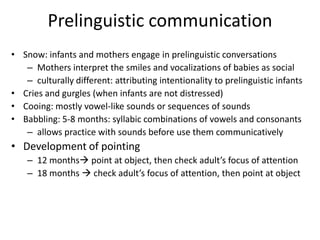
Prelinguistic communicationSnow: infants and mothers engage in prelinguistic conversationsMothers interpret the smiles and vocalizations of babies as socialculturally different: attributing intentionality to prelinguistic infantsCries and gurgles (when infants are not distressed)Cooing: mostly vowel-like sounds or sequences of soundsBabbling: 5-8 months: syllabic combinations of vowels and consonantsallows practice with sounds before use them communicativelyDevelopment of pointing12 months point at object, then check adult’s focus of attention18 months  check adult’s focus of attention, then point at object
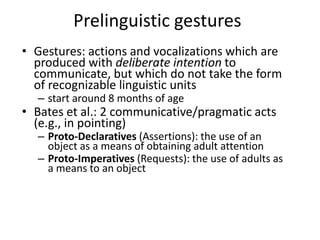
Prelinguistic gesturesGestures: actions and vocalizations which are produced with deliberate intention to communicate, but which do not take the form of recognizable linguistic unitsstart around 8 months of age Bates et al.: 2 communicative/pragmatic acts (e.g., in pointing)Proto-Declaratives (Assertions): the use of an object as a means of obtaining adult attentionProto-Imperatives (Requests): the use of adults as a means to an object
Phonological developmentEimas et al., Jusczyk: infants as young as 4 months old can perceive phonemic distinctionsNot only from the native language, but also from other languagesCategorical sound perception is innatebut after 8 months or so: ability to distinguish nonnative contrasts diminishesPhonological reorganization: phones are organized into the phonemic categories of the native language
Early wordsLexical development: the study of the development of vocabularySemantic development: the study of the development of meaningthe two are very much interlinkedwhat is the scope of meaning of early words?how are prelinguistic meanings mapped onto words?
Lexical developmentClark: on the assumption that children start building their vocabulary at around 18 months, on average, 8-9 new words a day!Collected in diary studies and checklists that include words that the children are likely to acquire and that are filled out by parentse.g., MacArthur Communicative Development Inventory (MCDI)
What kinds of words are first words?Bates et al., Nelson: nearly 40-65% of child’s first 50 words are common nounsverbs, adjectives, other words each account for less than 10%How about research in non-English languages?Chinese and Korean children have as many or more verbs in their early speechNoun bias vs. verb bias languages
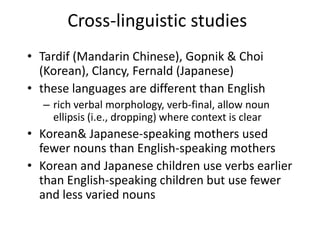
Cross-linguistic studiesTardif (Mandarin Chinese), Gopnik & Choi (Korean), Clancy, Fernald (Japanese)these languages are different than Englishrich verbal morphology, verb-final, allow noun ellipsis (i.e., dropping) where context is clearKorean& Japanese-speaking mothers used fewer nouns than English-speaking mothersKorean and Japanese children use verbs earlier than English-speaking children but use fewer and less varied nouns
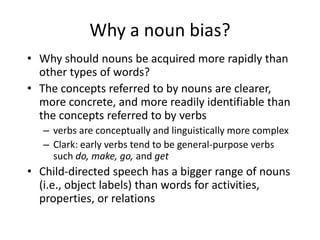
Why a noun bias?Why should nouns be acquired more rapidly than other types of words?The concepts referred to by nouns are clearer, more concrete, and more readily identifiable than the concepts referred to by verbsverbs are conceptually and linguistically more complexClark: early verbs tend to be general-purpose verbs such do, make, go, and getChild-directed speech has a bigger range of nouns (i.e., object labels) than words for activities, properties, or relations
Noun bias: challengesBloom, Gopnik: early words also include lots of relational words such as gone, up, there, more, uh-oh, again and social/performative words such as hi, byecross-linguistic challenges-- e.g., Chinese and Korean
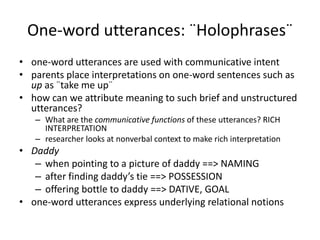
One-word utterances: ¨Holophrases¨one-word utterances are used with communicative intentparents place interpretations on one-word sentences such as up as ¨take me up¨how can we attribute meaning to such brief and unstructured utterances?What are the communicative functions of these utterances? RICH INTERPRETATIONresearcher looks at nonverbal context to make rich interpretationDaddywhen pointing to a picture of daddy ==> NAMINGafter finding daddy’s tie ==> POSSESSIONoffering bottle to daddy ==> DATIVE, GOALone-word utterances express underlying relational notions
Overextensions and UnderextensionsUnconventional word/meaning mappingsOverextension: when a child uses a word in a context or manner that is inconsistent with, but in some way related to the adult meaning of the wordterm is extended to concepts beyond the adult conceptdaddy for adult mencat for all four-legged animalsbye-bye to greet visitorsUnderextension: when a child uses a word for only a limited subset of the contexts used by the adultcat for the home pet onlytruck for the toy truck only
Semantic development: how?The gavagaiproblem: how do children map words onto observations about the world?Infinite number of possibilitieshow does the learner zero in to the right meaning?has come to be known as the mapping problemConstraints or Principleschildren entertain working hypotheses about the meanings of new wordsthe meaning of new words involves some process of comparing new to old semantic knowledge
Principles or constraintswhole object constraint (Macnamara, Markman): when a new label is introduced, assume that it refers to the whole object rather than its partsnovel name-nameless category principle (Golinkoff): new labels are mapped onto previously unnamed conceptsprinciple of contrast (Clark): the principle that no two words have exactly the same meaningprinciple of mutual exclusivity (Markman): no overlap between words, assuming that an object can only have one name

Early language development

  • 1.
    Early Language DevelopmentCluesto the Structure of the Human Mind
  • 2.
    Prelinguistic communicationSnow: infantsand mothers engage in prelinguistic conversationsMothers interpret the smiles and vocalizations of babies as socialculturally different: attributing intentionality to prelinguistic infantsCries and gurgles (when infants are not distressed)Cooing: mostly vowel-like sounds or sequences of soundsBabbling: 5-8 months: syllabic combinations of vowels and consonantsallows practice with sounds before use them communicativelyDevelopment of pointing12 months point at object, then check adult’s focus of attention18 months  check adult’s focus of attention, then point at object
  • 3.
    Prelinguistic gesturesGestures: actionsand vocalizations which are produced with deliberate intention to communicate, but which do not take the form of recognizable linguistic unitsstart around 8 months of age Bates et al.: 2 communicative/pragmatic acts (e.g., in pointing)Proto-Declaratives (Assertions): the use of an object as a means of obtaining adult attentionProto-Imperatives (Requests): the use of adults as a means to an object
  • 4.
    Phonological developmentEimas etal., Jusczyk: infants as young as 4 months old can perceive phonemic distinctionsNot only from the native language, but also from other languagesCategorical sound perception is innatebut after 8 months or so: ability to distinguish nonnative contrasts diminishesPhonological reorganization: phones are organized into the phonemic categories of the native language
  • 5.
    Early wordsLexical development:the study of the development of vocabularySemantic development: the study of the development of meaningthe two are very much interlinkedwhat is the scope of meaning of early words?how are prelinguistic meanings mapped onto words?
  • 6.
    Lexical developmentClark: onthe assumption that children start building their vocabulary at around 18 months, on average, 8-9 new words a day!Collected in diary studies and checklists that include words that the children are likely to acquire and that are filled out by parentse.g., MacArthur Communicative Development Inventory (MCDI)
  • 7.
    What kinds ofwords are first words?Bates et al., Nelson: nearly 40-65% of child’s first 50 words are common nounsverbs, adjectives, other words each account for less than 10%How about research in non-English languages?Chinese and Korean children have as many or more verbs in their early speechNoun bias vs. verb bias languages
  • 8.
    Cross-linguistic studiesTardif (MandarinChinese), Gopnik & Choi (Korean), Clancy, Fernald (Japanese)these languages are different than Englishrich verbal morphology, verb-final, allow noun ellipsis (i.e., dropping) where context is clearKorean& Japanese-speaking mothers used fewer nouns than English-speaking mothersKorean and Japanese children use verbs earlier than English-speaking children but use fewer and less varied nouns
  • 9.
    Why a nounbias?Why should nouns be acquired more rapidly than other types of words?The concepts referred to by nouns are clearer, more concrete, and more readily identifiable than the concepts referred to by verbsverbs are conceptually and linguistically more complexClark: early verbs tend to be general-purpose verbs such do, make, go, and getChild-directed speech has a bigger range of nouns (i.e., object labels) than words for activities, properties, or relations
  • 10.
    Noun bias: challengesBloom,Gopnik: early words also include lots of relational words such as gone, up, there, more, uh-oh, again and social/performative words such as hi, byecross-linguistic challenges-- e.g., Chinese and Korean
  • 11.
    One-word utterances: ¨Holophrases¨one-wordutterances are used with communicative intentparents place interpretations on one-word sentences such as up as ¨take me up¨how can we attribute meaning to such brief and unstructured utterances?What are the communicative functions of these utterances? RICH INTERPRETATIONresearcher looks at nonverbal context to make rich interpretationDaddywhen pointing to a picture of daddy ==> NAMINGafter finding daddy’s tie ==> POSSESSIONoffering bottle to daddy ==> DATIVE, GOALone-word utterances express underlying relational notions
  • 12.
    Overextensions and UnderextensionsUnconventionalword/meaning mappingsOverextension: when a child uses a word in a context or manner that is inconsistent with, but in some way related to the adult meaning of the wordterm is extended to concepts beyond the adult conceptdaddy for adult mencat for all four-legged animalsbye-bye to greet visitorsUnderextension: when a child uses a word for only a limited subset of the contexts used by the adultcat for the home pet onlytruck for the toy truck only
  • 13.
    Semantic development: how?Thegavagaiproblem: how do children map words onto observations about the world?Infinite number of possibilitieshow does the learner zero in to the right meaning?has come to be known as the mapping problemConstraints or Principleschildren entertain working hypotheses about the meanings of new wordsthe meaning of new words involves some process of comparing new to old semantic knowledge
  • 14.
    Principles or constraintswholeobject constraint (Macnamara, Markman): when a new label is introduced, assume that it refers to the whole object rather than its partsnovel name-nameless category principle (Golinkoff): new labels are mapped onto previously unnamed conceptsprinciple of contrast (Clark): the principle that no two words have exactly the same meaningprinciple of mutual exclusivity (Markman): no overlap between words, assuming that an object can only have one name