How to Teach Reading Skills
From Theory to practice
OUTLINE
•
Theoretical background
–
What is reading?
–
What is meant by teaching reading skills?
–
Skills vs strategies
–
Schema theory
–
Cognitive processing
–
Types of reading
•
In the classroom: how to teach reading?
–
Principles of teaching reading
–
Lesson plan
•
Objectives and structure
•
Stages of the lesson plan
•
Activities
•
Some reading procedures
•
Summary
•
Workshop
Concept defining
"[Reading is] the action or skill
of reading written or printed
material silently or aloud.“
Dictionary definition
- What is reading?
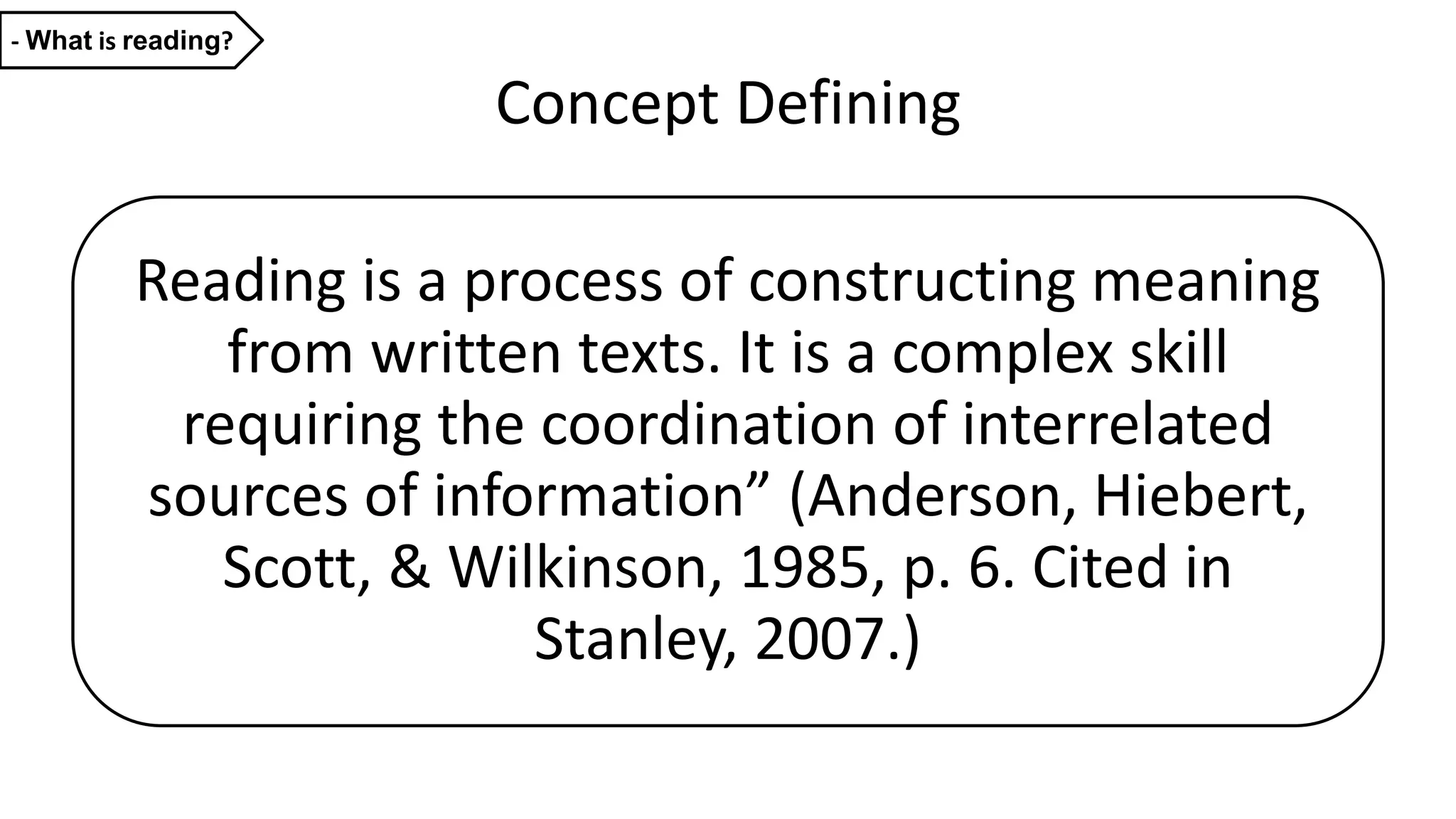
Concept Defining
Reading is a process of constructing meaning
from written texts. It is a complex skill
requiring the coordination of interrelated
sources of information” (Anderson, Hiebert,
Scott, & Wilkinson, 1985, p. 6. Cited in
Stanley, 2007.)
- What is reading?
List what you have recently read!
Newspaper
articles
Emails Letters
Text
messages
Labels on
bottles
Books
Online
materials
Leaflets
Fliers Maps ….
- What is reading?
Purpose of reading (Williams, 1984)
We read
to get general
information
to get specific
information
for pleasure
- What is reading?
Types of reading
Reading
Intensive Extensive
- What is reading?
TEACHING READING (theory)
Typical Reading procedure
T. chooses a text
T. asks the students to read it aloud
T. asks the students to answer comprehension
questions
Class correction
- Teaching vs
testing reading
Teaching vs testing reading
Testing
comprehension
is NOT
teaching
reading
comprehension
- Teaching vs
testing reading
Testing Reading or teaching reading?
Instead of
focusing on
testing SS
comprehension,
we should first and
foremost teach them
the skills and
strategies they need to
tackle different types
of texts
- Teaching vs
testing reading
Skills and strategies (the tools)
- Skills vs
strategies
Skills vs strategies
Skills
Unconscious ability / proficiency
The target
Automaticity
Reading skills operate without the reader’s
deliberate control or conscious awareness.
Strategies
Conscious plan
The journey
Tactics
Awareness helps the reader select an intended path,
the means to the goal, and the processes used to
achieve the goal.
- Skills vs
strategies
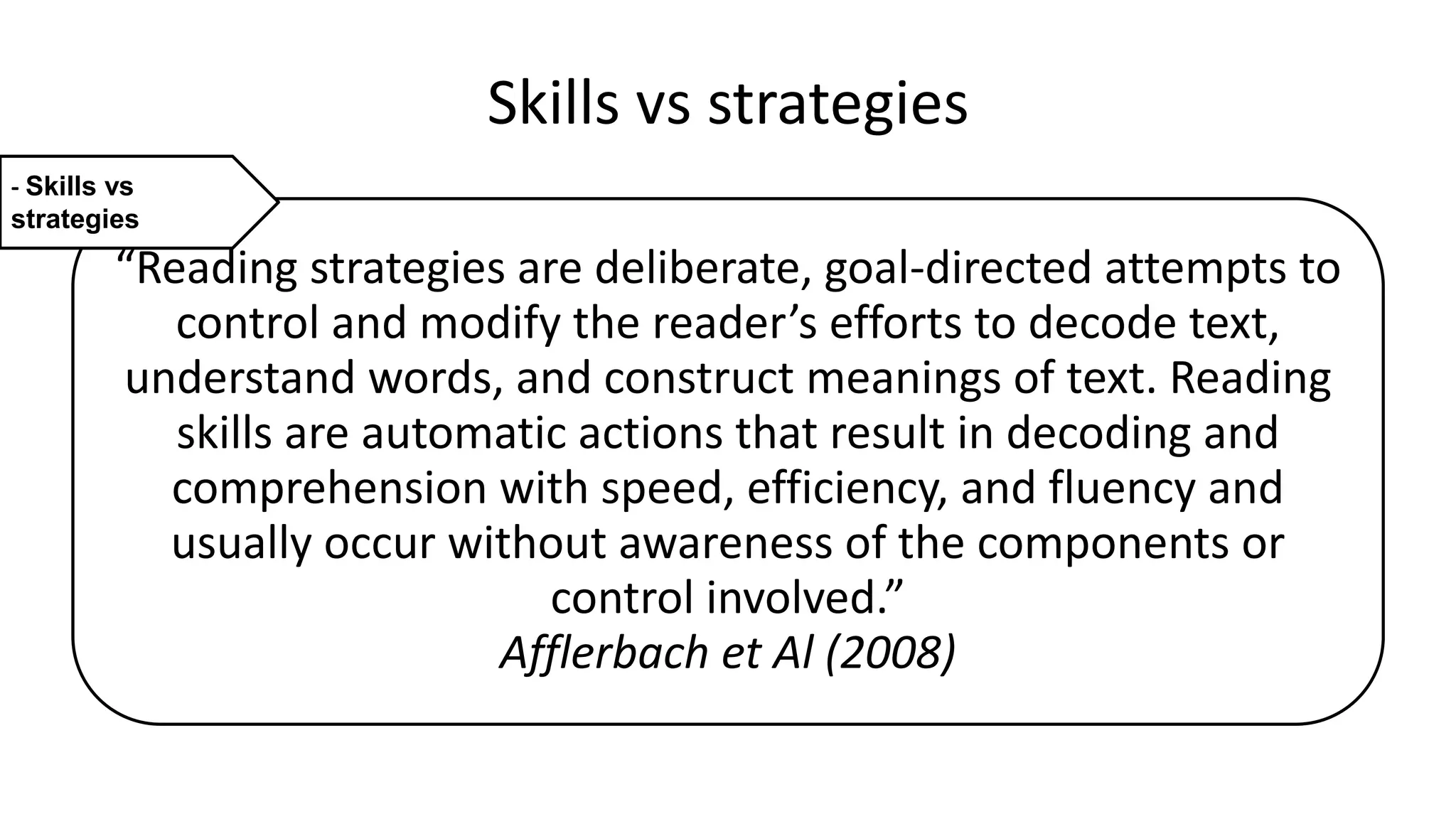
Skills vs strategies
“Reading strategies are deliberate, goal-directed attempts to
control and modify the reader’s efforts to decode text,
understand words, and construct meanings of text. Reading
skills are automatic actions that result in decoding and
comprehension with speed, efficiency, and fluency and
usually occur without awareness of the components or
control involved.”
Afflerbach et Al (2008)
- Skills vs
strategies
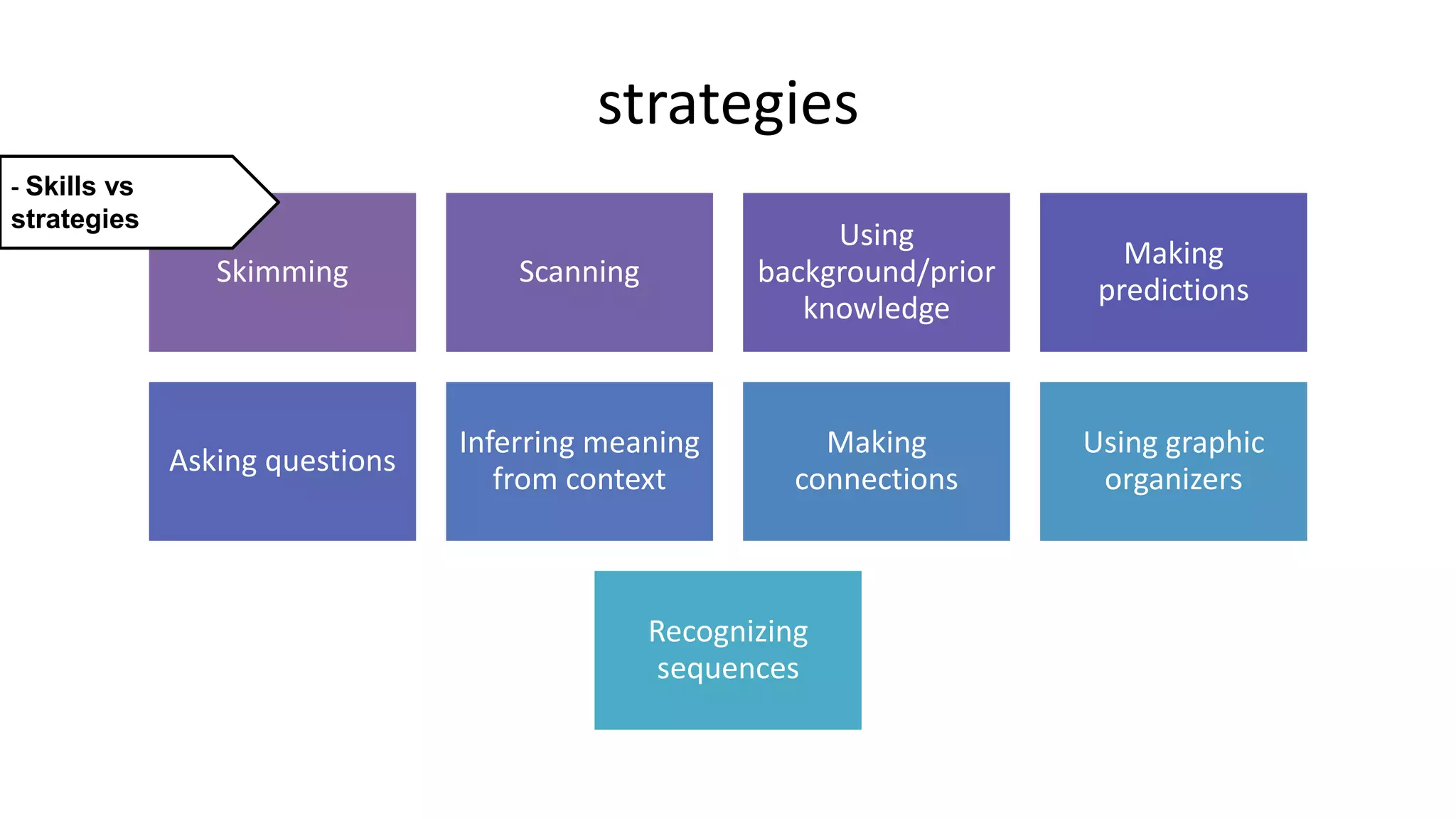
strategies
Skimming Scanning
Using
background/prior
knowledge
Making
predictions
Asking questions
Inferring meaning
from context
Making
connections
Using graphic
organizers
Recognizing
sequences
- Skills vs
strategies
Schema theory
Schema theory
Is the reader a ‘tabula rasa’?
- Schema theory
Schema theory
Schema theory tries to explain how
readers utilize prior knowledge to
understand and get new information
from the text (Rumelhart, 1980).
- Schema theory
COGNITIVE PROCESSING
Cognitive
processing
Top-down
Bottom-up
Interactive model
- Cognitive
processing
Top-down vs Bottom-up processing
From a distance, it’s just a wall! Closer, one can see the bricks!
- Cognitive
processing
Top-down model
Reader-based (i.e. readers as they interact with the text)
Focus is on what readers bring to the process by activating background
knowledge and making predictions.
Focus is on sampling the information of the text and contrasting it with the
reader’s world knowledge to make sense of it.
Meaning-oriented (i.e. overall meaning takes priority over individual words)
- Cognitive
processing
Bottom-up model
Text-based
Focus is on vocabulary, grammar and organization
Starts from letters, morphemes, words…
Reader depends on text variables: vocabulary, grammar, text content…
- Cognitive
processing
The interactive model
using both top-down and bottom-up skills.
Focus is on both
what is on the written page and what is in the reader’s mind
- Cognitive
processing
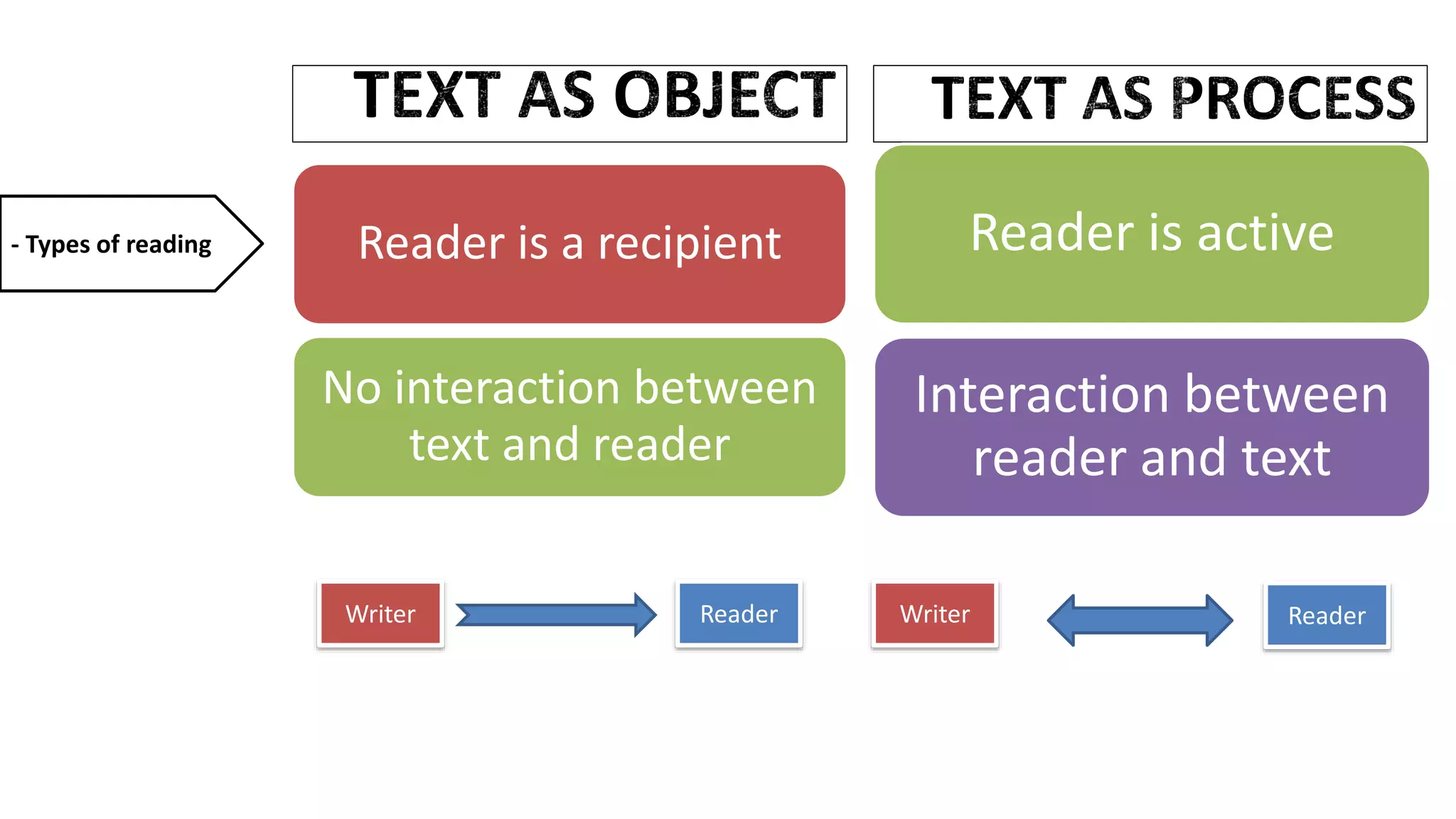
Reader is a recipient
No interaction between
text and reader
Reader is active
Interaction between
reader and text
- Types of reading
Writer Reader Writer Reader
In the classroom
Basic principles
Principles
of
teaching
reading
Reading is purposeful
Teachers should choose appropriate texts
Vocabulary knowledge facilitates comprehension
Opt for activities that focus on skill integration
Explicitly teach reading strategies
Text type knowledge is important
Devise a well-structured lesson plan
- Principles
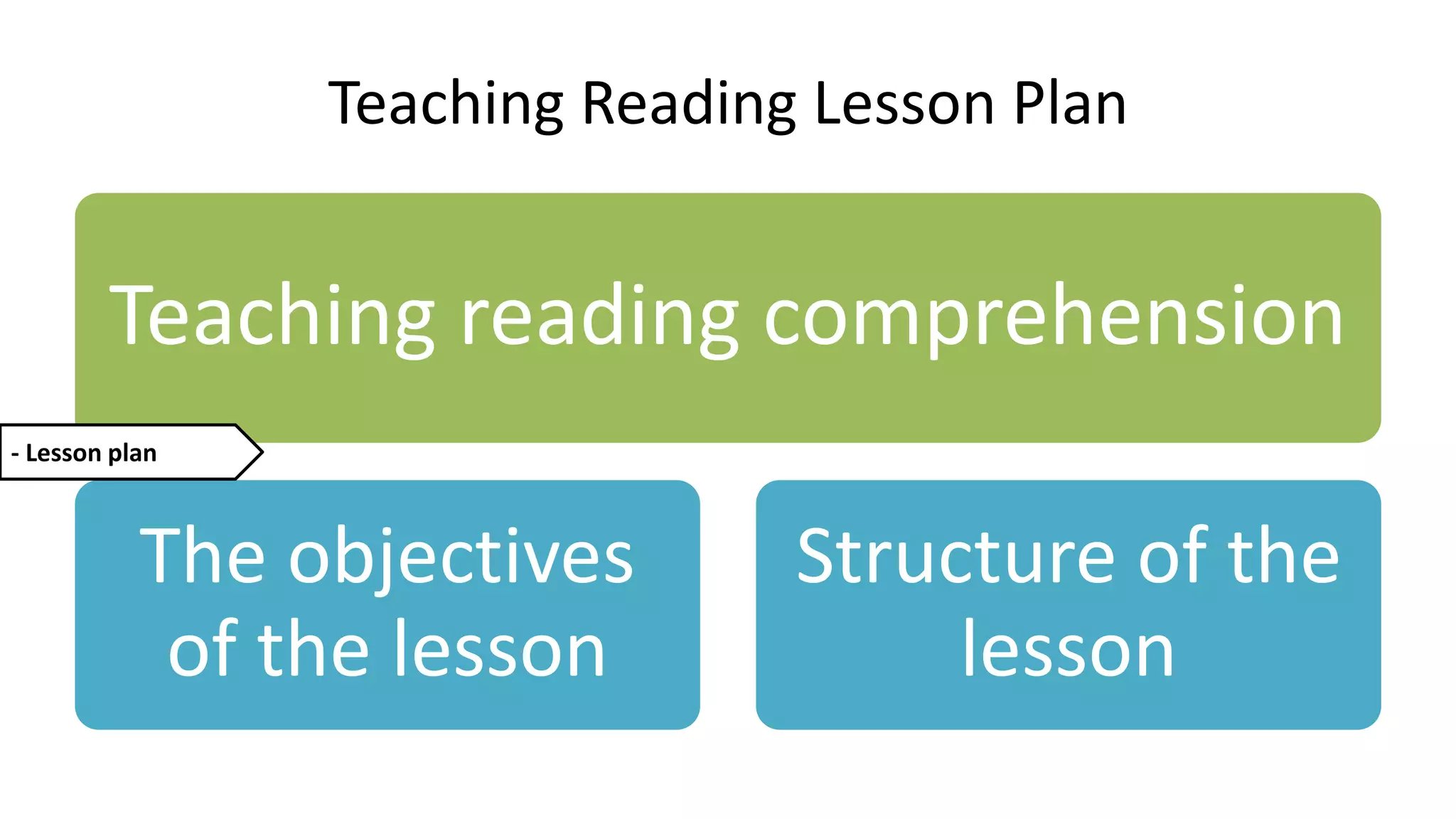
Teaching Reading Lesson Plan
Teaching reading comprehension
The objectives
of the lesson
Structure of the
lesson
- Lesson plan
Objectives
Reading
comprehension
objectives
Reading for gist?
Reading for specific information?
Reading for detailed comprehension?
Developing speed reading?
Training learners on specific reading strategies?
Inferring meaning from context?
A combination of the above goals?
…
- Objectives
How to teach reading (the stages)
Stages
Pre-reading
While reading
Post reading
- Lesson plan
Pre-reading activities
Pre-reading activities:
Prepare
students for
the reading
task
(vocabulary,
grammar,…)
Help learners
anticipate the
topic of the
reading.
Create the
need to know
more about a
topic.
Increase
students'
motivation.
- Stages
Pre-Reading activities
Brainstorming Discussion Pictures Pictionary
Predicting KWL Chart Word cloud Videos
- Stages
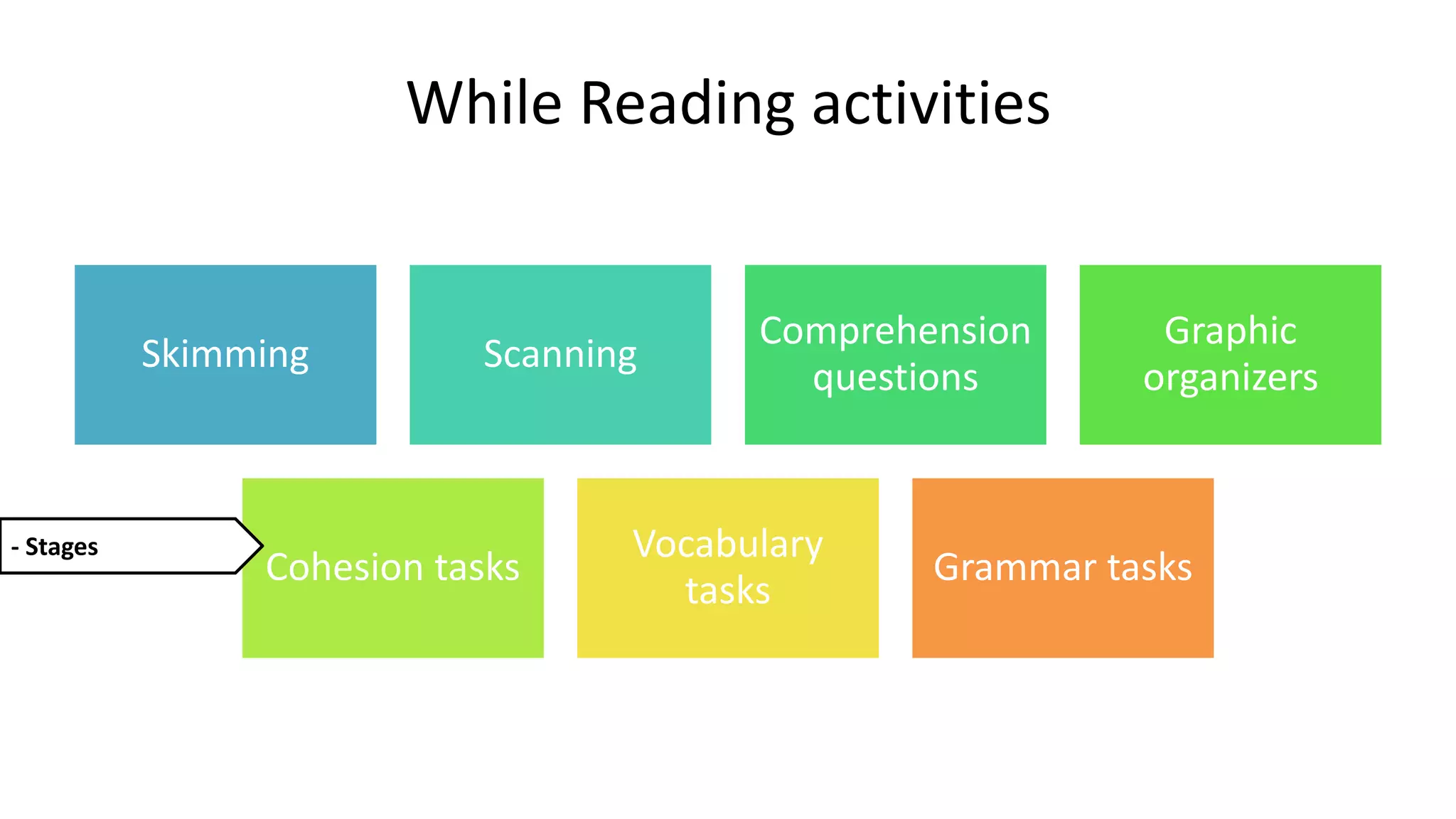
While reading activities
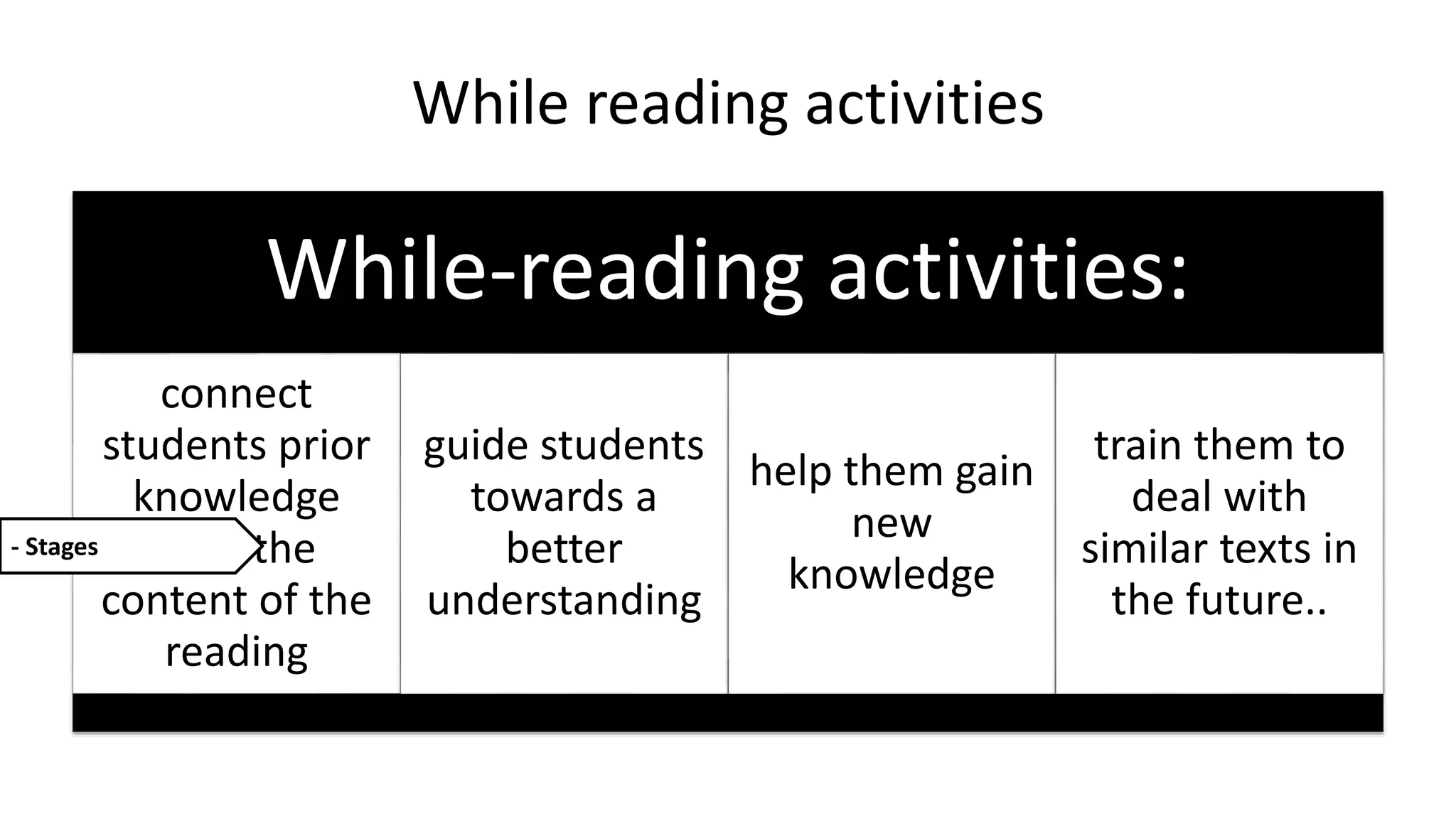
While-reading activities:
connect
students prior
knowledge
with the
content of the
reading
guide students
towards a
better
understanding
help them gain
new
knowledge
train them to
deal with
similar texts in
the future..
- Stages
While Reading activities
Skimming Scanning
Comprehension
questions
Graphic
organizers
Cohesion tasks
Vocabulary
tasks
Grammar tasks
- Stages
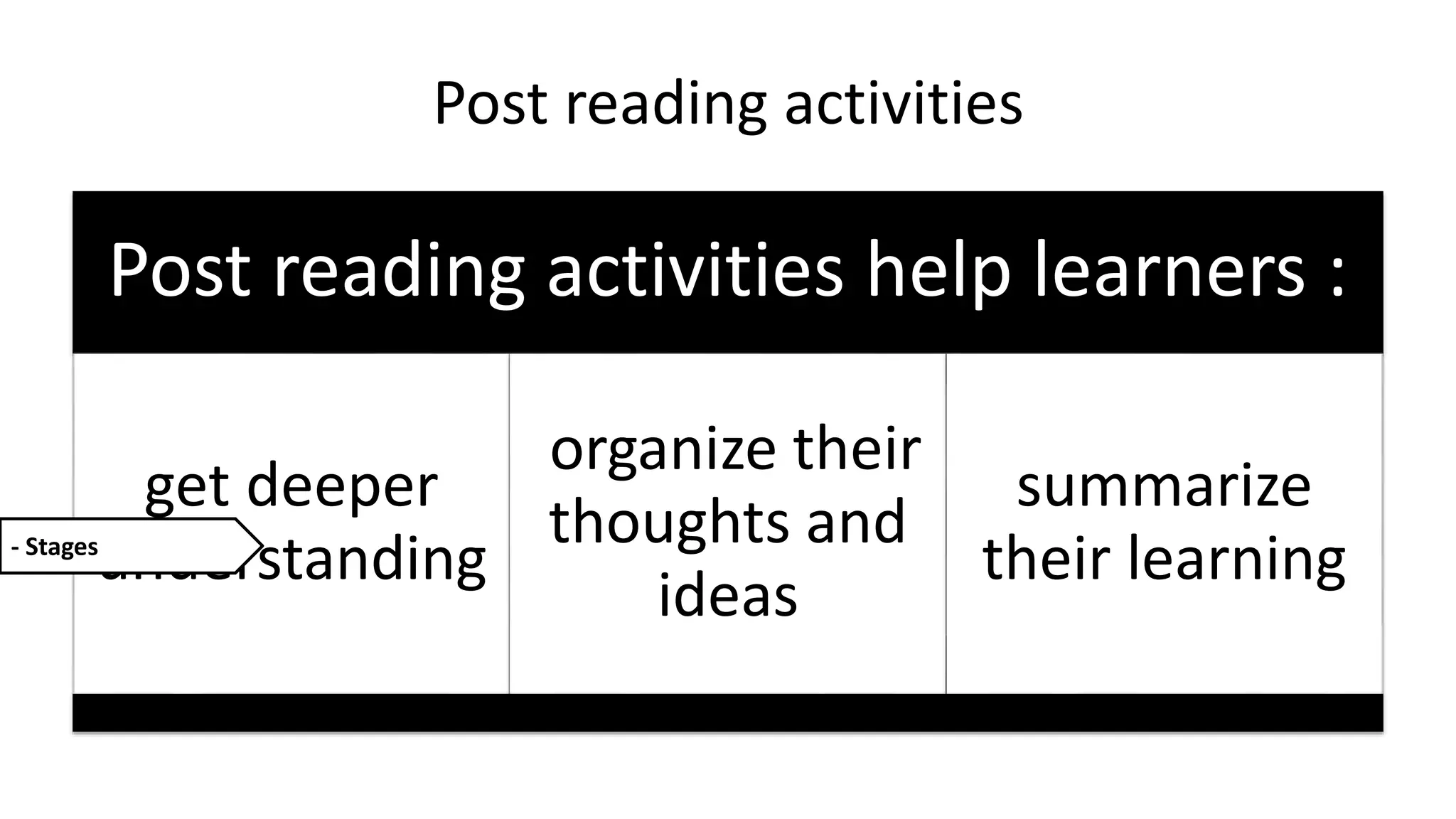
Post reading activities
Post reading activities help learners :
get deeper
understanding
organize their
thoughts and
ideas
summarize
their learning
- Stages
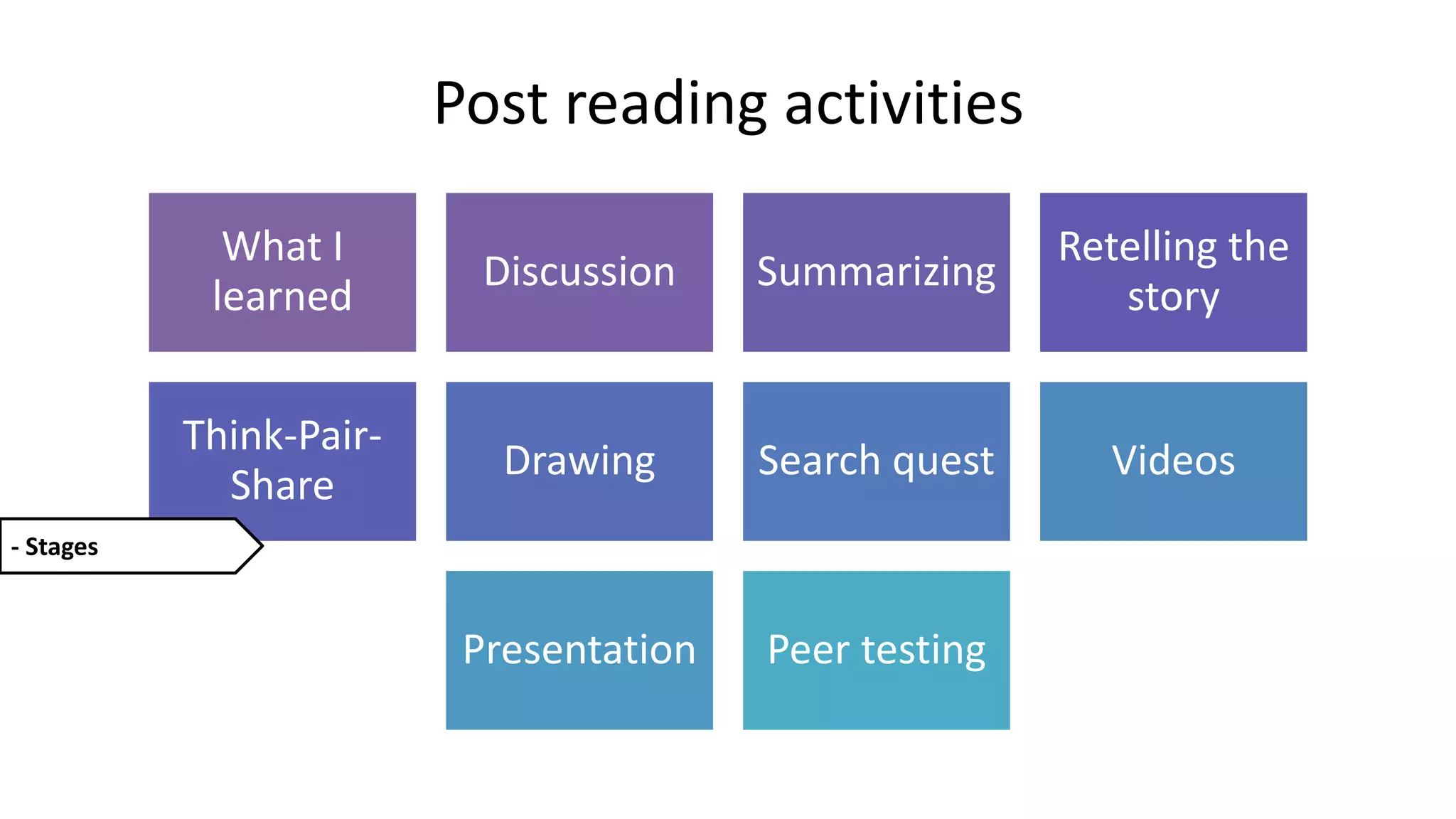
Post reading activities
What I
learned
Discussion Summarizing
Retelling the
story
Think-Pair-
Share
Drawing Search quest Videos
Presentation Peer testing
- Stages
The reading process
The readers’
mind
The text
The readers’
mind
- Stages
Some reading procedures
Some Reading procedures
SQ3R
Standard
reading exercise
reciprocal
teaching
Concept-
oriented reading
instruction
- Some reading
procedures
SQ3R (Survey, Question, Read, Recite, Review)
The SQ3R
method is
a step-by-
step
strategy
for
effective
reading
Students survey the assigned reading by first skimming through it.
Learners are encouraged to formulate questions
Students read the text and try to answer the questions they
generated previously.
Students are encouraged to recite the information from memory.
Students should review their questions, and see if they can answer
them all easily.
- Some reading
procedures
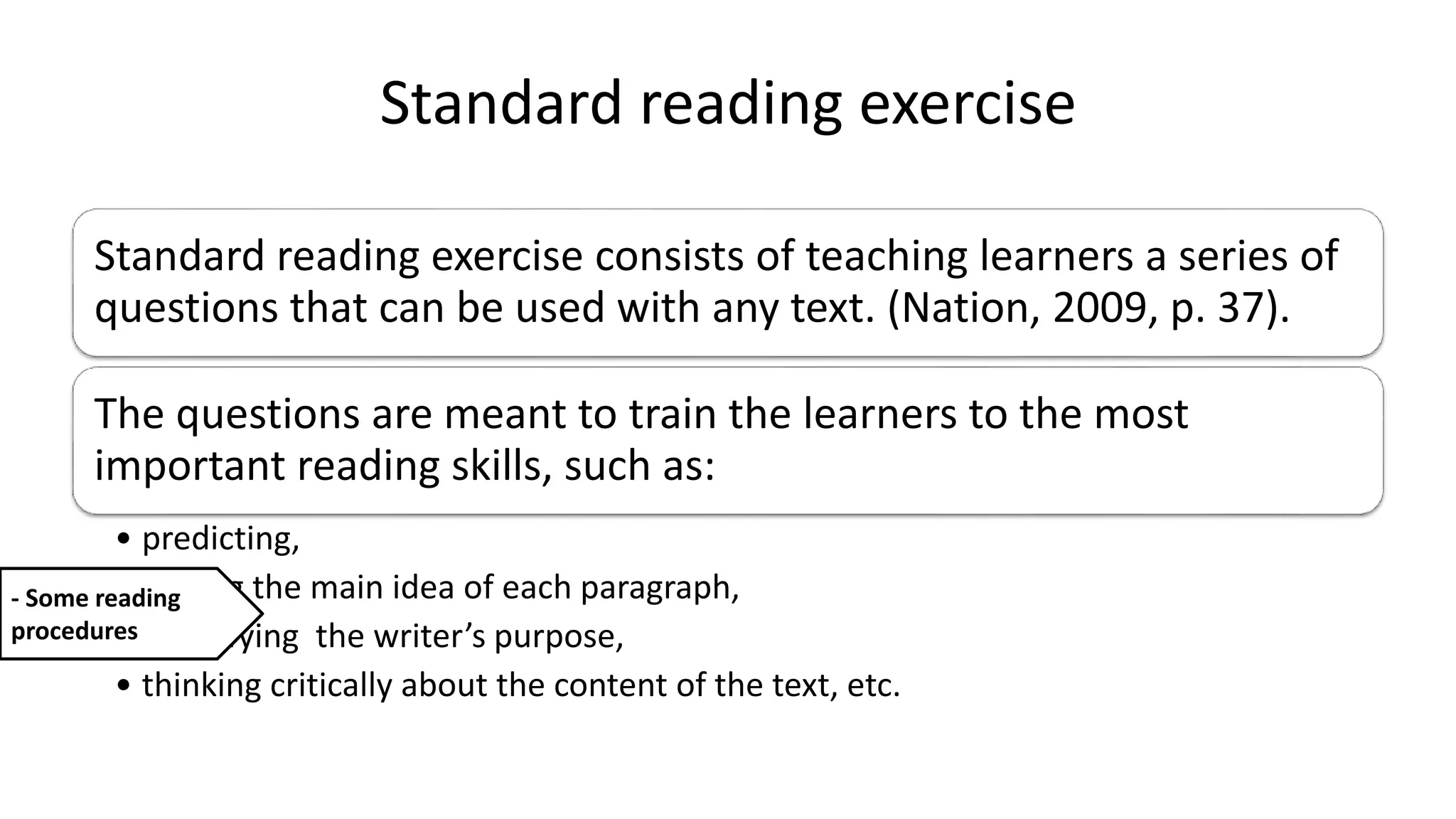
Standard reading exercise
Standard reading exercise consists of teaching learners a series of
questions that can be used with any text. (Nation, 2009, p. 37).
The questions are meant to train the learners to the most
important reading skills, such as:
• predicting,
• finding the main idea of each paragraph,
• identifying the writer’s purpose,
• thinking critically about the content of the text, etc.
- Some reading
procedures
Reciprocal teaching
Palincsar and Brown (1986, cited in Nation, 2009) designed a
procedure which they coined “reciprocal teaching”.
In this procedure, the teacher trains the learners to use four
main strategies, which could be applied to any text:
• The students predict the content of the paragraph before reading it;
• They make questions focusing on the main idea of the paragraph;
• They summarize what has just been read;
• They seek clarification on difficult points in the paragraph.
- Some reading
procedures
Concept-oriented reading instruction (CORI)
Nation (2009) describes concept-oriented reading instruction (CORI)
as an integrated strategy approach to reading comprehension
(Guthrie, 2003). This involves training learners to use a set of
strategies through the sequence of modelling, scaffolding, and guided
practice. These strategies include:
• activating background knowledge,
• questioning, searching for information,
• summarizing,
• organizing graphically,
• and structuring stories.
- Some reading
procedures
Summary
•
Reading is a purposeful task.
•
Choose appropriate texts
•
Classroom procedure should reflect the purposeful, task-based, interactive
nature of real reading.
•
Testing comprehension is NOT teaching reading comprehension
•
Teachers should identify the strategies, skills, and objectives of the efficient
reader during the process of real reading, and then help the learner to acquire
them.
•
Readers contribute meaning to a text; consequently, teachers must include tasks
which require readers to combine what is in their heads with what is in the text.
•
Identify clear objectives for reading
•
Develop reading lessons in three parts: pre, while, and post reading stages.
•
Encourage students to read extensively.
- Summary
www.MyEnglishPages.com
© Copyright
Workshop
Groups of 5 teachers are assigned 5 texts
They work together to prepare a lesson plan that includes:
• Level + Objectives
• Pre-reading activities
• While reading activities
• Post reading activities
- Workshop
References
•
Abraham, P. (2000) Skilled Reading: Top-Down, Bottom-Up, Field Notes, Vol. 10, No. 2 (Fall
2000)Publisher: SABES/World Education, Boston, MA, Copyright 2000. Retrieved from
http://www.sabes.org/sites/sabes.org/files/resources/fn102.pdf on August, 18 2017.
•
Anderson, R. C., Hiebert, E. H., Scott, J. A., & Wilkinson, I. A. G. (1985). Becoming a nation of
readers: The report of the commission on reading. Washington, D. C.:National Institute of
Education.
•
Chambers, F. and Brigham, A. 1989. Summary writing: a short cut to success. English Teaching
Forum 27, 1: 43–45.
•
Guthrie, J.R. 2003. Concept-oriented reading instruction. In A. Sweet and C. Snow (eds)
Rethinking reading comprehension. New York: Guilford Press: 115–140.
•
Palincsar, A.S. and Brown, A.L. 1986. Interactive teaching to promote independent learning from
text. Reading Teacher 20: 771–776.
•
Rumelhart, D.E. (1977). Toward an interactive model of reading. In: S. Dornic (ed.), Attention and
performance VI, (pp. 573-603). Hillsdale, NJ: Lawrence Erlbaum.
•
Stanley, S. (2007). An Analysis of Rx for Discovery Reading RTM for Elementary Students Below
Average in Reading. Retrieved from
http://digitalcommons.liberty.edu/cgi/viewcontent.cgi?article=1070&context=doctoral, on
September 14, 2017.
•
Stanovich, K.E. (1980). Toward an interactive-compensatory model of individual differences in
the development of reading fluency. Reading Research Quarterly, 16, 32-71.
Teaching Reading Skills

Teaching Reading Skills

  • 2.
    How to TeachReading Skills From Theory to practice
  • 3.
    OUTLINE • Theoretical background – What isreading? – What is meant by teaching reading skills? – Skills vs strategies – Schema theory – Cognitive processing – Types of reading • In the classroom: how to teach reading? – Principles of teaching reading – Lesson plan • Objectives and structure • Stages of the lesson plan • Activities • Some reading procedures • Summary • Workshop
  • 4.
    Concept defining "[Reading is]the action or skill of reading written or printed material silently or aloud.“ Dictionary definition - What is reading?
  • 5.
    Concept Defining Reading isa process of constructing meaning from written texts. It is a complex skill requiring the coordination of interrelated sources of information” (Anderson, Hiebert, Scott, & Wilkinson, 1985, p. 6. Cited in Stanley, 2007.) - What is reading?
  • 6.
    List what youhave recently read! Newspaper articles Emails Letters Text messages Labels on bottles Books Online materials Leaflets Fliers Maps …. - What is reading?
  • 7.
    Purpose of reading(Williams, 1984) We read to get general information to get specific information for pleasure - What is reading?
  • 8.
    Types of reading Reading IntensiveExtensive - What is reading?
  • 9.
  • 10.
    Typical Reading procedure T.chooses a text T. asks the students to read it aloud T. asks the students to answer comprehension questions Class correction - Teaching vs testing reading
  • 11.
    Teaching vs testingreading Testing comprehension is NOT teaching reading comprehension - Teaching vs testing reading
  • 12.
    Testing Reading orteaching reading? Instead of focusing on testing SS comprehension, we should first and foremost teach them the skills and strategies they need to tackle different types of texts - Teaching vs testing reading
  • 13.
    Skills and strategies(the tools) - Skills vs strategies
  • 14.
    Skills vs strategies Skills Unconsciousability / proficiency The target Automaticity Reading skills operate without the reader’s deliberate control or conscious awareness. Strategies Conscious plan The journey Tactics Awareness helps the reader select an intended path, the means to the goal, and the processes used to achieve the goal. - Skills vs strategies
  • 15.
    Skills vs strategies “Readingstrategies are deliberate, goal-directed attempts to control and modify the reader’s efforts to decode text, understand words, and construct meanings of text. Reading skills are automatic actions that result in decoding and comprehension with speed, efficiency, and fluency and usually occur without awareness of the components or control involved.” Afflerbach et Al (2008) - Skills vs strategies
  • 16.
    strategies Skimming Scanning Using background/prior knowledge Making predictions Asking questions Inferringmeaning from context Making connections Using graphic organizers Recognizing sequences - Skills vs strategies
  • 17.
  • 18.
    Schema theory Is thereader a ‘tabula rasa’? - Schema theory
  • 19.
    Schema theory Schema theorytries to explain how readers utilize prior knowledge to understand and get new information from the text (Rumelhart, 1980). - Schema theory
  • 20.
  • 21.
    Top-down vs Bottom-upprocessing From a distance, it’s just a wall! Closer, one can see the bricks! - Cognitive processing
  • 22.
    Top-down model Reader-based (i.e.readers as they interact with the text) Focus is on what readers bring to the process by activating background knowledge and making predictions. Focus is on sampling the information of the text and contrasting it with the reader’s world knowledge to make sense of it. Meaning-oriented (i.e. overall meaning takes priority over individual words) - Cognitive processing
  • 23.
    Bottom-up model Text-based Focus ison vocabulary, grammar and organization Starts from letters, morphemes, words… Reader depends on text variables: vocabulary, grammar, text content… - Cognitive processing
  • 24.
    The interactive model usingboth top-down and bottom-up skills. Focus is on both what is on the written page and what is in the reader’s mind - Cognitive processing
  • 25.
    Reader is arecipient No interaction between text and reader Reader is active Interaction between reader and text - Types of reading Writer Reader Writer Reader
  • 26.
  • 27.
    Basic principles Principles of teaching reading Reading ispurposeful Teachers should choose appropriate texts Vocabulary knowledge facilitates comprehension Opt for activities that focus on skill integration Explicitly teach reading strategies Text type knowledge is important Devise a well-structured lesson plan - Principles
  • 28.
    Teaching Reading LessonPlan Teaching reading comprehension The objectives of the lesson Structure of the lesson - Lesson plan
  • 29.
    Objectives Reading comprehension objectives Reading for gist? Readingfor specific information? Reading for detailed comprehension? Developing speed reading? Training learners on specific reading strategies? Inferring meaning from context? A combination of the above goals? … - Objectives
  • 30.
    How to teachreading (the stages) Stages Pre-reading While reading Post reading - Lesson plan
  • 31.
    Pre-reading activities Pre-reading activities: Prepare studentsfor the reading task (vocabulary, grammar,…) Help learners anticipate the topic of the reading. Create the need to know more about a topic. Increase students' motivation. - Stages
  • 32.
    Pre-Reading activities Brainstorming DiscussionPictures Pictionary Predicting KWL Chart Word cloud Videos - Stages
  • 33.
    While reading activities While-readingactivities: connect students prior knowledge with the content of the reading guide students towards a better understanding help them gain new knowledge train them to deal with similar texts in the future.. - Stages
  • 34.
    While Reading activities SkimmingScanning Comprehension questions Graphic organizers Cohesion tasks Vocabulary tasks Grammar tasks - Stages
  • 35.
    Post reading activities Postreading activities help learners : get deeper understanding organize their thoughts and ideas summarize their learning - Stages
  • 36.
    Post reading activities WhatI learned Discussion Summarizing Retelling the story Think-Pair- Share Drawing Search quest Videos Presentation Peer testing - Stages
  • 37.
    The reading process Thereaders’ mind The text The readers’ mind - Stages
  • 38.
  • 39.
    Some Reading procedures SQ3R Standard readingexercise reciprocal teaching Concept- oriented reading instruction - Some reading procedures
  • 40.
    SQ3R (Survey, Question,Read, Recite, Review) The SQ3R method is a step-by- step strategy for effective reading Students survey the assigned reading by first skimming through it. Learners are encouraged to formulate questions Students read the text and try to answer the questions they generated previously. Students are encouraged to recite the information from memory. Students should review their questions, and see if they can answer them all easily. - Some reading procedures
  • 41.
    Standard reading exercise Standardreading exercise consists of teaching learners a series of questions that can be used with any text. (Nation, 2009, p. 37). The questions are meant to train the learners to the most important reading skills, such as: • predicting, • finding the main idea of each paragraph, • identifying the writer’s purpose, • thinking critically about the content of the text, etc. - Some reading procedures
  • 42.
    Reciprocal teaching Palincsar andBrown (1986, cited in Nation, 2009) designed a procedure which they coined “reciprocal teaching”. In this procedure, the teacher trains the learners to use four main strategies, which could be applied to any text: • The students predict the content of the paragraph before reading it; • They make questions focusing on the main idea of the paragraph; • They summarize what has just been read; • They seek clarification on difficult points in the paragraph. - Some reading procedures
  • 43.
    Concept-oriented reading instruction(CORI) Nation (2009) describes concept-oriented reading instruction (CORI) as an integrated strategy approach to reading comprehension (Guthrie, 2003). This involves training learners to use a set of strategies through the sequence of modelling, scaffolding, and guided practice. These strategies include: • activating background knowledge, • questioning, searching for information, • summarizing, • organizing graphically, • and structuring stories. - Some reading procedures
  • 44.
    Summary • Reading is apurposeful task. • Choose appropriate texts • Classroom procedure should reflect the purposeful, task-based, interactive nature of real reading. • Testing comprehension is NOT teaching reading comprehension • Teachers should identify the strategies, skills, and objectives of the efficient reader during the process of real reading, and then help the learner to acquire them. • Readers contribute meaning to a text; consequently, teachers must include tasks which require readers to combine what is in their heads with what is in the text. • Identify clear objectives for reading • Develop reading lessons in three parts: pre, while, and post reading stages. • Encourage students to read extensively. - Summary
  • 45.
  • 46.
    Workshop Groups of 5teachers are assigned 5 texts They work together to prepare a lesson plan that includes: • Level + Objectives • Pre-reading activities • While reading activities • Post reading activities - Workshop
  • 47.
    References • Abraham, P. (2000)Skilled Reading: Top-Down, Bottom-Up, Field Notes, Vol. 10, No. 2 (Fall 2000)Publisher: SABES/World Education, Boston, MA, Copyright 2000. Retrieved from http://www.sabes.org/sites/sabes.org/files/resources/fn102.pdf on August, 18 2017. • Anderson, R. C., Hiebert, E. H., Scott, J. A., & Wilkinson, I. A. G. (1985). Becoming a nation of readers: The report of the commission on reading. Washington, D. C.:National Institute of Education. • Chambers, F. and Brigham, A. 1989. Summary writing: a short cut to success. English Teaching Forum 27, 1: 43–45. • Guthrie, J.R. 2003. Concept-oriented reading instruction. In A. Sweet and C. Snow (eds) Rethinking reading comprehension. New York: Guilford Press: 115–140. • Palincsar, A.S. and Brown, A.L. 1986. Interactive teaching to promote independent learning from text. Reading Teacher 20: 771–776. • Rumelhart, D.E. (1977). Toward an interactive model of reading. In: S. Dornic (ed.), Attention and performance VI, (pp. 573-603). Hillsdale, NJ: Lawrence Erlbaum. • Stanley, S. (2007). An Analysis of Rx for Discovery Reading RTM for Elementary Students Below Average in Reading. Retrieved from http://digitalcommons.liberty.edu/cgi/viewcontent.cgi?article=1070&context=doctoral, on September 14, 2017. • Stanovich, K.E. (1980). Toward an interactive-compensatory model of individual differences in the development of reading fluency. Reading Research Quarterly, 16, 32-71.