Accelera'ng	
  Learning	
  in	
  Literacy	
  
	
  Reading	
  	
  
Ley$a	
  Leota,	
  Doreen	
  Jukes	
  
ley$a.leota@xtra.co.nz	
  
doreen.mjukes@gmail.com	


}  Student Agency- knowing about the learner
}  Cultural responsive pedagogy
}  Student voice
}  Parent voice
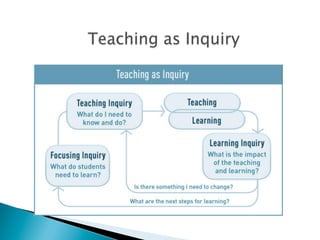
}  Iterative Inquiry
}  Four key levers of change
}  Theory of action
}  Self-review tools
}  BES exemplar
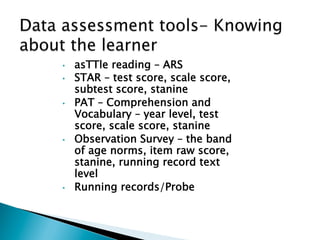
•  asTTle reading – ARS
•  STAR – test score, scale score,
subtest score, stanine
•  PAT – Comprehension and
Vocabulary – year level, test
score, scale score, stanine
•  Observation Survey – the band
of age norms, item raw score,
stanine, running record text
level
•  Running records/Probe
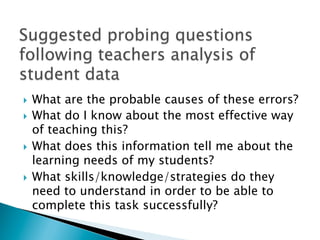
}  What are the probable causes of these errors?
}  What do I know about the most effective way
of teaching this?
}  What does this information tell me about the
learning needs of my students?
}  What skills/knowledge/strategies do they
need to understand in order to be able to
complete this task successfully?
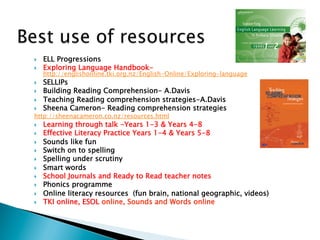
}  ELL Progressions
}  Exploring Language Handbook-
http://englishonline.tki.org.nz/English-Online/Exploring-language
}  SELLIPs
}  Building Reading Comprehension- A.Davis
}  Teaching Reading comprehension strategies-A.Davis
}  Sheena Cameron- Reading comprehension strategies
http://sheenacameron.co.nz/resources.html
}  Learning through talk -Years 1-3 & Years 4-8
}  Effective Literacy Practice Years 1-4 & Years 5-8
}  Sounds like fun
}  Switch on to spelling
}  Spelling under scrutiny
}  Smart words
}  School Journals and Ready to Read teacher notes
}  Phonics programme
}  Online literacy resources (fun brain, national geographic, videos)
}  TKI online, ESOL online, Sounds and Words online
—  www.clickspecialednz.com
—  Click news – newsletter
—  Narrative Assessment for special needs
—  SPELD- Special Education Learning
Difficulties
—  New Zealand exemplars for learners with
special education needs
—  www.spectronics.co.nz
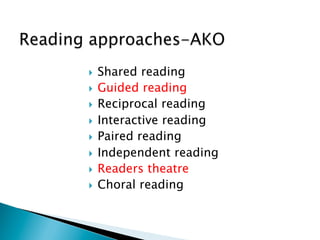
}  Shared reading
}  Guided reading
}  Reciprocal reading
}  Interactive reading
}  Paired reading
}  Independent reading
}  Readers theatre
}  Choral reading
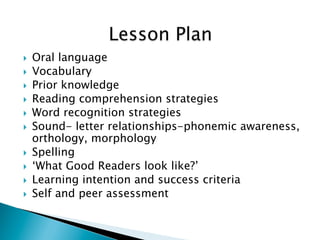
}  Oral language
}  Vocabulary
}  Prior knowledge
}  Reading comprehension strategies
}  Word recognition strategies
}  Sound- letter relationships-phonemic awareness,
orthology, morphology
}  Spelling
}  ‘What Good Readers look like?’
}  Learning intention and success criteria
}  Self and peer assessment
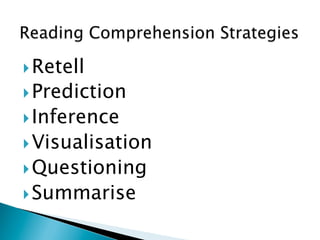
} Retell
} Prediction
} Inference
} Visualisation
} Questioning
} Summarise
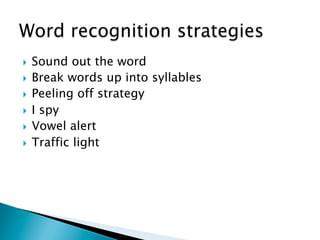
}  Sound out the word
}  Break words up into syllables
}  Peeling off strategy
}  I spy
}  Vowel alert
}  Traffic light
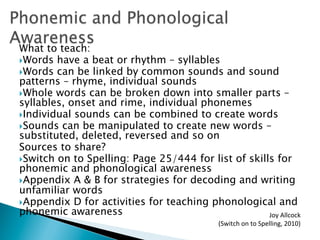
What to teach:
} Words have a beat or rhythm – syllables
} Words can be linked by common sounds and sound
patterns – rhyme, individual sounds
} Whole words can be broken down into smaller parts –
syllables, onset and rime, individual phonemes
} Individual sounds can be combined to create words
} Sounds can be manipulated to create new words –
substituted, deleted, reversed and so on
Sources to share?
} Switch on to Spelling: Page 25/444 for list of skills for
phonemic and phonological awareness
} Appendix A & B for strategies for decoding and writing
unfamiliar words
} Appendix D for activities for teaching phonological and
phonemic awareness Joy	
  Allcock	


(Switch	
  on	
  to	
  Spelling,	
  2010)	
  
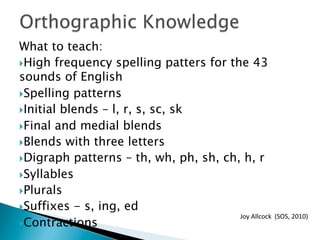
What to teach:
} High frequency spelling patters for the 43
sounds of English
} Spelling patterns
} Initial blends – l, r, s, sc, sk
} Final and medial blends
} Blends with three letters
} Digraph patterns – th, wh, ph, sh, ch, h, r
} Syllables
} Plurals
} Suffixes - s, ing, ed
} Contractions
Joy	
  Allcock	
  	
  (SOS,	
  2010)	
  
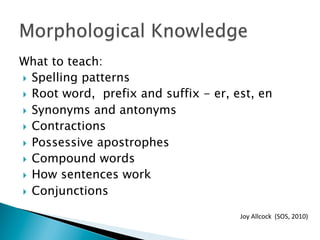
What to teach:
}  Spelling patterns
}  Root word, prefix and suffix - er, est, en
}  Synonyms and antonyms
}  Contractions
}  Possessive apostrophes
}  Compound words
}  How sentences work
}  Conjunctions
Joy	
  Allcock	
  	
  (SOS,	
  2010)	


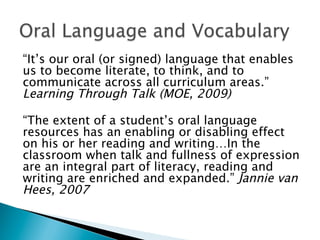
“It’s our oral (or signed) language that enables
us to become literate, to think, and to
communicate across all curriculum areas.”
Learning Through Talk (MOE, 2009)
“The extent of a student’s oral language
resources has an enabling or disabling effect
on his or her reading and writing…In the
classroom when talk and fullness of expression
are an integral part of literacy, reading and
writing are enriched and expanded.” Jannie van
Hees, 2007
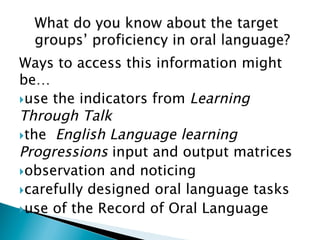
Ways to access this information might
be…
} use the indicators from Learning
Through Talk
} the English Language learning
Progressions input and output matrices
} observation and noticing
} carefully designed oral language tasks
} use of the Record of Oral Language
As	
  you	
  are	
  planning	
  your	
  interven'on	
  
consider..	
  
Instruction is most effective when it provides
multiple exposures to the words being taught.
Vocab needs to be presented in a range of
contexts, engaging students actively in learning
about words.
•  A pre-reading activity
•  Integrated within a reading comprehension
lesson
•  In response to reading
•  Mini lesson
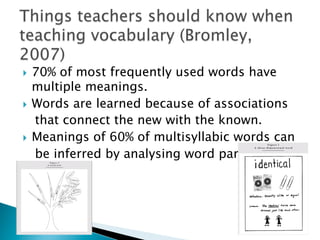
}  70% of most frequently used words have
multiple meanings.
}  Words are learned because of associations
that connect the new with the known.
}  Meanings of 60% of multisyllabic words can
be inferred by analysing word parts.
}  Teaching fewer words well is more effective
than teaching several words in a cursory
way.
Teach struggling students and English language
learners no more than three to five new words at a
time because they might have difficulty retaining
more than that. Teach words students will need to
know in the future and teach only words related to
the main idea of new material.
Effective teachers display an attitude of excitement
and interest in words and language.
Things to do:
• Reflect on your vocabulary teaching. Are you excited about
language and teaching or using new words? How do you most
often teach new words? Are there other, more effective ways?
• Educate yourself about best practice vocabulary teaching. Talk
with colleagues about how they teach vocabulary and what
works for them.
Read articles and books for new ways to teach vocabulary.
• Share your excitement with students about the fascinating
nature of words and language by providing students with a Word
of the Day.
Find these at Wordsmith (www.wordsmith.org/awad/index.html),
which introduces a word a day (around a weekly theme) with
definition, pronunciation, etymology, usage, and a quotation.
(Students can subscribe and receive it automatically.)
}  What behaviour does the student
demonstrate when faced with vocabulary
challenges?
}  What words are causing difficulty for the
student?
}  What does the students oral language reveal
about his or her vocabulary?
}  What words cause problems when they are
used in unfamiliar ways?
Thinking and knowing
}  Knowing about learning – knowing what
learning is, knowing how to learn, knowing
when you are learning and when you are
not, knowing what to do about it when you
are not learning, knowing to do this, and
knowing how to monitor what you have
done
}  A learners' automatic awareness of their
own knowledge and their ability to
understand, control, and manipulate their
own cognitive processesdavis.vision@xtra.co.nz 2013
•  Decode
•  Fluency and accuracy
•  Vocabulary
•  Understand continuous text
▫  Sentence level
▫  Within a paragraph
▫  Between paragraphs
▫  Across paragraphs
▫  Whole text
▫  Across a range of text
•  Understand non continuous text
▫  Photographs and captions
▫  Graphs and tables
▫  diagrams
davis.vision@xtra.co.nz 2013
The	
  student	
  at	
  the	
  center	
  of	
  all	
  learning	
  –	
  metacogni$vely	
  ac$ve	
  learners	
  
davis.vision@xtra.co.nz 2013
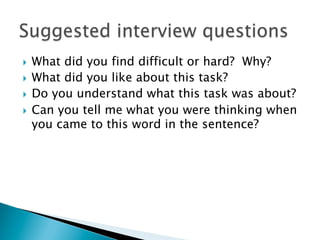
}  What did you find difficult or hard? Why?
}  What did you like about this task?
}  Do you understand what this task was about?
}  Can you tell me what you were thinking when
you came to this word in the sentence?
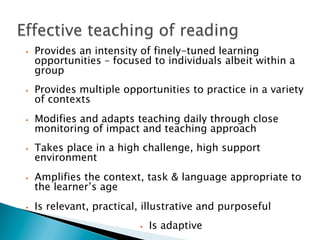
•  Provides an intensity of finely-tuned learning
opportunities – focused to individuals albeit within a
group
•  Provides multiple opportunities to practice in a variety
of contexts
•  Modifies and adapts teaching daily through close
monitoring of impact and teaching approach
•  Takes place in a high challenge, high support
environment
•  Amplifies the context, task & language appropriate to
the learner’s age
•  Is relevant, practical, illustrative and purposeful
•  Is adaptive
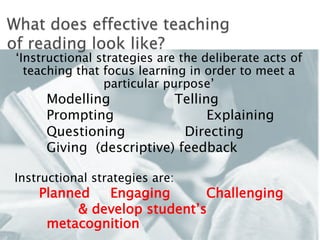
‘Instructional strategies are the deliberate acts of
teaching that focus learning in order to meet a
particular purpose’
Modelling Telling
Prompting Explaining
Questioning Directing
Giving (descriptive) feedback
Instructional strategies are:
Planned Engaging Challenging
& develop student’s
metacognition
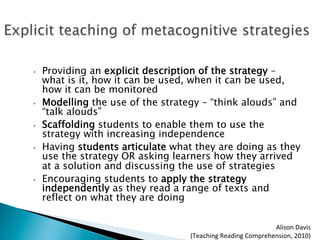
•  Providing an explicit description of the strategy –
what is it, how it can be used, when it can be used,
how it can be monitored
•  Modelling the use of the strategy – “think alouds” and
“talk alouds”
•  Scaffolding students to enable them to use the
strategy with increasing independence
•  Having students articulate what they are doing as they
use the strategy OR asking learners how they arrived
at a solution and discussing the use of strategies
•  Encouraging students to apply the strategy
independently as they read a range of texts and
reflect on what they are doing
Alison	
  Davis	
  	
  
(Teaching	
  Reading	
  Comprehension,	
  2010)	
  
}  Reading together
}  Shared reading for
older students
}  Pause, prompt, praise
}  Peer tutoring in
reading
}  Reciprocal teaching in
reading
}  Impress reading
}  The Daily 5
}  Language experience
•  Read	
  and	
  retell	
  
•  Reader’s	
  theatre	
  
•  Three	
  level	
  guides	
  
•  Reading	
  to	
  –	
  the	
  impact	
  of	
  
role	
  models	
  
•  Reading	
  and	
  wri$ng	
  links	
  	
  
•  Scaffolds	
  and	
  prompts	
  
•  Graphic	
  organisers	
  
•  Curiosity	
  kits	
  
•  The	
  Four	
  Blocks	
  literacy	
  
model	
  
}  Modelling
}  Prompting
}  Questioning
}  Giving feedback
}  Telling
}  Explaining
}  Directing
}  Commenting
}  Scaffolding
As you continue to design and flesh
out your intervention,
Why would your focus groups
WANT to read?
All reading 2014

All reading 2014

  • 1.
    Accelera'ng  Learning  in  Literacy    Reading     Ley$a  Leota,  Doreen  Jukes   ley$a.leota@xtra.co.nz   doreen.mjukes@gmail.com                  
  • 2.
    }  Student Agency-knowing about the learner }  Cultural responsive pedagogy }  Student voice }  Parent voice }  Iterative Inquiry }  Four key levers of change }  Theory of action }  Self-review tools }  BES exemplar
  • 4.
    •  asTTle reading– ARS •  STAR – test score, scale score, subtest score, stanine •  PAT – Comprehension and Vocabulary – year level, test score, scale score, stanine •  Observation Survey – the band of age norms, item raw score, stanine, running record text level •  Running records/Probe
  • 5.
    }  What arethe probable causes of these errors? }  What do I know about the most effective way of teaching this? }  What does this information tell me about the learning needs of my students? }  What skills/knowledge/strategies do they need to understand in order to be able to complete this task successfully?
  • 6.
    }  ELL Progressions } Exploring Language Handbook- http://englishonline.tki.org.nz/English-Online/Exploring-language }  SELLIPs }  Building Reading Comprehension- A.Davis }  Teaching Reading comprehension strategies-A.Davis }  Sheena Cameron- Reading comprehension strategies http://sheenacameron.co.nz/resources.html }  Learning through talk -Years 1-3 & Years 4-8 }  Effective Literacy Practice Years 1-4 & Years 5-8 }  Sounds like fun }  Switch on to spelling }  Spelling under scrutiny }  Smart words }  School Journals and Ready to Read teacher notes }  Phonics programme }  Online literacy resources (fun brain, national geographic, videos) }  TKI online, ESOL online, Sounds and Words online
  • 7.
    —  www.clickspecialednz.com —  Clicknews – newsletter —  Narrative Assessment for special needs —  SPELD- Special Education Learning Difficulties —  New Zealand exemplars for learners with special education needs —  www.spectronics.co.nz
  • 8.
    }  Shared reading } Guided reading }  Reciprocal reading }  Interactive reading }  Paired reading }  Independent reading }  Readers theatre }  Choral reading
  • 9.
    }  Oral language } Vocabulary }  Prior knowledge }  Reading comprehension strategies }  Word recognition strategies }  Sound- letter relationships-phonemic awareness, orthology, morphology }  Spelling }  ‘What Good Readers look like?’ }  Learning intention and success criteria }  Self and peer assessment
  • 10.
  • 11.
    }  Sound outthe word }  Break words up into syllables }  Peeling off strategy }  I spy }  Vowel alert }  Traffic light
  • 12.
    What to teach: } Wordshave a beat or rhythm – syllables } Words can be linked by common sounds and sound patterns – rhyme, individual sounds } Whole words can be broken down into smaller parts – syllables, onset and rime, individual phonemes } Individual sounds can be combined to create words } Sounds can be manipulated to create new words – substituted, deleted, reversed and so on Sources to share? } Switch on to Spelling: Page 25/444 for list of skills for phonemic and phonological awareness } Appendix A & B for strategies for decoding and writing unfamiliar words } Appendix D for activities for teaching phonological and phonemic awareness Joy  Allcock       (Switch  on  to  Spelling,  2010)  
  • 13.
    What to teach: } Highfrequency spelling patters for the 43 sounds of English } Spelling patterns } Initial blends – l, r, s, sc, sk } Final and medial blends } Blends with three letters } Digraph patterns – th, wh, ph, sh, ch, h, r } Syllables } Plurals } Suffixes - s, ing, ed } Contractions Joy  Allcock    (SOS,  2010)  
  • 14.
    What to teach: } Spelling patterns }  Root word, prefix and suffix - er, est, en }  Synonyms and antonyms }  Contractions }  Possessive apostrophes }  Compound words }  How sentences work }  Conjunctions Joy  Allcock    (SOS,  2010)    
  • 15.
    “It’s our oral(or signed) language that enables us to become literate, to think, and to communicate across all curriculum areas.” Learning Through Talk (MOE, 2009) “The extent of a student’s oral language resources has an enabling or disabling effect on his or her reading and writing…In the classroom when talk and fullness of expression are an integral part of literacy, reading and writing are enriched and expanded.” Jannie van Hees, 2007
  • 16.
    Ways to accessthis information might be… } use the indicators from Learning Through Talk } the English Language learning Progressions input and output matrices } observation and noticing } carefully designed oral language tasks } use of the Record of Oral Language
  • 17.
    As  you  are  planning  your  interven'on   consider..  
  • 18.
    Instruction is mosteffective when it provides multiple exposures to the words being taught. Vocab needs to be presented in a range of contexts, engaging students actively in learning about words. •  A pre-reading activity •  Integrated within a reading comprehension lesson •  In response to reading •  Mini lesson
  • 19.
    }  70% ofmost frequently used words have multiple meanings. }  Words are learned because of associations that connect the new with the known. }  Meanings of 60% of multisyllabic words can be inferred by analysing word parts.
  • 20.
    }  Teaching fewerwords well is more effective than teaching several words in a cursory way. Teach struggling students and English language learners no more than three to five new words at a time because they might have difficulty retaining more than that. Teach words students will need to know in the future and teach only words related to the main idea of new material.
  • 21.
    Effective teachers displayan attitude of excitement and interest in words and language. Things to do: • Reflect on your vocabulary teaching. Are you excited about language and teaching or using new words? How do you most often teach new words? Are there other, more effective ways? • Educate yourself about best practice vocabulary teaching. Talk with colleagues about how they teach vocabulary and what works for them. Read articles and books for new ways to teach vocabulary. • Share your excitement with students about the fascinating nature of words and language by providing students with a Word of the Day. Find these at Wordsmith (www.wordsmith.org/awad/index.html), which introduces a word a day (around a weekly theme) with definition, pronunciation, etymology, usage, and a quotation. (Students can subscribe and receive it automatically.)
  • 22.
    }  What behaviourdoes the student demonstrate when faced with vocabulary challenges? }  What words are causing difficulty for the student? }  What does the students oral language reveal about his or her vocabulary? }  What words cause problems when they are used in unfamiliar ways?
  • 23.
    Thinking and knowing } Knowing about learning – knowing what learning is, knowing how to learn, knowing when you are learning and when you are not, knowing what to do about it when you are not learning, knowing to do this, and knowing how to monitor what you have done }  A learners' automatic awareness of their own knowledge and their ability to understand, control, and manipulate their own cognitive processesdavis.vision@xtra.co.nz 2013
  • 24.
    •  Decode •  Fluencyand accuracy •  Vocabulary •  Understand continuous text ▫  Sentence level ▫  Within a paragraph ▫  Between paragraphs ▫  Across paragraphs ▫  Whole text ▫  Across a range of text •  Understand non continuous text ▫  Photographs and captions ▫  Graphs and tables ▫  diagrams davis.vision@xtra.co.nz 2013
  • 25.
    The  student  at  the  center  of  all  learning  –  metacogni$vely  ac$ve  learners   davis.vision@xtra.co.nz 2013
  • 26.
    }  What didyou find difficult or hard? Why? }  What did you like about this task? }  Do you understand what this task was about? }  Can you tell me what you were thinking when you came to this word in the sentence?
  • 27.
    •  Provides anintensity of finely-tuned learning opportunities – focused to individuals albeit within a group •  Provides multiple opportunities to practice in a variety of contexts •  Modifies and adapts teaching daily through close monitoring of impact and teaching approach •  Takes place in a high challenge, high support environment •  Amplifies the context, task & language appropriate to the learner’s age •  Is relevant, practical, illustrative and purposeful •  Is adaptive
  • 28.
    ‘Instructional strategies arethe deliberate acts of teaching that focus learning in order to meet a particular purpose’ Modelling Telling Prompting Explaining Questioning Directing Giving (descriptive) feedback Instructional strategies are: Planned Engaging Challenging & develop student’s metacognition
  • 29.
    •  Providing anexplicit description of the strategy – what is it, how it can be used, when it can be used, how it can be monitored •  Modelling the use of the strategy – “think alouds” and “talk alouds” •  Scaffolding students to enable them to use the strategy with increasing independence •  Having students articulate what they are doing as they use the strategy OR asking learners how they arrived at a solution and discussing the use of strategies •  Encouraging students to apply the strategy independently as they read a range of texts and reflect on what they are doing Alison  Davis     (Teaching  Reading  Comprehension,  2010)  
  • 30.
    }  Reading together } Shared reading for older students }  Pause, prompt, praise }  Peer tutoring in reading }  Reciprocal teaching in reading }  Impress reading }  The Daily 5 }  Language experience •  Read  and  retell   •  Reader’s  theatre   •  Three  level  guides   •  Reading  to  –  the  impact  of   role  models   •  Reading  and  wri$ng  links     •  Scaffolds  and  prompts   •  Graphic  organisers   •  Curiosity  kits   •  The  Four  Blocks  literacy   model  
  • 31.
    }  Modelling }  Prompting } Questioning }  Giving feedback }  Telling }  Explaining }  Directing }  Commenting }  Scaffolding
  • 32.
    As you continueto design and flesh out your intervention, Why would your focus groups WANT to read?