Activities:
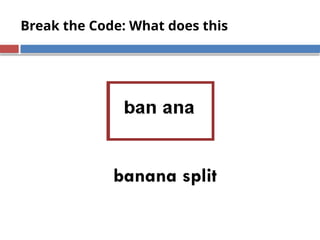
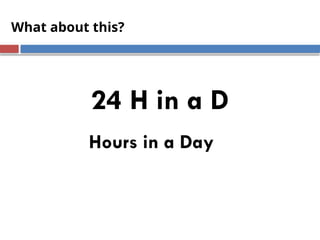
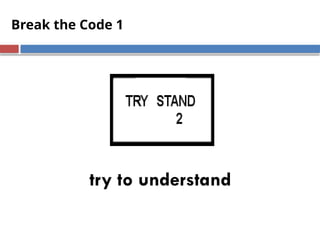
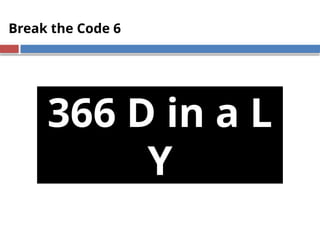
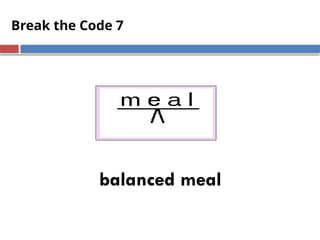
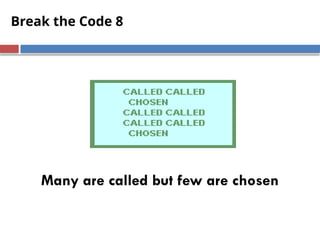
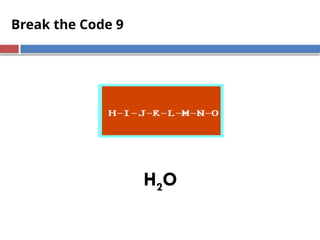
Introductory activity– Break the code
Pre-test with checking
Discussion of the concepts found in the pre-test
Additional lessons
Post-test
Developmental Reading
• Refersto a comprehensive reading program
which consists of several periods or stages.
• These periods usually coincide with the
developmental stages of growth of the
individual.
• It is believed that one progresses gradually in
acquiring and developing certain skills.
23.
What is Reading?
It is a thinking (cognitive) process
It is the reconstruction and interpretation of meaning
behind printed symbols
It is the process of understanding a written
language -- comprehension of written material
Readers are involved in constructing meaning from
text
24.
What is fluentreading?
Fluency is the ability to read a text accurately, quickly,
and with expression.
It is an active process in which the reader calls on
experience, language and prior knowledge to anticipate
and understand the author’s written language .
Readers both bring meaning to print and take meaning
from print.
The nature of reading process alters as students mature.
When fluent readers read silently, they recognize words
automatically.
What is Schema?
Schema refers to an organized chunk of knowledge or
experience, often accompanied by feelings or emotions
associated with experience at the time the information was stored.
Schema theory is an explanation of how readers use prior
knowledge to comprehend and learn from text (Rumelhart, 1980).
Constructivists argue that knowledge or learning is constructed
from experience and stored in memory.
We all have a uniquely personal store of knowledge gained
through a lifetime of experiences.
When students have little or no schema for a subject,
comprehension is greatly impaired.
28.
What is Schema?
The fundamental principle of the schema theory
assumes that written text does not carry meaning by
itself.
Rather, a text only provides directions for readers
as to how they should retrieve or construct meaning
from their own previously acquired knowledge (An,
2013).
29.
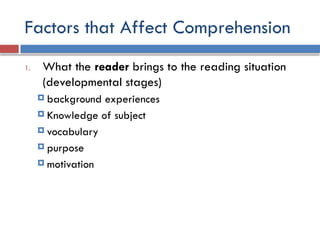
Factors that AffectComprehension
1. What the reader brings to the reading situation
(developmental stages)
background experiences
Knowledge of subject
vocabulary
purpose
motivation
30.
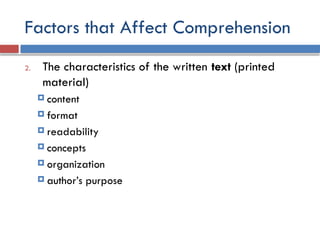
Factors that AffectComprehension
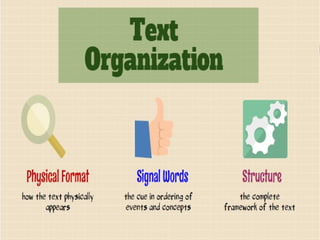
2. The characteristics of the written text (printed
material)
content
format
readability
concepts
organization
author’s purpose
32.
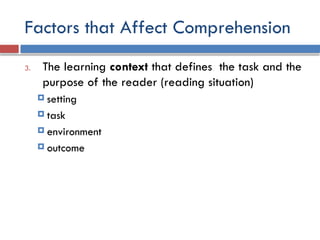
Factors that AffectComprehension
3. The learning context that defines the task and the
purpose of the reader (reading situation)
setting
task
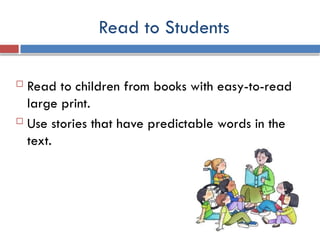
environment
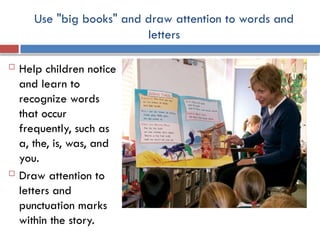
outcome
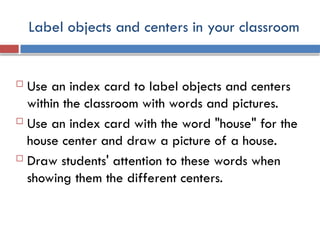
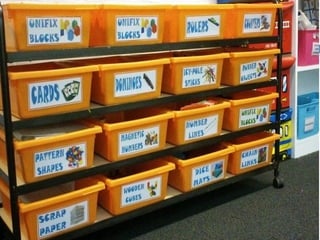
33.
Factors that AffectComprehension
4. The strategies consciously applied by the reader
to obtain meaning
Strategy is a systematic plan, consciously adapted and
monitored, to improve one’s performance in learning
(Harris and Hodges, 1995)
34.
Major Comprehension Strategies
The preparational strategies
1. previewing
2. activating prior knowledge
3. setting purpose and goals
4. predicting
35.
Major Comprehension Strategies
The organizational strategies
1. Comprehending the main idea
2. Determining important details
3. Organizing details topic sentence, supporting
sentences, concluding sentence)
4. Sequencing - components of a story – the
beginning, middle, ending
5. Summarizing
36.
Major Comprehension Strategies
The elaboration strategies
1. Making inferences
2. Imaging
3. Generating questions
4. Evaluating (critical reading)
37.
Major Comprehension Strategies
The metacognitive strategies
1. regulating – plan and control
2. checking - monitor
3. repairing - evaluate
38.
Three Main Groupsof Reading Theories
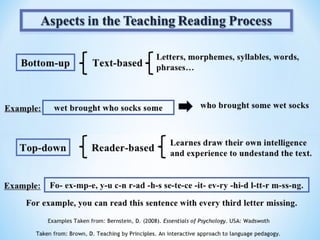
1. Bottom-Up Process: the readers construct the meaning by
reading word for word, letter for letter, carefully analyzing
both vocabulary and syntax.
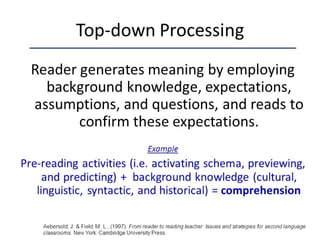
2. Top-Down is a processing in which the readers use their own
intelligence and experience to understand the text (Goodman,
1970) Our knowledge and experiences of the world around us
also influence how a text is read or processes, this is known as
schema theory (Bartlett, 1932)
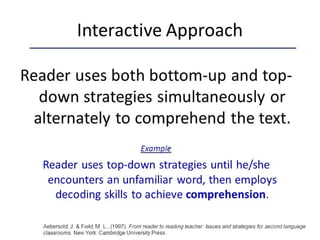
3. Interactive Process interactive model combines elements of both
bottom-up and top-down models. The top-down approach is
used to predict the meaning and the bottom-up approach is to
check it.
40.
Bottom-up Process
Bottom-upprocessing happens when someone tries to
understand language by looking at individual
meanings or grammatical characteristics of the most
basic units of the text, (e.g. sounds for a listening or
words for a reading), and moves from these to trying
to understand the whole text.
Bottom-up processing is not thought to be a very
efficient way to approach a text initially, and is often
contrasted with top-down processing, which is thought
to be more efficient.
42.
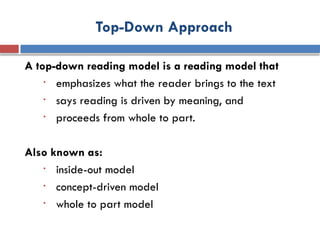
Top-Down Approach
A top-downreading model is a reading model that
• emphasizes what the reader brings to the text
• says reading is driven by meaning, and
• proceeds from whole to part.
Also known as:
• inside-out model
• concept-driven model
• whole to part model
45.
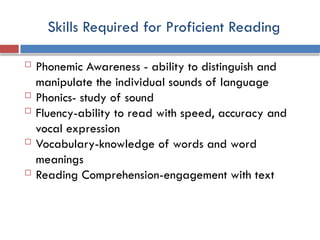
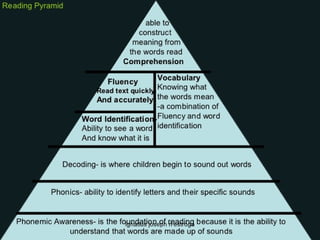
Skills Required forProficient Reading
Phonemic Awareness - ability to distinguish and
manipulate the individual sounds of language
Phonics- study of sound
Fluency-ability to read with speed, accuracy and
vocal expression
Vocabulary-knowledge of words and word
meanings
Reading Comprehension-engagement with text
47.
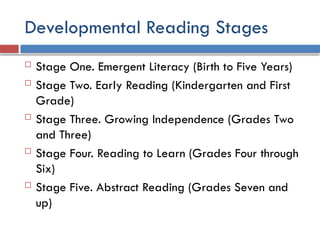
Developmental Reading Stages
Stage One. Emergent Literacy (Birth to Five Years)
Stage Two. Early Reading (Kindergarten and First
Grade)
Stage Three. Growing Independence (Grades Two
and Three)
Stage Four. Reading to Learn (Grades Four through
Six)
Stage Five. Abstract Reading (Grades Seven and
up)
48.
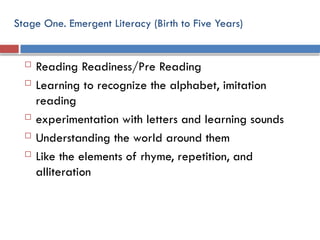
Stage One. EmergentLiteracy (Birth to Five Years)
Reading Readiness/Pre Reading
Learning to recognize the alphabet, imitation
reading
experimentation with letters and learning sounds
Understanding the world around them
Like the elements of rhyme, repetition, and
alliteration
49.
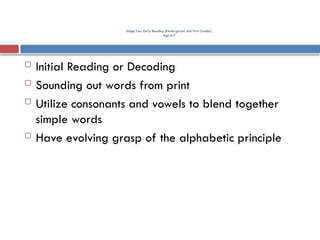
Stage Two. EarlyReading (Kindergarten and First Grade)
Age 6-7
Initial Reading or Decoding
Sounding out words from print
Utilize consonants and vowels to blend together
simple words
Have evolving grasp of the alphabetic principle
50.
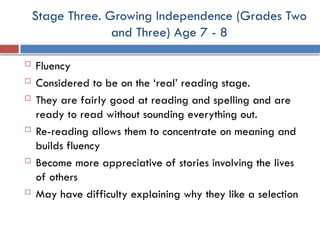
Stage Three. GrowingIndependence (Grades Two
and Three) Age 7 - 8
Fluency
Considered to be on the ‘real’ reading stage.
They are fairly good at reading and spelling and are
ready to read without sounding everything out.
Re-reading allows them to concentrate on meaning and
builds fluency
Become more appreciative of stories involving the lives
of others
May have difficulty explaining why they like a selection
51.
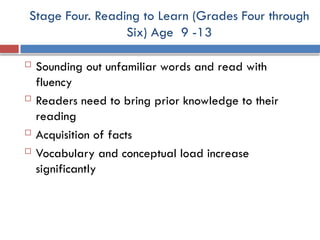
Stage Four. Readingto Learn (Grades Four through
Six) Age 9 -13
Sounding out unfamiliar words and read with
fluency
Readers need to bring prior knowledge to their
reading
Acquisition of facts
Vocabulary and conceptual load increase
significantly
52.
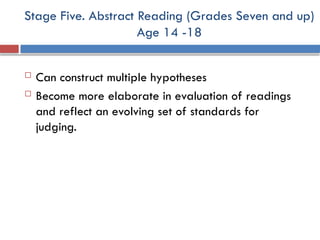
Stage Five. AbstractReading (Grades Seven and up)
Age 14 -18
Can construct multiple hypotheses
Become more elaborate in evaluation of readings
and reflect an evolving set of standards for
judging.
53.
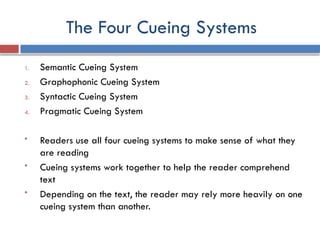
The Four CueingSystems
1. Semantic Cueing System
2. Graphophonic Cueing System
3. Syntactic Cueing System
4. Pragmatic Cueing System
Readers use all four cueing systems to make sense of what they
are reading
Cueing systems work together to help the reader comprehend
text
Depending on the text, the reader may rely more heavily on one
cueing system than another.
54.
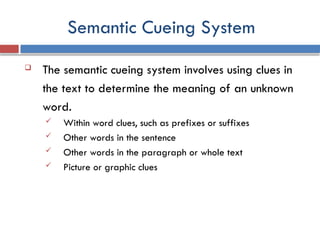
Semantic Cueing System
The semantic cueing system involves using clues in
the text to determine the meaning of an unknown
word.
Within word clues, such as prefixes or suffixes
Other words in the sentence
Other words in the paragraph or whole text
Picture or graphic clues
55.
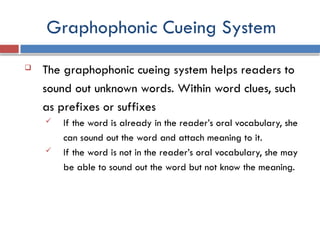
Graphophonic Cueing System
The graphophonic cueing system helps readers to
sound out unknown words. Within word clues, such
as prefixes or suffixes
If the word is already in the reader’s oral vocabulary, she
can sound out the word and attach meaning to it.
If the word is not in the reader’s oral vocabulary, she may
be able to sound out the word but not know the meaning.
56.
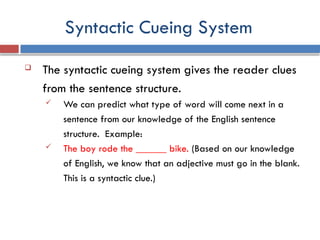
Syntactic Cueing System
The syntactic cueing system gives the reader clues
from the sentence structure.
We can predict what type of word will come next in a
sentence from our knowledge of the English sentence
structure. Example:
The boy rode the ______ bike. (Based on our knowledge
of English, we know that an adjective must go in the blank.
This is a syntactic clue.)
57.
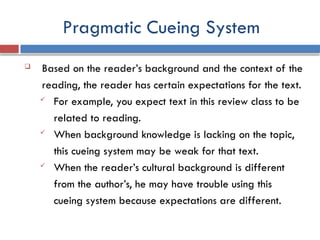
Pragmatic Cueing System
Based on the reader’s background and the context of the
reading, the reader has certain expectations for the text.
For example, you expect text in this review class to be
related to reading.
When background knowledge is lacking on the topic,
this cueing system may be weak for that text.
When the reader’s cultural background is different
from the author’s, he may have trouble using this
cueing system because expectations are different.
58.
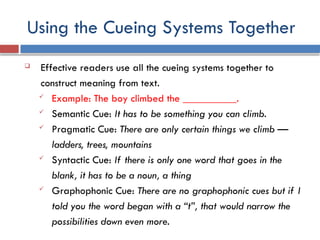
Using the CueingSystems Together
Effective readers use all the cueing systems together to
construct meaning from text.
Example: The boy climbed the __________.
Semantic Cue: It has to be something you can climb.
Pragmatic Cue: There are only certain things we climb —
ladders, trees, mountains
Syntactic Cue: If there is only one word that goes in the
blank, it has to be a noun, a thing
Graphophonic Cue: There are no graphophonic cues but if I
told you the word began with a “t”, that would narrow the
possibilities down even more.
59.
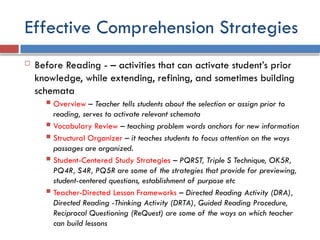
Effective Comprehension Strategies
Before Reading - – activities that can activate student’s prior
knowledge, while extending, refining, and sometimes building
schemata
Overview – Teacher tells students about the selection or assign prior to
reading, serves to activate relevant schemata
Vocabulary Review – teaching problem words anchors for new information
Structural Organizer – it teaches students to focus attention on the ways
passages are organized.
Student-Centered Study Strategies – PQRST, Triple S Technique, OK5R,
PQ4R, S4R, PQ5R are some of the strategies that provide for previewing,
student-centered questions, establishment of purpose etc
Teacher-Directed Lesson Frameworks – Directed Reading Activity (DRA),
Directed Reading -Thinking Activity (DRTA), Guided Reading Procedure,
Reciprocal Questioning (ReQuest) are some of the ways on which teacher
can build lessons
60.
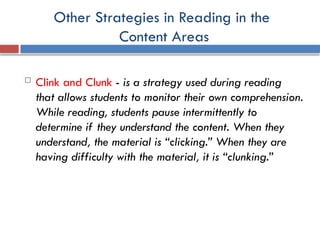
Other Strategies inReading in the
Content Areas
Clink and Clunk - is a strategy used during reading
that allows students to monitor their own comprehension.
While reading, students pause intermittently to
determine if they understand the content. When they
understand, the material is “clicking.” When they are
having difficulty with the material, it is “clunking.”
61.
Other Strategies inReading in the
Content Areas
Circle-Seat-Center –
Combine multiple strategies to enhance comprehensions and
response
Use strategies such as discussing with others and reading
guides to assist in comprehension
Work collaboratively with peers to respond to texts•
Demonstrate comprehension of texts through a variety of
responses
Procedure:
• Have students read the text.
• Divide the class into three groups: Circle, Seat or Center.
• The circle group reviews the text with your assistance.
• The seat group members work alone using study guides.
• The center group works on a project related to the text.
• Students rotate to all three groups
62.
Other Strategies inReading in the
Content Areas
Jigsaw
Background. Jigsaw is a strategy that emphasizes
cooperative learning by providing students an opportunity
to actively help each other build comprehension. Use this
technique to assign students to reading groups composed of
varying skill levels.
The Jigsaw Strategy is an efficient way to learn the course
material in a cooperative learning style. The jigsaw process
encourages listening, engagement, and empathy by giving
each member of the group an essential part to play in the
academic activity.
63.
Other Strategies inReading in the
Content Areas
Jigsaw Description
The cooperative learning strategy known as the "jigsaw"
technique helps students create their own learning. Teachers
arrange students in groups. Each group member is assigned
a different piece of information. Group members then join
with members of other groups assigned the same piece of
information, and research and/or share ideas about the
information. Eventually, students return to their original
groups to try to "piece together" a clear picture of the topic
at hand. That's the simple overview. The resources below will
fill in the details and provide examples of the technique in
action.
64.
Other Strategies inReading in the
Content Areas
Partner Prediction
This gives students the opportunity to work with their peers
and make predictions about the story or section. Since more
students are involved in the activity, they will not feel self-
conscious about speaking in front of the class.
Procedure: Identify a part in the text to stop and predict
what might happen next. Students should be seated with
partners so they can share their ideas. The process is
repeated throughout. When the story is about to end, stop
and ask how students think it will end.
65.
Other Strategies inReading in the
Content Areas
Reciprocal Teaching
Reciprocal teaching refers to an instructional activity in which
students become the teacher in small group reading sessions.
Teachers model, then help students learn to guide group
discussions using four strategies: summarizing, question generating,
clarifying, and predicting.
Once students have learned the strategies, they take turns
assuming the role of teacher in leading a dialogue about what
has been read.
Before Reciprocal Teaching can be used successfully by your
students, they need to have been taught and had time to practice
the four strategies that are used in reciprocal teaching
(summarizing, questioning, predicting, clarifying).
66.
Other Strategies inReading in the
Content Areas
Think-Pair-Share/Think-Pair-Square
Think-Pair-Share (TPS) is a collaborative learning strategy in
which students work together to solve a problem or answer a
question about an assigned reading.
This technique requires students to (1) think individually about a
topic or answer to a question; and (2) share ideas with
classmates.
Why use think-pair-share?
It helps students to think individually about a topic or answer to a
question.
It teaches students to share ideas with classmates and builds oral
communication skills.
It helps focus attention and engage students in comprehending the
reading material.
67.
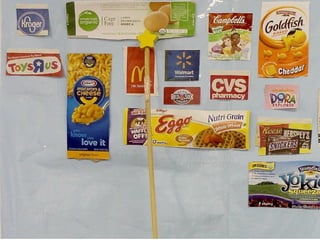
ENVIRONMENTAL PRINTS
Readingprint from the world around us is one of the beginning
stages of literacy development.
The letters, numbers, shapes, and colors found in logos for
products and stores such as McDonald’s, Wal-Mart, Coke, and
Campbell’s soup all provide opportunities for emerging
readers to interact with print and the written word in their own
environment.
We see Environmental Print everywhere, we see logos and
signs in our daily lives but as adults we don’t consider it real
“reading”.
However, Environmental Print is the first print a child learns to
“read”.
69.
WHY SHOULD ENVIRONMENTALPRINTS
BE USED IN THE CLASSROOM?
The logos and signs they see in their daily lives hold
great meaning for them.
Children get excited when they can “read” the print in
their environment.
Environmental Print is another way to build confidence
in young children and get them excited about
reading.
When children are excited about reading and print
holds meaning for them they will learn much faster
and begin to make connections to the world around
them.
70.
WHAT ARE SIGHTWORDS?
Sight words are words, like come, does, or who, that don’t
follow the rules of spelling or the six syllable types.
These words have to be memorized because decoding
them is really difficult.
Students are taught to memorize sight words as a whole,
by sight, so that they can recognize them immediately
(within three seconds) and read them without having to
use decoding skills.
Sight words are words that we teach our young readers
to know by heart.
That way, they don’t have to spend valuable time
decoding them.
71.
SIGHT WORDS vsHIGH FREQUENCY
WORDS
Sight words are words that do not fit standard
phonetic patterns and must be memorized.
High-frequency words are words that are most
commonly found in written language. Although some
fit standard phonetic patterns, some do not.
Where do I find word lists?
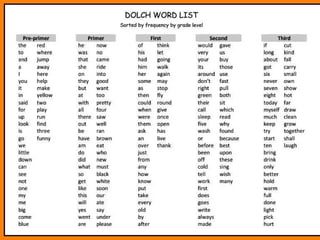
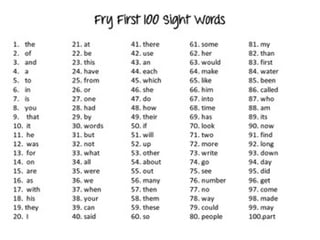
Two of the most popular sources are the Dolch Sight
Words list and the Fry Sight Words list.
72.
SIGHT WORDS vsHIGH FREQUENCY
WORDS
During the 1930s and 1940s, Dr. Edward Dolch
developed his word list, used for pre-K through third
grade, by studying the most frequently occurring
words in the children’s books of that era.
The list has 200 “service words” and also 95 high-
frequency nouns.
The Dolch word list comprises 80 percent of the words
you would find in a typical children’s book and 50
percent of the words found in writing for adults.
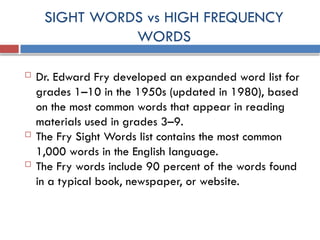
73.
SIGHT WORDS vsHIGH FREQUENCY
WORDS
Dr. Edward Fry developed an expanded word list for
grades 1–10 in the 1950s (updated in 1980), based
on the most common words that appear in reading
materials used in grades 3–9.
The Fry Sight Words list contains the most common
1,000 words in the English language.
The Fry words include 90 percent of the words found
in a typical book, newspaper, or website.
76.
What is SharedReading?
Shared Reading is an interactive reading
experience that occurs when students join in or share
the reading of a book or other text while guided
and supported by a teacher.
The teacher explicitly models the skills of proficient
readers, including reading with fluency and
expression.
The shared reading model often uses oversized
books (referred to as big books) with enlarged
print and illustrations.
77.
Why Use SharedReading?
It provides struggling readers with necessary
support.
Shared reading of predictable text can build sight
word knowledge and reading fluency
Allows students to enjoy materials that they may not
be able to read on their own.
Ensures that all students feel successful by providing
support to the entire group.
78.
PRINT AWARENESS
Printawareness is a child's earliest
understanding that written language carries
meaning.
The foundation of all other literacy learning
builds upon this knowledge.
79.
GUIDELINES FOR PROMOTING
PRINTAWARENESS
The organization of books
Read to students
Use “big books” and draw attention to words and
letters
Label objects and centers in your classroom
Encourage preschool children to play with print
Help children understand the relationship between
spoken and written language
Play with letters of the alphabet
80.
The Organization ofBooks
Make sure students know how books are
organized.
They should be taught the basics about books –
that they are read from left to right and top to
bottom, that print may be accompanied by
pictures or graphics, that the pages are
numbered, and that the purpose of reading is to
gain meaning from the text and understand
ideas that words convey.
81.
Read to Students
Read to children from books with easy-to-read
large print.
Use stories that have predictable words in the
text.
82.
Use "big books"and draw attention to words and
letters
Help children notice
and learn to
recognize words
that occur
frequently, such as
a, the, is, was, and
you.
Draw attention to
letters and
punctuation marks
within the story.
83.
Label objects andcenters in your classroom
Use an index card to label objects and centers
within the classroom with words and pictures.
Use an index card with the word "house" for the
house center and draw a picture of a house.
Draw students' attention to these words when
showing them the different centers.
85.
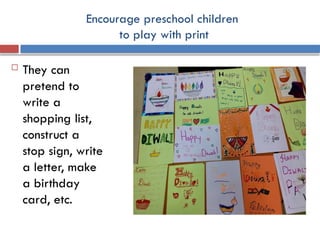
Encourage preschool children
toplay with print
They can
pretend to
write a
shopping list,
construct a
stop sign, write
a letter, make
a birthday
card, etc.
86.
Help children understandthe relationship
between spoken and written language
Encourage students to find on a page letters
that are in their names: "Look at this word, 'big.’
It begins with the same letter as the name of
someone in this room, 'Ben.'"
87.
Play with lettersof the alphabet
Place several copies of each letter of the
alphabet in a bowl and ask students to
withdraw one letter.
When everyone has a letter, ask each student to
say the letter's name and, if the letter is in his or
her own name, have the child keep the letter.
Continue until the first child to spell his or her
name wins.
88.
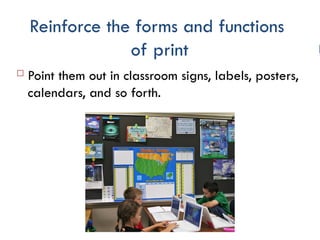
Reinforce the formsand functions
of print
Point them out in classroom signs, labels, posters,
calendars, and so forth.
89.
Allow children topractice what they are
learning
Ask them to listen to and participate in the reading of
predictable and patterned stories and books.
90.
Provide practice withpredictable and
patterned books
Also try using a wordless picture book.
Go through each page asking the children to tell
the story from the pictures.
Write their narration on a large piece of paper.
Celebrate the story they authored!
91.
Sample Activity forAssessing
Print Awareness
Give a student a storybook and ask him or her to
show you:
The front of the book
The title of the book
Where you should begin reading
A letter
A word
92.
Sample Activity forAssessing
Print Awareness
Give a student a storybook and ask him or her to show you:
The first word of a sentence
The last word of a sentence
The first and last word on a page
Punctuation marks
A capital letter
A lowercase letter
The back of the book
93.
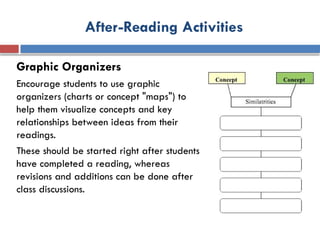
After-Reading Activities
Graphic Organizers
Encouragestudents to use graphic
organizers (charts or concept "maps") to
help them visualize concepts and key
relationships between ideas from their
readings.
These should be started right after students
have completed a reading, whereas
revisions and additions can be done after
class discussions.
94.
After-Reading Activities
Quiz Questions
Afterstudents read a chapter or section of a chapter in the course
textbook, ask them to develop questions for a quiz. (This can also
be done with other reading materials.) This activity forces them to
analyze the information in the chapter and decide on the most
important concepts to remember.
Formulating questions can also help them to organize the concepts
into logical chunks of information for easier retrieval. Working in
groups on this activity is helpful for further discussion of concepts.
95.
After-Reading Activities
Summary Writing
Ask students to write a summary of the main points of a text
or passage. Figuring out what to include in a summary is often
a difficult task for students, so passing out a handout with the
criteria for a good summary can serve as a reminder to
students.
Modeling the process of good summary writing during class is
also helpful. For example, when students have finished a
portion of text, begin a discussion of the most important points
from the text. Write all the points that students suggest on the
board.
96.
After-Reading Activities
Outlining
• Writingoutlines is also a good way to organize and
remember concepts.
• The emphasis here should be on how students see the
relationships between ideas being presented.
• Don't worry if students don't use the correct Roman
numerals or other markers.
• What is important is that they are able to distinguish
the main ideas from the supporting details and
organize the information in a logical format.
#34 Previewing is a pre-reading skill by which the reader tries to gather as much information about the text as he/she can before reading it. This gathering of information helps the reader to have a general picture of the text.
Call it schema, relevant background knowledge, prior knowledge, or just plain experience, when students make connections to the text they are reading, their comprehension increases.
Setting goals – provides direction, clearer focus and decision making, provides motivation, etc
Predicting - Making predictions is a strategy in which readers use information from a text (including titles, headings, pictures, and diagrams) and their own personal experiences to anticipate what they are about to read (or what comes next).
#40 Example
Asking learners to read aloud may encourage bottom-up processing because they focus on word forms, not meaning.