Oral Language:
Role in Literacy Development
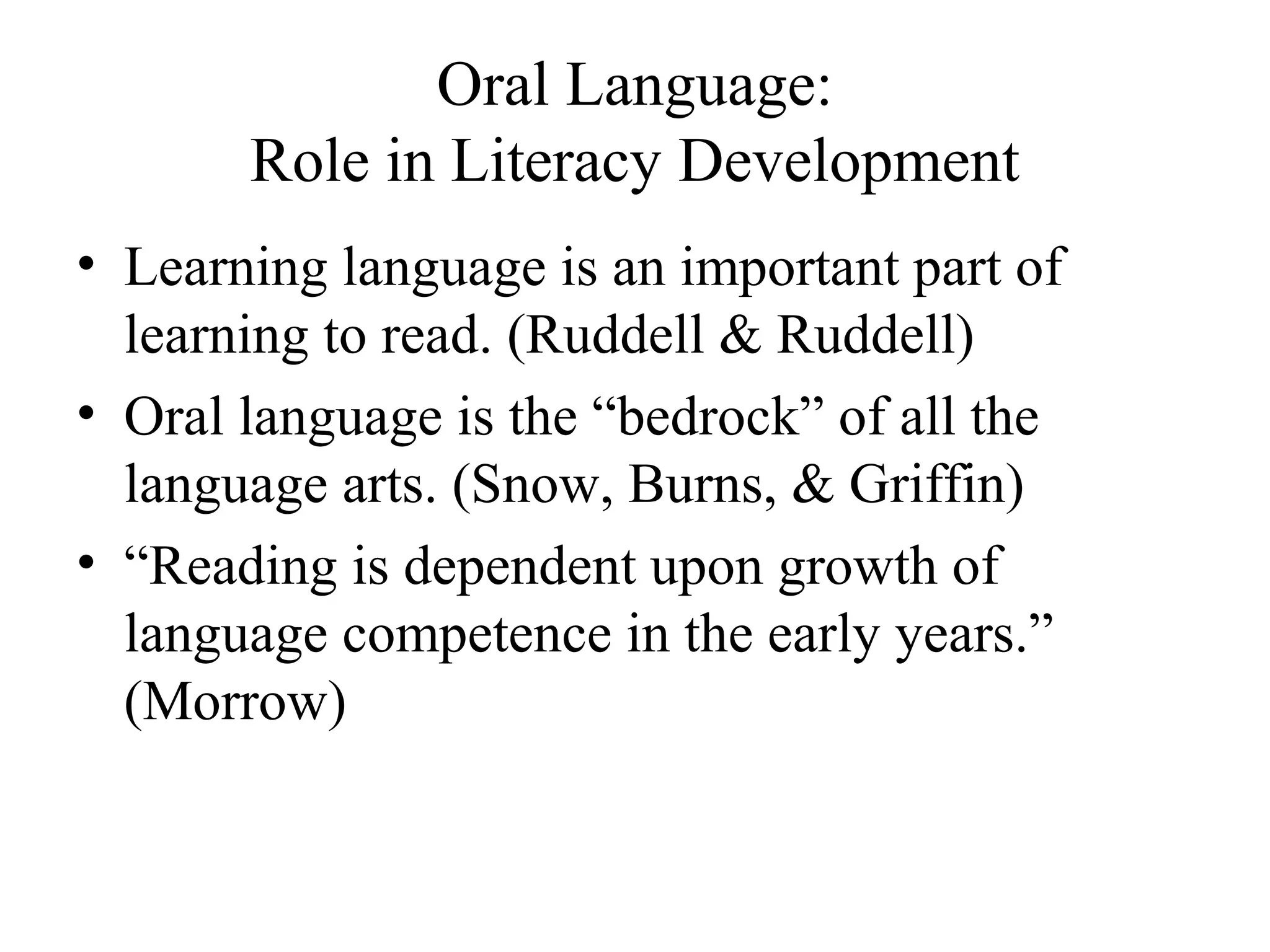
• Learning language is an important part of
learning to read. (Ruddell & Ruddell)
• Oral language is the “bedrock” of all the
language arts. (Snow, Burns, & Griffin)
• “Reading is dependent upon growth of
language competence in the early years.”
(Morrow)
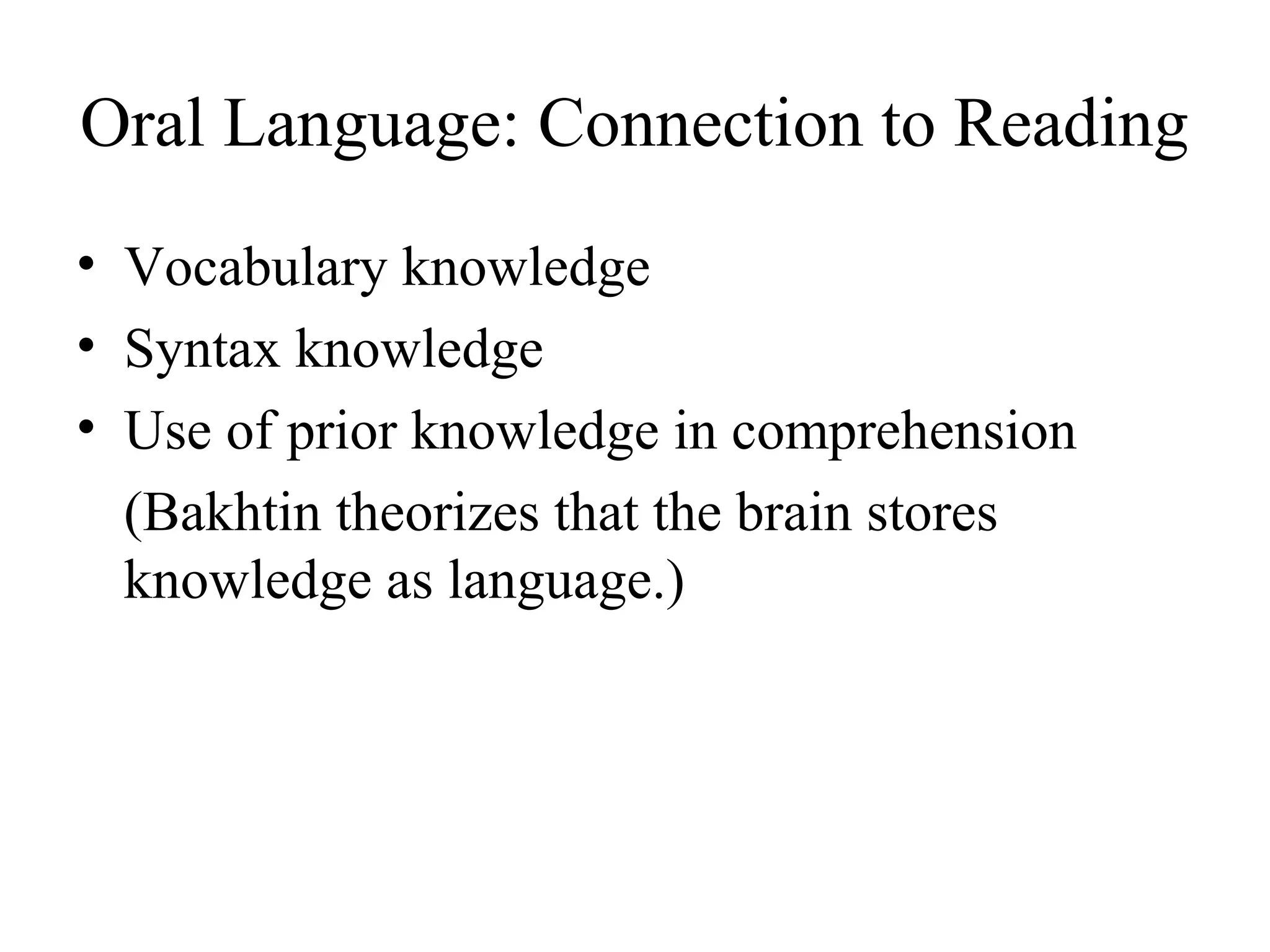
Oral Language: Connection to Reading
• Vocabulary knowledge
• Syntax knowledge
• Use of prior knowledge in comprehension
(Bakhtin theorizes that the brain stores
knowledge as language.)
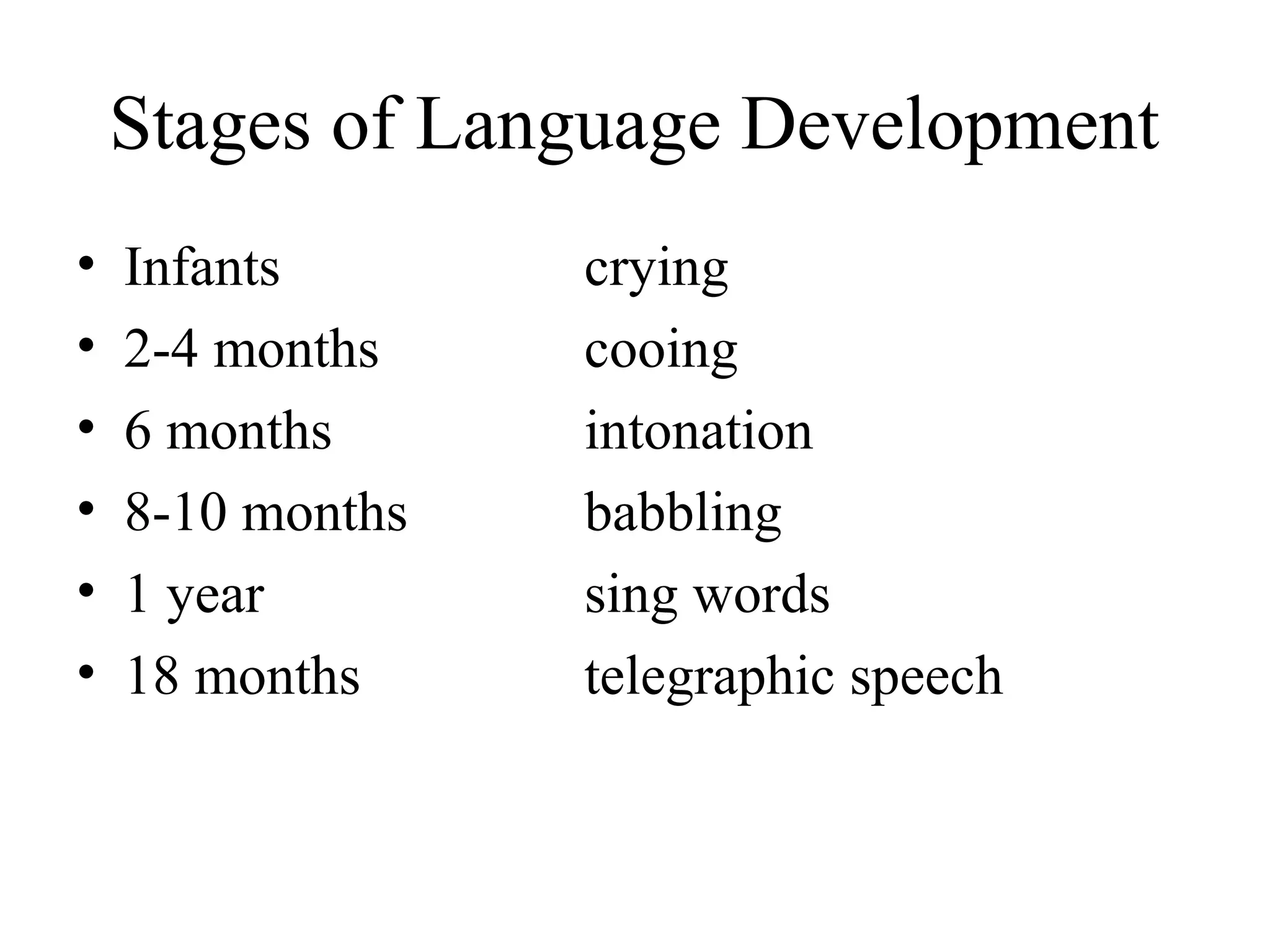
Stages of Language Development
• Infants crying
• 2-4 months cooing
• 6 months intonation
• 8-10 months babbling
• 1 year sing words
• 18 months telegraphic speech
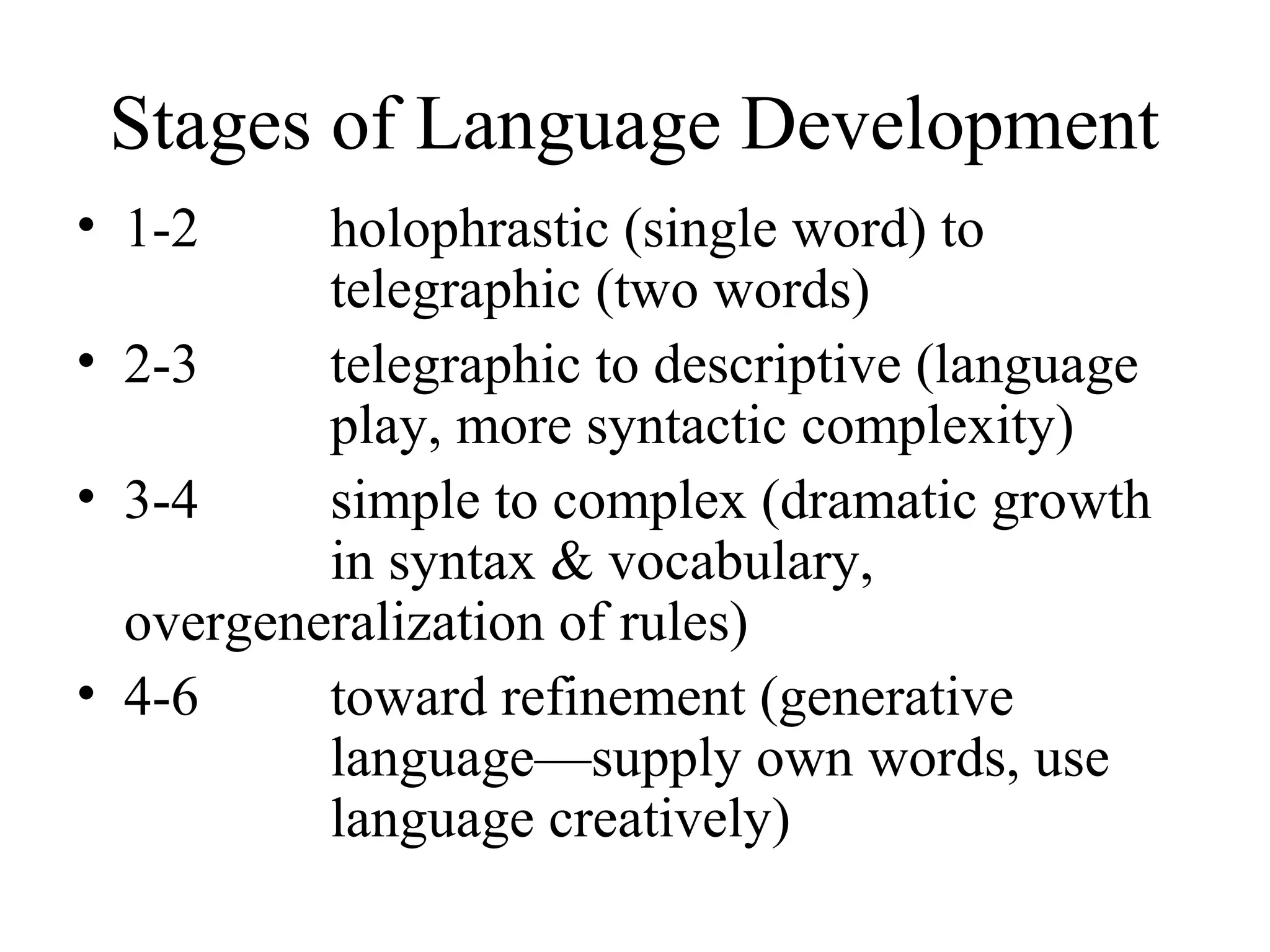
Stages of Language Development
• 1-2 holophrastic (single word) to
telegraphic (two words)
• 2-3 telegraphic to descriptive (language
play, more syntactic complexity)
• 3-4 simple to complex (dramatic growth
in syntax & vocabulary,
overgeneralization of rules)
• 4-6 toward refinement (generative
language—supply own words, use
language creatively)
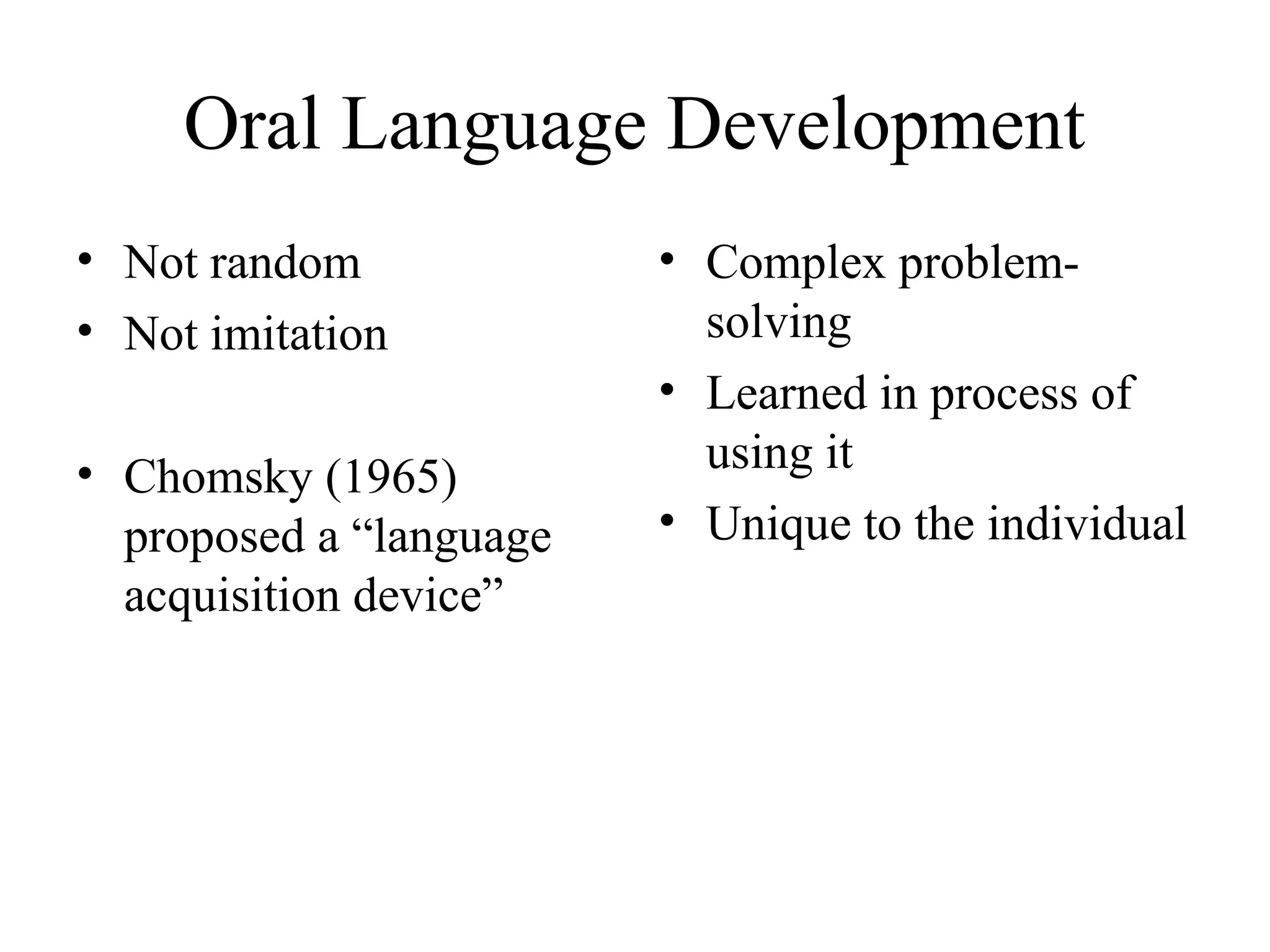
Oral Language Development
• Not random
• Not imitation
• Chomsky (1965)
proposed a “language
acquisition device”
• Complex problem-
solving
• Learned in process of
using it
• Unique to the individual
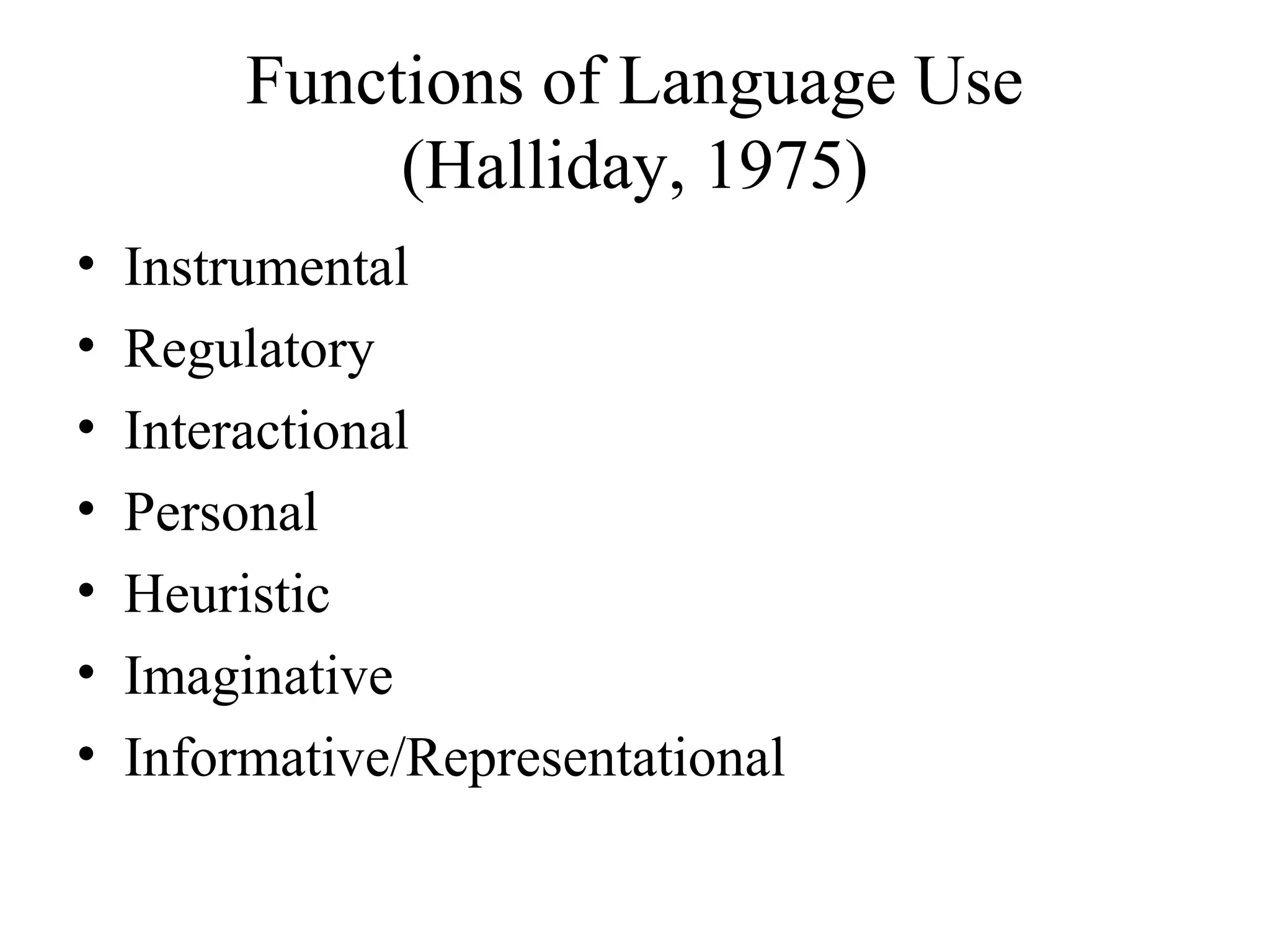
Functions of Language Use
(Halliday, 1975)
• Instrumental
• Regulatory
• Interactional
• Personal
• Heuristic
• Imaginative
• Informative/Representational
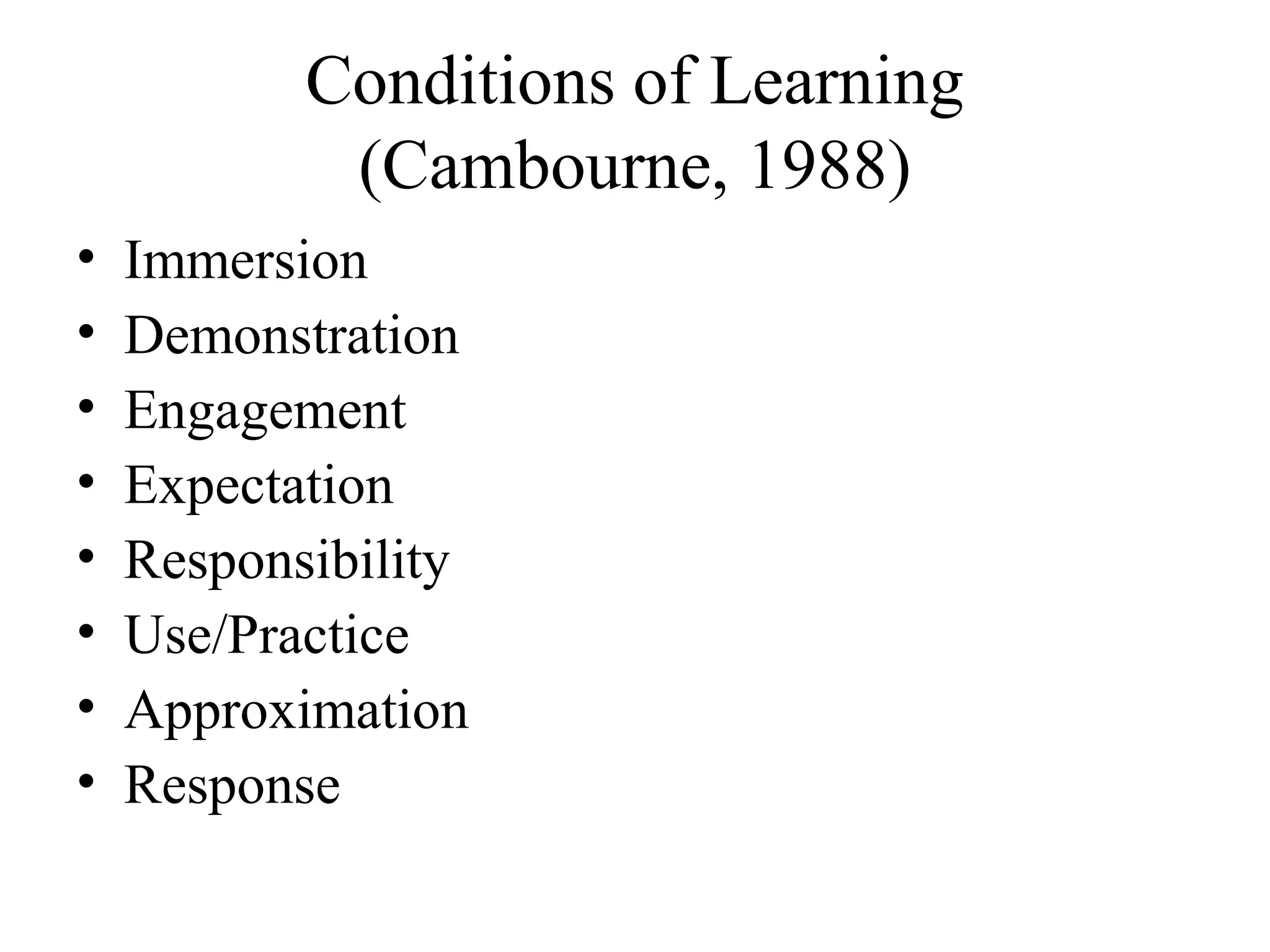
Conditions of Learning
(Cambourne, 1988)
• Immersion
• Demonstration
• Engagement
• Expectation
• Responsibility
• Use/Practice
• Approximation
• Response
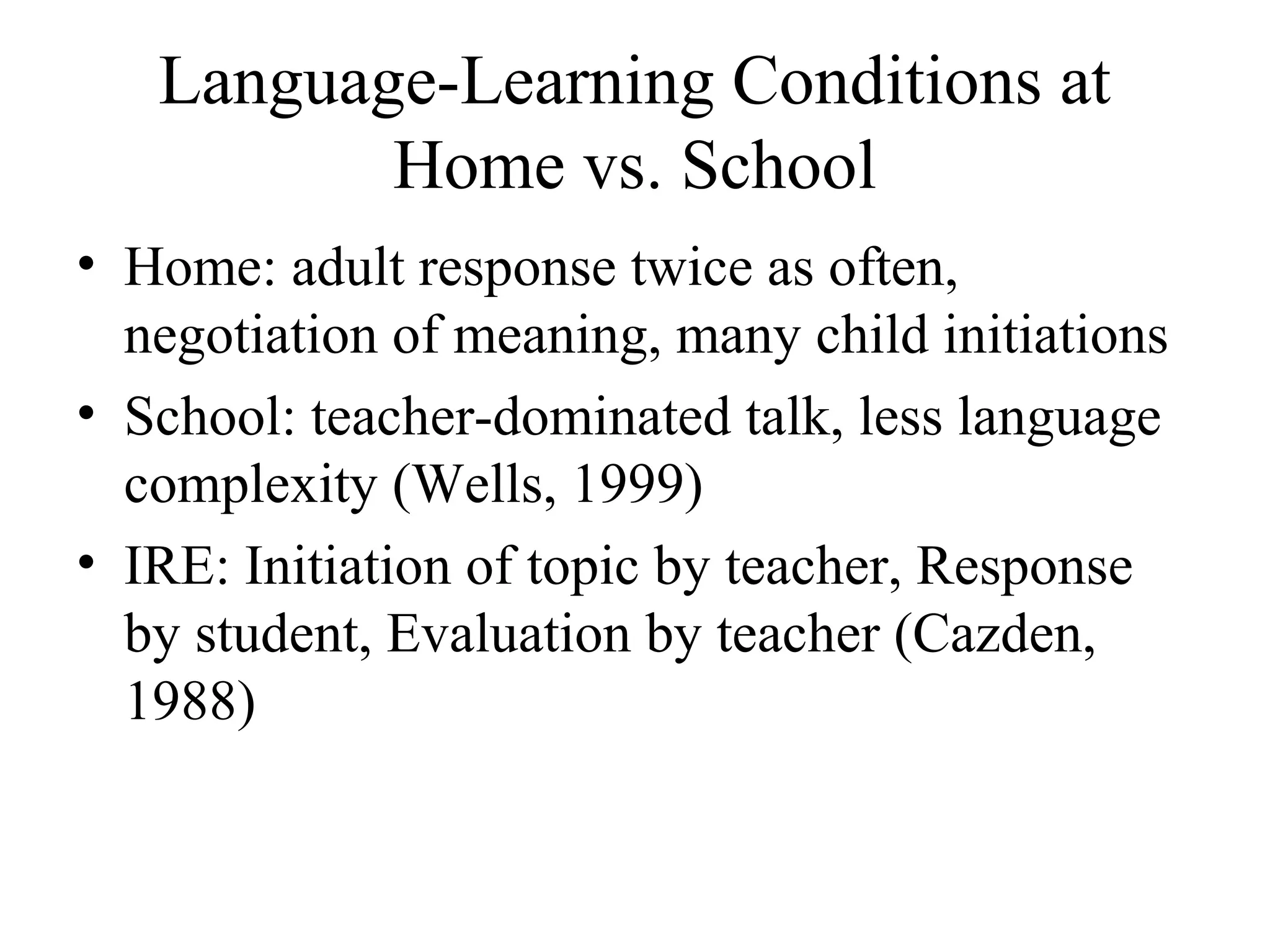
Language-Learning Conditions at
Home vs. School
• Home: adult response twice as often,
negotiation of meaning, many child initiations
• School: teacher-dominated talk, less language
complexity (Wells, 1999)
• IRE: Initiation of topic by teacher, Response
by student, Evaluation by teacher (Cazden,
1988)
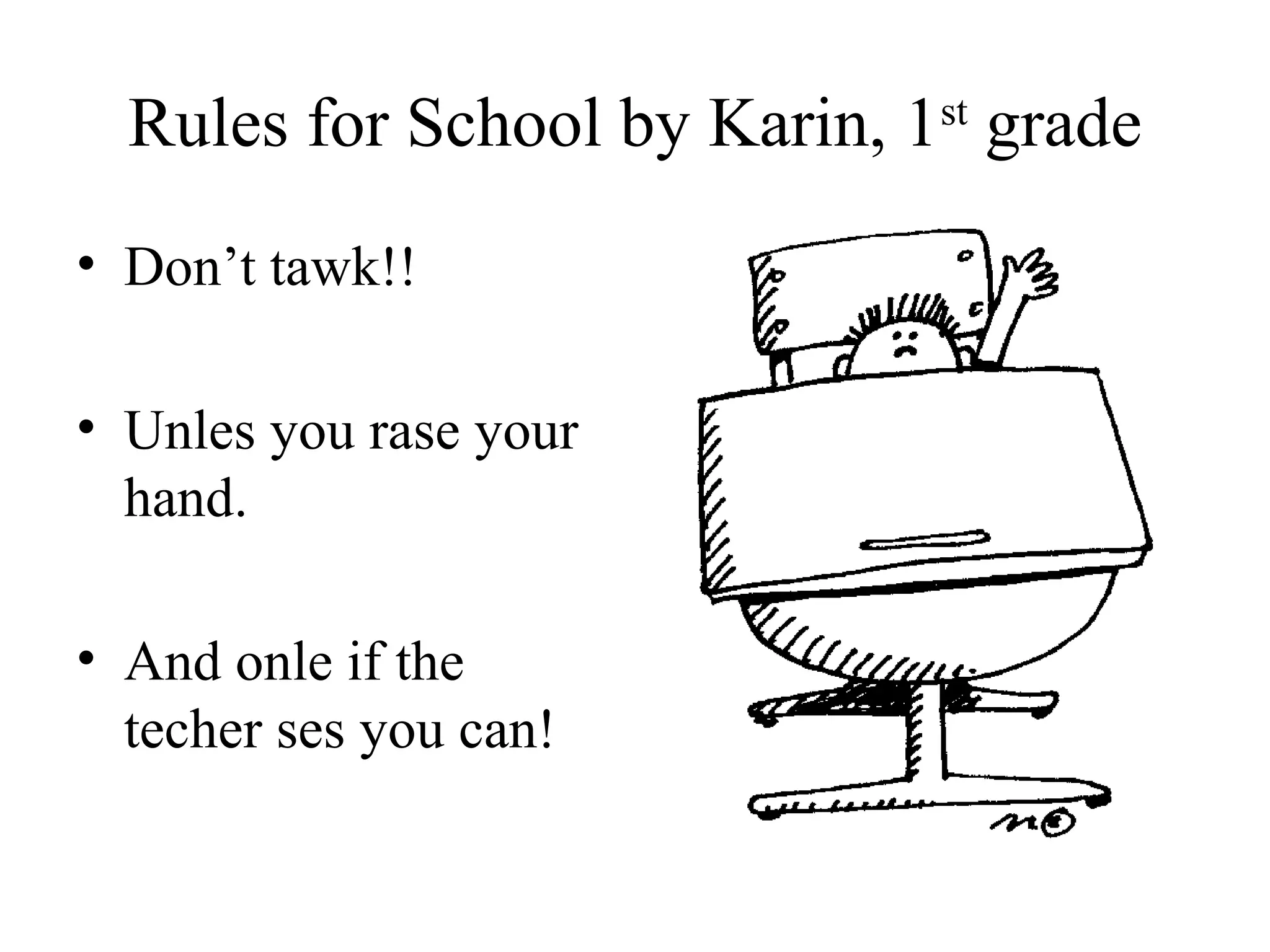
Rules for School by Karin, 1st
grade
• Don’t tawk!!
• Unles you rase your
hand.
• And onle if the
techer ses you can!
Fostering Oral Language in
Classrooms
• Physical Environment
• Psychological Environment
• Opportunities for Talk
• Group Task: Create an observational checklist
to assess the conditions for oral language
development in an early childhood, primary, or
elementary classroom.
Implications for English Language
Learners
• BICS vs. CALPS
– BICS: basic interpersonal language proficiency
skills (2-3 years)
– CALPS: cognitive academic language proficiency
skills (5-7 years)
• “comprehensible input”
• “total physical response”
• “funds of knowledge”
Phonological Awareness
• Definition: the ability to manipulate larger
units of sound, such as words and syllables,
onsets and rimes
• Hearing/recognizing rhyming patterns
• Producing rhymes
• Segmenting separate words in sentences
• Segmenting syllables in words
• Blending syllables in words
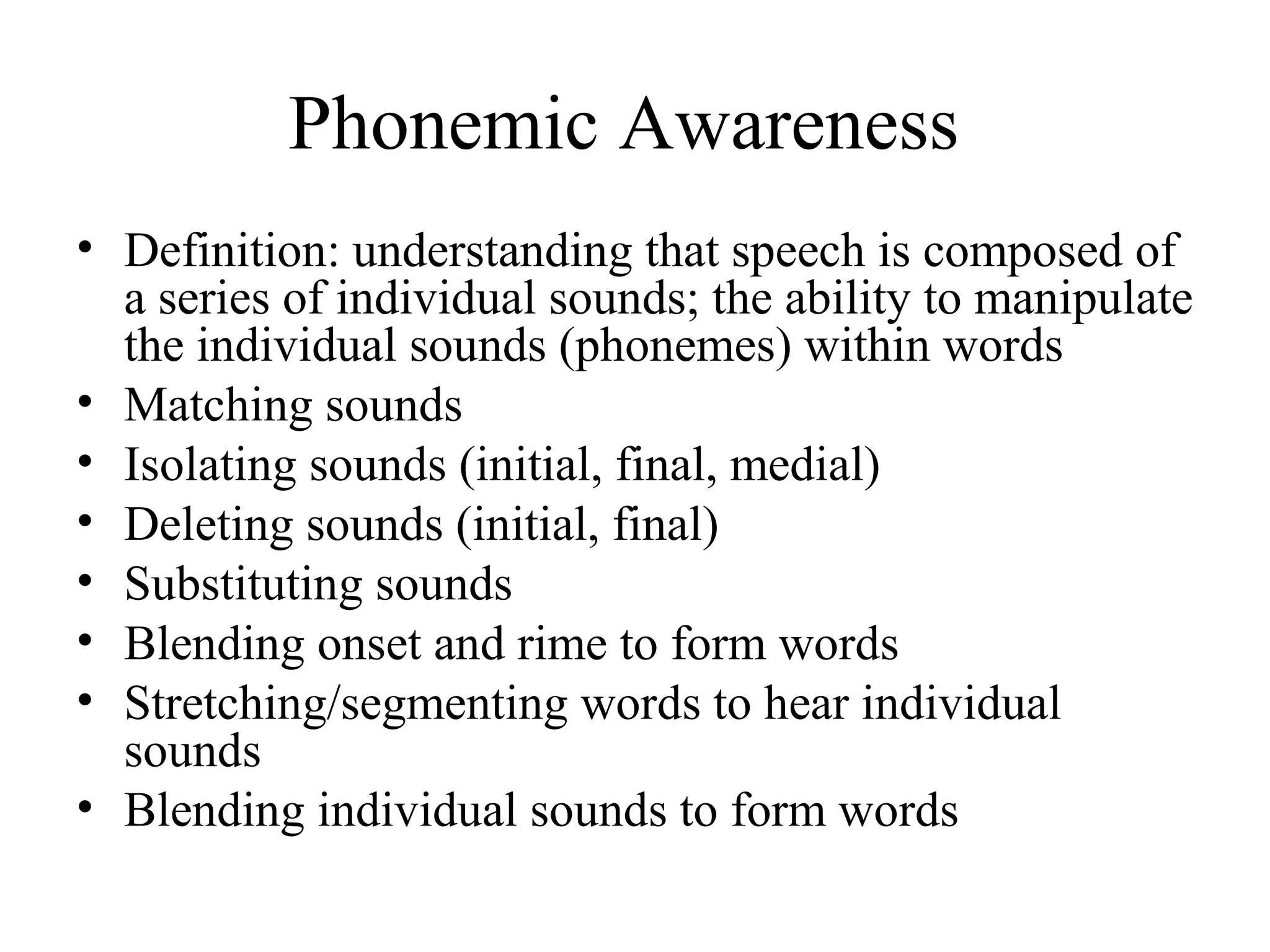
Phonemic Awareness
• Definition: understanding that speech is composed of
a series of individual sounds; the ability to manipulate
the individual sounds (phonemes) within words
• Matching sounds
• Isolating sounds (initial, final, medial)
• Deleting sounds (initial, final)
• Substituting sounds
• Blending onset and rime to form words
• Stretching/segmenting words to hear individual
sounds
• Blending individual sounds to form words
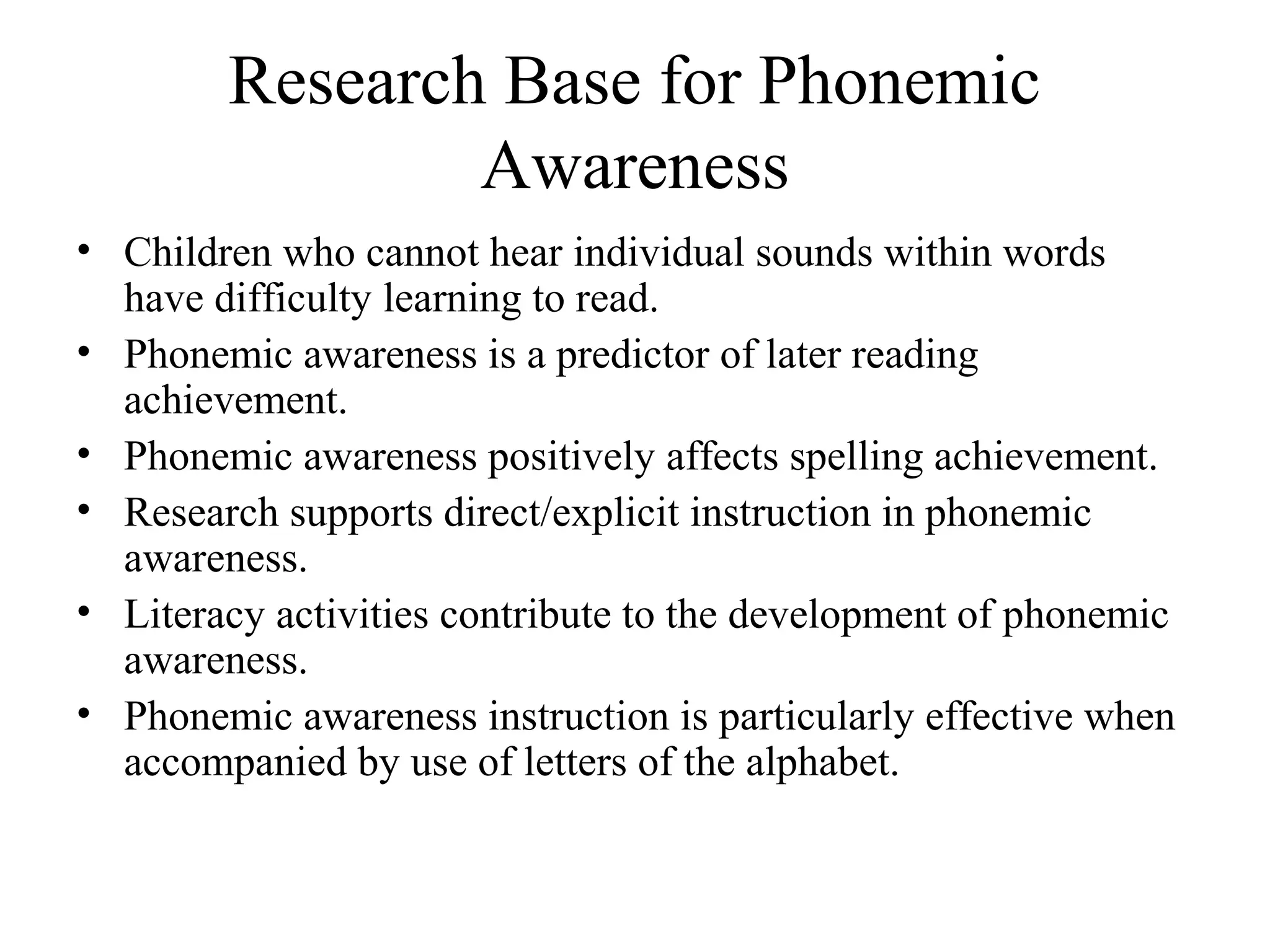
Research Base for Phonemic
Awareness
• Children who cannot hear individual sounds within words
have difficulty learning to read.
• Phonemic awareness is a predictor of later reading
achievement.
• Phonemic awareness positively affects spelling achievement.
• Research supports direct/explicit instruction in phonemic
awareness.
• Literacy activities contribute to the development of phonemic
awareness.
• Phonemic awareness instruction is particularly effective when
accompanied by use of letters of the alphabet.
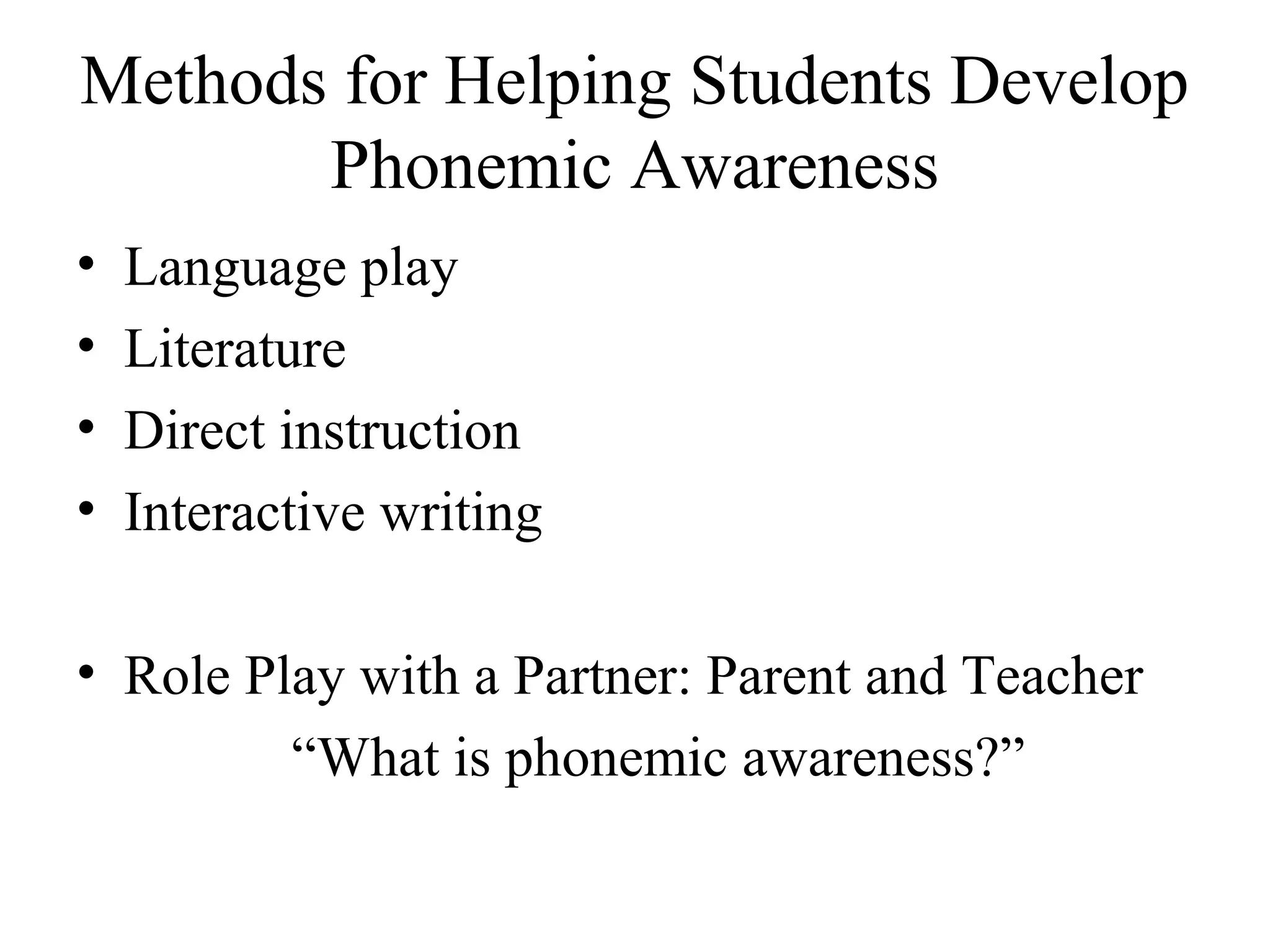
Methods for Helping Students Develop
Phonemic Awareness
• Language play
• Literature
• Direct instruction
• Interactive writing
• Role Play with a Partner: Parent and Teacher
“What is phonemic awareness?”
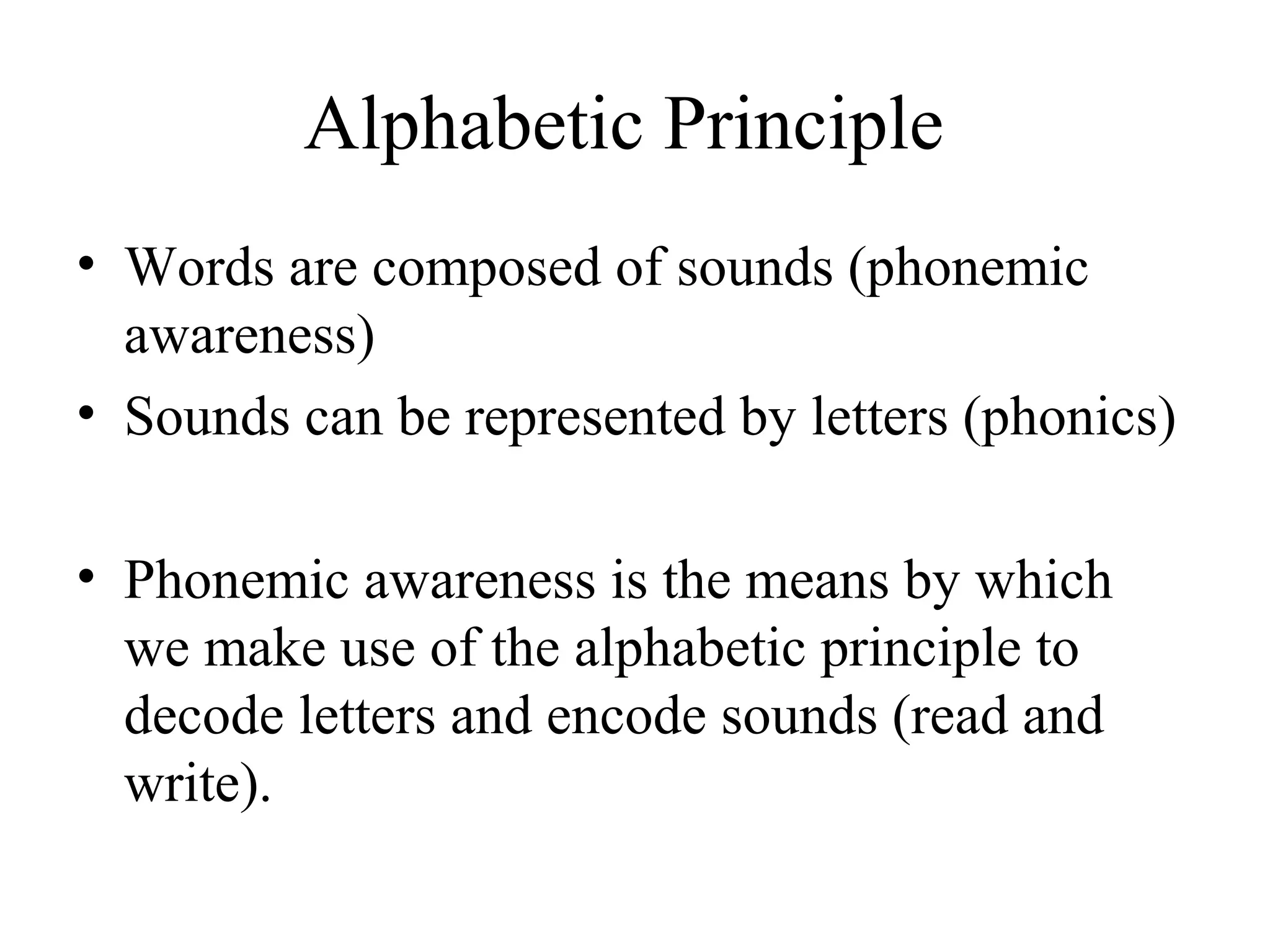
Alphabetic Principle
• Words are composed of sounds (phonemic
awareness)
• Sounds can be represented by letters (phonics)
• Phonemic awareness is the means by which
we make use of the alphabetic principle to
decode letters and encode sounds (read and
write).
Phonics Terms to Know
• Phoneme
• Grapheme
• Consonant Digraph
• Consonant Blends or Clusters
• Diphthongs
• Schwa
• Onset
• Rime
• Morpheme
• Structural Analysis
The Importance of Recognizing
Sight Words
• Effortless way for early readers to read words
before phonics instruction
• Recognition of some words in isolation assists
young readers in learning other word
identification strategies.
• Automatic recall of words leads to more word
recognition.
• Some high-frequency words in English are not
decodable.
The Importance of Recognizing
Sight Words
• Automatic word recognition contributes to
improved comprehension.
• A reader needs instant recognition of about
95% of words in any given text to read the text
independently.
• Reading in which a student cannot
automatically recognize many words is
laborious; in such cases, the student may never
develop a desire to read.
• Automatic visual recognition of whole words
is critical to fluency.
Balanced Literacy Approach
Phonics:
• Explicit, direct
instruction
• Systematic instruction
in the code
Whole Language:
• Authentic reading and
writing
• Daily opportunities to
read and write
Three Cueing Systems (Marie Clay)
• Graphophonic (visual): Does it look right?
• Syntactic (structure): Does it sound right?
• Semantic (meaning): Does it make sense?
He bocked the piffle with a tig daft.
• What did he bock?
• What did he use to bock?
• What kind of daft was it?
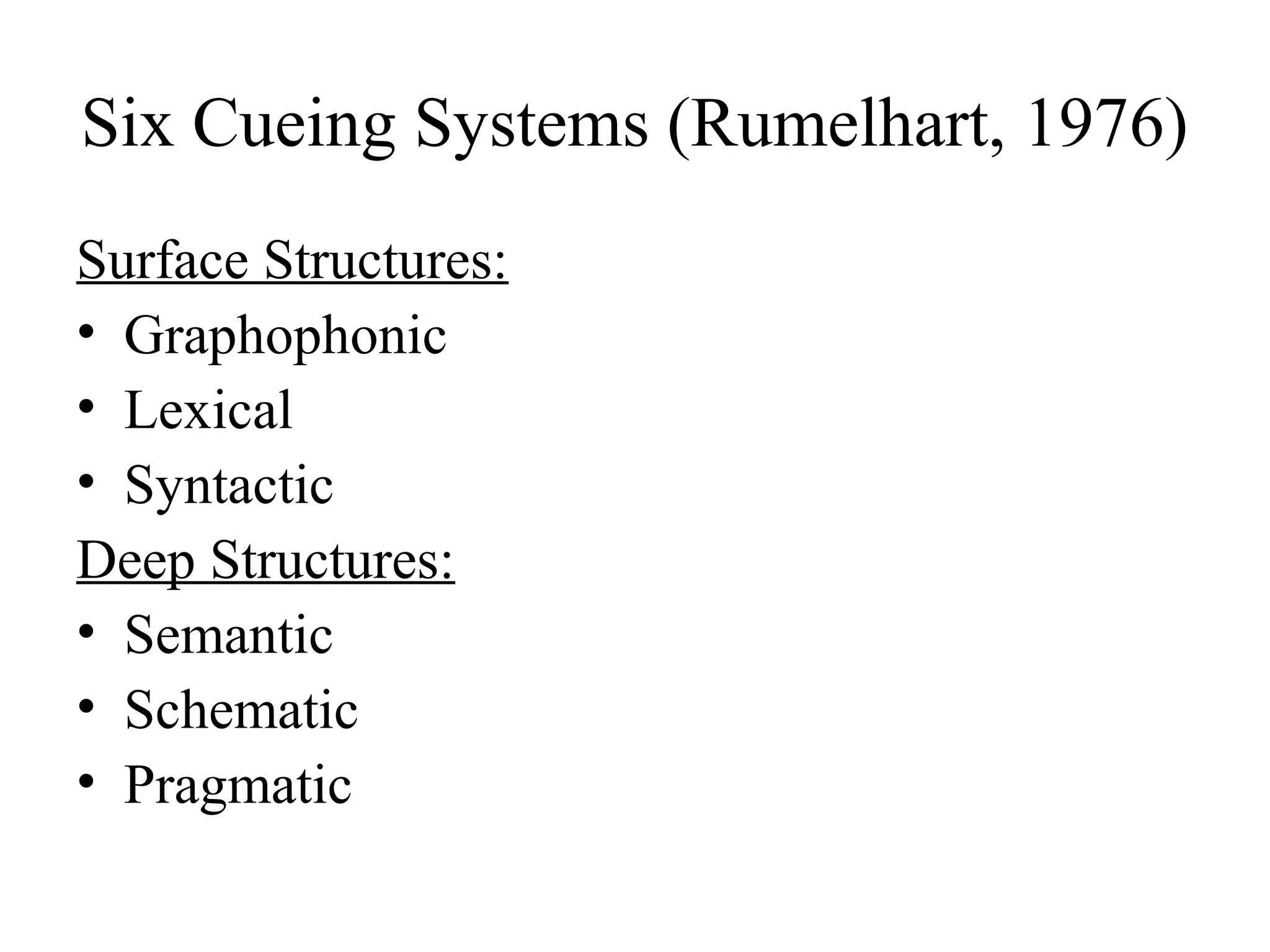
Six Cueing Systems (Rumelhart, 1976)
Surface Structures:
• Graphophonic
• Lexical
• Syntactic
Deep Structures:
• Semantic
• Schematic
• Pragmatic
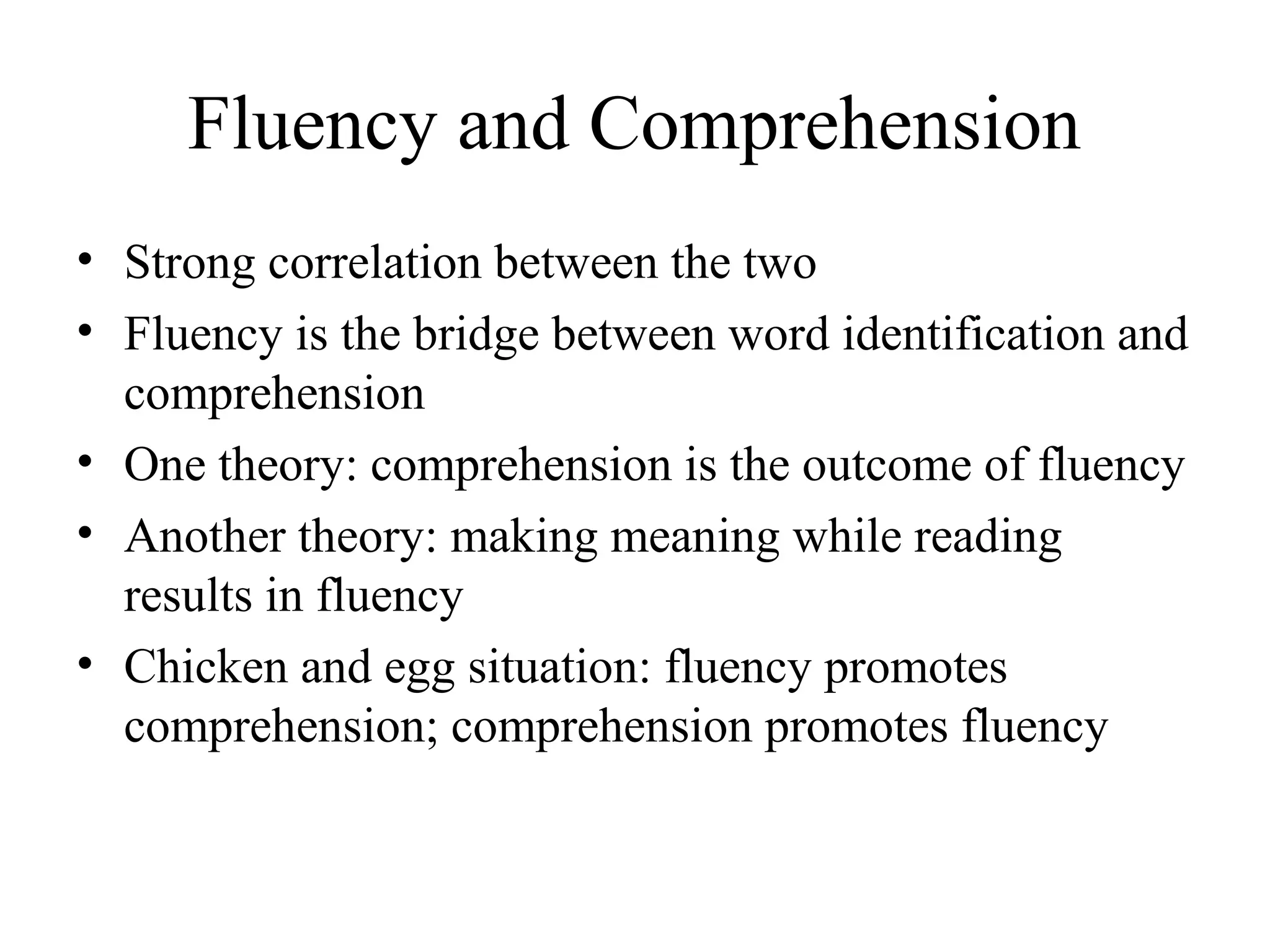
Fluency and Comprehension
• Strong correlation between the two
• Fluency is the bridge between word identification and
comprehension
• One theory: comprehension is the outcome of fluency
• Another theory: making meaning while reading
results in fluency
• Chicken and egg situation: fluency promotes
comprehension; comprehension promotes fluency
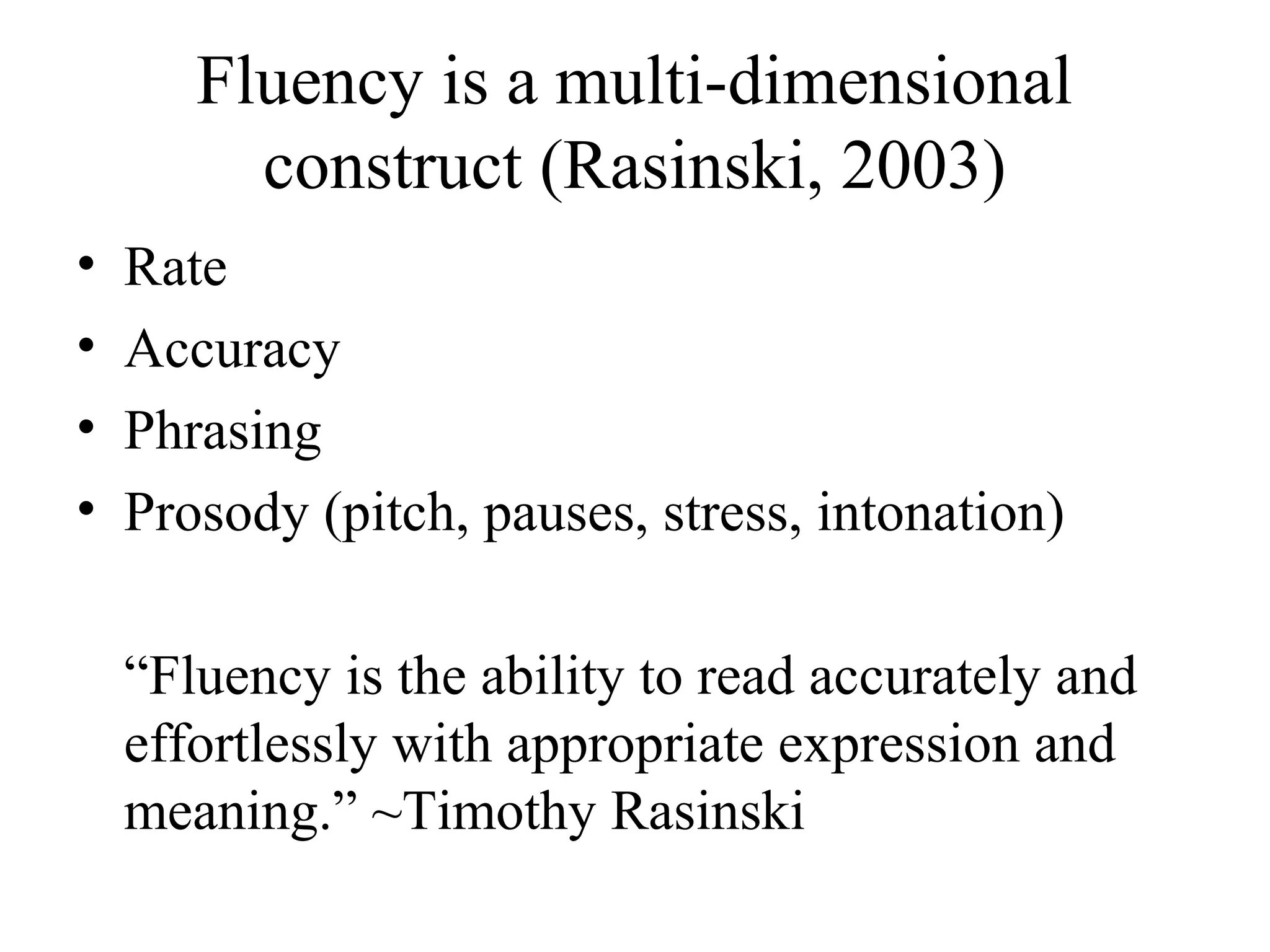
Fluency is a multi-dimensional
construct (Rasinski, 2003)
• Rate
• Accuracy
• Phrasing
• Prosody (pitch, pauses, stress, intonation)
“Fluency is the ability to read accurately and
effortlessly with appropriate expression and
meaning.” ~Timothy Rasinski
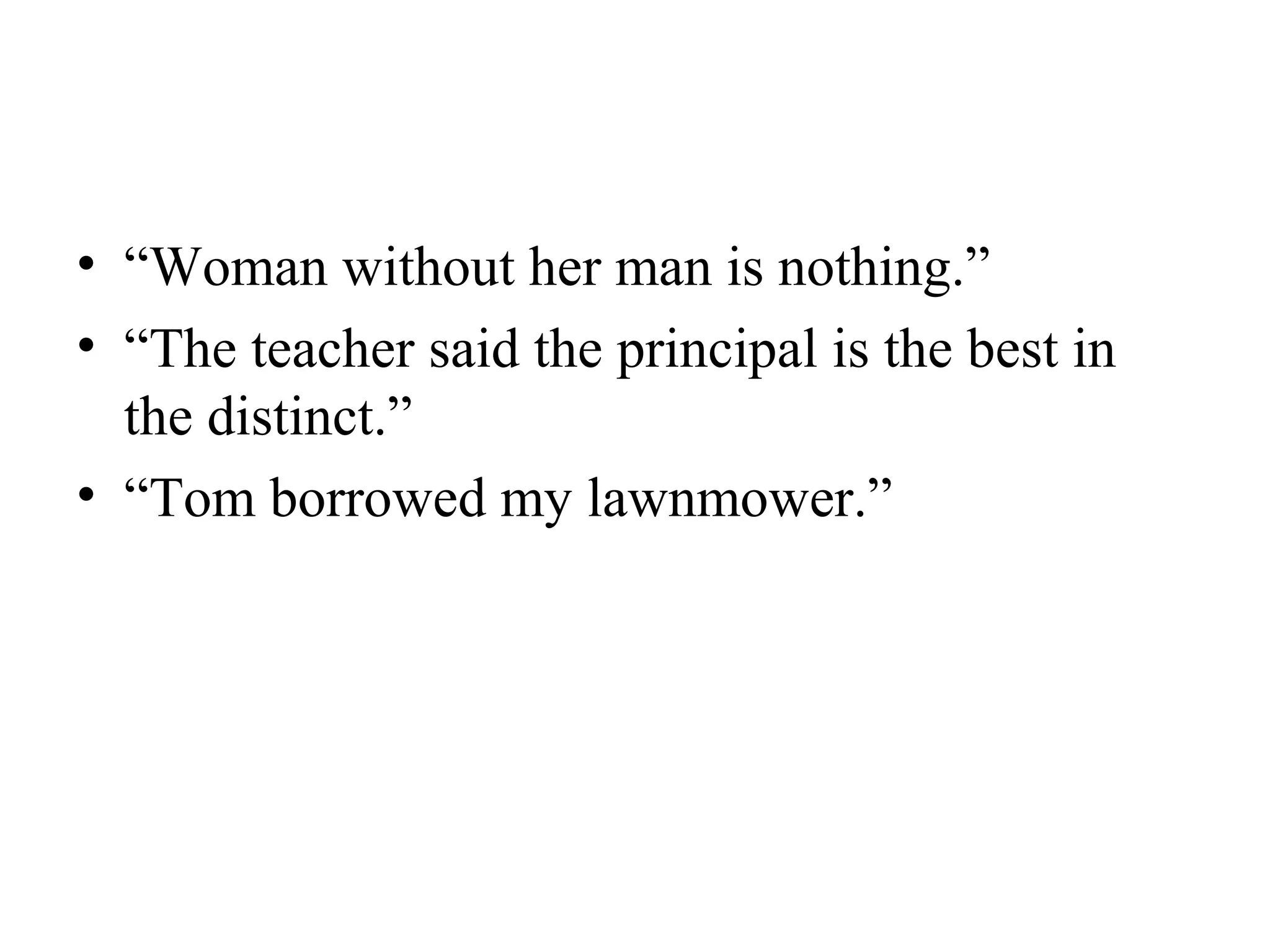
• “Woman without her man is nothing.”
• “The teacher said the principal is the best in
the distinct.”
• “Tom borrowed my lawnmower.”

Oral Language

  • 1.
    Oral Language: Role inLiteracy Development • Learning language is an important part of learning to read. (Ruddell & Ruddell) • Oral language is the “bedrock” of all the language arts. (Snow, Burns, & Griffin) • “Reading is dependent upon growth of language competence in the early years.” (Morrow)
  • 2.
    Oral Language: Connectionto Reading • Vocabulary knowledge • Syntax knowledge • Use of prior knowledge in comprehension (Bakhtin theorizes that the brain stores knowledge as language.)
  • 3.
    Stages of LanguageDevelopment • Infants crying • 2-4 months cooing • 6 months intonation • 8-10 months babbling • 1 year sing words • 18 months telegraphic speech
  • 4.
    Stages of LanguageDevelopment • 1-2 holophrastic (single word) to telegraphic (two words) • 2-3 telegraphic to descriptive (language play, more syntactic complexity) • 3-4 simple to complex (dramatic growth in syntax & vocabulary, overgeneralization of rules) • 4-6 toward refinement (generative language—supply own words, use language creatively)
  • 5.
    Oral Language Development •Not random • Not imitation • Chomsky (1965) proposed a “language acquisition device” • Complex problem- solving • Learned in process of using it • Unique to the individual
  • 6.
    Functions of LanguageUse (Halliday, 1975) • Instrumental • Regulatory • Interactional • Personal • Heuristic • Imaginative • Informative/Representational
  • 7.
    Conditions of Learning (Cambourne,1988) • Immersion • Demonstration • Engagement • Expectation • Responsibility • Use/Practice • Approximation • Response
  • 8.
    Language-Learning Conditions at Homevs. School • Home: adult response twice as often, negotiation of meaning, many child initiations • School: teacher-dominated talk, less language complexity (Wells, 1999) • IRE: Initiation of topic by teacher, Response by student, Evaluation by teacher (Cazden, 1988)
  • 9.
    Rules for Schoolby Karin, 1st grade • Don’t tawk!! • Unles you rase your hand. • And onle if the techer ses you can!
  • 10.
    Fostering Oral Languagein Classrooms • Physical Environment • Psychological Environment • Opportunities for Talk • Group Task: Create an observational checklist to assess the conditions for oral language development in an early childhood, primary, or elementary classroom.
  • 11.
    Implications for EnglishLanguage Learners • BICS vs. CALPS – BICS: basic interpersonal language proficiency skills (2-3 years) – CALPS: cognitive academic language proficiency skills (5-7 years) • “comprehensible input” • “total physical response” • “funds of knowledge”
  • 12.
    Phonological Awareness • Definition:the ability to manipulate larger units of sound, such as words and syllables, onsets and rimes • Hearing/recognizing rhyming patterns • Producing rhymes • Segmenting separate words in sentences • Segmenting syllables in words • Blending syllables in words
  • 13.
    Phonemic Awareness • Definition:understanding that speech is composed of a series of individual sounds; the ability to manipulate the individual sounds (phonemes) within words • Matching sounds • Isolating sounds (initial, final, medial) • Deleting sounds (initial, final) • Substituting sounds • Blending onset and rime to form words • Stretching/segmenting words to hear individual sounds • Blending individual sounds to form words
  • 14.
    Research Base forPhonemic Awareness • Children who cannot hear individual sounds within words have difficulty learning to read. • Phonemic awareness is a predictor of later reading achievement. • Phonemic awareness positively affects spelling achievement. • Research supports direct/explicit instruction in phonemic awareness. • Literacy activities contribute to the development of phonemic awareness. • Phonemic awareness instruction is particularly effective when accompanied by use of letters of the alphabet.
  • 15.
    Methods for HelpingStudents Develop Phonemic Awareness • Language play • Literature • Direct instruction • Interactive writing • Role Play with a Partner: Parent and Teacher “What is phonemic awareness?”
  • 16.
    Alphabetic Principle • Wordsare composed of sounds (phonemic awareness) • Sounds can be represented by letters (phonics) • Phonemic awareness is the means by which we make use of the alphabetic principle to decode letters and encode sounds (read and write).
  • 17.
    Phonics Terms toKnow • Phoneme • Grapheme • Consonant Digraph • Consonant Blends or Clusters • Diphthongs • Schwa • Onset • Rime • Morpheme • Structural Analysis
  • 18.
    The Importance ofRecognizing Sight Words • Effortless way for early readers to read words before phonics instruction • Recognition of some words in isolation assists young readers in learning other word identification strategies. • Automatic recall of words leads to more word recognition. • Some high-frequency words in English are not decodable.
  • 19.
    The Importance ofRecognizing Sight Words • Automatic word recognition contributes to improved comprehension. • A reader needs instant recognition of about 95% of words in any given text to read the text independently. • Reading in which a student cannot automatically recognize many words is laborious; in such cases, the student may never develop a desire to read. • Automatic visual recognition of whole words is critical to fluency.
  • 20.
    Balanced Literacy Approach Phonics: •Explicit, direct instruction • Systematic instruction in the code Whole Language: • Authentic reading and writing • Daily opportunities to read and write
  • 21.
    Three Cueing Systems(Marie Clay) • Graphophonic (visual): Does it look right? • Syntactic (structure): Does it sound right? • Semantic (meaning): Does it make sense? He bocked the piffle with a tig daft. • What did he bock? • What did he use to bock? • What kind of daft was it?
  • 22.
    Six Cueing Systems(Rumelhart, 1976) Surface Structures: • Graphophonic • Lexical • Syntactic Deep Structures: • Semantic • Schematic • Pragmatic
  • 23.
    Fluency and Comprehension •Strong correlation between the two • Fluency is the bridge between word identification and comprehension • One theory: comprehension is the outcome of fluency • Another theory: making meaning while reading results in fluency • Chicken and egg situation: fluency promotes comprehension; comprehension promotes fluency
  • 24.
    Fluency is amulti-dimensional construct (Rasinski, 2003) • Rate • Accuracy • Phrasing • Prosody (pitch, pauses, stress, intonation) “Fluency is the ability to read accurately and effortlessly with appropriate expression and meaning.” ~Timothy Rasinski
  • 25.
    • “Woman withouther man is nothing.” • “The teacher said the principal is the best in the distinct.” • “Tom borrowed my lawnmower.”