UNIVERSIDAD PEDAGÓGICA EXPERIMENTAL LIBERTADOR
        INSTITUTO PEDAGÓGICO DE CARACAS
      DEPARTAMENTO DE IDIOMAS MODERNOS
                PROGRAMA INGLÉS
          INGLÉS PARA FINES ESPECÍFICOS


       Teaching Reading

           Alexis Centrella Vegas
             Nancy Coronado


                June, 2012
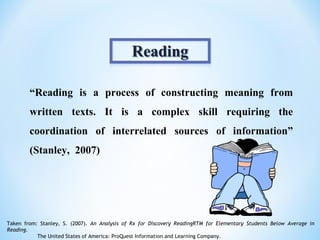
“Reading is a process of constructing meaning from
        written texts. It is a complex skill requiring the
        coordination of interrelated sources of information”
        (Stanley, 2007)


Taken from: Stanley, S. (2007). An Analysis of Rx for Discovery ReadingRTM for Elementary Students Below Average in
Reading.
           The United States of America: ProQuest Information and Learning Company.
 StudentsÂŽ carreer.

    Language acquisition.

    StudentsÂŽ vocabulary knowledge.

    Modelig English writing.

    Introduce topics.
    Stimulate discussions.


Taken from: Jeremy Harmer (2009). How to teach English. England: Pearson Education Limited
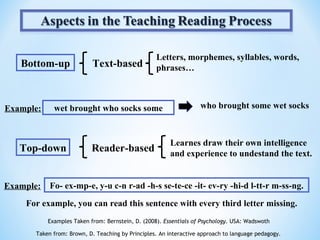
Letters, morphemes, syllables, words,
   Bottom-up               Text-based              phrases


Example:     wet brought who socks some                            who brought some wet socks


                                                        Learnes draw their own intelligence
   Top-down                Reader-based                 and experience to undestand the text.


Example:   Fo- ex-mp-e, y-u c-n r-ad -h-s se-te-ce -it- ev-ry -hi-d l-tt-r m-ss-ng.
    For example, you can read this sentence with every third letter missing.
           Examples Taken from: Bernstein, D. (2008). Essentials of Psychology. USA: Wadswoth

      Taken from: Brown, D. Teaching by Principles. An interactive approach to language pedagogy.
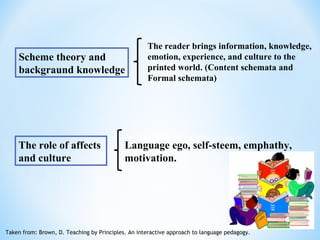
The reader brings information, knowledge,
    Scheme theory and                               emotion, experience, and culture to the
    backgraund knowledge                            printed world. (Content schemata and
                                                    Formal schemata)


    The role of affects                     Language ego, self-steem, emphathy,
    and culture                             motivation.


Taken from: Brown, D. Teaching by Principles. An interactive approach to language pedagogy.
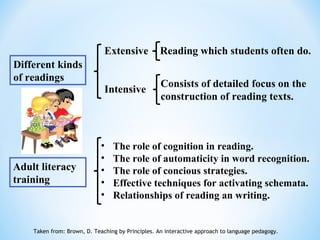
Extensive            Reading which students often do.
Different kinds
of readings
                                                   Consists of detailed focus on the
                              Intensive
                                                   construction of reading texts.


                             ‱   The role of cognition in reading.
                             ‱   The role of automaticity in word recognition.
Adult literacy               ‱   The role of concious strategies.
training                     ‱   Effective techniques for activating schemata.
                             ‱   Relationships of reading an writing.


    Taken from: Brown, D. Teaching by Principles. An interactive approach to language pedagogy.
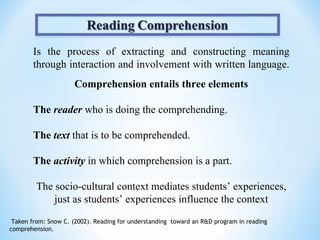
Is the process of extracting and constructing meaning
        through interaction and involvement with written language.
                     Comprehension entails three elements

        The reader who is doing the comprehending.

        The text that is to be comprehended.

        The activity in which comprehension is a part.

         The socio-cultural context mediates students’ experiences,
             just as students’ experiences influence the context
 Taken from: Snow C. (2002). Reading for understanding toward an R&D program in reading
comprehension.
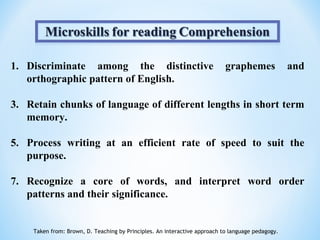
1. Discriminate among the distinctive                                      graphemes              and
   orthographic pattern of English.

3. Retain chunks of language of different lengths in short term
   memory.

5. Process writing at an efficient rate of speed to suit the
   purpose.

7. Recognize a core of words, and interpret word order
   patterns and their significance.


    Taken from: Brown, D. Teaching by Principles. An interactive approach to language pedagogy.
1. Recognize grammatical word classes, systems, patterns,
   rules, and elliptical forms.

3. Recognize that a particular meaning may be expressed in
   different grammatical forms.

5. Recognize cohesive devices in written discourse and their
   role in signaling the relationship between and among
   clauses.

7. Recognize the rhetorical forms of written discourse and
   their significance for interpretation.

9. Recognize the communicative functions of written texts,
   according to form and purposes.

    Taken from: Brown, D. Teaching by Principles. An interactive approach to language pedagogy.
1. Infer context that is not explicit by using background
   knowledge.

3. Infer links and connections between ideas, deduce cause and
   effect, detect such relations as main idea, supporting idea,
   new information, given information, generalization, and
   exemplification.

5. Distinguish between literal and implied meanings.

7. Detect culturally specific references and interpret them in a
   context of the appropriate cultural schemata.

9. Develop and use a battery of reading strategies.


     Taken from: Brown, D. Teaching by Principles. An interactive approach to language pedagogy.
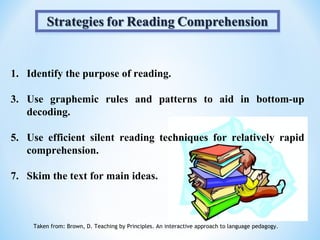
1. Identify the purpose of reading.

3. Use graphemic rules and patterns to aid in bottom-up
   decoding.

5. Use efficient silent reading techniques for relatively rapid
   comprehension.

7. Skim the text for main ideas.


    Taken from: Brown, D. Teaching by Principles. An interactive approach to language pedagogy.
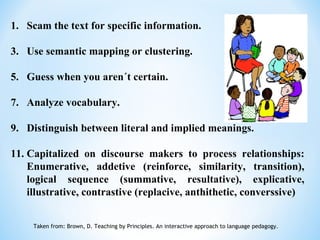
1. Scam the text for specific information.

3. Use semantic mapping or clustering.

5. Guess when you arenÂŽt certain.

7. Analyze vocabulary.

9. Distinguish between literal and implied meanings.

11. Capitalized on discourse makers to process relationships:
    Enumerative, addetive (reinforce, similarity, transition),
    logical sequence (summative, resultative), explicative,
    illustrative, contrastive (replacive, anthithetic, converssive)


     Taken from: Brown, D. Teaching by Principles. An interactive approach to language pedagogy.
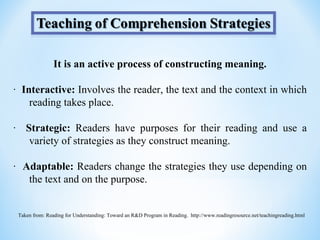
It is an active process of constructing meaning.

· Interactive: Involves the reader, the text and the context in which
    reading takes place.

· Strategic: Readers have purposes for their reading and use a
   variety of strategies as they construct meaning.

· Adaptable: Readers change the strategies they use depending on
   the text and on the purpose.


 Taken from: Reading for Understanding: Toward an R&D Program in Reading. http://www.readingresource.net/teachingreading.html
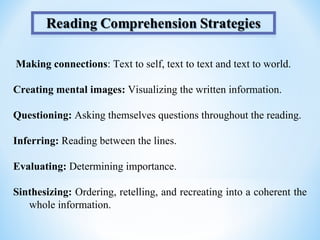
Making connections: Text to self, text to text and text to world.

Creating mental images: Visualizing the written information.

Questioning: Asking themselves questions throughout the reading.

Inferring: Reading between the lines.

Evaluating: Determining importance.

Sinthesizing: Ordering, retelling, and recreating into a coherent the
   whole information.
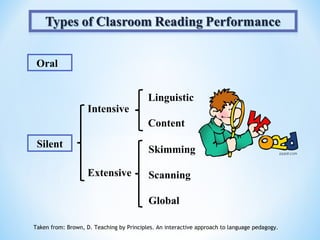
Oral


                                          Linguistic
                    Intensive
                                          Content
 Silent
                                          Skimming

                    Extensive             Scanning

                                          Global

Taken from: Brown, D. Teaching by Principles. An interactive approach to language pedagogy.
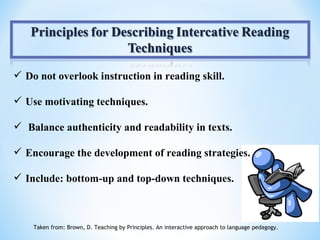
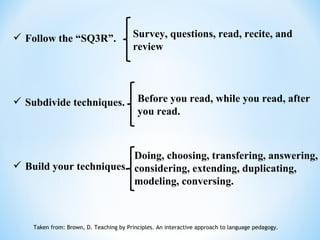
 Do not overlook instruction in reading skill.

 Use motivating techniques.

 Balance authenticity and readability in texts.

 Encourage the development of reading strategies.

 Include: bottom-up and top-down techniques.


    Taken from: Brown, D. Teaching by Principles. An interactive approach to language pedagogy.
 Follow the “SQ3R”.                    Survey, questions, read, recite, and
                                        review


 Subdivide techniques.                   Before you read, while you read, after
                                          you read.


                         Doing, choosing, transfering, answering,
 Build your techniques. considering, extending, duplicating,
                         modeling, conversing.


    Taken from: Brown, D. Teaching by Principles. An interactive approach to language pedagogy.
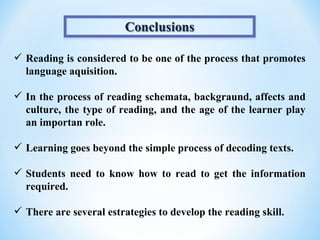
 Reading is considered to be one of the process that promotes
  language aquisition.

 In the process of reading schemata, backgraund, affects and
  culture, the type of reading, and the age of the learner play
  an importan role.

 Learning goes beyond the simple process of decoding texts.

 Students need to know how to read to get the information
  required.

 There are several estrategies to develop the reading skill.
Stanley, S. (2007). An Analysis of Rx for Discovery ReadingRTM for
   Elementary Students Below Average in Reading. The United States of
   America: ProQuest Information and Learning Company.

Jeremy Harmer (2009). How to teach English. England: Pearson
   Education Limited.


Brown, D. (2007). Teaching by Principles. An interactive approach to
  language pedagogy.

Snow C. (2002). Reading for understanding toward an R&D program in
  reading comprehension. [Book in line]. From: http://books.google.co.ve/
  books?id=R1t9btYnK_EC&pg=PA9&dq=definition+of+reading+
  comprehension&hl=es&sa=X&ei=F53TT6e1BvCK6QGr7uTAg&sqi=
  2&ved=0CDsQ6AEwAQ#v=onepage&q=definition%20of%20reading%
  20comprehension&f=false. [Consulted: 2012, June 10]

Teaching reading 1

  • 1.
    UNIVERSIDAD PEDAGÓGICA EXPERIMENTALLIBERTADOR INSTITUTO PEDAGÓGICO DE CARACAS DEPARTAMENTO DE IDIOMAS MODERNOS PROGRAMA INGLÉS INGLÉS PARA FINES ESPECÍFICOS Teaching Reading Alexis Centrella Vegas Nancy Coronado June, 2012
  • 2.
    “Reading is aprocess of constructing meaning from written texts. It is a complex skill requiring the coordination of interrelated sources of information” (Stanley, 2007) Taken from: Stanley, S. (2007). An Analysis of Rx for Discovery ReadingRTM for Elementary Students Below Average in Reading. The United States of America: ProQuest Information and Learning Company.
  • 3.
     StudentsÂŽ carreer.  Language acquisition.  StudentsÂŽ vocabulary knowledge.  Modelig English writing.  Introduce topics.  Stimulate discussions. Taken from: Jeremy Harmer (2009). How to teach English. England: Pearson Education Limited
  • 4.
    Letters, morphemes, syllables,words, Bottom-up Text-based phrases
 Example: wet brought who socks some who brought some wet socks Learnes draw their own intelligence Top-down Reader-based and experience to undestand the text. Example: Fo- ex-mp-e, y-u c-n r-ad -h-s se-te-ce -it- ev-ry -hi-d l-tt-r m-ss-ng. For example, you can read this sentence with every third letter missing. Examples Taken from: Bernstein, D. (2008). Essentials of Psychology. USA: Wadswoth Taken from: Brown, D. Teaching by Principles. An interactive approach to language pedagogy.
  • 5.
    The reader bringsinformation, knowledge, Scheme theory and emotion, experience, and culture to the backgraund knowledge printed world. (Content schemata and Formal schemata) The role of affects Language ego, self-steem, emphathy, and culture motivation. Taken from: Brown, D. Teaching by Principles. An interactive approach to language pedagogy.
  • 6.
    Extensive Reading which students often do. Different kinds of readings Consists of detailed focus on the Intensive construction of reading texts. ‱ The role of cognition in reading. ‱ The role of automaticity in word recognition. Adult literacy ‱ The role of concious strategies. training ‱ Effective techniques for activating schemata. ‱ Relationships of reading an writing. Taken from: Brown, D. Teaching by Principles. An interactive approach to language pedagogy.
  • 7.
    Is the processof extracting and constructing meaning through interaction and involvement with written language. Comprehension entails three elements The reader who is doing the comprehending. The text that is to be comprehended. The activity in which comprehension is a part. The socio-cultural context mediates students’ experiences, just as students’ experiences influence the context  Taken from: Snow C. (2002). Reading for understanding toward an R&D program in reading comprehension.
  • 8.
    1. Discriminate amongthe distinctive graphemes and orthographic pattern of English. 3. Retain chunks of language of different lengths in short term memory. 5. Process writing at an efficient rate of speed to suit the purpose. 7. Recognize a core of words, and interpret word order patterns and their significance. Taken from: Brown, D. Teaching by Principles. An interactive approach to language pedagogy.
  • 9.
    1. Recognize grammaticalword classes, systems, patterns, rules, and elliptical forms. 3. Recognize that a particular meaning may be expressed in different grammatical forms. 5. Recognize cohesive devices in written discourse and their role in signaling the relationship between and among clauses. 7. Recognize the rhetorical forms of written discourse and their significance for interpretation. 9. Recognize the communicative functions of written texts, according to form and purposes. Taken from: Brown, D. Teaching by Principles. An interactive approach to language pedagogy.
  • 10.
    1. Infer contextthat is not explicit by using background knowledge. 3. Infer links and connections between ideas, deduce cause and effect, detect such relations as main idea, supporting idea, new information, given information, generalization, and exemplification. 5. Distinguish between literal and implied meanings. 7. Detect culturally specific references and interpret them in a context of the appropriate cultural schemata. 9. Develop and use a battery of reading strategies. Taken from: Brown, D. Teaching by Principles. An interactive approach to language pedagogy.
  • 11.
    1. Identify thepurpose of reading. 3. Use graphemic rules and patterns to aid in bottom-up decoding. 5. Use efficient silent reading techniques for relatively rapid comprehension. 7. Skim the text for main ideas. Taken from: Brown, D. Teaching by Principles. An interactive approach to language pedagogy.
  • 12.
    1. Scam thetext for specific information. 3. Use semantic mapping or clustering. 5. Guess when you arenÂŽt certain. 7. Analyze vocabulary. 9. Distinguish between literal and implied meanings. 11. Capitalized on discourse makers to process relationships: Enumerative, addetive (reinforce, similarity, transition), logical sequence (summative, resultative), explicative, illustrative, contrastive (replacive, anthithetic, converssive) Taken from: Brown, D. Teaching by Principles. An interactive approach to language pedagogy.
  • 13.
    It is anactive process of constructing meaning. · Interactive: Involves the reader, the text and the context in which reading takes place. · Strategic: Readers have purposes for their reading and use a variety of strategies as they construct meaning. · Adaptable: Readers change the strategies they use depending on the text and on the purpose. Taken from: Reading for Understanding: Toward an R&D Program in Reading. http://www.readingresource.net/teachingreading.html
  • 14.
    Making connections: Textto self, text to text and text to world. Creating mental images: Visualizing the written information. Questioning: Asking themselves questions throughout the reading. Inferring: Reading between the lines. Evaluating: Determining importance. Sinthesizing: Ordering, retelling, and recreating into a coherent the whole information.
  • 15.
    Oral Linguistic Intensive Content Silent Skimming Extensive Scanning Global Taken from: Brown, D. Teaching by Principles. An interactive approach to language pedagogy.
  • 16.
     Do notoverlook instruction in reading skill.  Use motivating techniques.  Balance authenticity and readability in texts.  Encourage the development of reading strategies.  Include: bottom-up and top-down techniques. Taken from: Brown, D. Teaching by Principles. An interactive approach to language pedagogy.
  • 17.
     Follow the“SQ3R”. Survey, questions, read, recite, and review  Subdivide techniques. Before you read, while you read, after you read. Doing, choosing, transfering, answering,  Build your techniques. considering, extending, duplicating, modeling, conversing. Taken from: Brown, D. Teaching by Principles. An interactive approach to language pedagogy.
  • 18.
     Reading isconsidered to be one of the process that promotes language aquisition.  In the process of reading schemata, backgraund, affects and culture, the type of reading, and the age of the learner play an importan role.  Learning goes beyond the simple process of decoding texts.  Students need to know how to read to get the information required.  There are several estrategies to develop the reading skill.
  • 19.
    Stanley, S. (2007).An Analysis of Rx for Discovery ReadingRTM for Elementary Students Below Average in Reading. The United States of America: ProQuest Information and Learning Company. Jeremy Harmer (2009). How to teach English. England: Pearson Education Limited. Brown, D. (2007). Teaching by Principles. An interactive approach to language pedagogy. Snow C. (2002). Reading for understanding toward an R&D program in reading comprehension. [Book in line]. From: http://books.google.co.ve/ books?id=R1t9btYnK_EC&pg=PA9&dq=definition+of+reading+ comprehension&hl=es&sa=X&ei=F53TT6e1BvCK6QGr7uTAg&sqi= 2&ved=0CDsQ6AEwAQ#v=onepage&q=definition%20of%20reading% 20comprehension&f=false. [Consulted: 2012, June 10]