1
IT - 1
ID NO:1 To 5
Sub: Calculus
2
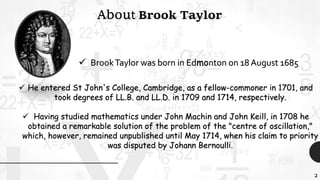
About Brook Taylor
 BrookTaylor was born in Edmonton on 18 August 1685
 He entered St John's College, Cambridge, as a fellow-commoner in 1701, and
took degrees of LL.B. and LL.D. in 1709 and 1714, respectively.
 Having studied mathematics under John Machin and John Keill, in 1708 he
obtained a remarkable solution of the problem of the "centre of oscillation,"
which, however, remained unpublished until May 1714, when his claim to priority
was disputed by Johann Bernoulli.
2
In mathematics, aTaylor series is a representation of a function as an
infinite sum of terms that are calculated from the values of the
function's derivatives at a single point.
The concept of aTaylor series was formulated by the Scottish
mathematician James Gregory and formally introduced by the English
mathematician BrookTaylor in 1715.
If theTaylor series is centered at zero, then that series is also called a
Maclaurin series
2
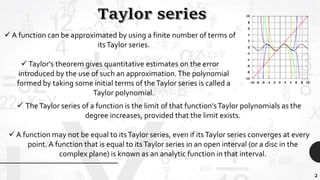
 A function can be approximated by using a finite number of terms of
itsTaylor series.
 Taylor's theorem gives quantitative estimates on the error
introduced by the use of such an approximation.The polynomial
formed by taking some initial terms of theTaylor series is called a
Taylor polynomial.
 TheTaylor series of a function is the limit of that function'sTaylor polynomials as the
degree increases, provided that the limit exists.
 A function may not be equal to itsTaylor series, even if itsTaylor series converges at every
point. A function that is equal to itsTaylor series in an open interval (or a disc in the
complex plane) is known as an analytic function in that interval.
2
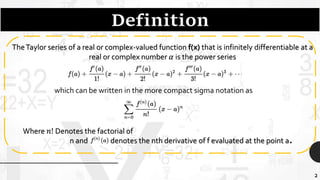
TheTaylor series of a real or complex-valued function f(x) that is infinitely differentiable at a
real or complex number 𝛼 is the power series
which can be written in the more compact sigma notation as
Where 𝑛! Denotes the factorial of
n and denotes the nth derivative of f evaluated at the point a.
2
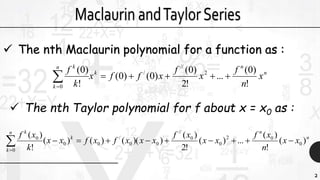
 The nth Maclaurin polynomial for a function as :
n
n
k
n
k
k
x
n
f
x
f
xffx
k
f
!
)0(
...
!2
)0(
)0()0(
!
)0( 2
//
/
0

 The nth Taylor polynomial for f about x = x0 as :
n
n
k
n
k
k
xx
n
xf
xx
xf
xxxfxfxx
k
xf
)(
!
)(
...)(
!2
)(
))(()()(
!
)(
0
02
0
0
//
00
/
00
0
0

2
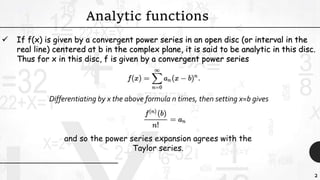
 If f(x) is given by a convergent power series in an open disc (or interval in the
real line) centered at b in the complex plane, it is said to be analytic in this disc.
Thus for x in this disc, f is given by a convergent power series
Analytic functions
Differentiating by x the above formula n times, then setting x=b gives
and so the power series expansion agrees with the
Taylor series.
2
EXAMPLE
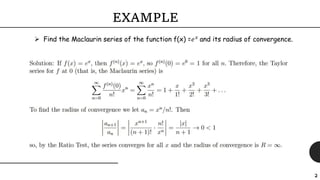
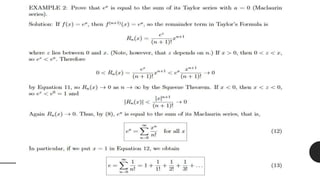
 Find the Maclaurin series of the function f(x) =ⅇ 𝑥 and its radius of convergence.
2
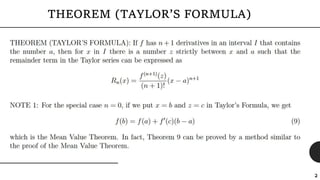
THEOREM (TAYLOR’S FORMULA)
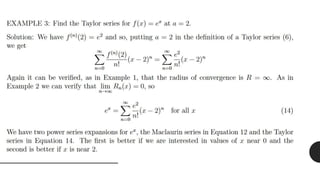
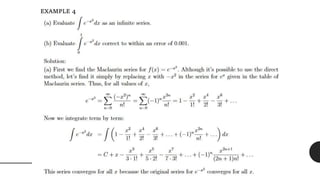
EXAMPLE 4
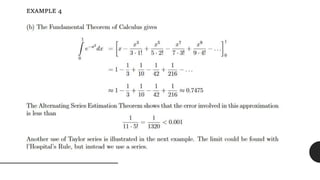
EXAMPLE 4
Taylor's and Maclaurin series

Taylor's and Maclaurin series

  • 1.
    1 IT - 1 IDNO:1 To 5 Sub: Calculus
  • 2.
    2 About Brook Taylor BrookTaylor was born in Edmonton on 18 August 1685  He entered St John's College, Cambridge, as a fellow-commoner in 1701, and took degrees of LL.B. and LL.D. in 1709 and 1714, respectively.  Having studied mathematics under John Machin and John Keill, in 1708 he obtained a remarkable solution of the problem of the "centre of oscillation," which, however, remained unpublished until May 1714, when his claim to priority was disputed by Johann Bernoulli.
  • 3.
    2 In mathematics, aTaylorseries is a representation of a function as an infinite sum of terms that are calculated from the values of the function's derivatives at a single point. The concept of aTaylor series was formulated by the Scottish mathematician James Gregory and formally introduced by the English mathematician BrookTaylor in 1715. If theTaylor series is centered at zero, then that series is also called a Maclaurin series
  • 4.
    2  A functioncan be approximated by using a finite number of terms of itsTaylor series.  Taylor's theorem gives quantitative estimates on the error introduced by the use of such an approximation.The polynomial formed by taking some initial terms of theTaylor series is called a Taylor polynomial.  TheTaylor series of a function is the limit of that function'sTaylor polynomials as the degree increases, provided that the limit exists.  A function may not be equal to itsTaylor series, even if itsTaylor series converges at every point. A function that is equal to itsTaylor series in an open interval (or a disc in the complex plane) is known as an analytic function in that interval.
  • 5.
    2 TheTaylor series ofa real or complex-valued function f(x) that is infinitely differentiable at a real or complex number 𝛼 is the power series which can be written in the more compact sigma notation as Where 𝑛! Denotes the factorial of n and denotes the nth derivative of f evaluated at the point a.
  • 6.
    2  The nthMaclaurin polynomial for a function as : n n k n k k x n f x f xffx k f ! )0( ... !2 )0( )0()0( ! )0( 2 // / 0   The nth Taylor polynomial for f about x = x0 as : n n k n k k xx n xf xx xf xxxfxfxx k xf )( ! )( ...)( !2 )( ))(()()( ! )( 0 02 0 0 // 00 / 00 0 0 
  • 7.
    2  If f(x)is given by a convergent power series in an open disc (or interval in the real line) centered at b in the complex plane, it is said to be analytic in this disc. Thus for x in this disc, f is given by a convergent power series Analytic functions Differentiating by x the above formula n times, then setting x=b gives and so the power series expansion agrees with the Taylor series.
  • 8.
    2 EXAMPLE  Find theMaclaurin series of the function f(x) =ⅇ 𝑥 and its radius of convergence.
  • 9.
  • 13.
  • 14.