TAXONOMIC
CLASSIFICATION
TAXONOMY
A science field designed to produce a
system of classification of the
biological resources that exist in the
world which best reflect the totality of
their similarities and differences.
THREE DOMAINS OF LIFE
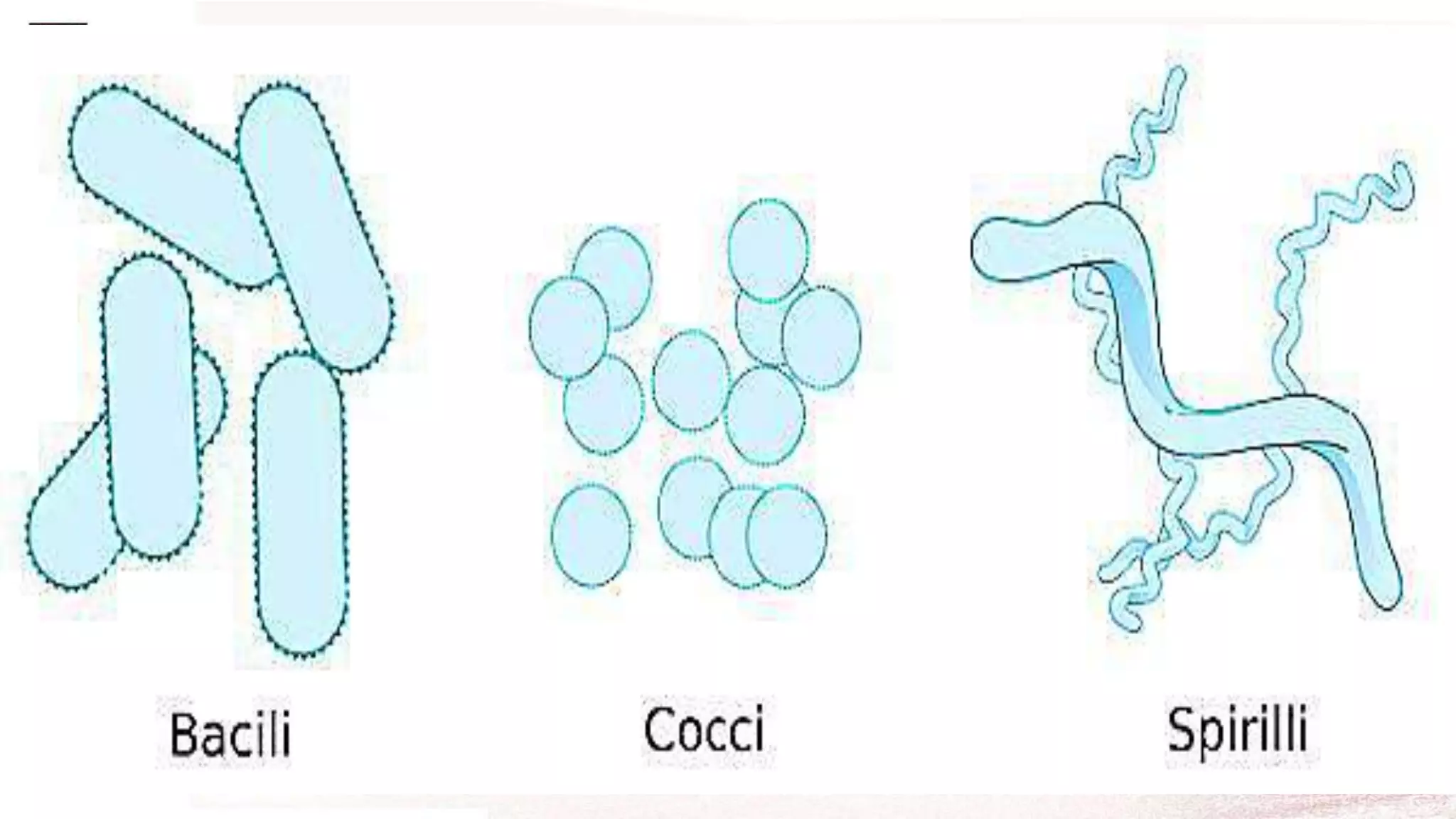
KINGDOM MONERA
All bacteria were once classified into Kingdom
Monera. Scientists discovered there were
differences among the evolutionary history
and biochemistry which led them classify them
into two very different kingdoms –
Archaebacteria and Eubacteria.
ARCHAEABACTERIA
 Also known as extremophiles
 Classified into:
- Halophiles (salty environments)
- Thermophiles (extremely hot environments)
- Methanogens (produce methane)
ARCHAEABACTERIA
Can survive in extreme, harsh
environments such as hot springs,
salt lakes, marshes, oceanic vents
and guts of ruminants and humans
ARCHAEABACTERIA
Their cell wall does not contain
peptidoglycan
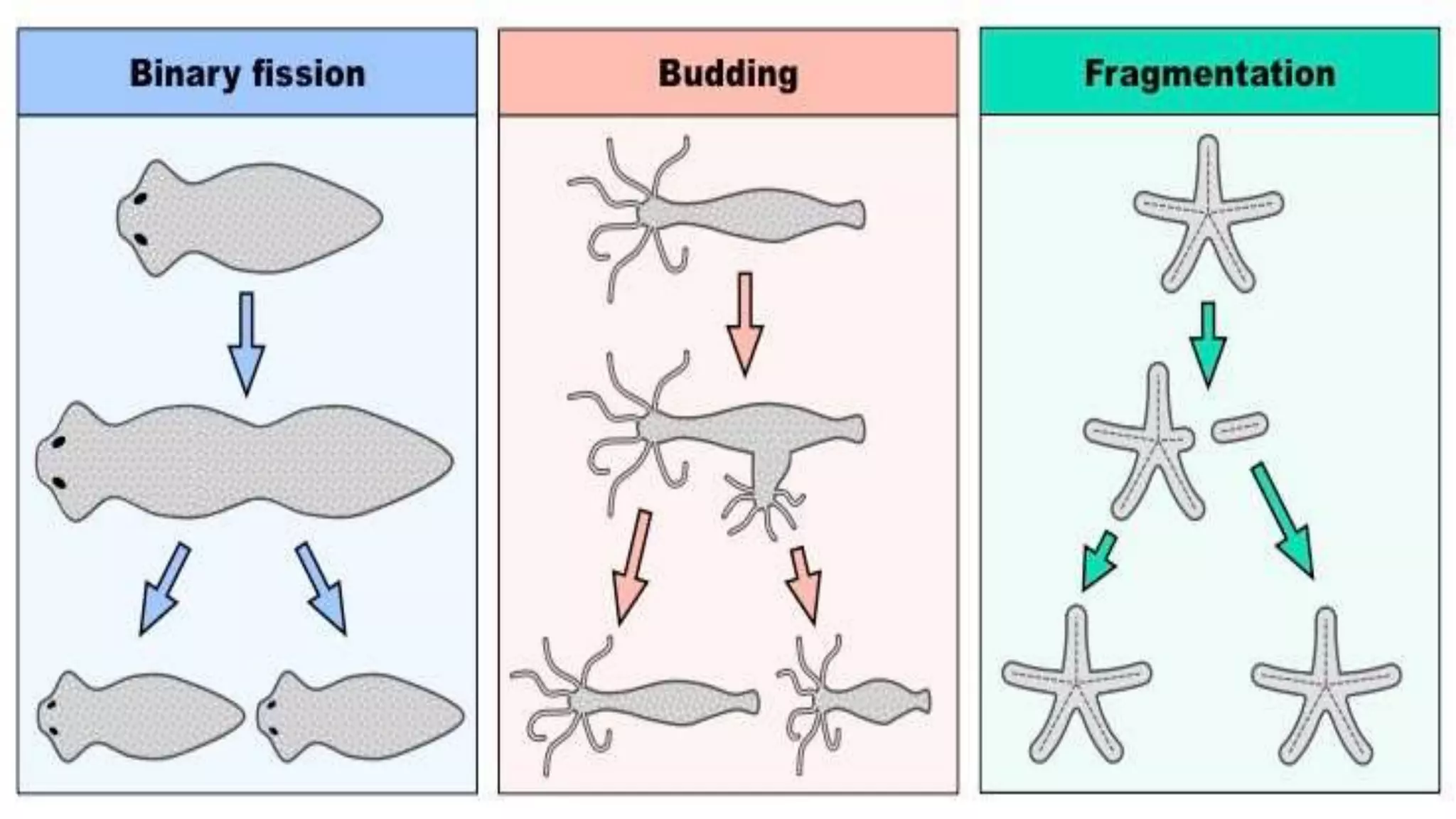
Reproduce asexually by binary
fission, fragmentation, and
budding
EUBACTERIA
Have the ability to form spores to
remain dormant over years
Found everywhere and live in
different types of habitats
EUBACTERIA
 Their cell wall contains peptidoglycan (an
essential component of the bacterial cell
envelope and protects the cell from bursting
due to turgor and maintains cell shape)
 Reproduce asexually by binary fission,
fragmentation, and budding
ARCHAEABACTERIA VS. EUBACTERIA
PARAMETER OF
COMPARISON
ARCHAEA EUBACTERIA
KINGDOM Monera Monera
DESCRIPTION
Single-celled and
simple microorganisms
that are capable of
living and thriving in
extreme conditions
Single-celled and
complex
microorganisms
that are capable of
living and thriving in
normal conditions
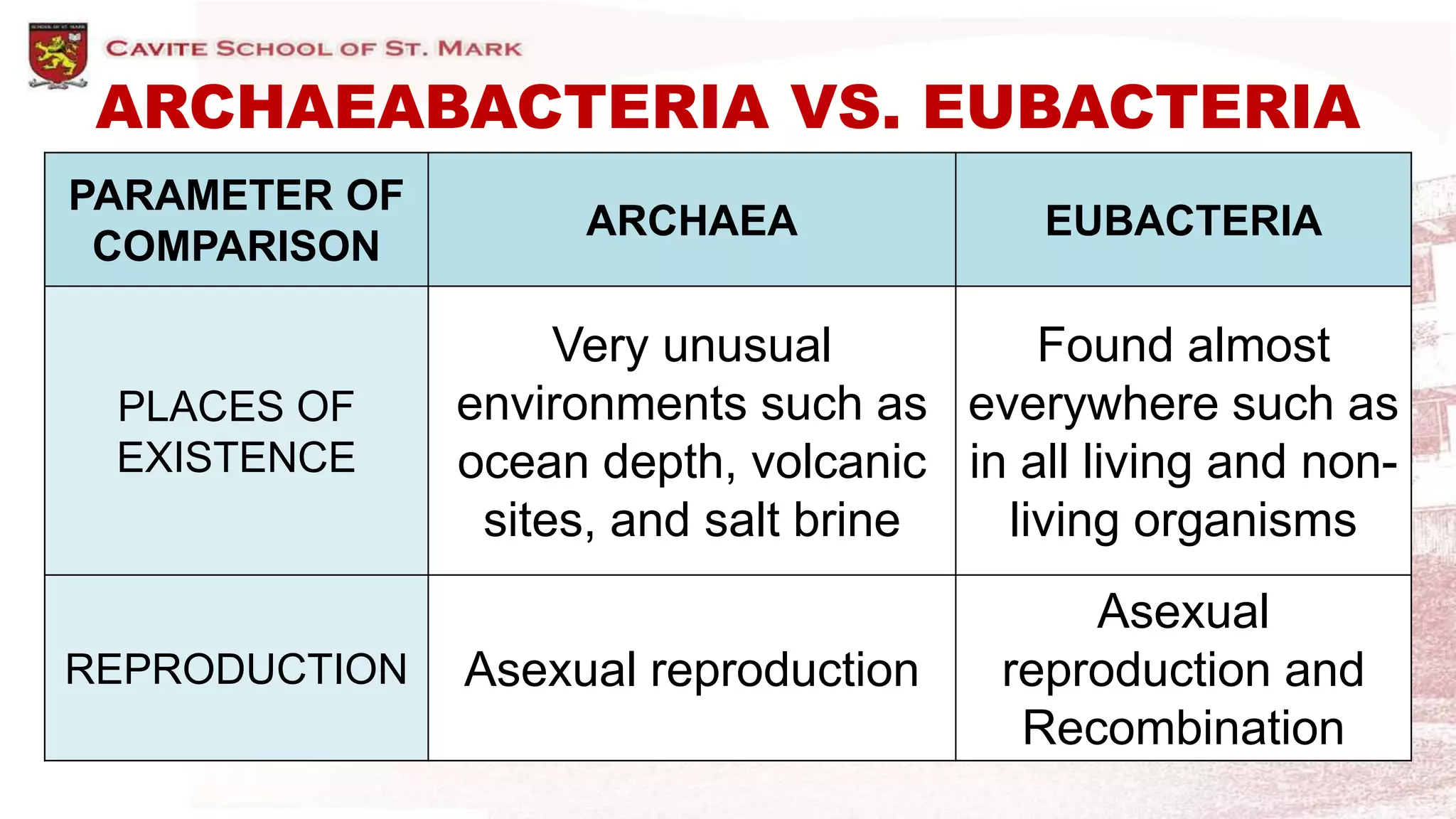
ARCHAEABACTERIA VS. EUBACTERIA
PARAMETER OF
COMPARISON
ARCHAEA EUBACTERIA
PLACES OF
EXISTENCE
Very unusual
environments such as
ocean depth, volcanic
sites, and salt brine
Found almost
everywhere such as
in all living and non-
living organisms
REPRODUCTION Asexual reproduction
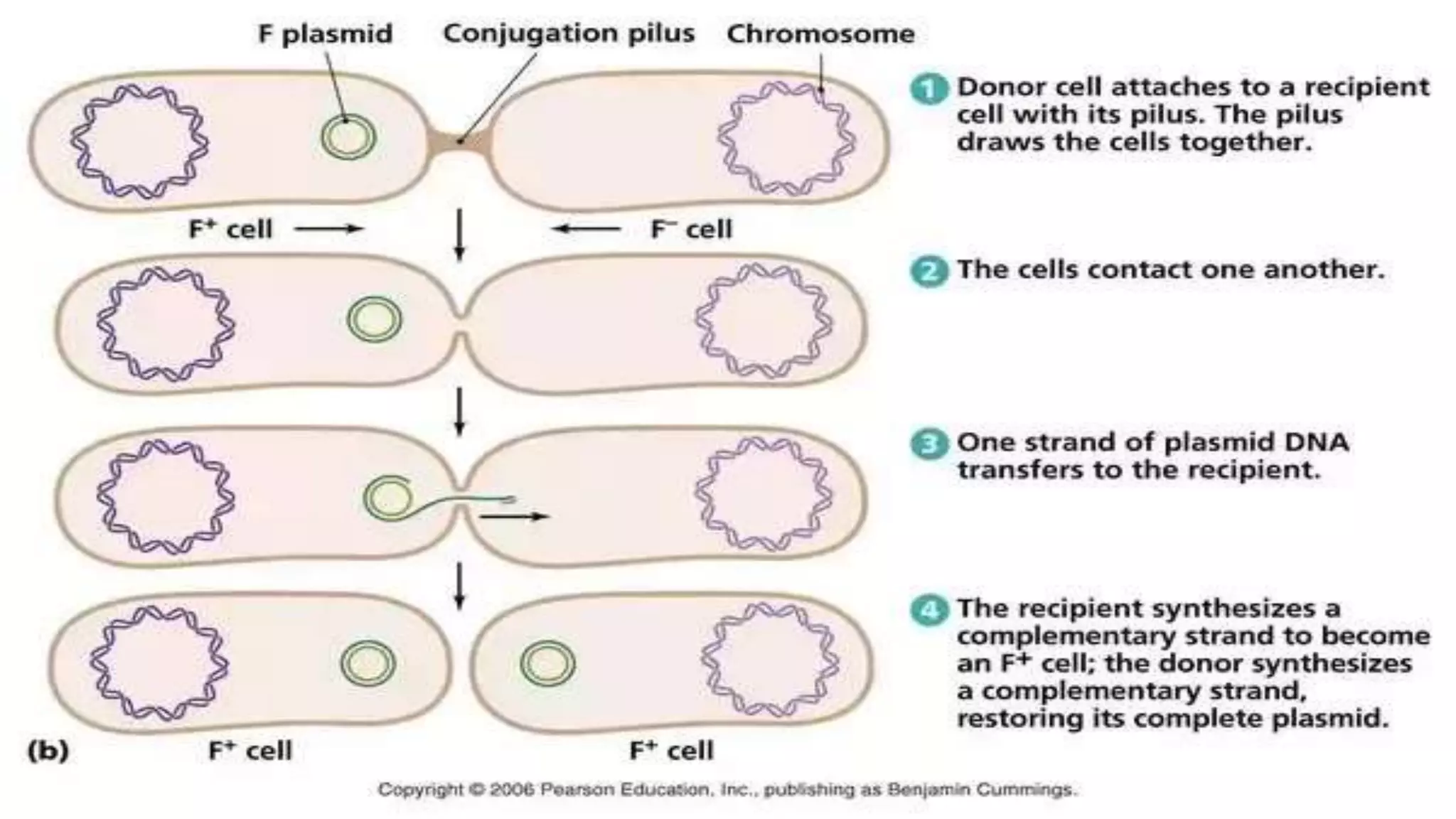
Asexual
reproduction and
Recombination
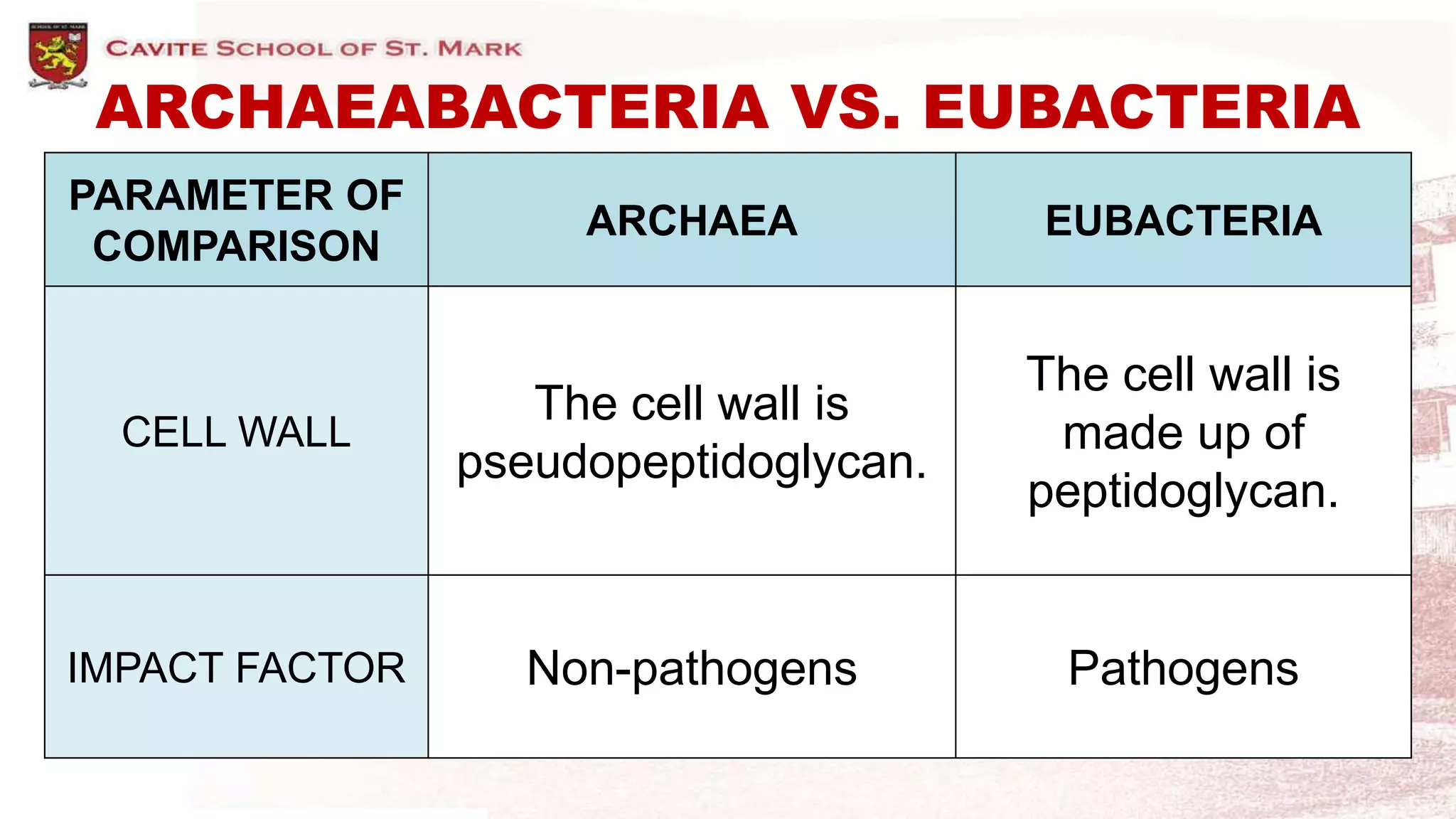
ARCHAEABACTERIA VS. EUBACTERIA
PARAMETER OF
COMPARISON
ARCHAEA EUBACTERIA
CELL WALL
The cell wall is
pseudopeptidoglycan.
The cell wall is
made up of
peptidoglycan.
IMPACT FACTOR Non-pathogens Pathogens
SEATWORK
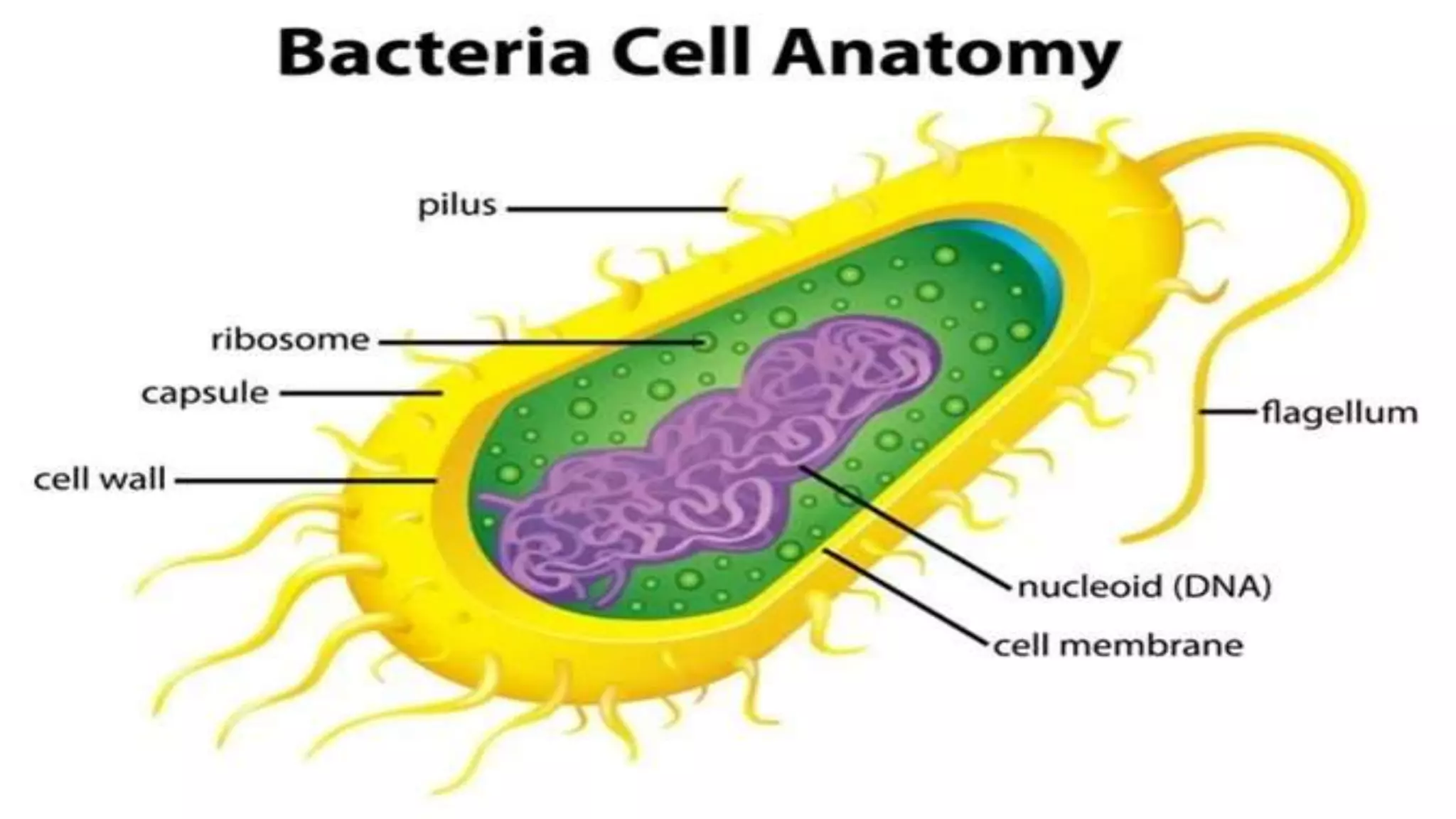
Label the diagram
of a bacterial cell
on the right.
cell wall, cell membrane,
pili, DNA, cytoplasm,
flagella and ribosomes
SEVEN MAJOR CLASSIFICATION
Country: Philippines
Region: IV-A
Province: Cavite
City: Bacoor
Barangay: Panapaan V
Street: Fourth
House No.: 281
Kingdom: Animalia
Phylum: Chordata
Class: Mammalia
Order: Primate
Family: Homonidae
Genus: Homo
Species: sapiens
SEVEN MAJOR CLASSIFICATION
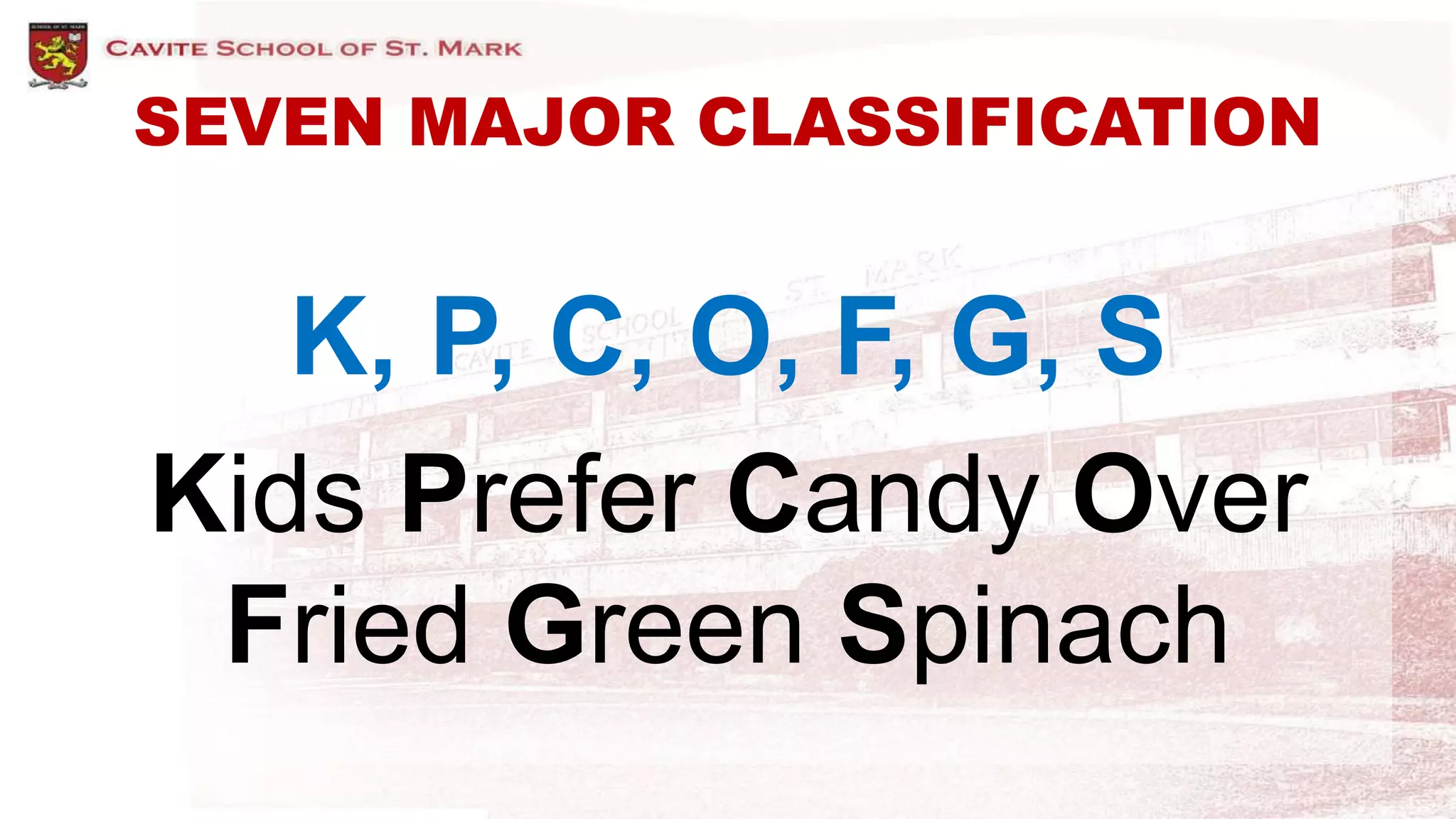
K, P, C, O, F, G, S
Kids Prefer Candy Over
Fried Green Spinach
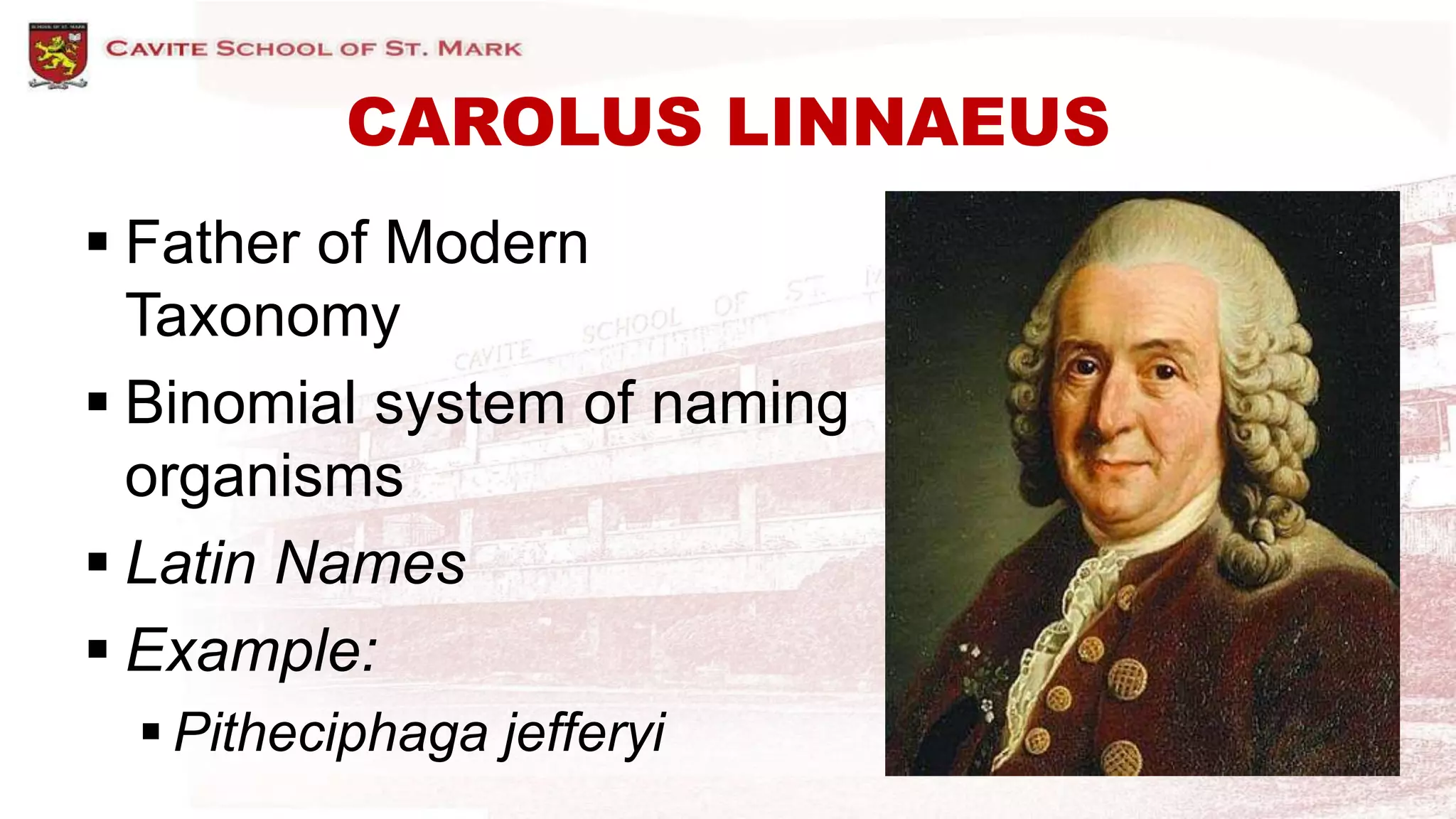
CAROLUS LINNAEUS
 Father of Modern
Taxonomy
 Binomial system of naming
organisms
 Latin Names
 Example:
 Pitheciphaga jefferyi
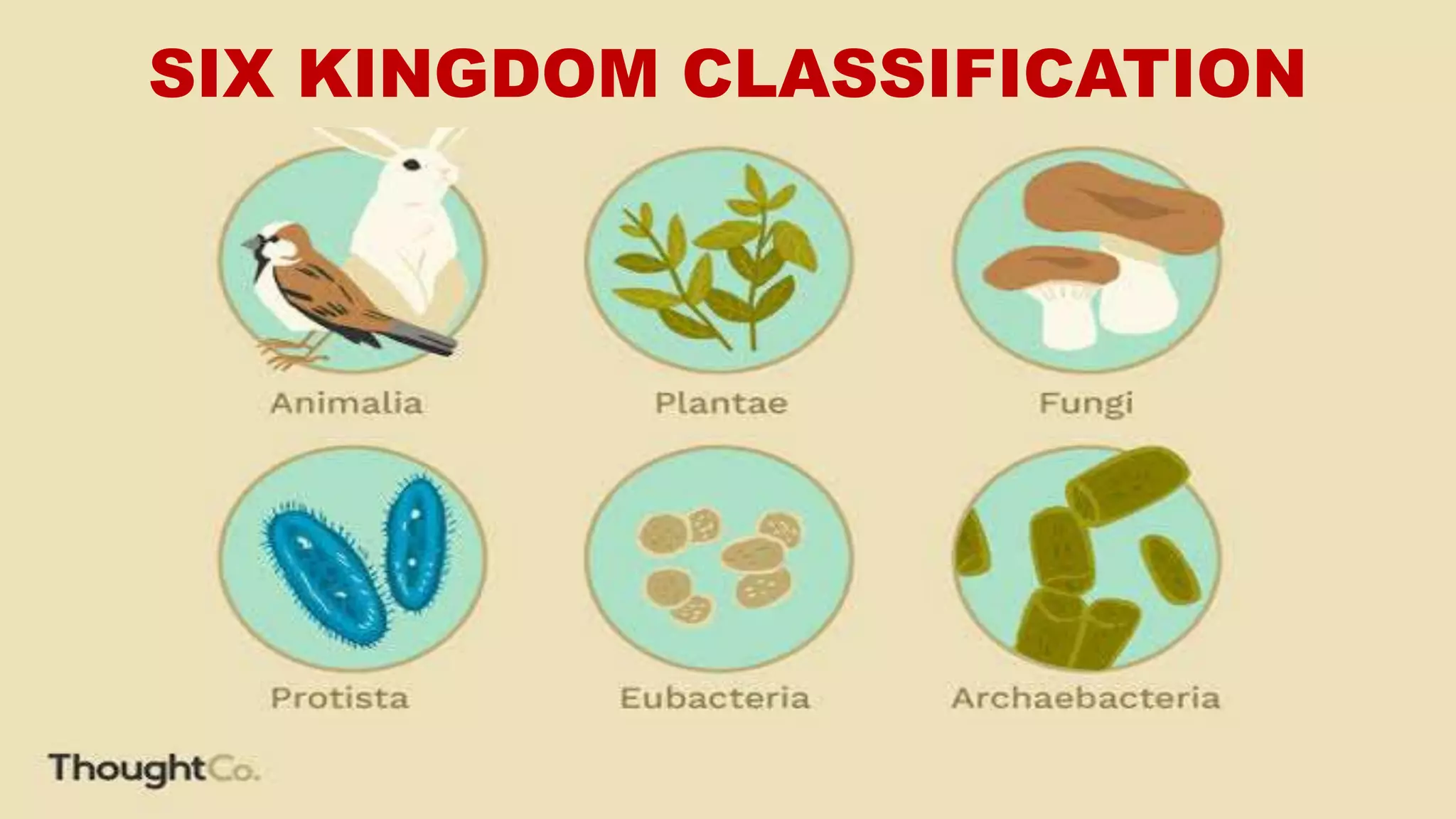
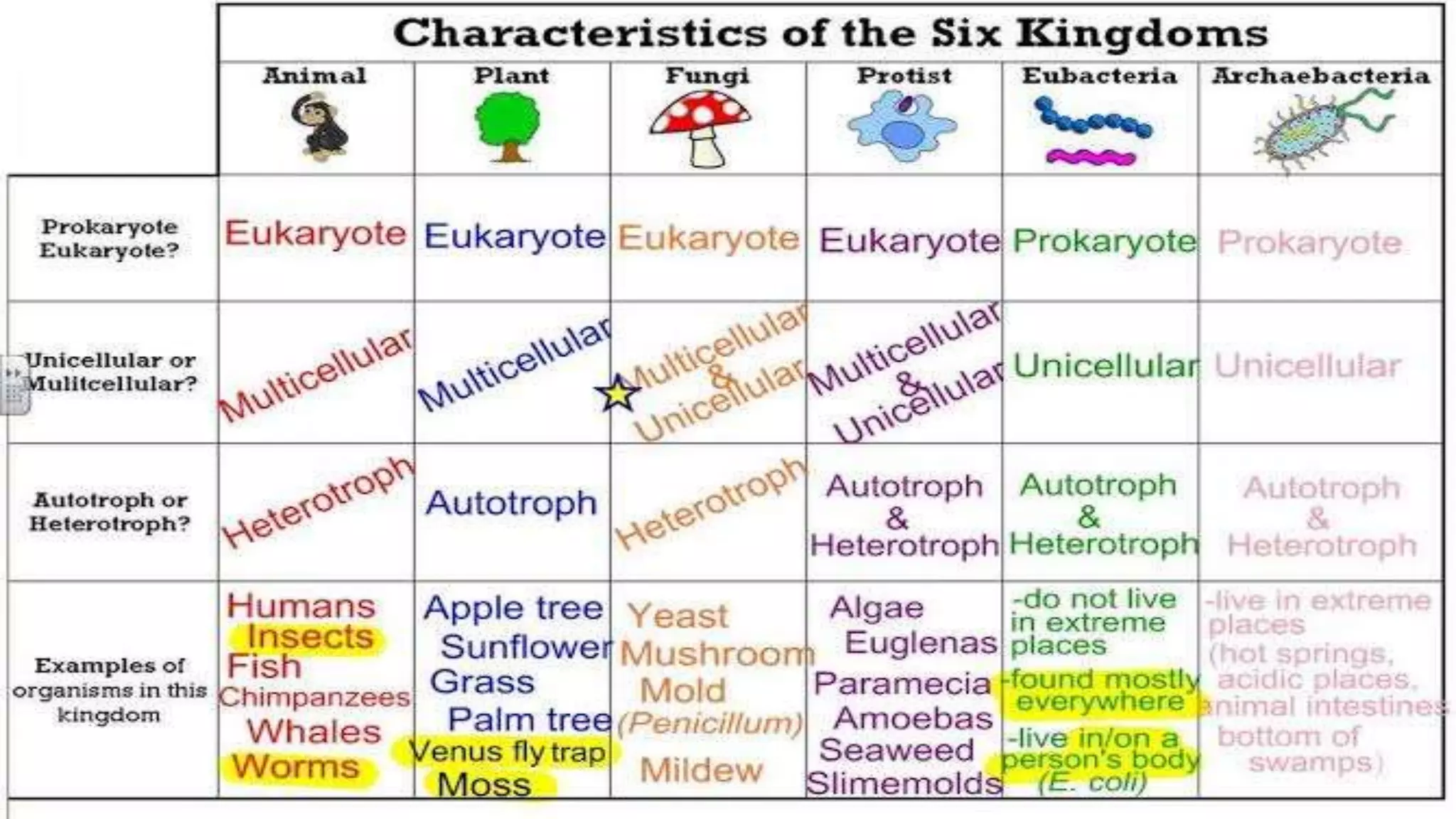
SIX KINGDOM CLASSIFICATION
FUNGI
 All fungi are heterotrophs
 Some are saprophytes
 They have cell walls made
of chitin
 Some are beneficial and
some are hazardous
PROTISTS
 Eukaryotes with nuclei and some
membrane-bound organelles
 Classified into:
Plant-like Protists (Algae)
Animal-like Protists (Protozoans)
Fungus-like Protist
PROTOZOANS
 Unicellular
 Heterotrophs and Motile
 Classified into:
Sarcodinians
Zooflagellates
Ciliophorans
PROTOZOANS
Food: Bacteria
Environment: Ocean/Water
Maintaining balance or homeostasis
Scavengers
Parasitic
ALGAE
Live where there is sufficient water
Some contains chlorophyll
Classified into:
Unicellular Algae
Multicellular Algae
FUNGUS-LIKE PROTISTS
Plasmodial Slime Molds
Cellular Slime Molds
Water Molds
THE TRADITIONAL
CLASSIFICATION OF
ANIMALS
NINE MAJOR PHYLA OF ANIMALS
1. Porifera
2. Cnidaria
3. Platyhelminthes
4. Nematoda
5. Mollusca
6. Annelida
7. Arthropoda
8. Echinodermata
9. Chordata
TASK
Find the key characteristics of the
assigned phylum to you.
Give at least five typical example
animals for each phylum.
Determine the approximate number of
species alive for each phylum.
PHYLUM
PORIFERA
PHYLUM PORIFERA
Pore Bearers
Most live in the oceans and some in
freshwater lakes and streams
Sessile animals
Most have no body symmetry
PHYLUM PORIFERA
 Sponges display variety of shapes, colors,
and sizes
 Marine sponges are usually red, orange,
yellow, or blue
 Freshwater ones are dull brown and green
 Very sensitive to water pollution
PHYLUM PORIFERA
Four Classes of Sponges:
1. Calcarea
2. Hyalospongiae
3. Demospongiae
4. Sclerospongiae
PHYLUM PORIFERA
 Sponges reproduce by sexual and asexual
means.
 They can produce both male and female
gametes.
 The zygote develops into a larva with a
flagellum which swims and attach to a new
surface.
PHYLUM PORIFERA
 Asexual reproduction of sponge involve
budding, fragmentation, and regeneration.
 Sponges are filter feeders
 Distinct Characteristic:
Amebocytes: for digestion and
reproduction
PHYLUM
CNIDARIA
PHYLUM CNIDARIA
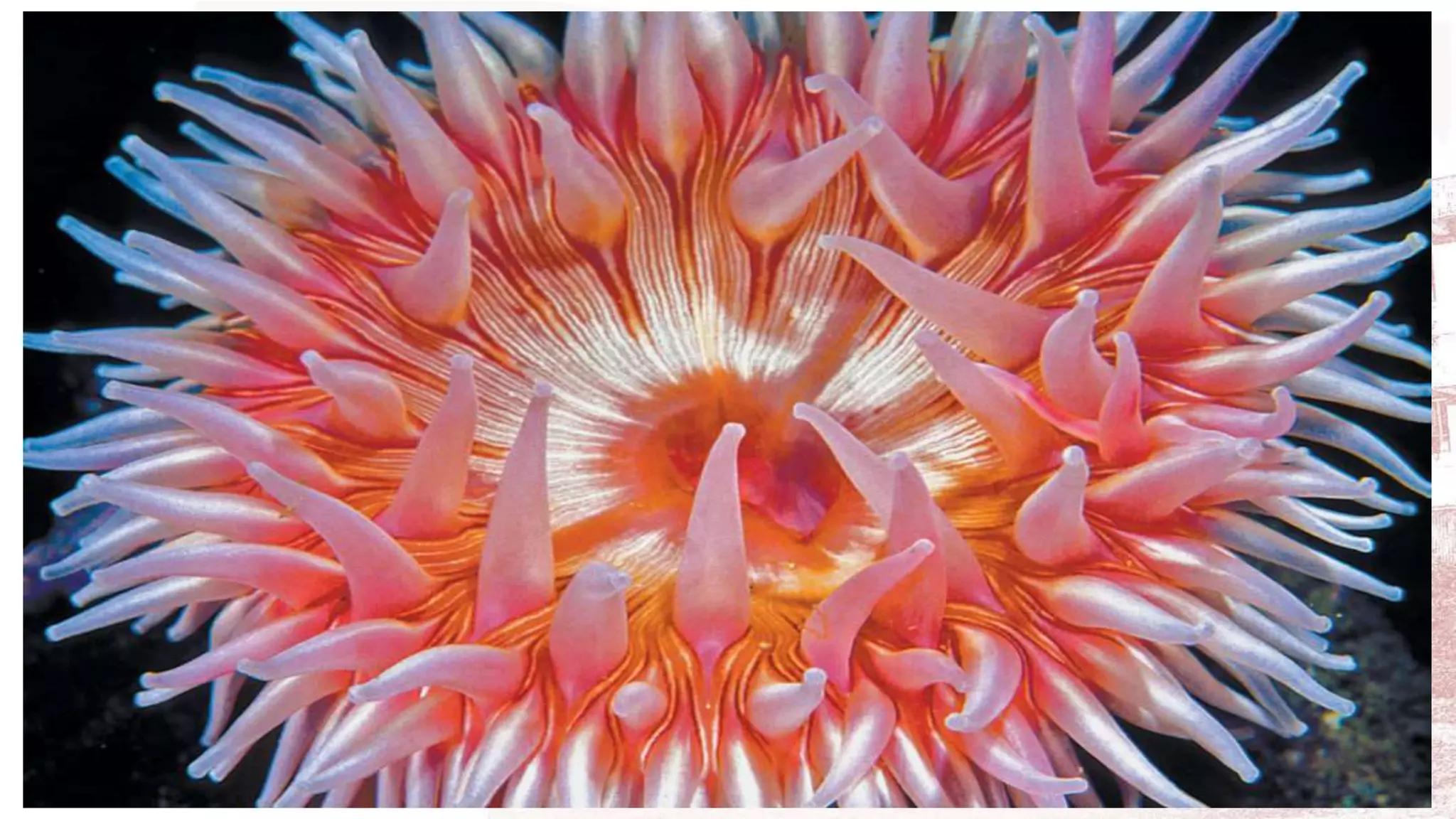
 Includes jellyfish, corals, hydra, and sea
anemones
 Distinct Characteristic:
Cnidocytes: contains stinging poisonous
barbs to attack prey
 Jellyfish and anemones live independently
 Corals live in colonies
PHYLUM CNIDARIA
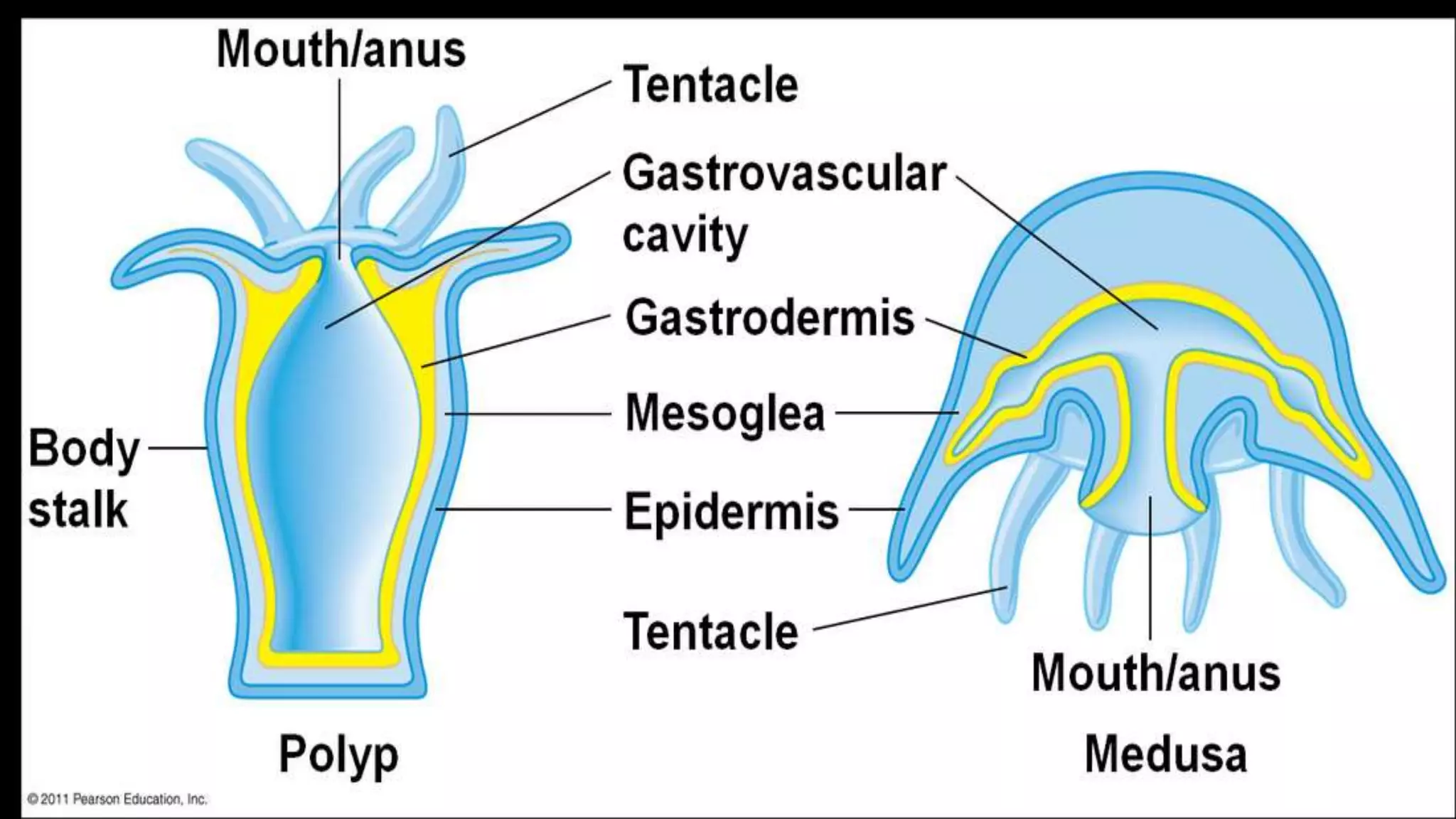
 Cnidarians are soft-bodied animals with
hollow central cavity, containing a single
opening, mouth, surrounded by tentacles.
 Two Basic Body Plans:
1. Polyp
2. Medusa
PHYLUM CNIDARIA
Polyp
Vase-shape
Sessile
Has mouth on the dorsal surface and
tentacles that point upward
PHYLUM CNIDARIA
Medusa
Umbrella-shape
Floating or free-swimming
Has a mouth on the ventral surface
and tentacles that point downward
PHYLUM CNIDARIA
 They catch food through the movement
of their tentacles
 Their digestive system is incomplete
 Has one opening for the entrance of food
and exit of wastes
 Their body cavity has a large capacity
PHYLUM CNIDARIA
Reproduction: Sexual and Asexual
External Fertilization
Asexual : Budding
Important source of food for many
marine animals
PHYLUM
PLATYHELMINTHES
PHYLUM PLATYHELMINTHES
Flatworms
Bilaterally Symmetrical Animals
Exhibit Cephalization
Can be harmless, decomposers, and
parasites
PHYLUM PLATYHELMINTHES
Three Classes:
Turbellaria
Trematoda
Cestoda
CLASS TURBELLARIA
Most are marine but some are
found in fresh water and moist
places on land
Have soft, flattened bodies
Example: Planaria
CLASS TURBELLARIA
 Planaria
Incomplete digestive system
Only one opening
The mouth is located at the middle of the
body
Flame cells- excretory mechanism
CLASS TURBELLARIA
 Planaria
 Circulatory and respiratory system are lacking
 The flat body allows gases to diffuse across it
surface
 The nervous system consists of two anterior:
ganglia and nerves
 There are two eyespots at the anterior end of the
body
CLASS TREMATODA
 Flukes
 Have tough protective body coverings that
prevent them from being digested by their
hosts
 Have two suckers:
Used to attach to the host
Used to suck in the host’s cells and fluids
CLASS TREMATODA
Some are external parasites
Most are internal parasites
Example: Blood Fluke Schistosoma
Causes the human disease called
schistosomiasis
CLASS TREMATODA
Most flukes are hermaphrodite
Blood flukes has separate sexes
They mate while in the blood vessels
of human intestines
The Schistosoma mansoni’s life cycle
requires both human and snail
CLASS CESTODA
Cestodes or Tapeworms
Live in the digestive tracts of their hosts
Lack mouth, digestive system, and
sense organs
They have nervous and excretory
system
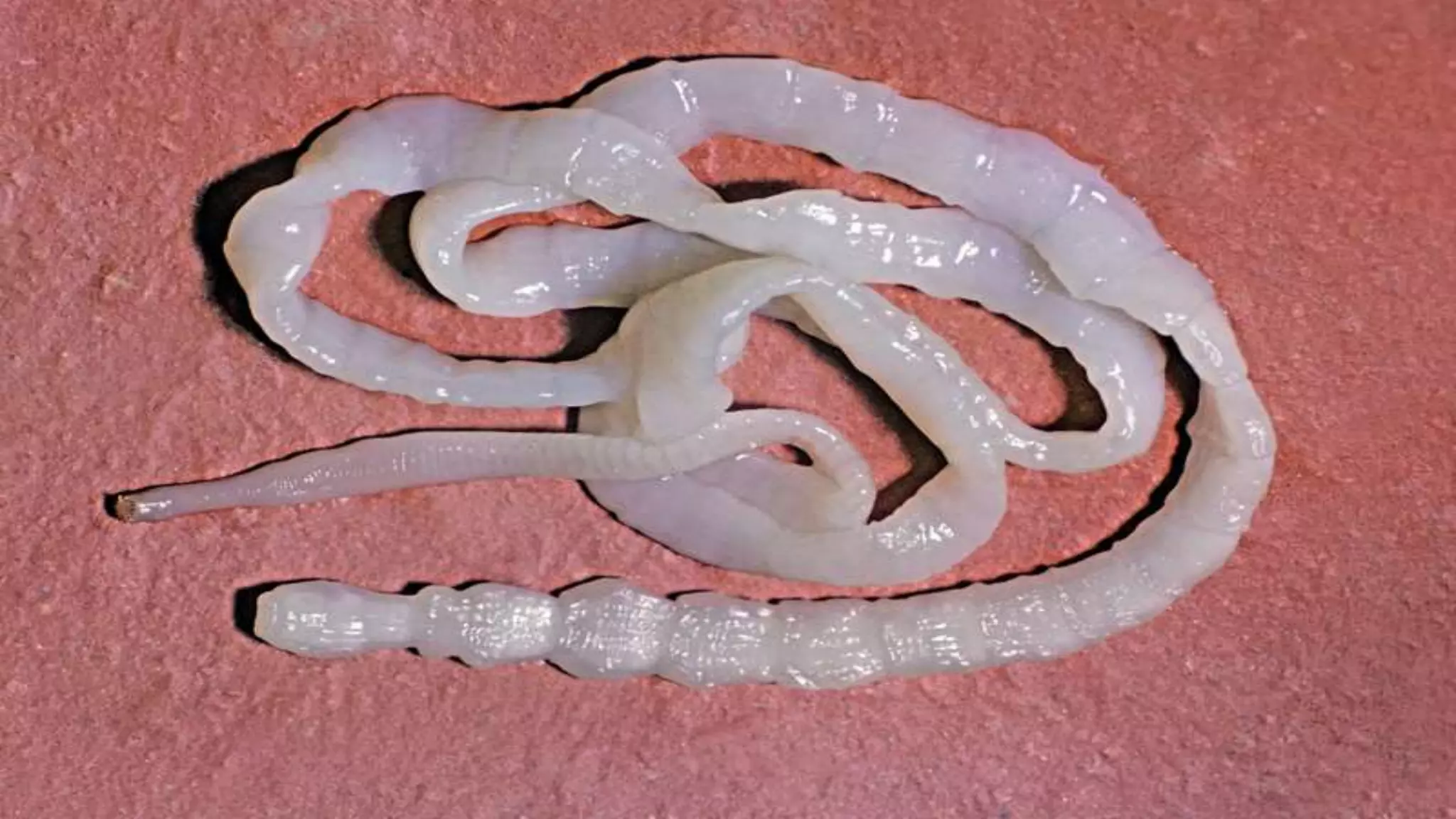
CLASS CESTODA
BODY PARTS
 Scolex
A knob-shaped head with hooks, suckers,
or both, for attachment to the host
 Proglottid
A body section that has a complete
hermaphroditic reproductive system
CLASS CESTODA
Tapeworms lifecycle involves two
hosts:
Cow that eats grass with egg-filled
proglottids
Humans that eat beef (not cooked
enough) with cysts that contain bladder
worms
PHYLUM
NEMATODA
PHYLUM NEMATODA
Nematodes or Roundworms
Abundant in soil
Some are found in fresh and salt water
Others live as parasites
Many are microscopic
PHYLUM NEMATODA
They are cylindrical, unsegmented
worms with bilateral symmetry
They have complete digestive system
They have pseudocoelom
They only reproduce sexually
PHYLUM NEMATODA
Parasitic nematodes cause serious
diseases in human, livestock, pets,
and crops.
Ascaris is one of the most common
parasites of humans
PHYLUM NEMATODA
Pinworms are parasitic roundworms
that commonly infect children.
Trichinella can cause painful illness
and death in humans.
Heterodera causes root knot disease,
which damage garden crops
PHYLUM
MOLLUSCA
PHYLUM MOLLUSCA
 Soft-bodied animal that has a muscular foot
used for locomotion or attachment
 Second largest of all animal phyla
 Mantle = soft outer layer of mollusk body
 Visceral mass = contains most of the internal
organs
 Most are protected by a hard shell
PHYLUM MOLLUSCA
 Some mollusks like oysters and mussels
are sessile
 All mollusks have a complete digestive
system
 Mollusks have nephridia
 Most of them have separate sexes but
some are hermaphrodite
PHYLUM MOLLUSCA
External fertilization
Clams
Internal fertilization
Squid
Certain snails
PHYLUM MOLLUSCA
Classes:
Polyplacophora- Eight overlapping
plates
Gastropods- one piece shell
Bivalvia- two piece shell
Cephalopods- tentacled mollusks
PHYLUM MOLLUSCA
Class Polyplacophora
Chiton
Class Gastropods
Snail, Unshelled slugs
PHYLUM MOLLUSCA
Class Bivalvia
Clams, Mussels, Scallops, Oysters
Class Cephalopods
Squid, Octopus, Cuttlefish
PHYLUM
ANNELIDA
PHYLUM ANNELIDA
 Segmented worms
 Live in freshwater or terrestrial habitat
 Most are marine
 Three classes:
Class Oligochaeta
Class Polychaeta
Class Hirudinea
CLASS OLIGOCHAETES
Have two sets of muscles
Circular- wraps around their body rings
Longitudinal- runs along the length of
their body
They have complete digestive tract
with two opening
CLASS OLIGOCHAETES
 Nephridia- long tubules that excretes
metabolic wastes
 Gas exchange takes place across the skin
 They have closed circulatory system
 Aortic arches- five pairs of enlarged ring
vessels that function as simple heart
CLASS OLIGOCHAETES
 They have small brain and ventral nerve
cord
 They have sensory receptors in the skin
that are sensitive to light, temperature,
moisture, vibrations, and chemicals
 Earthworms are hermaphrodite but cannot
fertilize their own
CLASS POLYCHAETES
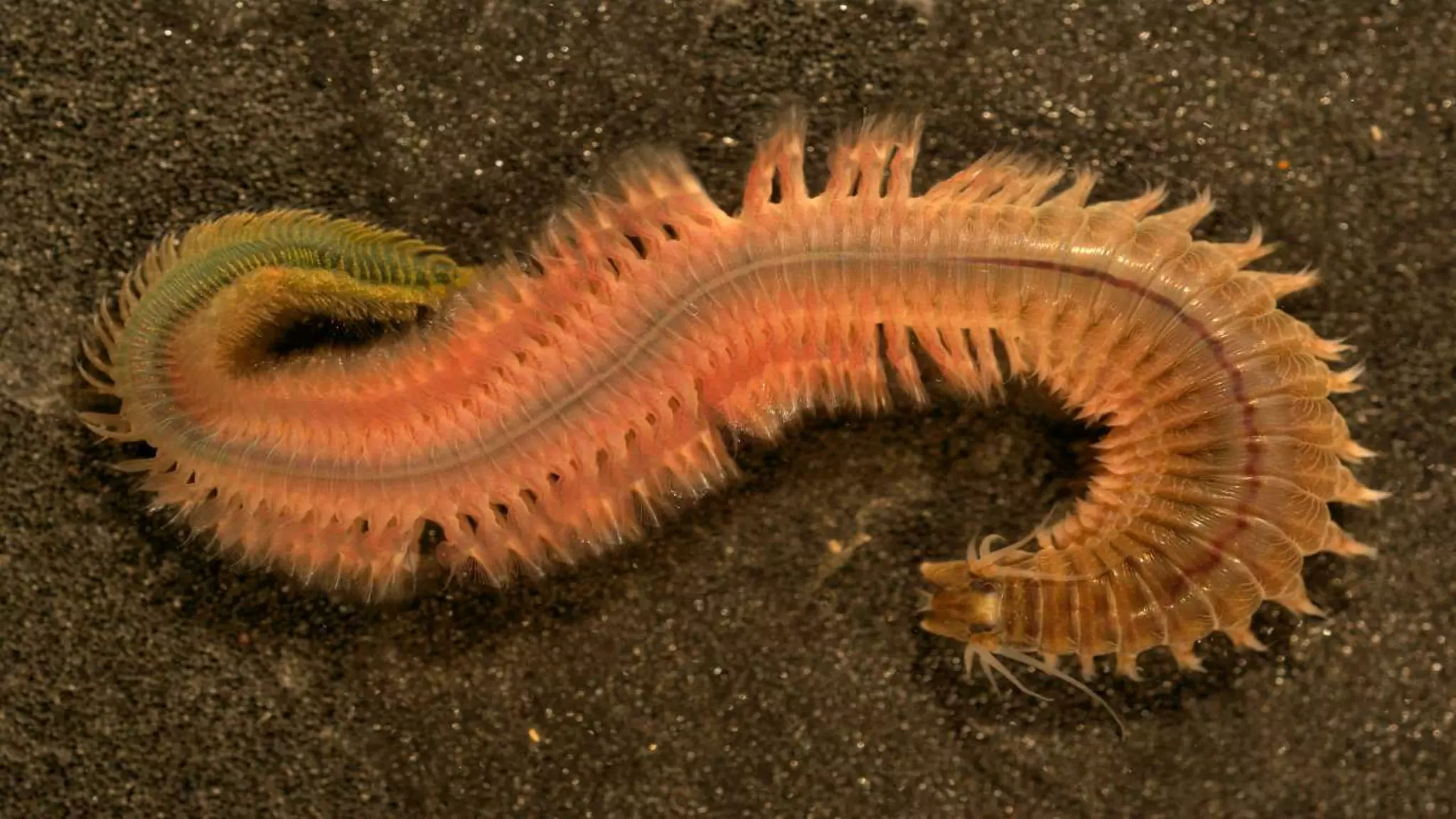
 The oldest and largest class of annelids
 They have a pair of parapodia on most
body segments
 Examples:
Fan worm
Clam worm
CLASS HIRUDINEA
 Lives in freshwater
 Others are marine, land in moist, and
tropical areas
 Many are parasites
 Can grow as long as 30 cm
 Some are predators and scavengers
PHYLUM
ARTHROPODA
PHYLUM ARTHROPODA
 Arthropods make up the largest phylum in the
animal kingdom
 They are segmented and most segments have
paired, jointed appendage
 They have exoskeleton
 They shed their exoskeleton in order to grow
(molting)
PHYLUM ARTHROPODA
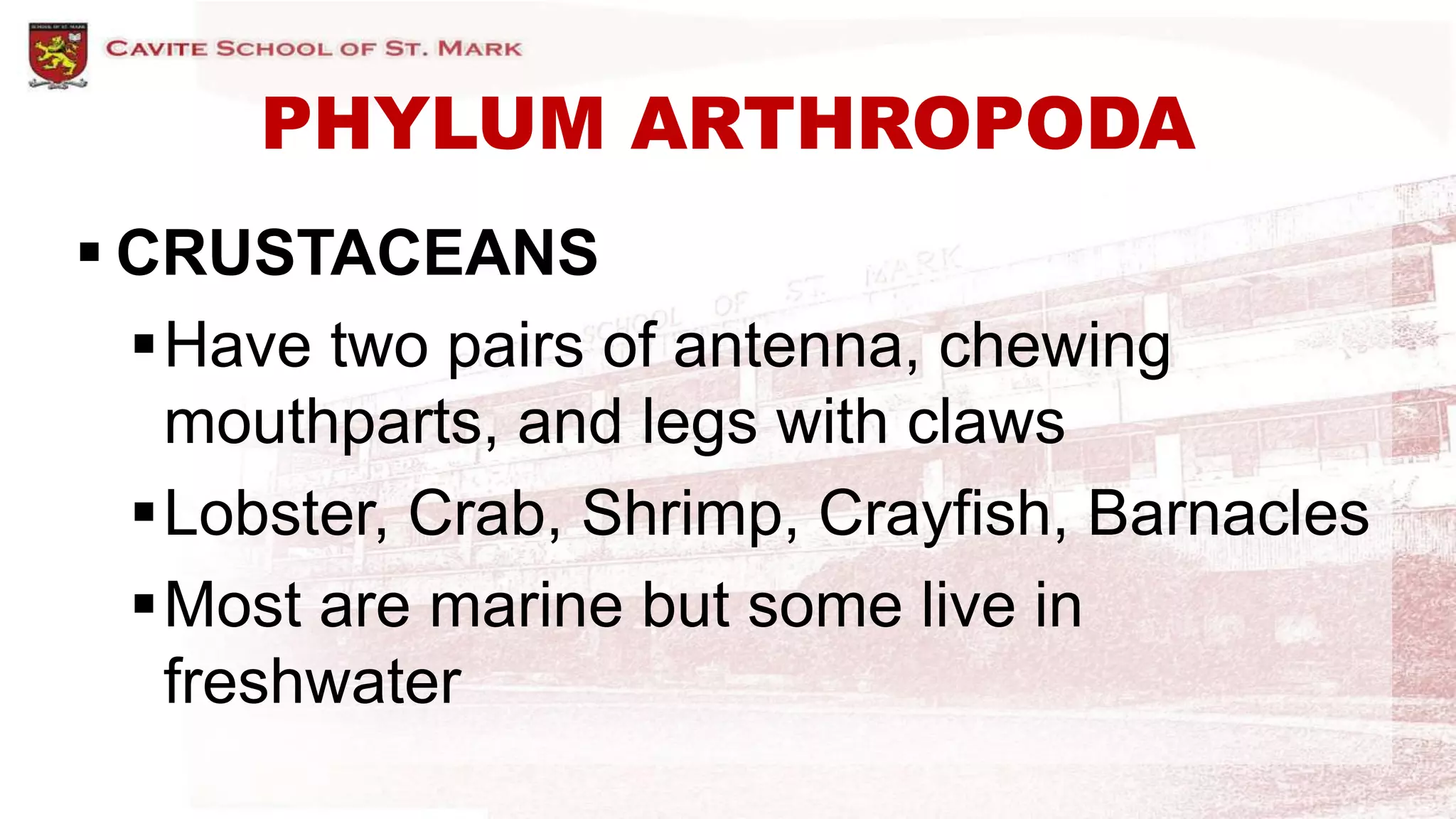
 CRUSTACEANS
Have two pairs of antenna, chewing
mouthparts, and legs with claws
Lobster, Crab, Shrimp, Crayfish, Barnacles
Most are marine but some live in
freshwater
PHYLUM ARTHROPODA
 ARACHNIDS
Terrestrial Arthropods
Scorpions, Spiders, Mites, and Ticks
Two Types of Spiders
Hunting Spiders- With heavy legs and well-
developed eyes
Spider that weave webs- With long and slender
legs and relatively poor eyesight
PHYLUM ARTHROPODA
 INSECTS
More than 75% of all known animal species are
insects
They were the first animals to develop flight
Insects behaviors are instinct
They have predictable patterns based on the
stimuli they sense
PHYLUM ARTHROPODA
 INSECTS
They communicate through touch, sound,
chemicals, and visual signals
Fireflies- light flashes
Crickets and Grasshoppers- rub their wings
Pheromones are chemical signals produced
by many insects in order to communicate
PHYLUM ARTHROPODA
 INSECTS
 Beehive Society System
 Individual honey bees cannot survive on their
own
 Three types of individuals in a beehive
Queen, Drones, and Workers
 Bee dance= way to communicate if a food
source is found
PHYLUM ARTHROPODA
INSECTS
QUEEN- reproduction
DRONE- male bee that mates with
the queen
WORKERS- maintain the hive and
collect foods for the queen and larvae
PHYLUM ARTHROPODA
INSECTS
Many insects have wings and other
have no wings at all
Wings are folded extensions of the
outer layer of the exoskeleton, the
cuticle
PHYLUM
ECHINODERMATA
PHYLUM ECHINODERMATA
 Marine invertebrates characterized by
spiny skin, radial symmetry, water vascular
system, and endoskeleton
 Lack brain or head
 Sea stars feed on mollusks, coral polyps,
and other echinoderms
PHYLUM ECHINODERMATA
 Lost body parts are regenerated by sea stars
 External Fertilization
 Free-swimming bilaterally symmetrical larvae
of sea stars settles to the bottom after two
years of being fertilized and undergoes
metamorphosis to become radially symmetrical
adult
PHYLUM ECHINODERMATA
 Five Classes of Echinodermata
1. Class Asteroidea
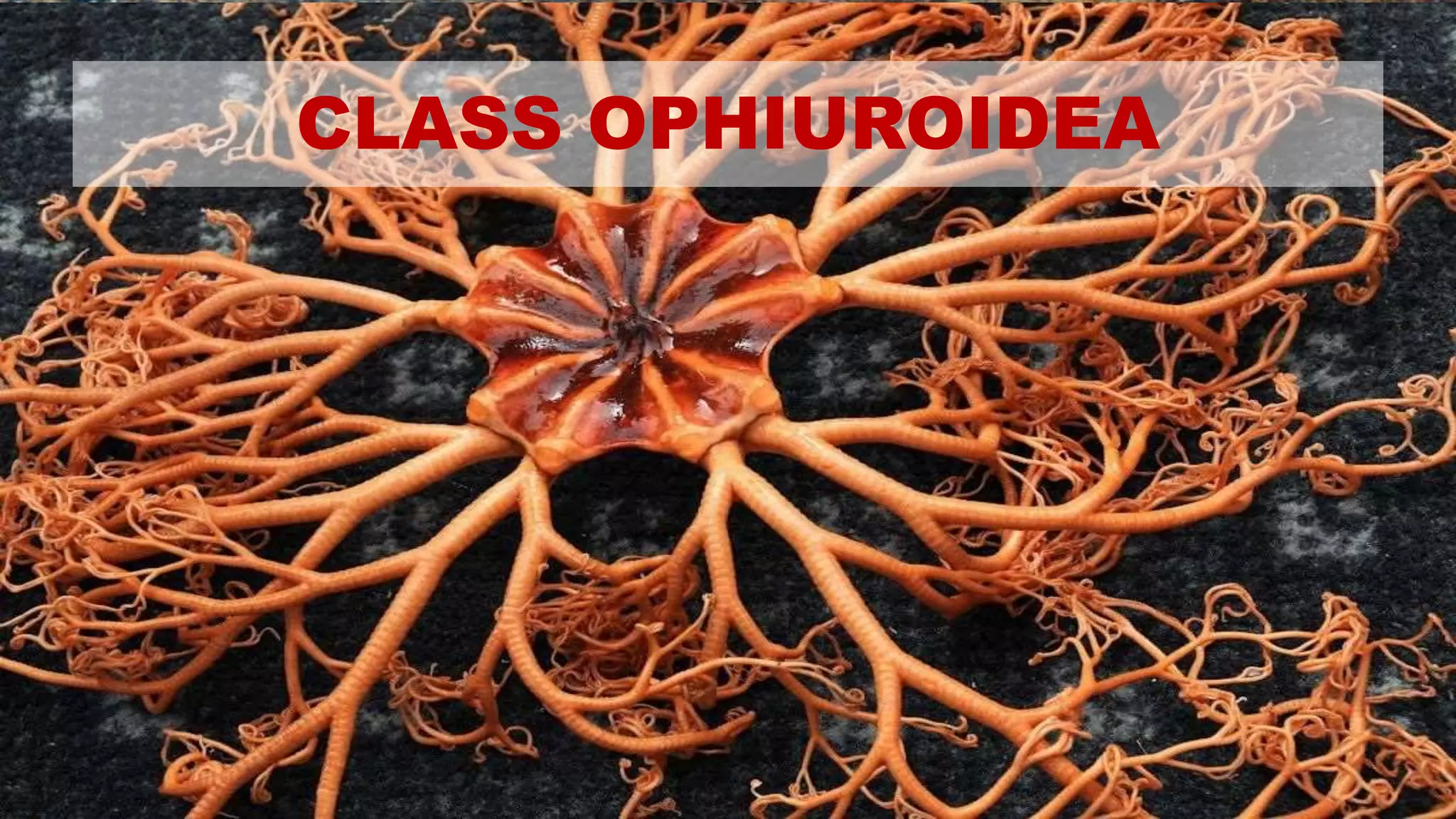
2. Class Ophiuroidea
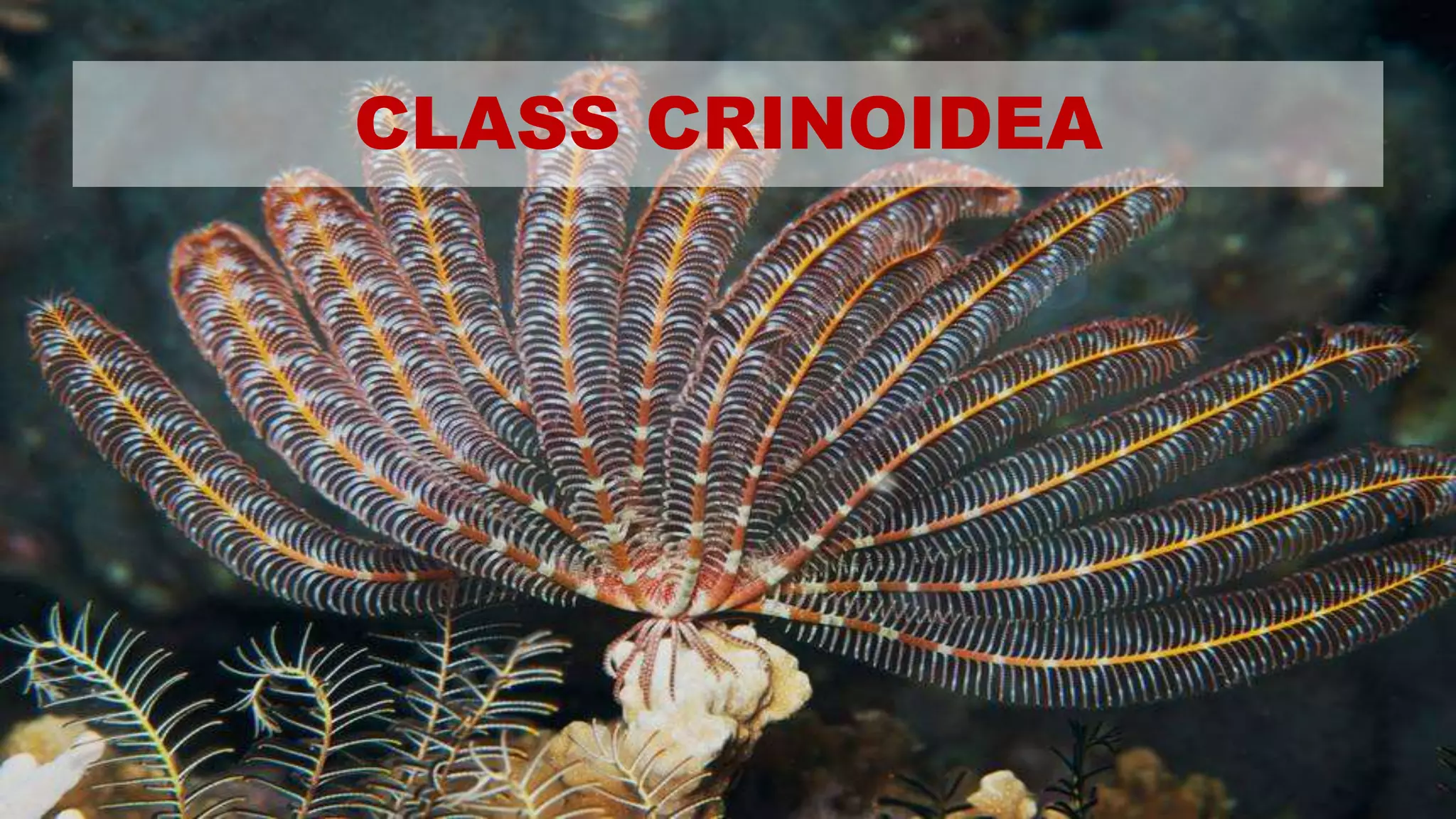
3. Class Crinoidea
4. Class Echinoidea
5. Class Holothuroidea
CLASS ASTEROIDEA
CLASS OPHIUROIDEA
CLASS CRINOIDEA
CLASS ECHINOIDEA
CLASS HOLOTHUROIDEA
PHYLUM
CHORDATA
PHYLUM CHORDATA
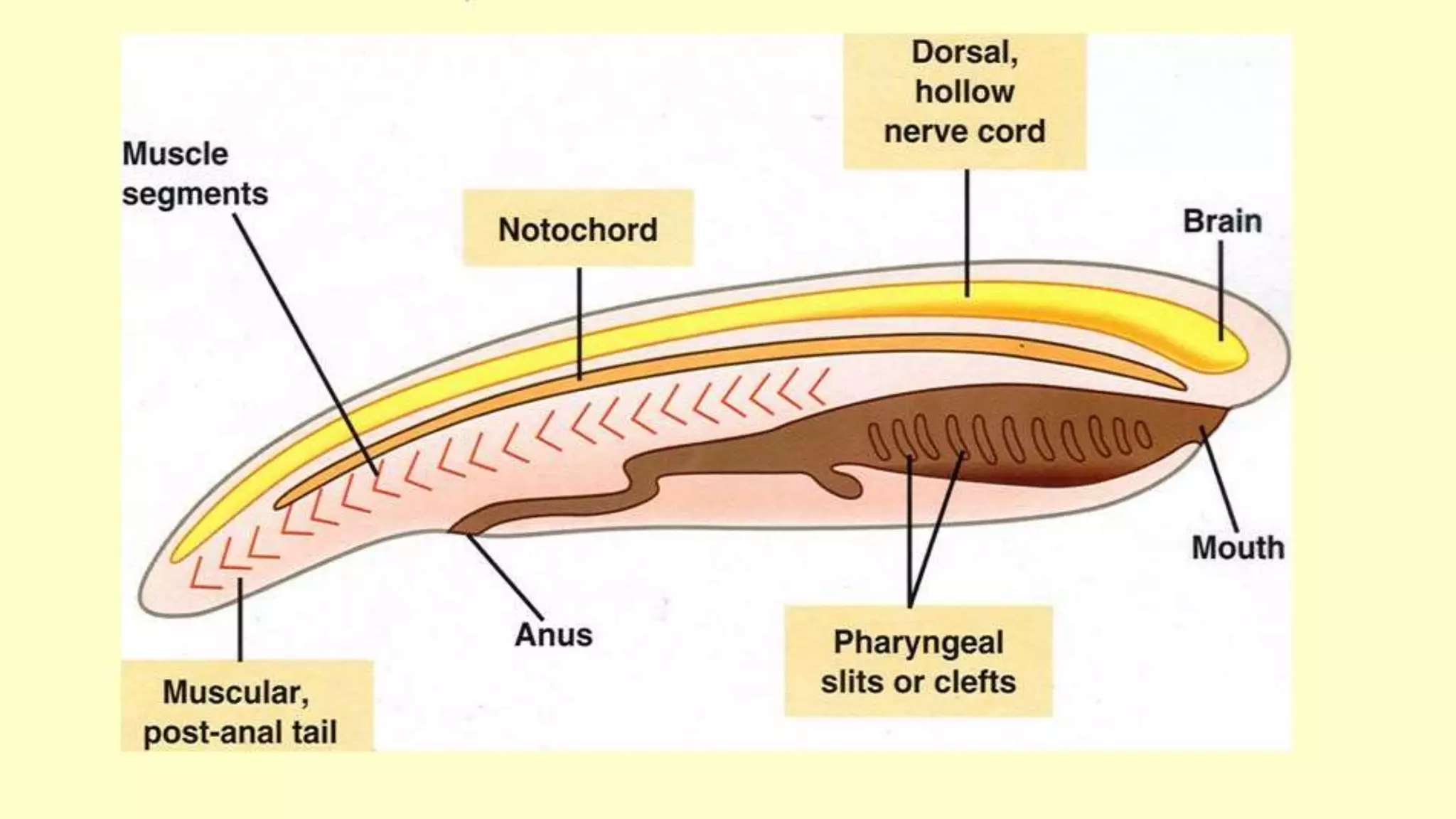
They have four distinct characteristics:
Hollow nerve tube
Notochord
Gill slits
Post-anal tails
PHYLUM CHORDATA
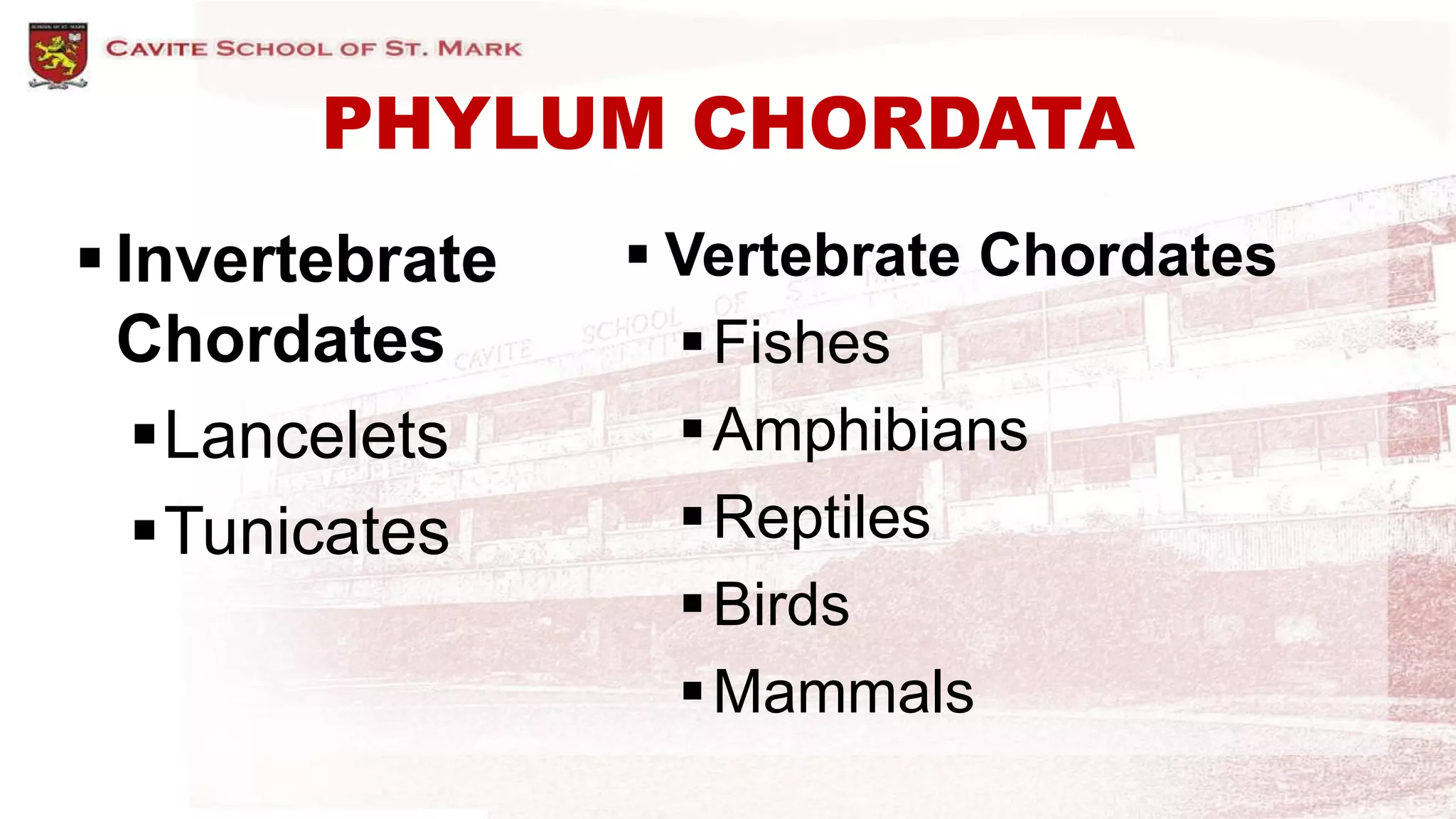
 Invertebrate
Chordates
Lancelets
Tunicates
 Vertebrate Chordates
Fishes
Amphibians
Reptiles
Birds
Mammals
PHYLUM CHORDATA
 VERTEBRATE ANIMALS
Animals with backbones
Notochord -> Backbone
Nerve cord -> Spinal cord and brain
Gill Slits -> Gills or Lungs
Post-anal Tail -> kept throughout life
PHYLUM CHORDATA
 VERTEBRATE ANIMALS
Exhibit a high degree of cephalization
Bilateral symmetry
Close type circulatory system
Complete digestive system
QUIZ#4:
PHYLUM
PLATYHELMINTHES
IDENTIFICATION
1. The body symmetry of flatworms
2. The concentration of sense organs and
ganglia in the head region
3-4. Hosts that tapeworms need in their life
cycle
5-6. Hosts that Schistosoma mansoni need in
their life cycle
IDENTIFICATION
7. The thing that prevents flukes from being
digested by their hosts
8. A knob-shaped head of tapeworms which is
used attachment to the host
9. The number of eggs that proglottids can carry
10. The cells of planarians that remove water
and chemical wastes

Taxonomic Classification

Editor's Notes

  • #4 Archaea frequently called extremophiles and are the novel prokaryotic cells found to date.
  • #26 Saprophytes= obtaining nutrients by absorbing it from dead organisms
  • #42 spicules, which are the sponge’s skeletal fibers
  • #55 CEPHALIZATION- concentration of sense organs and ganglia in the head region
  • #56 Turbellaria= free-living Trematoda and Cestoda= parasitic
  • #59 Flame cells= small bulblike structures that remove water and chemical wastes
  • #60 GANGLIA= brain of planarians
  • #61 Digestive system is simple or lacking
  • #62 SCHISTOSOMIASIS- clog blood vessels, allergic reactions, swelling, damage to internal organs
  • #63 The eggs are expelled from the body with feces If the eggs reach freshwater, hatch and burrow into snails The larvae leave the snail, attach and bore to the human skin until they reach the blood vessel and intestine
  • #66 Proglottids can contain up to 10, 000 zygotes It eventually separates and are shed from the tapeworm to leave the host with the feces
  • #71 Pseudocoelom= fluid-filled body cavity of nematodes
  • #72 Contaminated food, water, or soiled hands
  • #73 They cause annoying itching of the anus Obtained from undercooked pork
  • #75 Visceral mass = found bet. foot and mantle Hard shell made of calcium carbonate
  • #76 NEPHRIDIA- function to excrete metabolic wastes
  • #86 CLITELLUM- It produces most of the material secreted to form earthworm cocoons.  CROP- Temporary storage of soil GIZZARD- where organic matter is freed and broken down
  • #87 Parapodia are leg-like structures used for locomotion, anchoring, and respiration
  • #88 FAN WORM- tube dwellers and have tentacles Tentacles- trap food particles and carry on respiration
  • #91 Have a pair of suckers for attachment The bite doesn't hurt since leeches release an anesthetic when they bite, but due to the anticoagulant, the wounds bleed a fair bit
  • #93 Appendage- body extensions such as legs or antenna Exoskeleton- hard covering made of protein bound by a chitin
  • #96 Insects have automatic behavior coded in their genes
  • #98 Bee dance is done by a honey bee scout
  • #105 SEA STARS
  • #106 BRITTLE STARS, BASKET STARS
  • #107 SEA LILIES, FEATHER STARS
  • #108 SEA URCHINS SAND DOLLARS- produce a harmless substance called echinochrome, which will turn your skin yellow
  • #109 Sea cucumbers can also be eaten raw, pickled or fried. A stream of water often whooshes out of its anus
  • #113 Jawless Fishes, Cartilaginous Fishes, and Bony Fishes