EARTH: THE
LIVING PLANET
LPCNSHS-CAA Campus
G11-STEM
Ms. Jasmine Nikki M. Versoza
LET’S UNLOCK SOME WORDS!
IIOACGNNR
Inorganic: may or may not contain carbon
Examples: salt and carbon dioxide
LET’S UNLOCK SOME WORDS!
Organic: molecules associated with living organisms and
contains carbon and hydrogen
Examples: DNA, sucrose, methane
CAOGNRI
LET’S UNLOCK SOME WORDS!
CNAUUTLAMOIC
Accumulation: gathering or piling
LET’S UNLOCK SOME WORDS!
TRELEPCOA
Percolate: ability of liquid to slowly pass through a filter
THE DIFFERENT TYPES OF ROCKS
Rocks
 They are mixture of one or more minerals, glass,
and sometimes organic matter.
 Some rocks are shiny, some are flat and dull,
others are compact.
 Analyzing these differences can help us
understand how they were formed.
 They can also be defined as a naturally occurring
mass of solid or inorganic materials that formed a
significant part of the earth’s crust.
QUESTION 1
What will happen if
rocks don’t exist?
Types of Rocks
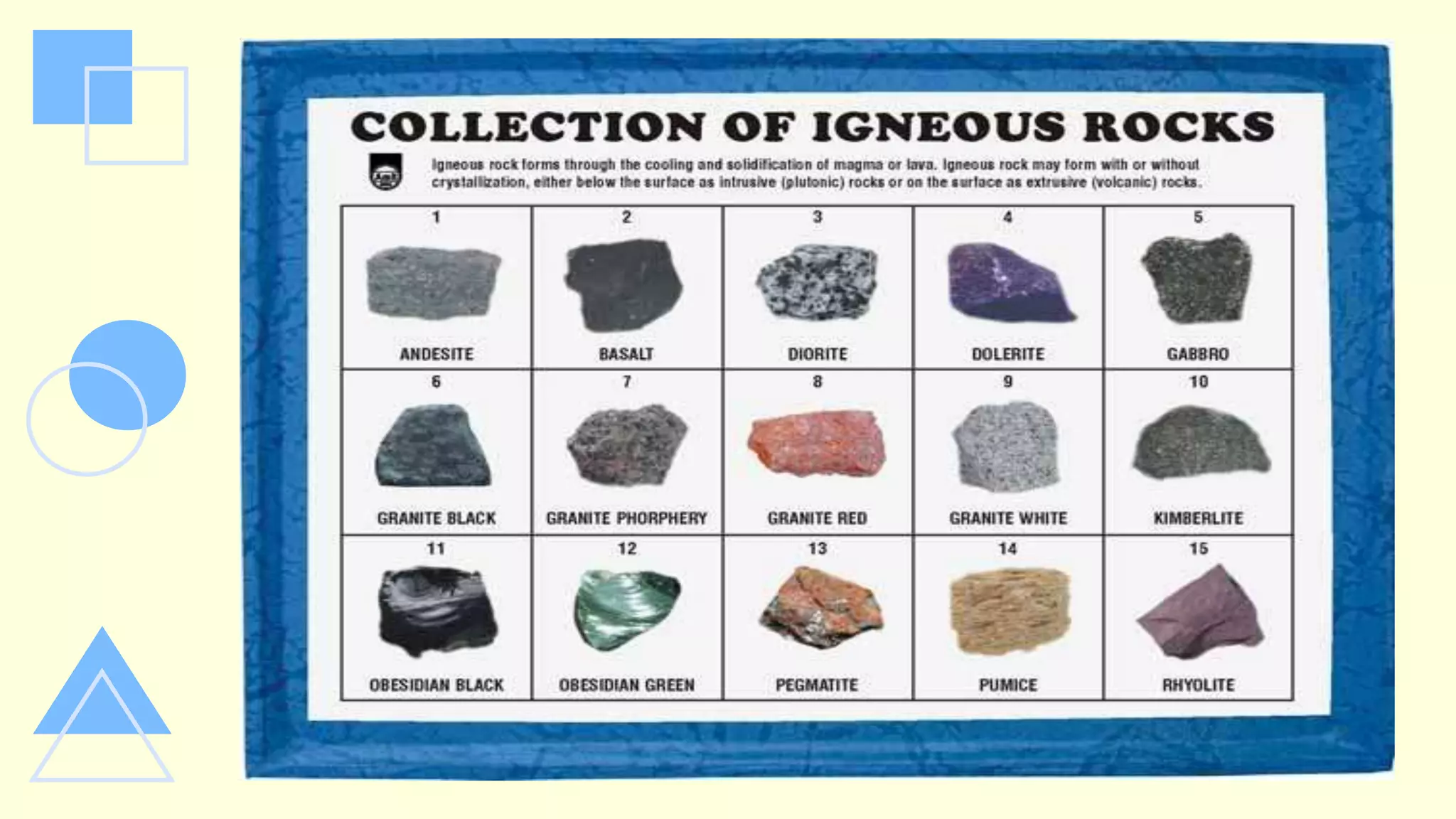
Igneous Rocks
 Also known as the fire-formed rocks
 They are formed from solidified molten
magma, which comes from beneath the
earth’s crust.
 They can be classified according to
texture and mineral constituents.
Types of Rocks
RATE OF COOLING and SIZE OF CRYSTALS
 Slow cooling enables the components of the
rocks to travel at great distances resulting to
the formation of large crystals.
 Rapid cooling results to quick combination
of rock components, thus, forming a solid
mass of small inter-grown crystals.
Types of Rocks
Igneous Rocks
 Extrusive or Volcanic Rock – crystallizes at
the surface (rapid cooling process)
Examples: andesite, basalt, and tuff
 Intrusive or Plutonic Rock – crystallizes
beneath the surface (slow cooling process)
Example: granite
Types of Rocks
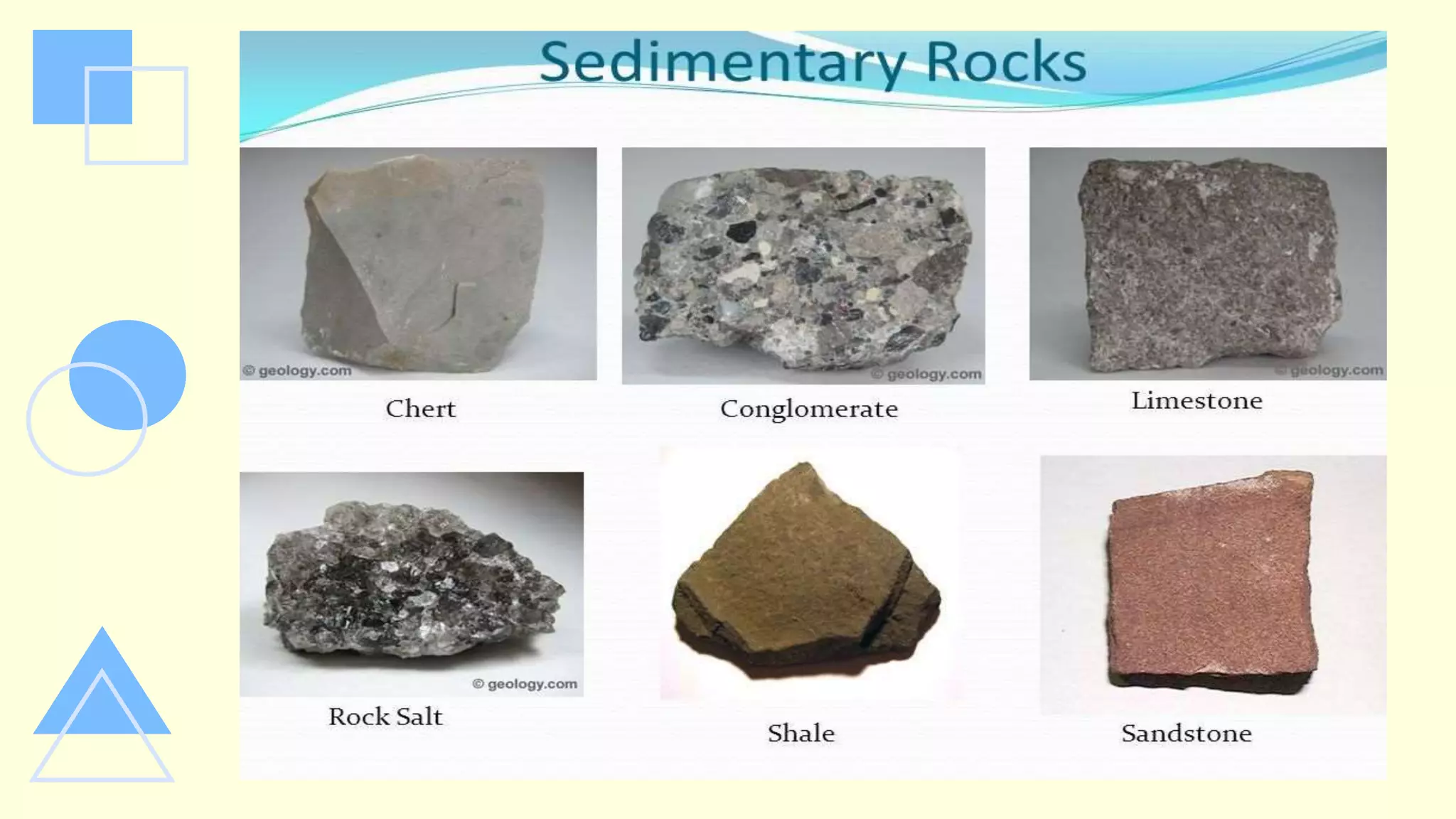
Sedimentary Rocks
 They are formed on or near the Earth’s
surface through the accumulation or
deposition of mineral particles.
 Particle size is very important to the
identification of sedimentary rocks.
Types of Rocks
Weathering and Erosion
 Processes that include the effects of wind
and rain, which slowly break down large
rocks into smaller ones.
 These processes transform boulders and
mountains into sediments, such as sand
or mud.
Types of Rocks
Lithification – the formation of rocks after
undergoing a series of compaction and cementation
of component parts.
 Compaction – as the sediments accumulate, the
pore spaces in between particles are reduced and
pressed closer to one another.
 Cementation – materials are carried in solution by
water which is percolating through the pore spaces
between particles, thus, filling up the open spaces.
Types of Rocks
Metamorphic Rocks
 They undergone transformation
through heat, pressure, or chemical
change.
 As a result, the texture and mineral
composition of the rock has been
changed.
Types of Rocks
Metamophism
 Low grade metamorphism – rock is subjected
to pressure and temperature with slight
lithification.
 High grade metamorphism – rock is subjected
to extreme conditions, that is, close to melting
it.
Rock Cycle
 The rock cycle explains how one type of rock
can be transformed into another in nature.
 Igneous rock can change into sedimentary rock or
metamorphic rock.
 Sedimentary rock can change into metamorphic
rock or igneous rock.
 Metamorphic rock can change into igneous rock or
sedimentary rock.
z
Rock Cycle
magma
sediments
Igneous Rock
Metamorphic Rock Sedimentary Rock
heat and pressure
ROCK COMPOSITION
 Granite is an igneous rock that contains
minerals biotite, quartz and felspar. If 10% of
this rock is biotite and 35% is quartz, what
percentage of the rock is feldspar?
 Limestone is a sedimentary rock containing
aragonite and calcite. If 95% of this rock is
calcite, what percentage is aragonite?
UP NEXT…
 Answer your learning activity
worksheet (LAW) week 4.
 Comment on my post in our fb group.

Types of Rocks

  • 1.
    EARTH: THE LIVING PLANET LPCNSHS-CAACampus G11-STEM Ms. Jasmine Nikki M. Versoza
  • 2.
    LET’S UNLOCK SOMEWORDS! IIOACGNNR Inorganic: may or may not contain carbon Examples: salt and carbon dioxide
  • 3.
    LET’S UNLOCK SOMEWORDS! Organic: molecules associated with living organisms and contains carbon and hydrogen Examples: DNA, sucrose, methane CAOGNRI
  • 4.
    LET’S UNLOCK SOMEWORDS! CNAUUTLAMOIC Accumulation: gathering or piling
  • 5.
    LET’S UNLOCK SOMEWORDS! TRELEPCOA Percolate: ability of liquid to slowly pass through a filter
  • 6.
    THE DIFFERENT TYPESOF ROCKS Rocks  They are mixture of one or more minerals, glass, and sometimes organic matter.  Some rocks are shiny, some are flat and dull, others are compact.  Analyzing these differences can help us understand how they were formed.  They can also be defined as a naturally occurring mass of solid or inorganic materials that formed a significant part of the earth’s crust.
  • 7.
    QUESTION 1 What willhappen if rocks don’t exist?
  • 8.
    Types of Rocks IgneousRocks  Also known as the fire-formed rocks  They are formed from solidified molten magma, which comes from beneath the earth’s crust.  They can be classified according to texture and mineral constituents.
  • 9.
    Types of Rocks RATEOF COOLING and SIZE OF CRYSTALS  Slow cooling enables the components of the rocks to travel at great distances resulting to the formation of large crystals.  Rapid cooling results to quick combination of rock components, thus, forming a solid mass of small inter-grown crystals.
  • 10.
    Types of Rocks IgneousRocks  Extrusive or Volcanic Rock – crystallizes at the surface (rapid cooling process) Examples: andesite, basalt, and tuff  Intrusive or Plutonic Rock – crystallizes beneath the surface (slow cooling process) Example: granite
  • 12.
    Types of Rocks SedimentaryRocks  They are formed on or near the Earth’s surface through the accumulation or deposition of mineral particles.  Particle size is very important to the identification of sedimentary rocks.
  • 14.
    Types of Rocks Weatheringand Erosion  Processes that include the effects of wind and rain, which slowly break down large rocks into smaller ones.  These processes transform boulders and mountains into sediments, such as sand or mud.
  • 15.
    Types of Rocks Lithification– the formation of rocks after undergoing a series of compaction and cementation of component parts.  Compaction – as the sediments accumulate, the pore spaces in between particles are reduced and pressed closer to one another.  Cementation – materials are carried in solution by water which is percolating through the pore spaces between particles, thus, filling up the open spaces.
  • 16.
    Types of Rocks MetamorphicRocks  They undergone transformation through heat, pressure, or chemical change.  As a result, the texture and mineral composition of the rock has been changed.
  • 17.
    Types of Rocks Metamophism Low grade metamorphism – rock is subjected to pressure and temperature with slight lithification.  High grade metamorphism – rock is subjected to extreme conditions, that is, close to melting it.
  • 19.
    Rock Cycle  Therock cycle explains how one type of rock can be transformed into another in nature.  Igneous rock can change into sedimentary rock or metamorphic rock.  Sedimentary rock can change into metamorphic rock or igneous rock.  Metamorphic rock can change into igneous rock or sedimentary rock.
  • 20.
    z Rock Cycle magma sediments Igneous Rock MetamorphicRock Sedimentary Rock heat and pressure
  • 21.
    ROCK COMPOSITION  Graniteis an igneous rock that contains minerals biotite, quartz and felspar. If 10% of this rock is biotite and 35% is quartz, what percentage of the rock is feldspar?  Limestone is a sedimentary rock containing aragonite and calcite. If 95% of this rock is calcite, what percentage is aragonite?
  • 22.
    UP NEXT…  Answeryour learning activity worksheet (LAW) week 4.  Comment on my post in our fb group.