Chapter 2.
CLASIFICATON OF
ORGANISM
By: Ms. Faradis Ulyah, S.Pd.
Basic Competence
3.2. Memahami prosedur pengklasifikasian makhluk hidup dan benda-benda tak hidup sebagai bagian kerja
ilmiah, serta mengklasifikasikan berbagai makhluk hidup dan benda-benda tak hidup berdasarkan ciri yang
diamati
4.2 Mengumpulkan data dan melakukan klasifikasi terhadap benda-benda, tumbuhan dan hewan yang ada di
lingkungan sekitar.
DO YOU
BELIEVE?
The land can expand by
itself?
DO YOU KNOW?
Biotic components Abiotic components
Humans
Animals
Plants
Microorganism
Land
Water
Air
Sunlight
Topography
Climate
THE
CHARACTERISTICS
OF LIVING
ORGANISM
8 Characteristics of Living Organism
1. Movement
2. Respiration
3. Nutrition
4. Growth
5. Reproduction
6. Excretion
7. Irritability
8. Adaptation
1. MOVEMENT
2. RESPIRATION
Breathing is a process of inhaling oxygen (O2) from the surrounding which will
be used to oxidize food nutrients in body cells to produce energy and release
carbon dioxide (CO2) and water vapour (H2O). The energy produced from
oxidation is used from many activities/ life activities
Reaksi Oksidasi
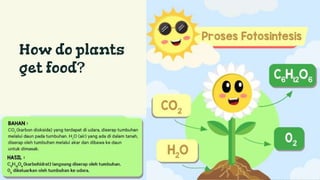
3. NUTRITION
How do plants
get food?
4. GROWTH
5. REPRODUCTION
Reproduction is the biological process by
which new individual organisms – "offspring" –
are produced from their "parent" or parents.
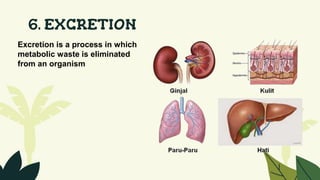
6. EXCRETION
Excretion is a process in which
metabolic waste is eliminated
from an organism
7. IRRITABILITY
Irritability is
that characteristic of
living organisms in
being aware of, and
being able to respond
to, a stimulus which
tends to disturb the
steady state or
homeostasis which all
organisms prefer for
maintaining life.
8. ADAPTATION
Adaptation is the evolutionary process whereby an
organism becomes better able to live in its habitat
or habitats.
The Different Characteristics
Between Animals And Plants
CLASSIFICATION
OF LIVING THINGS
A classification is a division or
category in a system which
divides things into groups or
types
Aristoteles(384 BC-322 BC) was a Greek philosopher. He
classified organism as follows:
• Animals, consisting of ‘blooded animals’ and ‘non-blooded
animals’ (such as, insects whose blood is not red)
• Plants, consisting of: Herbs, Shrubs and Trees
HISTORY OF CLASSIFICATION
The well-known classification figures are,
among others,
Aristoteles,
Carolus Linnaeus,and
RH. Whittaker.
HISTORY OF CLASSIFICATION
The person who first coined the basics of
classification was Carolus Linnaeus,
a Swedish biologist. He tried to classify
living things into two major groups;
animals and plants. These two groups,
eventually became a kingdom called
Animalia (animals) and
Plantae (plants).
Linnaeus continued his classification from the largest to the smaller ranks.
Animalia= Kingdom ->Phylum -> Class -> Order -> Family -> Genus -> Species
Plantae = Kingdom -> Division -> Class -> Order -> Family -> Genus -> Species
CLASSIFICATION OF LIVING THING
HISTORY OF CLASSIFICATION
Whittaker explained the classification of organism
based on the following:
1) The existence of nucleus membrane (prokaryote/
eukaryote)
2) How to get nutrition methods (autotrof/
heterotroph)
3) Number of cells forming body (unicellular/
multicellular)
4) Reproduction method
Then, in 1969, Robert H Whittaker proposed a 5
kingdom classification system.
Kingdom is no longer limited to Animalia and
Plantae, but also Monera, Protista, Fungi.
Robert H Whittaker
Types of Microscope
Venus has a beautiful
name and is the second
planet from the Sun
MICROSCOPE FOR OBSERVING MICROORGANISM
PARTS OF MICROSCOPE AND THEIR FUNCTIONS
How to use microscope?
ANIMALIA KINGDOM
In the 5 kingdom classification system, animals are
classified into the kingdom Animalia
General characteristic of the members of animalia kingdom are as
follows:
a. Nukleus covered by membrane (eukayote)
b. Obtaining food by hunting other organism (heterotroph)
c. Composed by more than one cells (multicellular)
d. Reproducing asexually and sexually
ANIMALIA KINGDOM
In the 5 kingdom classification system, animals are
classified into the kingdom Animalia
Based on the ownership of the spine, this kingdom is divided into two
groups, namely invertebrates that do not have a backbone and
vertebrates that have a backbone.
ANIMALIA KINGDOM
Avertebrata
1. Porifera (porous animal)
The examples of Porifera are Euspongia sp, red sponge and sponge coral
ANIMALIA KINGDOM
Avertebrata
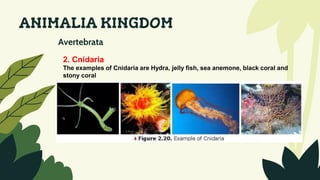
2. Cnidaria
The examples of Cnidaria are Hydra, jelly fish, sea anemone, black coral and
stony coral
ANIMALIA KINGDOM
Avertebrata
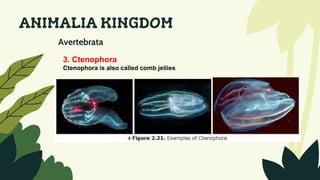
3. Ctenophora
Ctenophora is also called comb jellies
ANIMALIA KINGDOM
Avertebrata
4. Platyhelminthes (Flatworms)
Flatworms do not have legs and frame, their body is flattened and does not
have the digestive tract. Their life as parasite, such as tapeworms and liver
flukes, but some of them live free in fresh water, such as Planaria.
ANIMALIA KINGDOM
Avertebrata
5. Nematoda (Roundworms)
Roundworms have elliptical body (cilinder). They generally live as parasite
and cause disease in their host body. The examples are ascaris, hookworm,
and pinworm.
ANIMALIA KINGDOM
Avertebrata
6. Annelida (Segmented worms)
Annelids have segmented body, some of them have a kind of legs and they
live in land and sea habitats. The examples are earthworms, leeches, slug and
Neires virens.
ANIMALIA KINGDOM
Avertebrata
7. Mollusca (soft animals)
Mollusca have soft body and are generally protected by shell composed of
calcium, their body has a gland which produces slime.
ANIMALIA KINGDOM
Avertebrata
8. Echinodermata (spiny-skinned animals)
Echinoderm have spiny covering body, external skeleton (exoskeleton), do
not have head, move by using feet called ambulacral, namely tube feet with
suckers, and they are found in sea habitat.
ANIMALIA KINGDOM
Avertebrata
9. Arthropoda (animals with jointed legs)
Based on the number of their legs, Arthropod is classified into 4 classes:
a. Insect, having 6 legs
b. Arachnida (spiders), having 8 legs
c. Crustacea (shrimps), having 10 legs
d. Myriapoda (centipedes), having more than 10 legs
ANIMALIA KINGDOM
Avertebrata
9. Arthropoda (animals with jointed legs)
MONERA KINGDOM
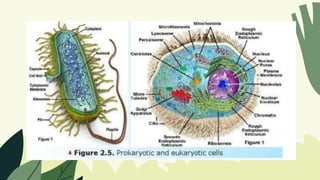
The characteristics of Monera are single-celled (unicellular body),
the cells do not have a nuclear membrane (prokaryotic), the cell
nucleus of bacteria is called nukleosom and the way of reproduction
is by dividing. Classified as heterotroph organism because it obtains
nutrition by decomposing organic compounds (as decomposer)
Living things
belonging to
Monera are
bacteria and
blue-green
algae.
MONERA KINGDOM
Based on its form, bacteria can classified into 3, namely coccus
(spherical), bacillus (rod-shapes) and spirillum (spiral).
MONERA KINGDOM
Advantageous bacteria, such as:
Escheria coli Lactobacillus bulgaricus
which help the decomposition of
food waste in our colon
which help to transform milk
into yoghurt
MONERA KINGDOM
There are also harmsless bacteria living as parasite, such as:
Myobacterium tuberculosis Clostridium tetani
which cause TBC which cause tetanus
PROTISTA KINGDOM
Kingdom Protista has a nuclear membrane (eukaryotic). The size is quite
diverse. Ranging from microscopic to macroscopic.
The characteristics of the kingdom
Protista are quite diverse.
• Eukaryote
• There are some living things
that are single-celled, and some
are multi-celled.
• Some are animal-like (cannot
make their own food), some are
plant-like (able to make their
own food), and some are
mushroom-like.
• It reproduces by duplicating
itself.
PROTISTA KINGDOM
Protista kingdom is classified into three groups, namely Protozoa (animal-like),
Algae (plant-like) and Slime molds (Myxomycetes)
PROTOZOA
a) Rhizophoda (pseudopod)
b) Flagellata (flagellum)
c) Ciliata (cilia)
d) Sporozoa (immobile)
PROTISTA KINGDOM
ALGAE
a) Green algae (Chlorophyta)
b) Golden algae (Chrysophyta)
c) Brown algae (Phaeophyta)
d) Red algae (Rhodophyta)
PROTISTA KINGDOM
SLIME FUNGUS
The examples of fungus-like protists are plasmodial slime molds and aquatic
fungi. Plasmodial slime molds (Myxomycetes) reproduce by spores just like
Fungi. Aquatic fungi produce spores called oospores and they can grow to
new hypha.
FUNGI KINGDOM
Characteristic of fungi are:
● Eukaryote
● Fungi are single-celled and
multi-celled
● Reproducing by spores
● Heterotroph organism
● Living in moist area, not having
chlorophyll and the cell wall
composed of chitin
● Breeding is done generative and
vegetative.
● the body consists of fine
threads (hyphae) which will
then form a weave called
mycelium.
FUNGI KINGDOM
Based on its sexual reproductive
system, fungi are classified into 4
groups, namely:
a. Zygomycota, reproduction
sexually by zygospore
b. Basidiomicota, reproducing
sexually by basidiospore
c. Ascomycota, reproducing
sexually by ascospore
d. Deuteromycota, the sexual
reproduction method is yet
unknown.
PLANTAE KINGDOM
Kingdom Plantae, based on the presence or absence of
transport vessels is divided into two:
1. Vascular plants
2. Non-vascular plants
PLANTAE KINGDOM
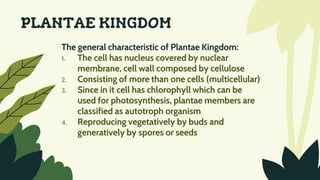
The general characteristic of Plantae Kingdom:
1. The cell has nucleus covered by nuclear
membrane, cell wall composed by cellulose
2. Consisting of more than one cells (multicellular)
3. Since in it cell has chlorophyll which can be
used for photosynthesis, plantae members are
classified as autotroph organism
4. Reproducing vegetatively by buds and
generatively by spores or seeds
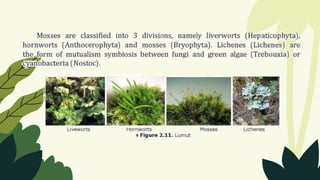
Mosses (Bryophyta)
Ferns (Pteridophyta)
Seed Plants (Spermatophyta)
Based on the location of their seeds, seed plants are divided into 2 groups,
namely:
1. Open Seed Plants (Gymnospermae)
2. Closed Seed Plants (Angiospermae)
Open Seed Plants (Gymnospermae)
Seed Plants (Spermatophyta)
Closed Seed Plants (Angiospermae)
Monocotyledons
Seed Plants (Spermatophyta)
Closed Seed Plants (Angiospermae)
Dicotyledons
CLASSIFICATION
A rainforest is characterized by towering, generally
evergreen trees and heavy rainfall. Despite covering
only 6% of the Earth's surface, they are immensely
diverse and complex, including more than half of
the world's plant and animal species

Chapter 2 - 7th Grade.pptx

  • 1.
  • 2.
    Basic Competence 3.2. Memahamiprosedur pengklasifikasian makhluk hidup dan benda-benda tak hidup sebagai bagian kerja ilmiah, serta mengklasifikasikan berbagai makhluk hidup dan benda-benda tak hidup berdasarkan ciri yang diamati 4.2 Mengumpulkan data dan melakukan klasifikasi terhadap benda-benda, tumbuhan dan hewan yang ada di lingkungan sekitar.
  • 3.
    DO YOU BELIEVE? The landcan expand by itself?
  • 4.
    DO YOU KNOW? Bioticcomponents Abiotic components Humans Animals Plants Microorganism Land Water Air Sunlight Topography Climate
  • 5.
  • 6.
    8 Characteristics ofLiving Organism 1. Movement 2. Respiration 3. Nutrition 4. Growth 5. Reproduction 6. Excretion 7. Irritability 8. Adaptation
  • 7.
  • 8.
    2. RESPIRATION Breathing isa process of inhaling oxygen (O2) from the surrounding which will be used to oxidize food nutrients in body cells to produce energy and release carbon dioxide (CO2) and water vapour (H2O). The energy produced from oxidation is used from many activities/ life activities Reaksi Oksidasi
  • 9.
  • 10.
  • 11.
  • 12.
    5. REPRODUCTION Reproduction isthe biological process by which new individual organisms – "offspring" – are produced from their "parent" or parents.
  • 13.
    6. EXCRETION Excretion isa process in which metabolic waste is eliminated from an organism
  • 14.
    7. IRRITABILITY Irritability is thatcharacteristic of living organisms in being aware of, and being able to respond to, a stimulus which tends to disturb the steady state or homeostasis which all organisms prefer for maintaining life.
  • 15.
    8. ADAPTATION Adaptation isthe evolutionary process whereby an organism becomes better able to live in its habitat or habitats.
  • 16.
  • 18.
    CLASSIFICATION OF LIVING THINGS Aclassification is a division or category in a system which divides things into groups or types
  • 19.
    Aristoteles(384 BC-322 BC)was a Greek philosopher. He classified organism as follows: • Animals, consisting of ‘blooded animals’ and ‘non-blooded animals’ (such as, insects whose blood is not red) • Plants, consisting of: Herbs, Shrubs and Trees HISTORY OF CLASSIFICATION The well-known classification figures are, among others, Aristoteles, Carolus Linnaeus,and RH. Whittaker.
  • 20.
    HISTORY OF CLASSIFICATION Theperson who first coined the basics of classification was Carolus Linnaeus, a Swedish biologist. He tried to classify living things into two major groups; animals and plants. These two groups, eventually became a kingdom called Animalia (animals) and Plantae (plants). Linnaeus continued his classification from the largest to the smaller ranks. Animalia= Kingdom ->Phylum -> Class -> Order -> Family -> Genus -> Species Plantae = Kingdom -> Division -> Class -> Order -> Family -> Genus -> Species
  • 21.
  • 22.
    HISTORY OF CLASSIFICATION Whittakerexplained the classification of organism based on the following: 1) The existence of nucleus membrane (prokaryote/ eukaryote) 2) How to get nutrition methods (autotrof/ heterotroph) 3) Number of cells forming body (unicellular/ multicellular) 4) Reproduction method Then, in 1969, Robert H Whittaker proposed a 5 kingdom classification system. Kingdom is no longer limited to Animalia and Plantae, but also Monera, Protista, Fungi. Robert H Whittaker
  • 24.
    Types of Microscope Venushas a beautiful name and is the second planet from the Sun MICROSCOPE FOR OBSERVING MICROORGANISM
  • 26.
    PARTS OF MICROSCOPEAND THEIR FUNCTIONS
  • 27.
    PARTS OF MICROSCOPEAND THEIR FUNCTIONS
  • 28.
    How to usemicroscope?
  • 29.
    How to usemicroscope?
  • 30.
    ANIMALIA KINGDOM In the5 kingdom classification system, animals are classified into the kingdom Animalia General characteristic of the members of animalia kingdom are as follows: a. Nukleus covered by membrane (eukayote) b. Obtaining food by hunting other organism (heterotroph) c. Composed by more than one cells (multicellular) d. Reproducing asexually and sexually
  • 31.
    ANIMALIA KINGDOM In the5 kingdom classification system, animals are classified into the kingdom Animalia Based on the ownership of the spine, this kingdom is divided into two groups, namely invertebrates that do not have a backbone and vertebrates that have a backbone.
  • 32.
    ANIMALIA KINGDOM Avertebrata 1. Porifera(porous animal) The examples of Porifera are Euspongia sp, red sponge and sponge coral
  • 33.
    ANIMALIA KINGDOM Avertebrata 2. Cnidaria Theexamples of Cnidaria are Hydra, jelly fish, sea anemone, black coral and stony coral
  • 34.
  • 35.
    ANIMALIA KINGDOM Avertebrata 4. Platyhelminthes(Flatworms) Flatworms do not have legs and frame, their body is flattened and does not have the digestive tract. Their life as parasite, such as tapeworms and liver flukes, but some of them live free in fresh water, such as Planaria.
  • 36.
    ANIMALIA KINGDOM Avertebrata 5. Nematoda(Roundworms) Roundworms have elliptical body (cilinder). They generally live as parasite and cause disease in their host body. The examples are ascaris, hookworm, and pinworm.
  • 37.
    ANIMALIA KINGDOM Avertebrata 6. Annelida(Segmented worms) Annelids have segmented body, some of them have a kind of legs and they live in land and sea habitats. The examples are earthworms, leeches, slug and Neires virens.
  • 38.
    ANIMALIA KINGDOM Avertebrata 7. Mollusca(soft animals) Mollusca have soft body and are generally protected by shell composed of calcium, their body has a gland which produces slime.
  • 39.
    ANIMALIA KINGDOM Avertebrata 8. Echinodermata(spiny-skinned animals) Echinoderm have spiny covering body, external skeleton (exoskeleton), do not have head, move by using feet called ambulacral, namely tube feet with suckers, and they are found in sea habitat.
  • 40.
    ANIMALIA KINGDOM Avertebrata 9. Arthropoda(animals with jointed legs) Based on the number of their legs, Arthropod is classified into 4 classes: a. Insect, having 6 legs b. Arachnida (spiders), having 8 legs c. Crustacea (shrimps), having 10 legs d. Myriapoda (centipedes), having more than 10 legs
  • 41.
    ANIMALIA KINGDOM Avertebrata 9. Arthropoda(animals with jointed legs)
  • 42.
    MONERA KINGDOM The characteristicsof Monera are single-celled (unicellular body), the cells do not have a nuclear membrane (prokaryotic), the cell nucleus of bacteria is called nukleosom and the way of reproduction is by dividing. Classified as heterotroph organism because it obtains nutrition by decomposing organic compounds (as decomposer) Living things belonging to Monera are bacteria and blue-green algae.
  • 43.
    MONERA KINGDOM Based onits form, bacteria can classified into 3, namely coccus (spherical), bacillus (rod-shapes) and spirillum (spiral).
  • 44.
    MONERA KINGDOM Advantageous bacteria,such as: Escheria coli Lactobacillus bulgaricus which help the decomposition of food waste in our colon which help to transform milk into yoghurt
  • 45.
    MONERA KINGDOM There arealso harmsless bacteria living as parasite, such as: Myobacterium tuberculosis Clostridium tetani which cause TBC which cause tetanus
  • 46.
    PROTISTA KINGDOM Kingdom Protistahas a nuclear membrane (eukaryotic). The size is quite diverse. Ranging from microscopic to macroscopic. The characteristics of the kingdom Protista are quite diverse. • Eukaryote • There are some living things that are single-celled, and some are multi-celled. • Some are animal-like (cannot make their own food), some are plant-like (able to make their own food), and some are mushroom-like. • It reproduces by duplicating itself.
  • 47.
    PROTISTA KINGDOM Protista kingdomis classified into three groups, namely Protozoa (animal-like), Algae (plant-like) and Slime molds (Myxomycetes) PROTOZOA a) Rhizophoda (pseudopod) b) Flagellata (flagellum) c) Ciliata (cilia) d) Sporozoa (immobile)
  • 48.
    PROTISTA KINGDOM ALGAE a) Greenalgae (Chlorophyta) b) Golden algae (Chrysophyta) c) Brown algae (Phaeophyta) d) Red algae (Rhodophyta)
  • 49.
    PROTISTA KINGDOM SLIME FUNGUS Theexamples of fungus-like protists are plasmodial slime molds and aquatic fungi. Plasmodial slime molds (Myxomycetes) reproduce by spores just like Fungi. Aquatic fungi produce spores called oospores and they can grow to new hypha.
  • 50.
    FUNGI KINGDOM Characteristic offungi are: ● Eukaryote ● Fungi are single-celled and multi-celled ● Reproducing by spores ● Heterotroph organism ● Living in moist area, not having chlorophyll and the cell wall composed of chitin ● Breeding is done generative and vegetative. ● the body consists of fine threads (hyphae) which will then form a weave called mycelium.
  • 51.
    FUNGI KINGDOM Based onits sexual reproductive system, fungi are classified into 4 groups, namely: a. Zygomycota, reproduction sexually by zygospore b. Basidiomicota, reproducing sexually by basidiospore c. Ascomycota, reproducing sexually by ascospore d. Deuteromycota, the sexual reproduction method is yet unknown.
  • 52.
    PLANTAE KINGDOM Kingdom Plantae,based on the presence or absence of transport vessels is divided into two: 1. Vascular plants 2. Non-vascular plants
  • 53.
    PLANTAE KINGDOM The generalcharacteristic of Plantae Kingdom: 1. The cell has nucleus covered by nuclear membrane, cell wall composed by cellulose 2. Consisting of more than one cells (multicellular) 3. Since in it cell has chlorophyll which can be used for photosynthesis, plantae members are classified as autotroph organism 4. Reproducing vegetatively by buds and generatively by spores or seeds
  • 54.
  • 56.
  • 57.
    Seed Plants (Spermatophyta) Basedon the location of their seeds, seed plants are divided into 2 groups, namely: 1. Open Seed Plants (Gymnospermae) 2. Closed Seed Plants (Angiospermae) Open Seed Plants (Gymnospermae)
  • 58.
    Seed Plants (Spermatophyta) ClosedSeed Plants (Angiospermae) Monocotyledons
  • 59.
    Seed Plants (Spermatophyta) ClosedSeed Plants (Angiospermae) Dicotyledons
  • 60.
    CLASSIFICATION A rainforest ischaracterized by towering, generally evergreen trees and heavy rainfall. Despite covering only 6% of the Earth's surface, they are immensely diverse and complex, including more than half of the world's plant and animal species