DINOFLAGELLATES
    By: Furkan Amin,
    Wesley Erd,
    Justin Krishnamurti
    And Ethan Pinckert
FACTS ABOUT DINOFLAGELLATES
 Dinoflagellates are unicellular plankton.
 They belong to the phylum dinoflagellata (dinophyta).
 They have a dinokaryotic nucleus. Contrary to prokaryotic or
    eukaryotic, their chromosomes are permanently condensed.
   The largest dinoflagellates are the Noctiluca. It is 2mm in size.
   There are over 20,000 species of dinoflagellates
   The Zooxanthellaae gives coral its color.
   Dinoflagellates belong to the kingdom Protista. Protists are
    organisms that are similar to organisms in Animal, Plants, and
    fungus kingdoms, but they are different. For example, a Protist
    may have chlorophyll but move on its own, or it may move on its
    own, but is unicellular.
CONTINUED FACTS ABOUT
DINOFLAGELLATES
 90% of dinoflagellates live in the ocean.
 All dinoflagellates are autotrophs, which means they
  use photosynthesis.
 Some even live in snow.
 Dinoflagellate means whirling flagella.
CHARACTERISTICS OF
DINOFLAGELLATES
 Dinoflagellates have two flagella.
 They spin in a top like motion.
 When disturbed, they glow causing the ocean to light up.
 However, not all dinoflagellates are harmless. Some such as
  Gonyaalax, Gymnodinium, Alexandrium, and many more have a
  harmful algal blooms which causes red tides.
 The chemical reaction that causes their glow is called
  Bioluminescene.
 These algal blooms release toxins that are harmful to sea
  creatures and humans if they eat seafood that have the toxin.
 Dinoflagellates are golden brown or summer green.
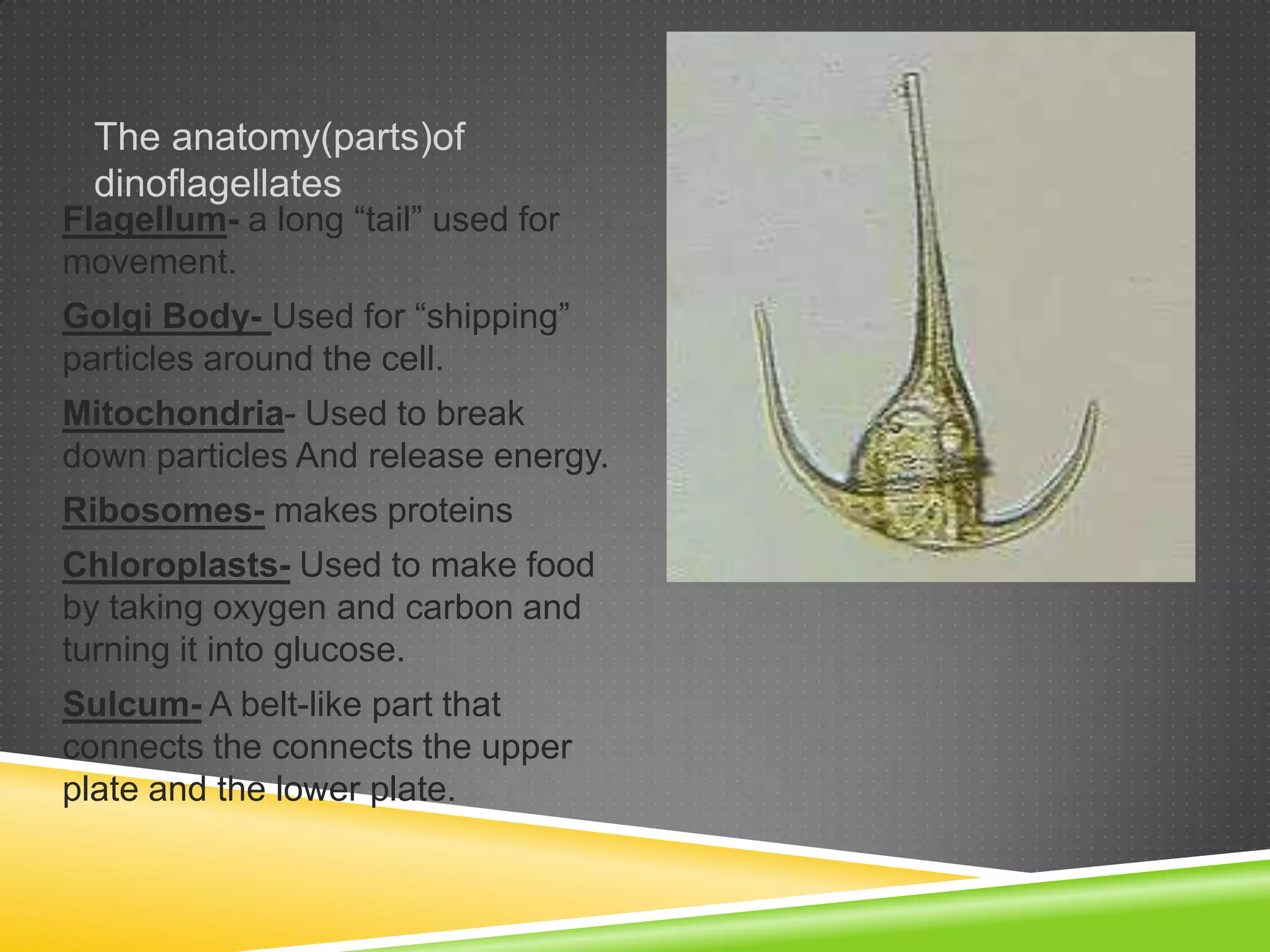
The anatomy(parts)of
  dinoflagellates
Flagellum- a long “tail” used for
movement.
Golgi Body- Used for “shipping”
particles around the cell.
Mitochondria- Used to break
down particles And release energy.
Ribosomes- makes proteins
Chloroplasts- Used to make food
by taking oxygen and carbon and
turning it into glucose.
Sulcum- A belt-like part that
connects the connects the upper
plate and the lower plate.
REPRODUCTION
Dinoflagellates reproduce asexually or by binary fission.
First, the parent cell expands. Next, the DNA is replicated (copied).
Then, the two DNA strands attach to
the cell membrane. After, the parent cell
Expands even more. Finally, the
Cell membrane meets at the center and
Splits into two new identical cells.
EXAMPLES

Zooxanthellaae
Notiluca
Corythodinum tesselatum
Ceratum buceros
Gonyaalaz
Gymnodinium
Alexandrium
THANKS FOR WATCHING

Dinoflagellates

  • 1.
    DINOFLAGELLATES By: Furkan Amin, Wesley Erd, Justin Krishnamurti And Ethan Pinckert
  • 2.
    FACTS ABOUT DINOFLAGELLATES Dinoflagellates are unicellular plankton.  They belong to the phylum dinoflagellata (dinophyta).  They have a dinokaryotic nucleus. Contrary to prokaryotic or eukaryotic, their chromosomes are permanently condensed.  The largest dinoflagellates are the Noctiluca. It is 2mm in size.  There are over 20,000 species of dinoflagellates  The Zooxanthellaae gives coral its color.  Dinoflagellates belong to the kingdom Protista. Protists are organisms that are similar to organisms in Animal, Plants, and fungus kingdoms, but they are different. For example, a Protist may have chlorophyll but move on its own, or it may move on its own, but is unicellular.
  • 3.
    CONTINUED FACTS ABOUT DINOFLAGELLATES 90% of dinoflagellates live in the ocean.  All dinoflagellates are autotrophs, which means they use photosynthesis.  Some even live in snow.  Dinoflagellate means whirling flagella.
  • 4.
    CHARACTERISTICS OF DINOFLAGELLATES  Dinoflagellateshave two flagella.  They spin in a top like motion.  When disturbed, they glow causing the ocean to light up.  However, not all dinoflagellates are harmless. Some such as Gonyaalax, Gymnodinium, Alexandrium, and many more have a harmful algal blooms which causes red tides.  The chemical reaction that causes their glow is called Bioluminescene.  These algal blooms release toxins that are harmful to sea creatures and humans if they eat seafood that have the toxin.  Dinoflagellates are golden brown or summer green.
  • 5.
    The anatomy(parts)of dinoflagellates Flagellum- a long “tail” used for movement. Golgi Body- Used for “shipping” particles around the cell. Mitochondria- Used to break down particles And release energy. Ribosomes- makes proteins Chloroplasts- Used to make food by taking oxygen and carbon and turning it into glucose. Sulcum- A belt-like part that connects the connects the upper plate and the lower plate.
  • 6.
    REPRODUCTION Dinoflagellates reproduce asexuallyor by binary fission. First, the parent cell expands. Next, the DNA is replicated (copied). Then, the two DNA strands attach to the cell membrane. After, the parent cell Expands even more. Finally, the Cell membrane meets at the center and Splits into two new identical cells.
  • 7.
  • 8.