Tannins
By
Dr. Ahmed Metwaly
Objectives:
1. Definition
2. Classification
3. General characters
4. Distribution and physiological role
5. Tests for identification
6. Quantitative determination
7. Medicinal and biological properties
8. Economic importance
Definition;
• They are high molecular weight phenolic compounds
capable of precipitation of animal proteins in hides and
converting them into leather. “Tanning Industry”
.
They are condensation products of Gallic acid or
Flavan-3-ol as well as their glycosides.
Gallic acid Flavan-3-ol
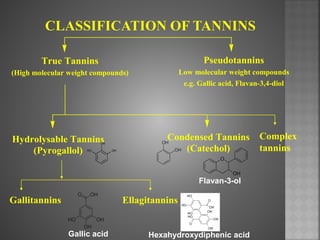
True Tannins
(High molecular weight compounds)
Hydrolysable Tannins
(Pyrogallol)
Condensed Tannins
(Catechol)
Pseudotannins
Low molecular weight compounds
e.g. Gallic acid, Flavan-3,4-diol
Gallitannins Ellagitannins
Hexahydroxydiphenic acid
Gallic acid
Flavan-3-ol
Complex
tannins
True tannins
 These are complex phenolic compounds of high
molecular weights ranging from about 1000 to 5000.
They display the general properties of tannins and
precipitated by gelatin in 1% solution.
 True tannins can be sub-classified into hydrolysable
tannins, condensed tannins and complex tannins.
Hydrolysable tannins (pyrogallol tannins)
 These may be hydrolyzed by acids or enzymes such as
tannase.
 They are formed from several molecules of phenolic
acids such as gallic and hexahydroxydiphenic acids
which are united by ester linkages to a central sugar
(mainly glucose) molecule.
 Like gallic acid their solutions turn blue with iron salts.
 They were formerly known as pyrogallol tannins, because
on dry distillation gallic acid and similar components are
converted into pyrogallol.
 Two principal types of hydrolysable tannins are
gallitannins and ellagitannins which are, respectively,
composed of gallic acid and hexahydroxydiphenic
acid units.
Tannaseis an enzyme that catalyzes the chemical reaction
digallate + H2O 2 gallate
This enzyme belongs to the family of hydrolases, specifically
those acting on carboxylic ester bonds. The systematic name
of this enzyme class is tannin acylhydrolase. Other names in
common use include tannase S, and tannin acetylhydrolase.
Tannase is a key enzyme in the degradation of gallotannins.
It is present in a diverse group of microorganisms,
including rumen bacteria
 The difference between Ellagitannins and gallotannins
that; galloyl groups are linked through C-C bonds in ellagitannins,
whereas the galloyl groups in gallotannins are linked by depside
bonds.
 A depside is a type of polyphenolic compound composed of two or
more monocyclic aromatic units linked by an ester bond.
 Ellagic acid (the depside of Hexahydroxydiphenic acid) can arise
by lactonization during chemical hydrolysis of the tannin; thus, the
term ellagitannin is a misnomer.
 C-glucosidic ellagitannins are common in a number of families
including the Myrtaceae, Hamamelidaceae, Punicaceae and
Ellagic acid
Hexahydroxydiphenic acid
Tannic acid 1,2,3,4,6-Pentagalloyl glucose
Grandinin
Casuarictin
raspberry ellagitannin
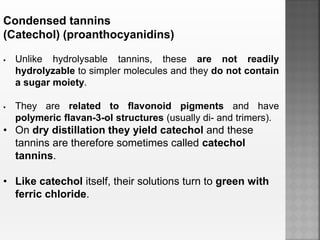
Condensed tannins
(Catechol) (proanthocyanidins)
 Unlike hydrolysable tannins, these are not readily
hydrolyzable to simpler molecules and they do not contain
a sugar moiety.
 They are related to flavonoid pigments and have
polymeric flavan-3-ol structures (usually di- and trimers).
• On dry distillation they yield catechol and these
tannins are therefore sometimes called catechol
tannins.
• Like catechol itself, their solutions turn to green with
ferric chloride.
 Catechins which also occur with the tannins and flavan-
3,4-diols (leucoanthocyanidins) are intermediates in the
biosynthesis of the polymeric molecules.
 Stereochemical variations add to the variety of possible
structures.
 On treatment with acids or enzymes condensed tannins
are converted into red insoluble compounds known as
phlobaphenes.
 Phlobaphenes give the characteristic red color to many
drugs such as red cinchona bark, which contain these
phlobatannins and their decomposition products.
Catechin Epicatechin
Schematic representation of a
condensed tannin molecule.
Condensed tannins can be linear (with
4→8 bounds) or branched (with 4→6
bounds)
Complex tannins
 These represent a group of tannins that are
biosynthesized from both hydrolysable tannin (mostly
a C-glucoside ellagitannin) (flavono-ellagitannin)and
condensed tannin.
Acutissimin A
Pseudotannins
 Pseudotannins are polyphenolic compounds of lower molecular
weight than true tannins.
 They do not respond to the goldbeater's skin test and may,
under certain conditions, e.g. in concentrated solutions, give
precipitates with gelatin and be partly retained by hide powder.
 Examples are gallic acid, catechins and chlorogenic acid.
Chlorogenic acid
Catechin
Gallic acid
Distribution
Type of tannin Plant name and organ
Hydrolysable tannins
Gallitannins
Ellagitannins
Rhubarb rhizome, clove buds, red rose petals, galls, hamamelis leaves and
chestnut bark.
Pomegranate rind and bark, eucalyptus leaves, myrobolans and oak bark.
Condensed tannins Barks: e.g. cinnamon, hamamelis and cinchona.
Roots and rhizomes: e.g. krameria and male fern.
Flowers: e.g. lime and hawthorn.
Seeds: e.g. cocoa, kola and areca.
Leaves: e.g. hamamelis, hawthorn and tea, especially green tea.
Extracts and dried juices: catechu and Indian kino.
Complex tannins Members of Fam. Combretaceae, Myrtaceae and Fagaceae.
Pseudotannins
Gallic acid
Catechins
Chlorogenic acid
Ipecacuanhic acid
Galls, rhubarb and most drugs that contain gallitannins.
Catechu, cocoa and most drugs containing condensed tannins.
Coffee particularly when unroasted.
Ipecacuanha.
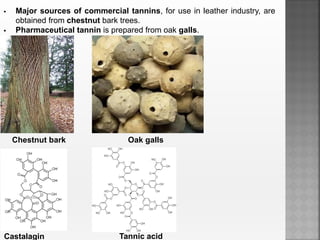
 Major sources of commercial tannins, for use in leather industry, are
obtained from chestnut bark trees.
 Pharmaceutical tannin is prepared from oak galls.
Chestnut bark
Castalagin
Oak galls
Tannic acid
Physiological role
 They exert an inhibitory effect on many enzymes due to protein
precipitation and, hence, may contribute a protective function in barks
and heartwoods.
• They play an important role in the mechanism of hydrogen transfer in
plant cells, probably due to their high affinity for oxygen.
• Certain drugs contain only one type of tannin. Others may contain
more than one type e.g. tea, hamamelis leaves and bark contain both
hydrolysable and condensed tannins.
Physical properties
 Tannins are non-crystallizable compounds.
 They are soluble in water forming colloidal solutions
with acidic reaction and sharp astringent taste.
 They are soluble in dilute alkalis, alcohol, glycerol and
acetone, but only sparingly soluble in other organic
solvents.
 Their solutions precipitate heavy metals, alkaloids,
glycosides and protein (e.g. gelatin).
Tests for identification
• Goldbeater's skin test (Skin tanning test):
 Goldbeater's skin is a membrane prepared from the intestine of the ox
and behaves similar to an untanned hide.
 Soak a small piece of goldbeater's skin in 25% HCl; rinse with distilled
water and place in the solution to be tested for 5 min. Wash with distilled
water and transfer to a 15 % solution of ferrous sulphate.
 A brown or black color on the skin denotes the presence of true
tannins.
• Gelatin test:
 Solutions of true tannins (about 0.5-1%) precipitate a 1% solution of
gelatin containing 10% sodium chloride.
 Gallic acid and other pseudotannins may react in concentrated
solutions.
• Test with phenazone:
 Add 0.5 g of sodium acid phosphate to about 5 ml of an aqueous extract
of the drug; warm, cool and filter. To the filtrate add 2 % phenazone
solution.
 All tannins are precipitated, the precipitate being bulky and often
colored.
• Test with ferric chloride:
 Add 5 % ferric chloride solution drop by drop to 2-3 ml of the extract and
observe the color produced.
 Hydrolysable tannins (gallitannins and ellagitannins) give bluish-black color
or precipitate and condensed tannins brownish-green ones.
 If the test is carried on an extract that contains both types of tannins, a blue
color is produced which changes to olive-green as more ferric chloride is
added.
• Test with bromine water:
Add bromine water to an aqueous extract of the drug.
- Condensed tannins gives a buff-colored precipitate
- Hydrolysable tannins do not form any precipitate.
• Test for catechin:
 Catechins on heating with acids form phloroglucinol and they can be
detected by a modification of the well-known test for lignin.
 Dip a matchstick in the plant extract containing catechin, dry, moisten with
concentrated HCl and warm near a flame a pink or red is produced.
• Test for chlorogenic acid:
Add aqueous ammonia to an extract containing chlorogenic acid, expose to
air a green color gradually develops.
Quantitative determination
1. Hide powder method:
 This is the most widely used on commercial scale.
 A known amount of a reference sample of hide powder is added to the
drug extract.
 The difference in the dry weight of the extract before and after treatment
with hide powder is a measure for the tannin content.
1. Copper acetate method:
 Tannin is precipitated quantitatively with copper acetate solution.
 The precipitate of copper tannate is collected on an ashless filter paper,
washed with water till free from copper ions and ignited.
 The residue of copper oxide obtained is completely oxidized by adding a
few drops of nitric acid.
 Tannin content is calculated on the basis that 1 part of copper oxide is
equivalent to 1.305 parts of tannins.
• Agglutination method
 This depends on that a suspension of red blood cells is agglutinated
with tannins, but haemolysis does not occur (c.f. saponins). The
erythrocytes are agglutinated (stick together) due to formation of a sticky
membrane on their surface in contact with tannins.
 The quantity of red blood cells precipitated is proportional to the
amount of "astringent" tannin present.
 The end point is reached when red blood cells are completely
precipitated i.e. the solution is colorless on shaking. Reaction is stopped
when the filtrate gives no precipitate with ferric chloride (this indicates
absence of tannins).
 The astringency value of the extract is compared with that of tannic acid
used as reference standard, recorded as percentage tannic acid and
referred to as "tannin number".
 All the solutions used should be isotonic.
 Catechin is inactive.
• Iodometric determination
 Tannins and pseudotannins quantitatively consume iodine from alkaline
medium due to their phenolic nature.
 Excess iodine is determined by titration, after acidification, with standard
sodium thiosulphate solution using starch as indicator.
 True tannins can be removed from the extract by precipitation with gelatin.
This can permit the determination of each group of constituents alone.
Medicinal and biological properties
 Tannin-containing drugs precipitate proteins and have been traditionally
used as styptics (stop hemorrhage) and internally for the protection of
inflamed surfaces of mouth and throat.
 They play an important role in the treatment of burns. They form a mild
antiseptic protective layer on the surface of the injured skin below which
regeneration of new tissue takes place.
 They act as anti-diarrheals, although not recommended in this respect as
they usually delay elimination of bacterial toxins from the body.
 Tannins have been employed as antidote in poisoning by heavy metals,
alkaloids and certain glycosides due to their precipitation as
tannates.
 Recently tannins as most polyphenols were proved to have a potent
antioxidant effect.
 Studies on the antitumor effect of tannins proved that a strong
activity is obtained with ellagitannins having galloyl groups at the O-
2 and O-3 positions of the glucose core(s), as in the
tellimagrandins.
 Certain tannins were proved to have anti-HIV activities
Tellimagrandin II (Anti herpes virus)
Economic importance
 Tannins are used in leather industry to transform raw animal skin to
leather due to their ability to cross-link with proteins. To be effective for
tannage, the polyphenol molecule must be neither too large as it will
be unable to enter the interstices between the collagen fibrils of the
animal skin nor too small as it will be unable to cross-link between the
protein molecules of adjacent fibrils at several points.
 Tannins are used in the manufacture of inks based on the dark colored
complexes they form with iron salts.
 Tannins are used in food industries to improve acceptance of many
beverages and foods when a degree of astringency is required.
Summary:
1. Definition
2. Classification
3. General characters
4. Distribution and physiological role
5. Tests for identification
6. Quantitative determination
7. Medicinal and biological properties
8. Economic importance

tannins PPT.pdf

  • 1.
  • 2.
    Objectives: 1. Definition 2. Classification 3.General characters 4. Distribution and physiological role 5. Tests for identification 6. Quantitative determination 7. Medicinal and biological properties 8. Economic importance
  • 3.
    Definition; • They arehigh molecular weight phenolic compounds capable of precipitation of animal proteins in hides and converting them into leather. “Tanning Industry” .
  • 5.
    They are condensationproducts of Gallic acid or Flavan-3-ol as well as their glycosides. Gallic acid Flavan-3-ol
  • 6.
    True Tannins (High molecularweight compounds) Hydrolysable Tannins (Pyrogallol) Condensed Tannins (Catechol) Pseudotannins Low molecular weight compounds e.g. Gallic acid, Flavan-3,4-diol Gallitannins Ellagitannins Hexahydroxydiphenic acid Gallic acid Flavan-3-ol Complex tannins
  • 7.
    True tannins  Theseare complex phenolic compounds of high molecular weights ranging from about 1000 to 5000. They display the general properties of tannins and precipitated by gelatin in 1% solution.  True tannins can be sub-classified into hydrolysable tannins, condensed tannins and complex tannins.
  • 8.
    Hydrolysable tannins (pyrogalloltannins)  These may be hydrolyzed by acids or enzymes such as tannase.  They are formed from several molecules of phenolic acids such as gallic and hexahydroxydiphenic acids which are united by ester linkages to a central sugar (mainly glucose) molecule.  Like gallic acid their solutions turn blue with iron salts.  They were formerly known as pyrogallol tannins, because on dry distillation gallic acid and similar components are converted into pyrogallol.  Two principal types of hydrolysable tannins are gallitannins and ellagitannins which are, respectively, composed of gallic acid and hexahydroxydiphenic acid units.
  • 9.
    Tannaseis an enzymethat catalyzes the chemical reaction digallate + H2O 2 gallate This enzyme belongs to the family of hydrolases, specifically those acting on carboxylic ester bonds. The systematic name of this enzyme class is tannin acylhydrolase. Other names in common use include tannase S, and tannin acetylhydrolase. Tannase is a key enzyme in the degradation of gallotannins. It is present in a diverse group of microorganisms, including rumen bacteria
  • 10.
     The differencebetween Ellagitannins and gallotannins that; galloyl groups are linked through C-C bonds in ellagitannins, whereas the galloyl groups in gallotannins are linked by depside bonds.  A depside is a type of polyphenolic compound composed of two or more monocyclic aromatic units linked by an ester bond.  Ellagic acid (the depside of Hexahydroxydiphenic acid) can arise by lactonization during chemical hydrolysis of the tannin; thus, the term ellagitannin is a misnomer.  C-glucosidic ellagitannins are common in a number of families including the Myrtaceae, Hamamelidaceae, Punicaceae and Ellagic acid Hexahydroxydiphenic acid
  • 11.
  • 12.
  • 13.
    Condensed tannins (Catechol) (proanthocyanidins) Unlike hydrolysable tannins, these are not readily hydrolyzable to simpler molecules and they do not contain a sugar moiety.  They are related to flavonoid pigments and have polymeric flavan-3-ol structures (usually di- and trimers). • On dry distillation they yield catechol and these tannins are therefore sometimes called catechol tannins. • Like catechol itself, their solutions turn to green with ferric chloride.
  • 14.
     Catechins whichalso occur with the tannins and flavan- 3,4-diols (leucoanthocyanidins) are intermediates in the biosynthesis of the polymeric molecules.  Stereochemical variations add to the variety of possible structures.  On treatment with acids or enzymes condensed tannins are converted into red insoluble compounds known as phlobaphenes.  Phlobaphenes give the characteristic red color to many drugs such as red cinchona bark, which contain these phlobatannins and their decomposition products.
  • 15.
    Catechin Epicatechin Schematic representationof a condensed tannin molecule. Condensed tannins can be linear (with 4→8 bounds) or branched (with 4→6 bounds)
  • 16.
    Complex tannins  Theserepresent a group of tannins that are biosynthesized from both hydrolysable tannin (mostly a C-glucoside ellagitannin) (flavono-ellagitannin)and condensed tannin.
  • 17.
  • 19.
    Pseudotannins  Pseudotannins arepolyphenolic compounds of lower molecular weight than true tannins.  They do not respond to the goldbeater's skin test and may, under certain conditions, e.g. in concentrated solutions, give precipitates with gelatin and be partly retained by hide powder.  Examples are gallic acid, catechins and chlorogenic acid. Chlorogenic acid Catechin Gallic acid
  • 20.
    Distribution Type of tanninPlant name and organ Hydrolysable tannins Gallitannins Ellagitannins Rhubarb rhizome, clove buds, red rose petals, galls, hamamelis leaves and chestnut bark. Pomegranate rind and bark, eucalyptus leaves, myrobolans and oak bark. Condensed tannins Barks: e.g. cinnamon, hamamelis and cinchona. Roots and rhizomes: e.g. krameria and male fern. Flowers: e.g. lime and hawthorn. Seeds: e.g. cocoa, kola and areca. Leaves: e.g. hamamelis, hawthorn and tea, especially green tea. Extracts and dried juices: catechu and Indian kino. Complex tannins Members of Fam. Combretaceae, Myrtaceae and Fagaceae. Pseudotannins Gallic acid Catechins Chlorogenic acid Ipecacuanhic acid Galls, rhubarb and most drugs that contain gallitannins. Catechu, cocoa and most drugs containing condensed tannins. Coffee particularly when unroasted. Ipecacuanha.
  • 21.
     Major sourcesof commercial tannins, for use in leather industry, are obtained from chestnut bark trees.  Pharmaceutical tannin is prepared from oak galls. Chestnut bark Castalagin Oak galls Tannic acid
  • 22.
    Physiological role  Theyexert an inhibitory effect on many enzymes due to protein precipitation and, hence, may contribute a protective function in barks and heartwoods. • They play an important role in the mechanism of hydrogen transfer in plant cells, probably due to their high affinity for oxygen. • Certain drugs contain only one type of tannin. Others may contain more than one type e.g. tea, hamamelis leaves and bark contain both hydrolysable and condensed tannins.
  • 23.
    Physical properties  Tanninsare non-crystallizable compounds.  They are soluble in water forming colloidal solutions with acidic reaction and sharp astringent taste.  They are soluble in dilute alkalis, alcohol, glycerol and acetone, but only sparingly soluble in other organic solvents.  Their solutions precipitate heavy metals, alkaloids, glycosides and protein (e.g. gelatin).
  • 24.
    Tests for identification •Goldbeater's skin test (Skin tanning test):  Goldbeater's skin is a membrane prepared from the intestine of the ox and behaves similar to an untanned hide.  Soak a small piece of goldbeater's skin in 25% HCl; rinse with distilled water and place in the solution to be tested for 5 min. Wash with distilled water and transfer to a 15 % solution of ferrous sulphate.  A brown or black color on the skin denotes the presence of true tannins. • Gelatin test:  Solutions of true tannins (about 0.5-1%) precipitate a 1% solution of gelatin containing 10% sodium chloride.  Gallic acid and other pseudotannins may react in concentrated solutions. • Test with phenazone:  Add 0.5 g of sodium acid phosphate to about 5 ml of an aqueous extract of the drug; warm, cool and filter. To the filtrate add 2 % phenazone solution.  All tannins are precipitated, the precipitate being bulky and often colored.
  • 25.
    • Test withferric chloride:  Add 5 % ferric chloride solution drop by drop to 2-3 ml of the extract and observe the color produced.  Hydrolysable tannins (gallitannins and ellagitannins) give bluish-black color or precipitate and condensed tannins brownish-green ones.  If the test is carried on an extract that contains both types of tannins, a blue color is produced which changes to olive-green as more ferric chloride is added. • Test with bromine water: Add bromine water to an aqueous extract of the drug. - Condensed tannins gives a buff-colored precipitate - Hydrolysable tannins do not form any precipitate. • Test for catechin:  Catechins on heating with acids form phloroglucinol and they can be detected by a modification of the well-known test for lignin.  Dip a matchstick in the plant extract containing catechin, dry, moisten with concentrated HCl and warm near a flame a pink or red is produced. • Test for chlorogenic acid: Add aqueous ammonia to an extract containing chlorogenic acid, expose to air a green color gradually develops.
  • 26.
    Quantitative determination 1. Hidepowder method:  This is the most widely used on commercial scale.  A known amount of a reference sample of hide powder is added to the drug extract.  The difference in the dry weight of the extract before and after treatment with hide powder is a measure for the tannin content. 1. Copper acetate method:  Tannin is precipitated quantitatively with copper acetate solution.  The precipitate of copper tannate is collected on an ashless filter paper, washed with water till free from copper ions and ignited.  The residue of copper oxide obtained is completely oxidized by adding a few drops of nitric acid.  Tannin content is calculated on the basis that 1 part of copper oxide is equivalent to 1.305 parts of tannins.
  • 27.
    • Agglutination method This depends on that a suspension of red blood cells is agglutinated with tannins, but haemolysis does not occur (c.f. saponins). The erythrocytes are agglutinated (stick together) due to formation of a sticky membrane on their surface in contact with tannins.  The quantity of red blood cells precipitated is proportional to the amount of "astringent" tannin present.  The end point is reached when red blood cells are completely precipitated i.e. the solution is colorless on shaking. Reaction is stopped when the filtrate gives no precipitate with ferric chloride (this indicates absence of tannins).  The astringency value of the extract is compared with that of tannic acid used as reference standard, recorded as percentage tannic acid and referred to as "tannin number".  All the solutions used should be isotonic.  Catechin is inactive. • Iodometric determination  Tannins and pseudotannins quantitatively consume iodine from alkaline medium due to their phenolic nature.  Excess iodine is determined by titration, after acidification, with standard sodium thiosulphate solution using starch as indicator.  True tannins can be removed from the extract by precipitation with gelatin. This can permit the determination of each group of constituents alone.
  • 28.
    Medicinal and biologicalproperties  Tannin-containing drugs precipitate proteins and have been traditionally used as styptics (stop hemorrhage) and internally for the protection of inflamed surfaces of mouth and throat.  They play an important role in the treatment of burns. They form a mild antiseptic protective layer on the surface of the injured skin below which regeneration of new tissue takes place.  They act as anti-diarrheals, although not recommended in this respect as they usually delay elimination of bacterial toxins from the body.  Tannins have been employed as antidote in poisoning by heavy metals, alkaloids and certain glycosides due to their precipitation as tannates.  Recently tannins as most polyphenols were proved to have a potent antioxidant effect.
  • 29.
     Studies onthe antitumor effect of tannins proved that a strong activity is obtained with ellagitannins having galloyl groups at the O- 2 and O-3 positions of the glucose core(s), as in the tellimagrandins.  Certain tannins were proved to have anti-HIV activities Tellimagrandin II (Anti herpes virus)
  • 30.
    Economic importance  Tanninsare used in leather industry to transform raw animal skin to leather due to their ability to cross-link with proteins. To be effective for tannage, the polyphenol molecule must be neither too large as it will be unable to enter the interstices between the collagen fibrils of the animal skin nor too small as it will be unable to cross-link between the protein molecules of adjacent fibrils at several points.  Tannins are used in the manufacture of inks based on the dark colored complexes they form with iron salts.  Tannins are used in food industries to improve acceptance of many beverages and foods when a degree of astringency is required.
  • 31.
    Summary: 1. Definition 2. Classification 3.General characters 4. Distribution and physiological role 5. Tests for identification 6. Quantitative determination 7. Medicinal and biological properties 8. Economic importance