Shaharyar Khan
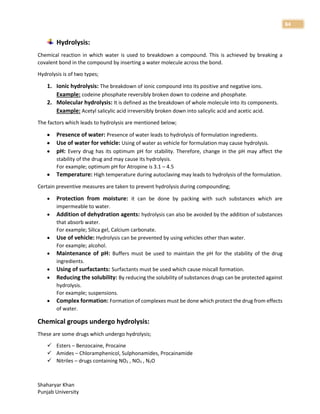
Punjab University
1
Basic Principles of
Compounding and
Dispensing including:
Weights and measures, calculations for
compounding and dispensing, Fundamental
operations in compounding, Containers and
closures for Dispensed products, Prescription –
handling (Parts of prescription, Filling,
Interpretation, Pricing) and Labelling of
Dispensed Medication.
Shaharyar Khan
Punjab University
2
Dispensing
The branch of pharmacy which is concerned with the distribution of medicaments especially the filling of
prescriptions. This is concerned with receiving, handling, compounding and dispensing pharmaceutical
products in conformity with the expressed wishes of a licensed practitioner.
Compounding: Compounding is the mixing of drugs by a compounding pharmacist to fit the unique
needs of a patient.
Prescription:
It is an order for the medication issued by physician, dentist or other properly licensed medical
practitioner.
It is may be written or may be verbal or oral.
Parts of prescription
Parts of prescription are as fallows;
1. Prescriber’s office information:
The prescription must contain the information about prescriber’s office. That includes address, telephone
no. It is essential because sometimes for the confirmation of dosage or medication or for the correction
of any sort discrepancy in prescription.
2. Date:
Date must be properly mentioned on the prescription as it tells about the day of prescription. It is
necessary for the narcotic medicine. It is also necessary to check on refill status.
3. Patient’s information:
Patient’s information must be asked and it should be written on the prescription as well. It includes name,
gender, age, address of the patient.
4. Superscription: R
Some say this is a Latin word, “Recipe” meaning ‘Take thou (you take)’ and some people says that it is the
sign of Jupiter .
5. Inscription:
It is called the ‘Heart of prescription.’ It contains the name and exact quantity of the prescribed medicine
(medication prescribed). It may be an official formula or trade name, generic name, special formula or
non-proprietary name.
Shaharyar Khan
Punjab University
3
6. Subscription:
It includes the directions to the pharmacist (dispensing directions), sometimes dispenses it in doses, or
compounding may be done (compounding prescription).
 How to make.
 What to make.
 The type of dosage form to be compound.
7. Signatura / sign:
It includes the instructions to the patient. These all information should clearly be mentioned on the label
for the convenience of patient.
Example:
 Dose of the medicine
 At what time the medication should be taken.
 Either the preparation is for external or internal use.
 If an external topical medication then where to apply, and how to apply.
 If an internal preparation then with what vehicle medicine should be take, which shouldn’t be
taken before and after medicine.
 Discard date of the preparation
 In case of ophthalmic preparations, instructions about how to instill, how much to instill, and
either in one eye or both.
 In case of emulsion or suspension, both should be shaken before use.
8. Refill information:
Dispensing on old prescription or again refilling of prescription.
Example:
 No refill is mentioned on the prescription for narcotic drugs.
 Refill is mentioned for diseases like tuberculosis.
9. Prescriber’s signature:
At the end of prescription the practitioner must confirm it either by the official sign no stamp. Signature
can be replaced by License no., narcotic registry sign, or license no. of any sort of by the country.
In case of verbal prescription then the pharmacist should first write it then take the signature.
Shaharyar Khan
Punjab University
4
Prescription handling
Prescription handling includes;
 Filling or Refusal of prescription
 Compounding of formulation
 Pricing
Filling or Refusal of prescription:
The pharmacist has the right to refuse the filling of prescription if it is not legal, legible and complete.
Filling of any prescription is carried out after the confirmation of all parts of prescription. The prescription
is refused on following bases;
 If either the ingredients are not present in the stock or they are not readily available.
 If the essential information is missing or doubtful.
 If the safety of the prescription is doubtful.
 If the prescription does not confirm to the legal requirements.
 If the parts of prescriptions are missing or not mentioned.
 If the prescription is not legible and confusing.
 If any forgery or illegal alteration is suspected.
Compounding:
If the prescription is of standard and complete from all aspects then it is accepted and compounding is
performed. During the compounding of preparation one must keep following things in mind;
 Compound one product at a time.
 Compounding should be performed at one place so that there will be less chances of mistakes.
Compounding includes;
 Choosing container
 Label preparation
 Filling the product
 Rechecking of the product
 Prizing of prescription
 Filling of prescription.
Shaharyar Khan
Punjab University
5
Prizing:
Pricing should be done by keeping all the aspects in the mind. Following prizes must be added with proper
proportion to the price of final product formulation;
 Cost of ingredients
 Cost of container
 Cost of time required for compounding and dispensing.
 Cost of professional services (knowledge, professional skill, time required, duties and services
indirectly related to compounding and dispensing).
 Cost of overhead expenses (electricity, tax, rent, heat, refrigeration and insurance, depreciation
in equipment, deterioration and obsolescence of drugs, advertising and other miscellaneous
expenses of the operation)
Shaharyar Khan
Punjab University
6
Containers & Closures
The choice of containers for the raw material or for dispensing is very much important.
Desired features for a container & closure:
1. The containers must be rigid enough to prevent damage to contents. For example; crushing of
capsule, fracture of tablet.
2. The material of the container must be inert i.e. it should not react with the contents present in it.
3. The closure must prevent;
 Access of moisture.
 Loss of moisture in case of creams lotions etc.
 Unintentional loss of contents.
 Entry of dirt or other contaminants. For example odors or vapors.
4. The closure must be easily removed and replaced.
5. It must not be difficult to abstract the contents or to empty the container completely.
6. For many products protection from light must be given.
The BPC defines; A light resistant container as one that doesn’t transmit more than 10% of
incident radiation at any wavelength between 290 nm – 450 nm.
The European Pharmacopoeia specifies uncolored glass for containers of injectable preparations
unless they are extremely light sensitive.
7. Medicaments or adjuncts must not be absorbed neither by container materials nor must diffuse
through the walls be possible.
8. It must be easy to label the container easily.
9. It must be elegant in appearance pharmaceutically.
Containers can be classified into four groups;
 Well closed container:
This container protects the contents from contamination with extraneous solids and under normal
conditions of handling storage and transport prevents unintentional release of contents.
 Air tight containers:
Thus containers give protection form extraneous solids, liquids and vapors, under normal conditions of
handling storage and transport prevent changes due to efflorescence, deliquescence and evaporation.
 Securely tight containers:
This is an air tight container with means of preventing unintentional displacement of the closures.
 Hermetically sealed containers:
This container is impervious to air and other gases under normal conditions of handling, storage and
transport. The most common example in glass ampule sealed by fusion.
Shaharyar Khan
Punjab University
7
 Liquid oral preparations:
Liquid preparations are of three types;
i. Intended to be swallowed
ii. Not to be swallowed
iii. Other liquid preparations
(i) Intended to be swallowed:
Colorless cheaper glass bottles are used. Which are flat from one side and ovoid from the other. The flat
side is for the label.
Screw caps made up of white propylene are available. They are of different sizes 50ml, 100ml, 500ml or
1000ml.
(ii) Not to be swallowed:
Ribbed or fluted bottle is used with pourable mouth shape. It is used to differentiate between oral and
external preparation.
 Other liquid preparations:
(i) Application in skin:
Colored or fluted bottle is used for packaging. Some preparations needs an applicator. For example; brush
for paints and such preparations have wide mouths.
Lotions and liniments and others without applicator must be packed in plastic collapsible bottle with
narrow tips.
Cavities; colored fluted bottle are used. Caps must have nozzle that assist administration or instillation.
 For inhalation:
Colored or fluted bottle are used for its packing.
Vitrellae inhalation: it is just like an ampule. It must be packed in boxes for better protection.
Shaharyar Khan
Punjab University
8
 Semi solid dosage form:
The packaging material must have these following properties;
 It is capable of preventing moisture or evaporation.
 It should be inert and shouldn’t liberate toxic chemicals.
 It must provide adequate mechanical strength and provide an effective seal.
 It should not liberate irritating or sensitizing substances.
The packaging material which is used for semisolid dosage forms are;
1. Collapsible metal or plastic tube
They prevent contamination. One should not touch the tip of the tube to the infected area while
application to prevent contamination of the product.
 They are acceptable due to few reasons;
 They possess narrow orifice.
 They prevent serious contamination.
 The wastage of the dosage form is reduce.
 For their better use, nozzle type applicators can be attached.
 Not replaced by air.
2. Glass or plastic pot
Plastic is preferred for packing as the metal is reactive to many chemicals. Similarly is it cheap as
compared to the metal bottles and easily available.
 Solid unit dosage form:
1. Intended to be swallowed, chewed, sucked, cachets, lozenges, pills, capsules, tablets.
2. Intended to be used in body cavities, like; suppositories:
3. Powders (oral powders & external powders)
1. Intended to be swallowed, chewed, sucked, cachets, lozenges, pills,
capsules, tablets:
They are packed in;
 Paper board
 Glass
 Plastic
 Aluminum
Shaharyar Khan
Punjab University
9
General features; robust, strong, unbreakable containers. So that;
 They prevent unintentional release of content.
 They prevent deformation in use which normally leads to the difficulty in closing.
 They are protective against moisture, oxygen and light.
(i) Paper boards:
They are either collapsible cartons, rigid boxes or drums. They are foiled or blister packed actually.
(ii) Glass:
It is an oval or rectangular bottle with plastic or metal screw caps. They are may be colorless. Normally
amber or opaque color glass is used.
(iii) Plastic:
For plastic packing the following materials are used; Poly vinyl chloride PVC, Polystyrene, Poly propylene.
(iv) Aluminum:
Lined with paper or internally lacquered. It is robust and unbreakable. It is lighter in weight. They require
less storage space. Its mechanical filling is simple. Label can be oriented simply. It provides protection
against light.
2. Intended to be used in body cavities, like; suppositories:
They are packed in shallow partitioned paper boxes. They are also wrapped in aluminum foils individually
and then placed in glass bottles.
3. Powders:
Powders are of two types;
(i) Powders for oral use
(ii) Powders for external use
(i) Powders for oral uses:
a. Bulk powders: They are packaged in wide mouth bottles made up of glass or plastic.
b. Unit dose powders: They are individually packed in sashes. Then these sashes are packed in
hard boxes.
(ii) Powders for external use, in body cavities:
They are packed in plastic containers with perforated lids for their easy application.
Shaharyar Khan
Punjab University
10
Labelling
After the transfer of the final formulation to the container, a neat, clean label according to the size of
container is pasted on the container.
It should have following information;
1. Pharmacy address and phone no.
In case of any query, patient can go back and confirm it or if he is unable to go to get refill, the
person going instead can have the address.
2. Patient’s information
It includes patient name, age, gender and address. It will assist the patient to locate his medicine,
and will restrict others to use someone else’s medicine.
3. Name and strength of the prescribed product
Some people favors while some others opposes the idea to mention name and strength of the
product.
The supporters are of the view;
 In case of toxicity one can know the strength to treat.
 It should be mentioned to manage the dose.
 If new therapy or treatment is given.
 Dosage form must be mentioned. It will assist the patient in its application or etc.
 It will help the health care professional to know the history of previous medication.
The non-supporters are of the view that;
 Sometime dispensed medicine is available with changed container.
 The brand f the same medicine can be changed
 The patient may start self-medication.
4. Directions for use:
These must be clearly mentioned on the label. They must be confusion free so that patient can
easily understand.
Example:
 ‘2’ 5ml spoonful three times a day. So one must write alphabetical ‘two’ instead of writing
in digits.
 Write ‘0’ before the decimal. E.g. 0.5ml
5. Prescription reference no. / date
6. Signature of the compounding pharmacist
In case of any adverse reaction to patient due to mistake in compounding one can caught the
actual culprit.
7. Dispensed date
It indicates that when the product is dispensed.
8. Discard date
Discard date must be mentioned on label, as it helps the patient to abstain from using the
medication after the expiry and save himself from toxicity or adverse effects.
Shaharyar Khan
Punjab University
11
Additional labels
They must be pasted for the patient compliance. Additional labels are pasted basically for two reasons;
1. Labels which are required by Law
2. Labels which are necessary for pharmaceutical reasons
1. Labels required by Law:
The labels which are required by Law are as fallows;
 For external use only: It is only mentioned on liquid preparations which are used
externally. For example Liniment.
 Not to be taken: It is mentioned on products which are packed in greater quantity more
than 3 liters. They are antiseptic of disinfectant solutions.
2. The labels necessary for pharmaceutical reasons:
The labels necessary for pharmaceutical reasons are as fallows;
For external use only: it must be on all preparations which are intended to be used externally
not to be taken orally.
Some Special labels are also mentioned on the preparations. These help the patients by making
it more understandable and legible.
Special labels:
There some reasons for special labels which are discussed below;
1. Special labels are pasted to indicate the restrictions on use of preparations.
Example:
 For pediatric patients only.
 For adults only.
 Not to apply.
 Not to be taken.
2. Special label also assist in the use of medication to a specific site in the body.
Example:
 For nasal use only for nasal drops.
 For rectal use only for rectal suppositories.
 For otic use only for ear drops.
Shaharyar Khan
Punjab University
12
3. Special labels are also pasted to give specific instructions to the patient regarding to the
formulation. They play dominant role in understanding the method of use of the formulation.
Example:
 For Poultice it is mentioned to apply with suitable dressing.
 For dusting powder it is mentioned that not to apply on open wounds.
 For Lotion it is mentioned that apply without rubbing.
 For liniment it is mentioned apply with rubbing.
4. Special labels are applied to specify the storage conditions for the formulation.
Example:
 Keep away from naked flame.
 Store below 150
C or store at cool place.
 Protect is from light.
5. Special labels are applied for the safety and protection of children.
Example:
Keep out of reach of children.
Shaharyar Khan
Punjab University
13
Fundamental operations in compounding
The fundamental operations of compounding includes;
 Weights and measures
 Size reduction
 Size separation
 Filtration
 Solution
 Mixing
Weights and measures:
 Accuracy: It is the measure of capability of a balance to approach a true or absolute value.
 Precision: It is the relative degree of repeatability i.e. how closely the values within a series of
replicate measurements agree.
 Tolerance: Tolerance or limits of permissible error is the extreme value of an error permitted by
specification for a measuring instrument.
 Sensitivity: it is the smallest weight to which the balance responds when loaded to capacity.
 Error: it is the excess of deficiency at full load.
The system of weighing are ad fallows;
1. The Apothecaries system:
The weigh was calculated by comparing it with barley grains. The units were grains, scruples, Drachms
and apothecaries ounce.
Grains (barley) Scruples Drachms Apothecaries ounce
480 24 8 1
60 3 1
20 1
2. The Imperial system:
 Weighing units:
Grains Avoirdupois ounces Avoirdupois pounds
437.5 1
7000 16 1
Shaharyar Khan
Punjab University
14
 Measuring units:
Minims Fluid drachms Fluid ounces Pints
9600 160 20 1
3. Decimal system
In 17th
century another system was introduced known as Decimal system of units. It was also called as
CGS system or Centimeter Gram Second system.
4. Metric system
The USP adopted the metric system in 1890. The system was introduced by the French when US adopted
it, they changed the spellings. Its latest form is SI system.
According to this system the units of weights are;
 Kilogram Kg
 Gram g
 Milligram mg
 Microgram µg
 Nanogram ng
According to this system units of volume are;
 Liter l
 Milliliter ml
 Microliter µl
According to SI system of units there are seven basic units:
Parameter Units Symbol
Current Ampere A
Mass Kilogram Kg
Length Meter m
Intensity of Light Candela Cad
Quantity of matter Mole mol
Time Second s
Temperature Kelvin K
In case of Latin, the prefixes are placed after the word gram while in case of Greek, prefixes are placed
before the unit.
Shaharyar Khan
Punjab University
15
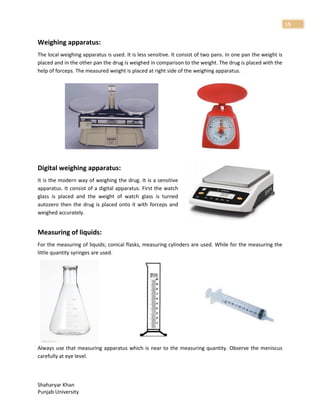
Weighing apparatus:
The local weighing apparatus is used. It is less sensitive. It consist of two pans. In one pan the weight is
placed and in the other pan the drug is weighed in comparison to the weight. The drug is placed with the
help of forceps. The measured weight is placed at right side of the weighing apparatus.
Digital weighing apparatus:
It is the modern way of weighing the drug. It is a sensitive
apparatus. It consist of a digital apparatus. First the watch
glass is placed and the weight of watch glass is turned
autozero then the drug is placed onto it with forceps and
weighed accurately.
Measuring of liquids:
For the measuring of liquids; conical flasks, measuring cylinders are used. While for the measuring the
little quantity syringes are used.
Always use that measuring apparatus which is near to the measuring quantity. Observe the meniscus
carefully at eye level.
Shaharyar Khan
Punjab University
16
Size reduction
The second operation is the size reduction for their better handling.
The most common methods of size reduction used are;
1. Trituration
2. Lavigation
Mechanism:
Mechanism consist of following steps;
 Cutting (knife)
 Compression (pressure, when both surfaces are stationary)
 Impact (pressure, when one surface is stationary and other is movable)
 Attrition (pressure, when both surfaces are movable)
Equipment:
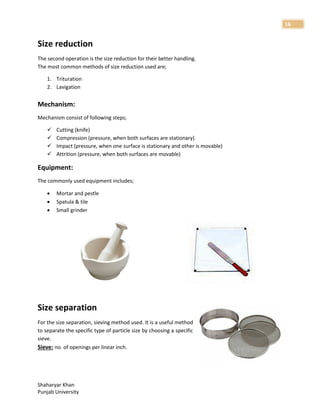
The commonly used equipment includes;
 Mortar and pestle
 Spatula & tile
 Small grinder
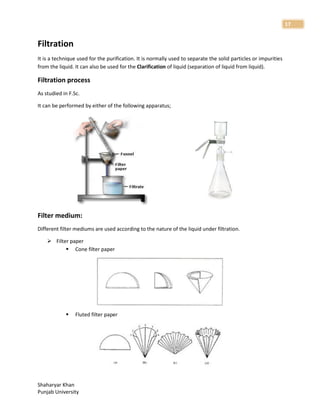
Size separation
For the size separation, sieving method used. It is a useful method
to separate the specific type of particle size by choosing a specific
sieve.
Sieve: no. of openings per linear inch.
Shaharyar Khan
Punjab University
17
Filtration
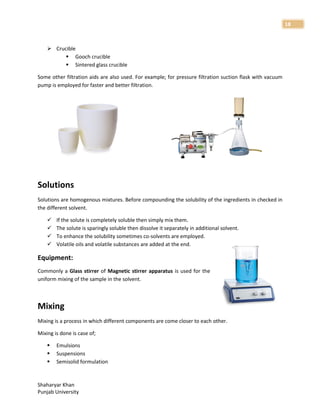
It is a technique used for the purification. It is normally used to separate the solid particles or impurities
from the liquid. It can also be used for the Clarification of liquid (separation of liquid from liquid).
Filtration process
As studied in F.Sc.
It can be performed by either of the following apparatus;
Filter medium:
Different filter mediums are used according to the nature of the liquid under filtration.
 Filter paper
 Cone filter paper
 Fluted filter paper
Shaharyar Khan
Punjab University
18
 Crucible
 Gooch crucible
 Sintered glass crucible
Some other filtration aids are also used. For example; for pressure filtration suction flask with vacuum
pump is employed for faster and better filtration.
Solutions
Solutions are homogenous mixtures. Before compounding the solubility of the ingredients in checked in
the different solvent.
 If the solute is completely soluble then simply mix them.
 The solute is sparingly soluble then dissolve it separately in additional solvent.
 To enhance the solubility sometimes co-solvents are employed.
 Volatile oils and volatile substances are added at the end.
Equipment:
Commonly a Glass stirrer of Magnetic stirrer apparatus is used for the
uniform mixing of the sample in the solvent.
Mixing
Mixing is a process in which different components are come closer to each other.
Mixing is done is case of;
 Emulsions
 Suspensions
 Semisolid formulation
Shaharyar Khan
Punjab University
19
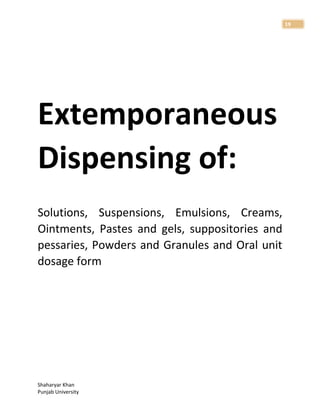
Extemporaneous
Dispensing of:
Solutions, Suspensions, Emulsions, Creams,
Ointments, Pastes and gels, suppositories and
pessaries, Powders and Granules and Oral unit
dosage form
Shaharyar Khan
Punjab University
20
Pharmaceutical powders
Pharmaceutical powders are solid dosage forms of medicament in which one or more drugs are dispensed
in finely divided state with or without excipients. They are available in crystalline or amorphous form.
The following types of preparation considered for Powders:
1. Bulk powders for external use – termed dusting powders
2. Bulk oral powders
3. Individual unit dose powders
4. Unit dose capsules
1. Bulk powders for external uses:
These are dry, free-flowing preparations consisting of one or a mixture of finely powdered substances and
intended for external application.
Advantages:
 They are easy to apply.
 They are pleasant to use.
 They absorb skin moisture, which leads to reduced friction between skin surfaces, discourages
bacterial growth and has a cooling effect.
Disadvantages:
 They may block pores, causing irritation, or if applied to parietal surfaces, granulomas, fibrosis or
adhesions.
 Starch, although an excellent dusting powder, is organic and can support microbial growth.
 Talc, despite being an inert compound, can be contaminated with microorganisms and must
therefore always be sterilized prior to incorporation into a dusting powder.
 Light fluffy powders may be inhaled by infants, causing breathing difficulties.
 They are not suitable for application to broken skin.
Shaharyar Khan
Punjab University
21
Dusting powders:
Dusting powders are applied to the skin for a surface effect such as drying or lubrication. Some dusting
powders incorporate medicaments, giving them antibacterial or antifungal action. Examples include:
Example:
1. Talc Dusting Powder BP – Used as a lubricant to prevent chafing.
2. Chlorhexidine Dusting Powder BP – Used for its antibacterial effect.
3. Tinaderm Powder – A proprietary product used for the treatment of fungal infections (e.g. Tinea
infections such as athlete’s foot)
4. Zinc, Starch and Talc Dusting Powder BPC 100 g (British Pharmaceutical Codex 1973, page 664):
 Zinc Oxide BP 25 g
 Starch BP 25 g
 Purified Talc BP 50 g
Use:
- It is used as lubricant.
- It is used as antiseptic.
Precaution: Don't apply on open wounds.
General method for preparing dusting powders:
The method for mixing powders in the formulation of a dusting powder is the standard ‘doubling-up’
technique.
1. Weigh the powder present in the smallest volume (powder A) and place in the mortar.
2. Weigh the powder present in the next largest volume (powder B) and place on labelled weighing
paper.
3. Add approximately the same amount of powder B as powder A in the mortar.
4. Mix well with pestle.
5. Continue adding an amount of powder B that is approximately the same as that in the mortar and
mix with the pestle, i.e. doubling the amount of powder in the mortar at each addition.
6. If further powders are to be added, add these in increasing order of volume as in parts 3, 4 and 5
above.
Shaharyar Khan
Punjab University
22
2. Bulk oral powders:
Powders are dispensed in bulk when accuracy of dosage is not important. They are supplied in wide
mouthed container with spoon. Bulk oral powders resemble dusting powders with the exception that they
are intended for oral administration. The dose to be taken is measured with a 5 mL spoon, stirred into a
quantity of water and then swallowed.
Preparations in this group are formulated on the basis of dose-weights, whereas the dose is actually
measured by volume. The measure of volume used is a heaped 5 mL spoonful, which is considered to be
the equivalent to 5g of powder.
It is obvious that both the accuracy and precision of the dosage will be significantly influenced by a large
number of varying factors. These include;
 The density of the powders used
 The interpretation of ‘heaped’ 5 mL spoon by the patient
Consequently, this formulation is restricted to use in preparations consisting of relatively non-potent
medicaments such as Kaolin BP and Magnesium Trisilicate BP.
Bulk powders may be a single powder (e.g. Magnesium Trisilicate Powder BP) or a mix of several powders
(e.g. Calcium Carbonate Compound Powder BPC 1973).
Example:
Compound Rhubarb powders B.P.C (Gregory's powder)
 Rhubarb powder 250 g
 Light magnesium carbonate 325 g
 Heavy magnesium carbonate 325 g
 Ginger in powder 100 g
Direction: 0.5g to 5g to be taken twice a day.
Advantages:
 Dry powders may be more stable than their liquid equivalent
 Large doses of bulky powders may be administered with relative ease (e.g. indigestion powders)
 Absorption from the gastrointestinal tract will be quicker than with capsules or tablets.
Disadvantages:
 The accuracy of dosage is not guaranteed, therefore it is not a suitable dosage form for potent
medication
 The large size container means that they may be inconvenient to carry
 It is difficult to mask any unpleasant taste.
Shaharyar Khan
Punjab University
23
3. Individual unit dose powders:
Definition:
Single-dose powders usually consist of one or more powdered active medicaments, together with an inert
diluent, and wrapped as single doses in white demy paper, folded to a uniform shape and size.
The sole difference between individual unit dose powders and bulk oral powders is that the dosage
problem is overcome by providing the patient with a set of separate doses, each of which has been
individually wrapped.
The weight of each powder should be 200 mg, our recommended weight, for ease of handling by the
patient. This weight is chosen because;
 200 mg can be weighed on a Class II balance (or electronic equivalent) (i.e. 200 mg is greater than
the minimum weighable quantity of the balance)
 200 mg is an easy figure to use in pharmaceutical calculations (it is easy to undertake calculations
using multiples or divisions of 200)
 200 mg is the amount of powder that will fit into a size 3 capsule and, for ease, it would make
sense to use the same calculations for both powders and capsules
The diluent used is normally Lactose BP as it is colorless, soluble and harmless and therefore shows the
ideal properties of an inert diluent. Starch BP is an alternative diluent if the patient is lactose intolerant.
Advantages:
 They show greater stability than liquid dosage forms as the rate of reaction between drugs in a
dosage form in atmospheric conditions is slower than the rate of reaction in a liquid medium.
 Accurate dosage is possible.
 They are easy to administer. Powders are relatively easy to swallow and may be mixed with food
or drink in order to assist administration.
 The small particle size leads to more rapid absorption from the gastrointestinal tract compared
with tablets. This in turn leads to reduced local irritation of the gastrointestinal tract which may
be caused by local concentration of a drug, as encountered when taking an equivalent tablet.
 They are well accepted by patients, attractive to patients and convenient to carry.
Disadvantages:
 They may be difficult to swallow.
 Unpleasant flavors, bitter or nauseous, are difficult to mask when in powder form.
Shaharyar Khan
Punjab University
24
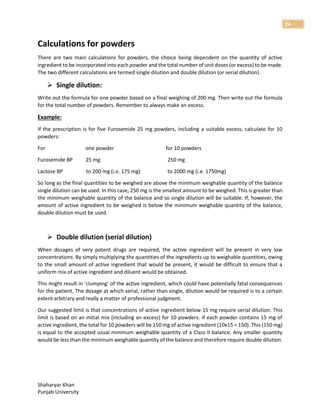
Calculations for powders
There are two main calculations for powders, the choice being dependent on the quantity of active
ingredient to be incorporated into each powder and the total number of unit doses (or excess) to be made.
The two different calculations are termed single dilution and double dilution (or serial dilution).
 Single dilution:
Write out the formula for one powder based on a final weighing of 200 mg. Then write out the formula
for the total number of powders. Remember to always make an excess.
Example:
If the prescription is for five Furosemide 25 mg powders, including a suitable excess, calculate for 10
powders:
For one powder for 10 powders
Furosemide BP 25 mg 250 mg
Lactose BP to 200 mg (i.e. 175 mg) to 2000 mg (i.e. 1750mg)
So long as the final quantities to be weighed are above the minimum weighable quantity of the balance
single dilution can be used. In this case, 250 mg is the smallest amount to be weighed. This is greater than
the minimum weighable quantity of the balance and so single dilution will be suitable. If, however, the
amount of active ingredient to be weighed is below the minimum weighable quantity of the balance,
double dilution must be used.
 Double dilution (serial dilution)
When dosages of very potent drugs are required, the active ingredient will be present in very low
concentrations. By simply multiplying the quantities of the ingredients up to weighable quantities, owing
to the small amount of active ingredient that would be present, it would be difficult to ensure that a
uniform mix of active ingredient and diluent would be obtained.
This might result in ‘clumping’ of the active ingredient, which could have potentially fatal consequences
for the patient. The dosage at which serial, rather than single, dilution would be required is to a certain
extent arbitrary and really a matter of professional judgment.
Our suggested limit is that concentrations of active ingredient below 15 mg require serial dilution. This
limit is based on an initial mix (including an excess) for 10 powders. If each powder contains 15 mg of
active ingredient, the total for 10 powders will be 150 mg of active ingredient (10x15 = 150). This (150 mg)
is equal to the accepted usual minimum weighable quantity of a Class II balance. Any smaller quantity
would be less than the minimum weighable quantity of the balance and therefore require double dilution.
Shaharyar Khan
Punjab University
25
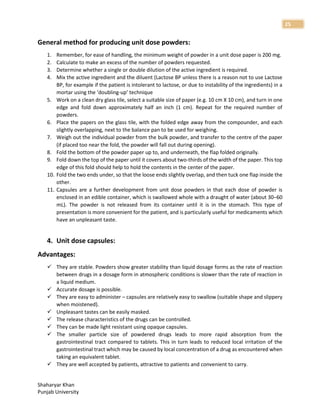
General method for producing unit dose powders:
1. Remember, for ease of handling, the minimum weight of powder in a unit dose paper is 200 mg.
2. Calculate to make an excess of the number of powders requested.
3. Determine whether a single or double dilution of the active ingredient is required.
4. Mix the active ingredient and the diluent (Lactose BP unless there is a reason not to use Lactose
BP, for example if the patient is intolerant to lactose, or due to instability of the ingredients) in a
mortar using the ‘doubling-up’ technique
5. Work on a clean dry glass tile, select a suitable size of paper (e.g. 10 cm X 10 cm), and turn in one
edge and fold down approximately half an inch (1 cm). Repeat for the required number of
powders.
6. Place the papers on the glass tile, with the folded edge away from the compounder, and each
slightly overlapping, next to the balance pan to be used for weighing.
7. Weigh out the individual powder from the bulk powder, and transfer to the centre of the paper
(if placed too near the fold, the powder will fall out during opening).
8. Fold the bottom of the powder paper up to, and underneath, the flap folded originally.
9. Fold down the top of the paper until it covers about two-thirds of the width of the paper. This top
edge of this fold should help to hold the contents in the center of the paper.
10. Fold the two ends under, so that the loose ends slightly overlap, and then tuck one flap inside the
other.
11. Capsules are a further development from unit dose powders in that each dose of powder is
enclosed in an edible container, which is swallowed whole with a draught of water (about 30–60
mL). The powder is not released from its container until it is in the stomach. This type of
presentation is more convenient for the patient, and is particularly useful for medicaments which
have an unpleasant taste.
4. Unit dose capsules:
Advantages:
 They are stable. Powders show greater stability than liquid dosage forms as the rate of reaction
between drugs in a dosage form in atmospheric conditions is slower than the rate of reaction in
a liquid medium.
 Accurate dosage is possible.
 They are easy to administer – capsules are relatively easy to swallow (suitable shape and slippery
when moistened).
 Unpleasant tastes can be easily masked.
 The release characteristics of the drugs can be controlled.
 They can be made light resistant using opaque capsules.
 The smaller particle size of powdered drugs leads to more rapid absorption from the
gastrointestinal tract compared to tablets. This in turn leads to reduced local irritation of the
gastrointestinal tract which may be caused by local concentration of a drug as encountered when
taking an equivalent tablet.
 They are well accepted by patients, attractive to patients and convenient to carry.
Shaharyar Khan
Punjab University
26
Disadvantages:
 They may be difficult to swallow.
 Capsules are unsuitable for very small children.
 Patients with strict religious beliefs and vegetarians may object to the use of animal gelatin
(although non-animal gelatin capsules may be available).
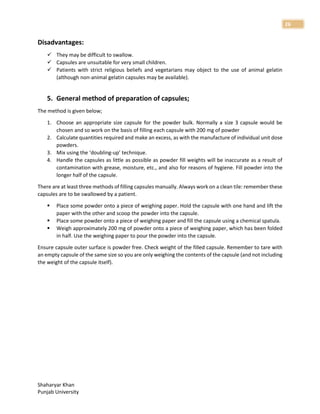
5. General method of preparation of capsules;
The method is given below;
1. Choose an appropriate size capsule for the powder bulk. Normally a size 3 capsule would be
chosen and so work on the basis of filling each capsule with 200 mg of powder
2. Calculate quantities required and make an excess, as with the manufacture of individual unit dose
powders.
3. Mix using the ‘doubling-up’ technique.
4. Handle the capsules as little as possible as powder fill weights will be inaccurate as a result of
contamination with grease, moisture, etc., and also for reasons of hygiene. Fill powder into the
longer half of the capsule.
There are at least three methods of filling capsules manually. Always work on a clean tile: remember these
capsules are to be swallowed by a patient.
 Place some powder onto a piece of weighing paper. Hold the capsule with one hand and lift the
paper with the other and scoop the powder into the capsule.
 Place some powder onto a piece of weighing paper and fill the capsule using a chemical spatula.
 Weigh approximately 200 mg of powder onto a piece of weighing paper, which has been folded
in half. Use the weighing paper to pour the powder into the capsule.
Ensure capsule outer surface is powder free. Check weight of the filled capsule. Remember to tare with
an empty capsule of the same size so you are only weighing the contents of the capsule (and not including
the weight of the capsule itself).
Shaharyar Khan
Punjab University
27
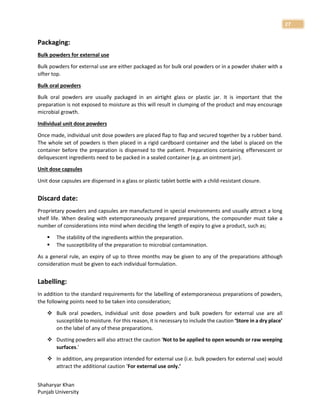
Packaging:
Bulk powders for external use
Bulk powders for external use are either packaged as for bulk oral powders or in a powder shaker with a
sifter top.
Bulk oral powders
Bulk oral powders are usually packaged in an airtight glass or plastic jar. It is important that the
preparation is not exposed to moisture as this will result in clumping of the product and may encourage
microbial growth.
Individual unit dose powders
Once made, individual unit dose powders are placed flap to flap and secured together by a rubber band.
The whole set of powders is then placed in a rigid cardboard container and the label is placed on the
container before the preparation is dispensed to the patient. Preparations containing effervescent or
deliquescent ingredients need to be packed in a sealed container (e.g. an ointment jar).
Unit dose capsules
Unit dose capsules are dispensed in a glass or plastic tablet bottle with a child-resistant closure.
Discard date:
Proprietary powders and capsules are manufactured in special environments and usually attract a long
shelf life. When dealing with extemporaneously prepared preparations, the compounder must take a
number of considerations into mind when deciding the length of expiry to give a product, such as;
 The stability of the ingredients within the preparation.
 The susceptibility of the preparation to microbial contamination.
As a general rule, an expiry of up to three months may be given to any of the preparations although
consideration must be given to each individual formulation.
Labelling:
In addition to the standard requirements for the labelling of extemporaneous preparations of powders,
the following points need to be taken into consideration;
 Bulk oral powders, individual unit dose powders and bulk powders for external use are all
susceptible to moisture. For this reason, it is necessary to include the caution ‘Store in a dry place’
on the label of any of these preparations.
 Dusting powders will also attract the caution ‘Not to be applied to open wounds or raw weeping
surfaces.’
 In addition, any preparation intended for external use (i.e. bulk powders for external use) would
attract the additional caution ‘For external use only.’
Shaharyar Khan
Punjab University
28
Dispensing of solutions
Mixtures:
When two or more things are mixed together without any fix ratio of mass, a mixture is formed.
Types of Mixtures:
1. Homogenous e.g. True solutions
2. Heterogeneous e.g. coarse and colloidal dispersions
Homogeneity means something evenly distributed
Heterogeneity means something not distributed evenly in space; a clump or cluster (not a single phase as
in case of colloidal and coarse dispersion).
Definition:
Essentially a solution is a homogeneous liquid preparation that contains one or more dissolved
medicaments. Since, by definition, active ingredients are dissolved within the vehicle, uniform doses by
volume may be obtained without any need to shake the formulation. This is an advantage over some other
formulation types, e.g. suspensions.
 A solution is a homogeneous mixture of two or more substances
 A solution is a homogenous mixture of solute and solvent.
 A solution is a homogenous mixture of two substances but consisting of one phase.
In the British Pharmacopoeia (BP), oral solutions are defined as ‘Oral Liquids containing one or more active
ingredients dissolved in a suitable vehicle’.
Generally, water is chosen as the vehicle in which medicaments are dissolved, since it is non-toxic, non-
irritant, tasteless, and relatively cheap and many drugs are water-soluble. Problems may be encountered
where active drugs are not particularly water-soluble or suffer from hydrolysis in aqueous solution. In
these cases it is often possible to formulate a vehicle containing water mixed with a variety of other
solvents.
Advantages:
 Drug available immediately for absorption:
When solid dosage forms are taken orally, the drug needs to dissolve before absorption into the body can
take place. By providing the drug in a solution, the dissolution phase of the absorption process can be
bypassed, providing quicker absorption.
 Flexible dosing:
The active ingredient within the solution will be present in a certain concentration per unit volume. If
alterations to the quantity of active ingredient to be administered are required, a simple alteration to the
quantity of solution to be taken is all that is required.
 Designed for any route of absorption:
Shaharyar Khan
Punjab University
29
Although when discussing solutions the oral route of administration is often considered, solutions can be
administered via a number of other routes. Parenteral preparations (injections), enemas for rectal use,
topical (for use on the skin) preparations and ophthalmic preparations can all be solutions.
 No need to shake the container:
Unlike some liquid preparations (e.g. suspensions), as the active ingredient is dissolved within the vehicle
there is no need to shake the container to ensure a uniform dose is measured.
 Facilitate swallowing in difficult cases:
Some patients may find it hard to swallow traditional solid dosage forms (e.g. infants or the elderly). In
these situations, it may be easier for the patient to take a liquid dosage form.
Disadvantages:
 Drug stability often reduced in solution by solvolysis, hydrolysis or oxidation:
The stability of the active ingredient needs to be taken into consideration when formulating a solution.
For this reason, it is common for solutions to attract a shorter expiry date than equivalent solid dosage
forms.
 Difficult to mask unpleasant tastes:
Although liquid dosage forms may be ideal for small children who are unable to swallow solid dosage
forms, many drugs taste unpleasant when formulated into a solution. It is possible to attempt to mask
any unpleasant tastes by the addition of a flavoring, but this will not always be successful.
 They are bulky, difficult to transport and prone to breakages:
A major disadvantage of all liquid dosage forms is that they are always much larger and more bulky than
their comparable solid formulation. This makes them heavier and more difficult to transport. Coupled
with this is the fact that, traditionally, pharmaceutical liquids are packed in glass bottles. These are
obviously prone to breakage which can be hazardous and cause the loss of the preparation.
 Technical accuracy is needed to measure the dose:
Although the dose can be titrated without the need to produce additional preparations (see point 2 from
the advantages above), patient accuracy in measuring a dose is required. It is accepted that patients’
abilities to measure an accurate dose can vary considerably and this needs to be taken into consideration
when preparing a liquid preparation. This is especially important when the volume of liquid to be
administered is very small, where small changes in the volume administered may result in large increases
or decreases in dose.
 Some drugs are poorly soluble:
The solubility of a drug needs to be taken into consideration when preparing a solution to ensure that the
final volume produced is not excessive. In some cases it may be necessary to alter the vehicle or drug form
(for example the free alkaloid or its salt) in order to be able to formulate a convenient preparation.
 A measuring device is needed for administration:
Shaharyar Khan
Punjab University
30
Although not a major disadvantage, it must be borne in mind that a measuring device will need to be
supplied to the patient in order for them to be able to measure an accurate dose (this will have cost
implications), and in addition the patient will need counseling on the use of the measuring device.
General principles of solution preparation
The two key characteristics that need to be considered when compounding solutions are solubility and
stability.
 Solubility
The following points relating to the solubility of the drug element(s) of the formulation need to be taken
into consideration:
 Will the drug(s) dissolve in the solvent or a component of the solvent system?
 What quantity of drug will dissolve?
 How long will dissolution take?
 Will the drug(s) remain in solution and for how long?
 What is the pH of solvent required for dissolution?
During compounding, is worth remembering that dissolution rates generally increase with;
 Smaller particle sizes
 Effective stirring
 Lower viscosities
 Increased temperature.
 Stability:
In addition to the solubility of the drug element(s) of the formulation, other considerations regarding the
physical stability of the preparation will need to be taken into consideration (e.g. temperature variation,
photosensitivity, etc.), as will the chemical stability and time period, and the microbiological stability and
need for a preservative.
Shaharyar Khan
Punjab University
31
General method:
The following general method should be used in the preparation of a solution:
1. Write out the formula either from the prescription (unofficial) or from an official text (official).
2. Calculate the quantities required for each ingredient in the formula to produce the required final
volume. Remember, it is not usual to calculate for an overage of product in the case of solutions
as it is relatively easy to transfer the entire final contents of the conical measure. Additionally, as
far as is practically possible, the product will be assembled in the final measure, thus reducing any
transference losses.
3. Complete all sections of the product worksheet.
4. Prepare a suitable label.
5. Weigh all solids.
6. Identify the soluble solids and calculate the quantity of vehicle required to dissolve the solids fully.
If more than one solid is to be dissolved, they are dissolved one by one, in order of solubility (i.e.
the least soluble first). In almost all cases, dissolution will take place in a glass (or occasionally
plastic) beaker, not a conical measure. Remember that the solubility of the soluble solids will be
dependent on the vehicle used.
7. Transfer the appropriate amount of vehicle to a glass beaker.
8. If necessary, transfer the solid to a glass mortar and use the glass pestle to reduce particle size to
aid dissolution.
9. Transfer the solid to the beaker and stir to aid dissolution. If a mortar and pestle have been used
to reduce particle size, ensure that the mortar is rinsed with a little vehicle to ensure complete
transfer of the powders.
10. When all the solid(s) has/have dissolved, transfer the solution to the conical measure that will be
used to hold the final solution.
11. Rinse out the beaker in which the solution was made with a portion of the vehicle and transfer
the rinsing to the conical measure.
12. Add any remaining liquid ingredients to the conical measure and stir.
13. Make up to final volume with remaining vehicle.
14. Transfer to a suitable container, label and dispense to the patient.
Key points from the method: During the dissolution phase, solutions should be stirred gently and
uniformly to avoid air entrapment, which may result in foaming of the solution. If available, automatic
stirring devices may be useful in assisting the production of a uniform product and can be time saving. If
stirring devices are used to assist dissolution (e.g. rod, magnetic stirrers), remember to remove them
before adjusting to final volume.
Further considerations: To aid dissolution, high-viscosity liquid components should be added to those
of lower viscosity. Completely dissolve salts in a small amount of water prior to the addition of other
solvent elements.
In complex solutions, organic components should be dissolved in alcoholic solvents and water soluble
components dissolved in aqueous solvents. Aqueous solutions should be added to alcoholic solutions with
stirring to maintain the alcohol concentration as high as possible – the reverse may result in separation of
any dissolved components.
Shaharyar Khan
Punjab University
32
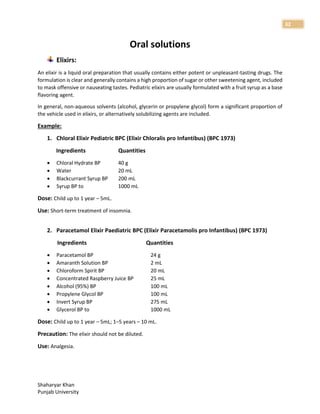
Oral solutions
Elixirs:
An elixir is a liquid oral preparation that usually contains either potent or unpleasant-tasting drugs. The
formulation is clear and generally contains a high proportion of sugar or other sweetening agent, included
to mask offensive or nauseating tastes. Pediatric elixirs are usually formulated with a fruit syrup as a base
flavoring agent.
In general, non-aqueous solvents (alcohol, glycerin or propylene glycol) form a significant proportion of
the vehicle used in elixirs, or alternatively solubilizing agents are included.
Example:
1. Chloral Elixir Pediatric BPC (Elixir Chloralis pro Infantibus) (BPC 1973)
Ingredients Quantities
 Chloral Hydrate BP 40 g
 Water 20 mL
 Blackcurrant Syrup BP 200 mL
 Syrup BP to 1000 mL
Dose: Child up to 1 year – 5mL.
Use: Short-term treatment of insomnia.
2. Paracetamol Elixir Paediatric BPC (Elixir Paracetamolis pro Infantibus) (BPC 1973)
Ingredients Quantities
 Paracetamol BP 24 g
 Amaranth Solution BP 2 mL
 Chloroform Spirit BP 20 mL
 Concentrated Raspberry Juice BP 25 mL
 Alcohol (95%) BP 100 mL
 Propylene Glycol BP 100 mL
 Invert Syrup BP 275 mL
 Glycerol BP to 1000 mL
Dose: Child up to 1 year – 5mL; 1–5 years – 10 mL.
Precaution: The elixir should not be diluted.
Use: Analgesia.
Shaharyar Khan
Punjab University
33
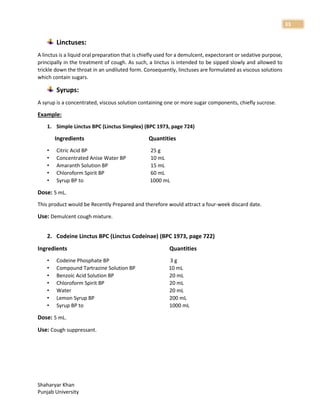
Linctuses:
A linctus is a liquid oral preparation that is chiefly used for a demulcent, expectorant or sedative purpose,
principally in the treatment of cough. As such, a linctus is intended to be sipped slowly and allowed to
trickle down the throat in an undiluted form. Consequently, linctuses are formulated as viscous solutions
which contain sugars.
Syrups:
A syrup is a concentrated, viscous solution containing one or more sugar components, chiefly sucrose.
Example:
1. Simple Linctus BPC (Linctus Simplex) (BPC 1973, page 724)
Ingredients Quantities
• Citric Acid BP 25 g
• Concentrated Anise Water BP 10 mL
• Amaranth Solution BP 15 mL
• Chloroform Spirit BP 60 mL
• Syrup BP to 1000 mL
Dose: 5 mL.
This product would be Recently Prepared and therefore would attract a four-week discard date.
Use: Demulcent cough mixture.
2. Codeine Linctus BPC (Linctus Codeinae) (BPC 1973, page 722)
Ingredients Quantities
• Codeine Phosphate BP 3 g
• Compound Tartrazine Solution BP 10 mL
• Benzoic Acid Solution BP 20 mL
• Chloroform Spirit BP 20 mL
• Water 20 mL
• Lemon Syrup BP 200 mL
• Syrup BP to 1000 mL
Dose: 5 mL.
Use: Cough suppressant.
Shaharyar Khan
Punjab University
34
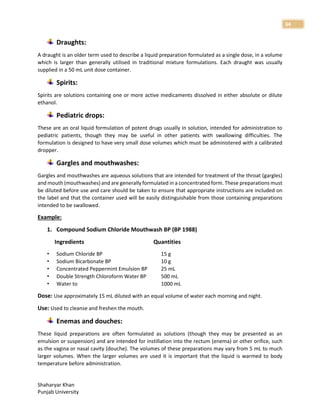
Draughts:
A draught is an older term used to describe a liquid preparation formulated as a single dose, in a volume
which is larger than generally utilised in traditional mixture formulations. Each draught was usually
supplied in a 50 mL unit dose container.
Spirits:
Spirits are solutions containing one or more active medicaments dissolved in either absolute or dilute
ethanol.
Pediatric drops:
These are an oral liquid formulation of potent drugs usually in solution, intended for administration to
pediatric patients, though they may be useful in other patients with swallowing difficulties. The
formulation is designed to have very small dose volumes which must be administered with a calibrated
dropper.
Gargles and mouthwashes:
Gargles and mouthwashes are aqueous solutions that are intended for treatment of the throat (gargles)
and mouth (mouthwashes) and are generally formulated in a concentrated form. These preparations must
be diluted before use and care should be taken to ensure that appropriate instructions are included on
the label and that the container used will be easily distinguishable from those containing preparations
intended to be swallowed.
Example:
1. Compound Sodium Chloride Mouthwash BP (BP 1988)
Ingredients Quantities
• Sodium Chloride BP 15 g
• Sodium Bicarbonate BP 10 g
• Concentrated Peppermint Emulsion BP 25 mL
• Double Strength Chloroform Water BP 500 mL
• Water to 1000 mL
Dose: Use approximately 15 mL diluted with an equal volume of water each morning and night.
Use: Used to cleanse and freshen the mouth.
Enemas and douches:
These liquid preparations are often formulated as solutions (though they may be presented as an
emulsion or suspension) and are intended for instillation into the rectum (enema) or other orifice, such
as the vagina or nasal cavity (douche). The volumes of these preparations may vary from 5 mL to much
larger volumes. When the larger volumes are used it is important that the liquid is warmed to body
temperature before administration.
Shaharyar Khan
Punjab University
35
External solutions
Lotions:
Lotions are solutions, but may also be suspensions or emulsions, that are intended to be applied to the
skin without friction on a carrier fabric such as lint and covered with a waterproof dressing. In some cases
lotions are applied to the scalp, where the vehicle for the medication is alcohol based, allowing for rapid
drying of the hair and thus making the product more acceptable to the patient (e.g. Salicylic Acid Lotion
2% BPC). In these cases, problems of flammability are addressed by suitable labelling.
Example:
1. Calamine Lotion Oily BP (Lotio Calamine Oleosa) (BP 1980)
Ingredients Quantities
• Calamine BP 50 g
• Wool Fat BP 10 g
• Arachis Oil BP 500 mL
• Oleic Acid BP 5 mL
• Calcium Hydroxide Solution BP to 1000 mL
Use: Calamine Lotion Oily was used as a mild astringent to soothe irritating rashes such as prickly heat or
chickenpox.
Liniments:
A liniment is a liquid preparation intended to be rubbed with friction and massaged onto the skin to obtain
analgesic, rubefacient or generally stimulating effects. Liniments should not be used on broken skin. They
are usually solutions of oils, alcohols or soaps, but may be formulated as emulsions.
Example:
1. White Liniment BPC (Linimentum Album) (BPC 1973, page 726)
Ingredients Quantities
• Ammonium Chloride BP 12.5 g
• Turpentine Oil BP 250 mL
• Oleic Acid BP 85 mL
• Dilute Ammonia Solution BP 45 mL
• Water 625 mL
Use: Lin Alb was also known as White Embrocation. The turpentine acts as a rubefacient and liniments
such as this were used for rheumatic pains and stiffness.
Shaharyar Khan
Punjab University
36
Collodians:
These are principally solutions of pyroxylin in a vehicle of ether and alcohol that are intended to be painted
onto the skin and left to dry. When dry, the collodion leaves a flexible film of cellulose on the skin which
may be used to seal minor injuries or retain a dissolved drug in contact with the skin for an extended
period. Collodions are highly volatile and highly flammable and care should be taken to label any
preparation appropriately.
Packaging of solutions:
When selecting packaging for extemporaneously prepared solutions, consideration should be given to the
route or method of administration. Liquid preparations that are intended for the oral route should be
packed in plain (smooth) amber bottles. External preparations and preparations that are not intended to
be taken internally (e.g. mouthwashes) should be packaged in fluted amber bottles (i.e. amber bottles
with vertical ridges or grooves). This will enable simple identification, by both sight and touch, of
preparations that are not to be taken via the oral route.
Discard date:
Extemporaneously compounded solutions are often relatively unstable for physical, chemical (hydrolysis)
and microbiological reasons. The exact impact of such processes on a compounded solution will depend
largely upon the storage conditions, the formulation and its intended purpose.
Commercially available manufactured products generally have long shelf-lives because of strictly
controlled manufacturing environments supported by rigorous quality assurance testing. Because of the
lack of complete control of conditions and inability to perform retrospective stability tests on
extemporaneously compounded solutions, much shorter shelf-lives must be attributed.
 ‘Freshly Prepared’ refers to a preparation that has been compounded less than 24 hours prior to
issue for use. In practical terms it is suggested that an expiry date two weeks is applied to oral
solutions that need to be Freshly Prepared or that contain an infusion or other vegetable matter.
 ‘Recently Prepared’ should be applied to compounded items that are likely to deteriorate if
stored for a period greater than four weeks when maintained at 15–25 C. In practical terms it is
suggested that four-week expiry should be applied oral solutions that require to be Recently
Prepared.
Remember that because patients frequently misunderstand the term ‘expiry’ it is suggested that a
preferred method of indicating shelf-life on the label of extemporaneously compounded products is to
apply the term ‘Discard after’ or ‘Do not use after’ followed by a definite date and/or time.
As a general rule in case of unofficial products, an expiry of 7–14 days would be given to any of the
following preparations;
• A solution that does not contain a preservative.
• A solution where there are no stability data available.
Shaharyar Khan
Punjab University
37
Labelling:
In addition to the standard requirements for the labelling of extemporaneous preparations, the following
points need to be taken into consideration;
 ‘Not to be taken’ and ‘Do not swallow in large amounts’ – This warning must be added to gargles
and mouthwashes.
 ‘Not to be taken’ – This warning should be added to inhalations and nasal drops.
 ‘For rectal use only’ and ‘Warm to body temperature before administration’ – These warnings
should be added to large-volume enemas.
 ‘For external use only’ – This warning must be added to the label of any other preparation that is
not intended for administration via the oral route.
Shaharyar Khan
Punjab University
38
Dispensing of Pharmaceutical Emulsions
The pharmaceutical term ‘emulsion’ is solely used to describe preparations intended for internal use (i.e.
via the oral route of administration). Emulsion formulation for external use are always given a different
title that reflects their use (e.g. application, lotion, cream, etc.).
An emulsion is essentially a liquid preparation containing a mixture of oil and water that is rendered
homogeneous by the addition of an emulsifying agent.
 The emulsifying agent ensures that the oil phase is finely dispersed throughout the water as
minute globules (Figure 1). This type of emulsion is termed an ‘oil-in-water’ emulsion. The oily
phase (disperse phase) is dispersed through the aqueous phase (continuous phase). Generally all
oral dose emulsions tend to be ‘oil in water’, as the oily phase is usually less pleasant to take and
more difficult to flavor.
 ‘Water-in-oil’ emulsions can be formed, but these tend to be those with external uses.
Definition:
According to the British Pharmacopoeia (BP):
Oral Emulsions are Oral Liquids containing one or more active ingredients. They are stabilised oil-in-water
dispersions, either or both phases of which may contain dissolved solids. Solids may also be suspended in
Oral Emulsions. When issued for use, Oral Emulsions should be supplied in wide-mouthed bottles.
Extemporaneous preparation:
In Oral Emulsions prepared according to the formula and directions given for Extemporaneous
preparation, the quantity of emulsifying agent specified in individual monographs may be reduced to yield
a preparation of suitable consistency provided that by so doing the stability of the preparation is not
adversely affected.
Shaharyar Khan
Punjab University
39
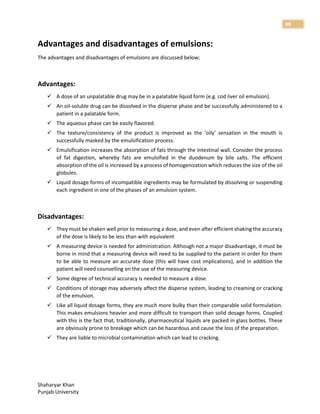
Advantages and disadvantages of emulsions:
The advantages and disadvantages of emulsions are discussed below;
Advantages:
 A dose of an unpalatable drug may be in a palatable liquid form (e.g. cod liver oil emulsion).
 An oil-soluble drug can be dissolved in the disperse phase and be successfully administered to a
patient in a palatable form.
 The aqueous phase can be easily flavored.
 The texture/consistency of the product is improved as the ‘oily’ sensation in the mouth is
successfully masked by the emulsification process.
 Emulsification increases the absorption of fats through the intestinal wall. Consider the process
of fat digestion, whereby fats are emulsified in the duodenum by bile salts. The efficient
absorption of the oil is increased by a process of homogenization which reduces the size of the oil
globules.
 Liquid dosage forms of incompatible ingredients may be formulated by dissolving or suspending
each ingredient in one of the phases of an emulsion system.
Disadvantages:
 They must be shaken well prior to measuring a dose, and even after efficient shaking the accuracy
of the dose is likely to be less than with equivalent
 A measuring device is needed for administration. Although not a major disadvantage, it must be
borne in mind that a measuring device will need to be supplied to the patient in order for them
to be able to measure an accurate dose (this will have cost implications), and in addition the
patient will need counselling on the use of the measuring device.
 Some degree of technical accuracy is needed to measure a dose.
 Conditions of storage may adversely affect the disperse system, leading to creaming or cracking
of the emulsion.
 Like all liquid dosage forms, they are much more bulky than their comparable solid formulation.
This makes emulsions heavier and more difficult to transport than solid dosage forms. Coupled
with this is the fact that, traditionally, pharmaceutical liquids are packed in glass bottles. These
are obviously prone to breakage which can be hazardous and cause the loss of the preparation.
 They are liable to microbial contamination which can lead to cracking.
Shaharyar Khan
Punjab University
40
Method of preparation
Continental & Dry gum method:
1. Extemporaneously prepared emulsions for oral administration are usually made by the
Continental or the dry gum method, where the emulsion is formed by mixing the emulsifying gum
(usually Acacia BP) with the oil, which is then mixed with the aqueous phase. The only difference
between the Continental and dry gum methods is the proportions of constituents within the
primary emulsion (for example, fixed oil emulsions made by the Continental method would use a
ratio of 4:3:2 rather than 4:2:1 with the dry gum method).
2. Internal emulsions prepared by the dry gum method should contain, in addition to the oil to be
emulsified, the following ingredients:
i. A vehicle – freshly boiled and cooled purified water is normally used because of the
increased risk from microbial contamination.
ii. A preservative (usually added to the product as Double Strength Chloroform Water BP at
50% of the volume of the vehicle). If freshly boiled and cooled purified water is used as
the vehicle, it would be appropriate to manufacture the Double Strength Chloroform
Water BP using freshly boiled and cooled purified water rather than potable water
iii. An emulsifying agent (or emulgent). The quantity of emulsifying agent added is
determined by the type of oil to be emulsified and the quantity of emulsion to be
prepared.
iv. Additional flavoring if required.
v. Additional coloring if required.
Occasionally, finely divided solids have been used to form emulsions. The solid must possess a balance of
hydrophilic and hydrophobic properties. Colloidal clays such as bentonite, magnesium hydroxide,
aluminium hydroxide, magnesium oxide and silica gel are some of the insoluble substances that have been
used as emulsifying agents.
If the chosen powder is easily wetted by water then an oil-in-water emulsion is formed, whereas those
that are preferentially wetted by the oil phase produce water-in-oil emulsions. The colloidal clays are
mainly used as emulsion stabilizers for external lotions or creams. Whereas, aluminum and magnesium
hydroxide have both been used as emulsifying agents for preparations intended for internal use.
All emulsifying agents will exhibit certain physical and chemical characteristics that will determine how
effective they are under various conditions of use.
Emulsifying agent:
All emulsifying agents will contain a water attracting or hydrophilic part and an oil-attracting or lipophilic
part.
 If an emulsifying agent was too hydrophilic it would dissolve completely in the aqueous phase.
 If it was too lipophilic it would totally dissolve in the oily phase.
Shaharyar Khan
Punjab University
41
The ideal emulsifying agent must concentrate predominantly at the interface between oil and aqueous
phases, where it is positioned such that the hydrophilic portion is in the aqueous phase and the lipophilic
portion is in the oily phase. When an emulsifying agent displays these properties it is said to have the
proper hydrophilic–lipophilic balance. If an emulsifying agent is predominantly hydrophilic an oil-in-water
emulsion is formed. Conversely, if it is predominantly lipophilic it will favor the production of a water-in-
oil emulsion.
The hydrophilic–lipophilic balance (HLB) of surface active agents has been categorized into the HLB system
of numbering.
 High HLB numbers indicate hydrophilic properties
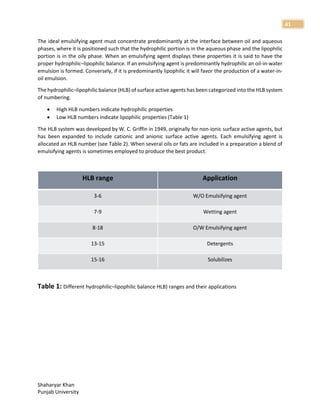
 Low HLB numbers indicate lipophilic properties (Table 1)
The HLB system was developed by W. C. Griffin in 1949, originally for non-ionic surface active agents, but
has been expanded to include cationic and anionic surface active agents. Each emulsifying agent is
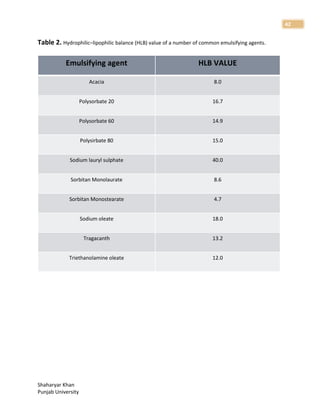
allocated an HLB number (see Table 2). When several oils or fats are included in a preparation a blend of
emulsifying agents is sometimes employed to produce the best product.
HLB range Application
3-6 W/O Emulsifying agent
7-9 Wetting agent
8-18 O/W Emulsifying agent
13-15 Detergents
15-16 Solubilizes
Table 1: Different hydrophilic–lipophilic balance HLB) ranges and their applications
Shaharyar Khan
Punjab University
42
Table 2. Hydrophilic–lipophilic balance (HLB) value of a number of common emulsifying agents.
Emulsifying agent HLB VALUE
Acacia 8.0
Polysorbate 20 16.7
Polysorbate 60 14.9
Polysirbate 80 15.0
Sodium lauryl sulphate 40.0
Sorbitan Monolaurate 8.6
Sorbitan Monostearate 4.7
Sodium oleate 18.0
Tragacanth 13.2
Triethanolamine oleate 12.0
Shaharyar Khan
Punjab University
43
 Calculation of the amount of emulsifying agent to be used in the preparation of an emulsion
using the dry gum method:
The amount of emulsifying agent used is dependent on the amount and type of oil to be emulsified. Oils
can be divided into three categories, fixed oils, mineral oils and aromatic (volatile) oils.
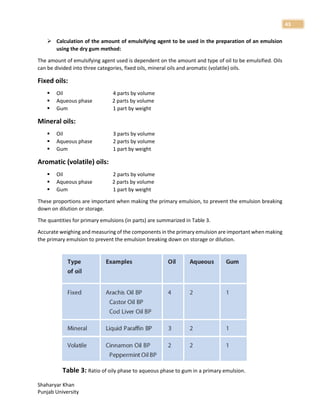
Fixed oils:
 Oil 4 parts by volume
 Aqueous phase 2 parts by volume
 Gum 1 part by weight
Mineral oils:
 Oil 3 parts by volume
 Aqueous phase 2 parts by volume
 Gum 1 part by weight
Aromatic (volatile) oils:
 Oil 2 parts by volume
 Aqueous phase 2 parts by volume
 Gum 1 part by weight
These proportions are important when making the primary emulsion, to prevent the emulsion breaking
down on dilution or storage.
The quantities for primary emulsions (in parts) are summarized in Table 3.
Accurate weighing and measuring of the components in the primary emulsion are important when making
the primary emulsion to prevent the emulsion breaking down on storage or dilution.
Table 3: Ratio of oily phase to aqueous phase to gum in a primary emulsion.
Shaharyar Khan
Punjab University
44
Wet gum method:
1. The proportions of oil, water and emulsifying agent for the preparation of the primary emulsion
are the same as those used in the dry gum method.
2. The difference is in the method of preparation. Using this method the acacia powder would be
added to the mortar and then triturated with the water until the gum was dissolved and a
mucilage formed (thick gluey substance).
3. The oil would then be added to the mucilage drop by drop while triturating continuously. When
nearly all the oil has been added, the resulting mixture in the mortar may appear a little poor with
some of the oil appearing to be absorbed or mixture become too thick. This can be rectified by
the addition of slightly more water.
4. The trituration continues until all the oil has been added, adding extra small amounts of water
when necessary.
5. When all the oil has been added, the mixture is triturated until a smooth primary emulsion is
obtained. In the main this method has fallen out of favor as it takes much longer than the dry gum
method.
Shaharyar Khan
Punjab University
45
General method of preparation of an emulsion using the dry gum
method:
It is relatively easy for an emulsion to crack, resulting in a failed product. Remember the following points
are critical when preparing emulsions:
1) Clean, dry equipment – All equipment should be thoroughly cleaned, rinsed with water and dried
carefully before use, particularly measures, mortars and pestles.
2) Accurate quantities – Accurate quantities are essential. Check weighing/measuring technique and
minimize transference losses (e.g. allow oil to drain from measure).
3) Have all ingredients ready – Correct rate of addition is important. Ingredients for the primary
emulsion should all be weighed and measured before starting to make the product.
The preparation of an emulsion has two main components:
 Preparation of a concentrate called the ‘primary emulsion’.
 Dilution of the concentrate.
Preparation of primary emulsion:
 Measure the oil accurately in a dry measure. Transfer the oil into a large dry porcelain mortar,
allowing all the oil to drain out.
 Measure the quantity of aqueous vehicle required for the primary emulsion. Place this within easy
reach.
 Weigh the emulsifying agent and place on the oil in the mortar. Mix lightly with the pestle, just
sufficient to disperse any lumps. Caution – over mixing generates heat, which may denature the
emulsifying agent and result in a poor product.
 Add all of the required aqueous vehicle in one addition. Then mix vigorously, using the pestle with
a shearing action in one direction.
 When the product becomes white and produces a ‘clicking’ sound the primary emulsion has been
formed. The product should be a thick white cream. Increased degree of whiteness indicates a
better quality product. Oil globules/slicks should not be apparent.
Dilution of the primary emulsion:
 Dilute the primary emulsion drop by drop with very small volumes of the remaining aqueous
vehicle. Mix carefully with the pestle in one direction.
 Transfer emulsion to a measure, with rinsing’s. Add other liquid ingredients if necessary and make
up to the final volume.
Shaharyar Khan
Punjab University
46
Stability of emulsion:
Emulsions can break down through cracking, creaming or phase inversion;
1. Cracking
This is the term applied when the disperse phase coalesces and forms a separate layer. Re-dispersion
cannot be achieved by shaking and the preparation is no longer an emulsion. Cracking can occur if the oil
turns rancid during storage. The acid formed denatures the emulsifying agent, causing the two phases to
separate.
2. Creaming:
In creaming, the oil separates out, forming a layer on top of the emulsion, but it usually remains in globules
so that it can be re-dispersed on shaking (e.g. the cream on the top of a pint of milk). This is undesirable
as the product appearance is poor and if the product is not adequately shaken there is a risk of the patient
obtaining an incorrect dose. Creaming is less likely to occur if the viscosity of the continuous phase is
increased.
3. Phase inversion
This is the process when an oil-in-water emulsion changes to a water-in-oil emulsion or vice versa. For
stability of an emulsion, the optimum range of concentration of dispersed phase is 30–60% of the total
volume. If the disperse phase exceeds this the stability of the emulsion is questionable. As the
concentration of the disperse phase approaches a theoretical maximum of 74% of the total volume, phase
inversion is more likely to occur.
Shaharyar Khan
Punjab University
47
Emulsions for external use:
Emulsions for external use are designed for application to the skin and may be liquid or semi-liquid in
consistency. The formulation of external emulsions differs from that of conventional emulsions in that no
primary emulsion is formed. As with internal emulsions, both oil-in-water and water-in-oil emulsions can
be produced and applied to the surface of the skin and mucous membranes.
The consistency of the formed emulsion determines whether it is a lotion or a much thicker cream
product. The advantage of an emulsion as an external application is that it is easily spread over the skin
and usually easily removed by washing.
Water miscible vehicles:
 Water – Usually freshly boiled and cooled purified water to reduce the chances of any microbial
contamination.
 Alcohol – Industrial methylated spirit (IMS) is the normal alcoholic constituent of products for
external use as it is exempt from excise duty and therefore cheaper than ethanol. Alcohol is
sometimes added to increase the cooling effect of the product, owing to the evaporation of the
alcohol from the skin’s surface.
Oily vehicles
 Mineral oils – e.g. Light Liquid Paraffin BP, Liquid Paraffin BP.
 Vegetable oils – e.g. Arachis Oil BP, Coconut Oi BP, Olive Oil BP. The problem with these oils
is that they tend to go rancid.
 Synthetic oils – e.g. Dimethicone (Dimeticone) BP.
Preservative:
The preservatives commonly used in emulsions for external use are the same as those commonly
employed in the extemporaneous formulation and production of creams namely;
 Benzoic Acid BP 0.1%
 Chlorocresol BP 0.1%
 Cetrimide BP 0.002–0.01%
Shaharyar Khan
Punjab University
48
Emulsifying agents used in the preparation of external emulsions
Water in oil emulsifiers:
 Beeswax – Occasionally used and is a traditional water-in-oil emulsifier; it is not a very good
emulsifier and nowadays tends to be used as an emulsion stabiliser.
 Calcium soaps – Made in situ by mixing a fatt acid and calcium hydroxide solution (lime
water).
 Wool alcohol – Preferable to wool fat as it is purer but still has the problem of creating
unpleasant odours in warm weather.
 Wool fat – Similar to human sebum and can cause sensitisation problems in some patients.
Mainly used as an emulsion stabiliser.
 Synthetic surfactants – Synthetic surface active agents with low HLB values.
Oil in water emulsifiers:
 Emulsifying waxes:
– Anionic – Emulsifying wax BP
– Cationic – Cetrimide Emulsifying Wax BP
– Non-ionic – Cetomacrogol Emulsifying Wax BP.
 Soaps:
– Soft soap – sticky green material that produces an oil-in-water emulsion (e.g. Turpentine Liniment BP)
– Ammonium soaps formed during the preparation of products when the oleic acid and ammonium
compounds react to produce ammonium oleate, an oil-in-water emulsifying agent.
Synthetic surface active agents with a high HLB value.
The emulsifying agents used for emulsions for internal use, namely tragacanth and acacia, would not be
suitable for an emulsion for external use as they are too sticky. Other than creams that are thick
emulsions, applications, lotions and liniments are often liquid emulsions.
Shaharyar Khan
Punjab University
49
Packaging:
With pharmaceutical emulsions intended for internal use, a suitable container would be a flat amber
medical bottle.
External emulsions (e.g. creams, liniments, lotions, etc.) would be packaged in suitable containers. For
example; a fluted amber bottle for liniments and lotions and a collapsible tube for a cream.
Pharmaceutical bottles come in a variety of different sizes and it is important to choose a suitably sized
container to match the volume of preparation to be dispensed. Obviously it is important not to use a size
of container that is too large for the volume of preparation to be dispensed, for both cost and appearance
reasons. Consideration should be given to selecting a bottle that will leave sufficient space to allow the
product to be shaken adequately before a dose is measured.
Discard dates:
Discard dates for pharmaceutical emulsions typically mirror those for pharmaceutical solutions. The
discard date of official preparations will be advised via the relative official texts. As with solutions and
suspensions, for official preparations the BP employs two definitions that are useful when
extemporaneously compounding emulsions:
 ‘Freshly Prepared’ refers to a preparation that has been compounded less than 24 hours prior to
issue for use.
 ‘Recently Prepared’ should be applied to compounded items that are likely to deteriorate if
stored for a period greater than four weeks when maintained at 15–25 C.
Traditionally it was suggested that an expiry date of four weeks be applied to oral emulsions in the
absence of any official guidance. Although emulsions usually contain a preservative (Double Strength
Chloroform Water BP at 50% v/v), they are liable to microbial contamination. For this reason,
consideration should be given to shortening the expiry date to 7–14 days.
Remember that because patients frequently misunderstand the term ‘expiry’ it is suggested that a
preferred method of indicating shelf-life on the label of extemporaneously compounded products is to
apply the term ‘Discard after’ or ‘Do not use after’ followed by a definite date and/or time.
Labeling:
In addition to the standard requirements for the labelling of extemporaneous preparations, the following
points need to be taken into consideration:
 ‘Shake the bottle’ – All emulsions will require this additional label.
 ‘For external use only’ – This warning must be added to the label of any external emulsion.
Shaharyar Khan
Punjab University
50
Dispensing of Pharmaceutical suspensions
Introduction:
Suspensions are an important pharmaceutical dosage form that are still widely in use. Owing to their
versatility they are often used in situations where an ‘emergency’ formulation is required. Common
pharmaceutical products that are suspensions Include;
 Ear drops
 Enemas
 Inhalations
 Lotions
 Mixtures for oral use.
Definition:
A pharmaceutical suspension is defined as a preparation where at least one of the active ingredients is
suspended throughout the vehicle. In contrast to solutions, in a suspension at least one of the
ingredients is not dissolved in the vehicle and so the preparation will require shaking before a dose is
administered.
The British Pharmacopoeia (BP) defines oral suspensions as, ‘Oral Liquids containing one or more active
ingredients suspended in a suitable vehicle. Suspended solids may slowly separate on standing but are
easily redispersed.’
Advantages:
The advantages of suspension are as fallows;
 Insoluble derivatives of certain drugs may be more palatable than their soluble equivalent.
 Insoluble derivatives of drugs may be more stable in the aqueous vehicle than the equivalent
soluble salt.
 Suspended insoluble powders are easy to swallow.
 Bulky insoluble powders such as Kaolin BP and Chalk BP can be administered in suspension and
can act as adsorbents of toxins in the gastrointestinal tract.
 Suspended drugs will be more rapidly absorbed from the gastrointestinal tract than the equivalent
solid dosage form (although absorption will be slower than from the equivalent solution).
 Lotions that are suspensions leave a thin layer of medicament on the skin. The liquid part of the
suspension evaporates, giving a cooling effect to the skin and leaving the thin layer of powder
behind (for example Calamine Lotion BP).
Shaharyar Khan
Punjab University
51
Disadvantages:
 They must be well shaken prior to measuring a dose.
 The accuracy of the dose is likely to be less than with the equivalent solution.
 Conditions of storage may adversely affect the disperse system and in the case of indiffusible
solids clumping may occur, leading to potential dosing inaccuracy.
 Like all liquid dosage forms, they are always much larger and more bulky than their comparable
solid formulations. This makes them heavy and difficult to transport. Coupled with this is the fact
that, traditionally, pharmaceutical liquids are packed in glass bottles. These are obviously prone
to breakage which can be hazardous and cause the loss of the preparation.
General principles of suspension preparation
Although similar to pharmaceutical solutions in a number of ways, pharmaceutical suspensions differ in
that one or more of the solid ingredients are suspended throughout the vehicle rather than dissolved
within it. Different pharmaceutical solids have differing abilities to suspend throughout a vehicle. This
results in two types of pharmaceutical suspension: diffusible suspensions and indiffusible suspensions.
Diffusible solids:
These are suspensions containing light powders that are insoluble, or only very slightly soluble, in the
vehicle but which on shaking disperse evenly throughout the vehicle for long enough to allow an
accurate dose to be poured.
Examples of diffusible powders commonly incorporated into pharmaceutical suspensions include;
 Light Kaolin BP – insoluble in water
 Light Magnesium Carbonate BP – very slightly soluble in water
 Magnesium Trisilicate BP – insoluble in water.
Indiffusible solids:
These are suspensions containing heavy powders that are insoluble in the vehicle and which on shaking
do not disperse evenly throughout the vehicle long enough to allow an accurate dose to be poured.
Examples of indiffusible powders commonly incorporated into pharmaceutical suspensions include;
 Aspirin BP
 Calamine BP
In the preparation of indiffusible suspensions, the main difference from diffusible suspensions is that the
vehicle must be thickened to slow down the rate at which the powder settles. This is achieved by the
addition of a suspending agent.
Shaharyar Khan
Punjab University
52
Formulation of suspensions:
The non-soluble ingredients of a suspension are dispersed in the vehicle and, as with pharmaceutical
solutions, water is normally the vehicle of choice. The density of the aqueous vehicle can be altered
slightly by the addition of sucrose or glycerol and the viscosity can be changed by the addition of
thickening agents. The increase in the viscosity means that the rate of sedimentation of the insoluble
solid will be slower.
Suspension as emergency formulation:
In addition to established formulae, compounders may be required to produce a suitable liquid
preparation for patients who are unable to swallow tablets or capsules. Occasionally, the medicament
required may only be available commercially as a solid dosage form. If a liquid preparation is
unavailable, the compounder may be expected to prepare a liquid product from the commercially
available solid dosage form. This normally involves crushing of tablets or opening of capsules to provide
powdered drug to prepare a suspension.
When preparing a suspension from solid dosage forms, it must always be remembered that tablets and
capsules will contain unknown excipients as well as the nominal quantity of drug. The bioavailability of
the drug is likely to be unknown, and if possible a pure sample of powdered drug should be obtained in
order to produce a suspension without extraneous components. However, in cases where the solid
dosage form is the only source of the drug, Tragacanth Powder BP or Compound Tragacanth Powder BP
are usually suitable suspending agents.
Shaharyar Khan
Punjab University
53
Oral diffusible suspensions
General method preparation:
The steps involved in the preparation of diffusible suspension are written below;
1. Check the solubility, in the vehicle, of all solids in the mixture.
2. Calculate the quantities of vehicle required to dissolve any soluble solids.
3. Prepare any Double Strength Chloroform Water BP required.
4. Weigh all solids on a Class II or electronic balance.
5. Dissolve all soluble solids in the vehicle in a small glass beaker using the same procedures as
outlined in the chapter on solutions.
6. Mix any insoluble diffusible powders in a porcelain mortar using the ‘doubling-up’ technique to
ensure complete mixing
7. Add a small quantity of the vehicle (which may or may not be a solution of the soluble ingredients)
to the solids in the mortar and mix using a pestle to form a smooth paste.
8. Add further vehicle in small quantities, and continue mixing until the mixture in the mortar is of a
pourable consistency.
9. Transfer the contents of the mortar to a conical measure of suitable size.
10. Rinse out the mortar with more vehicle and add any rinsings to the conical measure.
11. Add remaining liquid ingredients to the mixture in the conical measure. (These are added now, as
some may be volatile and therefore exposure during mixing needs to be reduced to prevent loss
of the ingredient by evaporation.)
12. Make up to final volume with vehicle.
13. Stir gently, transfer to a suitable container, ensuring that all the solid is transferred from the
conical measure to the bottle, and label ready to be dispensed to the patient.
Point of clarity – method; alternatively, the contents of the mortar could be transferred directly to a
pre-prepared tarred container. Rinsing from the mortar and other liquid ingredients could then be added
to the bottle before being made up to final volume. This would prevent any possible transference loss
caused by powders sedimentations in the conical measure
Shaharyar Khan
Punjab University
54
Oral indiffusiable suspension
Oral indiffusible suspensions are prepared using the same basic principles as for oral diffusible
suspensions. The main difference is that the preparation will require the addition of a suspending agent.
The suspending agent of choice will normally be combined with the indiffusible solid using the ‘doubling-
up’ technique before incorporation into the product.
General method of preparation:
The steps involved in the preparation of indiffusible suspension are written below;
1. Check the solubility in the vehicle of all solids in the mixture.
2. Calculate the quantities of vehicle required to dissolve any soluble solids.
3. Prepare any Double Strength Chloroform Water BP required.
4. Weigh all solids on a Class II or electronic balance.
5. Dissolve all soluble solids in the vehicle in a small glass beaker.
6. Mix any insoluble indiffusible powders and the suspending agent in a porcelain mortar using the
doubling-up’ technique to ensure complete mixing
7. Add a small quantity of the vehicle (which may or may not be a solution of the soluble ingredients)
to the solids in the mortar and mix using a pestle to form a smooth paste.
8. Add further vehicle in small quantities, and continue mixing until the mixture in the mortar is a
pourable consistency.
9. Transfer the contents of the mortar to a conical measure of suitable size.
10. Rinse out the mortar with more vehicle and add any rinsings to the conical measure.
11. Add remaining liquid ingredients to the mixture in the conical measure. (These are added now, as
some may be volatile and therefore exposure during mixing needs to be reduced to prevent loss
of the ingredient by evaporation.)
12. Make up to final volume with vehicle.
13. Stir gently, transfer to a suitable container, ensuring that all the solid is transferred from the
conical measure to the bottle, and label ready to be dispensed to the patient.
Point of clarity – method; alternatively, the contents of the mortar could be transferred directly to a
pre-prepared tared container. Rinsing from the mortar and other liquid ingredients could then be added
to the bottle before being made up to final volume. This would prevent any possible transference loss
caused by powders sedimenting in the conical measure.
Shaharyar Khan
Punjab University
55
Suspensions for external use:
Suspensions intended for external use can be compounded using the same basic principles as those
intended for internal use. There may be differences in the choice of suspending agent used.
Inhalations:
Inhalations are liquid products that contain volatile ingredients intended to be released and brought into
contact with the respiratory lining. Suspensions are a particularly useful way of effecting this transfer as
the volatile ingredient can be adsorbed onto a carrier powder (a diffusible solid) and formulated as a
suspension which can then provide an accurate dose to be added to hot (about 65 C) but not boiling water,
so that the volatile ingredient is released and inhaled by the patient. Alcoholic solutions are also suitable
to use as a ‘hot’ inhalation. If ingredients are volatile at room temperature they may be inhaled directly
from a handkerchief or absorbent pad.
Lotions:
Lotions can be suspensions, although they may also be solutions or emulsions. They are intended to be
applied to the skin, without friction, on a carrier fabric such as lint and covered with a waterproof dressing.
In some cases, such as Calamine Lotion BP, they may be dabbed onto the skin surface and allowed to dry.
Packaging:
The packaging for suspensions is based on the same principles as for solutions, as both preparation types
are based on liquid administration. When selecting packaging for extemporaneously prepared
suspensions, consideration should be given to the route or method of administration.
 Liquid preparations that are intended for the oral route should be packed in plain amber bottles.
 External preparations should be packaged in fluted amber bottles.
This will enable simple identification, by both sight and touch, of preparations that are not to be taken via
the oral route.
Pharmaceutical bottles come in a variety of different sizes and it is important to choose a suitably sized
container to match the volume of preparation to be dispensed. Obviously it is important not to use a size
of container that is too large for the volume of preparation to be dispensed, for both cost and appearance
issues. Consideration should be given to selecting a bottle that will leave sufficient space to allow the
product to be shaken adequately before a dose is measured
Shaharyar Khan
Punjab University
56
Discard date:
Discard dates for pharmaceutical suspensions typically mirror those for pharmaceutical solutions. The
discard date of official preparations will be advised via the relative official texts. As with solutions, for
official preparations the British Pharmacopoeia employs two definitions that are useful when
extemporaneously compounding suspensions:
 ‘Freshly Prepared’ refers to a preparation that has been compounded less than 24 hours prior to
issue for use.
 ‘Recently Prepared’ should be applied to compounded items that are likely to deteriorate if
stored for a period greater than four weeks when maintained at 15–25 C.
In practical terms it is suggested that an expiry date of two weeks is applied to oral suspensions that
need to be Freshly Prepared or that contain an infusion or other vegetable matter. A four-week expiry
should be applied to oral suspensions that need to be Recently Prepared.
Remember that because patients frequently misunderstand the term ‘expiry’ it is suggested that a
preferred method of indicating shelf-life on the label of extemporaneously compounded products is to
apply the term ‘Discard after’ or ‘Do not use after’ followed by a definite date and/or time.
When dealing with unofficial preparations, the compounder must consider the following. As a general
rule, an expiry of 7–14 days would be given to any of the following preparations;
 A suspension that does not contain a preservative
 A suspension where there are no stability data available
 A new suspension or ad hoc preparation.
Labelling:
In addition to the standard requirements for the labelling of extemporaneous preparations, the
following points need to be taken into consideration;
 ‘Shake the bottle’ – All suspensions will require this additional label.
 ‘Not to be taken’ – This warning must be added to the label of any inhalations.
 ‘For external use only’ – This warning must be added to the label of any other suspension not
intended for administration via the oral route.
Shaharyar Khan
Punjab University
57
Dispensing of pharmaceutical ointments
Ointments:
Ointments are preparations for external application but differ from creams in that they have greasy bases.
The base is usually anhydrous and immiscible with skin secretions. Ointments usually contain a
medicament or a mixture of medicaments dissolved or dispersed in the base.
According to the British Pharmacopoeia (BP) Ointments are formulated to provide preparation that are
immiscible, miscible or emulsifiable with the skin secretion. Hydrophobic ointments and water-
emulsifying ointments are intended to be applied to the skin or certain mucous membranes for emollient,
protective, therapeutic or prophylactic purposes where a degree of occlusion is desired. Hydrophilic
ointments are miscible with the skin secretion and are less emollient as a consequence.
Ointment bases:
The base of a traditional ointment consists of a mixture of waxes, fats and oils:
 Waxes – solid and hard at room temperature
 Fats – semi-solid, soft at room temperature
 Oils – liquid at room temperature.
A change in temperature can affect the physical state of a base (e.g. coconut oil is solid in winter but is
more likely to be liquid in summer).
The addition of a wax to an ointment makes the preparation smoother and lighter in consistency. Altering
the proportions of oil, fat and wax in the ointment may vary the consistency. For example, extra wax will
make the ointment stiffer; extra oil will make the ointment less viscous. The proportions used may vary
depending on storage or the climatic conditions.
Example: whether the product is intended for use in the Tropics or in the Arctic.
1. Hydrocarbon bases:
These bases are immiscible with water and are not absorbed by the skin. They usually consist of soft
paraffin or mixtures of soft paraffin with hard paraffin or liquid paraffin. The paraffins form a greasy
waterproof film on the skin. This inhibits water loss from the skin, thereby improving the hydration of the
skin, which is particularly important in the treatment of dry scaly conditions
2. Absorption bases:
Absorption bases are good emollients and are less occlusive and easier to apply than hydrocarbon bases.
Absorption bases can be divided into non-emulsified bases and water-in-oil emulsions;
 Non-emulsified – These bases absorb water to form water-in-oil emulsions. Generally they
consist of a hydrocarbon base combined with a water-in-oil emulsifier such as Wool Alcohols BP
(Wool alcohol ointment BP) or Wool Fat BP (Simple ointment BP).
Shaharyar Khan
Punjab University
58
 Water-in-oil emulsions – These are similar to non-emulsified bases but are capable of absorbing
more water. The constituents of emulsified bases include Hydrous Wool Fat BP (lanolin) and Oily
Cream BP (Hydrous Ointment BP).
3. Water miscible/ emulsifying bases:
These are anhydrous bases that contain oil-in-water emulsifying agents, which make them miscible with
water and therefore washable and easily removed after use. The following three emulsifying ointments
are used as water-miscible bases:
 Emulsifying Ointment BP (anionic)
 Cetrimide Emulsifying Ointment BP (cationic)
 Cetomacrogol Emulsifying Ointment BPC (non-ionic).
As the bases mix readily with the aqueous secretions of the skin and therefore wash out easily, they are
particularly suitable for use on the scalp
4. Hydrophilic bases:
These have been developed from polyethylene glycols (macrogols). They are non-occlusive, mix readily
with skin secretions and are easily removed by washing (e.g. Macrogol Ointment BP).
Macrogol bases are commonly used with local anesthetics such as Lidocaine BP.
Shaharyar Khan
Punjab University
59
General method for ointment preparation
Fusion
This involves melting together the bases over a water bath before incorporating any other ingredients.
The ointment base may include a mixture of waxes, fats and oils, of which some are solid at room
temperature and others are liquid:
 Hard – Paraffin BP, Beeswax BP, Cetostearyl Alcohol BP
 Soft – Yellow and White Soft Paraffin BP, Wool Fat BP
 Liquid – Liquid Paraffin BP and vegetable oils.
Method:
1. Always make excess as transference losses will always occur.
2. Determine the melting points of the fatty bases and then melt together. Starting with the base
with the highest melting point, each base should be melted at the lowest possible temperature
as the mixture progressively cools.
3. Add the ingredients to an evaporating basin over a water bath to avoid overheating – use a
thermometer to check the temperature regularly.
4. As the first base cools add the ingredients with decreasing melting points at the respective
temperatures, stirring continuously to ensure a homogeneous mix before leaving to set. It is
important to stir gently to avoid incorporating excess air, which could result in localized cooling
and a lumpy product.
Shaharyar Khan
Punjab University
60
General method for incorporating powders into an ointment base
 Soluble solids
Soluble solids should be added to the molten fatty bases at the lowest possible temperature and the
mixture stirred until cold. Alternatively, if using a pre-prepared base, soluble solids may be incorporated
using the method employed for insoluble solids.
 Insoluble solids
Insoluble solids should be incorporated using an ointment tile and spatula. If there is more than one
powder to be added these should be mixed in a mortar using the ‘doubling-up’ method.
General method for incorporating liquids into an ointment base
 Non-volatile, miscible liquids
Non-volatile, miscible liquids may be mixed with the molten fat in the evaporating basin. Alternatively, if
a pre-prepared base is used, then incorporate as for volatile or immiscible liquids.
 Volatile or immiscible liquids
Volatile or immiscible liquids (e.g. coal tar solutions) should be triturated with the ointment on the
ointment tile.
A very small amount of the ointment should be placed on the tile and a ‘well’ made in the center.
Traditionally, small quantities of liquid should be gently folded in to avoid splashing.
An alternative method is to spread a small amount of the ointment on the tile and then ‘score’ it with a
spatula. Then add small quantities of the liquid and fold into the base gently. If using coal tar or other
volatile ingredients, these should not be weighed until immediately before use and the beaker in which it
has been weighed should be covered with a watch glass to prevent evaporation.
Shaharyar Khan
Punjab University
61
Dispensing of Pharmaceutical Creams
In pharmacy the term ‘cream’ is reserved for external preparations. Creams are viscous semi-solid
emulsions for external use. Medicaments can be dissolved or suspended in creams.
A cream may be ‘water-in-oil’ or ‘oil-in-water’ depending on the emulsifying agent used. A cream is always
miscible with its continuous phase.
Definition: BP
Creams are formulated to provide preparations that are essentially miscible with the skin secretion. They
are intended to be applied to the skin or certain mucous membranes for protective, therapeutic or
prophylactic purposes, especially where an occlusive effect is not necessary.
 Water-in-oil creams (oily creams) as bases – These are produced by the emulsifying agents of
natural origin (e.g. beeswax, wool alcohols or wool fat). These bases have good emollient
properties. They are creamy, white or translucent and rather stiff.
 Oil-in-water creams (aqueous creams) as bases these are produced by the synthetic waxes (e.g.
macrogol and cetomacrogol). They are the best bases to use for rapid absorption and penetration
of drugs. They are thin, white and smooth in consistency.
Terminologies:
Terminology used in the preparation of creams, ointments, pastes and gels;
 Trituration
This is the term applied to the incorporation, into the base, of finely divided insoluble powders or liquids.
The powders are placed on the tile and the base is incorporated using the ‘doubling-up’ technique. Liquids
are usually incorporated by placing a small amount of ointment base on a tile and making a ‘well’ in the
center. Small quantities of liquid are then added and mixed in. Take care not to form air pockets that
contain liquid, which if squeezed when using an inappropriate mixing action will spray fluid on the
compounder and surrounding area.
Trituration can be successfully achieved using a mortar but this method is usually reserved for large
quantities.
 Levigation:
This is the term applied to the incorporation into the base of insoluble coarse powders. It is often termed
‘wet grinding’.
It is the process where the powder is rubbed down with either the molten base or a semisolid base. A
considerable shearing force is applied to avoid a gritty product.
Shaharyar Khan
Punjab University
62
General principles of cream preparation:
The preparation of a cream from first principles;
 As with other types of emulsion, hygiene is extremely important and all surfaces, spatulas and
other equipment must be thoroughly cleaned with industrial methylated spirits (IMS). IMS is
better than freshly boiled and cooled purified water as it will quickly evaporate, leaving no
residue.
 Always make an excess as it is never possible to transfer the entire cream into the final container.
 Determine which of the ingredients are soluble in/ miscible with the aqueous phase and which
with the oily phase. Dissolve the water-soluble ingredients in the aqueous phase.
 Melt the fatty bases in an evaporating dish over a water bath at the lowest possible temperature.
Start with the base having the highest melting point. These should then be cooled to 60 C
(overheating can denature the emulsifying agent and the stability of the product can be lost).
 Substances that are soluble/miscible with the oily phase should then be stirred into the melt.
 The temperature of the aqueous phase should then be adjusted to 60 C.
 The disperse phase should then be added to the continuous phase at the same temperature.
Hence, – for an oil-in-water (o/w) product add oil to water – for a water-in-oil (w/o) product add
water to oil.
 Stir the resulting emulsion without incorporating air, until the product sets. Do not hasten cooling
as this produces a poor product.
Shaharyar Khan
Punjab University
63
Incorporation of ingredients into cream base:
In addition to the preparation of a cream from first principles, it is common to incorporate either liquid or
solid ingredients into a cream base.
 Incorporation of solids into a cream base
If the cream base has been prepared from first principles, the solid can be incorporated into the cream as
it cools. Alternatively, if using a pre-prepared base, soluble and insoluble solids may be incorporated using
the method employed for insoluble solids.
 Soluble solids should be added to the molten cream at the lowest possible temperature and the
mixture stirred until cold.
 Insoluble solids should be incorporated using an ointment tile and spatula. If there is more than
one powder to be added these should be triturated together in a mortar using the ‘doubling-up’
technique prior to transfer to an ointment tile.
– To the evaporating basin with the remaining cream and stirred until cold or the remaining
cream in the evaporating basin may be allowed to cool and triturated with the
powder/cream mixture on the tile.
 Fine powders may be triturated into the otherwise finished cream on an ointment tile. Small
amounts of powder should be added to an equal amount of cream (i.e. using the ‘doubling up’
technique). These should be well triturated.
 Incorporation of liquid into cream base:
 Non-volatile, miscible liquids may be mixed with the molten cream in the evaporating basin.
Alternatively, if a pre-prepared base is used, the incorporate as for volatile or immiscible liquids.
 Volatile or immiscible liquids (e.g. coal tar solutions) should be triturated with the cream on the
ointment tile. A very small amount of the cream should be placed on the tile and a ‘well’ made in
the center.
Traditionally, small quantities of liquid should be gently folded in to avoid splashing. An alternative
method is to spread a small amount of the cream on the tile and then ‘score’ it with a spatula.
Then add small quantities of the liquid and fold into the base gently.
If using coal tar or other volatile ingredients, these should not be weighed until immediately
before use and the beaker in which it has been weighed should be covered with a watch glass to
prevent evaporation.
Shaharyar Khan
Punjab University
64
Packaging:
As all pharmaceutical creams are intended for external use, a suitable container would be either an amber
wide-necked ointment jar or a metal collapsible tube.
1. Pharmaceutical ointment jars come in a variety of different sizes and it is important to
choose a suitably sized container to match the volume of preparation to be dispensed. This is best
done by eye. Obviously it is important not to use a size of container that is too large for the volume
of preparation to be dispensed, for both cost and appearance reasons.
2. Amber glass jars are preferable to clear glass jars as they protect the preparation from
degradation by light. More recently, plastic ointment jars have become available and, although
cheaper than glass jars, are less preferable because of an increased likelihood of the products
reacting with the container (e.g. as can occur with preparations containing coal tar).
When packaging a cream into an ointment jar, ensure that the cream is packed well and that no air pockets
are visible. This will produce a product with a professional appearance.
Discard date:
Some official texts may give a suggested discard date for certain extemporaneously prepared creams. In
the absence of any guide, it is suggested that creams are given a four-week discard date. This is
significantly shorter than the suggested discard date for extemporaneously prepared ointments (which is
three months) because of the susceptibility of creams to microbial contamination.
Diluted creams would normally be given a two-week discard date. Remember that as patients frequently
misunderstand the term ‘expiry’ it is suggested that a preferred method of indicating shelf-life on the label
of extemporaneously compounded products is to apply the term ‘Discard after’ or ‘Do not use after’
followed by a definite date and/or time.
Labelling:
In addition to the standard requirements for the labelling of extemporaneous preparations, the following
points need to be taken into consideration;
 ‘For external use only’ – This warning must be added to the label of all extemporaneously
prepared creams as all creams are for external use only.
Shaharyar Khan
Punjab University
65
Dispensing of Pharmaceutical Paste and Gels
Paste:
Pastes are semi-solid preparations for external use. They consist of finely powdered medicaments
combined with White Soft Paraffin BP or Liquid Paraffin BP or with a non-greasy base made from glycerol,
mucilages or soaps.
Pastes contain a high proportion of powdered ingredients and therefore are normally very stiff. Because
pastes are stiff they do not spread easily and therefore this localizes drug delivery. This is particularly
important if the ingredient to be applied to the skin is corrosive, such as dithranol, coal tar or salicylic acid.
Advantages:
 It is easier to apply a paste to a discrete skin area such as a particular lesion or plaque, and thereby
not compromising the integrity of healthy skin.
 Pastes are also useful for absorbing harmful chemicals, such as the ammonia that is released by
bacterial action on urine, and so are often used in nappy products.
 Also because of their high powder content, they are often used to absorb wound exudates.
 Because pastes are so thick they can form an unbroken layer over the skin which is opaque and
can act as a sun filter. This makes them suitable for use by skiers as they prevent excessive
dehydration of the skin (wind burn) in addition to sun blocking.
 The principal use of pastes traditionally was as an antiseptic, protective or soothing dressing.
Often before application the paste was applied to lint and applied as a dressing.
Gels:
Pharmaceutical gels are often simple-phase, transparent semi-solid systems that are being increasingly
used as pharmaceutical topical formulations. The liquid phase of the gel may be retained within a three
dimensional polymer matrix. Drugs can be suspended in the matrix or dissolved in the liquid phase.
The advantages of gels are that;
 They are stable over long periods of time
 They have a good appearance
 They are suitable vehicles for applying medicaments to skin and mucous membranes, giving high
rates of release of the medicament and rapid absorption.
Gels are usually translucent or transparent and have a number of uses:
 Anaesthetic gels
 Coal tar gels for use in treatment of psoriasis or eczema
 Lubricant gels
 Spermicidal gels.
Shaharyar Khan
Punjab University
66
Gelating agent:
The consistency of gels can vary widely depending on the gelling agent used in their preparation. Common
gelling agents used in aqueous gels are discussed below. Generally the medication in a gel is released
quite freely provided the medicament does not bind with the polymer or clay used in its formation.
 Tragacanth
The Concentrations of 2–5% of tragacanth are used to produce different viscosities. Tragacanth is a natural
product and is therefore liable to microbial contamination.
The gum tends to form lumps when added to water and therefore most formulae will include a wetting
agent such as ethanol, glycerol or propylene glycol. By pre-wetting the tragacanth, the problems of a
lumpy product should be minimized, and should lumps develop they will disperse easily on standing.
Example: A typical tragacanth gel formula;
Formula:
 Tragacanth BP 3% w/w
 Glycerol BP 20% w/w
 Alcohol BP 2.5% w/w
 Methylparahydroxybenzoate BP 0.2% w/w
 Water to 100%
Method:
Mix together the Tragacanth BP and the Methylparahydroxybenzoate BP (the preservative) in a mortar.
1. Place the Alcohol BP and a small amount of Glycerol BP in a beaker.
2. Add the powder slowly.
3. Stir to form a smooth-flowing liquid.
4. Add any remaining glycerol.
5. Add all the water in one addition and stir (not too rapidly to avoid incorporation of air bubbles).
As a general rule, any powdered ingredients to be added to a gel, such as the crystalline
Methylparahydroxybenzoate BP, should be admixed with the Tragacanth BP powder prior to wetting.
 Alginates:
The viscosity of alginate gels is more standardised than that of tragacanth. Alginate concentrations of
1.5% produce fluid gels.
Alginate concentrations of 5–10% produce dermatological grade gels suitable for topical application.
Wetting agents (such as glycerol) need to be employed to prevent production of a lumpy product.
Shaharyar Khan
Punjab University
67
Example: A typical alginate gel;
 Sodium Alginate BP 7% w/w
 Glycerol BP 7% w/w
 Methylparahydroxybenzoate BP 0.2% w/w
 Water to 100%
Method:
1. Mix together the Sodium Alginate BP and the Methylparahydroxybenzoate BP (the preservative)
in a mortar.
2. Place the Glycerol BP in a beaker.
3. Add the powder slowly.
4. Stir to form a smooth-flowing liquid.
5. Add all the water in one addition and stir (not too rapidly to avoid incorporation of air bubbles).
Pectin:
* Pectin is suitable for acid products.
* It is prone to microbial contamination.
It is prone to water loss and therefore necessitates the addition of a humectant (e.g. glycerol, propylene
glycol or sorbitol).
Gelatin
Gelatin is rarely used as the sole gelling agent in dermatological preparations. It is usually combined with
other ingredients such as pectin or carmellose sodium.
Cellulose derivatives:
Cellulose derivatives are widely used and form neutral, stable gels. They exhibit good resistance to
microbial attack. They form clear gels with good film strength when dried on the skin.
Methylcellulose 450 is used in strengths of 3–5% to produce gels. Carmellose sodium (sodium
carboxymethylcellulose) is used in concentrations of 1.5–5% to make lubricating gels. In higher
concentrations it is used to make dermatological gels.
Carbomers:
Carbomer is useful in production of clear gels (provided too much air is not incorporated in the gel
production). In concentrations of 0.3–1%, carbomer acts as a lubricant.
Carbomer is used in dermatological preparations in concentrations of 0.5–5%.
Shaharyar Khan
Punjab University
68
Polyvinyl alcohol
Polyvinyl alcohol is useful for preparing quick drying gels. It leaves a residual film that is strong and plastic.
It provides gels that have good skin contact and therefore ensures the medicament has good skin contact.
Differing viscosities are achieved depending on the concentration of polyvinyl alcohol used (normally 10–
20%) and the grade of polyvinyl alcohol employed.
Clays:
Bentonite is used in concentrations of 7–20% to formulate dermatological bases. The resultant gel is
opalescent, therefore less attractive to the patient.
On drying, the gel leaves a powdery residue on the skin.
Other additives of Gels:
Among the other additives it contain various preservatives and humectants.
Humectants
Loss of water from a gel results in a skin forming. The addition of a humectant can minimize this.
Examples of additives that may be added to help retain water include;
 Glycerol in concentrations of up to 30%
 Propylene glycol in concentrations of approximately 15%
 Sorbitol in concentrations of 3–15%.
Preservatives
Gels have a higher water content than either ointments or pastes and this makes them susceptible to
microbial contamination. Choice of preservative is determined by the gelling agent employed
Shaharyar Khan
Punjab University
69
Table 1. Choice of preservative to be used in a gel
Shaharyar Khan
Punjab University
70
Packaging:
Ointments, pastes and gels are intended for external use, a suitable container would be either an amber
wide-necked ointment jar or metal collapsible tube.
Pharmaceutical ointment jars come in a variety of different sizes and it is important to choose a suitably
sized container to match the volume of preparation to be dispensed. Obviously it is important not to use
a size of container that is too large for the volume of preparation to be dispensed for both cost and
appearance issues.
 Amber glass jars are preferable to clear glass jars as they protect the preparation from
degradation by light. More recently, plastic ointment jars have become available and although
cheaper than glass jars, are less preferable because of an increased likelihood of the products
reacting with the container (e.g. as can occur in preparations containing coal tar).
When packaging a pharmaceutical product into an ointment jar, ensure that the product is packed well
and that no air pockets are visible. This will produce a final product with a professional appearance.
Discard date:
Some official texts may give a suggested discard date for extemporaneously prepared ointments, pastes
and gels. In the absence of any guide, it is suggested that ointments and pastes are given a three-month
discard date.
This is significantly longer than the suggested discard date for extemporaneously prepared creams (which
is four weeks) owing to the fact that ointments are less susceptible to microbial contamination. Diluted
ointments would normally be given a two-week discard date.
Gels, which have a higher water content, will attract a shorter discard date. In the absence of any official
guidance, it is suggested that gels are given a four-week expiry date.
Remember, that as patients frequently misunderstand the term ‘expiry’ it is suggested that a preferred
method of indicating shelf-life on the label of extemporaneously compounded products is to apply the
term ‘Discard after’ or ‘Do not use after’ followed by a definite date and/or time.
Labeling:
In addition to the standard requirements for the labelling of extemporaneous preparations, the following
points need to be taken into consideration:
 ‘For external use only’ – This warning must be added to the label of all extemporaneously
prepared ointments pastes and gels as all are for external use only.
 ‘Store below 15C’ – Depending on the temperature of the environment, it may be advisable to
place a storage temperature warning on the label. This would not normally be necessary in the
UK (depending on the ingredients within the preparation) but may be advisable if the patient is
travelling to a location with a warmer climate.
Shaharyar Khan
Punjab University
71
Dispensing of pharmaceutical suppositories and Pessaries
Suppositories:
Suppositories are solid unit dosage forms suitably shaped for insertion into the rectum. The bases used
either melt when warmed to body temperature or dissolve or disperse when in contact with mucous
secretions.
Suppositories may contain medicaments, dissolved or dispersed in the base, which are intended to exert
a systemic effect. Alternatively the medicaments or the base itself may be intended to exert a local
action. Suppositories are prepared extemporaneously b incorporating the medicaments into the base
and the molten mass is then poured at a suitable temperature into moulds and allowed to cool until set.
The British Pharmacopoeia (BP) definition is as follows;
Suppositories are solid, single-dose preparations. The shape, volume and consistency of suppositories
are suitable for rectal administration.
They contain one or more active substances dispersed or dissolved in a suitable basis which may be
soluble or dispersible in water or may melt at body temperature.
Excipients such as diluents, adsorbents, surface-active agents, lubricants, antimicrobial preservatives
and coloring matter, authorized by the competent authority, may be added if necessary.
Advanatages:
 They can be used to exert a local effect on the rectal mucosa (e.g. anaesthetic, etc.)
 They can be used to promote evacuation of the bowel
 if a particular drug causes irritation of the gastrointestinal tract this can be avoided by rectal
administration
 They can be used for patients who are unconscious, fitting or vomiting, etc.
 Systemic absorption can be achieved by rectal delivery and has the added advantage of avoiding
first-pass metabolism by the liver.
Disadvantages:
 They may be unacceptable to certain patients/ cultures
 They may be difficult to self-administer by arthritic or physically compromised patients
 They have unpredictable and variable absorption in vivo.
Shaharyar Khan
Punjab University
72
Pessaries:
Pessaries are a type of suppository intended for vaginal use. The larger size moulds are usually used in
the preparation of pessaries, such as 4 g and 8 g moulds.
Pessaries are used almost exclusively for local medication, the exception being prostaglandin pessaries
that do exert a systemic effect.
Common ingredients for inclusion in pessaries for local action include;
 Antiseptics
 Contraceptive agents
 Local anaesthetics
 Various therapeutic agents to treat trichomonal, bacterial and monilial infections.
The British Pharmacopoeia (BP) definition is as follows:
Pessaries are solid, single-dose preparations they have various shapes, usually ovoid, with a volume and
consistency suitable for insertion into the vagina. They contain one ormore active substances dispersed
or dissolved in a suitable basis that may be soluble or dispersible in water or may melt at body
temperature. Excipients such as diluents, adsorbents, surface-active agents, lubricants, antimicrobial
preservatives and colouring matter authorised by the competent authority may be added, if necessary.
General principles of suppository and pessary preparation
The methods used in the preparation of pessaries are the same as those for suppositories.
The preparation of suppositories invariably involves some wastage and therefore it is recommended
that calculations are made for excess.
Example: if you are required to dispense six suppositories, to include a suitable excess calculate for 10.
Suppository mould calibration:
Suppository moulds are calibrated in terms of the weight of Theobroma Oil BP each will contain. Typical
sizes are 1 g, 2 g or 4 g. Because the moulds are filled volumetrically, use of a base other than
Theobroma Oil BP will require recalibration of the moulds. Many synthetic fats have been formulated to
match the specific gravity of Theobroma Oil BP and therefore the mould sizing will be the same and not
require recalibration. However, this is not the case for all synthetic bases. To recalibrate a suppository
mould, the compounder needs to prepare a number (e.g. five) of (perfectly formed) suppositories
containing only the base. These can then be weighed and the total weight divided by the number of
suppositories present to find the mould calibration value.
Shaharyar Khan
Punjab University
73
Calibrate 1g of mould with a synthetic bases:
1. The synthetic base is melted in an evaporating basin over a water bath until around two-thirds of
the base has melted.
2. The evaporating basin is then removed from the heat and stirred, using the
3. Residual heat to melt the remaining synthetic base.
4. When the base has cooled to close to its melting point, it is poured into the mould and allowed to
overfill slightly.
5. After around 5 minutes, trim the tops and then leave the suppositories to set completely.
6. Weigh all the perfect suppositories (i.e. avoiding any chipped suppositories) and divide the total
weight by the number of suppositories weighed.
7. This will give the value that should be used for this particular mould with this base.
Displacement value:
Problems also arise when medicaments are added to the base, where the density of the medicament
differs from that of the base and a specific quantity of ingredient is required to be incorporated into
each suppository. The amount of base displaced will depend on the densities of the ingredients and the
base. For ease of calculation this is expressed in terms of a series of displacement values, where the
displacement value of an ingredient is defined as the number of parts by weight of the ingredient that
displaces one part of Theobroma Oil BP (or other fatty base, e.g. Hard Fat BP).
Definition: The displacement value is defined as the quantity of medicament that displaces one part of
the base. For example, Hydrocortisone BP has a displacement value of 1.5.
This means that 1.5 g Hydrocortisone BP displaces 1 g of the suppository base (Theobroma Oil BP or
Hard Fat BP).
Calculations using displacement values:
If the active ingredient in a suppository is expressed in terms of weight then a calculation based on
displacement values will need to be made in order to determine the amount of Hard Fat BP required.
Formulae requiring percentage calculations:
If the active ingredient in a suppository is expressed in terms of a % w/w then a calculation based on
displacement value will not be required. The drug is present in the suppository as a proportion.
Therefore, simply subtract the total weight of the medicament from the total weight of the fat to
determine the amount of fat required.
Shaharyar Khan
Punjab University
74
General method of suppository preparation:
The steps involved in the preparation of suppository are mentioned below;
1. Most moulds prepare six suppositories, but it is necessary to calculate to include an excess (usually
a multiple of 10).
2. Choose a suppository mould to provide the suppositories of the required size (usually a 1 g size).
Check that the two halves of the mould are matched (numbers are etched on the sides).
3. Check that the mould is clean and assemble the mould but do not over-tighten the screw.
4. For some suppository bases it is necessary to lubricate the mould (e.g. use Liquid Paraffin BP), but
this is not required when using Hard Fat BP.
5. If the suppository is to contain insoluble, coarse powders these must be ground down in a glass
mortar before incorporation.
6. It is important not to overheat the base, which may change its physical characteristics. Find the
melting point of the base and heat it to about 5– 10 C less than the melting point. (There should
still be some solid base present.) Hold the evaporating basin in the palm of your hand and stir (do
not use the thermometer to stir) to complete the melting process.
7. Immiscible liquids and insoluble solids should be incorporated into the fatty base by levigation
(wet grinding). The substance should be rubbed into the minimum quantity of molten base on a
tile using a spatula. The ‘shearing’ effect will not be obtained if too much base is used, resulting
in a gritty product.
8. The paste obtained in step above should be returned to the evaporating basin with the remainder
of the base, stirring constantly.
9. The molten mass should be poured into the mould when it is just about to solidify. (This is usually
judged by experience. Look for a slight sheen on the surface of the mass, similar to a skin forming
on custard as it cools.)
10. Pour the mass into the mould uniformly in one movement.
11. Allow the mixture to overfill slightly but not to run down the sides of the mould (if this happens,
it is likely to be due to the mixture still being too hot).
12. When the suppositories have contracted, but before they have set completely, trim off the excess
Hard Fat BP. This can easily be achieved by rubbing the flat blade of the spatula over the top of
the mould.
13. After further cooling, when the suppositories have set, loosen the screw and tap once sharply on
the bench. Remove the suppositories carefully (avoid over handling or damaging the suppositories
with your nails).
14. Pack the required number of suppositories individually in foil and place in an amber wide necked
jar.
Shaharyar Khan
Punjab University
75
Packaging:
Suppositories and pessaries that have been manufactured in metal moulds should be removed from the
mould carefully and individually wrapped in suitably sized pieces of aluminium foil. Once wrapped, the
suppositories can be placed in an ointment jar or cardboard carton and labelled.
Suppositories that have been manufactured in a disposable mould are often dispensed to the patient in
the mould. It is important to ensure that the patient will be able to release each suppository from the
mould and that the label is placed on a suitable part of the mould. Sometimes, it will be necessary to
remove the suppositories from the disposable mould and wrap and package as for those prepared in
metal moulds.
Discard dates:
In practical terms it is suggested that an expiry date of three months is given to suppositories and
pessaries in the absence of any official guidance
Remember that because patients frequently misunderstand the term ‘expiry’ it is suggested that a
preferred method of indicating shelf-life on the label of extemporaneously compounded products is to
apply the term ‘Discard after’ or ‘Do not use after’ followed by a definite date and/or time.
Labelling:
In addition to the standard requirements for the labelling of extemporaneous preparations, the
following points need to be taken into consideration:
 ‘For rectal use only’ – This warning must be added to the label of any suppositories.
 ‘For vaginal use only’ – This warning must be added to the label of any pessaries.
 ‘Store below 15 C’ – This warning must be added to the label of all suppositories and pessaries.
Shaharyar Khan
Punjab University
76
Pharmaceutical
incompatibilities
Types of incompatibilities, Manifestations,
Correction and Prevention with reference to
typical examples.
Shaharyar Khan
Punjab University
77
Pharmaceutical Incompatibilities
Incompatibility is the result of mixing two or more antagonistic substances and is detected by changes in
physical and chemical or therapeutic qualities. It may affect the safety efficacy and appearance of a
medicine.
A prescription is considered to possess an incompatibility when the combination of its ingredients
adversely effects the appearance, elegance, safety or therapeutic efficacy.
A problem arises during the pharmaceutical compounding of two or more substances because of their
therapeutic, physical or chemical properties the substances are said to be incompatible. In general we can
say there are two types of incompatibilities;
 Minor incompatibilities (which do not harm or which can be easily avoided)
 Major incompatibilities (which should not be dispensed)
Classification of incompatibilities:
Incompatibilities can be classified into three classes;
1. Physical incompatibilities
2. Chemical incompatibilities
3. Therapeutic incompatibilities
1. Therapeutic incompatibilities:
It can be defined as; undesirable pharmacological interactions between two or more ingredients that
leads to;
 Potentiation of each other’s therapeutic effect
 Destruction of effectiveness of any ingredient
 Occurrence of toxic manifestations within the patient
Therapeutic incompatibility arises when a drug error, dosage error or a dosage form error is made either
by the physician in prescribing or by pharmacist in counselling, prescription handling or compounding.
Drug error:
Drug error can be made either by the physician or by the pharmacist. It can be due to;
 Writing or speaking error by the physician in the verbal or non-verbal prescription
 Reading or hearing error by the pharmacist in prescription handling
Example:
Such problems tends to arise with, incorrect drug due to trademark or nomenclature error.
 Alphaden – Mineral supplement
 Alphalin – Vitamin A product
 Alphyllin – A diureticjjj
Shaharyar Khan
Punjab University
78
Contraindicated drugs:
Pharmacist should take history before dispensing the drug to the patient. So that;
 He must be aware of any sort drug – drug interaction
 He avoid dispensing a drug which undergo renal clearance, to a patient with renal insufficiency.
 He avoid dispensing a drug which mainly undergo hepatic metabolism, to a patient with liver
dysfunctioning.
 He avoid dispensing morphine to an asthmatic patient.
 He avoid dispensing vasoconstrictor to a hypersensitive patient.
Dosage form error:
These are the errors which occurs due to;
 If topical products is swallowed by the patient.
 If skin dosages are instilled into eyes, nose or ears.
 If auxiliary label is not mentioned on the final compounded product.
 If the doctor has asked to compound topical product and pharmacist compounded an oral
product.
Dosage error:
If there is an error in dosage requirement, i.e. how to take? When to take? How much to take? How long
to take?
 Over dosage; Excessive single dosage because of decimal errors. It occurs if the doctor wrote it
wrong or pharmacist read it in a wrong way.
 Excessive daily dose; suppose doctor has to write ‘after every 4 hours’ but mistakenly he wrote
‘after every 1 hour’ then by this error the patient will receive over dosage of the medicament.
 Addictive or synergistic combination; Two drugs may have such relation that when they are
administered together, leads to more intense effect.
Example: morphine with barbiturates produce intense CNS depressant action.
 Antagonistic combination; Two drugs may have such relation leads to under dosage to the
patients.
Example: The reduction of the anticoagulant effect of warfarin when an agent that accelerates
its hepatic metabolism, such as phenobarbital.
In case of emulsion or suspension if patient forget to shaken the preparation before usage, leads
to unequal dosage to user.
Shaharyar Khan
Punjab University
79
Methods of calculating dose
𝑌𝑜𝑢𝑛𝑔′
𝑠 𝑟𝑢𝑙𝑒 =
𝑎𝑔𝑒 (𝑦𝑒𝑎𝑟𝑠)
𝑎𝑔𝑒 (𝑦𝑒𝑎𝑟𝑠) + 12
× 𝐴𝑑𝑢𝑙𝑡 𝑑𝑜𝑠𝑒 = 𝑐ℎ𝑖𝑙𝑑′
𝑠 𝑑𝑜𝑠𝑒
𝐶𝑜𝑤𝑙𝑖𝑛𝑔′
𝑠 𝑟𝑢𝑙𝑒 =
𝑎𝑔𝑒 (𝑦𝑒𝑎𝑟𝑠)
24
× 𝐴𝑑𝑢𝑙𝑡 𝑑𝑜𝑠𝑒 = 𝑐ℎ𝑖𝑙𝑑′
𝑠 𝑑𝑜𝑠𝑒
𝐹𝑟𝑖𝑒𝑑′
𝑠 𝑟𝑢𝑙𝑒 =
𝑎𝑔𝑒 (𝑀𝑜𝑛𝑡ℎ𝑠)
150
× 𝐴𝑑𝑢𝑙𝑡 𝑑𝑜𝑠𝑒 = 𝑐ℎ𝑖𝑙𝑑′
𝑠 𝑑𝑜𝑠𝑒
𝐶𝑙𝑎𝑟𝑘′
𝑠 𝑟𝑢𝑙𝑒 =
𝑊𝑒𝑖𝑔ℎ𝑡 (𝑙𝑏𝑠)
150
× 𝐴𝑑𝑢𝑙𝑡 𝑑𝑜𝑠𝑒 = 𝑐ℎ𝑖𝑙𝑑′
𝑠𝑑𝑜𝑠𝑒
Shaharyar Khan
Punjab University
80
2. Physical incompatibilities:
Physical incompatibilities are those incompatibilities in which the physical properties of ingredients
produce a mixture unacceptable in appearance or in accuracy of dosage.
Physical incompatibilities can arise due to following reasons;
 Insolubility
 Liquefaction
 Immiscibility
Insolubility:
Insolubility occurs between solid and liquid ingredients.
 In complete solution;
 Wrong (agents) solvents e.g. gum-alcohol, silicon-water)
 Amount of solvent is insufficient
 In liquid preparations containing indiffusible solids such as; chalk, aromatic chalk, powder succinyl
sulphathiazole and sulphadimidine (in mixture) and calamine and Zinc oxide (in lotion), a
thickening agent is necessary to obtain an elegant product from which uniform dose can be
removed.
 Insoluble powders e.g. sulphur, certain corticosteroids and antibiotics are difficult to wet with
water, wetting agent are used.
Example:
 Saponins for sulphur continuing lotions.
 Polysorbates for parenteral suspensions of corticosteroids and antibiotics.
 The deflocculating action of excess surface active agent may be cause claying. This may be
controlled by reducing the surfactant concentration.
 Potent insoluble drugs are converted into salt form.
Example:
 An alkaloidal salt for an alkaloids
 Sodium salt of barbiturates for the corresponding free compound.
 Constituents of alcoholic vegetable extract may precipitate.
 When a resinous tincture is added to the water. The water-insoluble resin agglomerates forming
indiffusible clots.
Shaharyar Khan
Punjab University
81
Liquefaction:
At certain low melting point solids are powdered together, a liquid or soft mass is produced due to
lowering of melting point of the mixture to below room temperature.
Example:
Among the medicaments exhibiting this behavior are any pair of the following;
 Camphor, menthol, phenol, thymol, and chloral hydrate.
 Sodium salicylate or aspirin with phenazone.
Immiscibility:
Immiscibility occurs between two liquids ingredients.
 Oil (fixed oil) in water emulsion (emulsification or solublization)
 Concentrated hydrophilic solutions of volatile oils such as spirits and concentrated water used as
adjuncts. (For example flavoring agents) in aqueous preparations, are either gradually diluted with
the vehicle before admixture with the remaining ingredients or poured slowly into vehicle with
constant stirring.
 Addition of high concentration of electrolytes to mixtures in which vehicle is a saturated aqueous
solution of a volatile oil causes the oil to separate and collect as an unsightly surface layer.
Example: Potassium citrate mixture BPC, in which the large quantity of soluble solid, salts out
the lemon oil and to disperse this evenly quillaia tincture is added as a suspending agent or
emulsifying agents.
Shaharyar Khan
Punjab University
82
3. Chemical incompatibilities:
Chemical incompatibilities occur as a result of chemical reaction;
 Effervescence
 Precipitation
 Color changes
It can be immediate or it can be delayed.
Following are the types of reaction that occurs;
 Oxidation
 Hydrolysis
 Polymerization
 Combustion reactions
 Isomerization
 Decarboxylation
 Formation of insoluble complexes
 Absorption of CO2
Oxidation:
In general oxidation refers to the addition of oxygen. The factors which leads to oxidation are mentioned
below;
 Pressure of oxygen: Increased pressure of oxygen will lead to oxidation of the ingredients.
 Light: Presence of light may cause photochemical oxidation reactions.
 Temperature: Elevated temperature leads to oxidation of ingredients.
 pH: Every drug has its optimum pH for stability. Therefore, change in the pH may affect the
stability of the drug and may cause its oxidation.
 Pharmaceutical dosage form: Choice of dosage form is very important. Oxidation reactions
occurs in solutions faster than in solid dosage forms.
 Presence of pre-oxidants: Presence of pre-oxidants leads to the oxidation of ingredients.
For example; metals, peroxides.
 Type of solvents/ vehicle used: Oxidation occurs faster in aqueous solvent / vehicles than
others.
 Presence of unsaturated bonds: Presence of unsaturation (double or triple bond) leads to
easier oxidation than saturated bonds.
Shaharyar Khan
Punjab University
83
Certain preventive measures are taken to prevent oxidation reactions during compounding;
 Addition of antioxidants: To avoid oxidation antioxidants are used.
For example; Vitamin E, Vitamin C and inorganic sulfur compounds e.g. polysulfide and
thiosulfate.
 Protection form pre-oxidants: Addition of chemicals which forms complexes with metals.
For example; EDTA, Benzalkonium chloride.
 Protection from light: The drug ingredients must be protected from light by using dark
containers for packing, storage of formulation in dark places, or by packaging with substances
which absorbs light.
For example; oxybenzene.
 Choice dosage form: Suitable dosage form must be selected which reduces the possibility of
oxidation.
For example; solids dosage forms are better over solutions.
 Maintenance of pH: Buffers must be used to maintain the pH for the stability of the drug
ingredients.
 Choice of suitable solvent/ vehicle: Hydroalcoholic or alcoholic vehicles are used instead of
aqueous vehicle to overcome oxidation.
 Maintenance of temperature: Storage at low temperature prevent oxidation.
 Protection from air: Oxidation can be avoided by packing the formulation in well closed
container or by the replacement of oxygen by nitrogen inside the container.
Chemical groups undergo oxidation:
These are some drugs which undergo oxidation;
 Phenolic compounds – Phenylephrine
 Catechol derivatives – Adrenaline, Nor-adrenaline
 Antibiotics – Tetracycline
 Oils – Fixed oils and Volatile oils
 Vitamins – Lipid soluble vitamins and Water soluble vitamins
Shaharyar Khan
Punjab University
84
Hydrolysis:
Chemical reaction in which water is used to breakdown a compound. This is achieved by breaking a
covalent bond in the compound by inserting a water molecule across the bond.
Hydrolysis is of two types;
1. Ionic hydrolysis: The breakdown of ionic compound into its positive and negative ions.
Example: codeine phosphate reversibly broken down to codeine and phosphate.
2. Molecular hydrolysis: It is defined as the breakdown of whole molecule into its components.
Example: Acetyl salicylic acid irreversibly broken down into salicylic acid and acetic acid.
The factors which leads to hydrolysis are mentioned below;
 Presence of water: Presence of water leads to hydrolysis of formulation ingredients.
 Use of water for vehicle: Using of water as vehicle for formulation may cause hydrolysis.
 pH: Every drug has its optimum pH for stability. Therefore, change in the pH may affect the
stability of the drug and may cause its hydrolysis.
For example; optimum pH for Atropine is 3.1 – 4.5
 Temperature: High temperature during autoclaving may leads to hydrolysis of the formulation.
Certain preventive measures are taken to prevent hydrolysis during compounding;
 Protection from moisture: it can be done by packing with such substances which are
impermeable to water.
 Addition of dehydration agents: hydrolysis can also be avoided by the addition of substances
that absorb water.
For example; Silica gel, Calcium carbonate.
 Use of vehicle: Hydrolysis can be prevented by using vehicles other than water.
For example; alcohol.
 Maintenance of pH: Buffers must be used to maintain the pH for the stability of the drug
ingredients.
 Using of surfactants: Surfactants must be used which cause miscall formation.
 Reducing the solubility: By reducing the solubility of substances drugs can be protected against
hydrolysis.
For example; suspensions.
 Complex formation: Formation of complexes must be done which protect the drug from effects
of water.
Chemical groups undergo hydrolysis:
These are some drugs which undergo hydrolysis;
 Esters – Benzocaine, Procaine
 Amides – Chloramphenicol, Sulphonamides, Procainamide
 Nitriles – drugs containing NO2 , NO3 , N2O
Shaharyar Khan
Punjab University
85
Polymerization:
Polymerization can be defined as; the process in which small repeating units called monomers are bonded
to form a long chain polymer.
Example:
 Formaldehyde convert into para formaldehyde which appears in the form of precipitate. So, to
avoid, formaldehyde must be stored at suitable temperature.
 Ampicillin at high temperature form polymers which causes allergy.
The following factors induces polymerization;
 Light: light may cause polymerization in the formulation or individual ingredients.
 Solvent/ vehicle: certain solvents induce polymerization.
 pH: Every drug has its optimum pH for stability. Therefore, change in the pH may affect the
stability of the drug and may cause its polymerization of monomers.
 Temperature: High temperature causes polymerization of ingredients.
Certain preventive measures are taken to prevent Polymerization reactions during compounding;
 Protection from light: The drug ingredients must be protected from light by using dark
containers for packing, storage of ingrdients in dark places, or by packaging with substances which
absorbs light.
For example; oxybenzene.
 Use of vehicle: Polymerization can be prevented by using suitable vehicles.
 Maintenance of pH: Buffers must be used to maintain the pH for the stability of the drug
ingredients.
 Maintenance of temperature: Storage at suitable low temperature prevent polymerization.
Combustion reaction:
Such reactions takes place when the pharmaceutical dosage form contain substances with different
charges.
Example:
Surfactant with +ve and –ve charges.
Shaharyar Khan
Punjab University
86
Isomerization:
Conversion of drug to its isomer is called isomerization. While, isomers have same molecular formula and
different structural formula (arrangement of atoms).
There are two types of isomerism;
1. Optical isomerism: these are expressed by dextro rotatory and levo rotatory.
Example:
 L-adrenaline is converted into d-adrenaline by change in pH and temperature.
 D-tubocurarine is more active than its L form.
2. Geometrical isomerism: these are expressed by Cis and Trans. Most of the times the Cis form
is more active than trans form.
Example:
 Cis form of Vitamin A is more active.
The following factors induces isomerization;
 Solvent/ vehicle: certain solvents induce isomerization of ingredients.
 pH: Every drug has its optimum pH for stability. Therefore, change in the pH may affect the
stability of the drug and may cause its isomerization.
 Temperature: Variation in temperature causes isomerization of ingredients.
 Impurities: certain impurities leads to isomerization of ingredients.
Certain preventive measures are taken to prevent isomerization of ingredients during compounding;
 Use of vehicle: isomerization can be prevented by using suitable vehicles.
 Maintenance of pH: Buffers must be used to maintain the pH for the stability of the drug
ingredients.
 Maintenance of temperature: Storage at suitable temperature prevent isomerization of drug
ingredients.
 Protection from Impurities: Drugs can be protected against impurities by filtering them out.
Shaharyar Khan
Punjab University
87
Decarboxylation reaction:
In general it can be understand by; evolution of Carbon dioxide during the formulation.
 Carbon dioxide is evolved if a carbonate or bicarbonate is dispensed in a liquid medicine
containing an acid of an acidic drug. To prevent leakage or explosion the reaction must be
completed before the preparation is bottled.
 In some instances the reaction is slow and should be hastened by using a hot vehicle.
 All drugs containing bicarbonate are not sterilized at high temperature.
The following factors induces isomerization;
 Solvent/ vehicle: certain solvents induce decarboxylation of ingredients.
For example; acidic solvents
 pH: Every drug has its optimum pH for stability. Therefore, change in the pH may affect the
stability of the drug and may cause its decarboxylation reaction.
For example; if the pH changes o slightly acidic the decarboxylation will occur.
 Temperature: Variation in temperature causes deisomerization of ingredients.
Certain preventive measures are taken to prevent isomerization of ingredients during compounding;
 Use of vehicle: Decarboxylation can be prevented by using suitable non-acidic vehicles.
 Maintenance of pH: Buffers must be used to maintain the pH for the stability of the drug
ingredients.
 Maintenance of temperature: Storage at suitable temperature prevent decarbocylation of
drug ingredients.
Formation of insoluble complexes:
Complexes are formed either due to drug or due to adjuncts used in formulation.
 Drugs: tetracycline form complex with heavy metalsremoved with EDTA molecules.
 Adjuncts: Many molecular adjuncts used which medicaments and preservations are bound to
the macromolecules or trapped within miscall. The behavior is most common in non-ionic
macromolecules.
Therapeutic activity or adjunct efficacy may be seriously impaired by complex formation particularly
emulgents (macrobol esters and ethers) and solublizers (polysorbates) exhibit this phenomenon.
Shaharyar Khan
Punjab University
88
Classical
Dosage forms
Shaharyar Khan
Punjab University
89
Classical dosage form
The following sections are devoted to descriptions of the nature, preparation, equipment and technology
associated with the compounding of some traditional drug forms, compounds and formulations, most of
which have become defunct during the 20th
century. They are presented here in part to satisfy historical
interest and partly as a repository of methods and skills that would otherwise be lost completely to the
general pharmaceutical world.
 Galenicals:
Galen was the first scientist who device solutions of active constituents of plants. Therefore presently they
are referred to as Galenicals.
Galenicals are defined as the pharmaceutical preparations which are prepared by macerating or
percolating the active constituents of the plant by alcohol or suitable solvent leaving the undesired solid
(marc) behind.
Example: True galenicals are extracts, decoctions, tinctures, vinegars and oxymels etc.
 Bougies:
Bougies are solid dosage form which is designed to be inserted into the urethra, nose or ear in order to
exert their local or systemic action in a similar manner to the modern suppository.
Bougies are available in long thin pencil shapes. The weight is 2g for females and 4g for males. They are
formulated in Glycerogelatin base, Glyceriyl monosterate and polyoxyl ethylene.
Example: Furacin urethral inserts.
 Cachets:
Cachets are classical dosage form. Cachets are the solid unit dosage form of medicaments in which the
drug is enclosed or encapsulated in bread and jam.
Advantages:
 They are good in masking the taste of bitter drugs.
 They are easy to prepare because no complicated machinery is required.
 Drugs can be extemporaneously and quickly dispensed in cachets.
 They quickly disintegrate in stomach.
Shaharyar Khan
Punjab University
90
 Collodions:
It is a classical dosage form. Collodions are a clear or slightly opalescent, viscous liquid prepared by
dissolving pyroxylin (4% w/v) in a three to one 3:1 mixture of ether and alcohol.
The resulting solution is highly volatile and flammable and should be preserved in a tight container remote
from fire at a temperature not exceeding 300C.
Uses: It gives protective films useful in holding the edges of incised wound together.
Disadvantage: The presence is uncomfortable because it is of inflexible nature. Therefore there is flexible
colldoions.
Flexible Collodions:
If we add 2% camphor with 3% castor oil to the simple collodion the resulting mixture is referred to as
flexible collodion.
Camphor make the film water proof while the castor oil make the film more flexible and comfortable.
Uses:
 Its use is comfortable over skin areas that are normally movers, such as fingers and toes.
 Its coating is applied on stitched incisions to make them water proof and to protect them from
external stress.
Salicylic acid collodion:
It is prepared by mixing 10% solution of salicylic acid in flexible collodion.
Uses:
Apply one drop at a time on corms or warts. Line the adjacent healthy skin with white petrolatum prior to
application of product.
 Confections:
Confections are thick, sweet, soft, solid preparations into which one or more drug substances are
incorporated.
Example: Confection of Senna BP.
Advantages:
 They offer a convenient method of preservation.
 They help in making the bitter taste of drugs.
Shaharyar Khan
Punjab University
91
 Decoctions:
In this process, the crude drug is boiled in a specified volume of water for a defined time (10 minutes) it
is then cooled and strained or filtered.
This procedure is suitable for extracting water-soluble, heat-stable constituents and drugs of hard and
woody nature. This process is typically used in preparation of Ayurvedic extracts called quath or kawath.
Decoctionns are aqueous products thus they are very susceptible to decomposition and therefore they
are freshly prepared.
Example: Decoction of Chondrus.
 Extracts:
Extracts are produced by the action of various solvents (alcoholic, aqueous, ethereal) by variety of
processes (maceration, decoction, percolation, expression) which may be followed by evaporation with
or without the vacuum assistance to produce, liquid, semi-solid or solid extract.
Example: Extract of cannabis.
 Eye discs:
They are also known as Lamellae. Lamellae are small discs of glycol-gelatin base that are intended to be
placed onto the cornea of the eye, where they would be allowed to dissolove in lachrymal secretions to
produced their local effect.
Often, the active ingredient is an alkaloid that would be released for a local effect.
 Juices:
Juices are prepared by expression and evaporation, form the fresh natural products. Such extracts are
frequently termed as succi spissati.
Example: belladonna, henbane, hemlock, broom etc.
 Lozenges:
Lozenges are solid dosage form of medicaments which are designed to dissolve slowly and disintegrate in
the mouth. They are used principally for drugs exerting a local action in the mouth and throat.
Example: Strepsils, it is used for sore throat.
Shaharyar Khan
Punjab University
92
 Infusions:
Infusions are dilute solutions containing the readily soluble constituents of crude drugs.
Process:
It is a process of steeping or drenching a drug in water so as to extract the active principles.
It involves pouring water over the drugs and then allowing it to keep in contact with water for the stated
period (15 min) with occasional stirring and finally filtering off the liquid. Fresh infusion is prepared by
macerating the drug for a short period of time with cold or hot (boiling) water. Concentrated infusions are
prepared by a modified percolation or maceration process.
Infusion pot:
It consists of covered jar (made of earthenware, stainless-steel, ceramic, glass, porcelain) to which is fitted
at certain height a perforated tray upon which the crude drug may be allowed to rest in water being
poured over it.
The drug may be enclosed loosely in a small muslin bag and suspended in the jar at a height where it will
be just covered by the liquid. The perforated tray or muslin bag confers two advantages:
1. Complete extraction because when the menstruum (solvent) surrounding the drug becomes
saturated, it will sinks to the bottom due to its increased density and another amount of fresh
menstruum displace it leading to circulatory diffusion
2. At the end of infusion time, the drug can be lifted out, leaving clear liquid which can be strained
quickly.
Fresh (Dilute) Infusion
A fresh infusion is an aqueous solution of active constituents of a vegetable drug prepared by the process
of infusion. Water is used as menstruum. Fresh infusion should be used within 12 hours after its
preparation because it gets spoiled due to bacterial and fungal growth e.g. Fresh infusion of Quassia.
Concentrated (stock) infusion
Prepared by double or triple maceration 8 times stronger than fresh infusion. Alcohol in the concentration
of 20-25% is used as menstruum. Avoid rapid decomposition to which the fresh (dilute) infusions are
subjected. The dilution of 1 volume of concentrated infusion with 7 volumes of water resembles
corresponding fresh infusion in potency e.g. Concentrated infusion of Quassia.
 Mucilages:
Mucilages are thick, viscous, concentrated aqueous solutions or extractions of gums.
Example: Mucilage of Acacia, Mucilage of Tragacanth. Both are used as thickening agents in medications
for internal use.
Shaharyar Khan
Punjab University
93
 Glycerins:
They are produced by dissolving or incorporating substances in glycerin. The principal use of glycerin is to
provide simple and rapid method of producing aqueous solution of drug that was not otherwise readily
soluble.
Many of the glycerins are made in concentrated form that could easily diluted with water or alcohol
without precipitation.
Example: Glycerite of Tar.
 Oxymels:
The term is applied to purified honey to which acetic acid is added. There are many examples of oxymels
formulated with active ingredients.
Example: Oxymel BPC, Squill Oxymel BPC.
 Poultices or Cataplasm:
These are preparations of thick semisolid base which are often heated and applied to body part or area
on a cloth in order to draw infection or infectious material.
They are intended to localize infectious material in the body or to act as counter irritant. The material
intended to be absorptive which together with heat accounts for their popular use.
These should be supplied in a suitable container which minimize absorption, diffusion or evaporation of
ingredients.
Direction of use: They are either dabbed on the skin or applied on a suitable dressing and covered with
a water proof dressing to reduce evaporation.
Example: None is now official in USP. Though the last official preparation left is Kaolin poultice NF.
Uses:
These are used for the treatment of boils and other inflammatory skin conditions.
 Pills:
Pills are small solid oral dosage form of ovoid or lenticular shape.
Shaharyar Khan
Punjab University
94
 Resins:
Resins are solid preparations consisting of the resinous constituents of vegetable matter. They are soluble
in alcohol and in most organic solvents but insoluble in water.
Preparation:
They are prepared by extraction of vegetable matter using 90% alcohol. In order to isolate the resinous
matter the alcoholic extract is concentrated and poured into water. The resinous matter precipitates out,
which can be subsequently washed with water.
 Snuffs:
Snuffs are finely divided solid dosage form of medicaments which are inhaled into nostrils for their
antiseptic, decongestion or bronchodilators action. Snuffs should be dispensed in flat metal boxes.
 Aromatic water:
They are defined as aqueous solutions of volatile substances. The volatile substance can be solid, liquid or
gaseous. Concentrated aromatic waters also contain alcohol from 52 – 56 % v/v.
 These are to be free from smoke like odor and other odors.
 They must have odor and taste similar to those oil or drugs from which they are prepared.
Uses:
 Now days they are not frequently used but they can be used as; Perfuming, flavoring and for
special use i.e. camphor water is used as vehicle in eye preparations. It gives refreshing and
stimulating action.
 Hamamelis (witch hazel) water is employed in rule a perfuming and astringent in cosmetics (after
shave)
 Chloroform water is used as sedative in cough, asthma & colic mixtures. Also as vehicle for
administering other ingredients.
 Vinegars:
Medicated vinegars can be defined as, “solutions of drugs in dilute acetic acid, which is a good solvent and
possess antiseptic properties.
The use of vinegars has now declined but they are worthy of mention as their use as a menstruum for
medicinal preparations dates back to ancient times. Vinegar was itself used as an antiseptic.
Example: Squill vinegar BPC.
Shaharyar Khan
Punjab University
95
 Tinctures:
Tinctures are alcoholic solutions of drugs.
A product is called tincture when it contains 45% v/v or more alcohol. Tincture ipecacanha is an exception
containing about 23% v/v of alcohol.
Generally a tincture contains alcohol ranging 20% - 90% v/v alcohol. Four parts by of volumes product
represents one part by weight of the drug. (Strong ginger is an exception having 2 parts to 1 part of the
drug.)
Preparation:
They can be prepared by;
 Simple solution method
 Maceration
 Percolation
Example: Tincture of benzoin, Tincture of iodine.
 Wines:
Wines closely resemble with tinctures with the only difference being menstruum. The presence of
alcohol in medicated wines makes them more stable than decoctions and infusions.
Wines can be;
 Medicated wines – Vinum Xericum
 Un medicated wines – sherry
 Plasters:
Plasters is a solid or semisolid mass supplied on a backing material and intended to provide prolonged
contact with skin.
The adhesive material is a rubber base or a synthetic resin.
Types of Plaster:
Plasters are classified into two major categories;
 Unmedicated plasters: Unmedicated plasters are those plasters that provide protection or
medicinal support at the site of application.
Example: Adhesive tape.
 Medicated plasters:
Medicated plasters are those plasters which provide therapeutic effects
Shaharyar Khan
Punjab University
96
 Syrups:
Syrups are concentrated solutions of sugar (such as sucrose) in water or other aqueous liquids with or
without added flavoring agents and medicinal substances.
Types of syrups
Syrups are classified into three main categories;
1. Non- medicated syrup
2. Medicated syrup
3. Flavored syrup
1. Non- medicated syrup:
Non- medicated syrup is also known as simple syrup. It is the concentrated solution of sucrose in purified
water alone.
2. Medicated syrup:
It is aqueous solution of sucrose, it also contain ingredients giving them therapeutic value. Polyols
(glycerol or sorbitol) are sometimes added to retard the crystallization of sucrose.
Example: Ipecac Syrup - emetic
3. Flavored syrup:
It contains various aromatic and pleasantly flavored substances and is intended as a vehicle or flavor or
diluent for the preparations of other syrups.
Example: Orange Syrup, Glycyrrhiza Syrup, Raspberry Syrup.
Shaharyar Khan
Punjab University
97
I.V
Admixtures
Shaharyar Khan
Punjab University
98
Aseptic Dispensing Technique
Aseptic technique refers to a “procedure that is performed under sterile conditions.”
Validation is especially important in the aseptic dispensing of individual products prepared in response to
a prescription for a named patient.
All aspects of the aseptic process, including the technique of the operator, must be fully validated to
ensure that the product prepared is made to the desired standard and will be of the required quality.
Prescription verification:
The first step in the aseptic dispensing of an individual product prepared in response to a prescription for
a named patient is verification of the patient’s prescription. This is a clinical activity to ensure that the
product is appropriate for the individual patient, and must therefore be undertaken by a pharmacist.
Worksheet and label generation:
All products should be prepared in accordance with the appropriate ‘master’ worksheet to ensure that
they are made consistently to the required standard.
An individual product worksheet should be generated for each product prepared, for accountability and
traceability purposes.
Master worksheets should contain the following information;
 The product name (and strength where appropriate).
 The product formula.
 Ingredients to be used (drugs and diluents).
 The final container to be used for the product.
 The shelf life to be assigned to the product and a reference source for this information (for
aseptic products dispensed for individual patients this must not exceed 7 days).
 A sample of the label to be affixed to the final product.
 The location and type of clean air device to be used to prepare the product.
 Simple step-by-step dispensing instructions.
 Any specific safety precautions to be followed.
 The issue and revision dates of the master worksheet.
 The names of the people who wrote and approved the master worksheet (these should be
separate people).
Shaharyar Khan
Punjab University
99
The product worksheet should contain the following information;
 A unique identifying number.
 Patient information (name/hospital number, and other relevant information e.g.
ward/department, patient’s height/weight).
 The date of preparation.
 The expiry date of the final product.
 Batch numbers and expiry dates of all drugs and diluents used.
 Signature of the person who assembled the ingredients.
 Signature of the person who generated the labels.
 Details of any calculations carried out, and by whom.
 Signature of the person who carried out each dispensing step.
 Signature of the person who carried out each of the in-process checks.
 Signature of the person who carried out the label reconciliation.
 Signature of the authorized pharmacist who approved the final product for release.
Assembly of ingredients and consumables:
The next stage in aseptic processing is to assemble all the ingredients and consumables required to
prepare the product. The batch numbers and expiry dates of all drugs and diluents used should be
documented on the product worksheet in accordance with local SOPs.
Transfer of materials into the clean air device
Once the ingredients and consumables have been assembled, they are transferred from the preparation
room into the clean room via a transfer hatch.
It is important to follow the correct procedure for transferring materials into the clean air device, as this
will ensure that the risk of contamination is minimized at this stage of the process.
In process checks:
In-process checking is an important part of GMP. Any checks that are carried out during the dispensing
process should be performed by a pharmacist or an appropriately accredited aseptic checking technician.
These checks should be documented on the product worksheet in accordance with local SOs
Checks carried out during the dispensing process would usually include;
 Volumes of liquid used to reconstitute powders.
 Volumes of solutions to be added to infusion bags.
Product release:
Products should only be approved for release by an authorized pharmacist.
A final check should be carried out by the authorized pharmacist before product release. All checks should
be documented with a signature.
Shaharyar Khan
Punjab University
100
Points to be checked before Product Release:
Before the release of the product the authorized pharmacist (AP) must ensure that:
 The product complies with the prescription and the appropriate product specification
transcriptions of the prescription/requisition details onto the worksheet are correct.
 The correct ingredients, within the expiry dates, have been used
 All batch numbers, expiry dates and names of manufacturers have been recorded
 All in-process checks have been completed and recorded
 Any syringes used for the final product contain the correct volume
 A visual inspection of the product is carried out to look for particulate contamination,
precipitation
or creaming/cracking, and to ensure integrity of the final product
 All part-used and empty ingredient containers are reconciled label contents are appropriate
 All the labels generated are reconciled the daily microbiological and environmental monitoring
records of the unit are satisfactory
Shaharyar Khan
Punjab University
101
IV Admixtures
These preparations consist of one or more sterile drug products added to an IV fluid, such as dextrose,
sodium chloride, lactated ringer solution etc.
Parenteral comes from a Greek words “Para” and “enteron” = outside the intestine. So it simply means,
‘Injection medication into veins and through subcutaneous tissue.’
Hospital pharmacist have been involved with the preparation of parenteral dosage forms for several
decades. It has been estimated that 40 % of all drugs administered in the hospital are given in the form of
injection & their use is increasing. Part of this increase in parental therapy is due to the wider use of
intravenous fluids.
Advantages:
It is used to reach appropriate drug serum levels & for drugs with unreliable gastrointestinal absorption
for the patient who is
 Unconscious
 Uncooperative
 Can’t eat by mouth
Role of pharmacist:
Pharmacist is responsible for ensuring that compounded sterile preparation are properly;
 Prepared
 Labeled
 Stored
 Dispensed
 Delivered
Characteristics of IV admixtures:
The characteristics of IV admixtures as fallows;
 IV preparation are either solution or much less commonly, suspension.
 The body is primarily an aqueous or water containing vehicle & so most parenteral preparation
introduced into the body are made up of ingredients placed in a sterile water medium.
 Some parenteral preparation, however may be oleaginous or oily e.g. an emulsion containing fat
may be administered in some cases to supply extra calories to patient who cannot or will not feed
themselves & who need more calories than can be supplied by dextrose in water/or amino acids
in TPN.
 Parenteral preparation must also have chemical properties that will not damage the vessels or
blood cells or alter the chemical properties of the blood stream.
Shaharyar Khan
Punjab University
102
An IV preparation must possess following properties;
 IV solutions must be isotonic with the blood. For example; 0.9 % normal saline.
 The osmolality of blood serum is approx. 285 m Osm/L.
 The degree of acidity or alkalinity of solution is known as its pH value. If a solution has pH of less
than 7, then it is acidic. If it has a pH value more than 7, then it is alkaline.
Blood plasma has a pH of 7.4 therefore it is slightly alkaline. The blood pH in the body must stay very close
to this pH to stay healthy. Parenteral IV solutions should have a pH that is neutral (or near 7): otherwise
they may adversely affect the PH of the blood.
Method of Injection:
 Bolus or injection is given.
 The injection is performed using a syringe. Many injectable come prepackaged in the form of
filled, disposable plastic syringe.
 At other times, the injectable drugs must be taken up into the syringe from a single or multi dose
glass or plastic vial, or form a glass ampoule.
 In some cases as with lyophilized powder, the solid drug in the vial has to be reconstituted by
addition of liquid (generally Water for injection) before use.
 A vial may be colored or amber colored. The amber color protect the drug form exposure to light.
 IV infusion administer large amount of liquid into the blood stream, over prolonged periods of
time. The route of administration is used to deliver blood, water other fluids, nutrient such as
lipids & sugars, electrolyte & drugs
Shaharyar Khan
Punjab University
103
Equipment used in IV Preparation
The equipment consist of 5 things;
1. Syringe and needle
2. IV sets
3. Filters
4. Catheters
5. Pump and controller
1. Syringe & Needle:
Syringe, is used for IV push & in the preparation of infusion. Syringes are made of glass or plastic.
 Glass syringe, are more expensive, and their use is limited to medications that are absorbed by
plastic.
 Plastic syringe, are less expensive, also have the advantages of being disposable & they come
from the manufacturer in a sterile packaging.
A needle consists of;
 The canula or shaft
 The hub (the part attaches to the syringe).
 Needles are made of stainless steel or aluminum.
Shaharyar Khan
Punjab University
104
2. IV set:
An IV administration set is sterile, pyrogen free disposable device used to deliver IV fluids to patients.
The set may come in sterile packaging & sealed plastic wrap or it may be sterilized before use by means
of radiation or ethylene oxide. Sets do not carry expiration dates but do carry the following legend:
“Federal law restricts this device to sale by or on the ordered of physician.”
Nurses generally have the responsibility for attaching IV tubing to the fluid container, establishing &
maintain flow rate, & overall regulation of the system.
IV sets have certain basic components
a. Spike
b. A drip chamber
c. Control clamp
d. Flexible tubing
e. Needle adapter
f. In-line filter
g. Y-sites/injection port
Shaharyar Khan
Punjab University
105
a. Spike:
Spike is a rigid, sharpened plastic piece. The piece is used proximal to the IV fluid container. Spike is
covered with protective unit to maintain sterility & removed only when ready for insertion into the IV
container.
If an air vent is present on a set, it is located below the spike. The air vent points downward & has a
bacterial filter covering. The vent allows air to enter the bottles as fluid flows out of it. Some bottles don’t
have an air tube. For these a vent system is necessary.
b. Drip chamber:
It is a hollow chamber located below the set’s spike. It serves to prevent air bubbles from entering the
tubing. The drops of fluid fall into the chamber from an opening at the upper most end, closest to the
spike. The number of drops it takes to make 1mL identifies an IV set.
c. Control Clamp
Clamps allow for adjusting the rate of the flow & for shutting down the flow. Clamps may be located at
any position along the flexible tubing
Three types of clamps are commonly used for IV solution;
 Slide clamp
 Screw clamp
 Roller clamp
d. Flexible tubing:
Then is flexible tubing is present. It is made up of plastic. It delivers the formulation from container to
patient’s body.
e. Needle adapter
Needle adapter is usually located at the distal end of IV set, close to the patient. A needle or catheter may
be attached to the adapter. The adapter has a standard taper to fit all needles or catheters & is covered
by a sterile cover before removal for connection
f. In-line filter
A set may have a built-in or in-line filter, which provides a final filtration of the fluid before it enters the
patients. Final filtration should protect the patient against particulate matter, bacteria, and air emboli.
g. Injection port:
Y-site is an injection port found on most sets. The Y is a rigid plastic piece with one arm terminating in a
resalable port. The port, once disinfected with alcohol, is ready for the insertion of a needle & the injection
of medications.
Shaharyar Khan
Punjab University
106
3. Catheters:
It is needle like devices. These are the devices that are inserted into vein for direct access to the blood
vascular system.
 Peripheral catheters: it is inserted into veins close to the surface of the skin & used for up to 72
hours. It is easy to insert. It is usually inserted in the sites on the arms or hands but can also be
inserted in the feet & scalp if the nurse & physician cannot locate “good" veins in the arm & hand.
The disadvantage of this catheters is that it cause pain & irritation occurs in 20-50 % patients.
Some drugs cause vein irritation because of their drug inherent properties.
 Venous catheters: it is used to dilute hypertonic solution such as TPN solution or potentially toxic
drugs such as cancer chemotherapeutic agent. These catheters are placed deeper in the body.
Commonly used for therapy of 1-2 week or even longer in some cases.
They are more complicated to place & are inserted by a physician to minimize the risk of infection.
The common site for insertion are; Subclavin vein, Jugular vein, & Femoral vein.
4. Filters:
The device is used to remove contaminants such as glass, paints, fibers & rubber core. Filters do not have
the capacity to remove virus particles or toxin.
Filters sizes are as follow;
 5.0 Micron: it is a random path membrane filter. It removes large particulate matter.
 0.45 micron: it serves as an in-line filter for IV suspension drug.
 0.22 micron: it removes bacteria & produces a sterile solution
5. Pump and controllers:
Fluids & drugs are often delivered to catheters by some form of device, including electronic devices, to
control the infusion rate. These devices are the pumps & controllers. In this system fluid is run into the
cylinder & the nurse can add drug in the top of the cylinder injection port for dilution & mixing of the drug
before it is infused.
 Advantage: It is a better system than syringe system because the drug is being diluted in the
cylinder & it can be infused over a long period of time.
 Disadvantage: it can lead to potential drug incompatibility. Secondly, a drug cannot be identified
once it is injected into the cylinder.
Controllers:
These are low-pressure devices of 2 – 3 pounds per square inch. The pressure of controller is generated
by gravity. The flow rate is controlled by the rate of fluids drops falling through a counting chamber. Its
maximum flow rate is 400 ml/hr.
The low pressure of controllers is less likely to cause vein breakdown of infiltration. Most popular devices
are the infusion pump. They produce a positive pressure of 10-25 Psi & more accurate than controllers.
Its maximum flow is 999ml/hr. therefore providing a higher rate of infusion.
Shaharyar Khan
Punjab University
107
Preparation of IV Admixtures
The pharmacist must have knowledgeable in preparing a form for the combination of drugs and IV
infusions that will be suitable for administration to the patient.
Steps include in the preparation are as fallows;
1. Washing your hands thoroughly using a germicidal agent such as chlorhexidine gluconate or
povidone-iodine.
2. Wear gloves during the procedure.
3. Laminar flow hood are normally kept running. It should be operated at least 30 minutes before
being used to prepare sterile preparation.
4. Working in the laminar flow hood should be free from interruptions to maintain a sterile
environment & to stay mentally focused on IV preparation tasks to minimize medication error.
5. Before making the product, thoroughly clean all interior working surfaces & also make sure that
the inside of the airflow hood has been thoroughly cleaned with disinfectants.
6. All jewelry should be removed from the hands & wrists before scrubbing & while making a sterile
product.
7. Gather all the necessary materials for the operation & check these to make sure they are not
expired & free from particulate matter such as dust.
8. Only essential objects & materials necessary for product preparation should be placed in the
airflow hood.
9. Follow proper procedures for handling sterile devices & medication container to ensure an
accurate microbial free product.
10. Plunger & tip of the syringe should be sterile & must not be touched.
11. Electrolytes, vitamins & minerals are commonly added to IV solution.
12. Theses medication may be packaged in vials or ampoules.
13. Some product come from manufacture ready to use; others (for stability reason) come in dry
powder that must be reconstituted before they can be added to the IV admixture.
Shaharyar Khan
Punjab University
108
Using a syringe to draw liquid from a vial
 Choose the smallest gauge needle & handle carefully the rubber top of the vial thus preventing
particulate from the entering.
 Attach the needle to the syringe.
 Draw into the syringe an amount of air equal to the amount of drug to be drawn from the vial.
 Swab or spray the top of the vial with alcohol before entering into the laminar flow hood, puncture
the rubber top of the vial with the needle bevel up.
 Then bring the syringe & needle straight up, penetrate the stopper & depress the plunger of the
syringe, emptying the air into the vial
 Invert the vial from with the attached syringe.
 Draw up from the vial the amount of liquid required.
Shaharyar Khan
Punjab University
109
IV solutions
Most IV, intrathecal, intra-arterial & intracardiac injection will be solution & preservative free. A diluent
is the sterile fluid to be added to a powder to reconstitute or dissolve the medication.
Normally, saline will be used as diluents. Another common diluents is BWFI (bacteriostatic water for
injection) which contains preservatives for multiple uses.
The vehicle most commonly used for IV infusion are;
 Dextrose in water
 Normal saline solution
 Dextrose in saline solution.
Types of IV solutions:
Two main types of IV solution are in practice;
Small-volume parenteral (SVPs):
 It is about of 50 or 100 ml.
 SVPs are typically used for delivering medication at a controlled infusion rate.
Large-volume parenteral (LVPs)
 It is of more than 100 ml.
 LVPs are used to replenish fluids, to provide electrolytes, & to provide nutrients such as vitamins
& glucose. LVPs are commonly available in 250,500 & 1000 mL sizes.
Piggy back:
Definition: It involves the preparation of a small amount of solution usually 50 to 100 ml, in a mini bag
or bottles.
Some IV piggy backs are prepared in 250 ml solution because they contain a medication that is irritating
to the veins & thus require a large volume of solution.
The piggyback solution is infused into the tubing of the running IV, usually over a short time, from 30 min
to 1 hour. In some cases syringes are used instead of piggy back containers to deliver medication into
running IV.
Lactated ringer solution: A LVP usually contains one or more electrolytes that are added to the IV
solution. Potassium chloride is the most common additive but other salts of potassium, magnesium or
sodium can be added based on the requirements of the individual patients.
An IV solution that contain some electrolytes is called Lactated Ringer solution & may be used alone or in
combination with a dextrose or normal saline solution.
Additives to IV solution are multivitamins or trace elements as in the case of TPN solutions.
Labeling of an IV admixture:
Shaharyar Khan
Punjab University
110
When making an IV admixture, a label must also be prepared. The label should contain the following
information;
 Patient’s name & identification no.
 Room number
 Fluid & amount
 Drug name & strength
 Infusion period
 Flow rate
 Expiration date & time
 Additional information as required by the institution or federal guidelines, including auxiliary
labeling, storage requirement & device specification information.
Shaharyar Khan
Punjab University
111
Radio-Pharmacy
Techniques
&
Applications
Shaharyar Khan
Punjab University
112
Radio-Pharmacy
Radio pharmacy is also called as, ‘Nuclear Pharmacy.’ It is a special area of pharmacy practice dedicated
to the compounding and dispensing of radioactive materials for use in nuclear medicine procedures.
Radiopharmaceuticals:
Radiopharmaceutical is composed of two words Radio means ‘radiations’ and Pharmaceuticals means
‘dosage form.’ Radiopharmaceuticals is defined as; these are dosage forms which incorporate radio
nuclide (radio isotopes) and hence they are radioactive.
Isotopes:
Isotopes can be defined as, “the atoms of an element having same atomic no. but different mass no. is
called as isotopes.”
All substances are made up of atoms. Atoms have electrons revolving around them in the different energy
levels. The nucleus consist of protons and neutrons.
 The no. of protons present in the nucleus of an atom is called as Atomic no. it is denoted by Z.
 The no. of protons & neutrons present in the nucleus of an atom is called as Mass no. it is denoted
by A.
Radiations: Radiation refers to particles or waves coming from the nucleus of the atom
(radioisotopes or radionuclide) through which the atom attempts to attain a more stable configuration.
Radioactivity: It is a process in which an unstable isotopes undergoes changes until a stable state is
reached and in the transformation emits energy in the form of radiation.
Radionuclides: Radioisotopes of radionuclides are unstable isotopes which are distinguishable by
radioactive transformation.
Radioactive decay
It is a process in which an unstable atomic nucleus spontaneously loses energy by emitting ionizing
particles and radiations.
This decay or loss of energy results in an atom of one type called the parent nuclide transforming to an
atom of a different type, named the daughter nuclide.
 Half-life: The time taken for the activity of a given amount of a radioactive substance to decay to
half of its original value. It is represented by t1/2
 Total activity: It is the number of decay an object undergoes per second. It is represented with
A.
 Radionuclide purity: It is the percentage of the total radioactivity that is present in the form of
the stated radionuclide.
Shaharyar Khan
Punjab University
113
Radiations
Radiation refers to particles or waves coming from the nucleus of
the atom (radioisotopes or radionuclide) through which the atom
attempts to attain a more stable configuration.
When an unstable nucleus decays, it may give out;
Types of radiations
The type of radiation depends upon its application and its properties. There are two types of radiations;
1. Particulate radiations
 α – particles
 β – particles
2. Electromagnetic radiations
 γ – particles
i. α – particles:
Alpha particles are made up of 2 protons and 2 neutrons.
They are written as 2He4
or 2α4
. It means when a nucleus
emits an alpha particle its mass no. decreases by 4 and
atomic no. will decreases by 2. Alpha decay occurs in
heavy nucleuses like uranium etc.
Properties:
The properties of α – particles are as fallows;
 They are positively charged particles.
 They are slow & relatively heavy particles.
 They have short range.
 They have low penetrating power.
 They are not used in pharmaceutical preparations.
ii. β – particles:
Beta particles have a charge of -1. They have same mass
as electrons that is why they can be written as 𝛽
−1
0
or 𝑒
−1
0
. That means when a nucleus emits a beta particle
the mass no. is unchanged and the atomic no. either
decreases or increases by 1.
Shaharyar Khan
Punjab University
114
Properties:
The properties of β – particles are as fallows;
 They have same mass as electron.
 They are fast and light.
 They may be negatively charged (electron) and may be positively charged (positrons).
 Its range is a few meters in air or about 10mm in body.
 Beta particles have medium penetrating power, they can be stopped by simple aluminum sheet.
 These particles ionized atoms that they pass but not strongly as alpha particles do.
iii. γ – particles:
Gamma rays are waves they have no charge and mass.
The emission of Gamma particle has no changing on mass
no. and atomic no.
We don’t fine pure gamma source. Gamma rays are
emitted alongside alpha and beta particles.
Properties:
The properties of γ – particles are as fallows;
 They has no mass.
 They have no charge.
 They travel with a speed of light.
 They are highly penetrating. It takes thick sheets of metals like lead to reduce them.
 They are high energy rays can pass through several feet of solid matter.
 These rays don’t directly ionize other atoms. Although may cause other atoms to emit other
particles which will then cause ionization.
Shaharyar Khan
Punjab University
115
Radioactivity
It is a process in which an unstable isotopes undergoes changes until a stable state is reached and in the
transformation emits energy in the form of radiation.
Types of Radioactivity
Radioactivity is principally of two types;
1. Natural radioactivity
2. Artificial radioactivity
The detail is discussed below;
1. Natural radioactivity:
Atomic nuclei having atomic no. greater than 82 naturally emits radiations. Nuclear reactions or emissions
occurs simultaneously. This is called as natural radioactivity.
2. Artificial radioactivity:
The property of radioactivity produced by particle bombardment of electromagnetic radiations.
i. Charged particle reactions:
The charged particles are bombarded on the nuclei. For example; α – particles, protons etc.
ii. Photon induced reactions:
The source of electromagnetic energy may be gamma emitting radionuclide or high voltage
x-ray generator.
iii. Neutron induced reactions:
It is the most widely used method for radioactivity. It includes the bombardment of a
nonradioactive target nucleus with a source of thermal neutrons.
Shaharyar Khan
Punjab University
116
Radionuclides
Radioisotopes of radionuclides are unstable isotopes which are distinguishable by radioactive
transformation.
Production of radionuclides
Most of the radionuclides used in medicine and pharmacy are produced by artificially. The various
production method of radionuclides are as fallows;
1. Charged particles bombardment:
Radionuclides may be produced by bombarding target materials with charged particles in particles in
particle accelerators such as cyclotrons.
A cyclotron consist of two flat hollow objects called ‘dees.’ The dees are part of an electrical circuit. On
the other side of the dees, are large magnets that (drive) steer the injected charged particles (electrons,
protons, deuterons or alpha particles) in a circular path.
The charged particles follows a circular path until the particles has sufficient energy that is passes out of
the field and interact with target nucleus.
The operation of such machines depends upon the interaction of magnetic and/ r electrostatic fields with
charge of the particles undergoing acceleration. Cyclotrons produce neutron deficient radionuclides that
is it has low neutron to proton ratio. It produce radionuclides by transmutation reaction.
Shaharyar Khan
Punjab University
117
2. Neutron bombardment:
The majority of radiopharmaceuticals are produced by neutron activation reactions by placing a suitable
target material in a nuclear reactor where it is bombarded by neutrons.
By means of neutron activation & transmutation reactions, reactors produce radionuclides having a high
neutron to proton ratio that typically decay by emission of a negatron.
Example:
The radioactive phosphorus can be prepared from stable phosphorous 31
P by neutron capture.
𝑃
16
31
+ 𝑛
0
1
𝑃
16
32
+ 𝛾
3. Fission by products:
Fission is a radioactive process in which a relatively heavy nucleus is divided into two new nuclei of nearly
equal size with the simultaneous emission of two or three neutrons.
Fission may be spontaneous, but normally the reactions is induced by bombardment of the parent nucleus
with neutron.
Example:
In the following diagram neutron induced fission reaction is shown;
The nuclide must be separated chemically from a large no. of other fission produced radionuclides. For
many of the radionuclides produced by fission, separation of the desired radionuclide from the mixture
of fission products is too difficult or costly.
4. Radionuclide generator system:
Principle: a long lived parent radionuclide is allowed to decay to its short lived daughter radionuclide and
the latter is chemically separated in a physiological solution.
Example:
Technetium-99m, obtained from a generator constructed of molybdenum-99 absorbed to an alumina
column.
Shaharyar Khan
Punjab University
118
99
Mo/ 99m
Tc Generator:
Technetium 99m is the most commonly used metal atom in radiopharmaceuticals; probably 75% of all
radiopharmaceuticals include 99m
Tc as the radionuclide.
Technetium 99m is derived from the decay of parent nuclei 99
Mo as molybdate (99
MoO4
-1
). Since, 99
Mo
decays to daughter nuclei 99mTc, it is chemically separated and used to make various 99m
Tc
radiopharmaceuticals. This separation process occurs in 99
Mo/ 99m
Tc radionuclide generator system.
Alumina is used as an adsorbent material for 99
Mo. The 99m
Tc is eluted in the form of Sodium pertecnetate
(99m
TcO4
-1
) in normal saline solution, in +7 oxidation state. It is not reactive as such therefore the oxidation
state is reduced to lower value.
Features of Technetium:
 It has desirable physical properties of imaging purposes.
 It has a half-life of 6 hours.
 It has a 140 KeV gamma photon that is emitted with very high abundance.
 It has a versatile chemistry that allows it to be chelated with a variety of compounds.
Diagram:
Shaharyar Khan
Punjab University
119
Preparation of Radiopharmaceuticals
The preparation of radiopharmaceutical consist of following steps;
1. Sterilization:
Radiopharmaceuticals intended for parenteral administration therefore they must be sterilized by a
proper and suitable method of sterilization.
Sterilization is performed by either of the two ways;
 The formulation is terminally sterilized. The Autoclaving method is recommended for heat stable
products. The final product is placed in the autoclave and is sterilized at specified temperature.
 The Filtration method is recommended for heat labile products. In this method, the formulation
is passed through Millipore filters and filtration is done by applying pressure. Thus, the solid
impurities and even microbes are filtered out of the preparation. Finally the filtered formulation
is then transferred into the vial.
2. Addition of antimicrobial preservative:
Radiopharmaceutical injections are commonly supplied in multidose containers.
The requirement of the general monograph for parenteral preparations that such injections should
contain a suitable antimicrobial preservative in a suitable concentration does not necessary apply to
radiopharmaceutical preparations.
A reason for the exemption is that many common antimicrobial preservatives (for example; benzyl
alcohol) are gradually decomposed by the effect of radiation in aqueous solution.
3. Compounding:
The process of compounding radiopharmaceuticals must be carried out under the supervision of
recognized nuclear physician or a radiopharmacist.
The compounding process of a radiopharmaceutical can be as simple as; adding a radioactive liquid to a
commercial available Kit.
It can be as complex as;
 The creation of a multi-component reagent Kit.
 The synthesis of radiolabelled compound via a multi-step preparation process.
Stability of compounded preparations:
All extemporaneously compounded parenteral radiopharmaceutical preparations should be used no more
than 24 hours post compounding process unless data are available to support longer storage.
Shaharyar Khan
Punjab University
120
KIT:
It is single sterile & pyrogen free, freeze dried rubber cap vial which contain all necessary non-radioactive
ingredients (complexing agent, reducing agent, stabilizer, or dispersing agent) to prepare a specific
radiopharmaceuticals, and such vials are commonly referred to as ‘Kits.’
These are formulated near the patients as the radioactive drug keeps on decaying due to half-life.
Preparation of KITs:
The preparation of kit is as fallows;
 Take a suitable size vials.
 Now clean and antiseptize the top with cotton.
 Now calculate the radioactivity of radio nuclei in radioactivity units.
 Sometimes manufacturer specifies that how to add the radioisotopes and how much is to be
added. Its minimum and maximum quantity is mentioned on the Kit.
 Now add the radio nuclei to the vial with the help of a sterile syringe.
 Shake it well to mix the components with water.
 The preparation is ready for administration.
Advantages of KITs:
It has following benefits;
 There is no exposure of radiations during the preparation of kit.
 It minimizes the exposure during handling or preparing a radiopharmaceuticals.
 It also minimizes the administration of any microorganism to the radiopharmaceuticals.
While dealing with a radiopharmaceuticals one must take care about;
1. The half-life of the radioisotopes. Half-life is defined as time taken for the activity to fall to half of
its original value. Each nuclei has its own specific half-life. It is from fractions to seconds to years,
but we use isotopes of few seconds to few minutes, or days to months.
 Isotopes with half-life of few minutes are used for diagnosis.
 Isotopes with half-life of days to months are used for the treatment or palliative care.
Half-life of a radio nuclei is also important for the preparation of dosage form.
2. We should notice that which type of radiations it is emitting, either it is emitting alpha, beta or
gamma radiations.
3. Dose calculation is specifically made in units of radioactivity.
Curie: It was named on the name of the scientist Merie Curie. It is defined as 3.7 x 10¹⁰
atoms
disintegrate per second. It is converted into smaller unit Milicurie (3.7 x 10⁷
) and Microcurie (3.7
x 104
).
Becquerel: It was named on the scientist Hennery Becquerel. It is defined as one Becquerel is
equal to 1 disintegration per second.
Shaharyar Khan
Punjab University
121
4. Labelling:
The label on the outer package should include;
 A statement that a product is radioactive or the international symbol of
radioactivity.
 The name of the radiopharmaceutical preparation.
 The preparation is for a diagnostic or for therapeutic use.
 The route of administration
 The total radioactivity content
 The expiry date
 The batch (lot) number
 For solution the total volume
 Any special storage requirements with respect to temperature to light.
 The name of concentration of any added microbial preservative.
Discriminatory features of Radiopharmaceuticals
Radiopharmaceuticals differs from normal dosage forms, the discriminatory properties are discussed
below;
 In radiopharmaceuticals there is presence of radioactivity.
 Radiopharmaceuticals, either have very little pharmacological effect or they lack of
pharmacological effect.
 They have short half-lives.
 They are usually administered through parenteral route, but with exception of oral (iodine
capsule) and inhalation route (radioactive gases) is also used.
 The dose calculation is in radioactive units that is; Curie (Ci) and Becquerel (Bq).
 For the practice regulation radiopharmaceuticals, one needs license from atomic energy
commission.
 It has the description of the quantity of radioactive element used.
 In case of radiopharmaceuticals, always minimum quantity is prescribed.
Shaharyar Khan
Punjab University
122
Properties of an ideal diagnostic Radioisotope
An ideal diagnostic isotopes must have following properties;
 Types of emission:
They must be pure gamma radiation emitter. As alpha and beta particles are unimagable & deliver high
radiation dose.
 Energy of gamma rays:
The energy must be within range;
 The ideal energy of photon must be 100 – 250 KeV. For example; 99m
Tc, 127
I etc.
 Suboptimal range is greater than 100 and must be less than 250 KeV. For example; 201
Tl has
greater than 100 while 131
I has less than 250.
 Photon abundance:
The photons must be produced in excess to minimize the imaging time.
 Easy availability:
The radionuclide must be easily available, easy to produce and it must be inexpensive. For example; 99m
Tc.
 Target to non-target ratio:
The target to non-target ratio must be high.
 It minimizes the radiation dose to the patient.
 It also maximizes the efficacy of diagnosis.
 Effective half-life:
It should be short enough to minimize the radiation dose to patient and long enough to perform the
procedure. Ideally, 1.5 times the duration of diagnostic procedures.
Example: for a bone scan which is a 4 hour procedure 99m
Tc phosphate compound with an effective half-
life of 6 hours are the ideal radiopharmaceuticals.
 Preparation & quality control:
The preparation of radiopharmaceutical must be simple with very little manipulation. The steps involve in
its preparation shouldn’t be time consuming and no complicated equipment should be required for
formulation.
Shaharyar Khan
Punjab University
123
Applications of Radiopharmaceuticals
The applications of radiopharmaceuticals are very limited. They are used in either of the three ways;
1. Therapeutic applications
2. Diagnostic applications
3. Palliative applications
1. Therapeutic applications:
They are radiolabelled molecules designed to deliver therapeutic doses of ionizing radiation to specific
diseased sites. The radiations emitted form therapeutic radiopharmaceuticals cause damage selectively
to neoplastic cells within the body.
The radiopharmaceutical for therapeutic use normally contain a radionuclide that decays by emitting a β
– particles. The energy of β – particle should ideally be within the range of 0.5 – 1.0 MeV to prevent
widespread dissemination of radiation from the target. The half-life is normally of the order of several
days in order to provide reasonable time for action.
Example:
 Chromic phosphate 32
P for lung, ovarian, uterine, and prostate cancers.
 Sodium iodide 131
I is used from thyroid gland cancer.
 Samarium 153
Sm is used for cancerous bone tissue.
 Sodium phosphate 32
P for cancerous bone tissue and other types of cancers.
 Strontium chloride 89
Sr for cancerous bone tissue.
2. Diagnostic applications:
Radiopharmaceuticals are used as an aid in the diagnosis of diseases. The radiopharmaceutical
accumulated in an organ of interest and emit gamma radiations which are used for imaging of the organs
with the help of an external imaging device called gamma camera.
 Radiopharmaceuticals used in tracer techniques for measuring physiological parameters. For
example; 51
Cr-EDTA for measuring glomerular filtration rate.
 Radiopharmaceuticals are used for diagnostic imaging. For example; 99mTc-methylene
diphosphate (MDP) used in bone scanning.
3. Palliative applications:
The radiopharmaceuticals used to improve the quality of life of a patient but cannot eradicate a disease
provide palliative care.
Example:
Strontium-89 and phosphorous-32 are the examples that are used to relieve the pains due to cancer
metastasis in bone at terminal cancer stage patients.

Dispensing.pdf

  • 1.
    Shaharyar Khan Punjab University 1 BasicPrinciples of Compounding and Dispensing including: Weights and measures, calculations for compounding and dispensing, Fundamental operations in compounding, Containers and closures for Dispensed products, Prescription – handling (Parts of prescription, Filling, Interpretation, Pricing) and Labelling of Dispensed Medication.
  • 2.
    Shaharyar Khan Punjab University 2 Dispensing Thebranch of pharmacy which is concerned with the distribution of medicaments especially the filling of prescriptions. This is concerned with receiving, handling, compounding and dispensing pharmaceutical products in conformity with the expressed wishes of a licensed practitioner. Compounding: Compounding is the mixing of drugs by a compounding pharmacist to fit the unique needs of a patient. Prescription: It is an order for the medication issued by physician, dentist or other properly licensed medical practitioner. It is may be written or may be verbal or oral. Parts of prescription Parts of prescription are as fallows; 1. Prescriber’s office information: The prescription must contain the information about prescriber’s office. That includes address, telephone no. It is essential because sometimes for the confirmation of dosage or medication or for the correction of any sort discrepancy in prescription. 2. Date: Date must be properly mentioned on the prescription as it tells about the day of prescription. It is necessary for the narcotic medicine. It is also necessary to check on refill status. 3. Patient’s information: Patient’s information must be asked and it should be written on the prescription as well. It includes name, gender, age, address of the patient. 4. Superscription: R Some say this is a Latin word, “Recipe” meaning ‘Take thou (you take)’ and some people says that it is the sign of Jupiter . 5. Inscription: It is called the ‘Heart of prescription.’ It contains the name and exact quantity of the prescribed medicine (medication prescribed). It may be an official formula or trade name, generic name, special formula or non-proprietary name.
  • 3.
    Shaharyar Khan Punjab University 3 6.Subscription: It includes the directions to the pharmacist (dispensing directions), sometimes dispenses it in doses, or compounding may be done (compounding prescription).  How to make.  What to make.  The type of dosage form to be compound. 7. Signatura / sign: It includes the instructions to the patient. These all information should clearly be mentioned on the label for the convenience of patient. Example:  Dose of the medicine  At what time the medication should be taken.  Either the preparation is for external or internal use.  If an external topical medication then where to apply, and how to apply.  If an internal preparation then with what vehicle medicine should be take, which shouldn’t be taken before and after medicine.  Discard date of the preparation  In case of ophthalmic preparations, instructions about how to instill, how much to instill, and either in one eye or both.  In case of emulsion or suspension, both should be shaken before use. 8. Refill information: Dispensing on old prescription or again refilling of prescription. Example:  No refill is mentioned on the prescription for narcotic drugs.  Refill is mentioned for diseases like tuberculosis. 9. Prescriber’s signature: At the end of prescription the practitioner must confirm it either by the official sign no stamp. Signature can be replaced by License no., narcotic registry sign, or license no. of any sort of by the country. In case of verbal prescription then the pharmacist should first write it then take the signature.
  • 4.
    Shaharyar Khan Punjab University 4 Prescriptionhandling Prescription handling includes;  Filling or Refusal of prescription  Compounding of formulation  Pricing Filling or Refusal of prescription: The pharmacist has the right to refuse the filling of prescription if it is not legal, legible and complete. Filling of any prescription is carried out after the confirmation of all parts of prescription. The prescription is refused on following bases;  If either the ingredients are not present in the stock or they are not readily available.  If the essential information is missing or doubtful.  If the safety of the prescription is doubtful.  If the prescription does not confirm to the legal requirements.  If the parts of prescriptions are missing or not mentioned.  If the prescription is not legible and confusing.  If any forgery or illegal alteration is suspected. Compounding: If the prescription is of standard and complete from all aspects then it is accepted and compounding is performed. During the compounding of preparation one must keep following things in mind;  Compound one product at a time.  Compounding should be performed at one place so that there will be less chances of mistakes. Compounding includes;  Choosing container  Label preparation  Filling the product  Rechecking of the product  Prizing of prescription  Filling of prescription.
  • 5.
    Shaharyar Khan Punjab University 5 Prizing: Pricingshould be done by keeping all the aspects in the mind. Following prizes must be added with proper proportion to the price of final product formulation;  Cost of ingredients  Cost of container  Cost of time required for compounding and dispensing.  Cost of professional services (knowledge, professional skill, time required, duties and services indirectly related to compounding and dispensing).  Cost of overhead expenses (electricity, tax, rent, heat, refrigeration and insurance, depreciation in equipment, deterioration and obsolescence of drugs, advertising and other miscellaneous expenses of the operation)
  • 6.
    Shaharyar Khan Punjab University 6 Containers& Closures The choice of containers for the raw material or for dispensing is very much important. Desired features for a container & closure: 1. The containers must be rigid enough to prevent damage to contents. For example; crushing of capsule, fracture of tablet. 2. The material of the container must be inert i.e. it should not react with the contents present in it. 3. The closure must prevent;  Access of moisture.  Loss of moisture in case of creams lotions etc.  Unintentional loss of contents.  Entry of dirt or other contaminants. For example odors or vapors. 4. The closure must be easily removed and replaced. 5. It must not be difficult to abstract the contents or to empty the container completely. 6. For many products protection from light must be given. The BPC defines; A light resistant container as one that doesn’t transmit more than 10% of incident radiation at any wavelength between 290 nm – 450 nm. The European Pharmacopoeia specifies uncolored glass for containers of injectable preparations unless they are extremely light sensitive. 7. Medicaments or adjuncts must not be absorbed neither by container materials nor must diffuse through the walls be possible. 8. It must be easy to label the container easily. 9. It must be elegant in appearance pharmaceutically. Containers can be classified into four groups;  Well closed container: This container protects the contents from contamination with extraneous solids and under normal conditions of handling storage and transport prevents unintentional release of contents.  Air tight containers: Thus containers give protection form extraneous solids, liquids and vapors, under normal conditions of handling storage and transport prevent changes due to efflorescence, deliquescence and evaporation.  Securely tight containers: This is an air tight container with means of preventing unintentional displacement of the closures.  Hermetically sealed containers: This container is impervious to air and other gases under normal conditions of handling, storage and transport. The most common example in glass ampule sealed by fusion.
  • 7.
    Shaharyar Khan Punjab University 7 Liquid oral preparations: Liquid preparations are of three types; i. Intended to be swallowed ii. Not to be swallowed iii. Other liquid preparations (i) Intended to be swallowed: Colorless cheaper glass bottles are used. Which are flat from one side and ovoid from the other. The flat side is for the label. Screw caps made up of white propylene are available. They are of different sizes 50ml, 100ml, 500ml or 1000ml. (ii) Not to be swallowed: Ribbed or fluted bottle is used with pourable mouth shape. It is used to differentiate between oral and external preparation.  Other liquid preparations: (i) Application in skin: Colored or fluted bottle is used for packaging. Some preparations needs an applicator. For example; brush for paints and such preparations have wide mouths. Lotions and liniments and others without applicator must be packed in plastic collapsible bottle with narrow tips. Cavities; colored fluted bottle are used. Caps must have nozzle that assist administration or instillation.  For inhalation: Colored or fluted bottle are used for its packing. Vitrellae inhalation: it is just like an ampule. It must be packed in boxes for better protection.
  • 8.
    Shaharyar Khan Punjab University 8 Semi solid dosage form: The packaging material must have these following properties;  It is capable of preventing moisture or evaporation.  It should be inert and shouldn’t liberate toxic chemicals.  It must provide adequate mechanical strength and provide an effective seal.  It should not liberate irritating or sensitizing substances. The packaging material which is used for semisolid dosage forms are; 1. Collapsible metal or plastic tube They prevent contamination. One should not touch the tip of the tube to the infected area while application to prevent contamination of the product.  They are acceptable due to few reasons;  They possess narrow orifice.  They prevent serious contamination.  The wastage of the dosage form is reduce.  For their better use, nozzle type applicators can be attached.  Not replaced by air. 2. Glass or plastic pot Plastic is preferred for packing as the metal is reactive to many chemicals. Similarly is it cheap as compared to the metal bottles and easily available.  Solid unit dosage form: 1. Intended to be swallowed, chewed, sucked, cachets, lozenges, pills, capsules, tablets. 2. Intended to be used in body cavities, like; suppositories: 3. Powders (oral powders & external powders) 1. Intended to be swallowed, chewed, sucked, cachets, lozenges, pills, capsules, tablets: They are packed in;  Paper board  Glass  Plastic  Aluminum
  • 9.
    Shaharyar Khan Punjab University 9 Generalfeatures; robust, strong, unbreakable containers. So that;  They prevent unintentional release of content.  They prevent deformation in use which normally leads to the difficulty in closing.  They are protective against moisture, oxygen and light. (i) Paper boards: They are either collapsible cartons, rigid boxes or drums. They are foiled or blister packed actually. (ii) Glass: It is an oval or rectangular bottle with plastic or metal screw caps. They are may be colorless. Normally amber or opaque color glass is used. (iii) Plastic: For plastic packing the following materials are used; Poly vinyl chloride PVC, Polystyrene, Poly propylene. (iv) Aluminum: Lined with paper or internally lacquered. It is robust and unbreakable. It is lighter in weight. They require less storage space. Its mechanical filling is simple. Label can be oriented simply. It provides protection against light. 2. Intended to be used in body cavities, like; suppositories: They are packed in shallow partitioned paper boxes. They are also wrapped in aluminum foils individually and then placed in glass bottles. 3. Powders: Powders are of two types; (i) Powders for oral use (ii) Powders for external use (i) Powders for oral uses: a. Bulk powders: They are packaged in wide mouth bottles made up of glass or plastic. b. Unit dose powders: They are individually packed in sashes. Then these sashes are packed in hard boxes. (ii) Powders for external use, in body cavities: They are packed in plastic containers with perforated lids for their easy application.
  • 10.
    Shaharyar Khan Punjab University 10 Labelling Afterthe transfer of the final formulation to the container, a neat, clean label according to the size of container is pasted on the container. It should have following information; 1. Pharmacy address and phone no. In case of any query, patient can go back and confirm it or if he is unable to go to get refill, the person going instead can have the address. 2. Patient’s information It includes patient name, age, gender and address. It will assist the patient to locate his medicine, and will restrict others to use someone else’s medicine. 3. Name and strength of the prescribed product Some people favors while some others opposes the idea to mention name and strength of the product. The supporters are of the view;  In case of toxicity one can know the strength to treat.  It should be mentioned to manage the dose.  If new therapy or treatment is given.  Dosage form must be mentioned. It will assist the patient in its application or etc.  It will help the health care professional to know the history of previous medication. The non-supporters are of the view that;  Sometime dispensed medicine is available with changed container.  The brand f the same medicine can be changed  The patient may start self-medication. 4. Directions for use: These must be clearly mentioned on the label. They must be confusion free so that patient can easily understand. Example:  ‘2’ 5ml spoonful three times a day. So one must write alphabetical ‘two’ instead of writing in digits.  Write ‘0’ before the decimal. E.g. 0.5ml 5. Prescription reference no. / date 6. Signature of the compounding pharmacist In case of any adverse reaction to patient due to mistake in compounding one can caught the actual culprit. 7. Dispensed date It indicates that when the product is dispensed. 8. Discard date Discard date must be mentioned on label, as it helps the patient to abstain from using the medication after the expiry and save himself from toxicity or adverse effects.
  • 11.
    Shaharyar Khan Punjab University 11 Additionallabels They must be pasted for the patient compliance. Additional labels are pasted basically for two reasons; 1. Labels which are required by Law 2. Labels which are necessary for pharmaceutical reasons 1. Labels required by Law: The labels which are required by Law are as fallows;  For external use only: It is only mentioned on liquid preparations which are used externally. For example Liniment.  Not to be taken: It is mentioned on products which are packed in greater quantity more than 3 liters. They are antiseptic of disinfectant solutions. 2. The labels necessary for pharmaceutical reasons: The labels necessary for pharmaceutical reasons are as fallows; For external use only: it must be on all preparations which are intended to be used externally not to be taken orally. Some Special labels are also mentioned on the preparations. These help the patients by making it more understandable and legible. Special labels: There some reasons for special labels which are discussed below; 1. Special labels are pasted to indicate the restrictions on use of preparations. Example:  For pediatric patients only.  For adults only.  Not to apply.  Not to be taken. 2. Special label also assist in the use of medication to a specific site in the body. Example:  For nasal use only for nasal drops.  For rectal use only for rectal suppositories.  For otic use only for ear drops.
  • 12.
    Shaharyar Khan Punjab University 12 3.Special labels are also pasted to give specific instructions to the patient regarding to the formulation. They play dominant role in understanding the method of use of the formulation. Example:  For Poultice it is mentioned to apply with suitable dressing.  For dusting powder it is mentioned that not to apply on open wounds.  For Lotion it is mentioned that apply without rubbing.  For liniment it is mentioned apply with rubbing. 4. Special labels are applied to specify the storage conditions for the formulation. Example:  Keep away from naked flame.  Store below 150 C or store at cool place.  Protect is from light. 5. Special labels are applied for the safety and protection of children. Example: Keep out of reach of children.
  • 13.
    Shaharyar Khan Punjab University 13 Fundamentaloperations in compounding The fundamental operations of compounding includes;  Weights and measures  Size reduction  Size separation  Filtration  Solution  Mixing Weights and measures:  Accuracy: It is the measure of capability of a balance to approach a true or absolute value.  Precision: It is the relative degree of repeatability i.e. how closely the values within a series of replicate measurements agree.  Tolerance: Tolerance or limits of permissible error is the extreme value of an error permitted by specification for a measuring instrument.  Sensitivity: it is the smallest weight to which the balance responds when loaded to capacity.  Error: it is the excess of deficiency at full load. The system of weighing are ad fallows; 1. The Apothecaries system: The weigh was calculated by comparing it with barley grains. The units were grains, scruples, Drachms and apothecaries ounce. Grains (barley) Scruples Drachms Apothecaries ounce 480 24 8 1 60 3 1 20 1 2. The Imperial system:  Weighing units: Grains Avoirdupois ounces Avoirdupois pounds 437.5 1 7000 16 1
  • 14.
    Shaharyar Khan Punjab University 14 Measuring units: Minims Fluid drachms Fluid ounces Pints 9600 160 20 1 3. Decimal system In 17th century another system was introduced known as Decimal system of units. It was also called as CGS system or Centimeter Gram Second system. 4. Metric system The USP adopted the metric system in 1890. The system was introduced by the French when US adopted it, they changed the spellings. Its latest form is SI system. According to this system the units of weights are;  Kilogram Kg  Gram g  Milligram mg  Microgram µg  Nanogram ng According to this system units of volume are;  Liter l  Milliliter ml  Microliter µl According to SI system of units there are seven basic units: Parameter Units Symbol Current Ampere A Mass Kilogram Kg Length Meter m Intensity of Light Candela Cad Quantity of matter Mole mol Time Second s Temperature Kelvin K In case of Latin, the prefixes are placed after the word gram while in case of Greek, prefixes are placed before the unit.
  • 15.
    Shaharyar Khan Punjab University 15 Weighingapparatus: The local weighing apparatus is used. It is less sensitive. It consist of two pans. In one pan the weight is placed and in the other pan the drug is weighed in comparison to the weight. The drug is placed with the help of forceps. The measured weight is placed at right side of the weighing apparatus. Digital weighing apparatus: It is the modern way of weighing the drug. It is a sensitive apparatus. It consist of a digital apparatus. First the watch glass is placed and the weight of watch glass is turned autozero then the drug is placed onto it with forceps and weighed accurately. Measuring of liquids: For the measuring of liquids; conical flasks, measuring cylinders are used. While for the measuring the little quantity syringes are used. Always use that measuring apparatus which is near to the measuring quantity. Observe the meniscus carefully at eye level.
  • 16.
    Shaharyar Khan Punjab University 16 Sizereduction The second operation is the size reduction for their better handling. The most common methods of size reduction used are; 1. Trituration 2. Lavigation Mechanism: Mechanism consist of following steps;  Cutting (knife)  Compression (pressure, when both surfaces are stationary)  Impact (pressure, when one surface is stationary and other is movable)  Attrition (pressure, when both surfaces are movable) Equipment: The commonly used equipment includes;  Mortar and pestle  Spatula & tile  Small grinder Size separation For the size separation, sieving method used. It is a useful method to separate the specific type of particle size by choosing a specific sieve. Sieve: no. of openings per linear inch.
  • 17.
    Shaharyar Khan Punjab University 17 Filtration Itis a technique used for the purification. It is normally used to separate the solid particles or impurities from the liquid. It can also be used for the Clarification of liquid (separation of liquid from liquid). Filtration process As studied in F.Sc. It can be performed by either of the following apparatus; Filter medium: Different filter mediums are used according to the nature of the liquid under filtration.  Filter paper  Cone filter paper  Fluted filter paper
  • 18.
    Shaharyar Khan Punjab University 18 Crucible  Gooch crucible  Sintered glass crucible Some other filtration aids are also used. For example; for pressure filtration suction flask with vacuum pump is employed for faster and better filtration. Solutions Solutions are homogenous mixtures. Before compounding the solubility of the ingredients in checked in the different solvent.  If the solute is completely soluble then simply mix them.  The solute is sparingly soluble then dissolve it separately in additional solvent.  To enhance the solubility sometimes co-solvents are employed.  Volatile oils and volatile substances are added at the end. Equipment: Commonly a Glass stirrer of Magnetic stirrer apparatus is used for the uniform mixing of the sample in the solvent. Mixing Mixing is a process in which different components are come closer to each other. Mixing is done is case of;  Emulsions  Suspensions  Semisolid formulation
  • 19.
    Shaharyar Khan Punjab University 19 Extemporaneous Dispensingof: Solutions, Suspensions, Emulsions, Creams, Ointments, Pastes and gels, suppositories and pessaries, Powders and Granules and Oral unit dosage form
  • 20.
    Shaharyar Khan Punjab University 20 Pharmaceuticalpowders Pharmaceutical powders are solid dosage forms of medicament in which one or more drugs are dispensed in finely divided state with or without excipients. They are available in crystalline or amorphous form. The following types of preparation considered for Powders: 1. Bulk powders for external use – termed dusting powders 2. Bulk oral powders 3. Individual unit dose powders 4. Unit dose capsules 1. Bulk powders for external uses: These are dry, free-flowing preparations consisting of one or a mixture of finely powdered substances and intended for external application. Advantages:  They are easy to apply.  They are pleasant to use.  They absorb skin moisture, which leads to reduced friction between skin surfaces, discourages bacterial growth and has a cooling effect. Disadvantages:  They may block pores, causing irritation, or if applied to parietal surfaces, granulomas, fibrosis or adhesions.  Starch, although an excellent dusting powder, is organic and can support microbial growth.  Talc, despite being an inert compound, can be contaminated with microorganisms and must therefore always be sterilized prior to incorporation into a dusting powder.  Light fluffy powders may be inhaled by infants, causing breathing difficulties.  They are not suitable for application to broken skin.
  • 21.
    Shaharyar Khan Punjab University 21 Dustingpowders: Dusting powders are applied to the skin for a surface effect such as drying or lubrication. Some dusting powders incorporate medicaments, giving them antibacterial or antifungal action. Examples include: Example: 1. Talc Dusting Powder BP – Used as a lubricant to prevent chafing. 2. Chlorhexidine Dusting Powder BP – Used for its antibacterial effect. 3. Tinaderm Powder – A proprietary product used for the treatment of fungal infections (e.g. Tinea infections such as athlete’s foot) 4. Zinc, Starch and Talc Dusting Powder BPC 100 g (British Pharmaceutical Codex 1973, page 664):  Zinc Oxide BP 25 g  Starch BP 25 g  Purified Talc BP 50 g Use: - It is used as lubricant. - It is used as antiseptic. Precaution: Don't apply on open wounds. General method for preparing dusting powders: The method for mixing powders in the formulation of a dusting powder is the standard ‘doubling-up’ technique. 1. Weigh the powder present in the smallest volume (powder A) and place in the mortar. 2. Weigh the powder present in the next largest volume (powder B) and place on labelled weighing paper. 3. Add approximately the same amount of powder B as powder A in the mortar. 4. Mix well with pestle. 5. Continue adding an amount of powder B that is approximately the same as that in the mortar and mix with the pestle, i.e. doubling the amount of powder in the mortar at each addition. 6. If further powders are to be added, add these in increasing order of volume as in parts 3, 4 and 5 above.
  • 22.
    Shaharyar Khan Punjab University 22 2.Bulk oral powders: Powders are dispensed in bulk when accuracy of dosage is not important. They are supplied in wide mouthed container with spoon. Bulk oral powders resemble dusting powders with the exception that they are intended for oral administration. The dose to be taken is measured with a 5 mL spoon, stirred into a quantity of water and then swallowed. Preparations in this group are formulated on the basis of dose-weights, whereas the dose is actually measured by volume. The measure of volume used is a heaped 5 mL spoonful, which is considered to be the equivalent to 5g of powder. It is obvious that both the accuracy and precision of the dosage will be significantly influenced by a large number of varying factors. These include;  The density of the powders used  The interpretation of ‘heaped’ 5 mL spoon by the patient Consequently, this formulation is restricted to use in preparations consisting of relatively non-potent medicaments such as Kaolin BP and Magnesium Trisilicate BP. Bulk powders may be a single powder (e.g. Magnesium Trisilicate Powder BP) or a mix of several powders (e.g. Calcium Carbonate Compound Powder BPC 1973). Example: Compound Rhubarb powders B.P.C (Gregory's powder)  Rhubarb powder 250 g  Light magnesium carbonate 325 g  Heavy magnesium carbonate 325 g  Ginger in powder 100 g Direction: 0.5g to 5g to be taken twice a day. Advantages:  Dry powders may be more stable than their liquid equivalent  Large doses of bulky powders may be administered with relative ease (e.g. indigestion powders)  Absorption from the gastrointestinal tract will be quicker than with capsules or tablets. Disadvantages:  The accuracy of dosage is not guaranteed, therefore it is not a suitable dosage form for potent medication  The large size container means that they may be inconvenient to carry  It is difficult to mask any unpleasant taste.
  • 23.
    Shaharyar Khan Punjab University 23 3.Individual unit dose powders: Definition: Single-dose powders usually consist of one or more powdered active medicaments, together with an inert diluent, and wrapped as single doses in white demy paper, folded to a uniform shape and size. The sole difference between individual unit dose powders and bulk oral powders is that the dosage problem is overcome by providing the patient with a set of separate doses, each of which has been individually wrapped. The weight of each powder should be 200 mg, our recommended weight, for ease of handling by the patient. This weight is chosen because;  200 mg can be weighed on a Class II balance (or electronic equivalent) (i.e. 200 mg is greater than the minimum weighable quantity of the balance)  200 mg is an easy figure to use in pharmaceutical calculations (it is easy to undertake calculations using multiples or divisions of 200)  200 mg is the amount of powder that will fit into a size 3 capsule and, for ease, it would make sense to use the same calculations for both powders and capsules The diluent used is normally Lactose BP as it is colorless, soluble and harmless and therefore shows the ideal properties of an inert diluent. Starch BP is an alternative diluent if the patient is lactose intolerant. Advantages:  They show greater stability than liquid dosage forms as the rate of reaction between drugs in a dosage form in atmospheric conditions is slower than the rate of reaction in a liquid medium.  Accurate dosage is possible.  They are easy to administer. Powders are relatively easy to swallow and may be mixed with food or drink in order to assist administration.  The small particle size leads to more rapid absorption from the gastrointestinal tract compared with tablets. This in turn leads to reduced local irritation of the gastrointestinal tract which may be caused by local concentration of a drug, as encountered when taking an equivalent tablet.  They are well accepted by patients, attractive to patients and convenient to carry. Disadvantages:  They may be difficult to swallow.  Unpleasant flavors, bitter or nauseous, are difficult to mask when in powder form.
  • 24.
    Shaharyar Khan Punjab University 24 Calculationsfor powders There are two main calculations for powders, the choice being dependent on the quantity of active ingredient to be incorporated into each powder and the total number of unit doses (or excess) to be made. The two different calculations are termed single dilution and double dilution (or serial dilution).  Single dilution: Write out the formula for one powder based on a final weighing of 200 mg. Then write out the formula for the total number of powders. Remember to always make an excess. Example: If the prescription is for five Furosemide 25 mg powders, including a suitable excess, calculate for 10 powders: For one powder for 10 powders Furosemide BP 25 mg 250 mg Lactose BP to 200 mg (i.e. 175 mg) to 2000 mg (i.e. 1750mg) So long as the final quantities to be weighed are above the minimum weighable quantity of the balance single dilution can be used. In this case, 250 mg is the smallest amount to be weighed. This is greater than the minimum weighable quantity of the balance and so single dilution will be suitable. If, however, the amount of active ingredient to be weighed is below the minimum weighable quantity of the balance, double dilution must be used.  Double dilution (serial dilution) When dosages of very potent drugs are required, the active ingredient will be present in very low concentrations. By simply multiplying the quantities of the ingredients up to weighable quantities, owing to the small amount of active ingredient that would be present, it would be difficult to ensure that a uniform mix of active ingredient and diluent would be obtained. This might result in ‘clumping’ of the active ingredient, which could have potentially fatal consequences for the patient. The dosage at which serial, rather than single, dilution would be required is to a certain extent arbitrary and really a matter of professional judgment. Our suggested limit is that concentrations of active ingredient below 15 mg require serial dilution. This limit is based on an initial mix (including an excess) for 10 powders. If each powder contains 15 mg of active ingredient, the total for 10 powders will be 150 mg of active ingredient (10x15 = 150). This (150 mg) is equal to the accepted usual minimum weighable quantity of a Class II balance. Any smaller quantity would be less than the minimum weighable quantity of the balance and therefore require double dilution.
  • 25.
    Shaharyar Khan Punjab University 25 Generalmethod for producing unit dose powders: 1. Remember, for ease of handling, the minimum weight of powder in a unit dose paper is 200 mg. 2. Calculate to make an excess of the number of powders requested. 3. Determine whether a single or double dilution of the active ingredient is required. 4. Mix the active ingredient and the diluent (Lactose BP unless there is a reason not to use Lactose BP, for example if the patient is intolerant to lactose, or due to instability of the ingredients) in a mortar using the ‘doubling-up’ technique 5. Work on a clean dry glass tile, select a suitable size of paper (e.g. 10 cm X 10 cm), and turn in one edge and fold down approximately half an inch (1 cm). Repeat for the required number of powders. 6. Place the papers on the glass tile, with the folded edge away from the compounder, and each slightly overlapping, next to the balance pan to be used for weighing. 7. Weigh out the individual powder from the bulk powder, and transfer to the centre of the paper (if placed too near the fold, the powder will fall out during opening). 8. Fold the bottom of the powder paper up to, and underneath, the flap folded originally. 9. Fold down the top of the paper until it covers about two-thirds of the width of the paper. This top edge of this fold should help to hold the contents in the center of the paper. 10. Fold the two ends under, so that the loose ends slightly overlap, and then tuck one flap inside the other. 11. Capsules are a further development from unit dose powders in that each dose of powder is enclosed in an edible container, which is swallowed whole with a draught of water (about 30–60 mL). The powder is not released from its container until it is in the stomach. This type of presentation is more convenient for the patient, and is particularly useful for medicaments which have an unpleasant taste. 4. Unit dose capsules: Advantages:  They are stable. Powders show greater stability than liquid dosage forms as the rate of reaction between drugs in a dosage form in atmospheric conditions is slower than the rate of reaction in a liquid medium.  Accurate dosage is possible.  They are easy to administer – capsules are relatively easy to swallow (suitable shape and slippery when moistened).  Unpleasant tastes can be easily masked.  The release characteristics of the drugs can be controlled.  They can be made light resistant using opaque capsules.  The smaller particle size of powdered drugs leads to more rapid absorption from the gastrointestinal tract compared to tablets. This in turn leads to reduced local irritation of the gastrointestinal tract which may be caused by local concentration of a drug as encountered when taking an equivalent tablet.  They are well accepted by patients, attractive to patients and convenient to carry.
  • 26.
    Shaharyar Khan Punjab University 26 Disadvantages: They may be difficult to swallow.  Capsules are unsuitable for very small children.  Patients with strict religious beliefs and vegetarians may object to the use of animal gelatin (although non-animal gelatin capsules may be available). 5. General method of preparation of capsules; The method is given below; 1. Choose an appropriate size capsule for the powder bulk. Normally a size 3 capsule would be chosen and so work on the basis of filling each capsule with 200 mg of powder 2. Calculate quantities required and make an excess, as with the manufacture of individual unit dose powders. 3. Mix using the ‘doubling-up’ technique. 4. Handle the capsules as little as possible as powder fill weights will be inaccurate as a result of contamination with grease, moisture, etc., and also for reasons of hygiene. Fill powder into the longer half of the capsule. There are at least three methods of filling capsules manually. Always work on a clean tile: remember these capsules are to be swallowed by a patient.  Place some powder onto a piece of weighing paper. Hold the capsule with one hand and lift the paper with the other and scoop the powder into the capsule.  Place some powder onto a piece of weighing paper and fill the capsule using a chemical spatula.  Weigh approximately 200 mg of powder onto a piece of weighing paper, which has been folded in half. Use the weighing paper to pour the powder into the capsule. Ensure capsule outer surface is powder free. Check weight of the filled capsule. Remember to tare with an empty capsule of the same size so you are only weighing the contents of the capsule (and not including the weight of the capsule itself).
  • 27.
    Shaharyar Khan Punjab University 27 Packaging: Bulkpowders for external use Bulk powders for external use are either packaged as for bulk oral powders or in a powder shaker with a sifter top. Bulk oral powders Bulk oral powders are usually packaged in an airtight glass or plastic jar. It is important that the preparation is not exposed to moisture as this will result in clumping of the product and may encourage microbial growth. Individual unit dose powders Once made, individual unit dose powders are placed flap to flap and secured together by a rubber band. The whole set of powders is then placed in a rigid cardboard container and the label is placed on the container before the preparation is dispensed to the patient. Preparations containing effervescent or deliquescent ingredients need to be packed in a sealed container (e.g. an ointment jar). Unit dose capsules Unit dose capsules are dispensed in a glass or plastic tablet bottle with a child-resistant closure. Discard date: Proprietary powders and capsules are manufactured in special environments and usually attract a long shelf life. When dealing with extemporaneously prepared preparations, the compounder must take a number of considerations into mind when deciding the length of expiry to give a product, such as;  The stability of the ingredients within the preparation.  The susceptibility of the preparation to microbial contamination. As a general rule, an expiry of up to three months may be given to any of the preparations although consideration must be given to each individual formulation. Labelling: In addition to the standard requirements for the labelling of extemporaneous preparations of powders, the following points need to be taken into consideration;  Bulk oral powders, individual unit dose powders and bulk powders for external use are all susceptible to moisture. For this reason, it is necessary to include the caution ‘Store in a dry place’ on the label of any of these preparations.  Dusting powders will also attract the caution ‘Not to be applied to open wounds or raw weeping surfaces.’  In addition, any preparation intended for external use (i.e. bulk powders for external use) would attract the additional caution ‘For external use only.’
  • 28.
    Shaharyar Khan Punjab University 28 Dispensingof solutions Mixtures: When two or more things are mixed together without any fix ratio of mass, a mixture is formed. Types of Mixtures: 1. Homogenous e.g. True solutions 2. Heterogeneous e.g. coarse and colloidal dispersions Homogeneity means something evenly distributed Heterogeneity means something not distributed evenly in space; a clump or cluster (not a single phase as in case of colloidal and coarse dispersion). Definition: Essentially a solution is a homogeneous liquid preparation that contains one or more dissolved medicaments. Since, by definition, active ingredients are dissolved within the vehicle, uniform doses by volume may be obtained without any need to shake the formulation. This is an advantage over some other formulation types, e.g. suspensions.  A solution is a homogeneous mixture of two or more substances  A solution is a homogenous mixture of solute and solvent.  A solution is a homogenous mixture of two substances but consisting of one phase. In the British Pharmacopoeia (BP), oral solutions are defined as ‘Oral Liquids containing one or more active ingredients dissolved in a suitable vehicle’. Generally, water is chosen as the vehicle in which medicaments are dissolved, since it is non-toxic, non- irritant, tasteless, and relatively cheap and many drugs are water-soluble. Problems may be encountered where active drugs are not particularly water-soluble or suffer from hydrolysis in aqueous solution. In these cases it is often possible to formulate a vehicle containing water mixed with a variety of other solvents. Advantages:  Drug available immediately for absorption: When solid dosage forms are taken orally, the drug needs to dissolve before absorption into the body can take place. By providing the drug in a solution, the dissolution phase of the absorption process can be bypassed, providing quicker absorption.  Flexible dosing: The active ingredient within the solution will be present in a certain concentration per unit volume. If alterations to the quantity of active ingredient to be administered are required, a simple alteration to the quantity of solution to be taken is all that is required.  Designed for any route of absorption:
  • 29.
    Shaharyar Khan Punjab University 29 Althoughwhen discussing solutions the oral route of administration is often considered, solutions can be administered via a number of other routes. Parenteral preparations (injections), enemas for rectal use, topical (for use on the skin) preparations and ophthalmic preparations can all be solutions.  No need to shake the container: Unlike some liquid preparations (e.g. suspensions), as the active ingredient is dissolved within the vehicle there is no need to shake the container to ensure a uniform dose is measured.  Facilitate swallowing in difficult cases: Some patients may find it hard to swallow traditional solid dosage forms (e.g. infants or the elderly). In these situations, it may be easier for the patient to take a liquid dosage form. Disadvantages:  Drug stability often reduced in solution by solvolysis, hydrolysis or oxidation: The stability of the active ingredient needs to be taken into consideration when formulating a solution. For this reason, it is common for solutions to attract a shorter expiry date than equivalent solid dosage forms.  Difficult to mask unpleasant tastes: Although liquid dosage forms may be ideal for small children who are unable to swallow solid dosage forms, many drugs taste unpleasant when formulated into a solution. It is possible to attempt to mask any unpleasant tastes by the addition of a flavoring, but this will not always be successful.  They are bulky, difficult to transport and prone to breakages: A major disadvantage of all liquid dosage forms is that they are always much larger and more bulky than their comparable solid formulation. This makes them heavier and more difficult to transport. Coupled with this is the fact that, traditionally, pharmaceutical liquids are packed in glass bottles. These are obviously prone to breakage which can be hazardous and cause the loss of the preparation.  Technical accuracy is needed to measure the dose: Although the dose can be titrated without the need to produce additional preparations (see point 2 from the advantages above), patient accuracy in measuring a dose is required. It is accepted that patients’ abilities to measure an accurate dose can vary considerably and this needs to be taken into consideration when preparing a liquid preparation. This is especially important when the volume of liquid to be administered is very small, where small changes in the volume administered may result in large increases or decreases in dose.  Some drugs are poorly soluble: The solubility of a drug needs to be taken into consideration when preparing a solution to ensure that the final volume produced is not excessive. In some cases it may be necessary to alter the vehicle or drug form (for example the free alkaloid or its salt) in order to be able to formulate a convenient preparation.  A measuring device is needed for administration:
  • 30.
    Shaharyar Khan Punjab University 30 Althoughnot a major disadvantage, it must be borne in mind that a measuring device will need to be supplied to the patient in order for them to be able to measure an accurate dose (this will have cost implications), and in addition the patient will need counseling on the use of the measuring device. General principles of solution preparation The two key characteristics that need to be considered when compounding solutions are solubility and stability.  Solubility The following points relating to the solubility of the drug element(s) of the formulation need to be taken into consideration:  Will the drug(s) dissolve in the solvent or a component of the solvent system?  What quantity of drug will dissolve?  How long will dissolution take?  Will the drug(s) remain in solution and for how long?  What is the pH of solvent required for dissolution? During compounding, is worth remembering that dissolution rates generally increase with;  Smaller particle sizes  Effective stirring  Lower viscosities  Increased temperature.  Stability: In addition to the solubility of the drug element(s) of the formulation, other considerations regarding the physical stability of the preparation will need to be taken into consideration (e.g. temperature variation, photosensitivity, etc.), as will the chemical stability and time period, and the microbiological stability and need for a preservative.
  • 31.
    Shaharyar Khan Punjab University 31 Generalmethod: The following general method should be used in the preparation of a solution: 1. Write out the formula either from the prescription (unofficial) or from an official text (official). 2. Calculate the quantities required for each ingredient in the formula to produce the required final volume. Remember, it is not usual to calculate for an overage of product in the case of solutions as it is relatively easy to transfer the entire final contents of the conical measure. Additionally, as far as is practically possible, the product will be assembled in the final measure, thus reducing any transference losses. 3. Complete all sections of the product worksheet. 4. Prepare a suitable label. 5. Weigh all solids. 6. Identify the soluble solids and calculate the quantity of vehicle required to dissolve the solids fully. If more than one solid is to be dissolved, they are dissolved one by one, in order of solubility (i.e. the least soluble first). In almost all cases, dissolution will take place in a glass (or occasionally plastic) beaker, not a conical measure. Remember that the solubility of the soluble solids will be dependent on the vehicle used. 7. Transfer the appropriate amount of vehicle to a glass beaker. 8. If necessary, transfer the solid to a glass mortar and use the glass pestle to reduce particle size to aid dissolution. 9. Transfer the solid to the beaker and stir to aid dissolution. If a mortar and pestle have been used to reduce particle size, ensure that the mortar is rinsed with a little vehicle to ensure complete transfer of the powders. 10. When all the solid(s) has/have dissolved, transfer the solution to the conical measure that will be used to hold the final solution. 11. Rinse out the beaker in which the solution was made with a portion of the vehicle and transfer the rinsing to the conical measure. 12. Add any remaining liquid ingredients to the conical measure and stir. 13. Make up to final volume with remaining vehicle. 14. Transfer to a suitable container, label and dispense to the patient. Key points from the method: During the dissolution phase, solutions should be stirred gently and uniformly to avoid air entrapment, which may result in foaming of the solution. If available, automatic stirring devices may be useful in assisting the production of a uniform product and can be time saving. If stirring devices are used to assist dissolution (e.g. rod, magnetic stirrers), remember to remove them before adjusting to final volume. Further considerations: To aid dissolution, high-viscosity liquid components should be added to those of lower viscosity. Completely dissolve salts in a small amount of water prior to the addition of other solvent elements. In complex solutions, organic components should be dissolved in alcoholic solvents and water soluble components dissolved in aqueous solvents. Aqueous solutions should be added to alcoholic solutions with stirring to maintain the alcohol concentration as high as possible – the reverse may result in separation of any dissolved components.
  • 32.
    Shaharyar Khan Punjab University 32 Oralsolutions Elixirs: An elixir is a liquid oral preparation that usually contains either potent or unpleasant-tasting drugs. The formulation is clear and generally contains a high proportion of sugar or other sweetening agent, included to mask offensive or nauseating tastes. Pediatric elixirs are usually formulated with a fruit syrup as a base flavoring agent. In general, non-aqueous solvents (alcohol, glycerin or propylene glycol) form a significant proportion of the vehicle used in elixirs, or alternatively solubilizing agents are included. Example: 1. Chloral Elixir Pediatric BPC (Elixir Chloralis pro Infantibus) (BPC 1973) Ingredients Quantities  Chloral Hydrate BP 40 g  Water 20 mL  Blackcurrant Syrup BP 200 mL  Syrup BP to 1000 mL Dose: Child up to 1 year – 5mL. Use: Short-term treatment of insomnia. 2. Paracetamol Elixir Paediatric BPC (Elixir Paracetamolis pro Infantibus) (BPC 1973) Ingredients Quantities  Paracetamol BP 24 g  Amaranth Solution BP 2 mL  Chloroform Spirit BP 20 mL  Concentrated Raspberry Juice BP 25 mL  Alcohol (95%) BP 100 mL  Propylene Glycol BP 100 mL  Invert Syrup BP 275 mL  Glycerol BP to 1000 mL Dose: Child up to 1 year – 5mL; 1–5 years – 10 mL. Precaution: The elixir should not be diluted. Use: Analgesia.
  • 33.
    Shaharyar Khan Punjab University 33 Linctuses: Alinctus is a liquid oral preparation that is chiefly used for a demulcent, expectorant or sedative purpose, principally in the treatment of cough. As such, a linctus is intended to be sipped slowly and allowed to trickle down the throat in an undiluted form. Consequently, linctuses are formulated as viscous solutions which contain sugars. Syrups: A syrup is a concentrated, viscous solution containing one or more sugar components, chiefly sucrose. Example: 1. Simple Linctus BPC (Linctus Simplex) (BPC 1973, page 724) Ingredients Quantities • Citric Acid BP 25 g • Concentrated Anise Water BP 10 mL • Amaranth Solution BP 15 mL • Chloroform Spirit BP 60 mL • Syrup BP to 1000 mL Dose: 5 mL. This product would be Recently Prepared and therefore would attract a four-week discard date. Use: Demulcent cough mixture. 2. Codeine Linctus BPC (Linctus Codeinae) (BPC 1973, page 722) Ingredients Quantities • Codeine Phosphate BP 3 g • Compound Tartrazine Solution BP 10 mL • Benzoic Acid Solution BP 20 mL • Chloroform Spirit BP 20 mL • Water 20 mL • Lemon Syrup BP 200 mL • Syrup BP to 1000 mL Dose: 5 mL. Use: Cough suppressant.
  • 34.
    Shaharyar Khan Punjab University 34 Draughts: Adraught is an older term used to describe a liquid preparation formulated as a single dose, in a volume which is larger than generally utilised in traditional mixture formulations. Each draught was usually supplied in a 50 mL unit dose container. Spirits: Spirits are solutions containing one or more active medicaments dissolved in either absolute or dilute ethanol. Pediatric drops: These are an oral liquid formulation of potent drugs usually in solution, intended for administration to pediatric patients, though they may be useful in other patients with swallowing difficulties. The formulation is designed to have very small dose volumes which must be administered with a calibrated dropper. Gargles and mouthwashes: Gargles and mouthwashes are aqueous solutions that are intended for treatment of the throat (gargles) and mouth (mouthwashes) and are generally formulated in a concentrated form. These preparations must be diluted before use and care should be taken to ensure that appropriate instructions are included on the label and that the container used will be easily distinguishable from those containing preparations intended to be swallowed. Example: 1. Compound Sodium Chloride Mouthwash BP (BP 1988) Ingredients Quantities • Sodium Chloride BP 15 g • Sodium Bicarbonate BP 10 g • Concentrated Peppermint Emulsion BP 25 mL • Double Strength Chloroform Water BP 500 mL • Water to 1000 mL Dose: Use approximately 15 mL diluted with an equal volume of water each morning and night. Use: Used to cleanse and freshen the mouth. Enemas and douches: These liquid preparations are often formulated as solutions (though they may be presented as an emulsion or suspension) and are intended for instillation into the rectum (enema) or other orifice, such as the vagina or nasal cavity (douche). The volumes of these preparations may vary from 5 mL to much larger volumes. When the larger volumes are used it is important that the liquid is warmed to body temperature before administration.
  • 35.
    Shaharyar Khan Punjab University 35 Externalsolutions Lotions: Lotions are solutions, but may also be suspensions or emulsions, that are intended to be applied to the skin without friction on a carrier fabric such as lint and covered with a waterproof dressing. In some cases lotions are applied to the scalp, where the vehicle for the medication is alcohol based, allowing for rapid drying of the hair and thus making the product more acceptable to the patient (e.g. Salicylic Acid Lotion 2% BPC). In these cases, problems of flammability are addressed by suitable labelling. Example: 1. Calamine Lotion Oily BP (Lotio Calamine Oleosa) (BP 1980) Ingredients Quantities • Calamine BP 50 g • Wool Fat BP 10 g • Arachis Oil BP 500 mL • Oleic Acid BP 5 mL • Calcium Hydroxide Solution BP to 1000 mL Use: Calamine Lotion Oily was used as a mild astringent to soothe irritating rashes such as prickly heat or chickenpox. Liniments: A liniment is a liquid preparation intended to be rubbed with friction and massaged onto the skin to obtain analgesic, rubefacient or generally stimulating effects. Liniments should not be used on broken skin. They are usually solutions of oils, alcohols or soaps, but may be formulated as emulsions. Example: 1. White Liniment BPC (Linimentum Album) (BPC 1973, page 726) Ingredients Quantities • Ammonium Chloride BP 12.5 g • Turpentine Oil BP 250 mL • Oleic Acid BP 85 mL • Dilute Ammonia Solution BP 45 mL • Water 625 mL Use: Lin Alb was also known as White Embrocation. The turpentine acts as a rubefacient and liniments such as this were used for rheumatic pains and stiffness.
  • 36.
    Shaharyar Khan Punjab University 36 Collodians: Theseare principally solutions of pyroxylin in a vehicle of ether and alcohol that are intended to be painted onto the skin and left to dry. When dry, the collodion leaves a flexible film of cellulose on the skin which may be used to seal minor injuries or retain a dissolved drug in contact with the skin for an extended period. Collodions are highly volatile and highly flammable and care should be taken to label any preparation appropriately. Packaging of solutions: When selecting packaging for extemporaneously prepared solutions, consideration should be given to the route or method of administration. Liquid preparations that are intended for the oral route should be packed in plain (smooth) amber bottles. External preparations and preparations that are not intended to be taken internally (e.g. mouthwashes) should be packaged in fluted amber bottles (i.e. amber bottles with vertical ridges or grooves). This will enable simple identification, by both sight and touch, of preparations that are not to be taken via the oral route. Discard date: Extemporaneously compounded solutions are often relatively unstable for physical, chemical (hydrolysis) and microbiological reasons. The exact impact of such processes on a compounded solution will depend largely upon the storage conditions, the formulation and its intended purpose. Commercially available manufactured products generally have long shelf-lives because of strictly controlled manufacturing environments supported by rigorous quality assurance testing. Because of the lack of complete control of conditions and inability to perform retrospective stability tests on extemporaneously compounded solutions, much shorter shelf-lives must be attributed.  ‘Freshly Prepared’ refers to a preparation that has been compounded less than 24 hours prior to issue for use. In practical terms it is suggested that an expiry date two weeks is applied to oral solutions that need to be Freshly Prepared or that contain an infusion or other vegetable matter.  ‘Recently Prepared’ should be applied to compounded items that are likely to deteriorate if stored for a period greater than four weeks when maintained at 15–25 C. In practical terms it is suggested that four-week expiry should be applied oral solutions that require to be Recently Prepared. Remember that because patients frequently misunderstand the term ‘expiry’ it is suggested that a preferred method of indicating shelf-life on the label of extemporaneously compounded products is to apply the term ‘Discard after’ or ‘Do not use after’ followed by a definite date and/or time. As a general rule in case of unofficial products, an expiry of 7–14 days would be given to any of the following preparations; • A solution that does not contain a preservative. • A solution where there are no stability data available.
  • 37.
    Shaharyar Khan Punjab University 37 Labelling: Inaddition to the standard requirements for the labelling of extemporaneous preparations, the following points need to be taken into consideration;  ‘Not to be taken’ and ‘Do not swallow in large amounts’ – This warning must be added to gargles and mouthwashes.  ‘Not to be taken’ – This warning should be added to inhalations and nasal drops.  ‘For rectal use only’ and ‘Warm to body temperature before administration’ – These warnings should be added to large-volume enemas.  ‘For external use only’ – This warning must be added to the label of any other preparation that is not intended for administration via the oral route.
  • 38.
    Shaharyar Khan Punjab University 38 Dispensingof Pharmaceutical Emulsions The pharmaceutical term ‘emulsion’ is solely used to describe preparations intended for internal use (i.e. via the oral route of administration). Emulsion formulation for external use are always given a different title that reflects their use (e.g. application, lotion, cream, etc.). An emulsion is essentially a liquid preparation containing a mixture of oil and water that is rendered homogeneous by the addition of an emulsifying agent.  The emulsifying agent ensures that the oil phase is finely dispersed throughout the water as minute globules (Figure 1). This type of emulsion is termed an ‘oil-in-water’ emulsion. The oily phase (disperse phase) is dispersed through the aqueous phase (continuous phase). Generally all oral dose emulsions tend to be ‘oil in water’, as the oily phase is usually less pleasant to take and more difficult to flavor.  ‘Water-in-oil’ emulsions can be formed, but these tend to be those with external uses. Definition: According to the British Pharmacopoeia (BP): Oral Emulsions are Oral Liquids containing one or more active ingredients. They are stabilised oil-in-water dispersions, either or both phases of which may contain dissolved solids. Solids may also be suspended in Oral Emulsions. When issued for use, Oral Emulsions should be supplied in wide-mouthed bottles. Extemporaneous preparation: In Oral Emulsions prepared according to the formula and directions given for Extemporaneous preparation, the quantity of emulsifying agent specified in individual monographs may be reduced to yield a preparation of suitable consistency provided that by so doing the stability of the preparation is not adversely affected.
  • 39.
    Shaharyar Khan Punjab University 39 Advantagesand disadvantages of emulsions: The advantages and disadvantages of emulsions are discussed below; Advantages:  A dose of an unpalatable drug may be in a palatable liquid form (e.g. cod liver oil emulsion).  An oil-soluble drug can be dissolved in the disperse phase and be successfully administered to a patient in a palatable form.  The aqueous phase can be easily flavored.  The texture/consistency of the product is improved as the ‘oily’ sensation in the mouth is successfully masked by the emulsification process.  Emulsification increases the absorption of fats through the intestinal wall. Consider the process of fat digestion, whereby fats are emulsified in the duodenum by bile salts. The efficient absorption of the oil is increased by a process of homogenization which reduces the size of the oil globules.  Liquid dosage forms of incompatible ingredients may be formulated by dissolving or suspending each ingredient in one of the phases of an emulsion system. Disadvantages:  They must be shaken well prior to measuring a dose, and even after efficient shaking the accuracy of the dose is likely to be less than with equivalent  A measuring device is needed for administration. Although not a major disadvantage, it must be borne in mind that a measuring device will need to be supplied to the patient in order for them to be able to measure an accurate dose (this will have cost implications), and in addition the patient will need counselling on the use of the measuring device.  Some degree of technical accuracy is needed to measure a dose.  Conditions of storage may adversely affect the disperse system, leading to creaming or cracking of the emulsion.  Like all liquid dosage forms, they are much more bulky than their comparable solid formulation. This makes emulsions heavier and more difficult to transport than solid dosage forms. Coupled with this is the fact that, traditionally, pharmaceutical liquids are packed in glass bottles. These are obviously prone to breakage which can be hazardous and cause the loss of the preparation.  They are liable to microbial contamination which can lead to cracking.
  • 40.
    Shaharyar Khan Punjab University 40 Methodof preparation Continental & Dry gum method: 1. Extemporaneously prepared emulsions for oral administration are usually made by the Continental or the dry gum method, where the emulsion is formed by mixing the emulsifying gum (usually Acacia BP) with the oil, which is then mixed with the aqueous phase. The only difference between the Continental and dry gum methods is the proportions of constituents within the primary emulsion (for example, fixed oil emulsions made by the Continental method would use a ratio of 4:3:2 rather than 4:2:1 with the dry gum method). 2. Internal emulsions prepared by the dry gum method should contain, in addition to the oil to be emulsified, the following ingredients: i. A vehicle – freshly boiled and cooled purified water is normally used because of the increased risk from microbial contamination. ii. A preservative (usually added to the product as Double Strength Chloroform Water BP at 50% of the volume of the vehicle). If freshly boiled and cooled purified water is used as the vehicle, it would be appropriate to manufacture the Double Strength Chloroform Water BP using freshly boiled and cooled purified water rather than potable water iii. An emulsifying agent (or emulgent). The quantity of emulsifying agent added is determined by the type of oil to be emulsified and the quantity of emulsion to be prepared. iv. Additional flavoring if required. v. Additional coloring if required. Occasionally, finely divided solids have been used to form emulsions. The solid must possess a balance of hydrophilic and hydrophobic properties. Colloidal clays such as bentonite, magnesium hydroxide, aluminium hydroxide, magnesium oxide and silica gel are some of the insoluble substances that have been used as emulsifying agents. If the chosen powder is easily wetted by water then an oil-in-water emulsion is formed, whereas those that are preferentially wetted by the oil phase produce water-in-oil emulsions. The colloidal clays are mainly used as emulsion stabilizers for external lotions or creams. Whereas, aluminum and magnesium hydroxide have both been used as emulsifying agents for preparations intended for internal use. All emulsifying agents will exhibit certain physical and chemical characteristics that will determine how effective they are under various conditions of use. Emulsifying agent: All emulsifying agents will contain a water attracting or hydrophilic part and an oil-attracting or lipophilic part.  If an emulsifying agent was too hydrophilic it would dissolve completely in the aqueous phase.  If it was too lipophilic it would totally dissolve in the oily phase.
  • 41.
    Shaharyar Khan Punjab University 41 Theideal emulsifying agent must concentrate predominantly at the interface between oil and aqueous phases, where it is positioned such that the hydrophilic portion is in the aqueous phase and the lipophilic portion is in the oily phase. When an emulsifying agent displays these properties it is said to have the proper hydrophilic–lipophilic balance. If an emulsifying agent is predominantly hydrophilic an oil-in-water emulsion is formed. Conversely, if it is predominantly lipophilic it will favor the production of a water-in- oil emulsion. The hydrophilic–lipophilic balance (HLB) of surface active agents has been categorized into the HLB system of numbering.  High HLB numbers indicate hydrophilic properties  Low HLB numbers indicate lipophilic properties (Table 1) The HLB system was developed by W. C. Griffin in 1949, originally for non-ionic surface active agents, but has been expanded to include cationic and anionic surface active agents. Each emulsifying agent is allocated an HLB number (see Table 2). When several oils or fats are included in a preparation a blend of emulsifying agents is sometimes employed to produce the best product. HLB range Application 3-6 W/O Emulsifying agent 7-9 Wetting agent 8-18 O/W Emulsifying agent 13-15 Detergents 15-16 Solubilizes Table 1: Different hydrophilic–lipophilic balance HLB) ranges and their applications
  • 42.
    Shaharyar Khan Punjab University 42 Table2. Hydrophilic–lipophilic balance (HLB) value of a number of common emulsifying agents. Emulsifying agent HLB VALUE Acacia 8.0 Polysorbate 20 16.7 Polysorbate 60 14.9 Polysirbate 80 15.0 Sodium lauryl sulphate 40.0 Sorbitan Monolaurate 8.6 Sorbitan Monostearate 4.7 Sodium oleate 18.0 Tragacanth 13.2 Triethanolamine oleate 12.0
  • 43.
    Shaharyar Khan Punjab University 43 Calculation of the amount of emulsifying agent to be used in the preparation of an emulsion using the dry gum method: The amount of emulsifying agent used is dependent on the amount and type of oil to be emulsified. Oils can be divided into three categories, fixed oils, mineral oils and aromatic (volatile) oils. Fixed oils:  Oil 4 parts by volume  Aqueous phase 2 parts by volume  Gum 1 part by weight Mineral oils:  Oil 3 parts by volume  Aqueous phase 2 parts by volume  Gum 1 part by weight Aromatic (volatile) oils:  Oil 2 parts by volume  Aqueous phase 2 parts by volume  Gum 1 part by weight These proportions are important when making the primary emulsion, to prevent the emulsion breaking down on dilution or storage. The quantities for primary emulsions (in parts) are summarized in Table 3. Accurate weighing and measuring of the components in the primary emulsion are important when making the primary emulsion to prevent the emulsion breaking down on storage or dilution. Table 3: Ratio of oily phase to aqueous phase to gum in a primary emulsion.
  • 44.
    Shaharyar Khan Punjab University 44 Wetgum method: 1. The proportions of oil, water and emulsifying agent for the preparation of the primary emulsion are the same as those used in the dry gum method. 2. The difference is in the method of preparation. Using this method the acacia powder would be added to the mortar and then triturated with the water until the gum was dissolved and a mucilage formed (thick gluey substance). 3. The oil would then be added to the mucilage drop by drop while triturating continuously. When nearly all the oil has been added, the resulting mixture in the mortar may appear a little poor with some of the oil appearing to be absorbed or mixture become too thick. This can be rectified by the addition of slightly more water. 4. The trituration continues until all the oil has been added, adding extra small amounts of water when necessary. 5. When all the oil has been added, the mixture is triturated until a smooth primary emulsion is obtained. In the main this method has fallen out of favor as it takes much longer than the dry gum method.
  • 45.
    Shaharyar Khan Punjab University 45 Generalmethod of preparation of an emulsion using the dry gum method: It is relatively easy for an emulsion to crack, resulting in a failed product. Remember the following points are critical when preparing emulsions: 1) Clean, dry equipment – All equipment should be thoroughly cleaned, rinsed with water and dried carefully before use, particularly measures, mortars and pestles. 2) Accurate quantities – Accurate quantities are essential. Check weighing/measuring technique and minimize transference losses (e.g. allow oil to drain from measure). 3) Have all ingredients ready – Correct rate of addition is important. Ingredients for the primary emulsion should all be weighed and measured before starting to make the product. The preparation of an emulsion has two main components:  Preparation of a concentrate called the ‘primary emulsion’.  Dilution of the concentrate. Preparation of primary emulsion:  Measure the oil accurately in a dry measure. Transfer the oil into a large dry porcelain mortar, allowing all the oil to drain out.  Measure the quantity of aqueous vehicle required for the primary emulsion. Place this within easy reach.  Weigh the emulsifying agent and place on the oil in the mortar. Mix lightly with the pestle, just sufficient to disperse any lumps. Caution – over mixing generates heat, which may denature the emulsifying agent and result in a poor product.  Add all of the required aqueous vehicle in one addition. Then mix vigorously, using the pestle with a shearing action in one direction.  When the product becomes white and produces a ‘clicking’ sound the primary emulsion has been formed. The product should be a thick white cream. Increased degree of whiteness indicates a better quality product. Oil globules/slicks should not be apparent. Dilution of the primary emulsion:  Dilute the primary emulsion drop by drop with very small volumes of the remaining aqueous vehicle. Mix carefully with the pestle in one direction.  Transfer emulsion to a measure, with rinsing’s. Add other liquid ingredients if necessary and make up to the final volume.
  • 46.
    Shaharyar Khan Punjab University 46 Stabilityof emulsion: Emulsions can break down through cracking, creaming or phase inversion; 1. Cracking This is the term applied when the disperse phase coalesces and forms a separate layer. Re-dispersion cannot be achieved by shaking and the preparation is no longer an emulsion. Cracking can occur if the oil turns rancid during storage. The acid formed denatures the emulsifying agent, causing the two phases to separate. 2. Creaming: In creaming, the oil separates out, forming a layer on top of the emulsion, but it usually remains in globules so that it can be re-dispersed on shaking (e.g. the cream on the top of a pint of milk). This is undesirable as the product appearance is poor and if the product is not adequately shaken there is a risk of the patient obtaining an incorrect dose. Creaming is less likely to occur if the viscosity of the continuous phase is increased. 3. Phase inversion This is the process when an oil-in-water emulsion changes to a water-in-oil emulsion or vice versa. For stability of an emulsion, the optimum range of concentration of dispersed phase is 30–60% of the total volume. If the disperse phase exceeds this the stability of the emulsion is questionable. As the concentration of the disperse phase approaches a theoretical maximum of 74% of the total volume, phase inversion is more likely to occur.
  • 47.
    Shaharyar Khan Punjab University 47 Emulsionsfor external use: Emulsions for external use are designed for application to the skin and may be liquid or semi-liquid in consistency. The formulation of external emulsions differs from that of conventional emulsions in that no primary emulsion is formed. As with internal emulsions, both oil-in-water and water-in-oil emulsions can be produced and applied to the surface of the skin and mucous membranes. The consistency of the formed emulsion determines whether it is a lotion or a much thicker cream product. The advantage of an emulsion as an external application is that it is easily spread over the skin and usually easily removed by washing. Water miscible vehicles:  Water – Usually freshly boiled and cooled purified water to reduce the chances of any microbial contamination.  Alcohol – Industrial methylated spirit (IMS) is the normal alcoholic constituent of products for external use as it is exempt from excise duty and therefore cheaper than ethanol. Alcohol is sometimes added to increase the cooling effect of the product, owing to the evaporation of the alcohol from the skin’s surface. Oily vehicles  Mineral oils – e.g. Light Liquid Paraffin BP, Liquid Paraffin BP.  Vegetable oils – e.g. Arachis Oil BP, Coconut Oi BP, Olive Oil BP. The problem with these oils is that they tend to go rancid.  Synthetic oils – e.g. Dimethicone (Dimeticone) BP. Preservative: The preservatives commonly used in emulsions for external use are the same as those commonly employed in the extemporaneous formulation and production of creams namely;  Benzoic Acid BP 0.1%  Chlorocresol BP 0.1%  Cetrimide BP 0.002–0.01%
  • 48.
    Shaharyar Khan Punjab University 48 Emulsifyingagents used in the preparation of external emulsions Water in oil emulsifiers:  Beeswax – Occasionally used and is a traditional water-in-oil emulsifier; it is not a very good emulsifier and nowadays tends to be used as an emulsion stabiliser.  Calcium soaps – Made in situ by mixing a fatt acid and calcium hydroxide solution (lime water).  Wool alcohol – Preferable to wool fat as it is purer but still has the problem of creating unpleasant odours in warm weather.  Wool fat – Similar to human sebum and can cause sensitisation problems in some patients. Mainly used as an emulsion stabiliser.  Synthetic surfactants – Synthetic surface active agents with low HLB values. Oil in water emulsifiers:  Emulsifying waxes: – Anionic – Emulsifying wax BP – Cationic – Cetrimide Emulsifying Wax BP – Non-ionic – Cetomacrogol Emulsifying Wax BP.  Soaps: – Soft soap – sticky green material that produces an oil-in-water emulsion (e.g. Turpentine Liniment BP) – Ammonium soaps formed during the preparation of products when the oleic acid and ammonium compounds react to produce ammonium oleate, an oil-in-water emulsifying agent. Synthetic surface active agents with a high HLB value. The emulsifying agents used for emulsions for internal use, namely tragacanth and acacia, would not be suitable for an emulsion for external use as they are too sticky. Other than creams that are thick emulsions, applications, lotions and liniments are often liquid emulsions.
  • 49.
    Shaharyar Khan Punjab University 49 Packaging: Withpharmaceutical emulsions intended for internal use, a suitable container would be a flat amber medical bottle. External emulsions (e.g. creams, liniments, lotions, etc.) would be packaged in suitable containers. For example; a fluted amber bottle for liniments and lotions and a collapsible tube for a cream. Pharmaceutical bottles come in a variety of different sizes and it is important to choose a suitably sized container to match the volume of preparation to be dispensed. Obviously it is important not to use a size of container that is too large for the volume of preparation to be dispensed, for both cost and appearance reasons. Consideration should be given to selecting a bottle that will leave sufficient space to allow the product to be shaken adequately before a dose is measured. Discard dates: Discard dates for pharmaceutical emulsions typically mirror those for pharmaceutical solutions. The discard date of official preparations will be advised via the relative official texts. As with solutions and suspensions, for official preparations the BP employs two definitions that are useful when extemporaneously compounding emulsions:  ‘Freshly Prepared’ refers to a preparation that has been compounded less than 24 hours prior to issue for use.  ‘Recently Prepared’ should be applied to compounded items that are likely to deteriorate if stored for a period greater than four weeks when maintained at 15–25 C. Traditionally it was suggested that an expiry date of four weeks be applied to oral emulsions in the absence of any official guidance. Although emulsions usually contain a preservative (Double Strength Chloroform Water BP at 50% v/v), they are liable to microbial contamination. For this reason, consideration should be given to shortening the expiry date to 7–14 days. Remember that because patients frequently misunderstand the term ‘expiry’ it is suggested that a preferred method of indicating shelf-life on the label of extemporaneously compounded products is to apply the term ‘Discard after’ or ‘Do not use after’ followed by a definite date and/or time. Labeling: In addition to the standard requirements for the labelling of extemporaneous preparations, the following points need to be taken into consideration:  ‘Shake the bottle’ – All emulsions will require this additional label.  ‘For external use only’ – This warning must be added to the label of any external emulsion.
  • 50.
    Shaharyar Khan Punjab University 50 Dispensingof Pharmaceutical suspensions Introduction: Suspensions are an important pharmaceutical dosage form that are still widely in use. Owing to their versatility they are often used in situations where an ‘emergency’ formulation is required. Common pharmaceutical products that are suspensions Include;  Ear drops  Enemas  Inhalations  Lotions  Mixtures for oral use. Definition: A pharmaceutical suspension is defined as a preparation where at least one of the active ingredients is suspended throughout the vehicle. In contrast to solutions, in a suspension at least one of the ingredients is not dissolved in the vehicle and so the preparation will require shaking before a dose is administered. The British Pharmacopoeia (BP) defines oral suspensions as, ‘Oral Liquids containing one or more active ingredients suspended in a suitable vehicle. Suspended solids may slowly separate on standing but are easily redispersed.’ Advantages: The advantages of suspension are as fallows;  Insoluble derivatives of certain drugs may be more palatable than their soluble equivalent.  Insoluble derivatives of drugs may be more stable in the aqueous vehicle than the equivalent soluble salt.  Suspended insoluble powders are easy to swallow.  Bulky insoluble powders such as Kaolin BP and Chalk BP can be administered in suspension and can act as adsorbents of toxins in the gastrointestinal tract.  Suspended drugs will be more rapidly absorbed from the gastrointestinal tract than the equivalent solid dosage form (although absorption will be slower than from the equivalent solution).  Lotions that are suspensions leave a thin layer of medicament on the skin. The liquid part of the suspension evaporates, giving a cooling effect to the skin and leaving the thin layer of powder behind (for example Calamine Lotion BP).
  • 51.
    Shaharyar Khan Punjab University 51 Disadvantages: They must be well shaken prior to measuring a dose.  The accuracy of the dose is likely to be less than with the equivalent solution.  Conditions of storage may adversely affect the disperse system and in the case of indiffusible solids clumping may occur, leading to potential dosing inaccuracy.  Like all liquid dosage forms, they are always much larger and more bulky than their comparable solid formulations. This makes them heavy and difficult to transport. Coupled with this is the fact that, traditionally, pharmaceutical liquids are packed in glass bottles. These are obviously prone to breakage which can be hazardous and cause the loss of the preparation. General principles of suspension preparation Although similar to pharmaceutical solutions in a number of ways, pharmaceutical suspensions differ in that one or more of the solid ingredients are suspended throughout the vehicle rather than dissolved within it. Different pharmaceutical solids have differing abilities to suspend throughout a vehicle. This results in two types of pharmaceutical suspension: diffusible suspensions and indiffusible suspensions. Diffusible solids: These are suspensions containing light powders that are insoluble, or only very slightly soluble, in the vehicle but which on shaking disperse evenly throughout the vehicle for long enough to allow an accurate dose to be poured. Examples of diffusible powders commonly incorporated into pharmaceutical suspensions include;  Light Kaolin BP – insoluble in water  Light Magnesium Carbonate BP – very slightly soluble in water  Magnesium Trisilicate BP – insoluble in water. Indiffusible solids: These are suspensions containing heavy powders that are insoluble in the vehicle and which on shaking do not disperse evenly throughout the vehicle long enough to allow an accurate dose to be poured. Examples of indiffusible powders commonly incorporated into pharmaceutical suspensions include;  Aspirin BP  Calamine BP In the preparation of indiffusible suspensions, the main difference from diffusible suspensions is that the vehicle must be thickened to slow down the rate at which the powder settles. This is achieved by the addition of a suspending agent.
  • 52.
    Shaharyar Khan Punjab University 52 Formulationof suspensions: The non-soluble ingredients of a suspension are dispersed in the vehicle and, as with pharmaceutical solutions, water is normally the vehicle of choice. The density of the aqueous vehicle can be altered slightly by the addition of sucrose or glycerol and the viscosity can be changed by the addition of thickening agents. The increase in the viscosity means that the rate of sedimentation of the insoluble solid will be slower. Suspension as emergency formulation: In addition to established formulae, compounders may be required to produce a suitable liquid preparation for patients who are unable to swallow tablets or capsules. Occasionally, the medicament required may only be available commercially as a solid dosage form. If a liquid preparation is unavailable, the compounder may be expected to prepare a liquid product from the commercially available solid dosage form. This normally involves crushing of tablets or opening of capsules to provide powdered drug to prepare a suspension. When preparing a suspension from solid dosage forms, it must always be remembered that tablets and capsules will contain unknown excipients as well as the nominal quantity of drug. The bioavailability of the drug is likely to be unknown, and if possible a pure sample of powdered drug should be obtained in order to produce a suspension without extraneous components. However, in cases where the solid dosage form is the only source of the drug, Tragacanth Powder BP or Compound Tragacanth Powder BP are usually suitable suspending agents.
  • 53.
    Shaharyar Khan Punjab University 53 Oraldiffusible suspensions General method preparation: The steps involved in the preparation of diffusible suspension are written below; 1. Check the solubility, in the vehicle, of all solids in the mixture. 2. Calculate the quantities of vehicle required to dissolve any soluble solids. 3. Prepare any Double Strength Chloroform Water BP required. 4. Weigh all solids on a Class II or electronic balance. 5. Dissolve all soluble solids in the vehicle in a small glass beaker using the same procedures as outlined in the chapter on solutions. 6. Mix any insoluble diffusible powders in a porcelain mortar using the ‘doubling-up’ technique to ensure complete mixing 7. Add a small quantity of the vehicle (which may or may not be a solution of the soluble ingredients) to the solids in the mortar and mix using a pestle to form a smooth paste. 8. Add further vehicle in small quantities, and continue mixing until the mixture in the mortar is of a pourable consistency. 9. Transfer the contents of the mortar to a conical measure of suitable size. 10. Rinse out the mortar with more vehicle and add any rinsings to the conical measure. 11. Add remaining liquid ingredients to the mixture in the conical measure. (These are added now, as some may be volatile and therefore exposure during mixing needs to be reduced to prevent loss of the ingredient by evaporation.) 12. Make up to final volume with vehicle. 13. Stir gently, transfer to a suitable container, ensuring that all the solid is transferred from the conical measure to the bottle, and label ready to be dispensed to the patient. Point of clarity – method; alternatively, the contents of the mortar could be transferred directly to a pre-prepared tarred container. Rinsing from the mortar and other liquid ingredients could then be added to the bottle before being made up to final volume. This would prevent any possible transference loss caused by powders sedimentations in the conical measure
  • 54.
    Shaharyar Khan Punjab University 54 Oralindiffusiable suspension Oral indiffusible suspensions are prepared using the same basic principles as for oral diffusible suspensions. The main difference is that the preparation will require the addition of a suspending agent. The suspending agent of choice will normally be combined with the indiffusible solid using the ‘doubling- up’ technique before incorporation into the product. General method of preparation: The steps involved in the preparation of indiffusible suspension are written below; 1. Check the solubility in the vehicle of all solids in the mixture. 2. Calculate the quantities of vehicle required to dissolve any soluble solids. 3. Prepare any Double Strength Chloroform Water BP required. 4. Weigh all solids on a Class II or electronic balance. 5. Dissolve all soluble solids in the vehicle in a small glass beaker. 6. Mix any insoluble indiffusible powders and the suspending agent in a porcelain mortar using the doubling-up’ technique to ensure complete mixing 7. Add a small quantity of the vehicle (which may or may not be a solution of the soluble ingredients) to the solids in the mortar and mix using a pestle to form a smooth paste. 8. Add further vehicle in small quantities, and continue mixing until the mixture in the mortar is a pourable consistency. 9. Transfer the contents of the mortar to a conical measure of suitable size. 10. Rinse out the mortar with more vehicle and add any rinsings to the conical measure. 11. Add remaining liquid ingredients to the mixture in the conical measure. (These are added now, as some may be volatile and therefore exposure during mixing needs to be reduced to prevent loss of the ingredient by evaporation.) 12. Make up to final volume with vehicle. 13. Stir gently, transfer to a suitable container, ensuring that all the solid is transferred from the conical measure to the bottle, and label ready to be dispensed to the patient. Point of clarity – method; alternatively, the contents of the mortar could be transferred directly to a pre-prepared tared container. Rinsing from the mortar and other liquid ingredients could then be added to the bottle before being made up to final volume. This would prevent any possible transference loss caused by powders sedimenting in the conical measure.
  • 55.
    Shaharyar Khan Punjab University 55 Suspensionsfor external use: Suspensions intended for external use can be compounded using the same basic principles as those intended for internal use. There may be differences in the choice of suspending agent used. Inhalations: Inhalations are liquid products that contain volatile ingredients intended to be released and brought into contact with the respiratory lining. Suspensions are a particularly useful way of effecting this transfer as the volatile ingredient can be adsorbed onto a carrier powder (a diffusible solid) and formulated as a suspension which can then provide an accurate dose to be added to hot (about 65 C) but not boiling water, so that the volatile ingredient is released and inhaled by the patient. Alcoholic solutions are also suitable to use as a ‘hot’ inhalation. If ingredients are volatile at room temperature they may be inhaled directly from a handkerchief or absorbent pad. Lotions: Lotions can be suspensions, although they may also be solutions or emulsions. They are intended to be applied to the skin, without friction, on a carrier fabric such as lint and covered with a waterproof dressing. In some cases, such as Calamine Lotion BP, they may be dabbed onto the skin surface and allowed to dry. Packaging: The packaging for suspensions is based on the same principles as for solutions, as both preparation types are based on liquid administration. When selecting packaging for extemporaneously prepared suspensions, consideration should be given to the route or method of administration.  Liquid preparations that are intended for the oral route should be packed in plain amber bottles.  External preparations should be packaged in fluted amber bottles. This will enable simple identification, by both sight and touch, of preparations that are not to be taken via the oral route. Pharmaceutical bottles come in a variety of different sizes and it is important to choose a suitably sized container to match the volume of preparation to be dispensed. Obviously it is important not to use a size of container that is too large for the volume of preparation to be dispensed, for both cost and appearance issues. Consideration should be given to selecting a bottle that will leave sufficient space to allow the product to be shaken adequately before a dose is measured
  • 56.
    Shaharyar Khan Punjab University 56 Discarddate: Discard dates for pharmaceutical suspensions typically mirror those for pharmaceutical solutions. The discard date of official preparations will be advised via the relative official texts. As with solutions, for official preparations the British Pharmacopoeia employs two definitions that are useful when extemporaneously compounding suspensions:  ‘Freshly Prepared’ refers to a preparation that has been compounded less than 24 hours prior to issue for use.  ‘Recently Prepared’ should be applied to compounded items that are likely to deteriorate if stored for a period greater than four weeks when maintained at 15–25 C. In practical terms it is suggested that an expiry date of two weeks is applied to oral suspensions that need to be Freshly Prepared or that contain an infusion or other vegetable matter. A four-week expiry should be applied to oral suspensions that need to be Recently Prepared. Remember that because patients frequently misunderstand the term ‘expiry’ it is suggested that a preferred method of indicating shelf-life on the label of extemporaneously compounded products is to apply the term ‘Discard after’ or ‘Do not use after’ followed by a definite date and/or time. When dealing with unofficial preparations, the compounder must consider the following. As a general rule, an expiry of 7–14 days would be given to any of the following preparations;  A suspension that does not contain a preservative  A suspension where there are no stability data available  A new suspension or ad hoc preparation. Labelling: In addition to the standard requirements for the labelling of extemporaneous preparations, the following points need to be taken into consideration;  ‘Shake the bottle’ – All suspensions will require this additional label.  ‘Not to be taken’ – This warning must be added to the label of any inhalations.  ‘For external use only’ – This warning must be added to the label of any other suspension not intended for administration via the oral route.
  • 57.
    Shaharyar Khan Punjab University 57 Dispensingof pharmaceutical ointments Ointments: Ointments are preparations for external application but differ from creams in that they have greasy bases. The base is usually anhydrous and immiscible with skin secretions. Ointments usually contain a medicament or a mixture of medicaments dissolved or dispersed in the base. According to the British Pharmacopoeia (BP) Ointments are formulated to provide preparation that are immiscible, miscible or emulsifiable with the skin secretion. Hydrophobic ointments and water- emulsifying ointments are intended to be applied to the skin or certain mucous membranes for emollient, protective, therapeutic or prophylactic purposes where a degree of occlusion is desired. Hydrophilic ointments are miscible with the skin secretion and are less emollient as a consequence. Ointment bases: The base of a traditional ointment consists of a mixture of waxes, fats and oils:  Waxes – solid and hard at room temperature  Fats – semi-solid, soft at room temperature  Oils – liquid at room temperature. A change in temperature can affect the physical state of a base (e.g. coconut oil is solid in winter but is more likely to be liquid in summer). The addition of a wax to an ointment makes the preparation smoother and lighter in consistency. Altering the proportions of oil, fat and wax in the ointment may vary the consistency. For example, extra wax will make the ointment stiffer; extra oil will make the ointment less viscous. The proportions used may vary depending on storage or the climatic conditions. Example: whether the product is intended for use in the Tropics or in the Arctic. 1. Hydrocarbon bases: These bases are immiscible with water and are not absorbed by the skin. They usually consist of soft paraffin or mixtures of soft paraffin with hard paraffin or liquid paraffin. The paraffins form a greasy waterproof film on the skin. This inhibits water loss from the skin, thereby improving the hydration of the skin, which is particularly important in the treatment of dry scaly conditions 2. Absorption bases: Absorption bases are good emollients and are less occlusive and easier to apply than hydrocarbon bases. Absorption bases can be divided into non-emulsified bases and water-in-oil emulsions;  Non-emulsified – These bases absorb water to form water-in-oil emulsions. Generally they consist of a hydrocarbon base combined with a water-in-oil emulsifier such as Wool Alcohols BP (Wool alcohol ointment BP) or Wool Fat BP (Simple ointment BP).
  • 58.
    Shaharyar Khan Punjab University 58 Water-in-oil emulsions – These are similar to non-emulsified bases but are capable of absorbing more water. The constituents of emulsified bases include Hydrous Wool Fat BP (lanolin) and Oily Cream BP (Hydrous Ointment BP). 3. Water miscible/ emulsifying bases: These are anhydrous bases that contain oil-in-water emulsifying agents, which make them miscible with water and therefore washable and easily removed after use. The following three emulsifying ointments are used as water-miscible bases:  Emulsifying Ointment BP (anionic)  Cetrimide Emulsifying Ointment BP (cationic)  Cetomacrogol Emulsifying Ointment BPC (non-ionic). As the bases mix readily with the aqueous secretions of the skin and therefore wash out easily, they are particularly suitable for use on the scalp 4. Hydrophilic bases: These have been developed from polyethylene glycols (macrogols). They are non-occlusive, mix readily with skin secretions and are easily removed by washing (e.g. Macrogol Ointment BP). Macrogol bases are commonly used with local anesthetics such as Lidocaine BP.
  • 59.
    Shaharyar Khan Punjab University 59 Generalmethod for ointment preparation Fusion This involves melting together the bases over a water bath before incorporating any other ingredients. The ointment base may include a mixture of waxes, fats and oils, of which some are solid at room temperature and others are liquid:  Hard – Paraffin BP, Beeswax BP, Cetostearyl Alcohol BP  Soft – Yellow and White Soft Paraffin BP, Wool Fat BP  Liquid – Liquid Paraffin BP and vegetable oils. Method: 1. Always make excess as transference losses will always occur. 2. Determine the melting points of the fatty bases and then melt together. Starting with the base with the highest melting point, each base should be melted at the lowest possible temperature as the mixture progressively cools. 3. Add the ingredients to an evaporating basin over a water bath to avoid overheating – use a thermometer to check the temperature regularly. 4. As the first base cools add the ingredients with decreasing melting points at the respective temperatures, stirring continuously to ensure a homogeneous mix before leaving to set. It is important to stir gently to avoid incorporating excess air, which could result in localized cooling and a lumpy product.
  • 60.
    Shaharyar Khan Punjab University 60 Generalmethod for incorporating powders into an ointment base  Soluble solids Soluble solids should be added to the molten fatty bases at the lowest possible temperature and the mixture stirred until cold. Alternatively, if using a pre-prepared base, soluble solids may be incorporated using the method employed for insoluble solids.  Insoluble solids Insoluble solids should be incorporated using an ointment tile and spatula. If there is more than one powder to be added these should be mixed in a mortar using the ‘doubling-up’ method. General method for incorporating liquids into an ointment base  Non-volatile, miscible liquids Non-volatile, miscible liquids may be mixed with the molten fat in the evaporating basin. Alternatively, if a pre-prepared base is used, then incorporate as for volatile or immiscible liquids.  Volatile or immiscible liquids Volatile or immiscible liquids (e.g. coal tar solutions) should be triturated with the ointment on the ointment tile. A very small amount of the ointment should be placed on the tile and a ‘well’ made in the center. Traditionally, small quantities of liquid should be gently folded in to avoid splashing. An alternative method is to spread a small amount of the ointment on the tile and then ‘score’ it with a spatula. Then add small quantities of the liquid and fold into the base gently. If using coal tar or other volatile ingredients, these should not be weighed until immediately before use and the beaker in which it has been weighed should be covered with a watch glass to prevent evaporation.
  • 61.
    Shaharyar Khan Punjab University 61 Dispensingof Pharmaceutical Creams In pharmacy the term ‘cream’ is reserved for external preparations. Creams are viscous semi-solid emulsions for external use. Medicaments can be dissolved or suspended in creams. A cream may be ‘water-in-oil’ or ‘oil-in-water’ depending on the emulsifying agent used. A cream is always miscible with its continuous phase. Definition: BP Creams are formulated to provide preparations that are essentially miscible with the skin secretion. They are intended to be applied to the skin or certain mucous membranes for protective, therapeutic or prophylactic purposes, especially where an occlusive effect is not necessary.  Water-in-oil creams (oily creams) as bases – These are produced by the emulsifying agents of natural origin (e.g. beeswax, wool alcohols or wool fat). These bases have good emollient properties. They are creamy, white or translucent and rather stiff.  Oil-in-water creams (aqueous creams) as bases these are produced by the synthetic waxes (e.g. macrogol and cetomacrogol). They are the best bases to use for rapid absorption and penetration of drugs. They are thin, white and smooth in consistency. Terminologies: Terminology used in the preparation of creams, ointments, pastes and gels;  Trituration This is the term applied to the incorporation, into the base, of finely divided insoluble powders or liquids. The powders are placed on the tile and the base is incorporated using the ‘doubling-up’ technique. Liquids are usually incorporated by placing a small amount of ointment base on a tile and making a ‘well’ in the center. Small quantities of liquid are then added and mixed in. Take care not to form air pockets that contain liquid, which if squeezed when using an inappropriate mixing action will spray fluid on the compounder and surrounding area. Trituration can be successfully achieved using a mortar but this method is usually reserved for large quantities.  Levigation: This is the term applied to the incorporation into the base of insoluble coarse powders. It is often termed ‘wet grinding’. It is the process where the powder is rubbed down with either the molten base or a semisolid base. A considerable shearing force is applied to avoid a gritty product.
  • 62.
    Shaharyar Khan Punjab University 62 Generalprinciples of cream preparation: The preparation of a cream from first principles;  As with other types of emulsion, hygiene is extremely important and all surfaces, spatulas and other equipment must be thoroughly cleaned with industrial methylated spirits (IMS). IMS is better than freshly boiled and cooled purified water as it will quickly evaporate, leaving no residue.  Always make an excess as it is never possible to transfer the entire cream into the final container.  Determine which of the ingredients are soluble in/ miscible with the aqueous phase and which with the oily phase. Dissolve the water-soluble ingredients in the aqueous phase.  Melt the fatty bases in an evaporating dish over a water bath at the lowest possible temperature. Start with the base having the highest melting point. These should then be cooled to 60 C (overheating can denature the emulsifying agent and the stability of the product can be lost).  Substances that are soluble/miscible with the oily phase should then be stirred into the melt.  The temperature of the aqueous phase should then be adjusted to 60 C.  The disperse phase should then be added to the continuous phase at the same temperature. Hence, – for an oil-in-water (o/w) product add oil to water – for a water-in-oil (w/o) product add water to oil.  Stir the resulting emulsion without incorporating air, until the product sets. Do not hasten cooling as this produces a poor product.
  • 63.
    Shaharyar Khan Punjab University 63 Incorporationof ingredients into cream base: In addition to the preparation of a cream from first principles, it is common to incorporate either liquid or solid ingredients into a cream base.  Incorporation of solids into a cream base If the cream base has been prepared from first principles, the solid can be incorporated into the cream as it cools. Alternatively, if using a pre-prepared base, soluble and insoluble solids may be incorporated using the method employed for insoluble solids.  Soluble solids should be added to the molten cream at the lowest possible temperature and the mixture stirred until cold.  Insoluble solids should be incorporated using an ointment tile and spatula. If there is more than one powder to be added these should be triturated together in a mortar using the ‘doubling-up’ technique prior to transfer to an ointment tile. – To the evaporating basin with the remaining cream and stirred until cold or the remaining cream in the evaporating basin may be allowed to cool and triturated with the powder/cream mixture on the tile.  Fine powders may be triturated into the otherwise finished cream on an ointment tile. Small amounts of powder should be added to an equal amount of cream (i.e. using the ‘doubling up’ technique). These should be well triturated.  Incorporation of liquid into cream base:  Non-volatile, miscible liquids may be mixed with the molten cream in the evaporating basin. Alternatively, if a pre-prepared base is used, the incorporate as for volatile or immiscible liquids.  Volatile or immiscible liquids (e.g. coal tar solutions) should be triturated with the cream on the ointment tile. A very small amount of the cream should be placed on the tile and a ‘well’ made in the center. Traditionally, small quantities of liquid should be gently folded in to avoid splashing. An alternative method is to spread a small amount of the cream on the tile and then ‘score’ it with a spatula. Then add small quantities of the liquid and fold into the base gently. If using coal tar or other volatile ingredients, these should not be weighed until immediately before use and the beaker in which it has been weighed should be covered with a watch glass to prevent evaporation.
  • 64.
    Shaharyar Khan Punjab University 64 Packaging: Asall pharmaceutical creams are intended for external use, a suitable container would be either an amber wide-necked ointment jar or a metal collapsible tube. 1. Pharmaceutical ointment jars come in a variety of different sizes and it is important to choose a suitably sized container to match the volume of preparation to be dispensed. This is best done by eye. Obviously it is important not to use a size of container that is too large for the volume of preparation to be dispensed, for both cost and appearance reasons. 2. Amber glass jars are preferable to clear glass jars as they protect the preparation from degradation by light. More recently, plastic ointment jars have become available and, although cheaper than glass jars, are less preferable because of an increased likelihood of the products reacting with the container (e.g. as can occur with preparations containing coal tar). When packaging a cream into an ointment jar, ensure that the cream is packed well and that no air pockets are visible. This will produce a product with a professional appearance. Discard date: Some official texts may give a suggested discard date for certain extemporaneously prepared creams. In the absence of any guide, it is suggested that creams are given a four-week discard date. This is significantly shorter than the suggested discard date for extemporaneously prepared ointments (which is three months) because of the susceptibility of creams to microbial contamination. Diluted creams would normally be given a two-week discard date. Remember that as patients frequently misunderstand the term ‘expiry’ it is suggested that a preferred method of indicating shelf-life on the label of extemporaneously compounded products is to apply the term ‘Discard after’ or ‘Do not use after’ followed by a definite date and/or time. Labelling: In addition to the standard requirements for the labelling of extemporaneous preparations, the following points need to be taken into consideration;  ‘For external use only’ – This warning must be added to the label of all extemporaneously prepared creams as all creams are for external use only.
  • 65.
    Shaharyar Khan Punjab University 65 Dispensingof Pharmaceutical Paste and Gels Paste: Pastes are semi-solid preparations for external use. They consist of finely powdered medicaments combined with White Soft Paraffin BP or Liquid Paraffin BP or with a non-greasy base made from glycerol, mucilages or soaps. Pastes contain a high proportion of powdered ingredients and therefore are normally very stiff. Because pastes are stiff they do not spread easily and therefore this localizes drug delivery. This is particularly important if the ingredient to be applied to the skin is corrosive, such as dithranol, coal tar or salicylic acid. Advantages:  It is easier to apply a paste to a discrete skin area such as a particular lesion or plaque, and thereby not compromising the integrity of healthy skin.  Pastes are also useful for absorbing harmful chemicals, such as the ammonia that is released by bacterial action on urine, and so are often used in nappy products.  Also because of their high powder content, they are often used to absorb wound exudates.  Because pastes are so thick they can form an unbroken layer over the skin which is opaque and can act as a sun filter. This makes them suitable for use by skiers as they prevent excessive dehydration of the skin (wind burn) in addition to sun blocking.  The principal use of pastes traditionally was as an antiseptic, protective or soothing dressing. Often before application the paste was applied to lint and applied as a dressing. Gels: Pharmaceutical gels are often simple-phase, transparent semi-solid systems that are being increasingly used as pharmaceutical topical formulations. The liquid phase of the gel may be retained within a three dimensional polymer matrix. Drugs can be suspended in the matrix or dissolved in the liquid phase. The advantages of gels are that;  They are stable over long periods of time  They have a good appearance  They are suitable vehicles for applying medicaments to skin and mucous membranes, giving high rates of release of the medicament and rapid absorption. Gels are usually translucent or transparent and have a number of uses:  Anaesthetic gels  Coal tar gels for use in treatment of psoriasis or eczema  Lubricant gels  Spermicidal gels.
  • 66.
    Shaharyar Khan Punjab University 66 Gelatingagent: The consistency of gels can vary widely depending on the gelling agent used in their preparation. Common gelling agents used in aqueous gels are discussed below. Generally the medication in a gel is released quite freely provided the medicament does not bind with the polymer or clay used in its formation.  Tragacanth The Concentrations of 2–5% of tragacanth are used to produce different viscosities. Tragacanth is a natural product and is therefore liable to microbial contamination. The gum tends to form lumps when added to water and therefore most formulae will include a wetting agent such as ethanol, glycerol or propylene glycol. By pre-wetting the tragacanth, the problems of a lumpy product should be minimized, and should lumps develop they will disperse easily on standing. Example: A typical tragacanth gel formula; Formula:  Tragacanth BP 3% w/w  Glycerol BP 20% w/w  Alcohol BP 2.5% w/w  Methylparahydroxybenzoate BP 0.2% w/w  Water to 100% Method: Mix together the Tragacanth BP and the Methylparahydroxybenzoate BP (the preservative) in a mortar. 1. Place the Alcohol BP and a small amount of Glycerol BP in a beaker. 2. Add the powder slowly. 3. Stir to form a smooth-flowing liquid. 4. Add any remaining glycerol. 5. Add all the water in one addition and stir (not too rapidly to avoid incorporation of air bubbles). As a general rule, any powdered ingredients to be added to a gel, such as the crystalline Methylparahydroxybenzoate BP, should be admixed with the Tragacanth BP powder prior to wetting.  Alginates: The viscosity of alginate gels is more standardised than that of tragacanth. Alginate concentrations of 1.5% produce fluid gels. Alginate concentrations of 5–10% produce dermatological grade gels suitable for topical application. Wetting agents (such as glycerol) need to be employed to prevent production of a lumpy product.
  • 67.
    Shaharyar Khan Punjab University 67 Example:A typical alginate gel;  Sodium Alginate BP 7% w/w  Glycerol BP 7% w/w  Methylparahydroxybenzoate BP 0.2% w/w  Water to 100% Method: 1. Mix together the Sodium Alginate BP and the Methylparahydroxybenzoate BP (the preservative) in a mortar. 2. Place the Glycerol BP in a beaker. 3. Add the powder slowly. 4. Stir to form a smooth-flowing liquid. 5. Add all the water in one addition and stir (not too rapidly to avoid incorporation of air bubbles). Pectin: * Pectin is suitable for acid products. * It is prone to microbial contamination. It is prone to water loss and therefore necessitates the addition of a humectant (e.g. glycerol, propylene glycol or sorbitol). Gelatin Gelatin is rarely used as the sole gelling agent in dermatological preparations. It is usually combined with other ingredients such as pectin or carmellose sodium. Cellulose derivatives: Cellulose derivatives are widely used and form neutral, stable gels. They exhibit good resistance to microbial attack. They form clear gels with good film strength when dried on the skin. Methylcellulose 450 is used in strengths of 3–5% to produce gels. Carmellose sodium (sodium carboxymethylcellulose) is used in concentrations of 1.5–5% to make lubricating gels. In higher concentrations it is used to make dermatological gels. Carbomers: Carbomer is useful in production of clear gels (provided too much air is not incorporated in the gel production). In concentrations of 0.3–1%, carbomer acts as a lubricant. Carbomer is used in dermatological preparations in concentrations of 0.5–5%.
  • 68.
    Shaharyar Khan Punjab University 68 Polyvinylalcohol Polyvinyl alcohol is useful for preparing quick drying gels. It leaves a residual film that is strong and plastic. It provides gels that have good skin contact and therefore ensures the medicament has good skin contact. Differing viscosities are achieved depending on the concentration of polyvinyl alcohol used (normally 10– 20%) and the grade of polyvinyl alcohol employed. Clays: Bentonite is used in concentrations of 7–20% to formulate dermatological bases. The resultant gel is opalescent, therefore less attractive to the patient. On drying, the gel leaves a powdery residue on the skin. Other additives of Gels: Among the other additives it contain various preservatives and humectants. Humectants Loss of water from a gel results in a skin forming. The addition of a humectant can minimize this. Examples of additives that may be added to help retain water include;  Glycerol in concentrations of up to 30%  Propylene glycol in concentrations of approximately 15%  Sorbitol in concentrations of 3–15%. Preservatives Gels have a higher water content than either ointments or pastes and this makes them susceptible to microbial contamination. Choice of preservative is determined by the gelling agent employed
  • 69.
    Shaharyar Khan Punjab University 69 Table1. Choice of preservative to be used in a gel
  • 70.
    Shaharyar Khan Punjab University 70 Packaging: Ointments,pastes and gels are intended for external use, a suitable container would be either an amber wide-necked ointment jar or metal collapsible tube. Pharmaceutical ointment jars come in a variety of different sizes and it is important to choose a suitably sized container to match the volume of preparation to be dispensed. Obviously it is important not to use a size of container that is too large for the volume of preparation to be dispensed for both cost and appearance issues.  Amber glass jars are preferable to clear glass jars as they protect the preparation from degradation by light. More recently, plastic ointment jars have become available and although cheaper than glass jars, are less preferable because of an increased likelihood of the products reacting with the container (e.g. as can occur in preparations containing coal tar). When packaging a pharmaceutical product into an ointment jar, ensure that the product is packed well and that no air pockets are visible. This will produce a final product with a professional appearance. Discard date: Some official texts may give a suggested discard date for extemporaneously prepared ointments, pastes and gels. In the absence of any guide, it is suggested that ointments and pastes are given a three-month discard date. This is significantly longer than the suggested discard date for extemporaneously prepared creams (which is four weeks) owing to the fact that ointments are less susceptible to microbial contamination. Diluted ointments would normally be given a two-week discard date. Gels, which have a higher water content, will attract a shorter discard date. In the absence of any official guidance, it is suggested that gels are given a four-week expiry date. Remember, that as patients frequently misunderstand the term ‘expiry’ it is suggested that a preferred method of indicating shelf-life on the label of extemporaneously compounded products is to apply the term ‘Discard after’ or ‘Do not use after’ followed by a definite date and/or time. Labeling: In addition to the standard requirements for the labelling of extemporaneous preparations, the following points need to be taken into consideration:  ‘For external use only’ – This warning must be added to the label of all extemporaneously prepared ointments pastes and gels as all are for external use only.  ‘Store below 15C’ – Depending on the temperature of the environment, it may be advisable to place a storage temperature warning on the label. This would not normally be necessary in the UK (depending on the ingredients within the preparation) but may be advisable if the patient is travelling to a location with a warmer climate.
  • 71.
    Shaharyar Khan Punjab University 71 Dispensingof pharmaceutical suppositories and Pessaries Suppositories: Suppositories are solid unit dosage forms suitably shaped for insertion into the rectum. The bases used either melt when warmed to body temperature or dissolve or disperse when in contact with mucous secretions. Suppositories may contain medicaments, dissolved or dispersed in the base, which are intended to exert a systemic effect. Alternatively the medicaments or the base itself may be intended to exert a local action. Suppositories are prepared extemporaneously b incorporating the medicaments into the base and the molten mass is then poured at a suitable temperature into moulds and allowed to cool until set. The British Pharmacopoeia (BP) definition is as follows; Suppositories are solid, single-dose preparations. The shape, volume and consistency of suppositories are suitable for rectal administration. They contain one or more active substances dispersed or dissolved in a suitable basis which may be soluble or dispersible in water or may melt at body temperature. Excipients such as diluents, adsorbents, surface-active agents, lubricants, antimicrobial preservatives and coloring matter, authorized by the competent authority, may be added if necessary. Advanatages:  They can be used to exert a local effect on the rectal mucosa (e.g. anaesthetic, etc.)  They can be used to promote evacuation of the bowel  if a particular drug causes irritation of the gastrointestinal tract this can be avoided by rectal administration  They can be used for patients who are unconscious, fitting or vomiting, etc.  Systemic absorption can be achieved by rectal delivery and has the added advantage of avoiding first-pass metabolism by the liver. Disadvantages:  They may be unacceptable to certain patients/ cultures  They may be difficult to self-administer by arthritic or physically compromised patients  They have unpredictable and variable absorption in vivo.
  • 72.
    Shaharyar Khan Punjab University 72 Pessaries: Pessariesare a type of suppository intended for vaginal use. The larger size moulds are usually used in the preparation of pessaries, such as 4 g and 8 g moulds. Pessaries are used almost exclusively for local medication, the exception being prostaglandin pessaries that do exert a systemic effect. Common ingredients for inclusion in pessaries for local action include;  Antiseptics  Contraceptive agents  Local anaesthetics  Various therapeutic agents to treat trichomonal, bacterial and monilial infections. The British Pharmacopoeia (BP) definition is as follows: Pessaries are solid, single-dose preparations they have various shapes, usually ovoid, with a volume and consistency suitable for insertion into the vagina. They contain one ormore active substances dispersed or dissolved in a suitable basis that may be soluble or dispersible in water or may melt at body temperature. Excipients such as diluents, adsorbents, surface-active agents, lubricants, antimicrobial preservatives and colouring matter authorised by the competent authority may be added, if necessary. General principles of suppository and pessary preparation The methods used in the preparation of pessaries are the same as those for suppositories. The preparation of suppositories invariably involves some wastage and therefore it is recommended that calculations are made for excess. Example: if you are required to dispense six suppositories, to include a suitable excess calculate for 10. Suppository mould calibration: Suppository moulds are calibrated in terms of the weight of Theobroma Oil BP each will contain. Typical sizes are 1 g, 2 g or 4 g. Because the moulds are filled volumetrically, use of a base other than Theobroma Oil BP will require recalibration of the moulds. Many synthetic fats have been formulated to match the specific gravity of Theobroma Oil BP and therefore the mould sizing will be the same and not require recalibration. However, this is not the case for all synthetic bases. To recalibrate a suppository mould, the compounder needs to prepare a number (e.g. five) of (perfectly formed) suppositories containing only the base. These can then be weighed and the total weight divided by the number of suppositories present to find the mould calibration value.
  • 73.
    Shaharyar Khan Punjab University 73 Calibrate1g of mould with a synthetic bases: 1. The synthetic base is melted in an evaporating basin over a water bath until around two-thirds of the base has melted. 2. The evaporating basin is then removed from the heat and stirred, using the 3. Residual heat to melt the remaining synthetic base. 4. When the base has cooled to close to its melting point, it is poured into the mould and allowed to overfill slightly. 5. After around 5 minutes, trim the tops and then leave the suppositories to set completely. 6. Weigh all the perfect suppositories (i.e. avoiding any chipped suppositories) and divide the total weight by the number of suppositories weighed. 7. This will give the value that should be used for this particular mould with this base. Displacement value: Problems also arise when medicaments are added to the base, where the density of the medicament differs from that of the base and a specific quantity of ingredient is required to be incorporated into each suppository. The amount of base displaced will depend on the densities of the ingredients and the base. For ease of calculation this is expressed in terms of a series of displacement values, where the displacement value of an ingredient is defined as the number of parts by weight of the ingredient that displaces one part of Theobroma Oil BP (or other fatty base, e.g. Hard Fat BP). Definition: The displacement value is defined as the quantity of medicament that displaces one part of the base. For example, Hydrocortisone BP has a displacement value of 1.5. This means that 1.5 g Hydrocortisone BP displaces 1 g of the suppository base (Theobroma Oil BP or Hard Fat BP). Calculations using displacement values: If the active ingredient in a suppository is expressed in terms of weight then a calculation based on displacement values will need to be made in order to determine the amount of Hard Fat BP required. Formulae requiring percentage calculations: If the active ingredient in a suppository is expressed in terms of a % w/w then a calculation based on displacement value will not be required. The drug is present in the suppository as a proportion. Therefore, simply subtract the total weight of the medicament from the total weight of the fat to determine the amount of fat required.
  • 74.
    Shaharyar Khan Punjab University 74 Generalmethod of suppository preparation: The steps involved in the preparation of suppository are mentioned below; 1. Most moulds prepare six suppositories, but it is necessary to calculate to include an excess (usually a multiple of 10). 2. Choose a suppository mould to provide the suppositories of the required size (usually a 1 g size). Check that the two halves of the mould are matched (numbers are etched on the sides). 3. Check that the mould is clean and assemble the mould but do not over-tighten the screw. 4. For some suppository bases it is necessary to lubricate the mould (e.g. use Liquid Paraffin BP), but this is not required when using Hard Fat BP. 5. If the suppository is to contain insoluble, coarse powders these must be ground down in a glass mortar before incorporation. 6. It is important not to overheat the base, which may change its physical characteristics. Find the melting point of the base and heat it to about 5– 10 C less than the melting point. (There should still be some solid base present.) Hold the evaporating basin in the palm of your hand and stir (do not use the thermometer to stir) to complete the melting process. 7. Immiscible liquids and insoluble solids should be incorporated into the fatty base by levigation (wet grinding). The substance should be rubbed into the minimum quantity of molten base on a tile using a spatula. The ‘shearing’ effect will not be obtained if too much base is used, resulting in a gritty product. 8. The paste obtained in step above should be returned to the evaporating basin with the remainder of the base, stirring constantly. 9. The molten mass should be poured into the mould when it is just about to solidify. (This is usually judged by experience. Look for a slight sheen on the surface of the mass, similar to a skin forming on custard as it cools.) 10. Pour the mass into the mould uniformly in one movement. 11. Allow the mixture to overfill slightly but not to run down the sides of the mould (if this happens, it is likely to be due to the mixture still being too hot). 12. When the suppositories have contracted, but before they have set completely, trim off the excess Hard Fat BP. This can easily be achieved by rubbing the flat blade of the spatula over the top of the mould. 13. After further cooling, when the suppositories have set, loosen the screw and tap once sharply on the bench. Remove the suppositories carefully (avoid over handling or damaging the suppositories with your nails). 14. Pack the required number of suppositories individually in foil and place in an amber wide necked jar.
  • 75.
    Shaharyar Khan Punjab University 75 Packaging: Suppositoriesand pessaries that have been manufactured in metal moulds should be removed from the mould carefully and individually wrapped in suitably sized pieces of aluminium foil. Once wrapped, the suppositories can be placed in an ointment jar or cardboard carton and labelled. Suppositories that have been manufactured in a disposable mould are often dispensed to the patient in the mould. It is important to ensure that the patient will be able to release each suppository from the mould and that the label is placed on a suitable part of the mould. Sometimes, it will be necessary to remove the suppositories from the disposable mould and wrap and package as for those prepared in metal moulds. Discard dates: In practical terms it is suggested that an expiry date of three months is given to suppositories and pessaries in the absence of any official guidance Remember that because patients frequently misunderstand the term ‘expiry’ it is suggested that a preferred method of indicating shelf-life on the label of extemporaneously compounded products is to apply the term ‘Discard after’ or ‘Do not use after’ followed by a definite date and/or time. Labelling: In addition to the standard requirements for the labelling of extemporaneous preparations, the following points need to be taken into consideration:  ‘For rectal use only’ – This warning must be added to the label of any suppositories.  ‘For vaginal use only’ – This warning must be added to the label of any pessaries.  ‘Store below 15 C’ – This warning must be added to the label of all suppositories and pessaries.
  • 76.
    Shaharyar Khan Punjab University 76 Pharmaceutical incompatibilities Typesof incompatibilities, Manifestations, Correction and Prevention with reference to typical examples.
  • 77.
    Shaharyar Khan Punjab University 77 PharmaceuticalIncompatibilities Incompatibility is the result of mixing two or more antagonistic substances and is detected by changes in physical and chemical or therapeutic qualities. It may affect the safety efficacy and appearance of a medicine. A prescription is considered to possess an incompatibility when the combination of its ingredients adversely effects the appearance, elegance, safety or therapeutic efficacy. A problem arises during the pharmaceutical compounding of two or more substances because of their therapeutic, physical or chemical properties the substances are said to be incompatible. In general we can say there are two types of incompatibilities;  Minor incompatibilities (which do not harm or which can be easily avoided)  Major incompatibilities (which should not be dispensed) Classification of incompatibilities: Incompatibilities can be classified into three classes; 1. Physical incompatibilities 2. Chemical incompatibilities 3. Therapeutic incompatibilities 1. Therapeutic incompatibilities: It can be defined as; undesirable pharmacological interactions between two or more ingredients that leads to;  Potentiation of each other’s therapeutic effect  Destruction of effectiveness of any ingredient  Occurrence of toxic manifestations within the patient Therapeutic incompatibility arises when a drug error, dosage error or a dosage form error is made either by the physician in prescribing or by pharmacist in counselling, prescription handling or compounding. Drug error: Drug error can be made either by the physician or by the pharmacist. It can be due to;  Writing or speaking error by the physician in the verbal or non-verbal prescription  Reading or hearing error by the pharmacist in prescription handling Example: Such problems tends to arise with, incorrect drug due to trademark or nomenclature error.  Alphaden – Mineral supplement  Alphalin – Vitamin A product  Alphyllin – A diureticjjj
  • 78.
    Shaharyar Khan Punjab University 78 Contraindicateddrugs: Pharmacist should take history before dispensing the drug to the patient. So that;  He must be aware of any sort drug – drug interaction  He avoid dispensing a drug which undergo renal clearance, to a patient with renal insufficiency.  He avoid dispensing a drug which mainly undergo hepatic metabolism, to a patient with liver dysfunctioning.  He avoid dispensing morphine to an asthmatic patient.  He avoid dispensing vasoconstrictor to a hypersensitive patient. Dosage form error: These are the errors which occurs due to;  If topical products is swallowed by the patient.  If skin dosages are instilled into eyes, nose or ears.  If auxiliary label is not mentioned on the final compounded product.  If the doctor has asked to compound topical product and pharmacist compounded an oral product. Dosage error: If there is an error in dosage requirement, i.e. how to take? When to take? How much to take? How long to take?  Over dosage; Excessive single dosage because of decimal errors. It occurs if the doctor wrote it wrong or pharmacist read it in a wrong way.  Excessive daily dose; suppose doctor has to write ‘after every 4 hours’ but mistakenly he wrote ‘after every 1 hour’ then by this error the patient will receive over dosage of the medicament.  Addictive or synergistic combination; Two drugs may have such relation that when they are administered together, leads to more intense effect. Example: morphine with barbiturates produce intense CNS depressant action.  Antagonistic combination; Two drugs may have such relation leads to under dosage to the patients. Example: The reduction of the anticoagulant effect of warfarin when an agent that accelerates its hepatic metabolism, such as phenobarbital. In case of emulsion or suspension if patient forget to shaken the preparation before usage, leads to unequal dosage to user.
  • 79.
    Shaharyar Khan Punjab University 79 Methodsof calculating dose 𝑌𝑜𝑢𝑛𝑔′ 𝑠 𝑟𝑢𝑙𝑒 = 𝑎𝑔𝑒 (𝑦𝑒𝑎𝑟𝑠) 𝑎𝑔𝑒 (𝑦𝑒𝑎𝑟𝑠) + 12 × 𝐴𝑑𝑢𝑙𝑡 𝑑𝑜𝑠𝑒 = 𝑐ℎ𝑖𝑙𝑑′ 𝑠 𝑑𝑜𝑠𝑒 𝐶𝑜𝑤𝑙𝑖𝑛𝑔′ 𝑠 𝑟𝑢𝑙𝑒 = 𝑎𝑔𝑒 (𝑦𝑒𝑎𝑟𝑠) 24 × 𝐴𝑑𝑢𝑙𝑡 𝑑𝑜𝑠𝑒 = 𝑐ℎ𝑖𝑙𝑑′ 𝑠 𝑑𝑜𝑠𝑒 𝐹𝑟𝑖𝑒𝑑′ 𝑠 𝑟𝑢𝑙𝑒 = 𝑎𝑔𝑒 (𝑀𝑜𝑛𝑡ℎ𝑠) 150 × 𝐴𝑑𝑢𝑙𝑡 𝑑𝑜𝑠𝑒 = 𝑐ℎ𝑖𝑙𝑑′ 𝑠 𝑑𝑜𝑠𝑒 𝐶𝑙𝑎𝑟𝑘′ 𝑠 𝑟𝑢𝑙𝑒 = 𝑊𝑒𝑖𝑔ℎ𝑡 (𝑙𝑏𝑠) 150 × 𝐴𝑑𝑢𝑙𝑡 𝑑𝑜𝑠𝑒 = 𝑐ℎ𝑖𝑙𝑑′ 𝑠𝑑𝑜𝑠𝑒
  • 80.
    Shaharyar Khan Punjab University 80 2.Physical incompatibilities: Physical incompatibilities are those incompatibilities in which the physical properties of ingredients produce a mixture unacceptable in appearance or in accuracy of dosage. Physical incompatibilities can arise due to following reasons;  Insolubility  Liquefaction  Immiscibility Insolubility: Insolubility occurs between solid and liquid ingredients.  In complete solution;  Wrong (agents) solvents e.g. gum-alcohol, silicon-water)  Amount of solvent is insufficient  In liquid preparations containing indiffusible solids such as; chalk, aromatic chalk, powder succinyl sulphathiazole and sulphadimidine (in mixture) and calamine and Zinc oxide (in lotion), a thickening agent is necessary to obtain an elegant product from which uniform dose can be removed.  Insoluble powders e.g. sulphur, certain corticosteroids and antibiotics are difficult to wet with water, wetting agent are used. Example:  Saponins for sulphur continuing lotions.  Polysorbates for parenteral suspensions of corticosteroids and antibiotics.  The deflocculating action of excess surface active agent may be cause claying. This may be controlled by reducing the surfactant concentration.  Potent insoluble drugs are converted into salt form. Example:  An alkaloidal salt for an alkaloids  Sodium salt of barbiturates for the corresponding free compound.  Constituents of alcoholic vegetable extract may precipitate.  When a resinous tincture is added to the water. The water-insoluble resin agglomerates forming indiffusible clots.
  • 81.
    Shaharyar Khan Punjab University 81 Liquefaction: Atcertain low melting point solids are powdered together, a liquid or soft mass is produced due to lowering of melting point of the mixture to below room temperature. Example: Among the medicaments exhibiting this behavior are any pair of the following;  Camphor, menthol, phenol, thymol, and chloral hydrate.  Sodium salicylate or aspirin with phenazone. Immiscibility: Immiscibility occurs between two liquids ingredients.  Oil (fixed oil) in water emulsion (emulsification or solublization)  Concentrated hydrophilic solutions of volatile oils such as spirits and concentrated water used as adjuncts. (For example flavoring agents) in aqueous preparations, are either gradually diluted with the vehicle before admixture with the remaining ingredients or poured slowly into vehicle with constant stirring.  Addition of high concentration of electrolytes to mixtures in which vehicle is a saturated aqueous solution of a volatile oil causes the oil to separate and collect as an unsightly surface layer. Example: Potassium citrate mixture BPC, in which the large quantity of soluble solid, salts out the lemon oil and to disperse this evenly quillaia tincture is added as a suspending agent or emulsifying agents.
  • 82.
    Shaharyar Khan Punjab University 82 3.Chemical incompatibilities: Chemical incompatibilities occur as a result of chemical reaction;  Effervescence  Precipitation  Color changes It can be immediate or it can be delayed. Following are the types of reaction that occurs;  Oxidation  Hydrolysis  Polymerization  Combustion reactions  Isomerization  Decarboxylation  Formation of insoluble complexes  Absorption of CO2 Oxidation: In general oxidation refers to the addition of oxygen. The factors which leads to oxidation are mentioned below;  Pressure of oxygen: Increased pressure of oxygen will lead to oxidation of the ingredients.  Light: Presence of light may cause photochemical oxidation reactions.  Temperature: Elevated temperature leads to oxidation of ingredients.  pH: Every drug has its optimum pH for stability. Therefore, change in the pH may affect the stability of the drug and may cause its oxidation.  Pharmaceutical dosage form: Choice of dosage form is very important. Oxidation reactions occurs in solutions faster than in solid dosage forms.  Presence of pre-oxidants: Presence of pre-oxidants leads to the oxidation of ingredients. For example; metals, peroxides.  Type of solvents/ vehicle used: Oxidation occurs faster in aqueous solvent / vehicles than others.  Presence of unsaturated bonds: Presence of unsaturation (double or triple bond) leads to easier oxidation than saturated bonds.
  • 83.
    Shaharyar Khan Punjab University 83 Certainpreventive measures are taken to prevent oxidation reactions during compounding;  Addition of antioxidants: To avoid oxidation antioxidants are used. For example; Vitamin E, Vitamin C and inorganic sulfur compounds e.g. polysulfide and thiosulfate.  Protection form pre-oxidants: Addition of chemicals which forms complexes with metals. For example; EDTA, Benzalkonium chloride.  Protection from light: The drug ingredients must be protected from light by using dark containers for packing, storage of formulation in dark places, or by packaging with substances which absorbs light. For example; oxybenzene.  Choice dosage form: Suitable dosage form must be selected which reduces the possibility of oxidation. For example; solids dosage forms are better over solutions.  Maintenance of pH: Buffers must be used to maintain the pH for the stability of the drug ingredients.  Choice of suitable solvent/ vehicle: Hydroalcoholic or alcoholic vehicles are used instead of aqueous vehicle to overcome oxidation.  Maintenance of temperature: Storage at low temperature prevent oxidation.  Protection from air: Oxidation can be avoided by packing the formulation in well closed container or by the replacement of oxygen by nitrogen inside the container. Chemical groups undergo oxidation: These are some drugs which undergo oxidation;  Phenolic compounds – Phenylephrine  Catechol derivatives – Adrenaline, Nor-adrenaline  Antibiotics – Tetracycline  Oils – Fixed oils and Volatile oils  Vitamins – Lipid soluble vitamins and Water soluble vitamins
  • 84.
    Shaharyar Khan Punjab University 84 Hydrolysis: Chemicalreaction in which water is used to breakdown a compound. This is achieved by breaking a covalent bond in the compound by inserting a water molecule across the bond. Hydrolysis is of two types; 1. Ionic hydrolysis: The breakdown of ionic compound into its positive and negative ions. Example: codeine phosphate reversibly broken down to codeine and phosphate. 2. Molecular hydrolysis: It is defined as the breakdown of whole molecule into its components. Example: Acetyl salicylic acid irreversibly broken down into salicylic acid and acetic acid. The factors which leads to hydrolysis are mentioned below;  Presence of water: Presence of water leads to hydrolysis of formulation ingredients.  Use of water for vehicle: Using of water as vehicle for formulation may cause hydrolysis.  pH: Every drug has its optimum pH for stability. Therefore, change in the pH may affect the stability of the drug and may cause its hydrolysis. For example; optimum pH for Atropine is 3.1 – 4.5  Temperature: High temperature during autoclaving may leads to hydrolysis of the formulation. Certain preventive measures are taken to prevent hydrolysis during compounding;  Protection from moisture: it can be done by packing with such substances which are impermeable to water.  Addition of dehydration agents: hydrolysis can also be avoided by the addition of substances that absorb water. For example; Silica gel, Calcium carbonate.  Use of vehicle: Hydrolysis can be prevented by using vehicles other than water. For example; alcohol.  Maintenance of pH: Buffers must be used to maintain the pH for the stability of the drug ingredients.  Using of surfactants: Surfactants must be used which cause miscall formation.  Reducing the solubility: By reducing the solubility of substances drugs can be protected against hydrolysis. For example; suspensions.  Complex formation: Formation of complexes must be done which protect the drug from effects of water. Chemical groups undergo hydrolysis: These are some drugs which undergo hydrolysis;  Esters – Benzocaine, Procaine  Amides – Chloramphenicol, Sulphonamides, Procainamide  Nitriles – drugs containing NO2 , NO3 , N2O
  • 85.
    Shaharyar Khan Punjab University 85 Polymerization: Polymerizationcan be defined as; the process in which small repeating units called monomers are bonded to form a long chain polymer. Example:  Formaldehyde convert into para formaldehyde which appears in the form of precipitate. So, to avoid, formaldehyde must be stored at suitable temperature.  Ampicillin at high temperature form polymers which causes allergy. The following factors induces polymerization;  Light: light may cause polymerization in the formulation or individual ingredients.  Solvent/ vehicle: certain solvents induce polymerization.  pH: Every drug has its optimum pH for stability. Therefore, change in the pH may affect the stability of the drug and may cause its polymerization of monomers.  Temperature: High temperature causes polymerization of ingredients. Certain preventive measures are taken to prevent Polymerization reactions during compounding;  Protection from light: The drug ingredients must be protected from light by using dark containers for packing, storage of ingrdients in dark places, or by packaging with substances which absorbs light. For example; oxybenzene.  Use of vehicle: Polymerization can be prevented by using suitable vehicles.  Maintenance of pH: Buffers must be used to maintain the pH for the stability of the drug ingredients.  Maintenance of temperature: Storage at suitable low temperature prevent polymerization. Combustion reaction: Such reactions takes place when the pharmaceutical dosage form contain substances with different charges. Example: Surfactant with +ve and –ve charges.
  • 86.
    Shaharyar Khan Punjab University 86 Isomerization: Conversionof drug to its isomer is called isomerization. While, isomers have same molecular formula and different structural formula (arrangement of atoms). There are two types of isomerism; 1. Optical isomerism: these are expressed by dextro rotatory and levo rotatory. Example:  L-adrenaline is converted into d-adrenaline by change in pH and temperature.  D-tubocurarine is more active than its L form. 2. Geometrical isomerism: these are expressed by Cis and Trans. Most of the times the Cis form is more active than trans form. Example:  Cis form of Vitamin A is more active. The following factors induces isomerization;  Solvent/ vehicle: certain solvents induce isomerization of ingredients.  pH: Every drug has its optimum pH for stability. Therefore, change in the pH may affect the stability of the drug and may cause its isomerization.  Temperature: Variation in temperature causes isomerization of ingredients.  Impurities: certain impurities leads to isomerization of ingredients. Certain preventive measures are taken to prevent isomerization of ingredients during compounding;  Use of vehicle: isomerization can be prevented by using suitable vehicles.  Maintenance of pH: Buffers must be used to maintain the pH for the stability of the drug ingredients.  Maintenance of temperature: Storage at suitable temperature prevent isomerization of drug ingredients.  Protection from Impurities: Drugs can be protected against impurities by filtering them out.
  • 87.
    Shaharyar Khan Punjab University 87 Decarboxylationreaction: In general it can be understand by; evolution of Carbon dioxide during the formulation.  Carbon dioxide is evolved if a carbonate or bicarbonate is dispensed in a liquid medicine containing an acid of an acidic drug. To prevent leakage or explosion the reaction must be completed before the preparation is bottled.  In some instances the reaction is slow and should be hastened by using a hot vehicle.  All drugs containing bicarbonate are not sterilized at high temperature. The following factors induces isomerization;  Solvent/ vehicle: certain solvents induce decarboxylation of ingredients. For example; acidic solvents  pH: Every drug has its optimum pH for stability. Therefore, change in the pH may affect the stability of the drug and may cause its decarboxylation reaction. For example; if the pH changes o slightly acidic the decarboxylation will occur.  Temperature: Variation in temperature causes deisomerization of ingredients. Certain preventive measures are taken to prevent isomerization of ingredients during compounding;  Use of vehicle: Decarboxylation can be prevented by using suitable non-acidic vehicles.  Maintenance of pH: Buffers must be used to maintain the pH for the stability of the drug ingredients.  Maintenance of temperature: Storage at suitable temperature prevent decarbocylation of drug ingredients. Formation of insoluble complexes: Complexes are formed either due to drug or due to adjuncts used in formulation.  Drugs: tetracycline form complex with heavy metalsremoved with EDTA molecules.  Adjuncts: Many molecular adjuncts used which medicaments and preservations are bound to the macromolecules or trapped within miscall. The behavior is most common in non-ionic macromolecules. Therapeutic activity or adjunct efficacy may be seriously impaired by complex formation particularly emulgents (macrobol esters and ethers) and solublizers (polysorbates) exhibit this phenomenon.
  • 88.
  • 89.
    Shaharyar Khan Punjab University 89 Classicaldosage form The following sections are devoted to descriptions of the nature, preparation, equipment and technology associated with the compounding of some traditional drug forms, compounds and formulations, most of which have become defunct during the 20th century. They are presented here in part to satisfy historical interest and partly as a repository of methods and skills that would otherwise be lost completely to the general pharmaceutical world.  Galenicals: Galen was the first scientist who device solutions of active constituents of plants. Therefore presently they are referred to as Galenicals. Galenicals are defined as the pharmaceutical preparations which are prepared by macerating or percolating the active constituents of the plant by alcohol or suitable solvent leaving the undesired solid (marc) behind. Example: True galenicals are extracts, decoctions, tinctures, vinegars and oxymels etc.  Bougies: Bougies are solid dosage form which is designed to be inserted into the urethra, nose or ear in order to exert their local or systemic action in a similar manner to the modern suppository. Bougies are available in long thin pencil shapes. The weight is 2g for females and 4g for males. They are formulated in Glycerogelatin base, Glyceriyl monosterate and polyoxyl ethylene. Example: Furacin urethral inserts.  Cachets: Cachets are classical dosage form. Cachets are the solid unit dosage form of medicaments in which the drug is enclosed or encapsulated in bread and jam. Advantages:  They are good in masking the taste of bitter drugs.  They are easy to prepare because no complicated machinery is required.  Drugs can be extemporaneously and quickly dispensed in cachets.  They quickly disintegrate in stomach.
  • 90.
    Shaharyar Khan Punjab University 90 Collodions: It is a classical dosage form. Collodions are a clear or slightly opalescent, viscous liquid prepared by dissolving pyroxylin (4% w/v) in a three to one 3:1 mixture of ether and alcohol. The resulting solution is highly volatile and flammable and should be preserved in a tight container remote from fire at a temperature not exceeding 300C. Uses: It gives protective films useful in holding the edges of incised wound together. Disadvantage: The presence is uncomfortable because it is of inflexible nature. Therefore there is flexible colldoions. Flexible Collodions: If we add 2% camphor with 3% castor oil to the simple collodion the resulting mixture is referred to as flexible collodion. Camphor make the film water proof while the castor oil make the film more flexible and comfortable. Uses:  Its use is comfortable over skin areas that are normally movers, such as fingers and toes.  Its coating is applied on stitched incisions to make them water proof and to protect them from external stress. Salicylic acid collodion: It is prepared by mixing 10% solution of salicylic acid in flexible collodion. Uses: Apply one drop at a time on corms or warts. Line the adjacent healthy skin with white petrolatum prior to application of product.  Confections: Confections are thick, sweet, soft, solid preparations into which one or more drug substances are incorporated. Example: Confection of Senna BP. Advantages:  They offer a convenient method of preservation.  They help in making the bitter taste of drugs.
  • 91.
    Shaharyar Khan Punjab University 91 Decoctions: In this process, the crude drug is boiled in a specified volume of water for a defined time (10 minutes) it is then cooled and strained or filtered. This procedure is suitable for extracting water-soluble, heat-stable constituents and drugs of hard and woody nature. This process is typically used in preparation of Ayurvedic extracts called quath or kawath. Decoctionns are aqueous products thus they are very susceptible to decomposition and therefore they are freshly prepared. Example: Decoction of Chondrus.  Extracts: Extracts are produced by the action of various solvents (alcoholic, aqueous, ethereal) by variety of processes (maceration, decoction, percolation, expression) which may be followed by evaporation with or without the vacuum assistance to produce, liquid, semi-solid or solid extract. Example: Extract of cannabis.  Eye discs: They are also known as Lamellae. Lamellae are small discs of glycol-gelatin base that are intended to be placed onto the cornea of the eye, where they would be allowed to dissolove in lachrymal secretions to produced their local effect. Often, the active ingredient is an alkaloid that would be released for a local effect.  Juices: Juices are prepared by expression and evaporation, form the fresh natural products. Such extracts are frequently termed as succi spissati. Example: belladonna, henbane, hemlock, broom etc.  Lozenges: Lozenges are solid dosage form of medicaments which are designed to dissolve slowly and disintegrate in the mouth. They are used principally for drugs exerting a local action in the mouth and throat. Example: Strepsils, it is used for sore throat.
  • 92.
    Shaharyar Khan Punjab University 92 Infusions: Infusions are dilute solutions containing the readily soluble constituents of crude drugs. Process: It is a process of steeping or drenching a drug in water so as to extract the active principles. It involves pouring water over the drugs and then allowing it to keep in contact with water for the stated period (15 min) with occasional stirring and finally filtering off the liquid. Fresh infusion is prepared by macerating the drug for a short period of time with cold or hot (boiling) water. Concentrated infusions are prepared by a modified percolation or maceration process. Infusion pot: It consists of covered jar (made of earthenware, stainless-steel, ceramic, glass, porcelain) to which is fitted at certain height a perforated tray upon which the crude drug may be allowed to rest in water being poured over it. The drug may be enclosed loosely in a small muslin bag and suspended in the jar at a height where it will be just covered by the liquid. The perforated tray or muslin bag confers two advantages: 1. Complete extraction because when the menstruum (solvent) surrounding the drug becomes saturated, it will sinks to the bottom due to its increased density and another amount of fresh menstruum displace it leading to circulatory diffusion 2. At the end of infusion time, the drug can be lifted out, leaving clear liquid which can be strained quickly. Fresh (Dilute) Infusion A fresh infusion is an aqueous solution of active constituents of a vegetable drug prepared by the process of infusion. Water is used as menstruum. Fresh infusion should be used within 12 hours after its preparation because it gets spoiled due to bacterial and fungal growth e.g. Fresh infusion of Quassia. Concentrated (stock) infusion Prepared by double or triple maceration 8 times stronger than fresh infusion. Alcohol in the concentration of 20-25% is used as menstruum. Avoid rapid decomposition to which the fresh (dilute) infusions are subjected. The dilution of 1 volume of concentrated infusion with 7 volumes of water resembles corresponding fresh infusion in potency e.g. Concentrated infusion of Quassia.  Mucilages: Mucilages are thick, viscous, concentrated aqueous solutions or extractions of gums. Example: Mucilage of Acacia, Mucilage of Tragacanth. Both are used as thickening agents in medications for internal use.
  • 93.
    Shaharyar Khan Punjab University 93 Glycerins: They are produced by dissolving or incorporating substances in glycerin. The principal use of glycerin is to provide simple and rapid method of producing aqueous solution of drug that was not otherwise readily soluble. Many of the glycerins are made in concentrated form that could easily diluted with water or alcohol without precipitation. Example: Glycerite of Tar.  Oxymels: The term is applied to purified honey to which acetic acid is added. There are many examples of oxymels formulated with active ingredients. Example: Oxymel BPC, Squill Oxymel BPC.  Poultices or Cataplasm: These are preparations of thick semisolid base which are often heated and applied to body part or area on a cloth in order to draw infection or infectious material. They are intended to localize infectious material in the body or to act as counter irritant. The material intended to be absorptive which together with heat accounts for their popular use. These should be supplied in a suitable container which minimize absorption, diffusion or evaporation of ingredients. Direction of use: They are either dabbed on the skin or applied on a suitable dressing and covered with a water proof dressing to reduce evaporation. Example: None is now official in USP. Though the last official preparation left is Kaolin poultice NF. Uses: These are used for the treatment of boils and other inflammatory skin conditions.  Pills: Pills are small solid oral dosage form of ovoid or lenticular shape.
  • 94.
    Shaharyar Khan Punjab University 94 Resins: Resins are solid preparations consisting of the resinous constituents of vegetable matter. They are soluble in alcohol and in most organic solvents but insoluble in water. Preparation: They are prepared by extraction of vegetable matter using 90% alcohol. In order to isolate the resinous matter the alcoholic extract is concentrated and poured into water. The resinous matter precipitates out, which can be subsequently washed with water.  Snuffs: Snuffs are finely divided solid dosage form of medicaments which are inhaled into nostrils for their antiseptic, decongestion or bronchodilators action. Snuffs should be dispensed in flat metal boxes.  Aromatic water: They are defined as aqueous solutions of volatile substances. The volatile substance can be solid, liquid or gaseous. Concentrated aromatic waters also contain alcohol from 52 – 56 % v/v.  These are to be free from smoke like odor and other odors.  They must have odor and taste similar to those oil or drugs from which they are prepared. Uses:  Now days they are not frequently used but they can be used as; Perfuming, flavoring and for special use i.e. camphor water is used as vehicle in eye preparations. It gives refreshing and stimulating action.  Hamamelis (witch hazel) water is employed in rule a perfuming and astringent in cosmetics (after shave)  Chloroform water is used as sedative in cough, asthma & colic mixtures. Also as vehicle for administering other ingredients.  Vinegars: Medicated vinegars can be defined as, “solutions of drugs in dilute acetic acid, which is a good solvent and possess antiseptic properties. The use of vinegars has now declined but they are worthy of mention as their use as a menstruum for medicinal preparations dates back to ancient times. Vinegar was itself used as an antiseptic. Example: Squill vinegar BPC.
  • 95.
    Shaharyar Khan Punjab University 95 Tinctures: Tinctures are alcoholic solutions of drugs. A product is called tincture when it contains 45% v/v or more alcohol. Tincture ipecacanha is an exception containing about 23% v/v of alcohol. Generally a tincture contains alcohol ranging 20% - 90% v/v alcohol. Four parts by of volumes product represents one part by weight of the drug. (Strong ginger is an exception having 2 parts to 1 part of the drug.) Preparation: They can be prepared by;  Simple solution method  Maceration  Percolation Example: Tincture of benzoin, Tincture of iodine.  Wines: Wines closely resemble with tinctures with the only difference being menstruum. The presence of alcohol in medicated wines makes them more stable than decoctions and infusions. Wines can be;  Medicated wines – Vinum Xericum  Un medicated wines – sherry  Plasters: Plasters is a solid or semisolid mass supplied on a backing material and intended to provide prolonged contact with skin. The adhesive material is a rubber base or a synthetic resin. Types of Plaster: Plasters are classified into two major categories;  Unmedicated plasters: Unmedicated plasters are those plasters that provide protection or medicinal support at the site of application. Example: Adhesive tape.  Medicated plasters: Medicated plasters are those plasters which provide therapeutic effects
  • 96.
    Shaharyar Khan Punjab University 96 Syrups: Syrups are concentrated solutions of sugar (such as sucrose) in water or other aqueous liquids with or without added flavoring agents and medicinal substances. Types of syrups Syrups are classified into three main categories; 1. Non- medicated syrup 2. Medicated syrup 3. Flavored syrup 1. Non- medicated syrup: Non- medicated syrup is also known as simple syrup. It is the concentrated solution of sucrose in purified water alone. 2. Medicated syrup: It is aqueous solution of sucrose, it also contain ingredients giving them therapeutic value. Polyols (glycerol or sorbitol) are sometimes added to retard the crystallization of sucrose. Example: Ipecac Syrup - emetic 3. Flavored syrup: It contains various aromatic and pleasantly flavored substances and is intended as a vehicle or flavor or diluent for the preparations of other syrups. Example: Orange Syrup, Glycyrrhiza Syrup, Raspberry Syrup.
  • 97.
  • 98.
    Shaharyar Khan Punjab University 98 AsepticDispensing Technique Aseptic technique refers to a “procedure that is performed under sterile conditions.” Validation is especially important in the aseptic dispensing of individual products prepared in response to a prescription for a named patient. All aspects of the aseptic process, including the technique of the operator, must be fully validated to ensure that the product prepared is made to the desired standard and will be of the required quality. Prescription verification: The first step in the aseptic dispensing of an individual product prepared in response to a prescription for a named patient is verification of the patient’s prescription. This is a clinical activity to ensure that the product is appropriate for the individual patient, and must therefore be undertaken by a pharmacist. Worksheet and label generation: All products should be prepared in accordance with the appropriate ‘master’ worksheet to ensure that they are made consistently to the required standard. An individual product worksheet should be generated for each product prepared, for accountability and traceability purposes. Master worksheets should contain the following information;  The product name (and strength where appropriate).  The product formula.  Ingredients to be used (drugs and diluents).  The final container to be used for the product.  The shelf life to be assigned to the product and a reference source for this information (for aseptic products dispensed for individual patients this must not exceed 7 days).  A sample of the label to be affixed to the final product.  The location and type of clean air device to be used to prepare the product.  Simple step-by-step dispensing instructions.  Any specific safety precautions to be followed.  The issue and revision dates of the master worksheet.  The names of the people who wrote and approved the master worksheet (these should be separate people).
  • 99.
    Shaharyar Khan Punjab University 99 Theproduct worksheet should contain the following information;  A unique identifying number.  Patient information (name/hospital number, and other relevant information e.g. ward/department, patient’s height/weight).  The date of preparation.  The expiry date of the final product.  Batch numbers and expiry dates of all drugs and diluents used.  Signature of the person who assembled the ingredients.  Signature of the person who generated the labels.  Details of any calculations carried out, and by whom.  Signature of the person who carried out each dispensing step.  Signature of the person who carried out each of the in-process checks.  Signature of the person who carried out the label reconciliation.  Signature of the authorized pharmacist who approved the final product for release. Assembly of ingredients and consumables: The next stage in aseptic processing is to assemble all the ingredients and consumables required to prepare the product. The batch numbers and expiry dates of all drugs and diluents used should be documented on the product worksheet in accordance with local SOPs. Transfer of materials into the clean air device Once the ingredients and consumables have been assembled, they are transferred from the preparation room into the clean room via a transfer hatch. It is important to follow the correct procedure for transferring materials into the clean air device, as this will ensure that the risk of contamination is minimized at this stage of the process. In process checks: In-process checking is an important part of GMP. Any checks that are carried out during the dispensing process should be performed by a pharmacist or an appropriately accredited aseptic checking technician. These checks should be documented on the product worksheet in accordance with local SOs Checks carried out during the dispensing process would usually include;  Volumes of liquid used to reconstitute powders.  Volumes of solutions to be added to infusion bags. Product release: Products should only be approved for release by an authorized pharmacist. A final check should be carried out by the authorized pharmacist before product release. All checks should be documented with a signature.
  • 100.
    Shaharyar Khan Punjab University 100 Pointsto be checked before Product Release: Before the release of the product the authorized pharmacist (AP) must ensure that:  The product complies with the prescription and the appropriate product specification transcriptions of the prescription/requisition details onto the worksheet are correct.  The correct ingredients, within the expiry dates, have been used  All batch numbers, expiry dates and names of manufacturers have been recorded  All in-process checks have been completed and recorded  Any syringes used for the final product contain the correct volume  A visual inspection of the product is carried out to look for particulate contamination, precipitation or creaming/cracking, and to ensure integrity of the final product  All part-used and empty ingredient containers are reconciled label contents are appropriate  All the labels generated are reconciled the daily microbiological and environmental monitoring records of the unit are satisfactory
  • 101.
    Shaharyar Khan Punjab University 101 IVAdmixtures These preparations consist of one or more sterile drug products added to an IV fluid, such as dextrose, sodium chloride, lactated ringer solution etc. Parenteral comes from a Greek words “Para” and “enteron” = outside the intestine. So it simply means, ‘Injection medication into veins and through subcutaneous tissue.’ Hospital pharmacist have been involved with the preparation of parenteral dosage forms for several decades. It has been estimated that 40 % of all drugs administered in the hospital are given in the form of injection & their use is increasing. Part of this increase in parental therapy is due to the wider use of intravenous fluids. Advantages: It is used to reach appropriate drug serum levels & for drugs with unreliable gastrointestinal absorption for the patient who is  Unconscious  Uncooperative  Can’t eat by mouth Role of pharmacist: Pharmacist is responsible for ensuring that compounded sterile preparation are properly;  Prepared  Labeled  Stored  Dispensed  Delivered Characteristics of IV admixtures: The characteristics of IV admixtures as fallows;  IV preparation are either solution or much less commonly, suspension.  The body is primarily an aqueous or water containing vehicle & so most parenteral preparation introduced into the body are made up of ingredients placed in a sterile water medium.  Some parenteral preparation, however may be oleaginous or oily e.g. an emulsion containing fat may be administered in some cases to supply extra calories to patient who cannot or will not feed themselves & who need more calories than can be supplied by dextrose in water/or amino acids in TPN.  Parenteral preparation must also have chemical properties that will not damage the vessels or blood cells or alter the chemical properties of the blood stream.
  • 102.
    Shaharyar Khan Punjab University 102 AnIV preparation must possess following properties;  IV solutions must be isotonic with the blood. For example; 0.9 % normal saline.  The osmolality of blood serum is approx. 285 m Osm/L.  The degree of acidity or alkalinity of solution is known as its pH value. If a solution has pH of less than 7, then it is acidic. If it has a pH value more than 7, then it is alkaline. Blood plasma has a pH of 7.4 therefore it is slightly alkaline. The blood pH in the body must stay very close to this pH to stay healthy. Parenteral IV solutions should have a pH that is neutral (or near 7): otherwise they may adversely affect the PH of the blood. Method of Injection:  Bolus or injection is given.  The injection is performed using a syringe. Many injectable come prepackaged in the form of filled, disposable plastic syringe.  At other times, the injectable drugs must be taken up into the syringe from a single or multi dose glass or plastic vial, or form a glass ampoule.  In some cases as with lyophilized powder, the solid drug in the vial has to be reconstituted by addition of liquid (generally Water for injection) before use.  A vial may be colored or amber colored. The amber color protect the drug form exposure to light.  IV infusion administer large amount of liquid into the blood stream, over prolonged periods of time. The route of administration is used to deliver blood, water other fluids, nutrient such as lipids & sugars, electrolyte & drugs
  • 103.
    Shaharyar Khan Punjab University 103 Equipmentused in IV Preparation The equipment consist of 5 things; 1. Syringe and needle 2. IV sets 3. Filters 4. Catheters 5. Pump and controller 1. Syringe & Needle: Syringe, is used for IV push & in the preparation of infusion. Syringes are made of glass or plastic.  Glass syringe, are more expensive, and their use is limited to medications that are absorbed by plastic.  Plastic syringe, are less expensive, also have the advantages of being disposable & they come from the manufacturer in a sterile packaging. A needle consists of;  The canula or shaft  The hub (the part attaches to the syringe).  Needles are made of stainless steel or aluminum.
  • 104.
    Shaharyar Khan Punjab University 104 2.IV set: An IV administration set is sterile, pyrogen free disposable device used to deliver IV fluids to patients. The set may come in sterile packaging & sealed plastic wrap or it may be sterilized before use by means of radiation or ethylene oxide. Sets do not carry expiration dates but do carry the following legend: “Federal law restricts this device to sale by or on the ordered of physician.” Nurses generally have the responsibility for attaching IV tubing to the fluid container, establishing & maintain flow rate, & overall regulation of the system. IV sets have certain basic components a. Spike b. A drip chamber c. Control clamp d. Flexible tubing e. Needle adapter f. In-line filter g. Y-sites/injection port
  • 105.
    Shaharyar Khan Punjab University 105 a.Spike: Spike is a rigid, sharpened plastic piece. The piece is used proximal to the IV fluid container. Spike is covered with protective unit to maintain sterility & removed only when ready for insertion into the IV container. If an air vent is present on a set, it is located below the spike. The air vent points downward & has a bacterial filter covering. The vent allows air to enter the bottles as fluid flows out of it. Some bottles don’t have an air tube. For these a vent system is necessary. b. Drip chamber: It is a hollow chamber located below the set’s spike. It serves to prevent air bubbles from entering the tubing. The drops of fluid fall into the chamber from an opening at the upper most end, closest to the spike. The number of drops it takes to make 1mL identifies an IV set. c. Control Clamp Clamps allow for adjusting the rate of the flow & for shutting down the flow. Clamps may be located at any position along the flexible tubing Three types of clamps are commonly used for IV solution;  Slide clamp  Screw clamp  Roller clamp d. Flexible tubing: Then is flexible tubing is present. It is made up of plastic. It delivers the formulation from container to patient’s body. e. Needle adapter Needle adapter is usually located at the distal end of IV set, close to the patient. A needle or catheter may be attached to the adapter. The adapter has a standard taper to fit all needles or catheters & is covered by a sterile cover before removal for connection f. In-line filter A set may have a built-in or in-line filter, which provides a final filtration of the fluid before it enters the patients. Final filtration should protect the patient against particulate matter, bacteria, and air emboli. g. Injection port: Y-site is an injection port found on most sets. The Y is a rigid plastic piece with one arm terminating in a resalable port. The port, once disinfected with alcohol, is ready for the insertion of a needle & the injection of medications.
  • 106.
    Shaharyar Khan Punjab University 106 3.Catheters: It is needle like devices. These are the devices that are inserted into vein for direct access to the blood vascular system.  Peripheral catheters: it is inserted into veins close to the surface of the skin & used for up to 72 hours. It is easy to insert. It is usually inserted in the sites on the arms or hands but can also be inserted in the feet & scalp if the nurse & physician cannot locate “good" veins in the arm & hand. The disadvantage of this catheters is that it cause pain & irritation occurs in 20-50 % patients. Some drugs cause vein irritation because of their drug inherent properties.  Venous catheters: it is used to dilute hypertonic solution such as TPN solution or potentially toxic drugs such as cancer chemotherapeutic agent. These catheters are placed deeper in the body. Commonly used for therapy of 1-2 week or even longer in some cases. They are more complicated to place & are inserted by a physician to minimize the risk of infection. The common site for insertion are; Subclavin vein, Jugular vein, & Femoral vein. 4. Filters: The device is used to remove contaminants such as glass, paints, fibers & rubber core. Filters do not have the capacity to remove virus particles or toxin. Filters sizes are as follow;  5.0 Micron: it is a random path membrane filter. It removes large particulate matter.  0.45 micron: it serves as an in-line filter for IV suspension drug.  0.22 micron: it removes bacteria & produces a sterile solution 5. Pump and controllers: Fluids & drugs are often delivered to catheters by some form of device, including electronic devices, to control the infusion rate. These devices are the pumps & controllers. In this system fluid is run into the cylinder & the nurse can add drug in the top of the cylinder injection port for dilution & mixing of the drug before it is infused.  Advantage: It is a better system than syringe system because the drug is being diluted in the cylinder & it can be infused over a long period of time.  Disadvantage: it can lead to potential drug incompatibility. Secondly, a drug cannot be identified once it is injected into the cylinder. Controllers: These are low-pressure devices of 2 – 3 pounds per square inch. The pressure of controller is generated by gravity. The flow rate is controlled by the rate of fluids drops falling through a counting chamber. Its maximum flow rate is 400 ml/hr. The low pressure of controllers is less likely to cause vein breakdown of infiltration. Most popular devices are the infusion pump. They produce a positive pressure of 10-25 Psi & more accurate than controllers. Its maximum flow is 999ml/hr. therefore providing a higher rate of infusion.
  • 107.
    Shaharyar Khan Punjab University 107 Preparationof IV Admixtures The pharmacist must have knowledgeable in preparing a form for the combination of drugs and IV infusions that will be suitable for administration to the patient. Steps include in the preparation are as fallows; 1. Washing your hands thoroughly using a germicidal agent such as chlorhexidine gluconate or povidone-iodine. 2. Wear gloves during the procedure. 3. Laminar flow hood are normally kept running. It should be operated at least 30 minutes before being used to prepare sterile preparation. 4. Working in the laminar flow hood should be free from interruptions to maintain a sterile environment & to stay mentally focused on IV preparation tasks to minimize medication error. 5. Before making the product, thoroughly clean all interior working surfaces & also make sure that the inside of the airflow hood has been thoroughly cleaned with disinfectants. 6. All jewelry should be removed from the hands & wrists before scrubbing & while making a sterile product. 7. Gather all the necessary materials for the operation & check these to make sure they are not expired & free from particulate matter such as dust. 8. Only essential objects & materials necessary for product preparation should be placed in the airflow hood. 9. Follow proper procedures for handling sterile devices & medication container to ensure an accurate microbial free product. 10. Plunger & tip of the syringe should be sterile & must not be touched. 11. Electrolytes, vitamins & minerals are commonly added to IV solution. 12. Theses medication may be packaged in vials or ampoules. 13. Some product come from manufacture ready to use; others (for stability reason) come in dry powder that must be reconstituted before they can be added to the IV admixture.
  • 108.
    Shaharyar Khan Punjab University 108 Usinga syringe to draw liquid from a vial  Choose the smallest gauge needle & handle carefully the rubber top of the vial thus preventing particulate from the entering.  Attach the needle to the syringe.  Draw into the syringe an amount of air equal to the amount of drug to be drawn from the vial.  Swab or spray the top of the vial with alcohol before entering into the laminar flow hood, puncture the rubber top of the vial with the needle bevel up.  Then bring the syringe & needle straight up, penetrate the stopper & depress the plunger of the syringe, emptying the air into the vial  Invert the vial from with the attached syringe.  Draw up from the vial the amount of liquid required.
  • 109.
    Shaharyar Khan Punjab University 109 IVsolutions Most IV, intrathecal, intra-arterial & intracardiac injection will be solution & preservative free. A diluent is the sterile fluid to be added to a powder to reconstitute or dissolve the medication. Normally, saline will be used as diluents. Another common diluents is BWFI (bacteriostatic water for injection) which contains preservatives for multiple uses. The vehicle most commonly used for IV infusion are;  Dextrose in water  Normal saline solution  Dextrose in saline solution. Types of IV solutions: Two main types of IV solution are in practice; Small-volume parenteral (SVPs):  It is about of 50 or 100 ml.  SVPs are typically used for delivering medication at a controlled infusion rate. Large-volume parenteral (LVPs)  It is of more than 100 ml.  LVPs are used to replenish fluids, to provide electrolytes, & to provide nutrients such as vitamins & glucose. LVPs are commonly available in 250,500 & 1000 mL sizes. Piggy back: Definition: It involves the preparation of a small amount of solution usually 50 to 100 ml, in a mini bag or bottles. Some IV piggy backs are prepared in 250 ml solution because they contain a medication that is irritating to the veins & thus require a large volume of solution. The piggyback solution is infused into the tubing of the running IV, usually over a short time, from 30 min to 1 hour. In some cases syringes are used instead of piggy back containers to deliver medication into running IV. Lactated ringer solution: A LVP usually contains one or more electrolytes that are added to the IV solution. Potassium chloride is the most common additive but other salts of potassium, magnesium or sodium can be added based on the requirements of the individual patients. An IV solution that contain some electrolytes is called Lactated Ringer solution & may be used alone or in combination with a dextrose or normal saline solution. Additives to IV solution are multivitamins or trace elements as in the case of TPN solutions. Labeling of an IV admixture:
  • 110.
    Shaharyar Khan Punjab University 110 Whenmaking an IV admixture, a label must also be prepared. The label should contain the following information;  Patient’s name & identification no.  Room number  Fluid & amount  Drug name & strength  Infusion period  Flow rate  Expiration date & time  Additional information as required by the institution or federal guidelines, including auxiliary labeling, storage requirement & device specification information.
  • 111.
  • 112.
    Shaharyar Khan Punjab University 112 Radio-Pharmacy Radiopharmacy is also called as, ‘Nuclear Pharmacy.’ It is a special area of pharmacy practice dedicated to the compounding and dispensing of radioactive materials for use in nuclear medicine procedures. Radiopharmaceuticals: Radiopharmaceutical is composed of two words Radio means ‘radiations’ and Pharmaceuticals means ‘dosage form.’ Radiopharmaceuticals is defined as; these are dosage forms which incorporate radio nuclide (radio isotopes) and hence they are radioactive. Isotopes: Isotopes can be defined as, “the atoms of an element having same atomic no. but different mass no. is called as isotopes.” All substances are made up of atoms. Atoms have electrons revolving around them in the different energy levels. The nucleus consist of protons and neutrons.  The no. of protons present in the nucleus of an atom is called as Atomic no. it is denoted by Z.  The no. of protons & neutrons present in the nucleus of an atom is called as Mass no. it is denoted by A. Radiations: Radiation refers to particles or waves coming from the nucleus of the atom (radioisotopes or radionuclide) through which the atom attempts to attain a more stable configuration. Radioactivity: It is a process in which an unstable isotopes undergoes changes until a stable state is reached and in the transformation emits energy in the form of radiation. Radionuclides: Radioisotopes of radionuclides are unstable isotopes which are distinguishable by radioactive transformation. Radioactive decay It is a process in which an unstable atomic nucleus spontaneously loses energy by emitting ionizing particles and radiations. This decay or loss of energy results in an atom of one type called the parent nuclide transforming to an atom of a different type, named the daughter nuclide.  Half-life: The time taken for the activity of a given amount of a radioactive substance to decay to half of its original value. It is represented by t1/2  Total activity: It is the number of decay an object undergoes per second. It is represented with A.  Radionuclide purity: It is the percentage of the total radioactivity that is present in the form of the stated radionuclide.
  • 113.
    Shaharyar Khan Punjab University 113 Radiations Radiationrefers to particles or waves coming from the nucleus of the atom (radioisotopes or radionuclide) through which the atom attempts to attain a more stable configuration. When an unstable nucleus decays, it may give out; Types of radiations The type of radiation depends upon its application and its properties. There are two types of radiations; 1. Particulate radiations  α – particles  β – particles 2. Electromagnetic radiations  γ – particles i. α – particles: Alpha particles are made up of 2 protons and 2 neutrons. They are written as 2He4 or 2α4 . It means when a nucleus emits an alpha particle its mass no. decreases by 4 and atomic no. will decreases by 2. Alpha decay occurs in heavy nucleuses like uranium etc. Properties: The properties of α – particles are as fallows;  They are positively charged particles.  They are slow & relatively heavy particles.  They have short range.  They have low penetrating power.  They are not used in pharmaceutical preparations. ii. β – particles: Beta particles have a charge of -1. They have same mass as electrons that is why they can be written as 𝛽 −1 0 or 𝑒 −1 0 . That means when a nucleus emits a beta particle the mass no. is unchanged and the atomic no. either decreases or increases by 1.
  • 114.
    Shaharyar Khan Punjab University 114 Properties: Theproperties of β – particles are as fallows;  They have same mass as electron.  They are fast and light.  They may be negatively charged (electron) and may be positively charged (positrons).  Its range is a few meters in air or about 10mm in body.  Beta particles have medium penetrating power, they can be stopped by simple aluminum sheet.  These particles ionized atoms that they pass but not strongly as alpha particles do. iii. γ – particles: Gamma rays are waves they have no charge and mass. The emission of Gamma particle has no changing on mass no. and atomic no. We don’t fine pure gamma source. Gamma rays are emitted alongside alpha and beta particles. Properties: The properties of γ – particles are as fallows;  They has no mass.  They have no charge.  They travel with a speed of light.  They are highly penetrating. It takes thick sheets of metals like lead to reduce them.  They are high energy rays can pass through several feet of solid matter.  These rays don’t directly ionize other atoms. Although may cause other atoms to emit other particles which will then cause ionization.
  • 115.
    Shaharyar Khan Punjab University 115 Radioactivity Itis a process in which an unstable isotopes undergoes changes until a stable state is reached and in the transformation emits energy in the form of radiation. Types of Radioactivity Radioactivity is principally of two types; 1. Natural radioactivity 2. Artificial radioactivity The detail is discussed below; 1. Natural radioactivity: Atomic nuclei having atomic no. greater than 82 naturally emits radiations. Nuclear reactions or emissions occurs simultaneously. This is called as natural radioactivity. 2. Artificial radioactivity: The property of radioactivity produced by particle bombardment of electromagnetic radiations. i. Charged particle reactions: The charged particles are bombarded on the nuclei. For example; α – particles, protons etc. ii. Photon induced reactions: The source of electromagnetic energy may be gamma emitting radionuclide or high voltage x-ray generator. iii. Neutron induced reactions: It is the most widely used method for radioactivity. It includes the bombardment of a nonradioactive target nucleus with a source of thermal neutrons.
  • 116.
    Shaharyar Khan Punjab University 116 Radionuclides Radioisotopesof radionuclides are unstable isotopes which are distinguishable by radioactive transformation. Production of radionuclides Most of the radionuclides used in medicine and pharmacy are produced by artificially. The various production method of radionuclides are as fallows; 1. Charged particles bombardment: Radionuclides may be produced by bombarding target materials with charged particles in particles in particle accelerators such as cyclotrons. A cyclotron consist of two flat hollow objects called ‘dees.’ The dees are part of an electrical circuit. On the other side of the dees, are large magnets that (drive) steer the injected charged particles (electrons, protons, deuterons or alpha particles) in a circular path. The charged particles follows a circular path until the particles has sufficient energy that is passes out of the field and interact with target nucleus. The operation of such machines depends upon the interaction of magnetic and/ r electrostatic fields with charge of the particles undergoing acceleration. Cyclotrons produce neutron deficient radionuclides that is it has low neutron to proton ratio. It produce radionuclides by transmutation reaction.
  • 117.
    Shaharyar Khan Punjab University 117 2.Neutron bombardment: The majority of radiopharmaceuticals are produced by neutron activation reactions by placing a suitable target material in a nuclear reactor where it is bombarded by neutrons. By means of neutron activation & transmutation reactions, reactors produce radionuclides having a high neutron to proton ratio that typically decay by emission of a negatron. Example: The radioactive phosphorus can be prepared from stable phosphorous 31 P by neutron capture. 𝑃 16 31 + 𝑛 0 1 𝑃 16 32 + 𝛾 3. Fission by products: Fission is a radioactive process in which a relatively heavy nucleus is divided into two new nuclei of nearly equal size with the simultaneous emission of two or three neutrons. Fission may be spontaneous, but normally the reactions is induced by bombardment of the parent nucleus with neutron. Example: In the following diagram neutron induced fission reaction is shown; The nuclide must be separated chemically from a large no. of other fission produced radionuclides. For many of the radionuclides produced by fission, separation of the desired radionuclide from the mixture of fission products is too difficult or costly. 4. Radionuclide generator system: Principle: a long lived parent radionuclide is allowed to decay to its short lived daughter radionuclide and the latter is chemically separated in a physiological solution. Example: Technetium-99m, obtained from a generator constructed of molybdenum-99 absorbed to an alumina column.
  • 118.
    Shaharyar Khan Punjab University 118 99 Mo/99m Tc Generator: Technetium 99m is the most commonly used metal atom in radiopharmaceuticals; probably 75% of all radiopharmaceuticals include 99m Tc as the radionuclide. Technetium 99m is derived from the decay of parent nuclei 99 Mo as molybdate (99 MoO4 -1 ). Since, 99 Mo decays to daughter nuclei 99mTc, it is chemically separated and used to make various 99m Tc radiopharmaceuticals. This separation process occurs in 99 Mo/ 99m Tc radionuclide generator system. Alumina is used as an adsorbent material for 99 Mo. The 99m Tc is eluted in the form of Sodium pertecnetate (99m TcO4 -1 ) in normal saline solution, in +7 oxidation state. It is not reactive as such therefore the oxidation state is reduced to lower value. Features of Technetium:  It has desirable physical properties of imaging purposes.  It has a half-life of 6 hours.  It has a 140 KeV gamma photon that is emitted with very high abundance.  It has a versatile chemistry that allows it to be chelated with a variety of compounds. Diagram:
  • 119.
    Shaharyar Khan Punjab University 119 Preparationof Radiopharmaceuticals The preparation of radiopharmaceutical consist of following steps; 1. Sterilization: Radiopharmaceuticals intended for parenteral administration therefore they must be sterilized by a proper and suitable method of sterilization. Sterilization is performed by either of the two ways;  The formulation is terminally sterilized. The Autoclaving method is recommended for heat stable products. The final product is placed in the autoclave and is sterilized at specified temperature.  The Filtration method is recommended for heat labile products. In this method, the formulation is passed through Millipore filters and filtration is done by applying pressure. Thus, the solid impurities and even microbes are filtered out of the preparation. Finally the filtered formulation is then transferred into the vial. 2. Addition of antimicrobial preservative: Radiopharmaceutical injections are commonly supplied in multidose containers. The requirement of the general monograph for parenteral preparations that such injections should contain a suitable antimicrobial preservative in a suitable concentration does not necessary apply to radiopharmaceutical preparations. A reason for the exemption is that many common antimicrobial preservatives (for example; benzyl alcohol) are gradually decomposed by the effect of radiation in aqueous solution. 3. Compounding: The process of compounding radiopharmaceuticals must be carried out under the supervision of recognized nuclear physician or a radiopharmacist. The compounding process of a radiopharmaceutical can be as simple as; adding a radioactive liquid to a commercial available Kit. It can be as complex as;  The creation of a multi-component reagent Kit.  The synthesis of radiolabelled compound via a multi-step preparation process. Stability of compounded preparations: All extemporaneously compounded parenteral radiopharmaceutical preparations should be used no more than 24 hours post compounding process unless data are available to support longer storage.
  • 120.
    Shaharyar Khan Punjab University 120 KIT: Itis single sterile & pyrogen free, freeze dried rubber cap vial which contain all necessary non-radioactive ingredients (complexing agent, reducing agent, stabilizer, or dispersing agent) to prepare a specific radiopharmaceuticals, and such vials are commonly referred to as ‘Kits.’ These are formulated near the patients as the radioactive drug keeps on decaying due to half-life. Preparation of KITs: The preparation of kit is as fallows;  Take a suitable size vials.  Now clean and antiseptize the top with cotton.  Now calculate the radioactivity of radio nuclei in radioactivity units.  Sometimes manufacturer specifies that how to add the radioisotopes and how much is to be added. Its minimum and maximum quantity is mentioned on the Kit.  Now add the radio nuclei to the vial with the help of a sterile syringe.  Shake it well to mix the components with water.  The preparation is ready for administration. Advantages of KITs: It has following benefits;  There is no exposure of radiations during the preparation of kit.  It minimizes the exposure during handling or preparing a radiopharmaceuticals.  It also minimizes the administration of any microorganism to the radiopharmaceuticals. While dealing with a radiopharmaceuticals one must take care about; 1. The half-life of the radioisotopes. Half-life is defined as time taken for the activity to fall to half of its original value. Each nuclei has its own specific half-life. It is from fractions to seconds to years, but we use isotopes of few seconds to few minutes, or days to months.  Isotopes with half-life of few minutes are used for diagnosis.  Isotopes with half-life of days to months are used for the treatment or palliative care. Half-life of a radio nuclei is also important for the preparation of dosage form. 2. We should notice that which type of radiations it is emitting, either it is emitting alpha, beta or gamma radiations. 3. Dose calculation is specifically made in units of radioactivity. Curie: It was named on the name of the scientist Merie Curie. It is defined as 3.7 x 10¹⁰ atoms disintegrate per second. It is converted into smaller unit Milicurie (3.7 x 10⁷ ) and Microcurie (3.7 x 10⁴ ). Becquerel: It was named on the scientist Hennery Becquerel. It is defined as one Becquerel is equal to 1 disintegration per second.
  • 121.
    Shaharyar Khan Punjab University 121 4.Labelling: The label on the outer package should include;  A statement that a product is radioactive or the international symbol of radioactivity.  The name of the radiopharmaceutical preparation.  The preparation is for a diagnostic or for therapeutic use.  The route of administration  The total radioactivity content  The expiry date  The batch (lot) number  For solution the total volume  Any special storage requirements with respect to temperature to light.  The name of concentration of any added microbial preservative. Discriminatory features of Radiopharmaceuticals Radiopharmaceuticals differs from normal dosage forms, the discriminatory properties are discussed below;  In radiopharmaceuticals there is presence of radioactivity.  Radiopharmaceuticals, either have very little pharmacological effect or they lack of pharmacological effect.  They have short half-lives.  They are usually administered through parenteral route, but with exception of oral (iodine capsule) and inhalation route (radioactive gases) is also used.  The dose calculation is in radioactive units that is; Curie (Ci) and Becquerel (Bq).  For the practice regulation radiopharmaceuticals, one needs license from atomic energy commission.  It has the description of the quantity of radioactive element used.  In case of radiopharmaceuticals, always minimum quantity is prescribed.
  • 122.
    Shaharyar Khan Punjab University 122 Propertiesof an ideal diagnostic Radioisotope An ideal diagnostic isotopes must have following properties;  Types of emission: They must be pure gamma radiation emitter. As alpha and beta particles are unimagable & deliver high radiation dose.  Energy of gamma rays: The energy must be within range;  The ideal energy of photon must be 100 – 250 KeV. For example; 99m Tc, 127 I etc.  Suboptimal range is greater than 100 and must be less than 250 KeV. For example; 201 Tl has greater than 100 while 131 I has less than 250.  Photon abundance: The photons must be produced in excess to minimize the imaging time.  Easy availability: The radionuclide must be easily available, easy to produce and it must be inexpensive. For example; 99m Tc.  Target to non-target ratio: The target to non-target ratio must be high.  It minimizes the radiation dose to the patient.  It also maximizes the efficacy of diagnosis.  Effective half-life: It should be short enough to minimize the radiation dose to patient and long enough to perform the procedure. Ideally, 1.5 times the duration of diagnostic procedures. Example: for a bone scan which is a 4 hour procedure 99m Tc phosphate compound with an effective half- life of 6 hours are the ideal radiopharmaceuticals.  Preparation & quality control: The preparation of radiopharmaceutical must be simple with very little manipulation. The steps involve in its preparation shouldn’t be time consuming and no complicated equipment should be required for formulation.
  • 123.
    Shaharyar Khan Punjab University 123 Applicationsof Radiopharmaceuticals The applications of radiopharmaceuticals are very limited. They are used in either of the three ways; 1. Therapeutic applications 2. Diagnostic applications 3. Palliative applications 1. Therapeutic applications: They are radiolabelled molecules designed to deliver therapeutic doses of ionizing radiation to specific diseased sites. The radiations emitted form therapeutic radiopharmaceuticals cause damage selectively to neoplastic cells within the body. The radiopharmaceutical for therapeutic use normally contain a radionuclide that decays by emitting a β – particles. The energy of β – particle should ideally be within the range of 0.5 – 1.0 MeV to prevent widespread dissemination of radiation from the target. The half-life is normally of the order of several days in order to provide reasonable time for action. Example:  Chromic phosphate 32 P for lung, ovarian, uterine, and prostate cancers.  Sodium iodide 131 I is used from thyroid gland cancer.  Samarium 153 Sm is used for cancerous bone tissue.  Sodium phosphate 32 P for cancerous bone tissue and other types of cancers.  Strontium chloride 89 Sr for cancerous bone tissue. 2. Diagnostic applications: Radiopharmaceuticals are used as an aid in the diagnosis of diseases. The radiopharmaceutical accumulated in an organ of interest and emit gamma radiations which are used for imaging of the organs with the help of an external imaging device called gamma camera.  Radiopharmaceuticals used in tracer techniques for measuring physiological parameters. For example; 51 Cr-EDTA for measuring glomerular filtration rate.  Radiopharmaceuticals are used for diagnostic imaging. For example; 99mTc-methylene diphosphate (MDP) used in bone scanning. 3. Palliative applications: The radiopharmaceuticals used to improve the quality of life of a patient but cannot eradicate a disease provide palliative care. Example: Strontium-89 and phosphorous-32 are the examples that are used to relieve the pains due to cancer metastasis in bone at terminal cancer stage patients.